
Life, 1911-03-16 · page 19 of 44
Life — March 16, 1911 — page 19: what you’re looking at
What you’re looking at
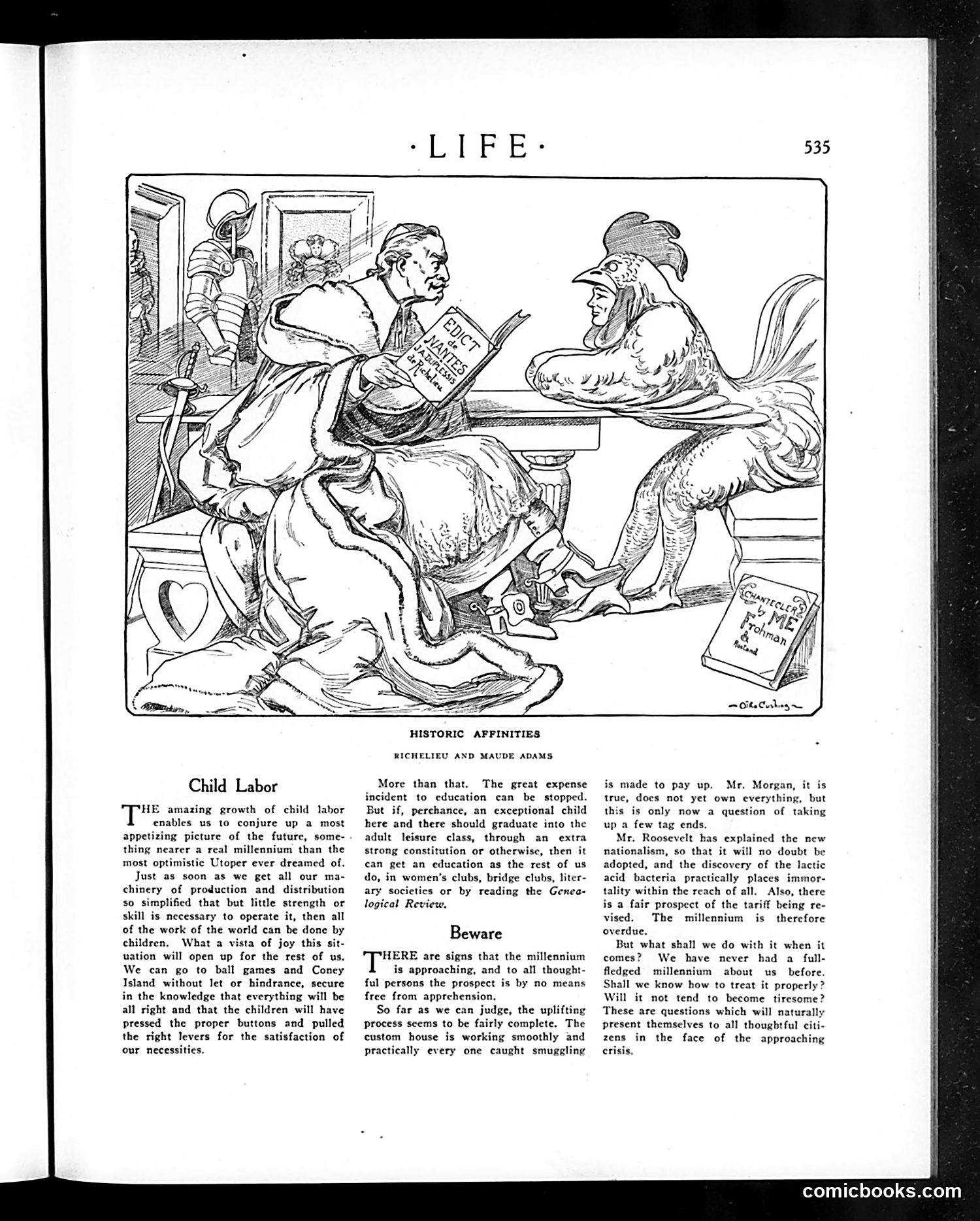
This page contains **two satirical pieces mocking early 20th-century optimism about industrial "progress."** The main cartoon (titled "Historic Affinities: Richelieu and Maude Adams") depicts a wealthy woman reading while servants attend her—satirizing how the leisure class benefits from child labor. The accompanying text uses **heavy irony** to critique child labor expansion: it pretends to celebrate a future where simplified machinery allows children to do all work, freeing adults for leisure. The satire argues this exposes society's hypocrisy about "progress." The "Beware" section continues this ironic tone, mocking complacency about approaching a "millennium" of perfection. It references contemporary figures (Mr. Morgan—likely J.P. Morgan the financier; Mr. Roosevelt—Theodore Roosevelt) and suggests society hasn't actually solved its problems despite claims of advancement. The satire's core point: **Industrial society was celebrating technological progress while ignoring the human cost—particularly child exploitation—that enabled it.**
📄 Transcribed text from this page (OCR, searchable)
Machine-transcribed from the original scan — historical spelling and the odd misread are preserved.
Child Labor HE amazing growth of child labor enables us to conjure up a most appetizing picture of the future, some- thing nearer a real millennium than the most optimistic Utoper ever dreamed of. Just as soon as we get all our ma- chinery of production and distribution so simplified that but little strength or skill is necessary to operate it, then all of the work of the world can be done by children. What a vista of joy this sit- uation will open up for the rest of us. We can go to ball games and Coney Island without let or hindrance, secure in the knowledge that everything will be all right and that the children will have pressed the proper buttons and pulled the right levers for the satisfaction of our necessities. HISTORIC AFFINITIES RICHELIEU AND MAUDE ADAMS. More than that. The great expense incident to education can be stopped. But if, perchance, an exceptional child here and there should graduate into the adult leisure class, through an extra strong constitution or otherwise, then it can get an education as the rest of us do, in women’s clubs, bridge clubs, liter- ary societies or by reading the Genea- logical Review, Beware HERE are signs that the millennium is approaching, and to all thought- ful persons the prospect is by no means free from apprehension. So far as we can judge, the uplifting process seems to be fairly complete. The custom house is working smoothly and practically every one caught smuggling is made to pay up. Mr. Morgan, i true, does not yet own everythi this is only now a question of taking up a few tag ends. Mr. Roosevelt has explained the new nationalism, so that it will no doubt be adopted, and the discovery of the lactic acid bacteria practically places immor- tality within the reach of all. Also, there is a fair prospect of the tariff being re- vised. The millennium is therefore overdue. But what shall we do with it when it comes? We have never had a full- fledged millennium about us_ before. Shall we know how to treat it properly? Will it not tend to become tiresome? These are questions which will naturally present themselves to all thoughtful citi- zens in the face of the approaching crisis, comicbooks.com