
Life, 1911-03-16 · page 21 of 44
Life — March 16, 1911 — page 21: what you’re looking at
What you’re looking at
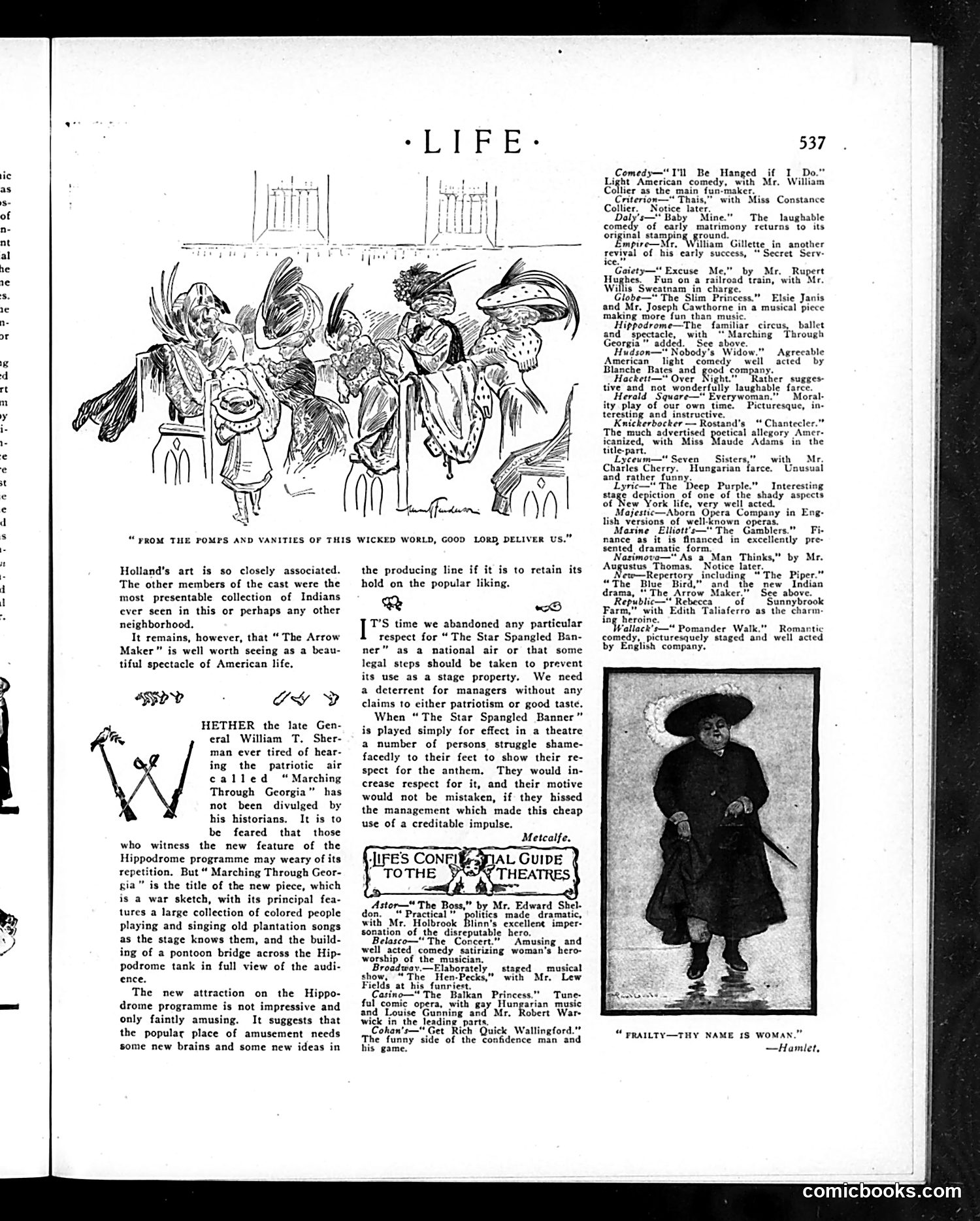
The main cartoon depicts caricatured figures—appearing to represent various types from American society—with the caption "From the Pomps and Vanities of This Wicked World, Good Lord Deliver Us," a biblical reference mocking contemporary social pretension. The page's primary focus, however, is theatrical criticism. The text attacks a Hippodrome production called "Marching Through Georgia," a Civil War-themed spectacle featuring "colored people" performing plantation songs and building a pontoon bridge. The reviewer considers it shallow entertainment that exploits both the subject matter and audience patriotism. More pointedly, the critic condemns theaters' misuse of "The Star Spangled Banner" as mere stage property, arguing that audiences feel obligated to stand respectfully for the anthem even when cynically deployed for theatrical effect—a manipulation the writer finds in poor taste. The page reflects early 20th-century attitudes toward race, spectacle, and nationalism, revealing contemporaneous debates about commercialized patriotism and entertainment ethics.
📄 Transcribed text from this page (OCR, searchable)
Machine-transcribed from the original scan — historical spelling and the odd misread are preserved.
“ PROM THE POMPS AND VANITIES OF THIS WICKED WORLD, GOOD LORD, DELIVER US.” Holland's art is so closely associated. The other members of the cast were the most presentable collection of Indians ever seen in this or perhaps any other neighborhood. It remains, however, that “ The Arrow Maker" is well worth seeing as a beau- tiful spectacle of American life, SHY oO“ Y HETHER the late Gen- eral William T. Sher- man ever tired of hear- ing the patriotic air called “Marching Through Georgia” has not been divulged by his historians. It is to be feared that those who witness the new feature of the Hippodrome programme may weary of its n. But “ Marching Through Geor- gia” is the title of the new piece, which is a war sketch, with its principal fea- tures a large collection of colored people playing and singing old plantation songs as the stage knows them, and the build- ing of a pontoon bridge across the Hip- podrome tank in full view of the audi- ence. The new attraction on the Hippo- drome programme is not impressive and only faintly amusing. It suggests that the popular place of amusement needs some new brains and some new ideas in the producing line if it is to retain its hold on the popular liking. Se <S T’S time we abandoned any particular respect for “The Star Spangled Ban- ner” as a national air or that some legal steps should be taken to prevent its use as a stage property. We need a deterrent for managers without any claims to either patriotism or good taste. When “The Star Spangled Banner” is played simply for effect in a theatre a number of persons struggle shame- facedly to their feet to show their re- spect for the anthem. They would in- crease respect for it, and their motive would not be mistaken, if they hissed the management which made this cheap use of a creditable impulse. Metcalfe. IAL GUIDE % THEATRES S - ej Astor— The Boss,” by Mr. Edward Shel- don. |“ Practical” ‘politics made dramatic, with Mr. Holbrook Blinn’s excellent imper sonation of the disreputable hero. Belasco" The Conc Amusing and well acted comedy satirizing woman's hero- worship of the musician, Brocdwav.—Elaborately, show, “The Hen-Pecks,” Fields at his funniest, Casino—" The Balkan Princess.” Tune- ful comic opera, with gay Hungarian music and Louise Gunning and Mr. Robert War wick in the leading parts. Cohan’s—" Get Rich Quick Wallingfor: The funny side of the confidence man and his game. aged musical with Mr. Lew 537 Comedy—“I'll Be Hanged if I, Do.” Light American comedy, with Mr. William Collier as the main fun-makei Criterion—" Thais, Miss Constance Collier, Notice late Doly's—" Baby” Mine.” | The | laughable comedy of early matrimony returns to its original stamping ground. - ‘mpire—Mr, William Gillette in another revival of his early success, "Secret Serv- ic Gaiety—" Excuse Me,” by Mr. Rupert Hughes. | Fun on a railroad train, with Willis Sweatnam in charge. i Globe— The Slim Princess.” Elsie Janis and Mr. Joseph Cawthorne in a musical piece making more fun than music. Hippodrome—The familiar circus, ballet and spectacle, with "Marching Through Georgia” .. See above. Hudson—" Nobody's Widow.” American. light comedy well Blanche Bates and good company. _Hackett—" Over Night.” Rather sugges- tive and not wonderfully laughable farce. Herald Square—" Everywoman.” —Moral- ity play of our own time. Picturesque, in- teresting and instructive, Knickerbocker — Rostand’s “ Chantecler. The much advertised poetical allegory Ame icanized, with Miss Maude Adams in the title-part. Lyceum—" Seven _ Sisters,” Charles Cherry. Hungarian farce. and rather funny. Lyric—" The Deep Purple.” Interesting stage depiction of one of the shady aspects of New York life, very well acted. _ Majestic—Aborn Opera Company in Eng- lish versions of well-known operas. : Maxine Elliott's—" The Gamblers.” Fi- nance as it is financed in excellently pre- sented dramatic form. Nasimovo—" As a Man Thinks,” by Mr. Augustus Thomas. Notice later. New—Repertory including “The Piper.” “The Blue Bird,” and the new Indian drama, “The Arrow Maker,” See above. Republic—" Rebecca of — Sunnybrook Farm,” with Edith Taliaferro as the charm- ing heroine. Wallack’s—“ Pomander Walk." Romantic comedy, picturesquely staged and well acted by English company, Agrecable acted by with = Mr, Unusual “ PRAILTY—THY NAME 1S —Hamilet, comicbooks.com