
A complete issue · 44 pages · 1910
Life — October 20, 1910
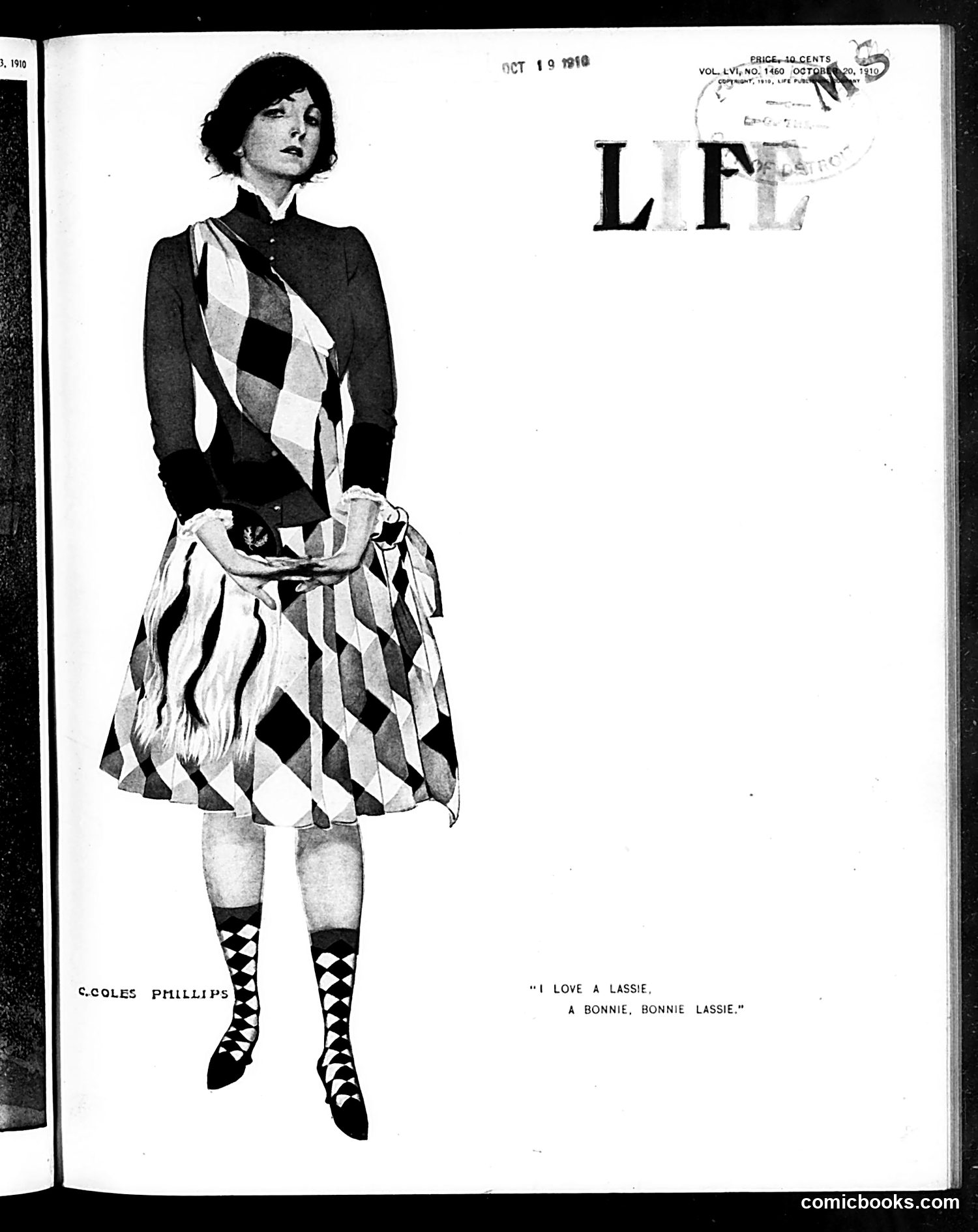
This is a fashion illustration rather than a political cartoon. The page features a woman modeled by "C. Coles Phillips," a prominent illustrator of the 1910s era. She wears a geometric argyle-patterned outfit—a cardigan sweater with diamond motifs and a matching skirt—paired with argyle socks in the same black-and-white pattern. The caption quotes a Scottish song lyric: "I love a lassie, a bonnie, bonnie lassie." This appears to be a lighthearted play on Scottish fashion or identity, pairing the argyle pattern (strongly associated with Scotland) with the sentimental song reference. This is primarily a fashion showcase highlighting the popularity of argyle patterns in 1918 women's wear, with Scottish cultural references providing thematic appeal rather than political commentary.
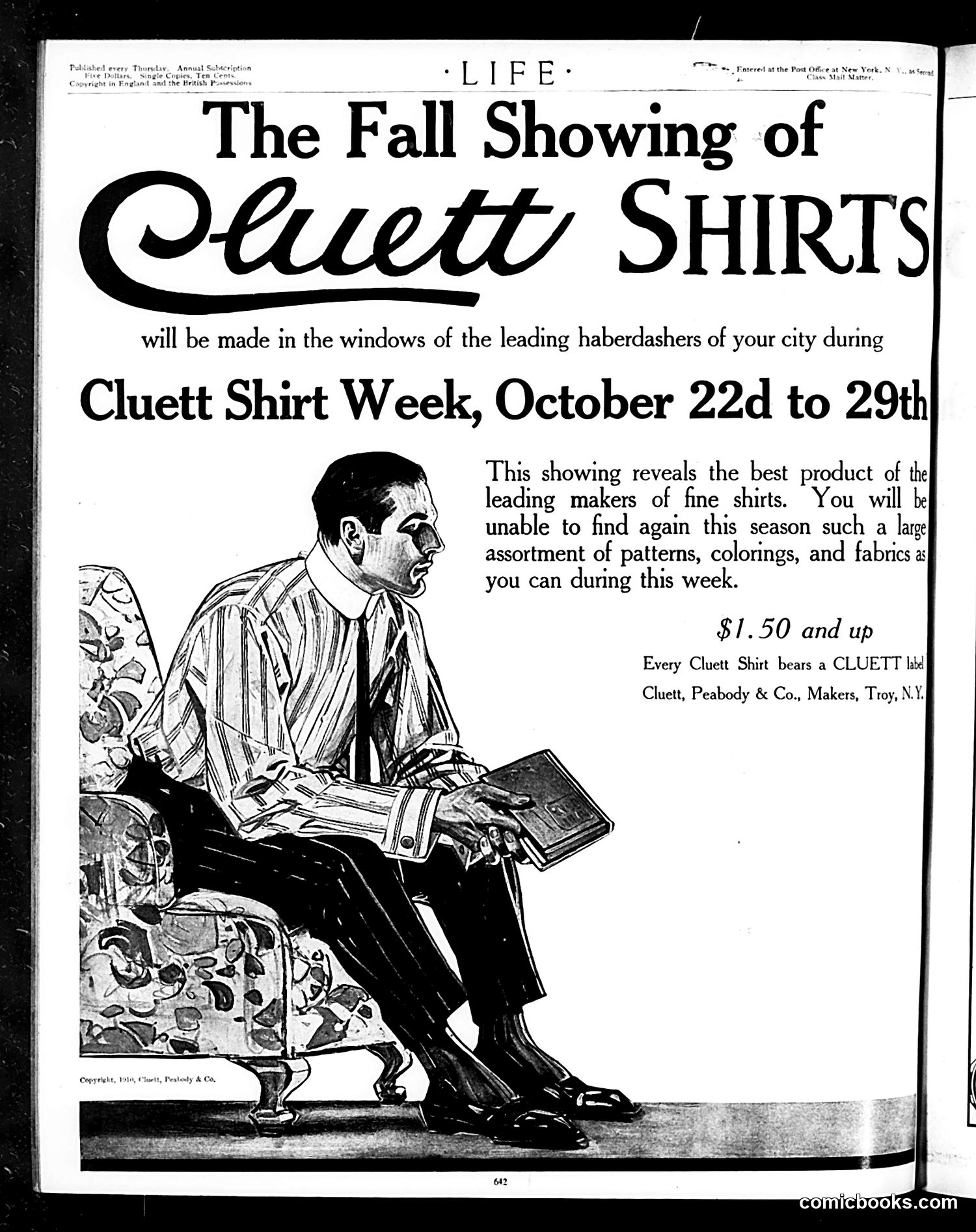
This is a straightforward **advertisement, not political satire**. It promotes Cluett Shirts during "Cluett Shirt Week," October 22-29, with window displays planned at haberdasheries nationwide. The illustration depicts a well-dressed man examining shirt samples from his chair—a common advertising trope emphasizing leisure and refined taste. The multiple patterned fabrics visible suggest the variety available. **Key selling points:** - Price: $1.50 and up - Large seasonal assortment - Made by Cluett, Peabody & Co., Troy, N.Y. The advertisement appears in *Life* magazine, which published both satirical content and paid advertising. This page exemplifies the latter—a period advertisement targeting middle-class male consumers interested in quality menswear.
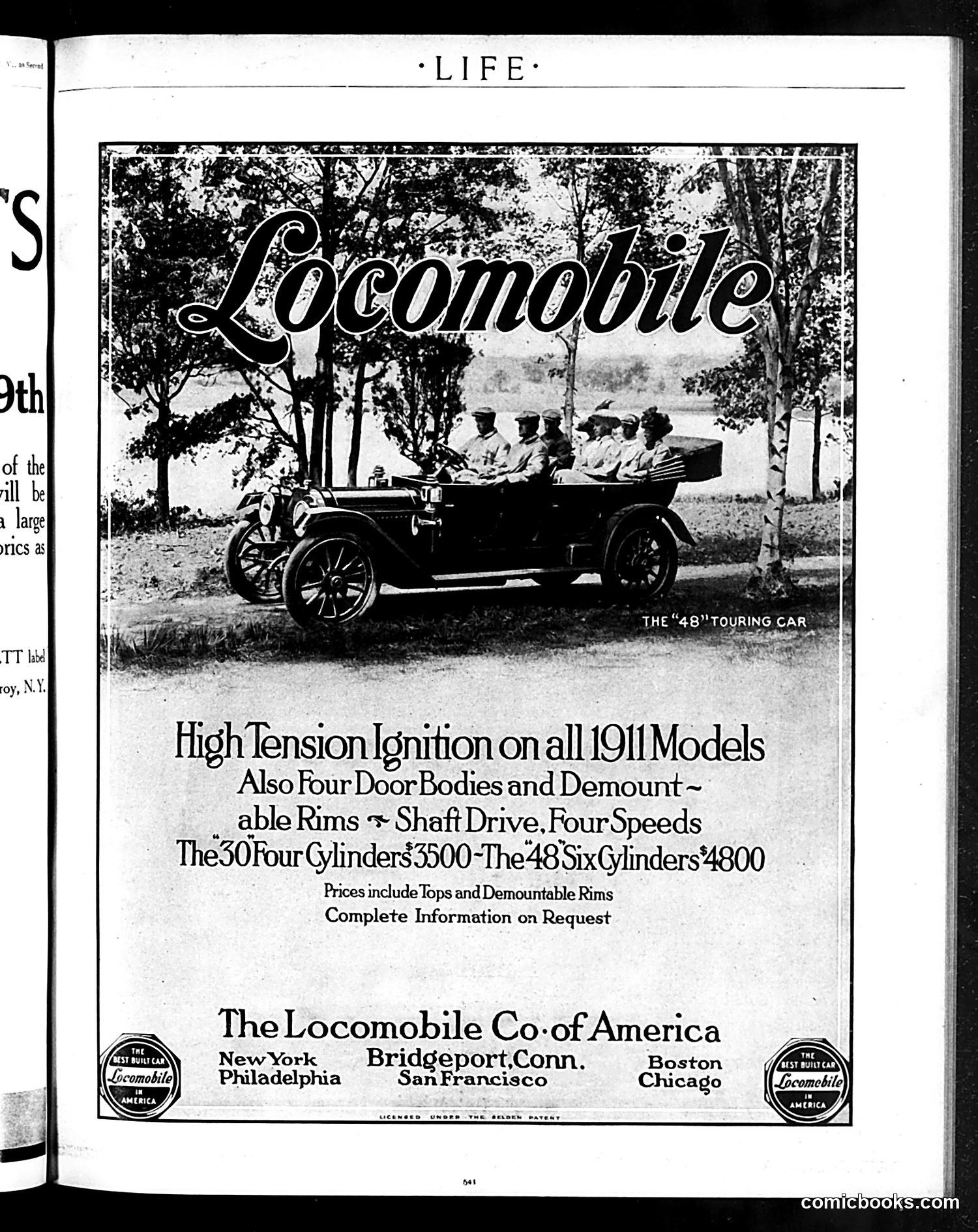
This page is **primarily an advertisement**, not satirical content. It promotes the Locomobile automobile, specifically the "48" touring car model for 1911. The ad features a photograph of six well-dressed men in the open-air vehicle, parked in a scenic tree-lined setting. The marketing emphasizes technical features: high-tension ignition, four-door bodies, demountable rims, shaft drive, and four speeds. Two engine options are listed—the 30 Four Cylinders at $3,500 and the 48 Six Cylinders at $4,800. The Locomobile Company of America lists offices in New York, Bridgeport, Philadelphia, San Francisco, Boston, and Chicago, suggesting this was a premium automobile manufacturer of the era. There is no political satire or cartoon content on this page.
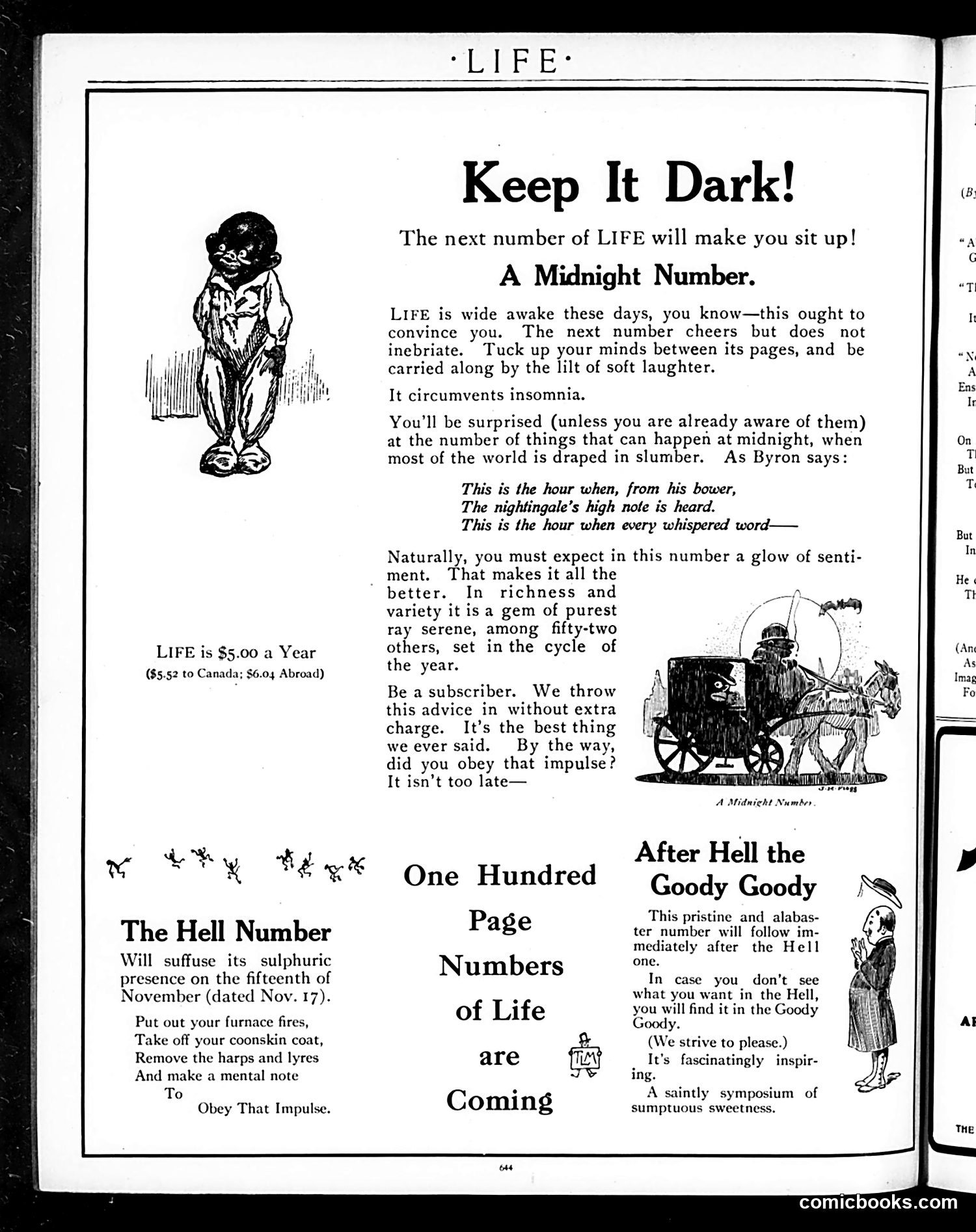
This page promotes an upcoming "Midnight Number" of *Life* magazine, using humor to encourage subscriptions. The central cartoon depicts a sleepless figure—representing insomnia—suggesting the magazine's content will be too entertaining to sleep through. The page employs playful mockery of the magazine's own upcoming issues: "The Hell Number" (promising sulfuric satire for November 17), "One Hundred Page Numbers" (apparently a lengthy special), and "After Hell the Goody Goody" (a contrasting wholesome issue). The satirical tone is self-aware and tongue-in-cheek—*Life* markets itself as intellectually stimulating and morally varied, offering "richness and variety" among "fifty-two" annual issues. The Byron quote about the nightingale emphasizes the magazine's literary aspirations. Subscription cost: $5 yearly.
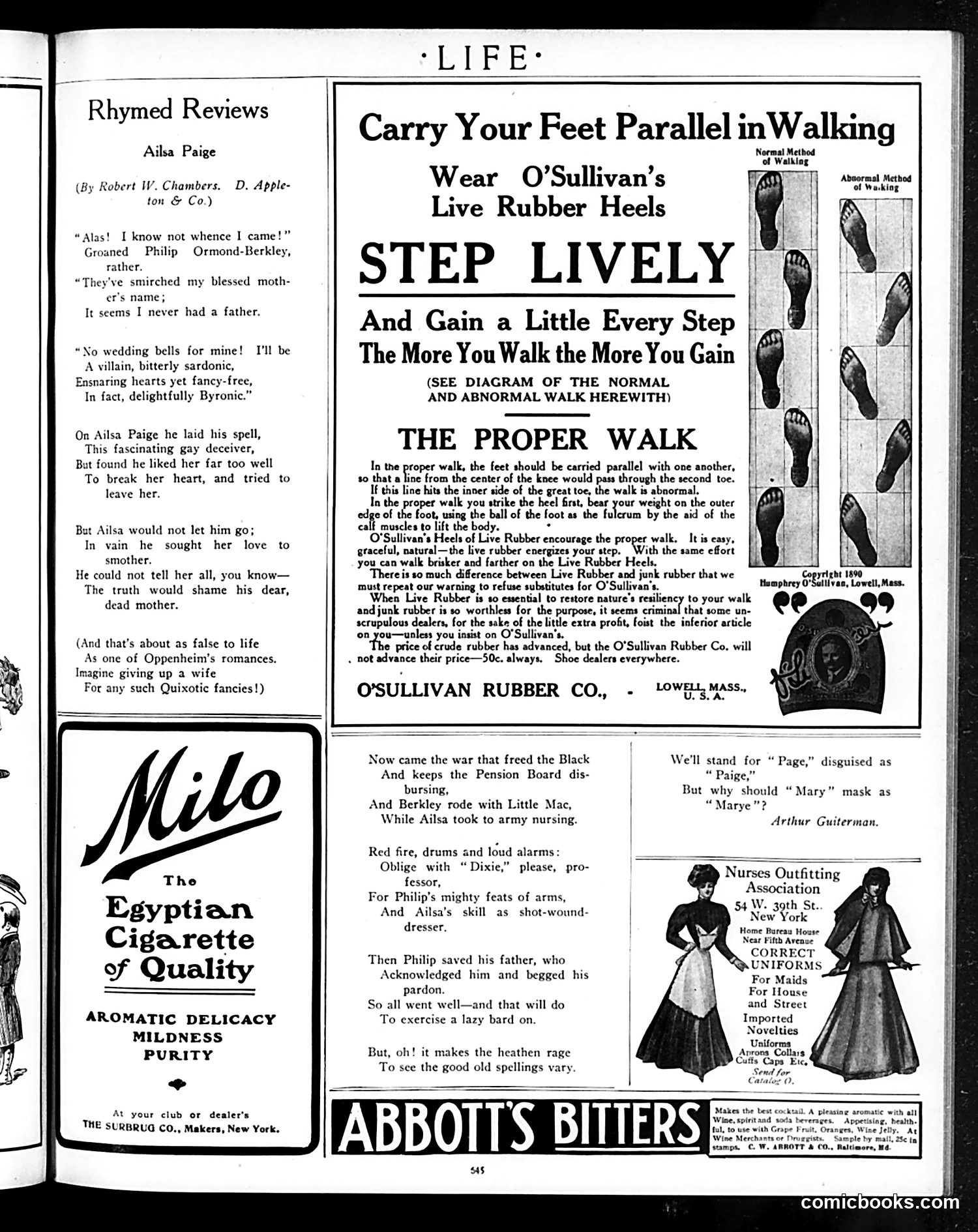
This page is primarily **advertising and literary content** rather than political satire. The left column features "Rhymed Reviews" by Robert W. Chambers discussing *Ailsa Paige*, a romantic novel. The poem satirizes the melodramatic plot—a man trying to seduce a woman, failing because she won't betray her late mother's memory, concluding that such overwrought romance is absurd ("Quixotic fancies"). The dominant right side is a **product advertisement** for O'Sullivan's Live Rubber Heels, using diagrams to promote proper walking posture. This is straightforward commercial copy, not satire. Lower advertisements include Milo cigarettes, Nurses Outfitting Association services, and Abbott's Bitters. The page contains **no discernible political cartoon or social satire**—it's a typical magazine page mixing book reviews, product advertisements, and lifestyle content.
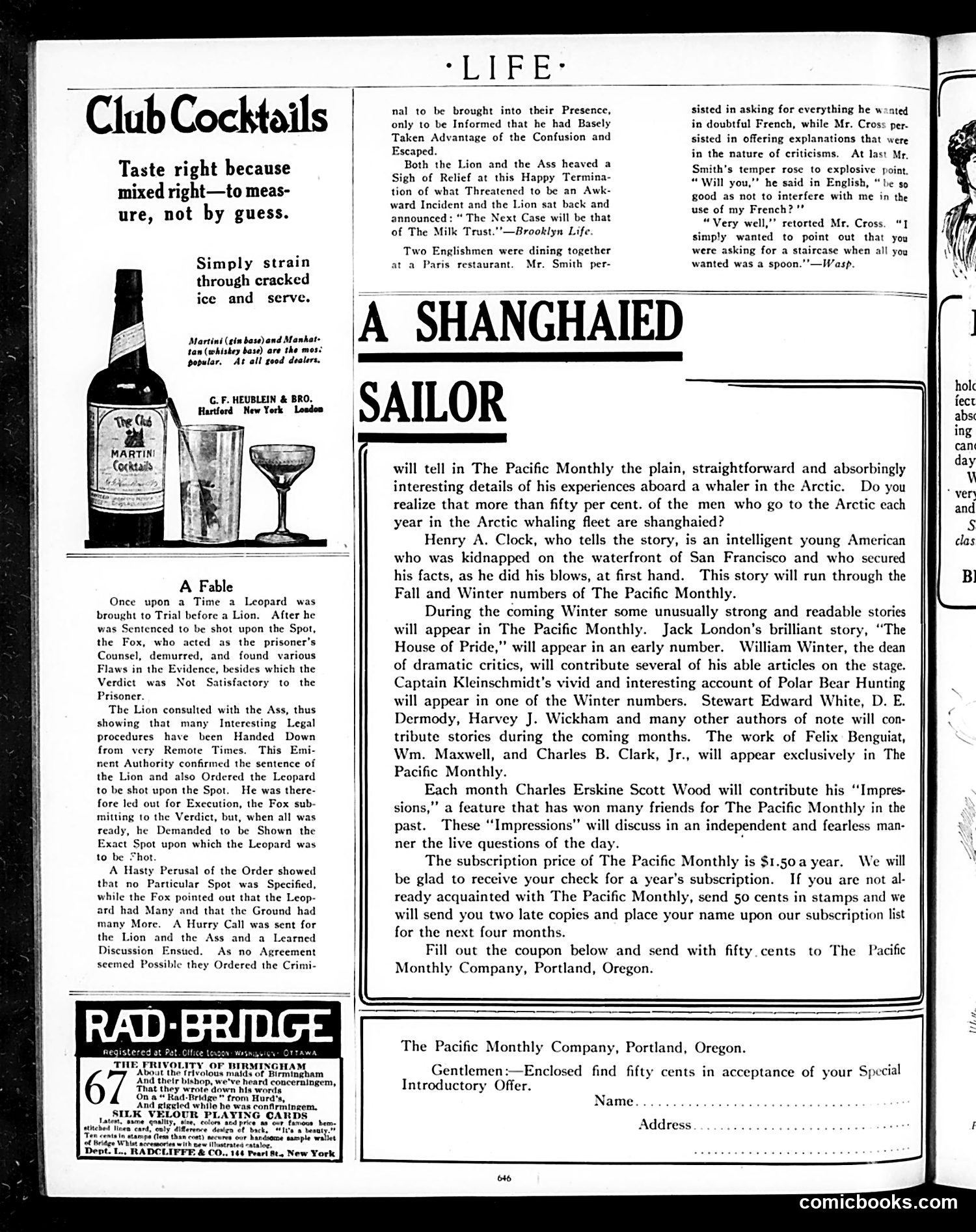
This page is primarily **advertising and editorial content** rather than political satire. The left side features two advertisements: one for martini cocktails (emphasizing proper mixing technique) and another for "Rad-Bridge" silk products, promoting quality goods. The main editorial content—"A Shanghaied Sailor"—announces upcoming stories in *The Pacific Monthly* magazine, including a first-person account by Henry A. Clock about being kidnapped in San Francisco and working on an Arctic whaling vessel. The page promotes other forthcoming adventure stories and serialized works, with a subscription offer (50 cents for a year). There is **no evident political cartoon or satire** on this page. It represents typical early 20th-century magazine layout mixing advertisements with editorial promotion.
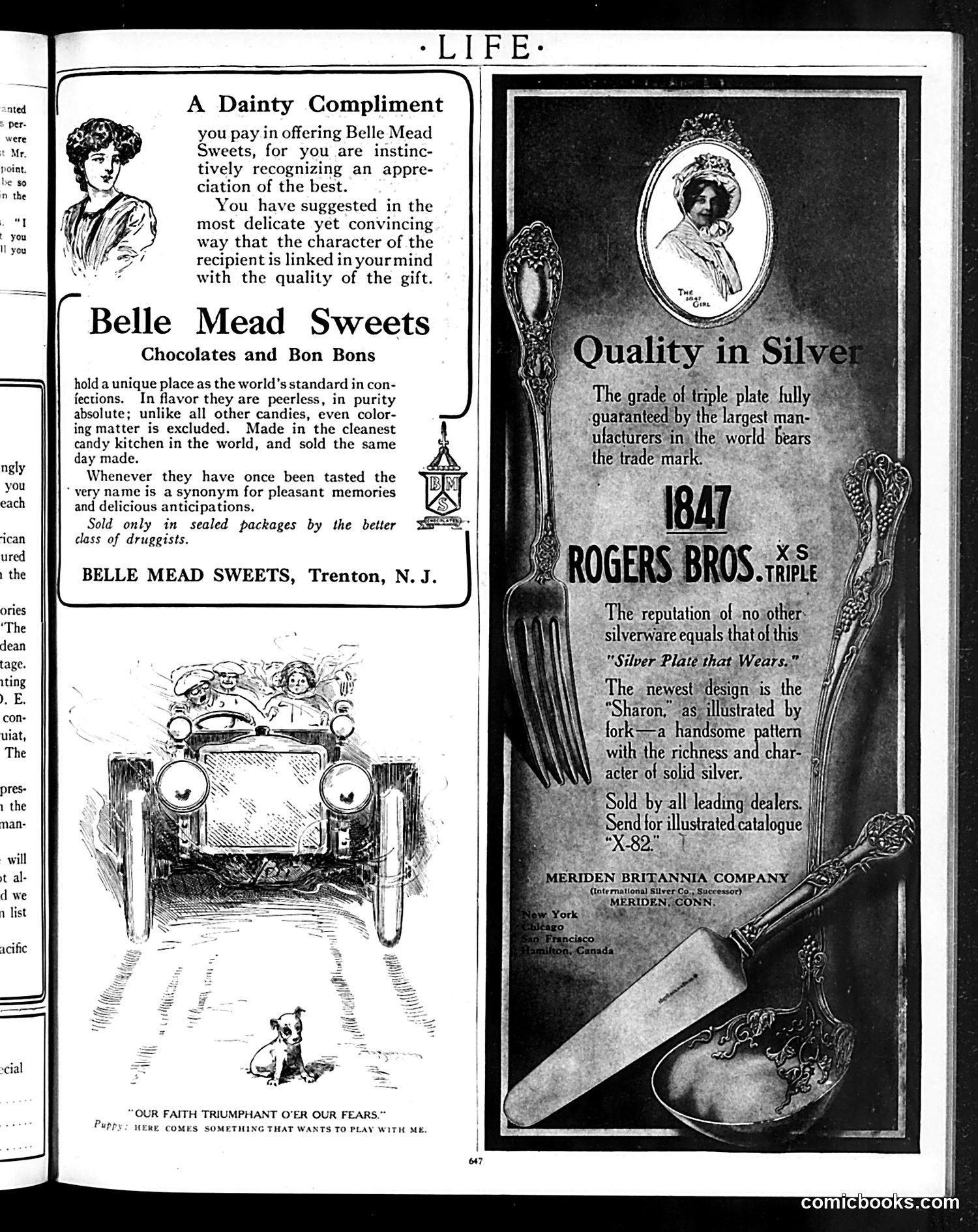
This is primarily **advertising content** rather than political satire. The page contains two advertisements: 1. **Belle Mead Sweets** (left): A candy company advertisement emphasizing quality chocolates and bon bons, sold through druggists. Includes a humorous illustration of a car full of cherubic figures with the caption "OUR FAITH TRIUMPHANT O'ER OUR FEARS" and "PUPPY: HERE COMES SOMETHING THAT WANTS TO PLAY WITH ME"—a lighthearted joke about a speeding automobile. 2. **Rogers Bros. Silverware** (right): An advertisement for triple-plated silverware featuring elegant serving utensils and the slogan "Silver Plate that Wears." Emphasizes durability and design quality. The page reflects early 20th-century consumer advertising and contains no political commentary.
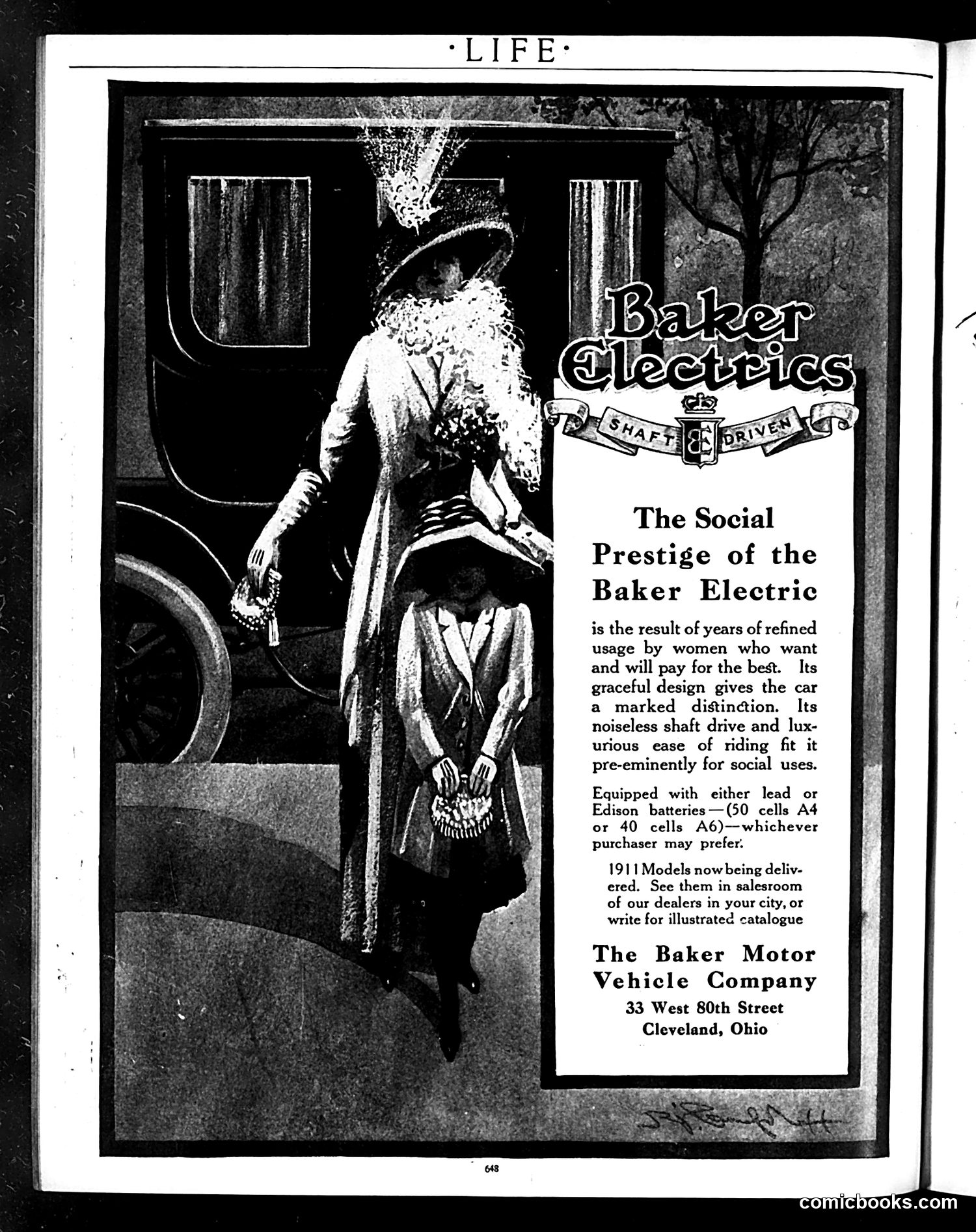
This is a commercial advertisement for Baker Electric vehicles, not political satire. The image shows a well-dressed woman in elegant Edwardian attire entering or exiting an electric automobile, positioned outside what appears to be a upscale residence. The ad emphasizes "social prestige" and "refined usage by women," marketing the Baker Electric as a status symbol suitable for ladies of means. The vehicle's "noiseless shaft drive and luxurious ease" are highlighted as ideal for social occasions. This reflects early 1900s attitudes where electric cars were marketed as suitable for women—quieter and easier to operate than gasoline vehicles. The ad targets affluent female consumers, positioning the Baker as both a practical and socially prestigious purchase. The 1911 models mentioned were being delivered at that time.
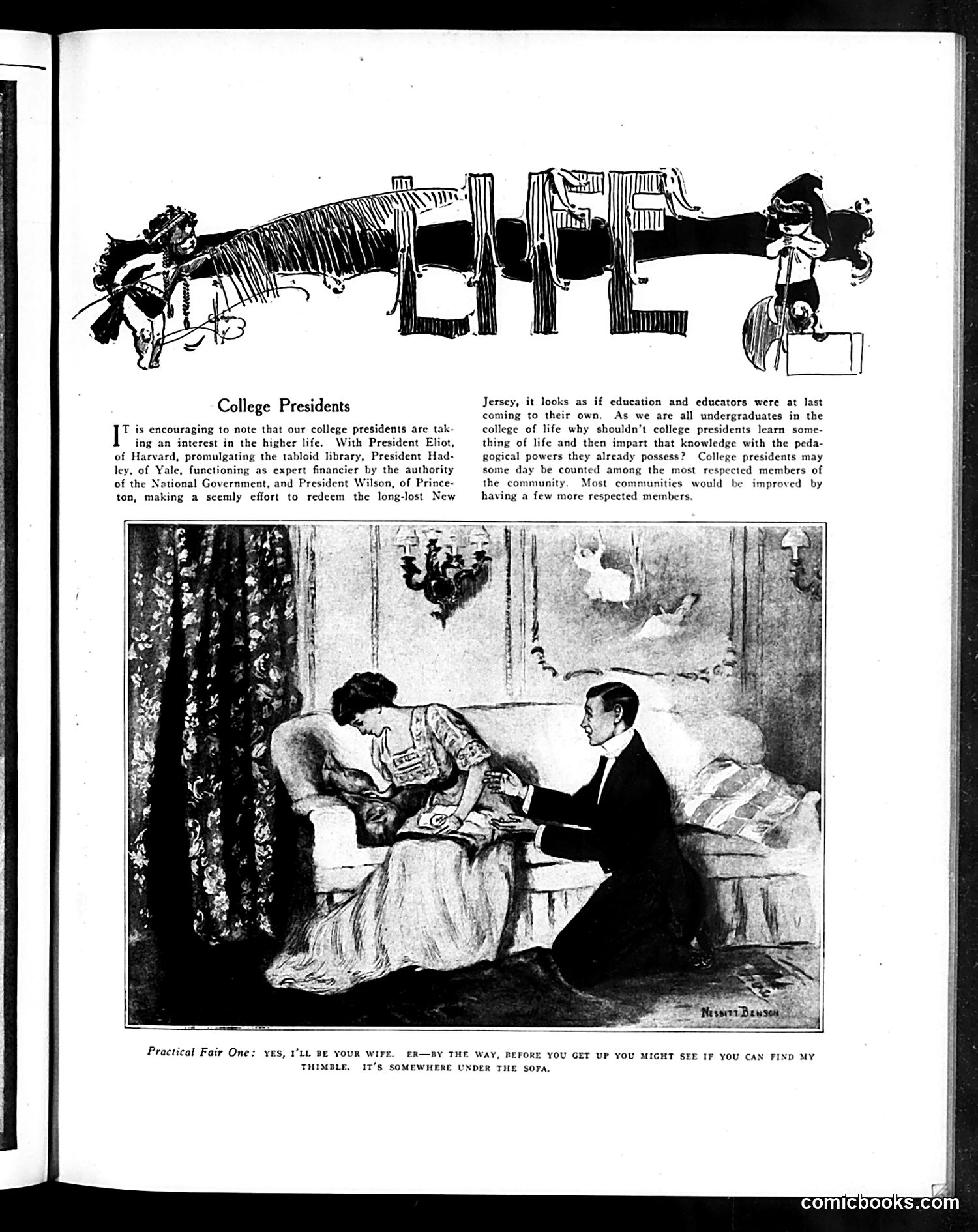
The page contains two satirical pieces about college leadership and courtship. **Top cartoon ("College Presidents"):** A visual pun where the word "LIFE" is formed by college presidents' elongated bodies stretched horizontally. The text praises college presidents like Harvard's President Eliot, Yale's Hadley, and Princeton's Wilson for engaging in higher civic pursuits—suggesting education leaders should contribute to public governance and community respect, not merely run academic institutions. **Bottom cartoon ("Practical Fair One"):** A couple on a sofa; the woman says she'll marry the man but asks him to find her thimble under the sofa before he leaves. The joke is a coy, practical courtship scenario—poking fun at the somewhat calculated, transactional nature of romantic proposals and acceptance in early 20th-century courtship rituals.
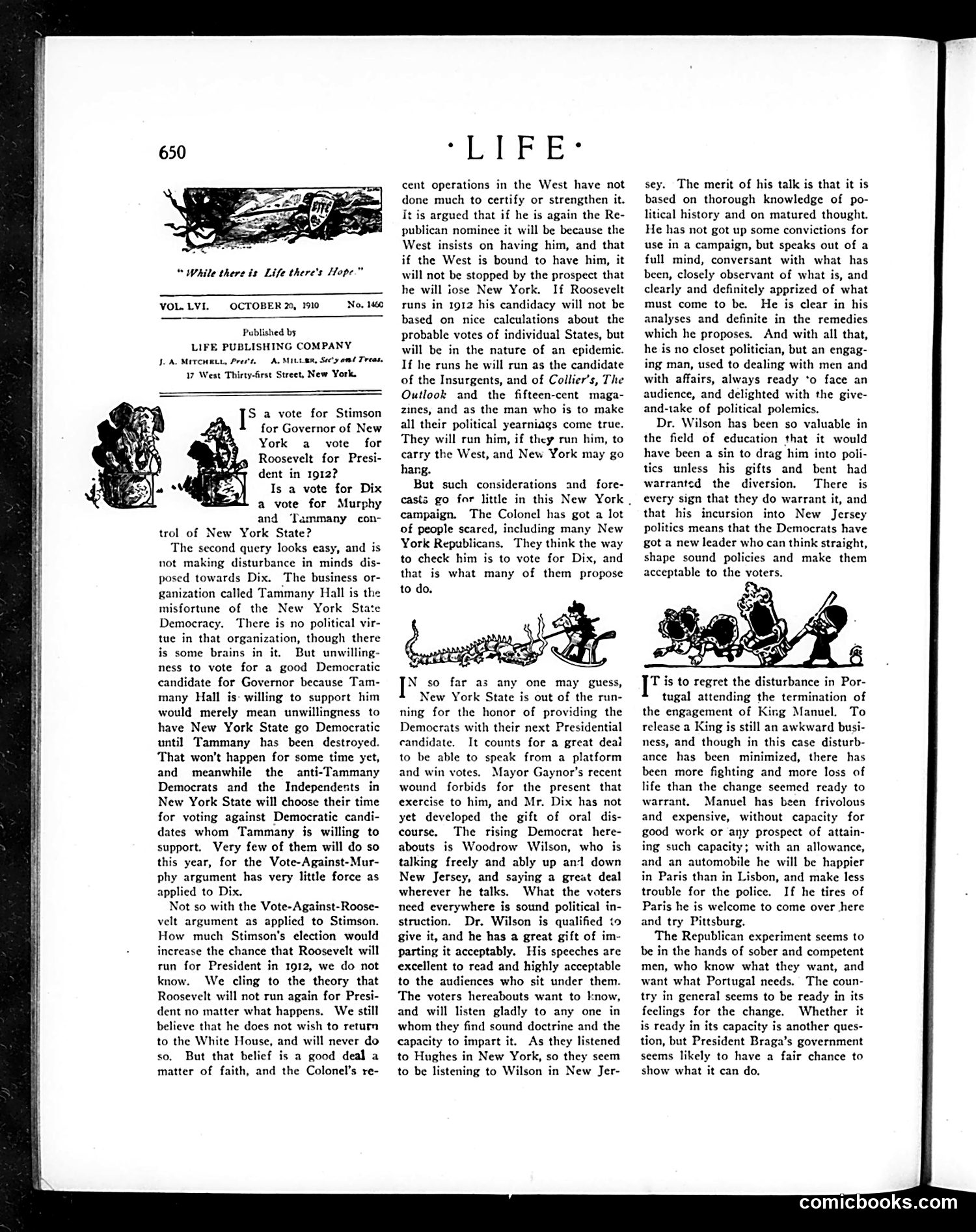
This page discusses the 1912 U.S. presidential election prospects. The text debates whether Theodore Roosevelt should run for president again, and considers alternative Republican candidates like Simson, Dix, and Murphy for New York governor. The two political cartoons (rendered in black ink) appear to satirize candidates or political figures, though the specific identities are unclear from the image quality. One cartoon shows what appears to be a creature or caricatured figure; the other depicts people in some form of conflict or struggle. The article also discusses Woodrow Wilson as a potential Democratic presidential candidate, praising his political insight and speaking abilities while questioning whether his gifts warrant involvement in New Jersey politics.
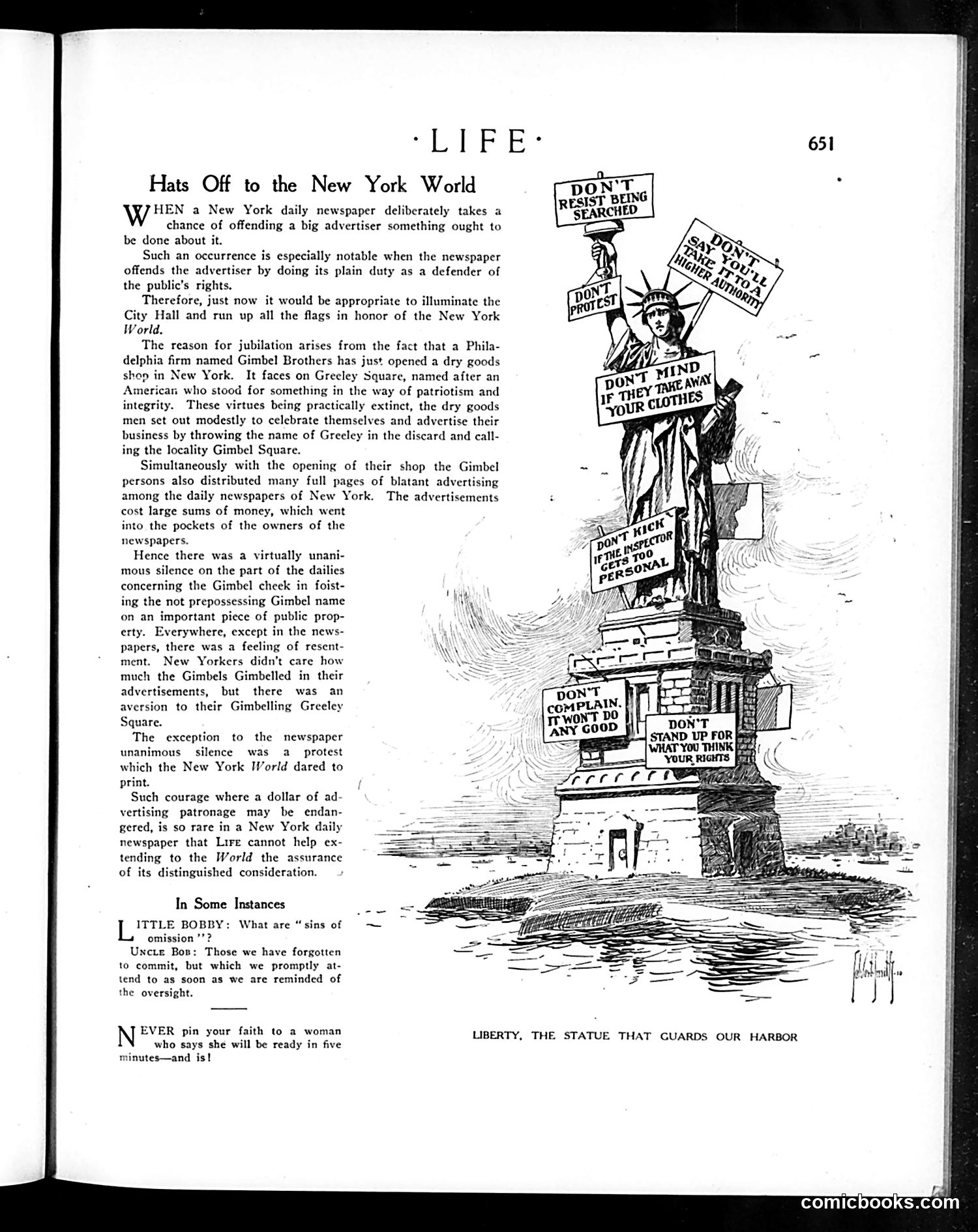
This page satirizes the New York *World* newspaper's principled stance against the Gimbel Brothers department store. The *World* refused to run the Gimbels' advertisements after they renamed Greeley Square to "Gimbel Square" without permission—an affront to public property and the memory of Horace Greeley. The cartoon depicts the Statue of Liberty covered with protest signs ("Don't Resist Being Searched," "Don't Mind if They Take Your Advertising," etc.), sarcastically suggesting the *World* has compromised American values by advertising despite their principles. The satire criticizes how financial incentives ("a dollar of advertising patronage") can undermine editorial integrity and free speech protections—core democratic ideals Liberty symbolizes.
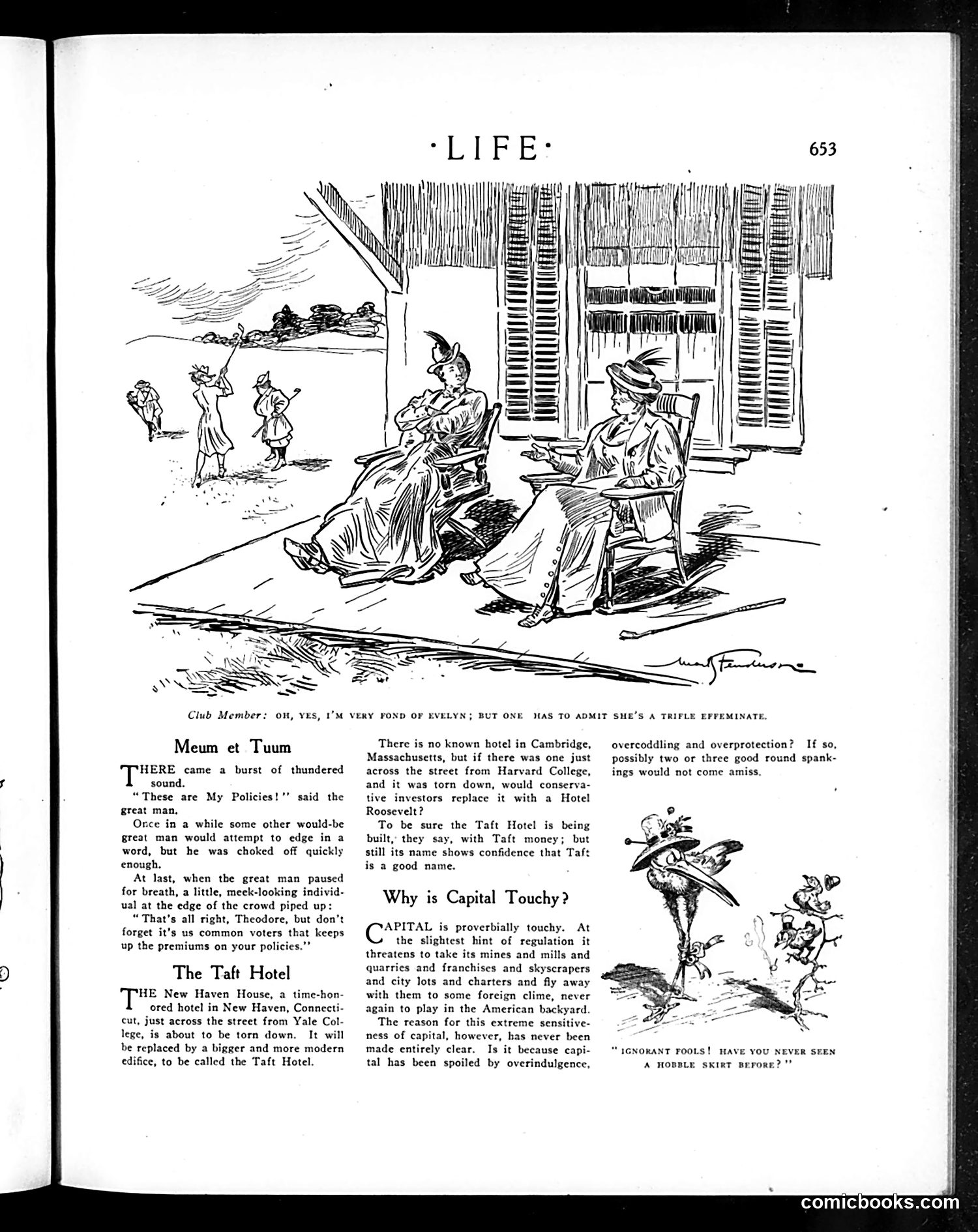
**Main Cartoon (top):** Shows two women in a domestic setting discussing a third woman named Evelyn. The caption reads: "Club Member: 'Oh yes, I'm very fond of Evelyn; but one has to admit she's a trifle effeminate.'" **The Satire:** This is a joke about social hypocrisy and gender expectations. The speaker is criticizing another woman for being "effeminate"—supposedly too feminine—while speaking to someone equally feminine. The humor comes from the absurdity of women judging other women for displaying traditionally feminine traits. **Secondary Content:** Articles about Cambridge hotels and capital investment appear below, with an unrelated small cartoon about foolish behavior. **Context:** The satire reflects 1910s-20s anxieties about changing gender roles and social pretension among club women.
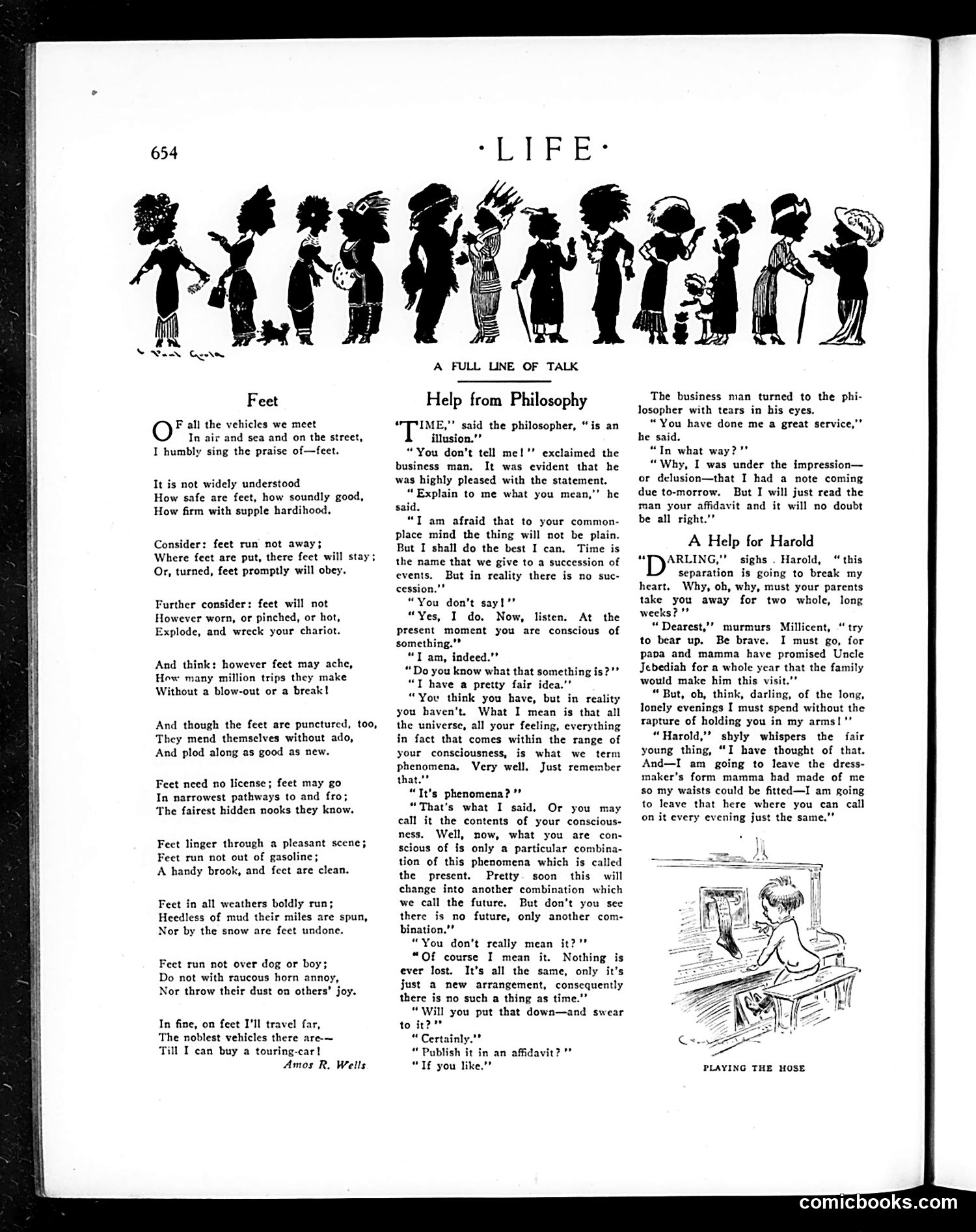
This Life magazine page contains three satirical pieces mocking contemporary attitudes: **"Feet"** (poem by Amos R. Wells): A humorous defense of walking over automobiles. The satire targets the era's car-culture obsession by praising feet as reliable, affordable, and practical—culminating in the joke that the speaker will walk "till I can buy a touring-car," mocking both pedestrians' envy of car owners and cars' unreliability (breakdowns, blow-outs). **"Help from Philosophy"**: Satirizes pseudo-intellectual philosophy and gullible businessmen. A philosopher uses elaborate jargon about "phenomena" and "illusion of time" to confuse a businessman, who then plans to use the philosopher's affidavit to dodge paying a debt. The joke mocks both pretentious philosophical talk and the businessman's desperation to exploit it. **"A Help for Harold"**: A brief romantic comedy where Harold laments his girlfriend Millicent leaving for two weeks, and she consoles him by promising... something (text cuts off). The satire targets melodramatic young love and sentimental separation anxieties.
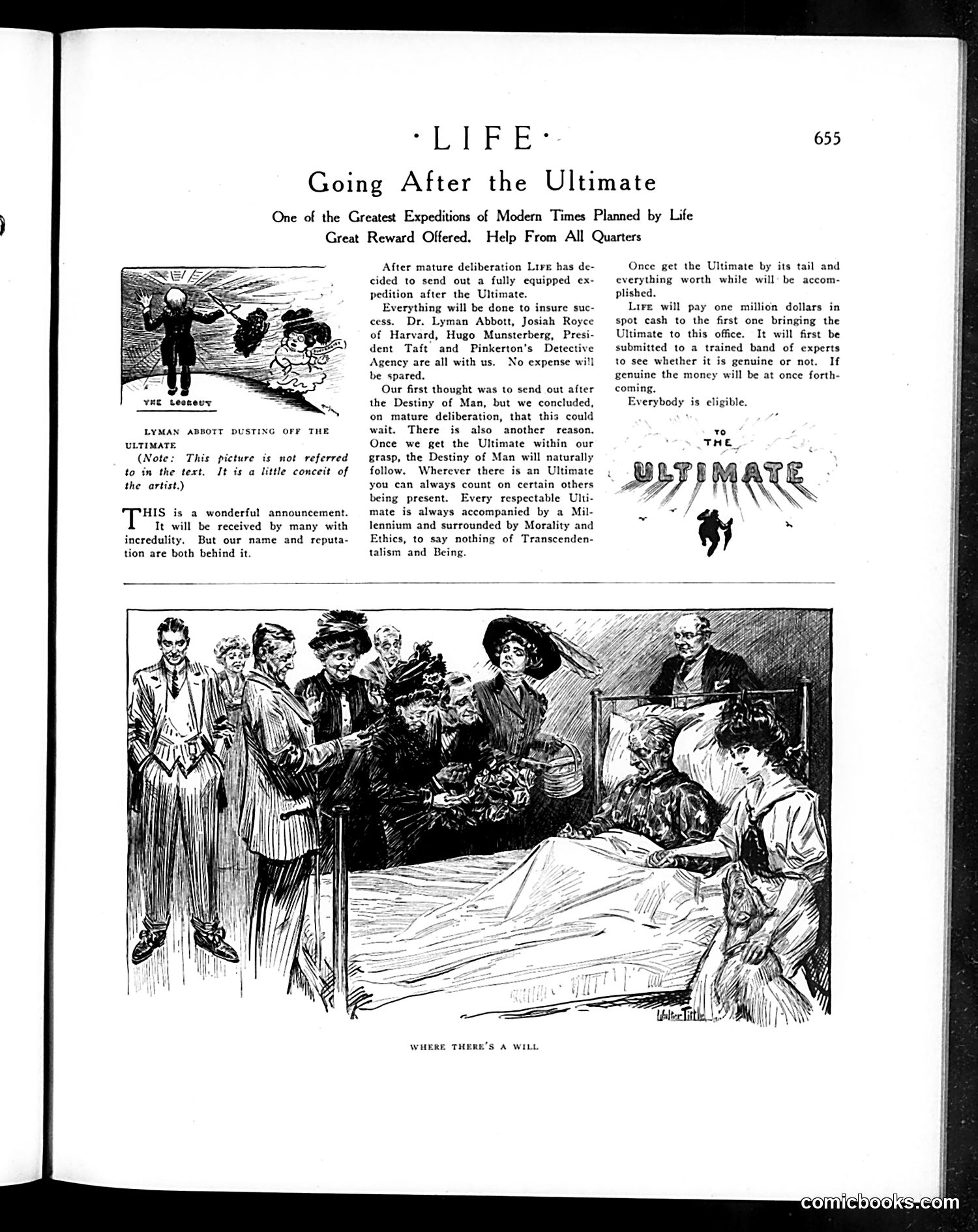
This is satirical commentary on contemporary American philosophy and intellectualism. Life magazine humorously announces an "expedition" to capture "the Ultimate"—a deliberately vague philosophical concept—offering one million dollars as reward. The satire targets prominent intellectual and political figures of the era: Lyman Abbott (religious leader), Josiah Royce (Harvard philosopher), Hugo Munsterberg (psychologist), and President Taft. By assembling these luminaries alongside Pinkerton's Detective Agency to hunt an abstract philosophical concept, Life mocks the era's obsession with grand intellectual pursuits and the pretentiousness of American philosophy. The bottom illustration, "Where There's a Will," depicts a deathbed scene—reinforcing the satire's implication that such philosophical questing is ultimately futile and death-bound. The joke suggests these intellectual endeavors, despite serious intent, are fundamentally absurd pursuits.
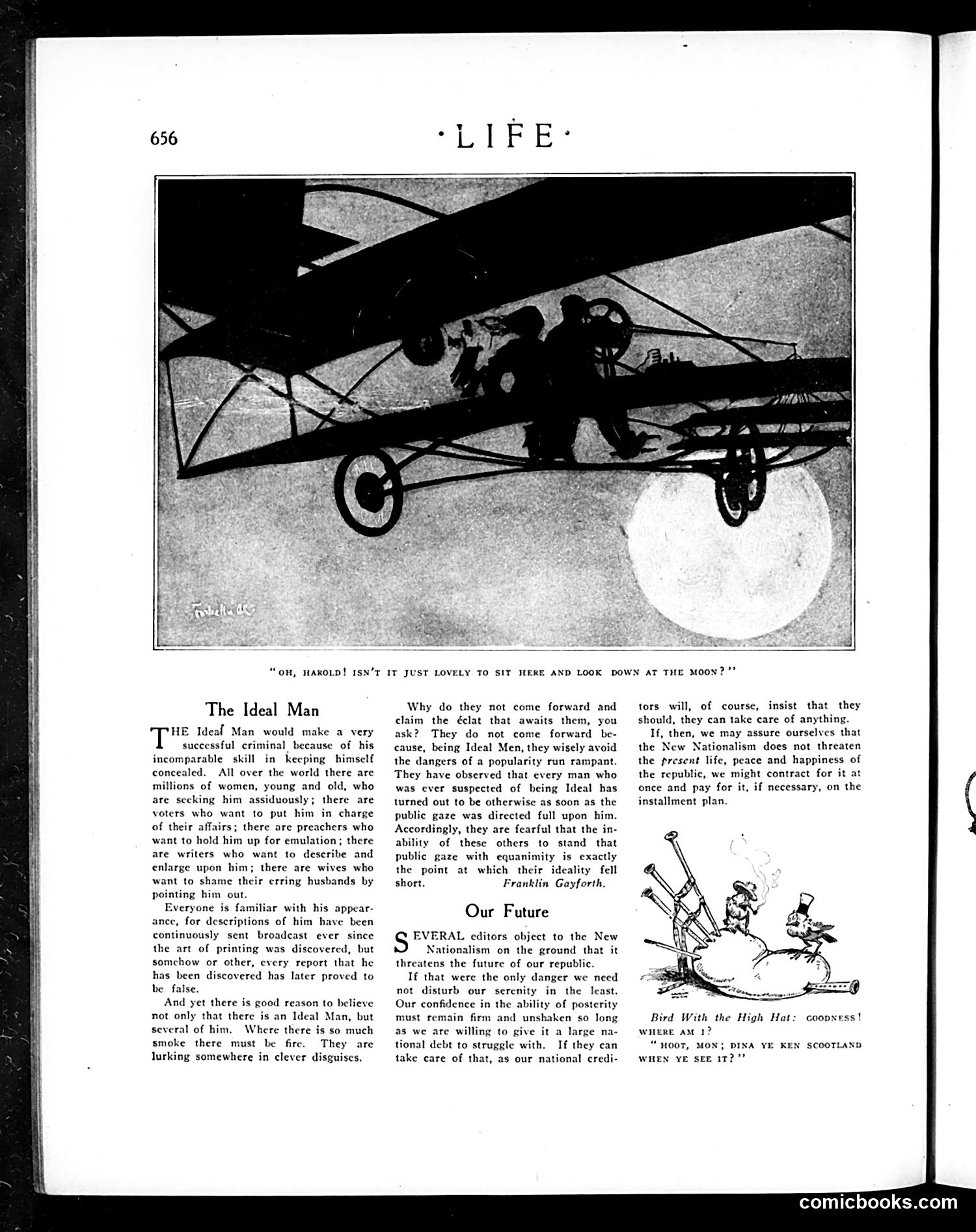
**Top Cartoon:** A silhouetted couple in an airplane gazes at the moon below. The caption's romantic tone ("Oh, Harold! Isn't it just lovely to sit here and look down at the moon?") contrasts with the perspective—they're actually looking DOWN at the moon, which is impossible. This is visual satire on romantic delusion or the absurdity of lovers' talk. **"The Ideal Man" Article:** A satirical essay by Franklin Gayforth argues that the "Ideal Man" must exist (since so many women, voters, and preachers seek him) yet successfully hides because any man publicly identified as ideal immediately proves otherwise when scrutinized. The piece mocks the gap between idealized masculine perfection and reality. **"Our Future" Piece:** Political satire on the "New Nationalism" (likely Theodore Roosevelt's progressive platform). It mockingly argues we needn't fear the policy threatens the republic—we can confidently saddle future generations with massive national debt, trusting posterity to manage it. **Bottom Cartoon:** A Scottish figure asks where he is; another responds sarcastically that if he can't recognize Scotland, he shouldn't be there—simple ethnic/regional humor.
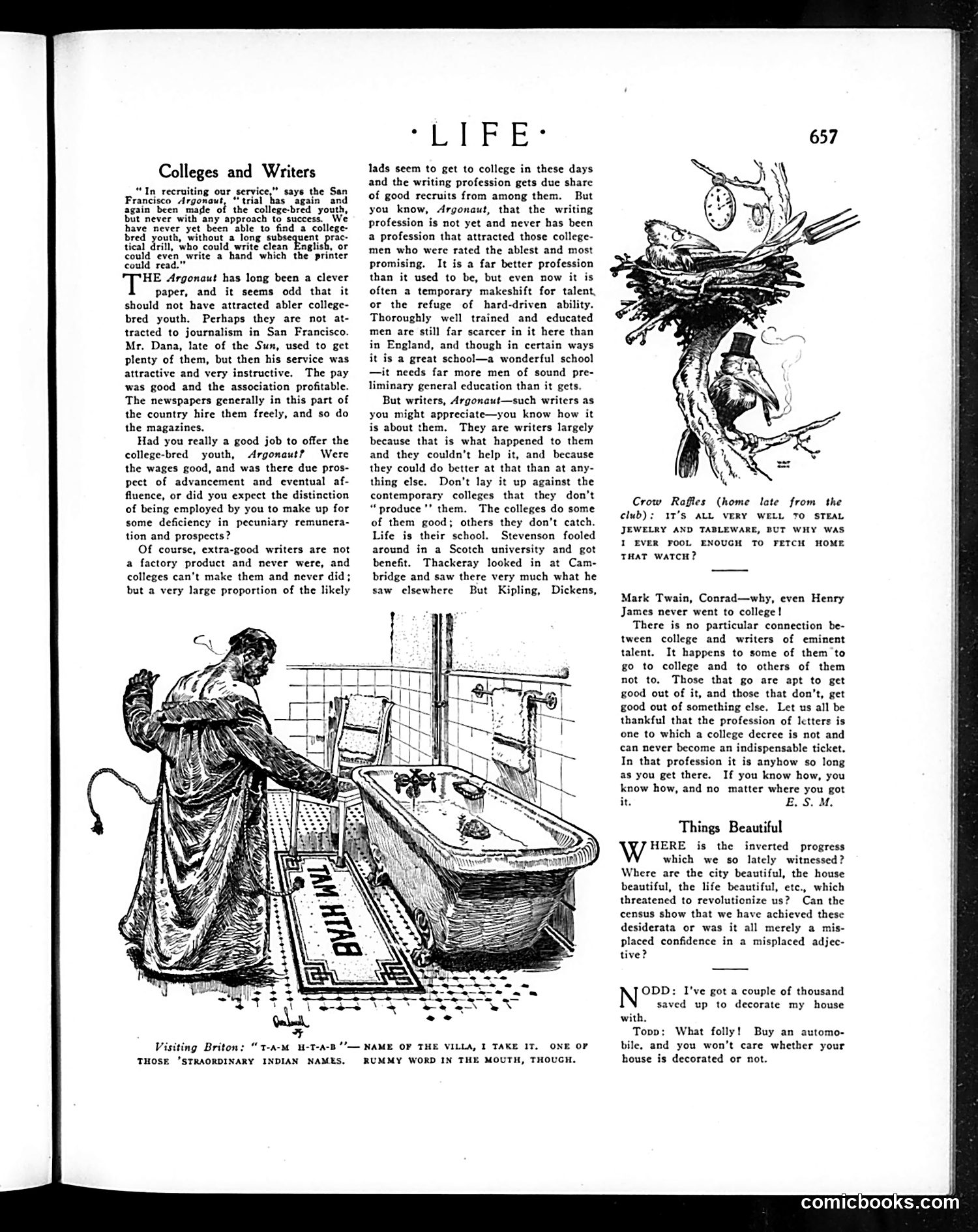
This page contains two distinct pieces of satire: **"Colleges and Writers"** (main article): Life responds to the San Francisco *Argonaut* newspaper's complaint that college-educated recruits can't write well. Life argues the *Argonaut* simply didn't offer competitive wages or advancement—good papers like the *Sun* attracted capable college graduates. More importantly, Life contends that innate writing talent cannot be "produced" by colleges; great writers (Kipling, Dickens, Mark Twain, Conrad, Henry James) often skipped college entirely. The piece defends higher education while insisting that exceptional writing ability develops through life experience, not degrees. **Bottom cartoon**: A visiting British tourist compliments an Indian villa's "extraordinary" name, which he phonetically renders as "1-a-M M-T-A-B." The joke mocks British tourists' tendency to marvel at and mispronounce foreign place names, treating unfamiliar words as exotic curiosities while fundamentally misunderstanding them.
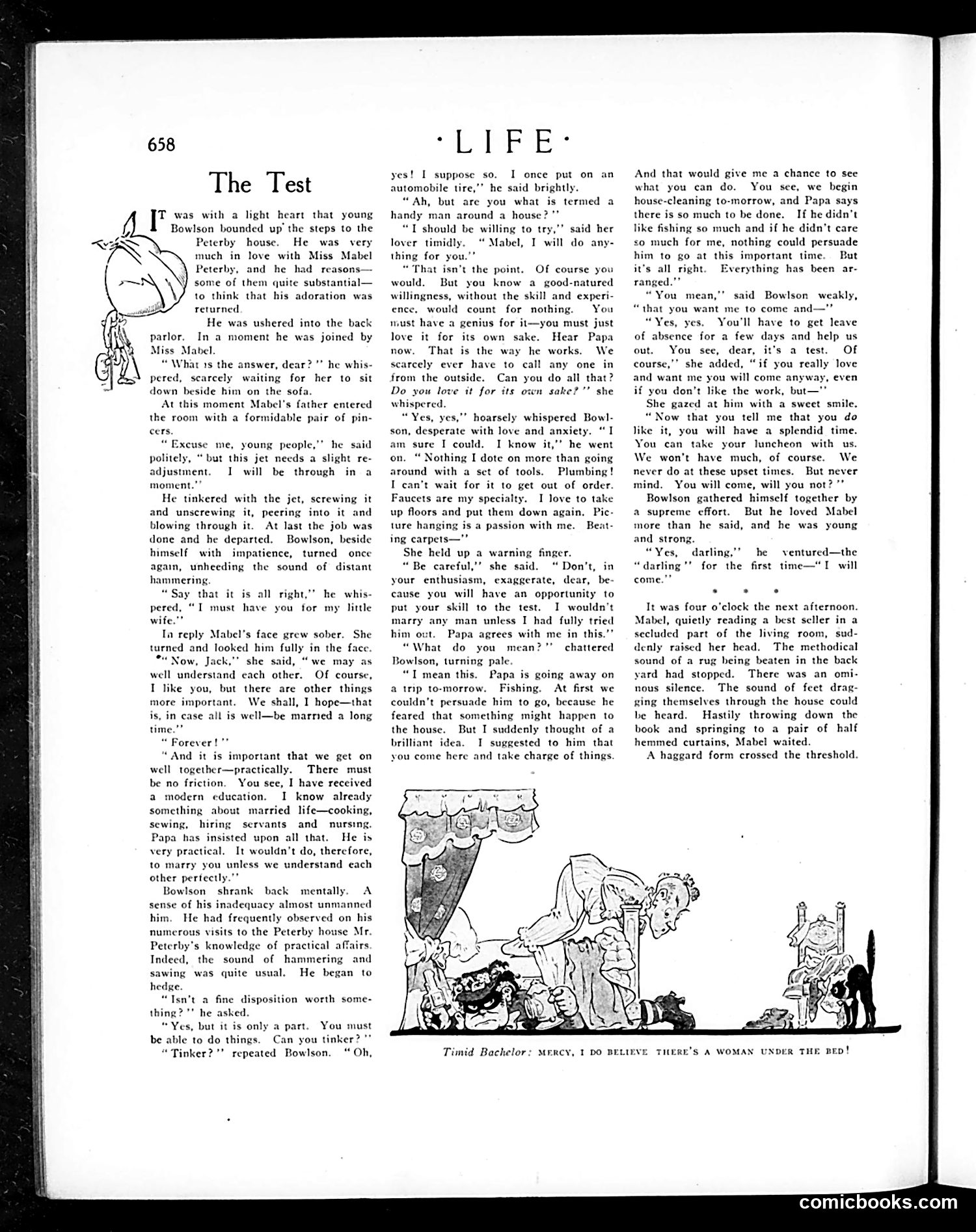
This story satirizes the new "modern" woman's practical demands on courtship. Young Bowlson seeks to marry Miss Mabel Peterby, but she insists on testing whether he possesses practical domestic skills—plumbing, carpentry, tinkling—before accepting his proposal. The satire targets the tension between romantic love and the emerging ideal of the "modern" educated woman (circa 1910s-1920s) who demands a husband capable of household repairs and maintenance. Mabel's father, constantly tinkering with household items, embodies this practical competence that Bowlson lacks. Bowlson's desperate, false claims about loving plumbing and floor work reveal his inadequacy. The cartoon below shows the "Timid Bachelor" humorously panicked—suggesting he'll face a literal test of his handyman abilities before marriage is approved. The joke mocks both young men unprepared for modern expectations and women who prioritize practical usefulness over traditional romantic sentiment.
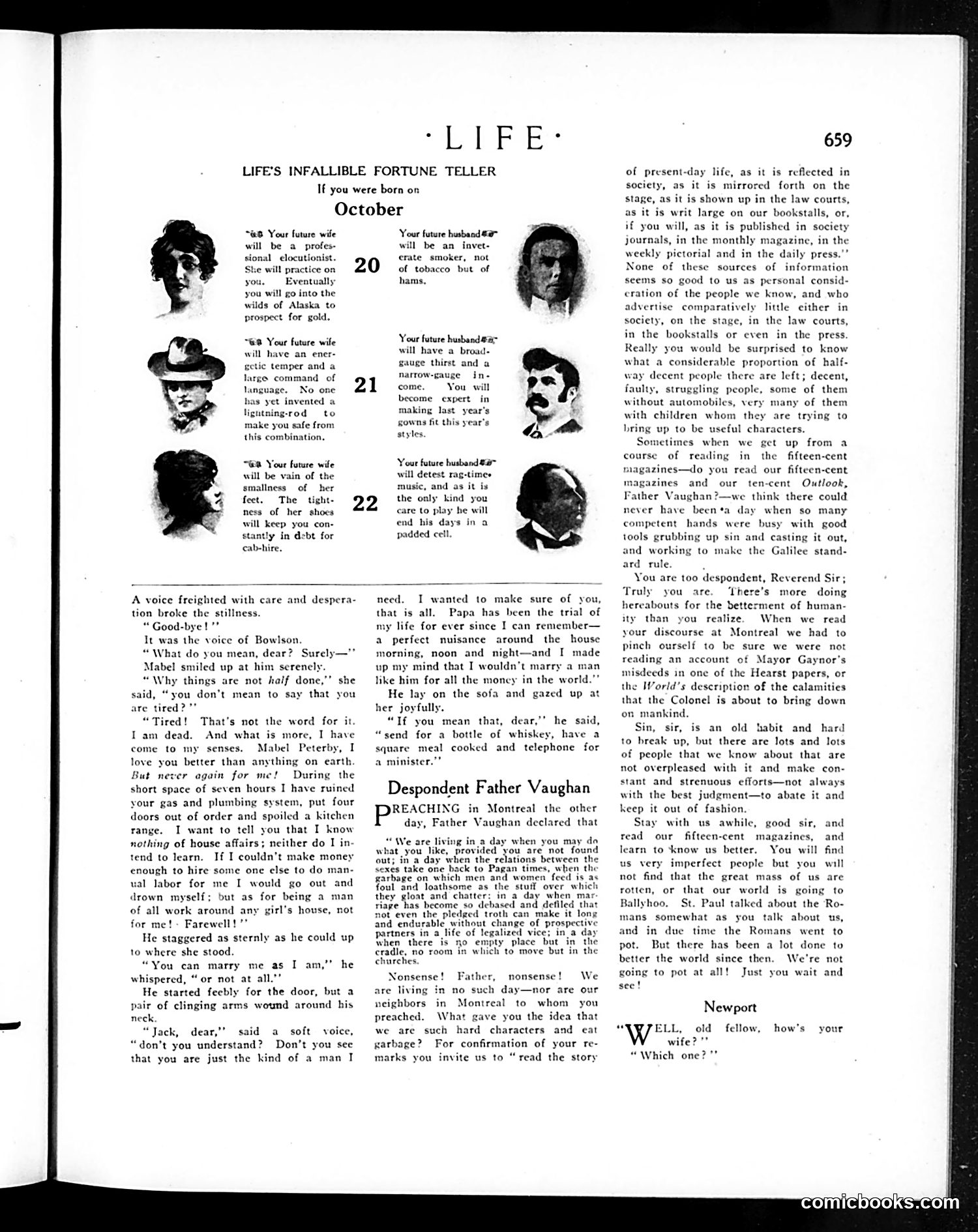
This page contains **Life magazine's satirical fortune-telling feature**, which humorously predicts marriages for people born in October. The humor relies on exaggerated marital stereotypes common to early 20th-century American comedy: **The jokes target:** - Wives as domineering (elocutionists who practice on husbands, temperamental, vain about shoe size) - Husbands as financially inadequate or incompatible (smokers of ham, poor drinkers, tone-deaf music haters) The accompanying short story depicts a newlywed husband frustrated by domestic incompetence, only to discover his wife *wants* precisely such a useless husband—reversing expectations for comic effect. **The "Despondent Father Vaughan" column** responds sarcastically to a real priest's gloomy sermon about modern moral decline, defending contemporary society against claims of degeneracy. The editor essentially calls Vaughan's pessimism exaggerated nonsense—a common rhetorical move in *Life's* satirical defense of modernity against moral panic.
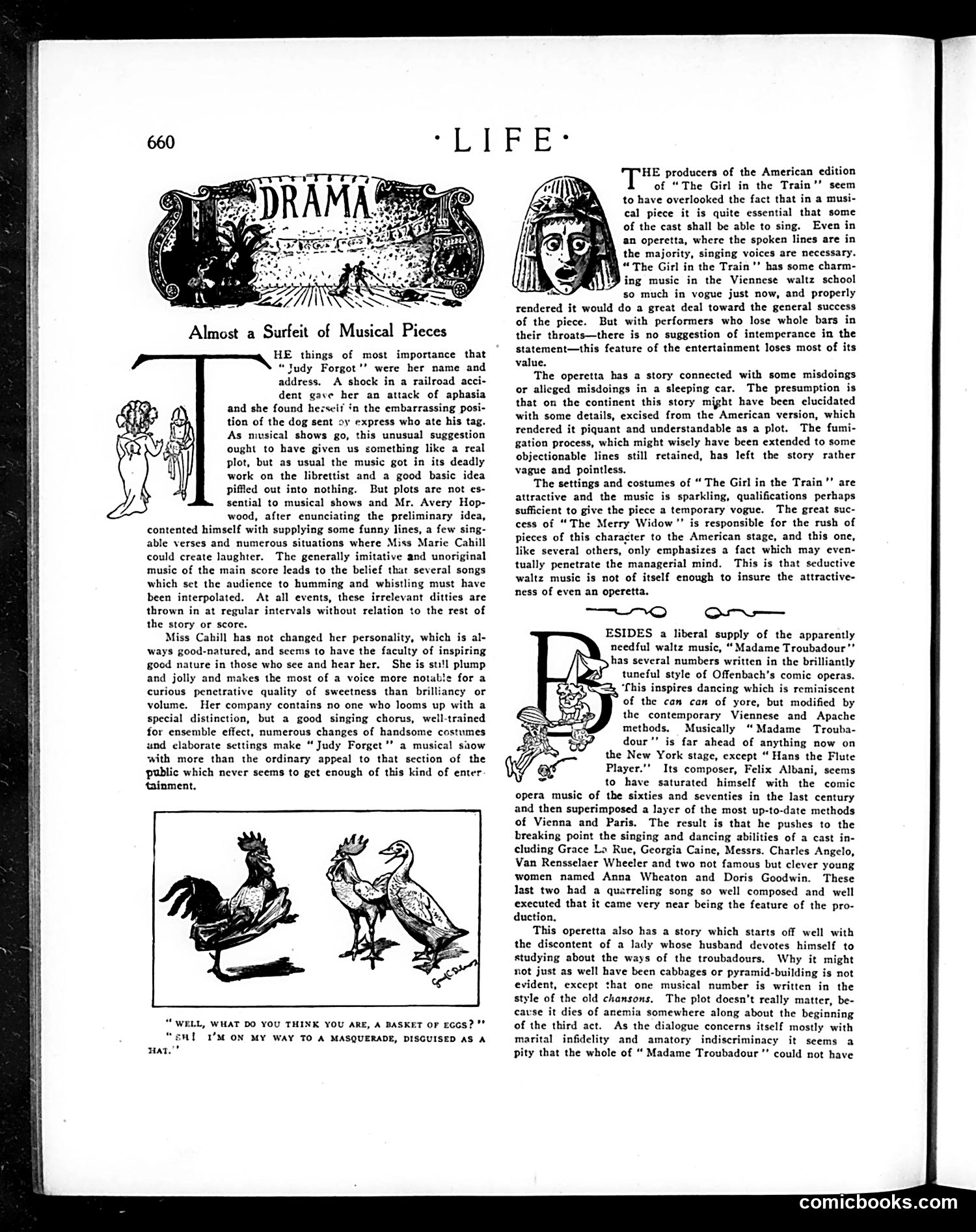
This page contains two theatrical reviews from Life magazine's "Drama" section, critiquing contemporary musical productions. **"Judy Forgot"** stars Marie Cahill in a show with a thin premise: a woman loses her memory in a railroad accident. The critic acknowledges the interesting setup but complains the plot dissolves into disconnected musical numbers. He praises Cahill's charm and comedic timing but notes the music appears to be interpolated songs with little relation to the story—a common practice in early 1900s musical theater where popular songs were inserted regardless of narrative fit. **"The Girl in the Train"** is criticized more harshly for poor casting: performers cannot sing properly despite the operetta requiring vocal talent. The critic notes the original Continental version likely contained risqué sleeping-car plot details removed for American audiences, leaving the story "vague and pointless." He attributes the show's existence to the enormous success of "The Merry Widow," suggesting producers chased that waltz-opera trend without understanding that seductive music alone cannot sustain a weak production.
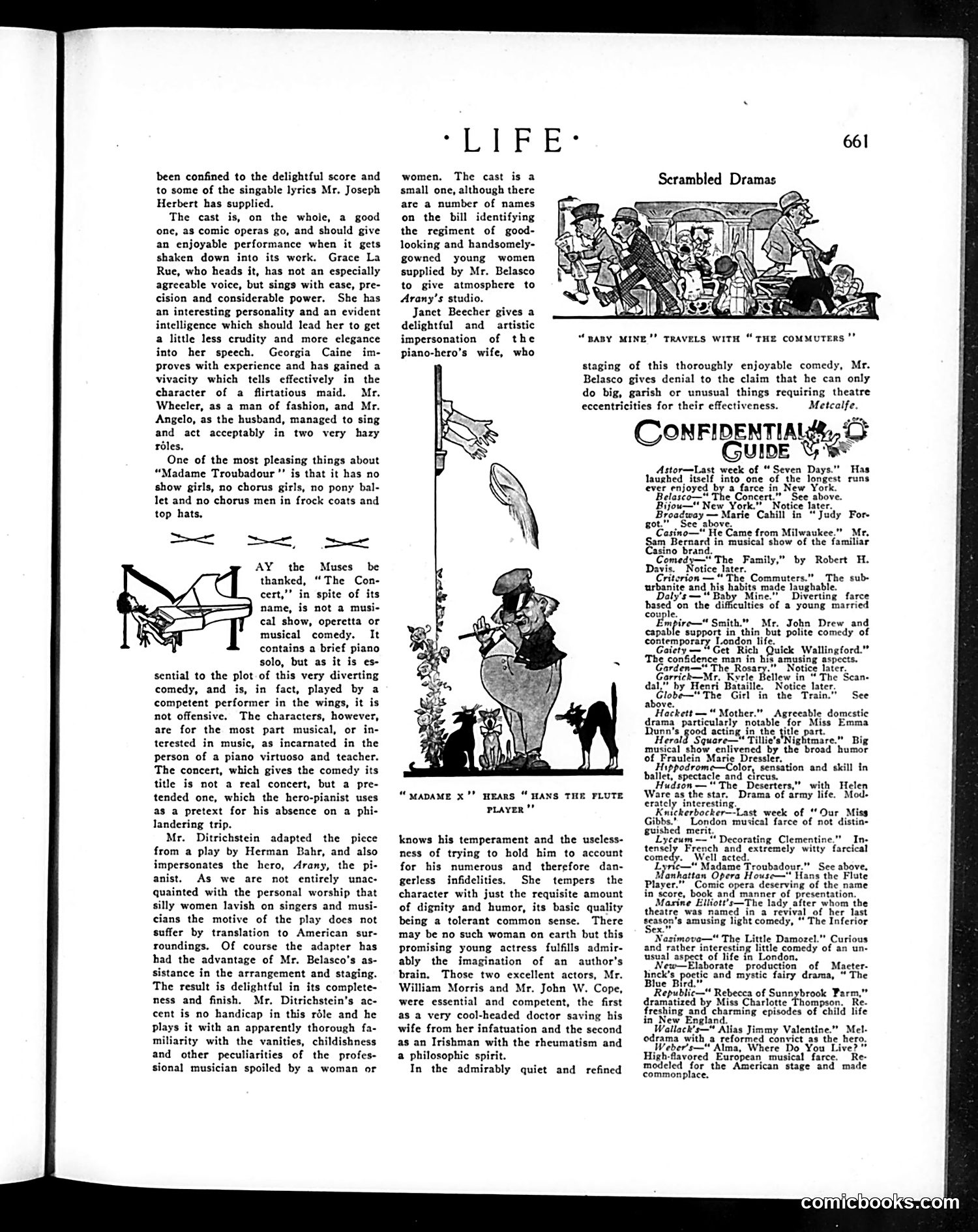
This page contains theatre reviews, not political cartoons. The content discusses several Broadway productions from the early 20th century. The main reviews cover: 1. **"Madame Troubadour"** - A comic opera praised for avoiding typical show-girl spectacle, featuring Grace La Rue and noting performances by Wheeler and Angelo. 2. **"The Concert"** - A comedy adapted by Mr. Ditrichstein (who also stars) from a Herman Bahr play, about a pianist using a pretended concert as cover for philandering. The review praises David Belasco's staging and Janet Beecher's performance as the pianist's tolerant wife. The illustrations show theatrical scenes and a figure labeled "Madame X Hears Hans the Flute Player" - likely depicting a scene from one of the reviewed productions. The tone is characteristic of early Life magazine: sophisticated theatre criticism dismissing sentimentality while celebrating wit and artistic merit. The "Confidential Guide" column lists current Broadway shows with brief notices.
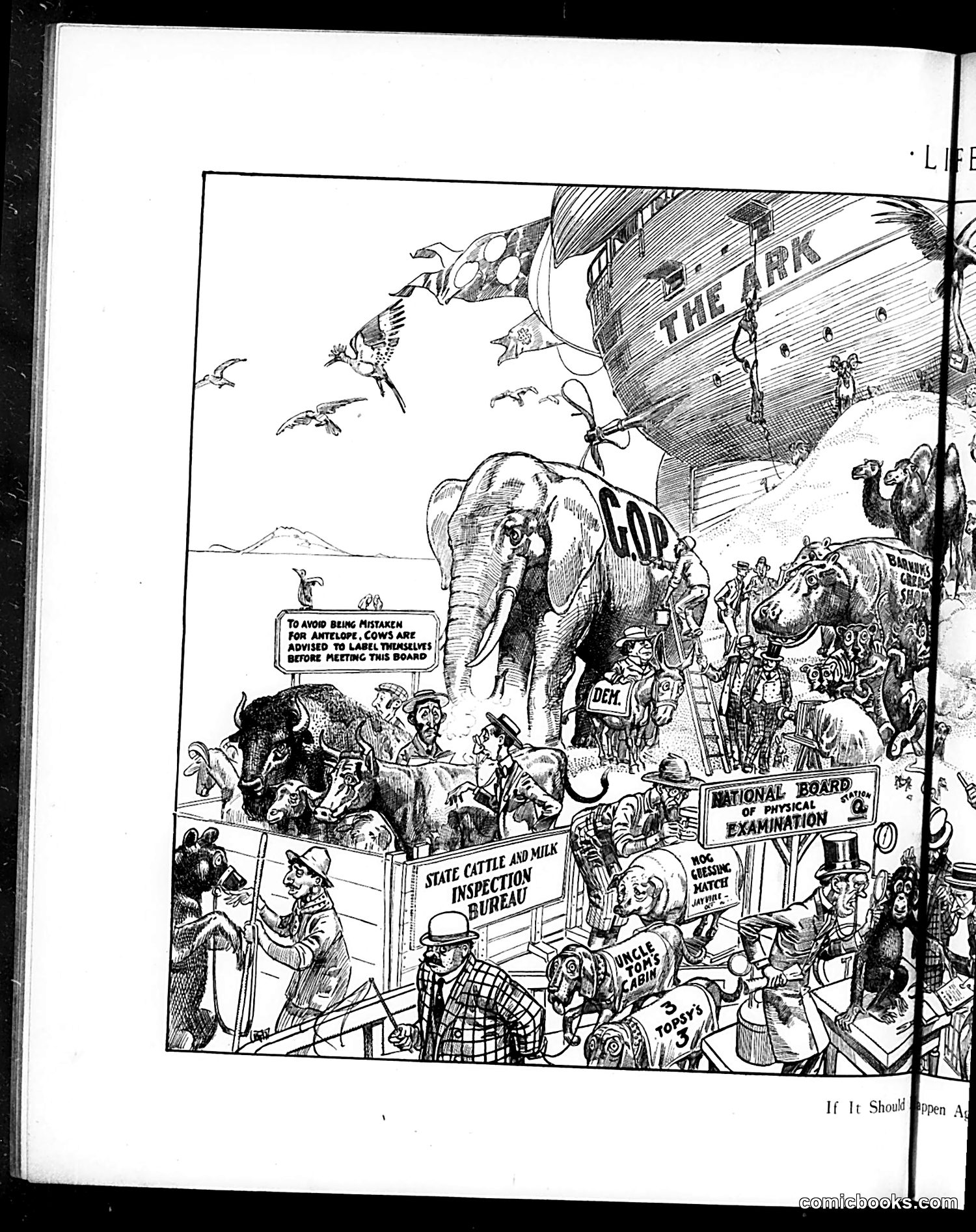
This Life magazine cartoon satirizes the "Republican elephant" (labeled "GOP") boarding "The Ark" alongside various government inspection and regulatory agencies. The visual joke compares the situation to Noah's Ark—suggesting these institutions are boarding together, possibly for protection or survival. The cartoon appears to critique Republican political machinery and bureaucratic expansion. Visible labels include "State Cattle and Milk Inspection Bureau" and "National Board of Examination," suggesting satire about government oversight agencies. The text bubble advises avoiding being "mistaken for antelope" before boarding, a cryptic reference unclear without additional context. The work likely dates to the early-to-mid 20th century based on style and the reference to GOP politics during that era. The precise political moment remains unclear from this single page.
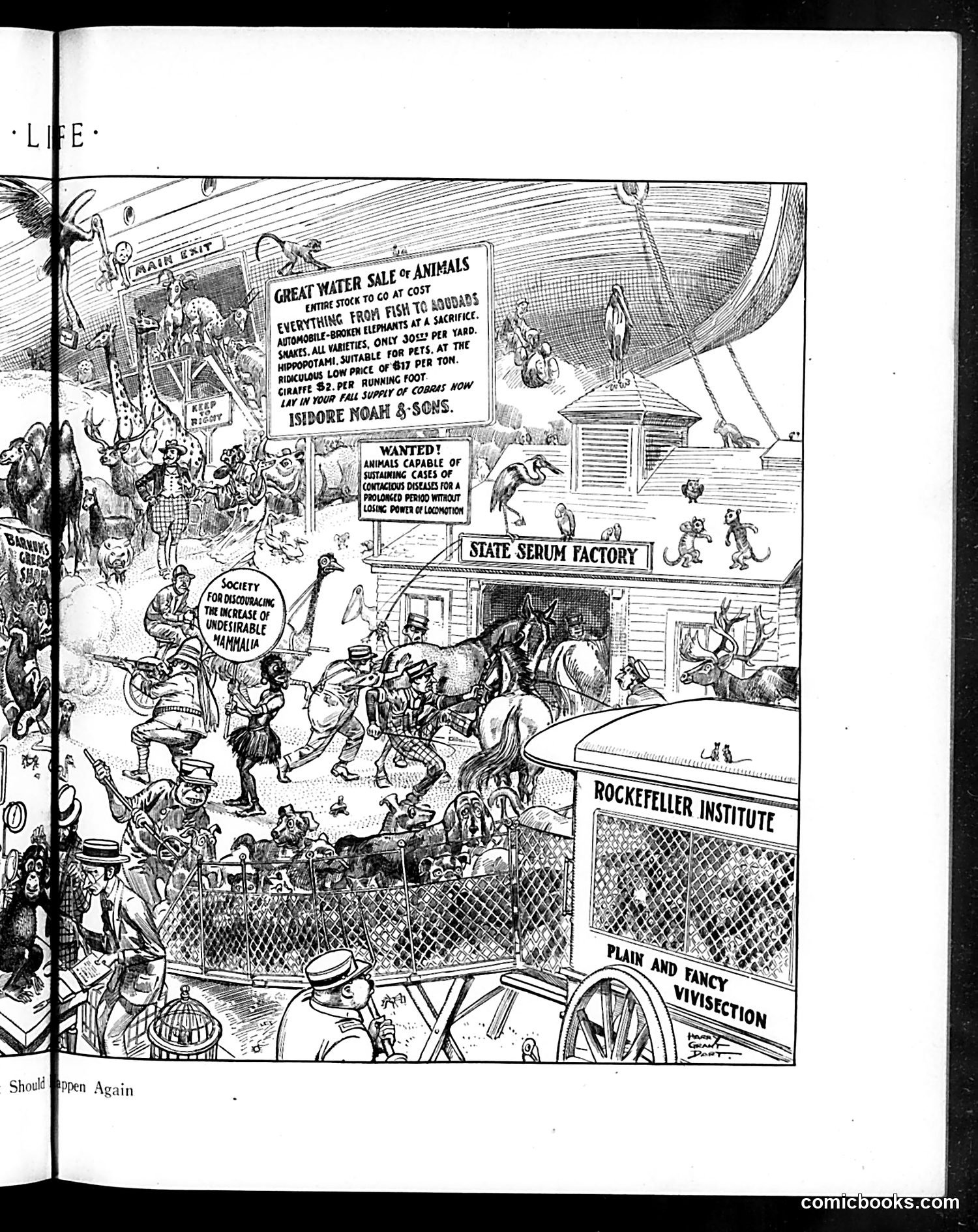
This is a satirical cartoon depicting a chaotic fair or carnival scene. The main joke appears to center on absurd commercial enterprises displayed as booths: - "Great Water Sale of Animals" by Isidore Noah & Sons (a biblical Noah's Ark reference) selling exotic animals cheaply - "State Serum Factory" - "Rockefeller Institute" advertising "Plain and Fancy Vivisection" The cartoon mocks wealthy institutions and commercial ventures exploiting animals. One speech bubble mentions "disgusting the public with undesirable animals," suggesting criticism of both animal cruelty and public health concerns. The crowded, chaotic crowd scene emphasizes the satirical tone—presenting these institutions as carnival attractions rather than serious scientific or commercial enterprises. The overall critique appears aimed at unethical animal treatment by wealthy institutions and businesses operating under a veneer of legitimacy.
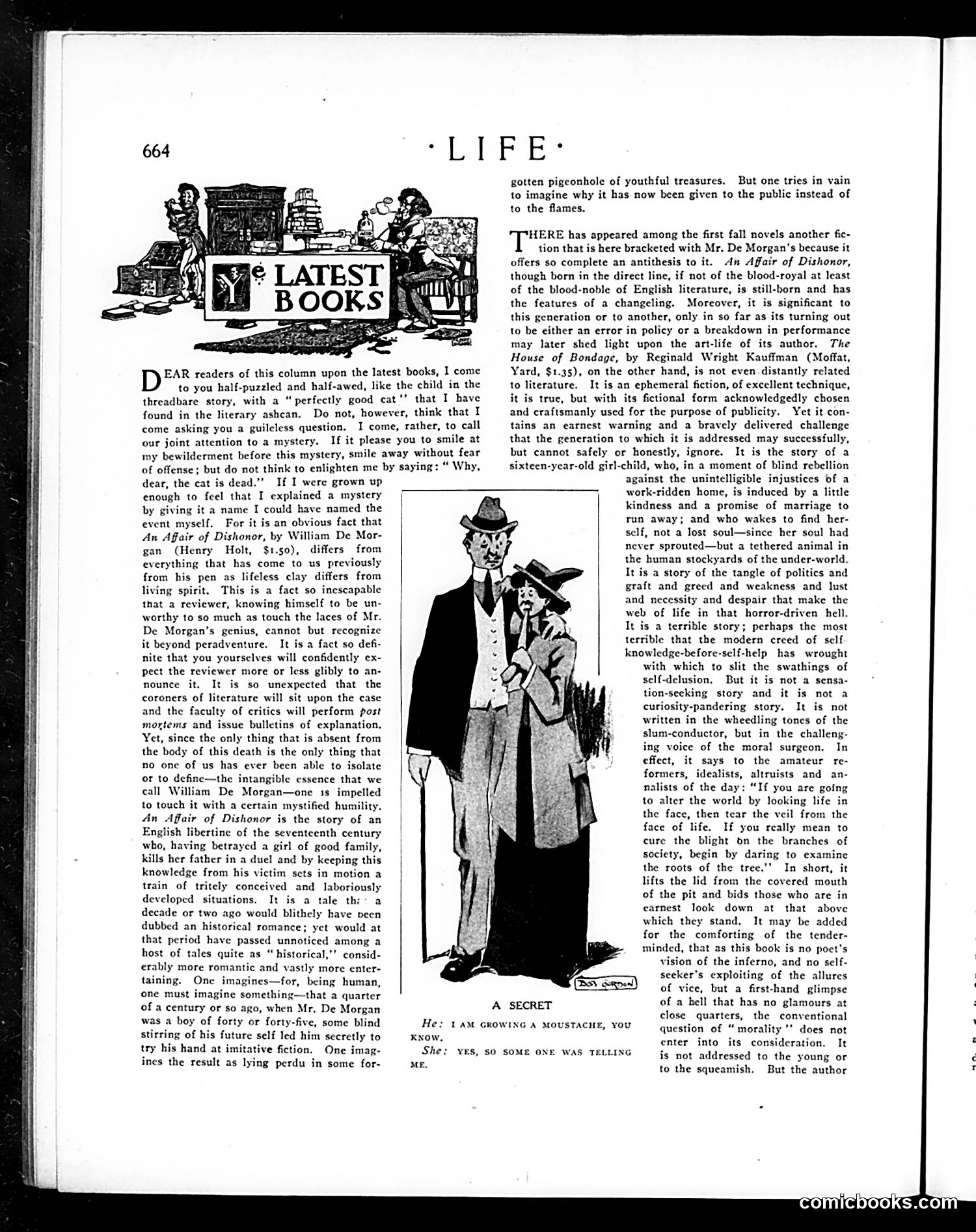
This page contains a book review column titled "The Latest Books," discussing recent fall novels. The reviewer analyzes two contrasting works: William De Morgan's *An Affair of Dishonor* and Reginald Wright Kauffman's *The House of Bondage*. The accompanying illustration labeled "A Secret" depicts two men in conversation—one older and mustached, one younger—with dialogue below: "He: I am growing a moustache, you know. / She: Yes, so some one was telling me." This is a humorous non-sequitur joke playing on misheard or miscommunicated gossip. The humor relies on the absurdity of casual social chitchat being reported as notable news. The review itself critiques De Morgan's novel as surprisingly lifeless compared to his earlier work, while defending Kauffman's *House of Bondage* as socially important despite its commercial motivation—it addresses serious social injustices facing young women.
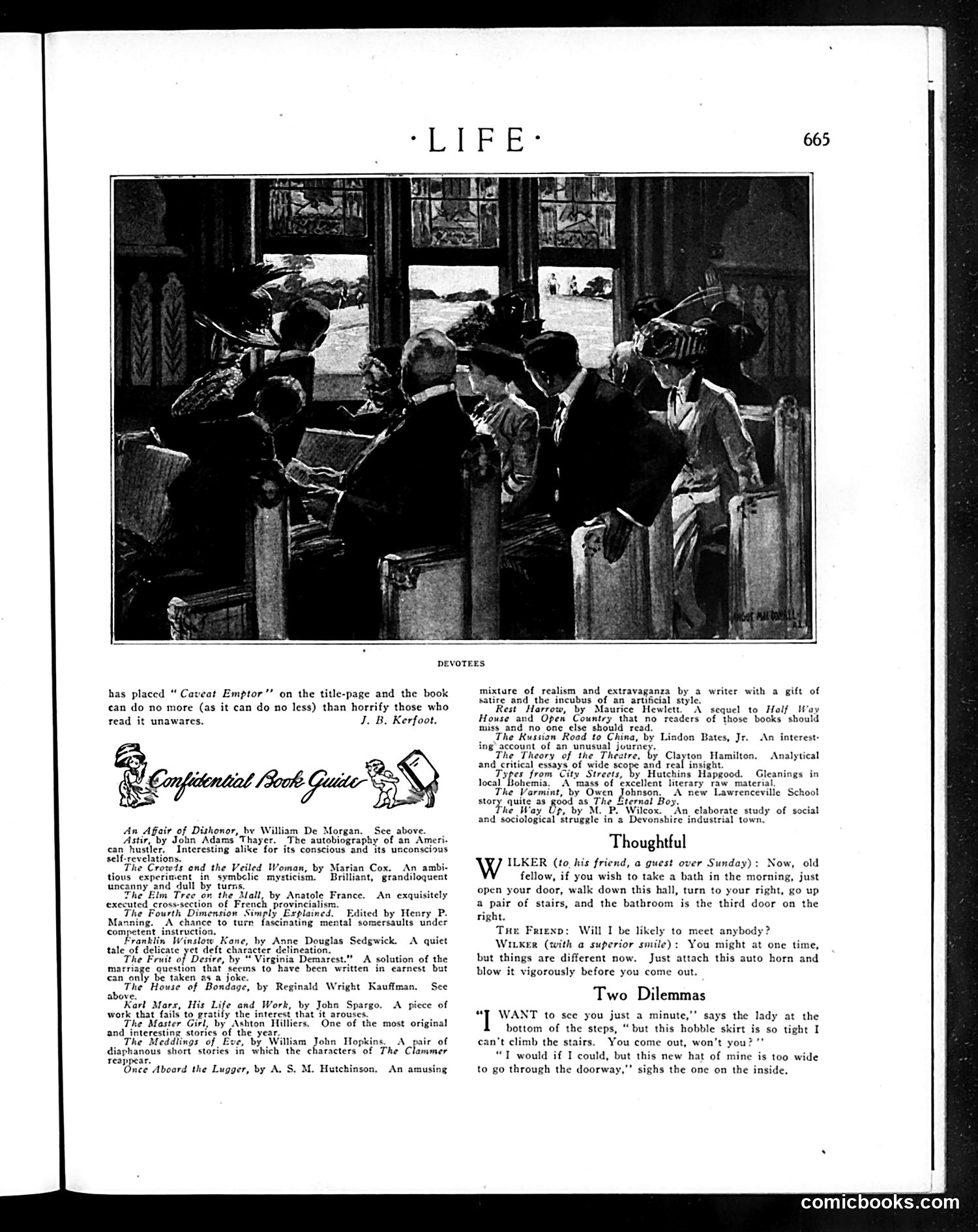
This page contains **book reviews** (titled "Confidential Book Guide") and **two brief humorous dialogues** satirizing contemporary fashion and domestic inconveniences. The photograph at top shows what appears to be **religious devotees or worshippers** in a church or chapel setting—likely illustrating the "Caveat Emptor" (Buyer Beware) reference to cautionary tales in the reviewed books. The two comic dialogues at bottom mock **early 1900s fashion absurdities**: 1. **"Thoughtful"**: A host gives elaborate directions to a bathroom, then jokes about attaching an "auto horn" as a warning signal—because guests might encounter others in the hallway (likely a veiled reference to romantic encounters or propriety concerns in large homes). 2. **"Two Dilemmas"**: Two women cannot meet because fashion has rendered them literally immobile—the "hobble skirt" prevents one from climbing stairs, while the other's oversized hat won't fit through a doorway. Both sketches ridicule the impracticality of contemporary fashions, a recurring satire target during the Edwardian era when hobble skirts and elaborate millinery were popular despite their dysfunction.
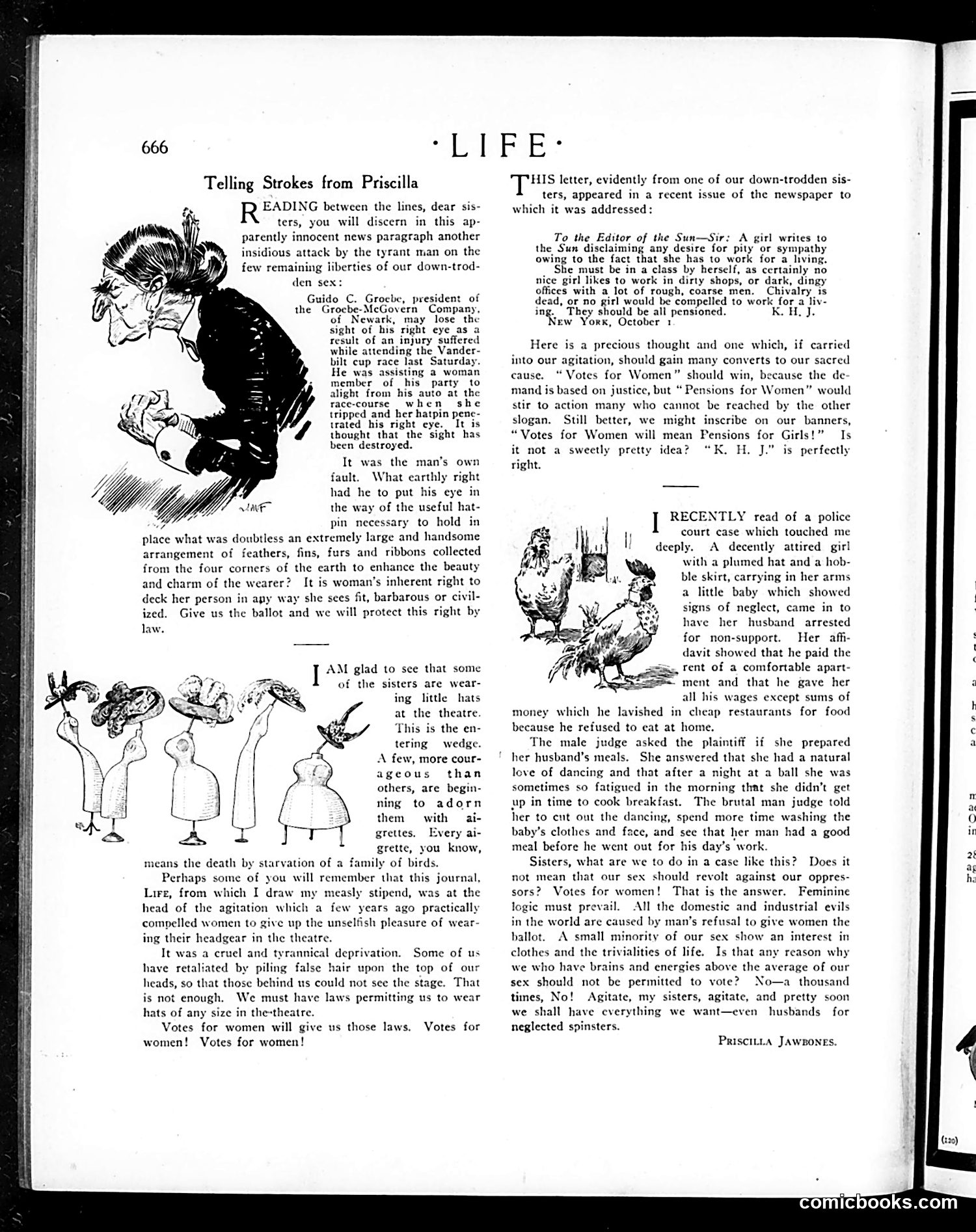
This satirical column by Priscilla Jamborees mocks the women's suffrage movement through exaggerated arguments. The first cartoon depicts a man blinded by a woman's oversized hatpin—the joke being that suffragists blame men for women's problems while ignoring women's own choices (elaborate hats with dangerous pins). The column ridicules specific feminist arguments: that voting will solve all injustices, that women should wear massive theater hats without restriction, and that women deserve government pensions rather than working. The police court anecdote portrays a wife whose husband provides housing and wages but is still deemed an inadequate provider—suggesting women's grievances are unreasonable. The satire targets what Jamborees sees as illogical feminist logic: attributing every problem to "male tyranny" while demanding rights that ignore practical reality. The illustrations of women wearing increasingly absurd hat arrangements reinforce this mockery of the movement's perceived disconnect from reason.
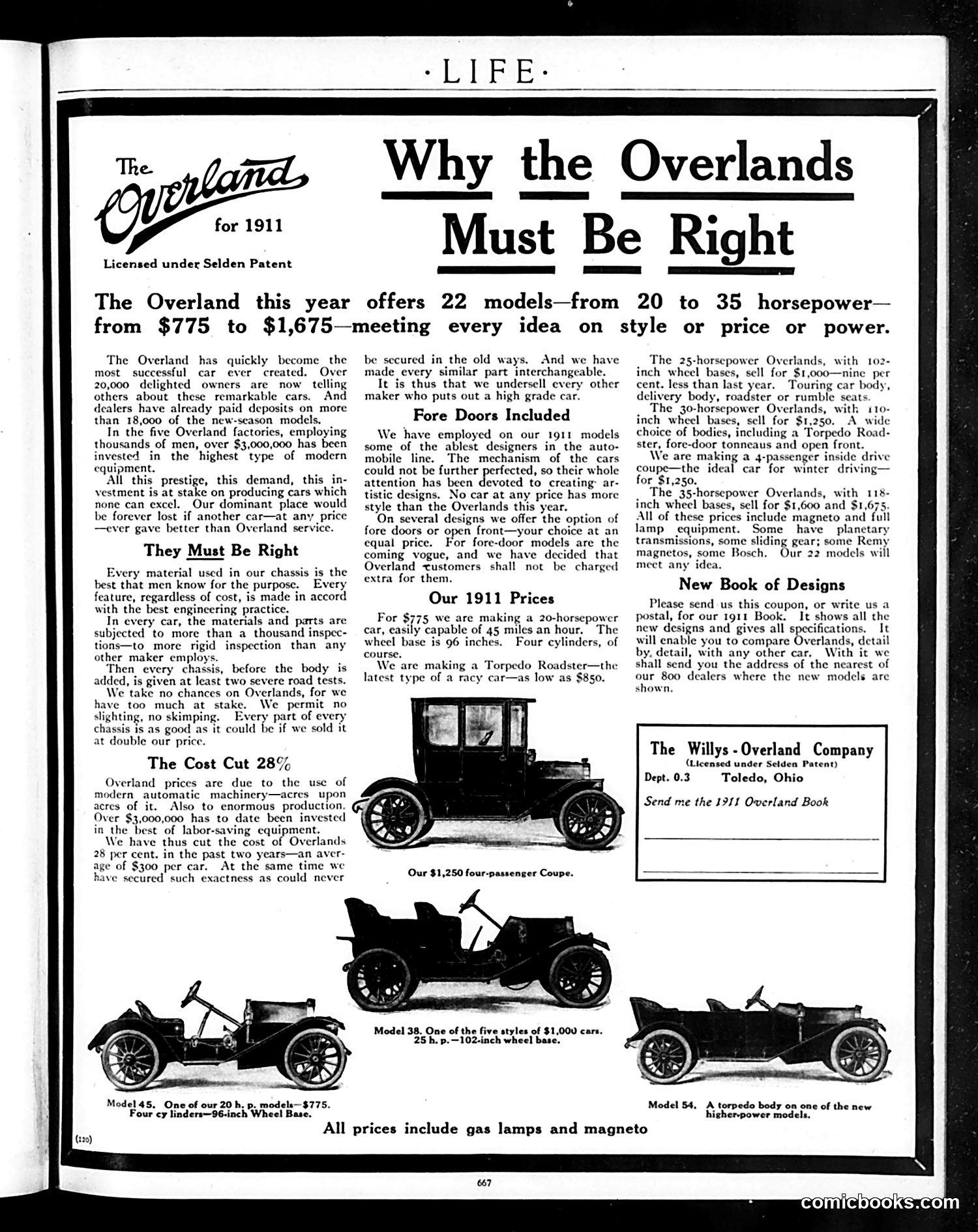
This is a **straightforward automobile advertisement** for the Overland car, not a political cartoon or satire. The page appeared in *Life* magazine's 1911 issue, where advertisements were common alongside satirical content. The ad promotes the Overland's 22 models (priced $775–$1,675) by emphasizing manufacturing superiority: modern machinery, rigorous quality control (1,000+ inspections per car), and cost reduction (28% cut). Key selling points include interchangeable parts, fore-door options at no extra charge, and diverse body styles. The three car illustrations showcase different models—the Model 45 (20 hp, $775), Model 38 ($1,000), and Model 54 torpedo roadster. An insert box offers the "1911 Book of Designs." The text's repetitive assurances ("They Must Be Right," "no slighting, no skimping") reflect early automotive marketing's emphasis on reliability—a significant consumer concern when automobiles were novel, expensive purchases.
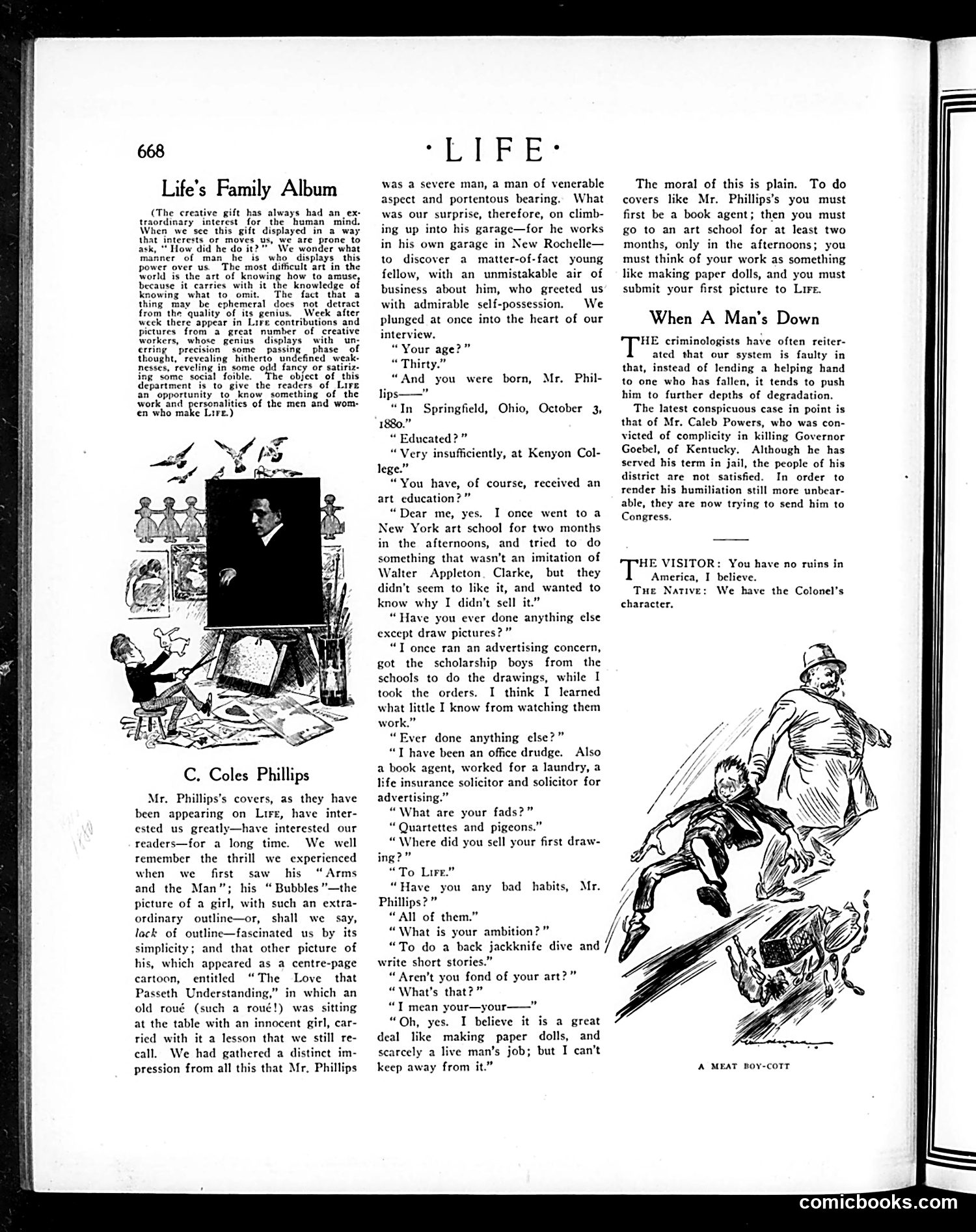
This page profiles illustrator C. Coles Phillips through an interview format. Phillips was Life's celebrated cover artist known for distinctive, minimalist line work and sophisticated compositions. The text reveals the magazine's surprise that this "severe man" of "venerable aspect" was actually a casual thirty-year-old from Ohio with minimal formal art training. The humor lies in the contrast between Phillips's refined artistic output and his mundane résumé—advertising work, office drudgery, laundry jobs, insurance soliciting. His dismissive attitude toward his own art ("like making paper dolls...scarcely a live man's job") yet compulsive need to create satirizes artistic pretension while celebrating raw talent over credentials. The right-side cartoon "A Meat Boy-Cott" appears unrelated—likely satirizing consumer boycotts of the era.
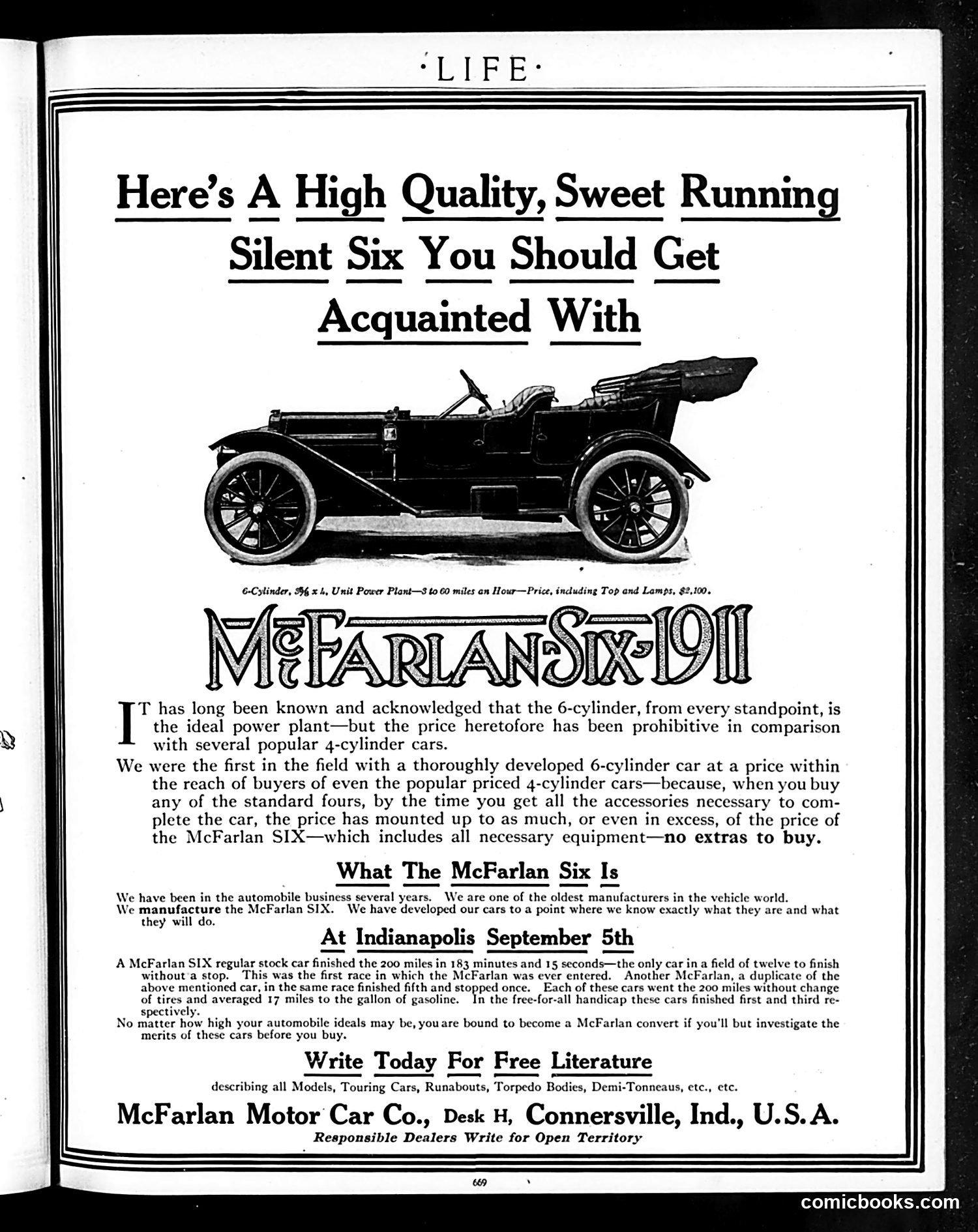
This is a straightforward automobile advertisement, not a cartoon or satire. It promotes the McFarlan SIX, a six-cylinder car manufactured in Connersville, Indiana. The ad's main pitch addresses a genuine market concern of the era: six-cylinder engines were superior but expensive. McFarlan claims to offer this better technology at prices comparable to four-cylinder competitors, especially when factoring in accessories buyers typically added. The advertisement emphasizes reliability through a specific racing achievement at Indianapolis on September 5th (year unclear from image), where a McFarlan finished a 200-mile race without stopping—claimed as the only car in a twelve-car field to do so. This appears in *Life* magazine's advertising section and represents typical early automotive marketing that relied on technical specifications and performance claims rather than humor or satire.
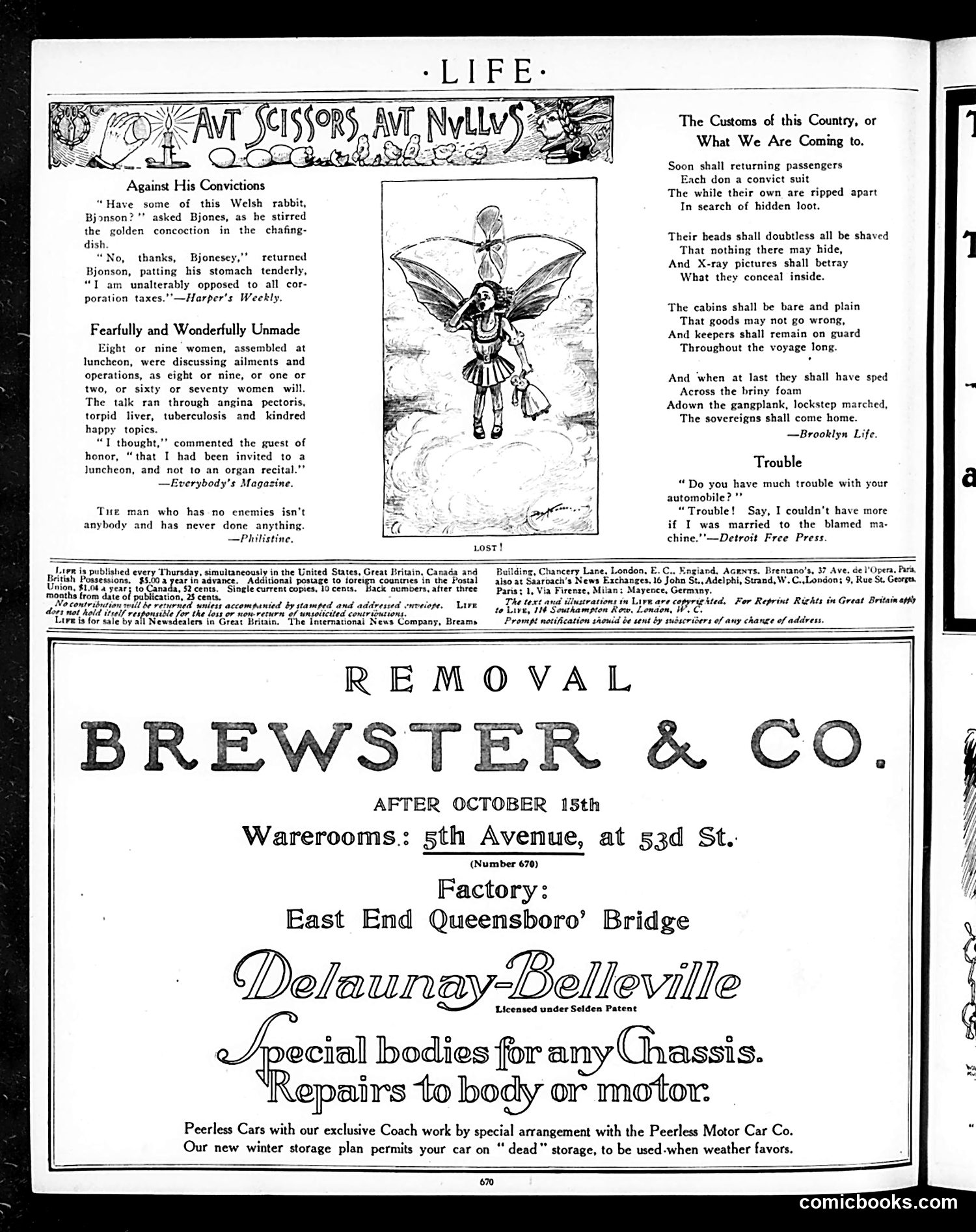
This page contains three brief satirical pieces mocking social hypocrisy and contemporary absurdities: **"Against His Convictions"** mocks a man refusing Welsh rabbit (cheese dish) while claiming opposition to "corporation taxes"—the joke being his reasoning is nonsensical, as if stomach discomfort were a political stance. **"Fearfully and Wonderfully Unmade"** satirizes women's luncheon conversations dominated by medical complaints and surgical procedures, treated as tedious "organ recitals" rather than genuine conversation. **"The Customs of This Country"** presents a darkly comic poem about future customs inspections, imagining returning passengers strip-searched, shaved, and X-rayed like convicts before being marched home—satirizing invasive border security practices. The central illustration labeled "LOST" appears to show a winged figure, likely representing Lady Liberty or Americana, suggesting the poem's commentary on American freedoms being eroded. The page is primarily advertising (Brewster & Co., Delaunay-Belleville automobiles) below the editorial content.
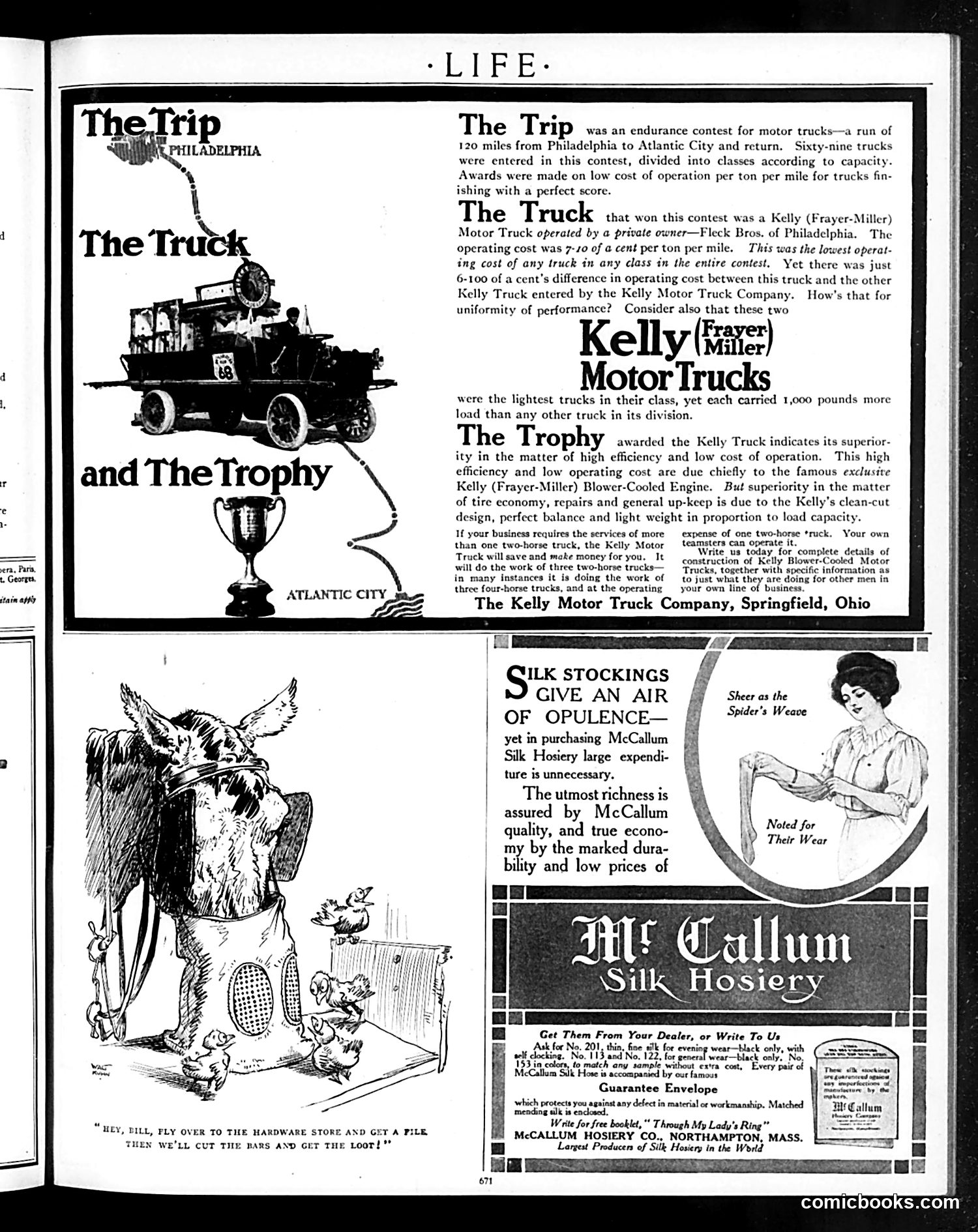
This page contains **two distinct advertisements** rather than political satire. **Top Advertisement - Kelly Motor Trucks:** Promotes the Kelly (Frayer-Miller) truck brand by describing its victory in "The Trip," a 120-mile endurance contest from Philadelphia to Atlantic City. The ad emphasizes the winning truck's superior fuel efficiency (lowest operating cost per ton-mile) and lighter weight while carrying heavier loads than competitors. It's straightforward commercial messaging highlighting engineering efficiency. **Bottom Left - Cartoon:** A humorous illustration of a cow holding a milk pail, surrounded by small figures. The caption reads: "HEY, FILL, FLY OVER TO THE HARDWARE STORE AND GET A FILE—THEN WE'LL CUT THE BARS AND GET THE LOOT!" This appears to be a whimsical joke about theft or escape, though its specific reference is unclear from context alone. **Bottom Right - McCallum Silk Hosiery Advertisement:** Promotes women's silk stockings as luxurious yet affordable, emphasizing durability and quality. Features an illustration of a woman's leg. The page is primarily **advertising-driven**, typical of 1910s-era Life magazine content.
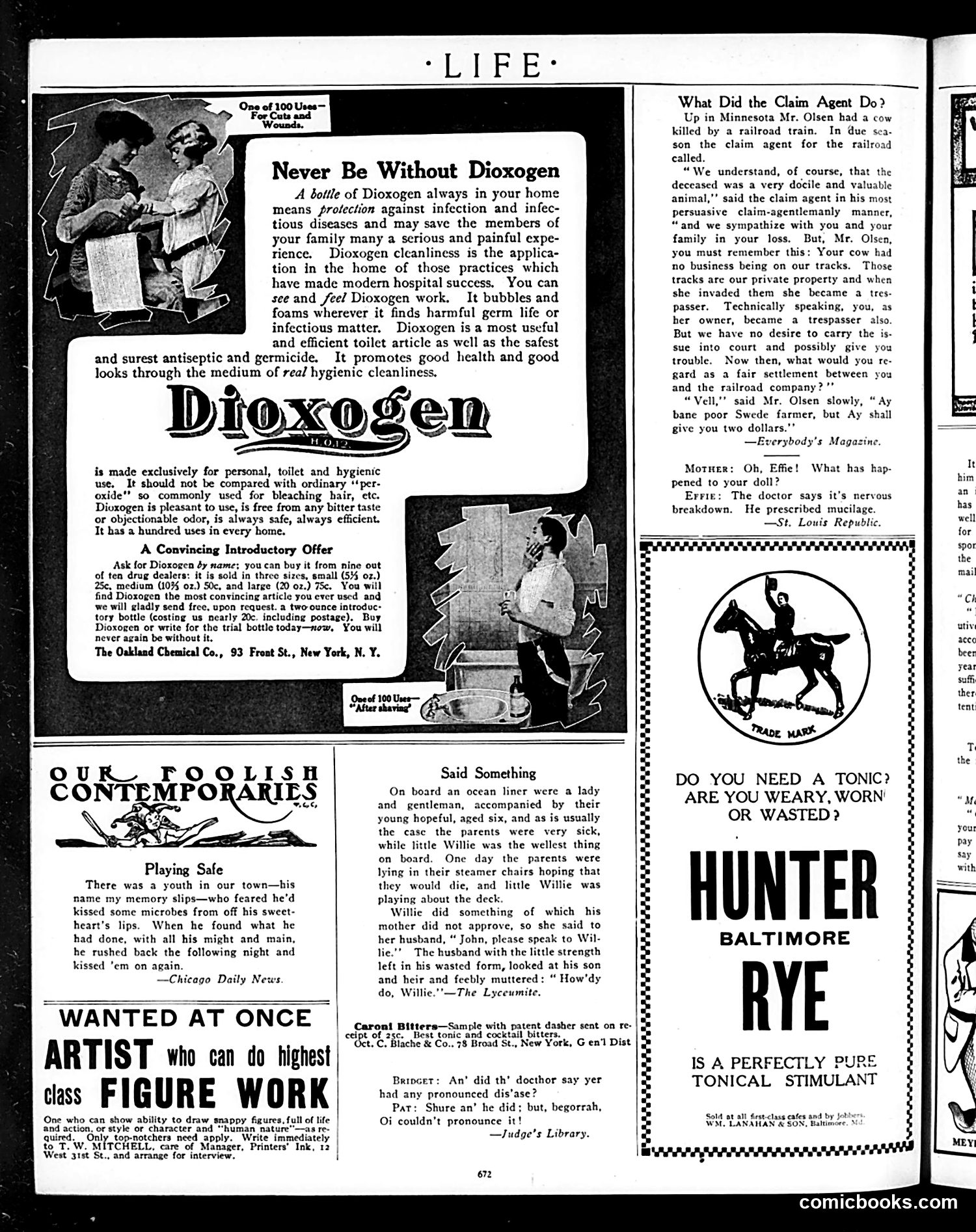
This page is primarily **advertising mixed with light humor**, typical of early 20th-century *Life* magazine. The main feature is a lengthy ad for **Dioxogen**, a disinfectant/antiseptic product marketed for household hygiene. The ad uses medical authority and claims about "germ life" to sell the product—reflecting era-specific anxieties about invisible infectious disease. The humor pieces are brief anecdotes: - **"What Did the Claim Agent Do?"** satirizes railroad companies' penny-pinching. A Minnesota farmer's cow is killed by a train; the claim agent argues the farmer is technically a "trespasser" on railroad property and offers the farmer a pittance ($2), which the poor farmer accepts—mocking corporate exploitation of rural workers. - **"Playing Safe"** is bawdy humor about kissing and germs. - **"Said Something"** involves a seasick couple and their healthy child aboard a ship. The other ads seek an artist and promote Hunter Baltimore Rye whiskey as a "tonic" for fatigue—reflecting Prohibition-era marketing strategies euphemizing alcohol as medicine.
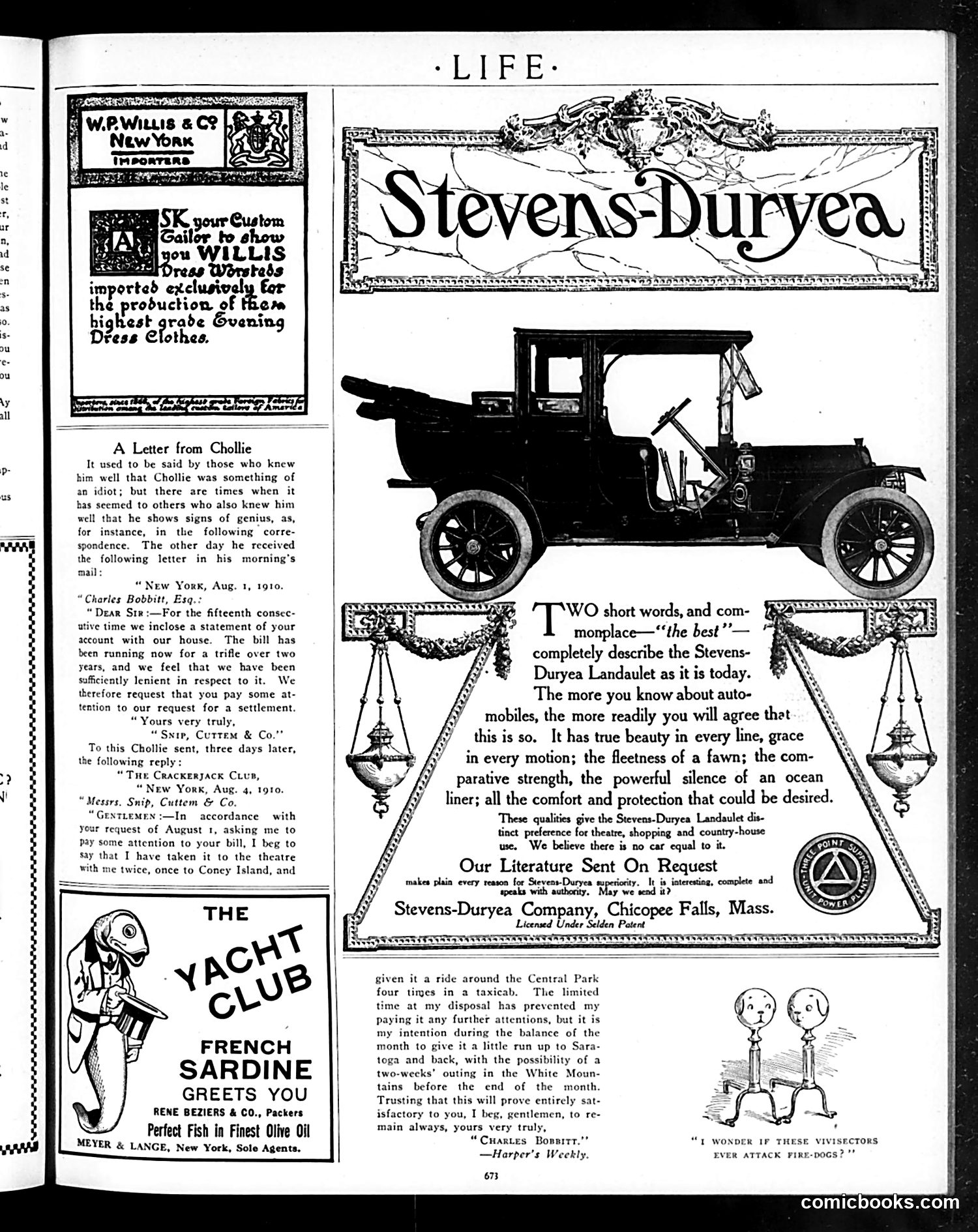
This is a humorous piece satirizing a wealthy, idle young man named "Chollie" (a typical name for frivolous upper-class characters in early 1900s American satire). A creditor's firm demands payment on a two-year-old unpaid bill. Chollie's response—that he has "paid attention" to the invoice by taking it to theaters, Coney Island, Central Park, and plans to take it to Saratoga and the White Mountains—is absurd mockery of his own irresponsibility. The joke targets the leisure class: Chollie treats a serious debt with comical indifference, interpreting "pay attention" literally as entertainment rather than financial obligation. His elaborate explanation of future social plans instead of payment exposes the disconnect between wealthy idlers and actual consequences. The satire reflects Progressive-era criticism of unproductive aristocracy and financial irresponsibility among the privileged.
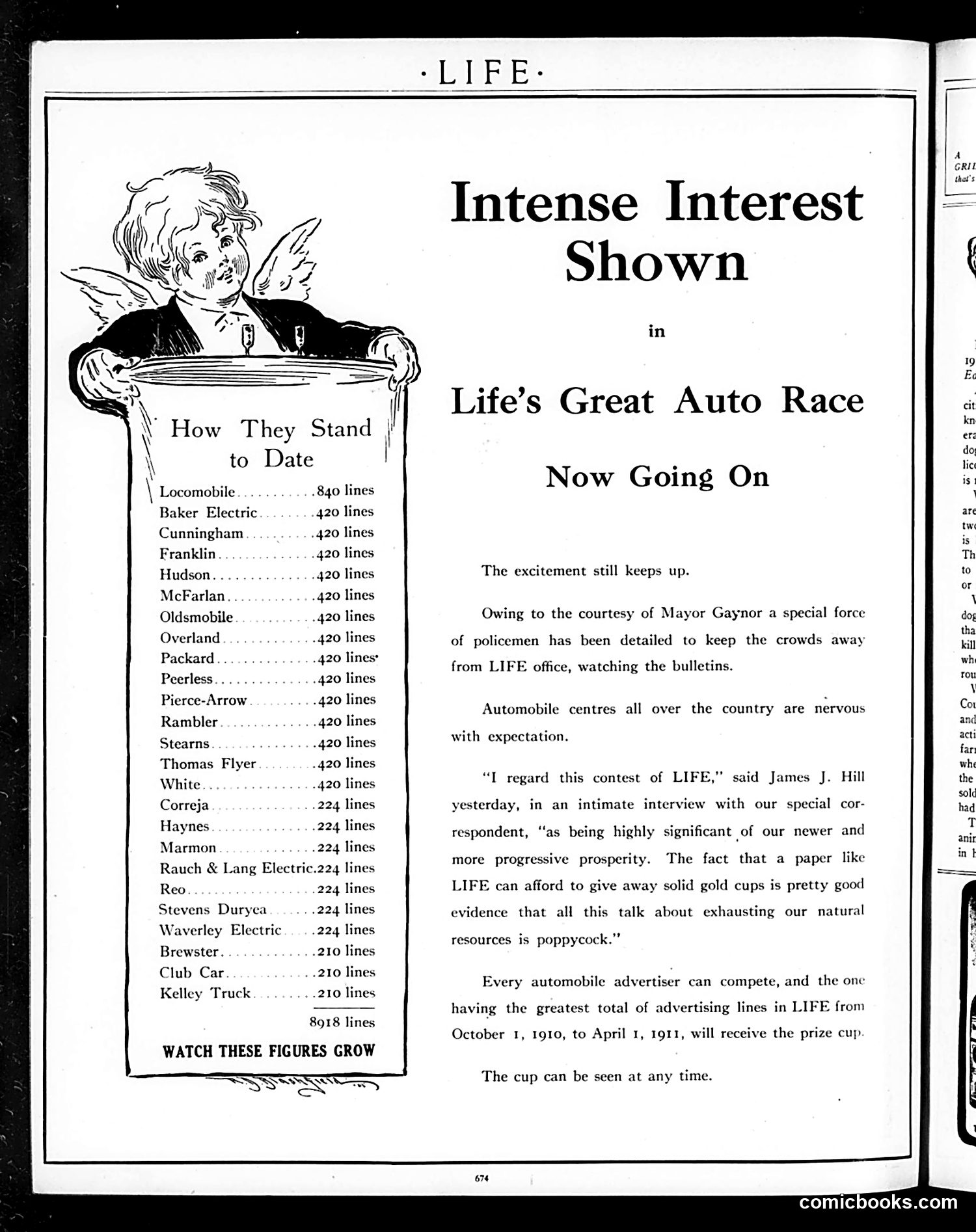
This page announces Life magazine's advertising competition disguised as editorial content. Automobile manufacturers compete for a gold cup based on total advertising lines purchased between October 1910 and April 1911—the winner being whoever advertises most heavily in Life itself. The cherub illustration represents Life's self-promotion. The leaderboard tracks advertising volume, not actual vehicle performance, yet frames this as thrilling competition. James J. Hill's quoted endorsement (likely the railroad magnate) legitimizes the contest while sardonically defending America's resource abundance. The satire is two-fold: Life commercializes editorial space while presenting advertising as news, and the implicit message mocks both corporate excess and America's confident dismissal of resource depletion concerns. The phrase "watch these figures grow" explicitly urges readers to monitor—and presumably buy into—the competition's inflation.
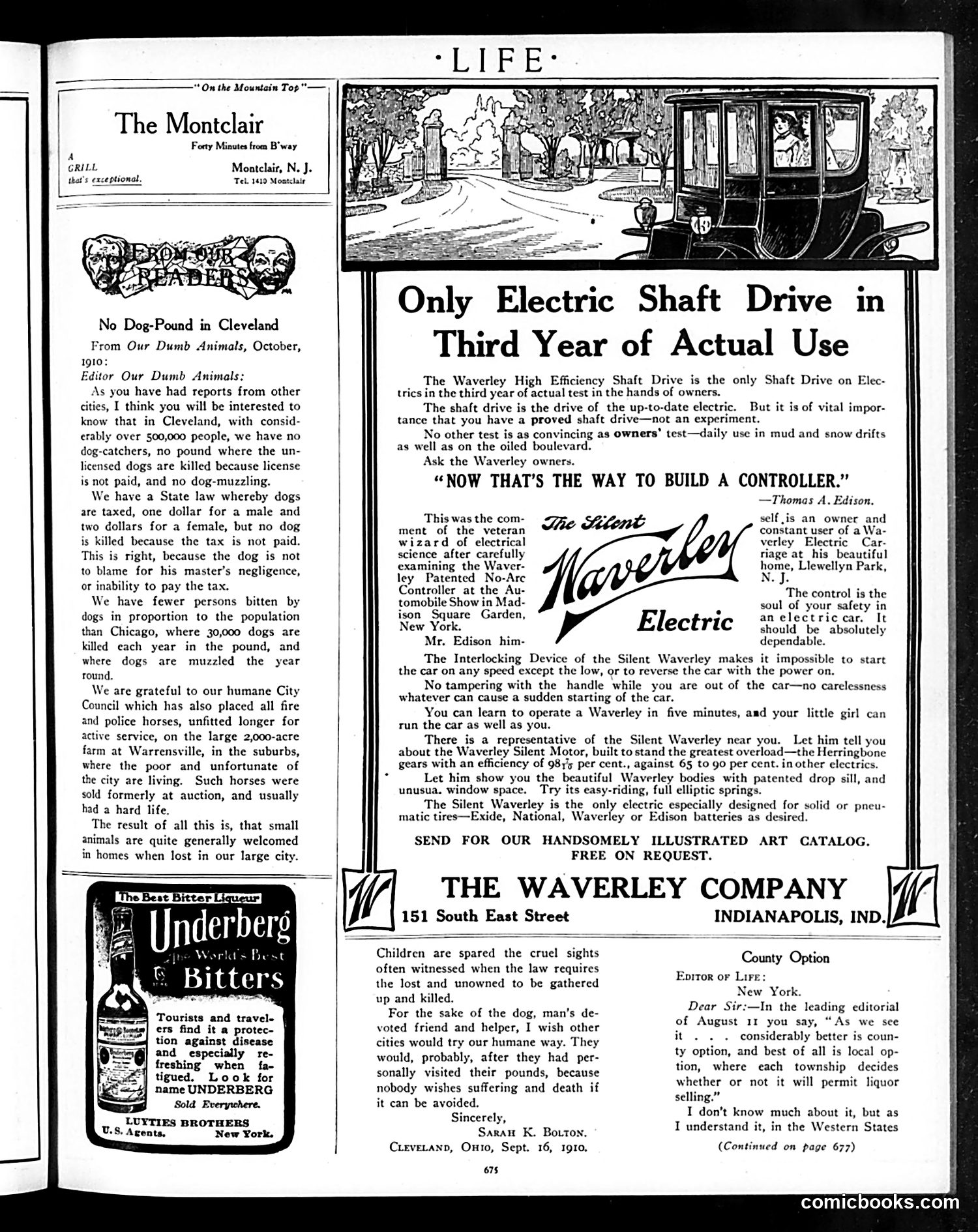
This page contains **no political cartoon**—it's primarily advertising and editorial content from *Life* magazine (circa 1910). The main content includes: 1. **"No Dog-Pound in Cleveland"**: A letter praising Cleveland's humane animal policies. Unlike Chicago (which killed 30,000 dogs yearly), Cleveland taxed dogs but didn't execute unlicensed ones, arguing the dog isn't responsible for owner negligence. The writer credits this approach with fewer dog-bite incidents and better treatment of retired police/fire horses. 2. **Waverley Electric Car Advertisement**: Promotes electric automobiles, claiming Edison endorsed their "shaft drive" controller. Emphasizes safety features, ease of operation ("your little girl can run the car"), and efficiency. This reflects early-1900s enthusiasm for electric vehicles as modern, safe alternatives to gasoline cars. The page reflects Progressive-era concerns: animal welfare reform and emerging automotive technology. The Underberg Bitters ad is unrelated product placement.
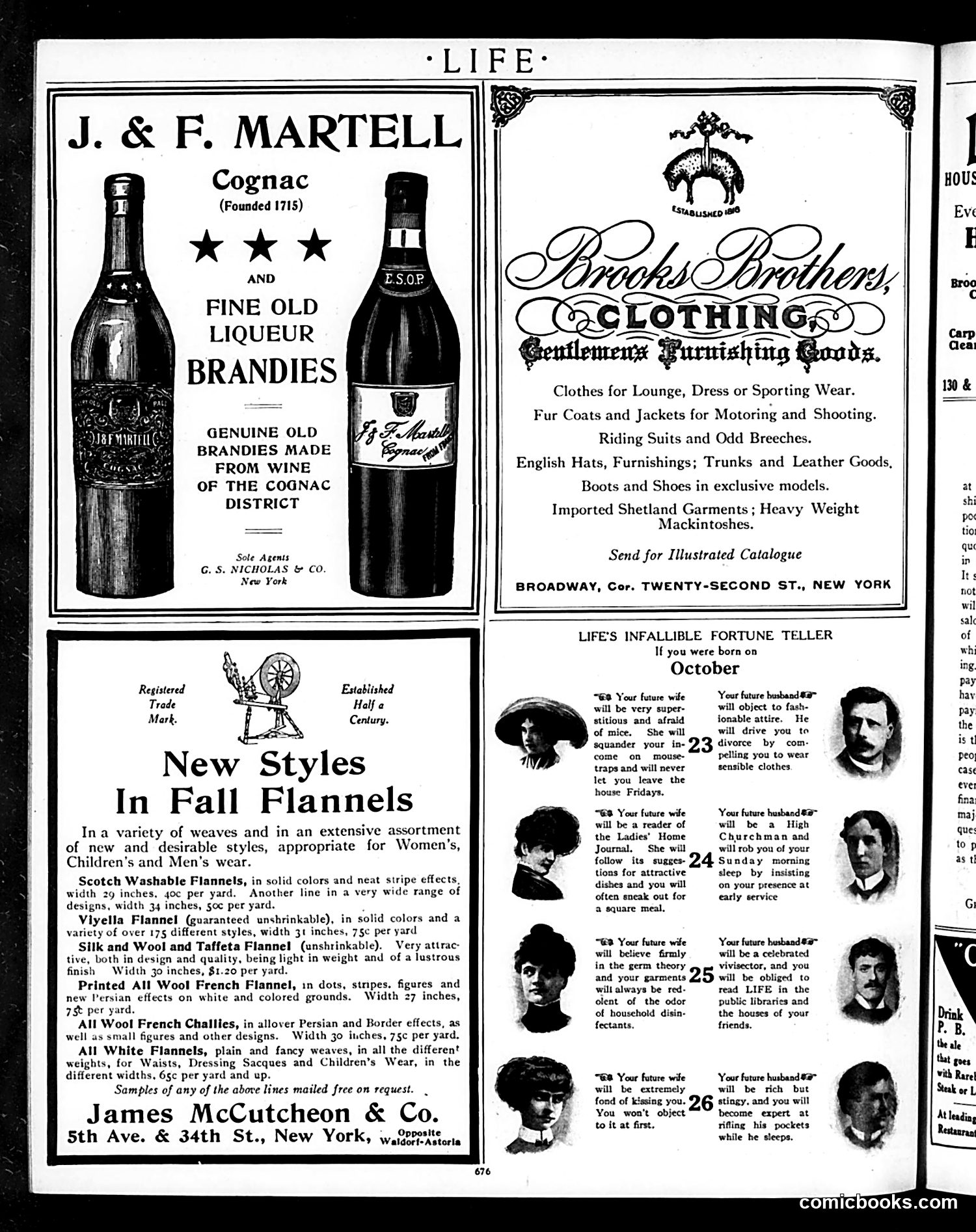
This page is primarily advertising, but features a satirical "fortune teller" section mocking romantic expectations based on birth month. The October fortunes present cynical jokes about marriage: - Women born in October are portrayed as superstitious, wasteful, and controlling (forbidding husbands to leave on Fridays) - Their future husbands are depicted as fashion-conscious complainers who force divorce through demands for "sensible clothes" - Later entries joke about wives obsessed with germ theory, compulsive kissers, and husbands who are either pious bores or wealthy misers The humor relies on exaggerated gender stereotypes and marital discord—a common satirical theme in early 20th-century magazines. The accompanying portrait photographs of supposedly typical October-born people reinforce the joke through mock-serious presentation. The format parodies popular "fortune telling" entertainment of the era while offering readers contemporary domestic anxieties played for laughs.
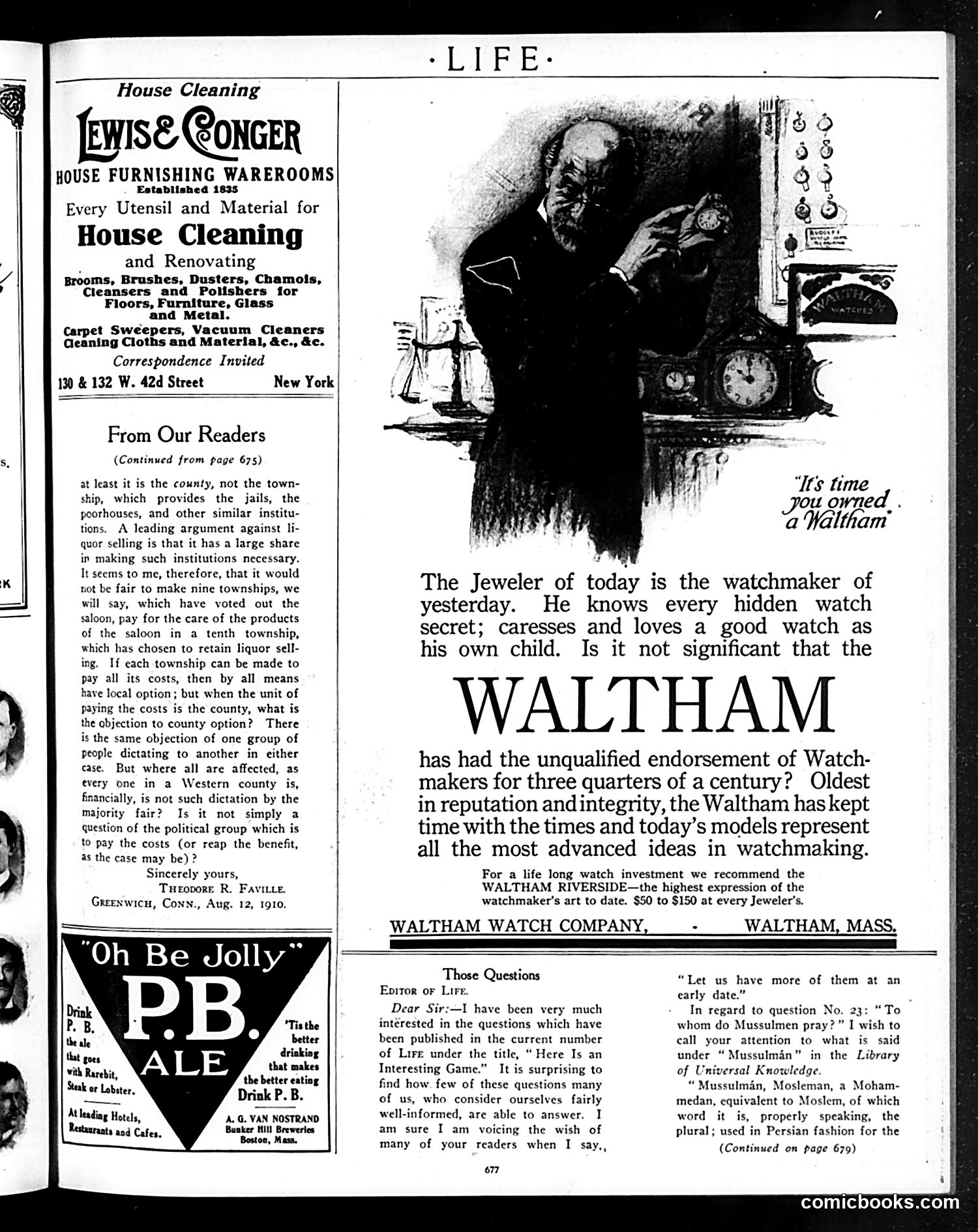
This page contains primarily **advertisements and reader correspondence**, not political satire or editorial cartoons. **Key elements:** 1. **Lewis & Conger ad** (top left): House cleaning supplies company advertisement 2. **Waltham Watch ad** (center-right): Features an illustrated elderly jeweler/watchmaker examining a watch. The ad emphasizes Waltham's long reputation—"three quarters of a century" of watchmaker endorsement—positioning it as a trusted, established brand. The tagline "It's time you owned a Waltham" is a straightforward marketing appeal to consumers seeking quality timepieces. 3. **P.B. Ale ad** (bottom left): "Oh Be Jolly" campaign promoting beer as enhancing dining pleasure 4. **Reader correspondence**: Letters to the editor discussing local liquor policy and educational quiz questions about world religions The page is primarily **commercial content** rather than satirical commentary. The watch advertisement uses nostalgic imagery of traditional craftsmanship to build brand credibility.
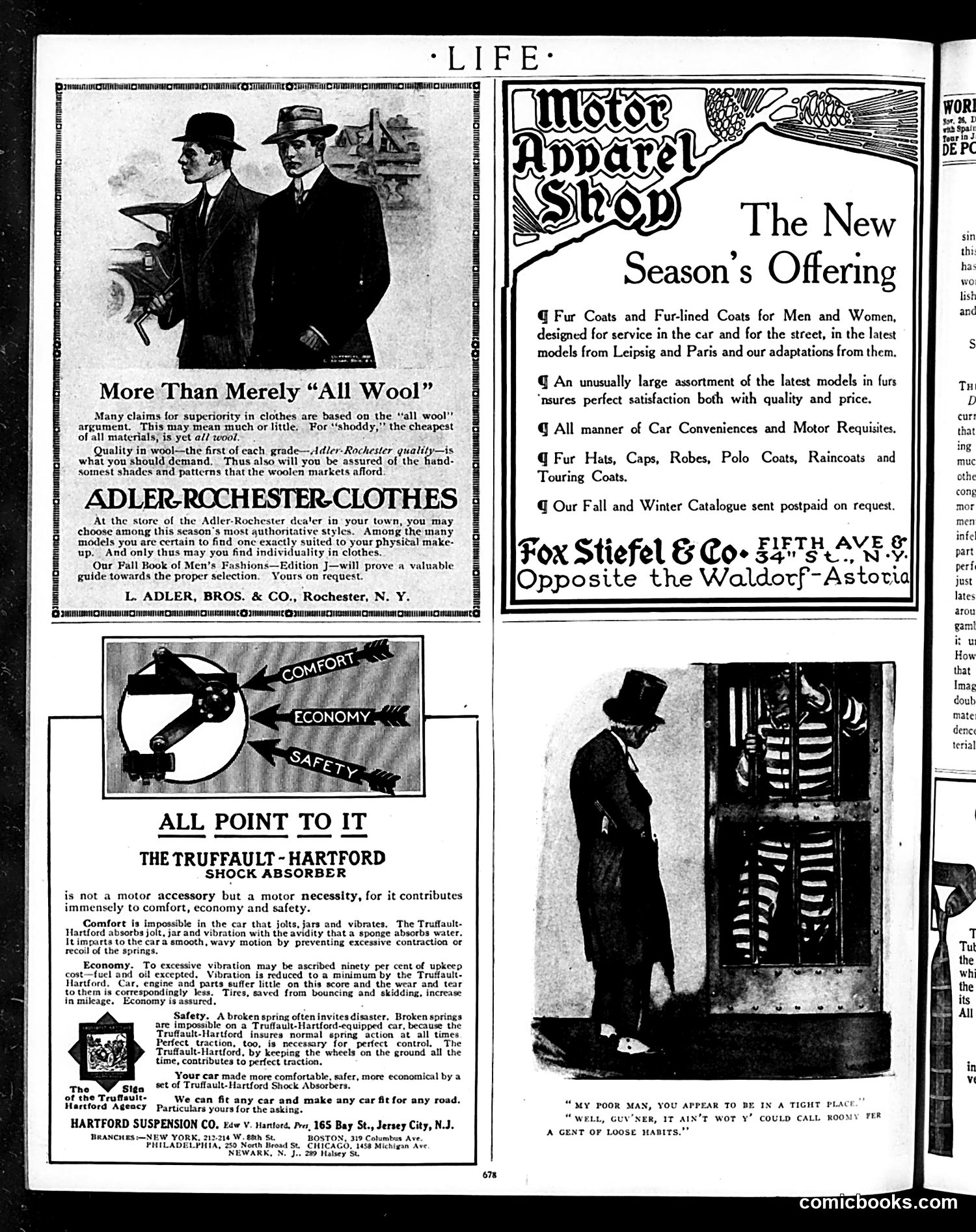
This page is primarily **advertising**, with one cartoon at the bottom. ## The Cartoon The bottom illustration depicts two men in a confined space (appears to be an elevator or narrow room). One wears a top hat (suggesting wealth/status), the other is working-class. The working man quips that the tight space "ain't what you'd call roomy for a gent of loose habits"—a class-conscious joke implying the wealthy man has loose morals or spends money freely, making cramped quarters unsuitable for his lifestyle. ## Advertisements The page features four ads typical of early 20th-century Life: - **Adler-Rochester Clothes**: Men's suits emphasizing wool quality - **Fox Stiefel & Co.**: Luxury furs and motor apparel near the Waldorf-Astoria - **Truffault-Hartford Shock Absorber**: Automobile suspension technology promising comfort, economy, and safety The ads reflect the era's consumer culture and automobile boom, while the cartoon offers mild social commentary on class differences.
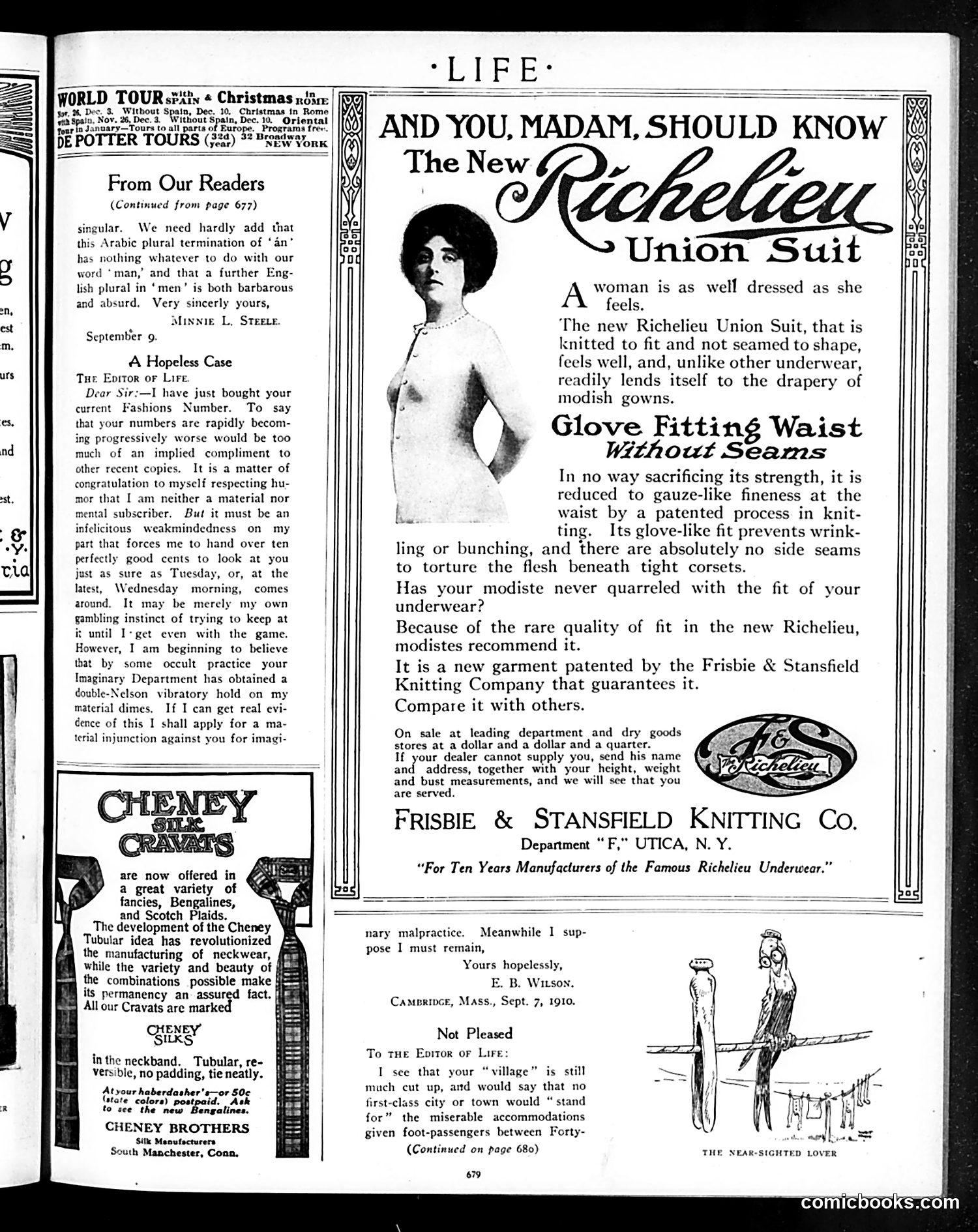
This page is primarily **advertising with reader letters**, not political satire. The main content features: **The Richelieu Union Suit Advertisement** (center-right): A full-page ad for women's underwear emphasizing comfort and fit. The accompanying illustration shows a woman in the garment. The pitch targets women concerned with how undergarments affect dress appearance—selling the idea that this suit provides a smooth, flattering silhouette without visible seams or the discomfort of corsets. **Reader Letters Section** (left): Typical early-1900s magazine correspondence addressing various topics: - A linguistic debate about Arabic plurals - A humorous complaint about *Life* magazine's declining quality - A critical letter about poor village accommodations **Bottom Right**: A cartoon titled "The Near-Sighted Lover" (artist unclear), showing two birds on a wire. **Lower Left**: Advertisements for Cheney Brothers neckwear and Cheney Silks. The page reflects *Life* magazine's mixed format: satirical commentary alongside conventional advertising and reader engagement—characteristic of early-twentieth-century American magazines.
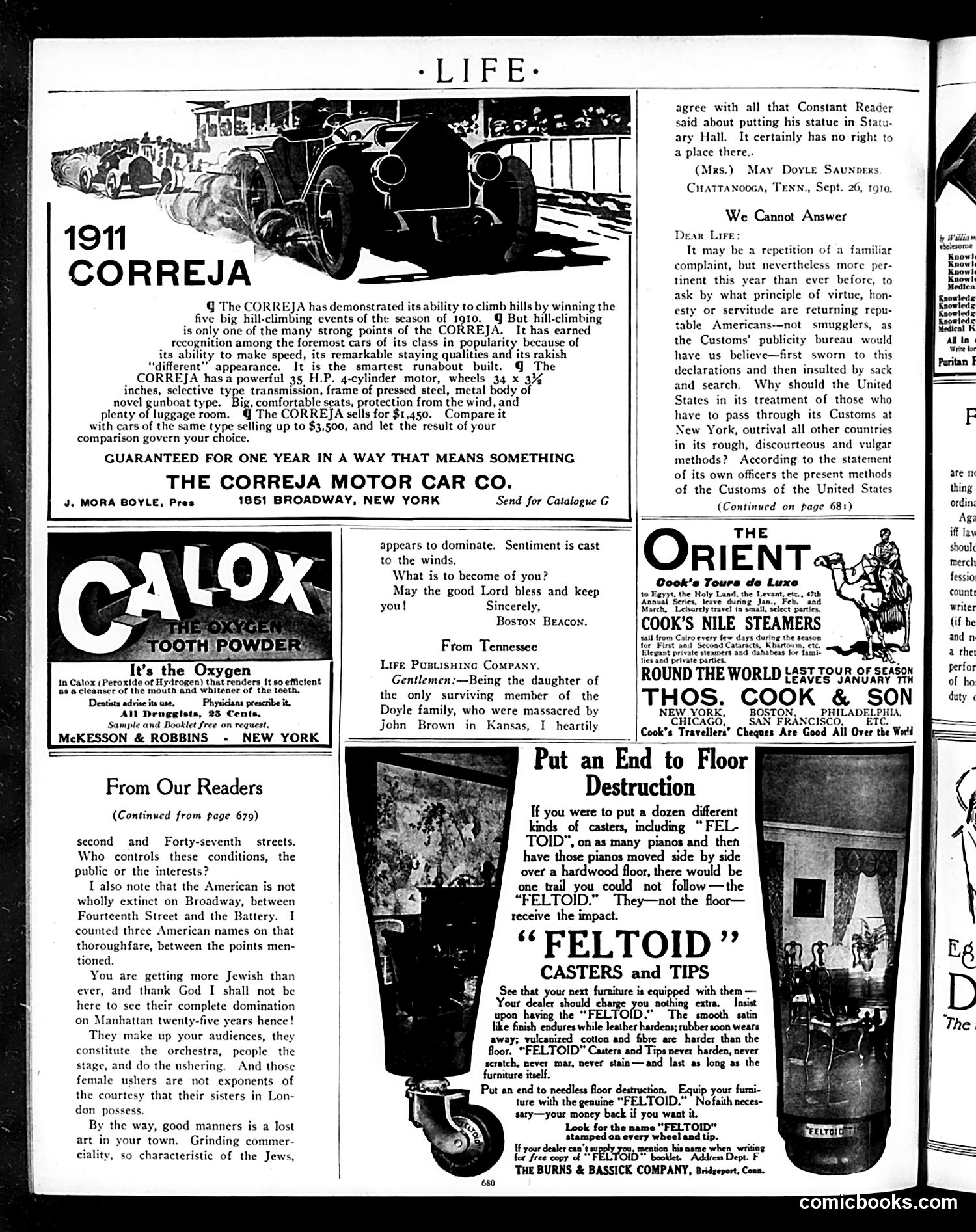
This page mixes advertisements with reader letters and editorial content typical of *Life* magazine's format. **Main Content:** The page features a **Correja automobile advertisement** emphasizing the car's hill-climbing ability and competitive pricing ($1,450 versus $3,500 for comparable models). It's straightforward product promotion. **Reader Letters Section:** "From Our Readers" includes complaints about: - A proposed statue in Statuary Hall (unclear who/what) - U.S. Customs Bureau treatment of returning Americans, criticizing their "rough, discourteous and vulgar methods" and invasive searches at New York **Other Advertisements:** Include Calox tooth powder, Cook's travel tours, and "Feltoid" furniture casters. The letters suggest contemporary tensions over government authority and courteous treatment of citizens, reflecting progressive-era concerns about bureaucratic power and dignity.
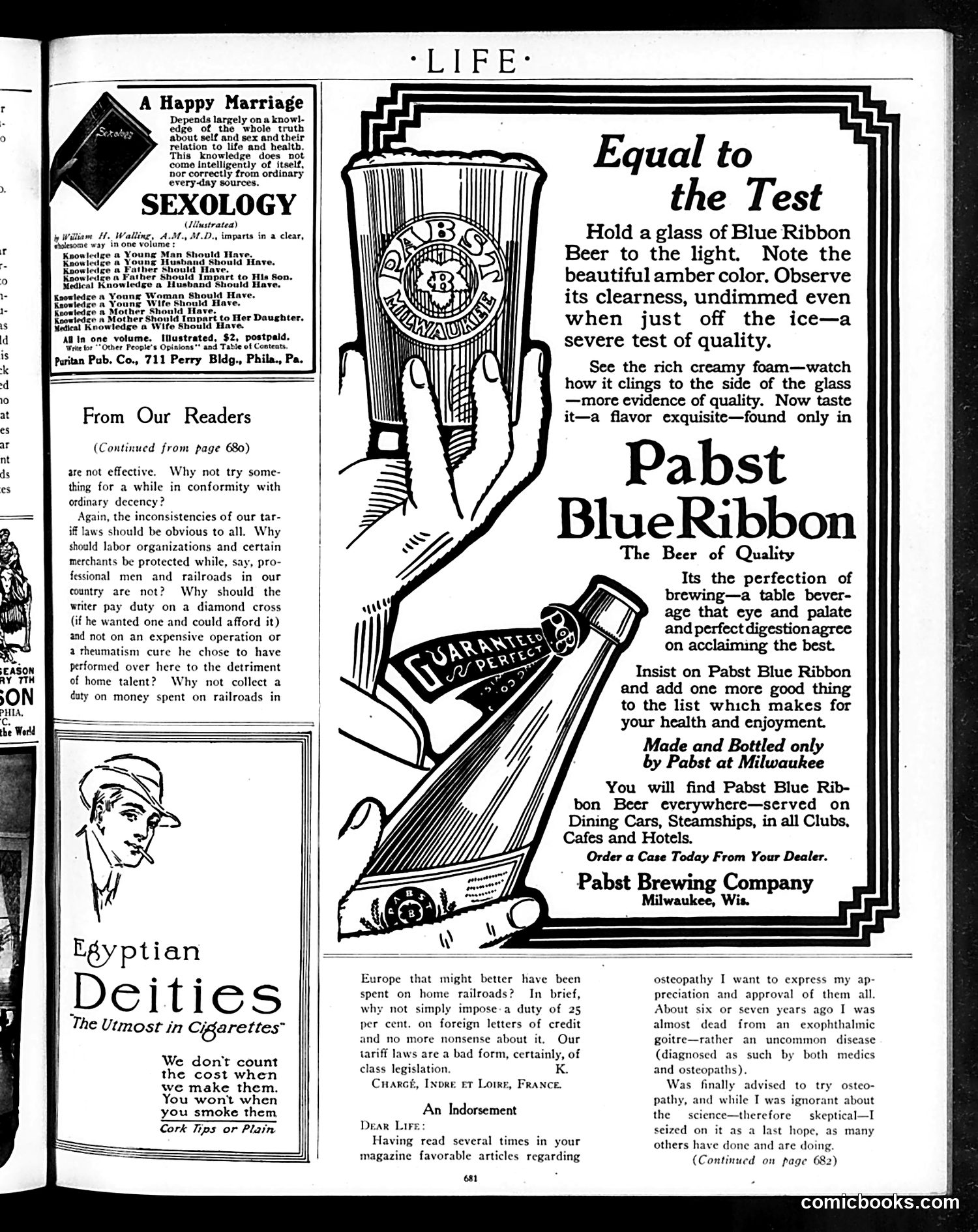
This page is primarily **advertising and reader correspondence**, not satirical content. The main advertisement promotes **Pabst Blue Ribbon Beer**, using pseudo-scientific language about quality testing (color, foam, taste) to market beer as a refined beverage suitable for "health and enjoyment"—reflecting pre-Prohibition era advertising that often made health claims for alcohol. The left column contains two unrelated items: a book advertisement for *Sexology* (educational materials on marriage and reproduction) and reader letters debating tariff policy and endorsing osteopathy as medical treatment. A small cigarette ad for "Egyptian Deities" appears at bottom left. **For modern readers:** This reflects early-1900s America before strict advertising regulations, when beer and patent medicines made unsubstantiated health claims, and alternative medicine (osteopathy) competed with conventional medicine without FDA oversight.
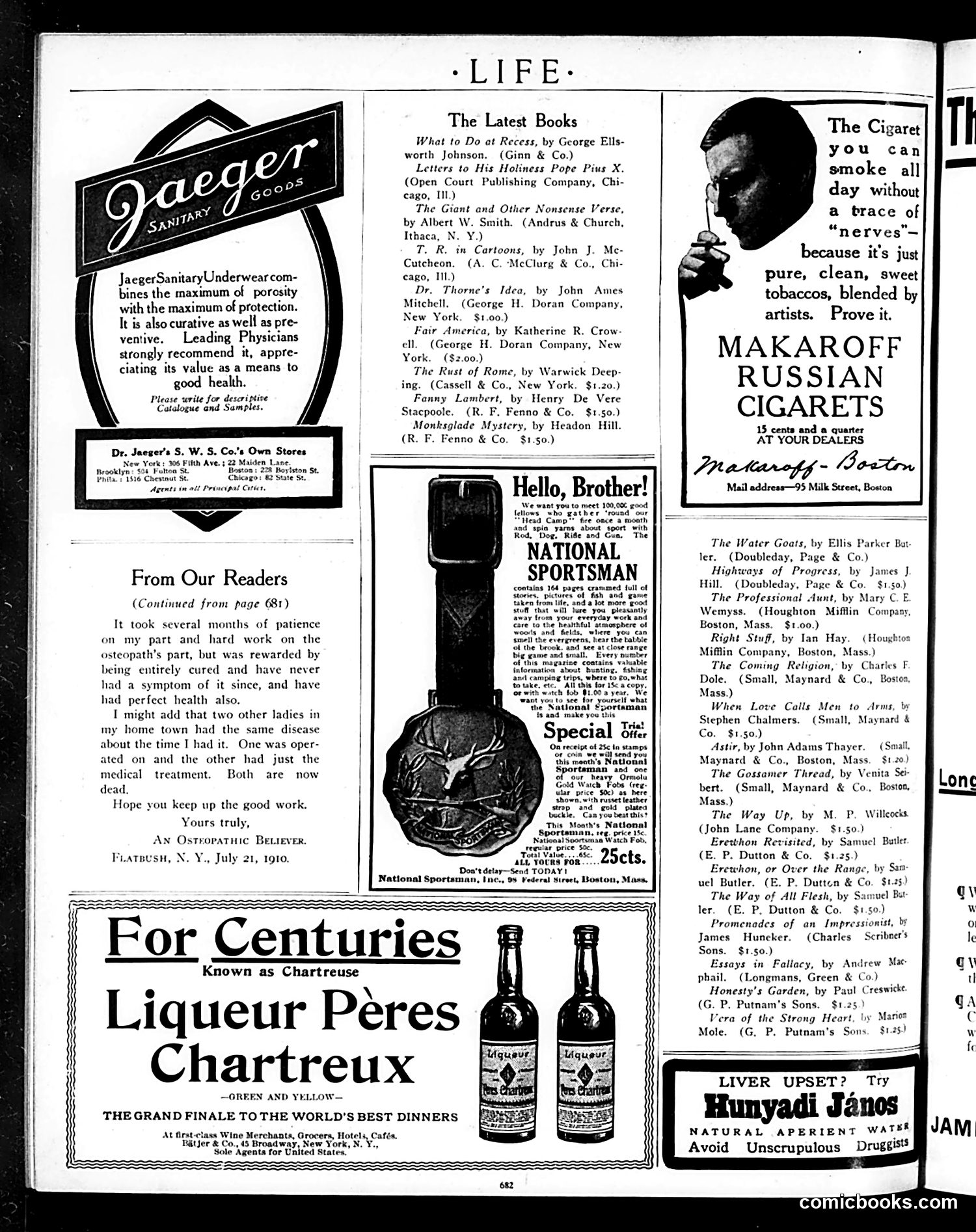
This is primarily an **advertising-heavy page** from Life magazine, not a satirical cartoon page. The content consists mostly of product advertisements and a book review section. **Notable elements:** - **Jaeger Sanitary Underwear** ad claims health benefits through porosity and "curative" properties—typical of early 1900s medical marketing that lacked FDA regulation - **National Sportsman** magazine ad emphasizes outdoors/hunting culture popular with American men - **Makaroff Russian Cigarettes** boasts smokability without "nerves"—pre-Surgeon General warning era when cigarettes were openly marketed as safe - **Chartreuse liqueur** positioned as fine dining luxury - **"From Our Readers"** section contains a testimonial from "An Osteopathic Believer" from July 21, 1910, praising osteopathy treatment The page reflects **early 20th-century consumer culture** with unregulated health claims and foreign luxury goods marketed to affluent Americans. No political satire is evident.
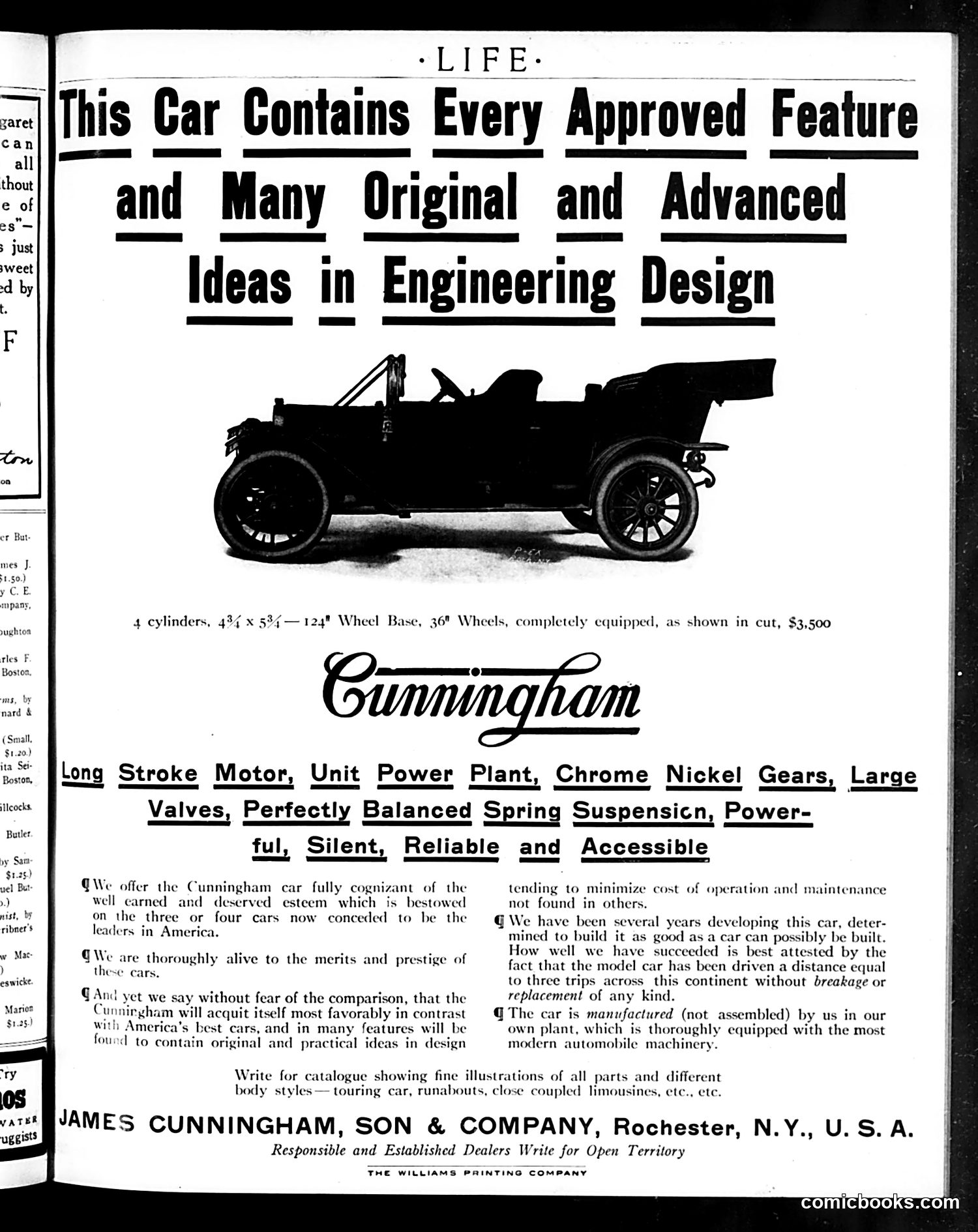
This is a vintage automobile advertisement, not a political cartoon. It appears from *Life* magazine (likely early 1900s based on the car's design) promoting the Cunningham automobile manufactured in Rochester, New York. The ad emphasizes the car's engineering credentials—highlighting features like its "long stroke motor," chrome nickel gears, and balanced suspension. The marketing pitch stresses quality and reliability: the company claims their car has been driven across the continent multiple times "without breakage or replacement of any kind," positioning it among America's top three or four automobiles. At $3,500 (a substantial sum for the era), this was a luxury vehicle. The ad targets established dealers and buyers seeking prestige engineering. There is no satire here—this is straightforward commercial promotion typical of early automotive advertising that emphasized mechanical superiority and American manufacturing pride.
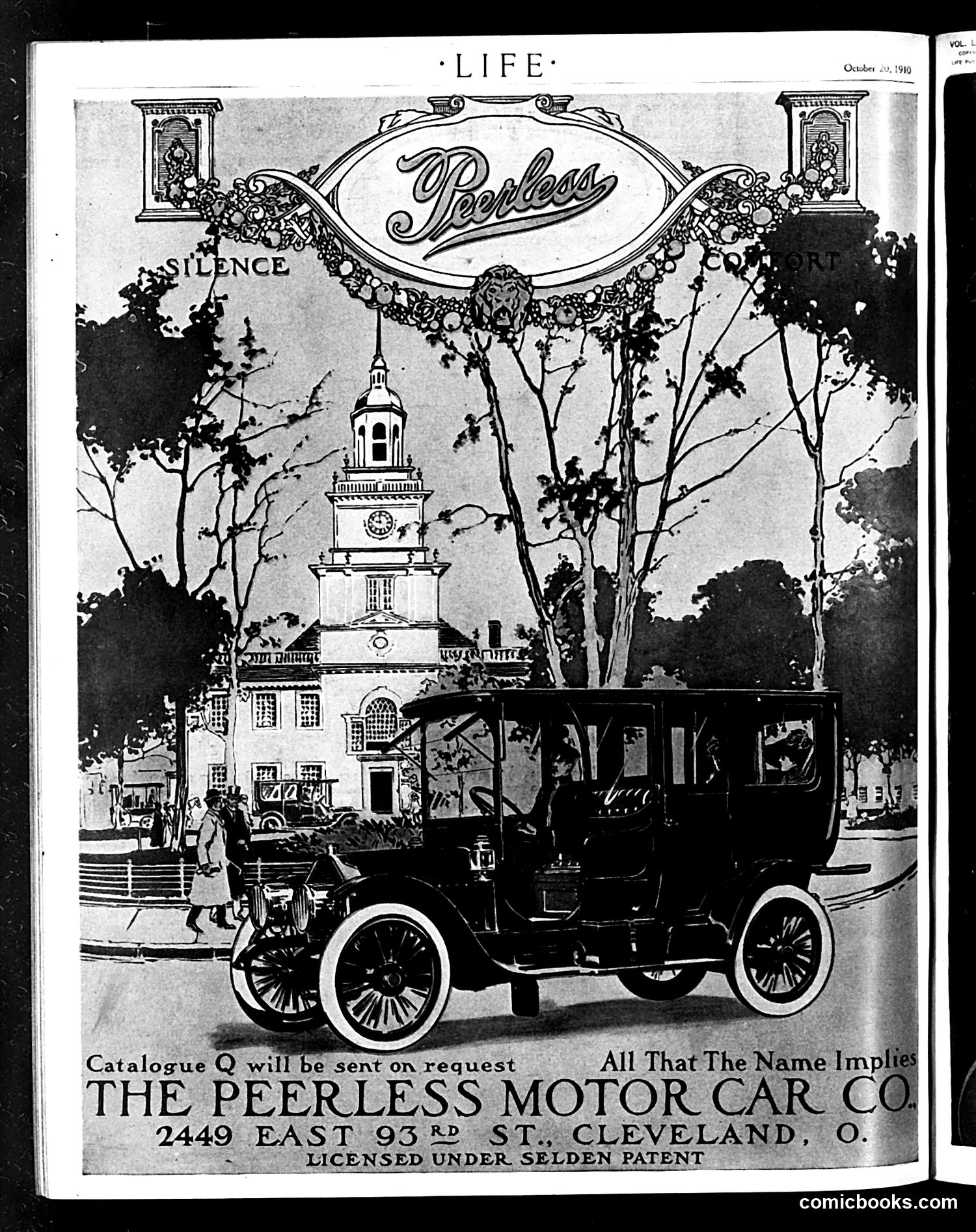
This is an advertisement for the Peerless Motor Car Company, not a political cartoon. The page features an illustration of an early automobile positioned in front of a classical church or civic building with a clock tower, framed by decorative flourishes reading "Peerless" at the top. The ad emphasizes luxury and respectability by placing the vehicle in an idealized American town setting. The text promises "Catalogue Q" and uses the slogan "All That The Name Implies," marketing the automobile as a premium product. The reference to "Licensed Under Selden Patent" indicates this was during patent disputes over automotive technology—the Selden Patent covered fundamental auto-manufacturing processes. The composition suggests affluence and civic pride, appealing to wealthy potential customers.