
Life, 1910-10-20 · page 21 of 44
Life — October 20, 1910 — page 21: what you’re looking at
What you’re looking at
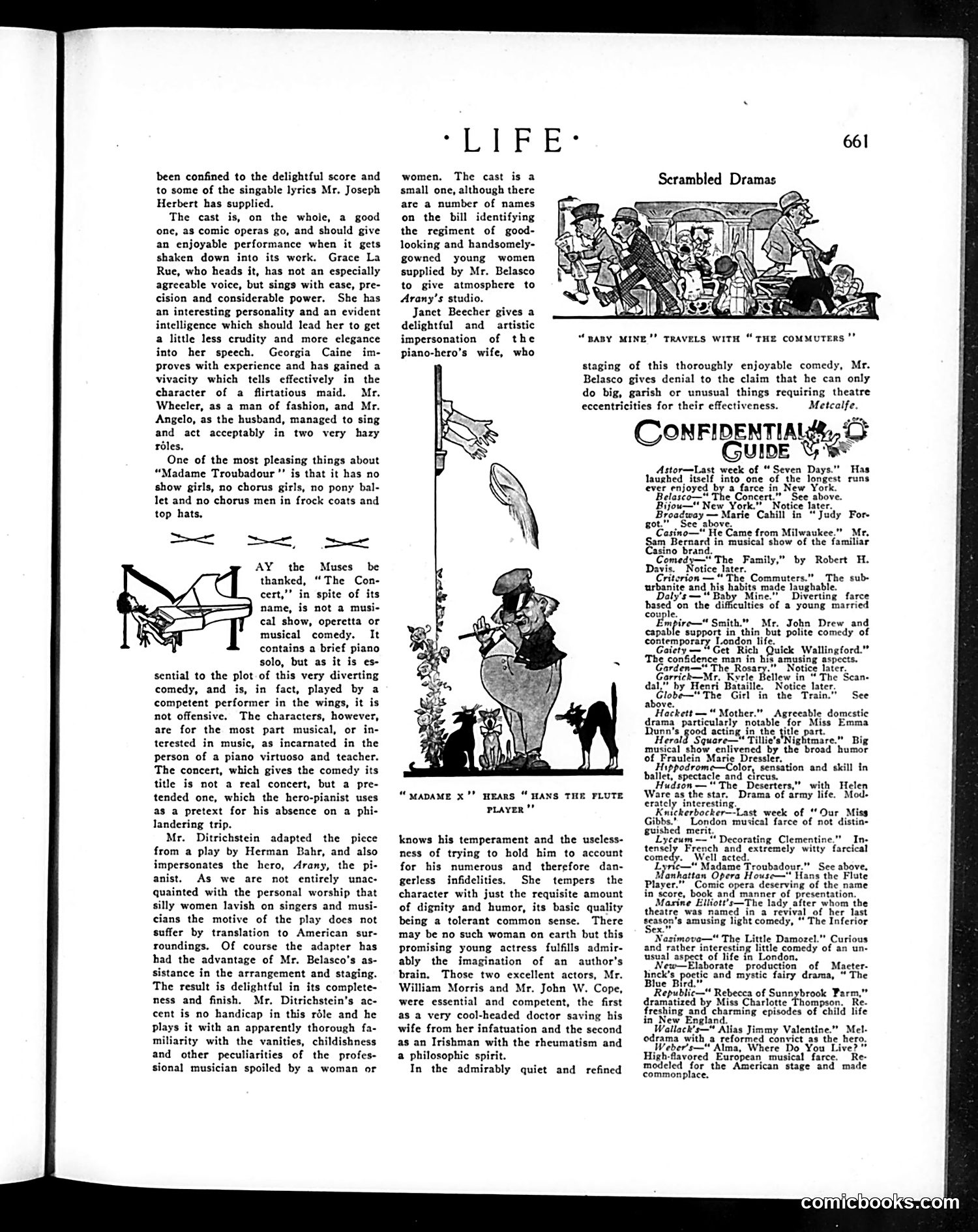
This page contains theatre reviews, not political cartoons. The content discusses several Broadway productions from the early 20th century. The main reviews cover: 1. **"Madame Troubadour"** - A comic opera praised for avoiding typical show-girl spectacle, featuring Grace La Rue and noting performances by Wheeler and Angelo. 2. **"The Concert"** - A comedy adapted by Mr. Ditrichstein (who also stars) from a Herman Bahr play, about a pianist using a pretended concert as cover for philandering. The review praises David Belasco's staging and Janet Beecher's performance as the pianist's tolerant wife. The illustrations show theatrical scenes and a figure labeled "Madame X Hears Hans the Flute Player" - likely depicting a scene from one of the reviewed productions. The tone is characteristic of early Life magazine: sophisticated theatre criticism dismissing sentimentality while celebrating wit and artistic merit. The "Confidential Guide" column lists current Broadway shows with brief notices.
📄 Transcribed text from this page (OCR, searchable)
Machine-transcribed from the original scan — historical spelling and the odd misread are preserved.
been confined to the delightful score and to some of the singable lyrics Mr. Joseph Herbert has supplied. The cast is, on the whole, a good one, as comic operas go, and should give an enjoyable performance when it gets shaken down into its work. Grace La Rue, who heads it, has not an especially agreeable voice, but sings with case, pre- cision and considerable power. She has an interesting personality and an evident intelligence which should lead her to get a little less crudity and more elegance into her speech. Georgia Caine im- proves with experience and has gained a vivacity which tells effectively in the character of a flirtatious maid. Mr. Wheeler, as a man of fashion, and Mr. Angelo, as the husband, managed to sing and act acceptably in two very hazy roles. One of the most pleasing things about “Madame Troubadour ’’ is that it has no show girls, no chorus girls, no pony bal- let and no chorus men in frock coats and top hats, >< Ul SSO SH — AY the Muses be thanked, “The Con- cert,”’ in spite of its name, is not a musi- cal show, operetta or musical comedy. It contains a brief piano solo, but as it is es- sential to the plot of this very diverting comedy, and is, in fact, played by a competent performer in the wings, it is not offensive. The characters, however, are for the most part musical, or in- terested in music, as incarnated in the person of a piano virtuoso and teacher. The concert, which gives the comedy its title is not a real concert, but a pre- tended one, which the hero-pianist uses as a pretext for his absence on a phi- landering trip. Mr. Ditrichstein adapted the piece from a play by Herman Bahr, and also impersonates the hero, Arany, the pi- anist. As we are not entirely unac- quainted with the personal worship that silly women lavish on singers and musi- cians the motive of the play does not suffer by translation to American sur- roundings. Of course the adapter has had the advantage of Mr. Belasco’s as- sistance in the arrangement and staging. The result is delightful in its complete- ness and finish. Mr. Ditrichstein’s ac- cent is no handicap in this réle and he plays it with an apparently thorough fa- miliarity with the vanities, childishness and other peculiarities of the profes- sional musician spoiled by a woman or LIFE women. The cast is a small one, although there are a number of names on the bill identifying the regiment of good- looking and handsomely- gowned young women supplied by Mr. Belasco to give atmosphere to Arany’s studio. Janet Beecher gives a delightful and artistic impersonation of the piano-hero’s wife, who “BABY MINE’ TRAVELS WITH Scrambled Dramas wo NE “THE COMMUTERS" staging of this thoroughly enjoyable comedy, Mr. Belasco gives denial to the claim that he can only do big, garish or unusual things requiring theatre eccentricities for their effectiveness. HEARS “ HANS THE FLUTE PLAYER"? “ MADAME xX"? knows his temperament and the useless- ness of trying to hold him to account for his numerous and therefore dan- gerless infidelities. She character with just the requi: of dignity and humor, its basic quality being a tolerant common sense. There may be no such woman on earth but this promising young actress fulfills admir- ably the imagination of an author's brain. Those two excellent actors, Mr. William Morris and Mr. John W. Cope, were essential and competent, the first as a very cool-headed doctor saving his wife from her infatuation and the second as an Irishman with the rheumatism and a philosophic spirit. In the admirably quiet and refined Metcalfe. Astor—Last week of “ Seven Days.” Has laughed itself into one of the longest runs ever fre" Thee a o— farce in New York. Concert,”* poe shove Bijou—" New ork.” e lat Broadway Marie Cahill in "Judy Fore got.” See above. Casino—" He Came from Milwaukee.” Sam Bernard in musical show of the familiar Casino brand. nedy—" The Family,” by Robert H. The sub Notice later. ‘ritorion — “ The Commuters.” wane ‘and his habits made laughable. Daly's —“* Baby Mine." Diverting farce based on the culties of a young married cou Eniret Smith.” Mr. John Drew and capable support in thin but polite comedy of contemporary London life. Gaiety — Get Rich Quick Wallingford.” The confiden e Seg) fa hi Garden: N neko Mr Kee dal," by Heart Bataille, | Notice. later, jlobe—*The Girl in the Train.” Tackett —“ Mother.” Agreeable domestic drama particularly notable for Miss Emma Dupn’s good acting in the title pa Herald Square" Tillie Nightenare.” Big musical show enlivened by the broad humor of Fraulein Marie Dressler. Hippodrome—Color, sensation and skill in ballet, spectacle and circus. Hudson —“The Deserters,” with Helen Ware as the star. Drama of army life. Mod- eratcly interesting. Knickerbocker—-Last week of ‘Our Miss Gibbs." London musical farce of not distin« guished merit Lyceum — * Decorating Clementine” In. sped French and, extremely witty farcical comedy. Well acted Lyric" Madame Troubadour.” See above. Manhattan Opera House—" Hans the Flute Player.” Comic opera deserving of the name in book and manner of presentation. Marine Eliott's—The lady after whom the theatre was named in a revival of her last season's amusing light comedy, “ The Inferior Se: Nazimove— The Little Damozel.” Curious and rather interesting little comedy of an un- usual aspect of life in London, New—Elaborate production of Macter- linck’s poetic and mystic fairy drama, “The Blue Bird. Republic" Rebeces of Sunnybrook Parm, gramatized by Miss Charlotte Thompson, Re- freshing and charming episodes of child life in New England. Wallack's—" Alias Jimmy Valentine.” Mel- odrama with a reformed convict as the hero, Yeber’s—" Alma, Where Do You Live?" Highlavored European musical farce. | Re- jodeled for the American stage and made commonplace. Belase« al