
Life, 1910-10-20 · page 17 of 44
Life — October 20, 1910 — page 17: what you’re looking at
What you’re looking at
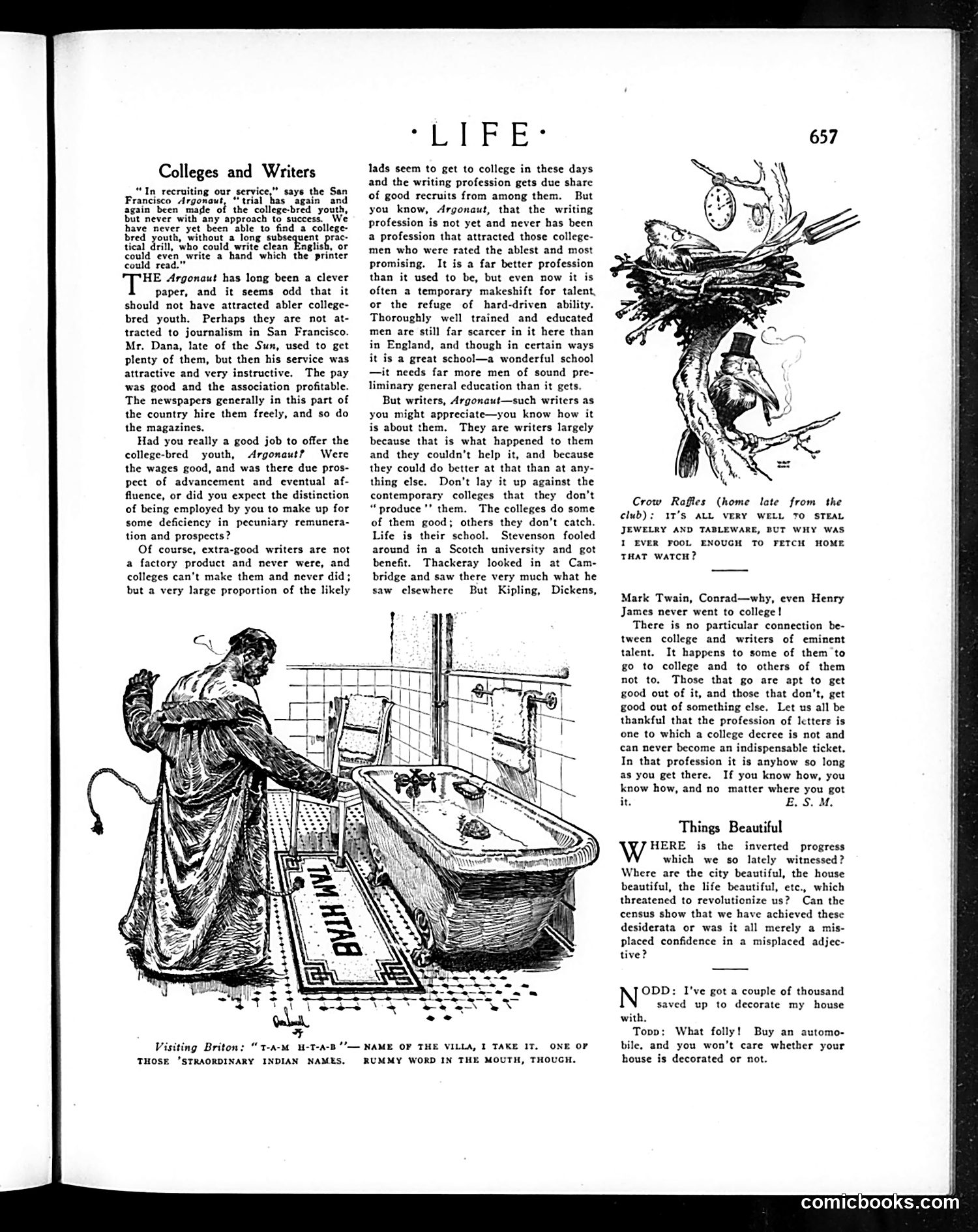
This page contains two distinct pieces of satire: **"Colleges and Writers"** (main article): Life responds to the San Francisco *Argonaut* newspaper's complaint that college-educated recruits can't write well. Life argues the *Argonaut* simply didn't offer competitive wages or advancement—good papers like the *Sun* attracted capable college graduates. More importantly, Life contends that innate writing talent cannot be "produced" by colleges; great writers (Kipling, Dickens, Mark Twain, Conrad, Henry James) often skipped college entirely. The piece defends higher education while insisting that exceptional writing ability develops through life experience, not degrees. **Bottom cartoon**: A visiting British tourist compliments an Indian villa's "extraordinary" name, which he phonetically renders as "1-a-M M-T-A-B." The joke mocks British tourists' tendency to marvel at and mispronounce foreign place names, treating unfamiliar words as exotic curiosities while fundamentally misunderstanding them.
📄 Transcribed text from this page (OCR, searchable)
Machine-transcribed from the original scan — historical spelling and the odd misread are preserved.
Colleges and Writers “In recruiting our service,” says the San Francisco Argonaut, “ trial again. and again been made of the college-bred youth, but never with any approach to success. We have never yet been able to find a college- bred youth, without a long subsequent prac- tical drill, who could write clean English, or could even write a hand which the printer could read.” HE Argonaut has long been a clever paper, and it seems odd that it should not have attracted abler college- bred youth. Perhaps they are not at- tracted to journalism in San Francisco. Mr. Dana, late of the Sun, used to get plenty of them, but then his service was attractive and very instructive. The pay was good and the association profitable. The newspapers generally in this part of the country hire them freely, and so do the magazines. Had you really a good job to offer the college-bred youth, Argonaut? Were the wages good, and was there due pros- pect of advancement and eventual af- fluence, or did you expect the distinction of being employed by you to make up for some deficiency in pecuniary remunera- tion and prospects? Of course, extra-good writers are not a factory product and never were, and colleges can’t make them and never did; but a very large proportion of the likely Visiting Briton: “1-a-M M-T-A-B’’— NAME OF THE VILLA, I TAKE 17. THOSE 'STRAORDINARY INDIAN NAMES. ‘LIFE? lads seem to get to college in these days and the writing profession gets due share of good recruits from among them. But you know, Argonaut, that the writing profession is not yet and never has been a profession that attracted those college- men who were rated the ablest and most promising. It is a far better profession than it used to be, but even now it is often a temporary makeshift for talent, or the refuge of hard-driven ability. Thoroughly well trained and educated men are still far scarcer in it here than in England, and though in certain ways it is a great school—a wonderful school it needs far more men of sound pre- liminary general education than it gets, But writers, Argonaut—such writers as you might appreciate—you know how it is about them. They are writers largely because that is what happened to them and they couldn’t help it, and because they could do better at that than at any- thing else. Don’t lay it up against the contemporary colleges that they don’t “produce "’ them. The colleges do some of them good; others they don’t catch. Life is their school. Stevenson fooled around in a Scotch university and got benefit. Thackeray looked in at Cam- bridge and saw there very much what he saw elsewhere But Kipling, Dickens, ONE OF RUMMY WORD IN THE MOUTH, THOUGH. Crow Rafies (home late from the club): 17S ALL VERY WELL 70 STEAL JEWELRY AND TABLEWARE, BUT WHY WAS 1 EVER FOOL ENOUGH TO FETCH HOME THAT WATCH? Mark Twain, Conrad—why, even Henry James never went to college! There is no particular connection be- tween college and writers of eminent talent. It happens to some of them to go to college and to others of them not to. Those that go are apt to get good out of it, and those that don’t, get good out of something else. Let us all be thankful that the profession of letters is one to which a college decree is not and can never become an indispensable ticket. In that profession it is anyhow so long as you get there. If you know how, you know how, and no matter where you got it. ELS. M. Things Beautiful HERE is the inverted progress which we so lately witnessed? Where are the city beautiful, the house beautiful, the life beautiful, ete., which threatened to revolutionize us? Can the census show that we have achieved these desiderata or was it all merely a mis- placed confidence in a misplaced adjec- tive? ODD: I've got a couple of thousand saved up to decorate my house with, Topp: What folly! Buy an automo- bile, and you won’t care whether your house is decorated or not. comicbooks.com