
Life, 1910-10-20 · page 24 of 44
Life — October 20, 1910 — page 24: what you’re looking at
What you’re looking at
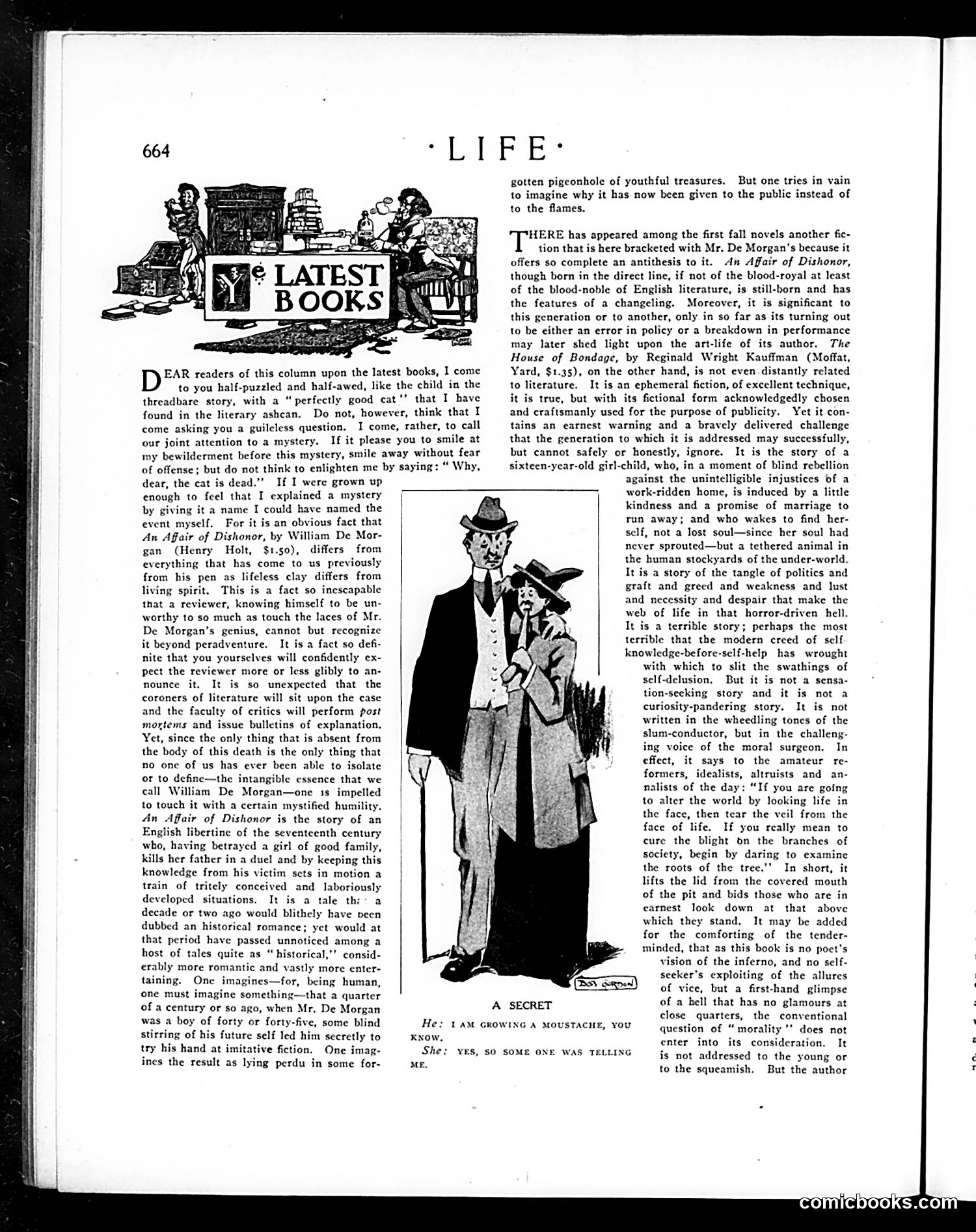
This page contains a book review column titled "The Latest Books," discussing recent fall novels. The reviewer analyzes two contrasting works: William De Morgan's *An Affair of Dishonor* and Reginald Wright Kauffman's *The House of Bondage*. The accompanying illustration labeled "A Secret" depicts two men in conversation—one older and mustached, one younger—with dialogue below: "He: I am growing a moustache, you know. / She: Yes, so some one was telling me." This is a humorous non-sequitur joke playing on misheard or miscommunicated gossip. The humor relies on the absurdity of casual social chitchat being reported as notable news. The review itself critiques De Morgan's novel as surprisingly lifeless compared to his earlier work, while defending Kauffman's *House of Bondage* as socially important despite its commercial motivation—it addresses serious social injustices facing young women.
📄 Transcribed text from this page (OCR, searchable)
Machine-transcribed from the original scan — historical spelling and the odd misread are preserved.
EAR readers of this column upon the latest books, I come to you half-puzzled and half-awed, like the child in the threadbare story, with a “perfectly good cat’ that I have found in the literary ashcan. Do not, however, think that I come asking you a guileless question. I come, rather, to call our joint attention to a mystery. If it please you to smile at my bewilderment before this mystery, smile away without fear of offense; but do not think to enlighten me by saying: “ Why, dear, the cat is dead.” If I were grown up PE * gotten pigeonhole of youthful treasures. But one tries in vain to imagine why it has now been given to the public instead of to the flames, HERE has appeared among the first fall novels another fic- tion that is here bracketed with Mr. De Morgan’s because it offers so complete an antithesis to it. An Affair of Dishonor, though born in the direct line, if not of the blood-royal at least of the blood-noble of English literature, is still-born and has the features of a changeling. Moreover, it is significant to this generation or to another, only in so far as its turning out to be either an error in policy or a breakdown in performance may later shed light upon the art-life of its author. The House of Bondage, by Reginald Wright Kauffman (Moffat, Yard, $1.35), on the other hand, is not even distantly related to literature. It is an ephemeral fiction, of excellent technique, it is true, but with its fictional form acknowledgedly chosen and craftsmanly used for the purpose of publicity. Yet it con- tains an earnest warning and a bravely delivered challenge that the generation to which it is addressed may successfully, but cannot safely or honestly, ignore. It is the story of a sixteen-year-old girl-child, who, in a moment of blind rebellion against the unintelligible injustices of a enough to feel that I explained a mystery by giving it a name I could have named the event myself. For it is an obvious fact that An Afair of Dishonor, by William De Mor- gan (Henry Holt, $1.50), differs from everything that has come to us previously from his pen as lifeless clay differs from living spirit. This is a fact so inescapable that a reviewer, knowing himself to be un- worthy to so much as touch the laces of Mr. De Morgan’s genius, cannot but recognize it beyond peradventure. It is a fact so defi- nite that you yourselves will confidently ex- pect the reviewer more or less glibly to an- nounce it. It is so unexpected that the coroners of literature will sit upon the case and the faculty of critics will perform post mortems and issue bulletins of explanation. Yet, since the only thing that is absent from the body of this death is the only thing that no one of us has ever been able to isolate or to define—the intangible essence that we call William De Morgan—one 18 impelled to touch it with a certain mystified humility. An Affair of Dishonor is the story of an English libertine of the seventeenth century who, having betrayed a girl of good famil. kills her father in a duel and by keeping this knowledge from his victim sets in motion a train of tritely conceived and laboriously developed situations. It is a tale thr: a decade or two ago would blithely have pcen dubbed an historical romance; yet would at that period have passed unnoticed among a host of tales quite as “historical,’’ consid- erably more romantic and vastly more enter- taining. One imagines—for, being human, one must imagine something—that a quarter of a century or so ago, when Mr. De Morgan was a boy of forty or forty-five, some blind stirring of his future self led him secretly to try his hand at imitative fiction. One imag- ines the result as lying perdu in some for- He: Know, She: ME. TAM GROWING A MOUSTACHE, YoU YES, SO SOME ONE work-ridden home, is induced by a little kindness and a promise of marriage to run away; and who wakes to find her- self, not a lost soul—since her soul had never sprouted—but a tethered animal in the human stockyards of the under-world. It is a story of the tangle of politics and graft and greed and weakness and lust and necessity and despair that make the web of life in that horror-driven hell. It is a terrible story; perhaps the most terrible that the modern creed of self knowledge-before-self-help has wrought with which to slit the swathings of self-delusion. But it is not a sensa- tion-seeking story and it is not a curiosity-pandering story. It is not written in the wheedling tones of the slum-conductor, but in the challeng- ing voice of the moral surgeon. In effect, it says to the amateur re- formers, idealists, altruists and an- nalists of the day: “If you are going to alter the world by looking life in the face, then tear the veil from the face of life. If you really mean to cure the blight on the branches of society, begin by daring to examine the roots of the tree.’’ In short, it lifts the lid from the covered mouth of the pit and bids those who are in earnest look down at that above which they stand. It may be added for the comforting of the tender- minded, that as this book is no poet's vision of the inferno, and no self- seeker’s exploiting of the allures of vice, but a first-hand glimpse of a bell that has no glamours at close quarters, the conventional question of “ morality ’’ does not enter into its consideration. It is not addressed to the young or to the squeamish. But the author A SECRET WAS TELLING