
Life, 1910-10-20 · page 11 of 44
Life — October 20, 1910 — page 11: what you’re looking at
What you’re looking at
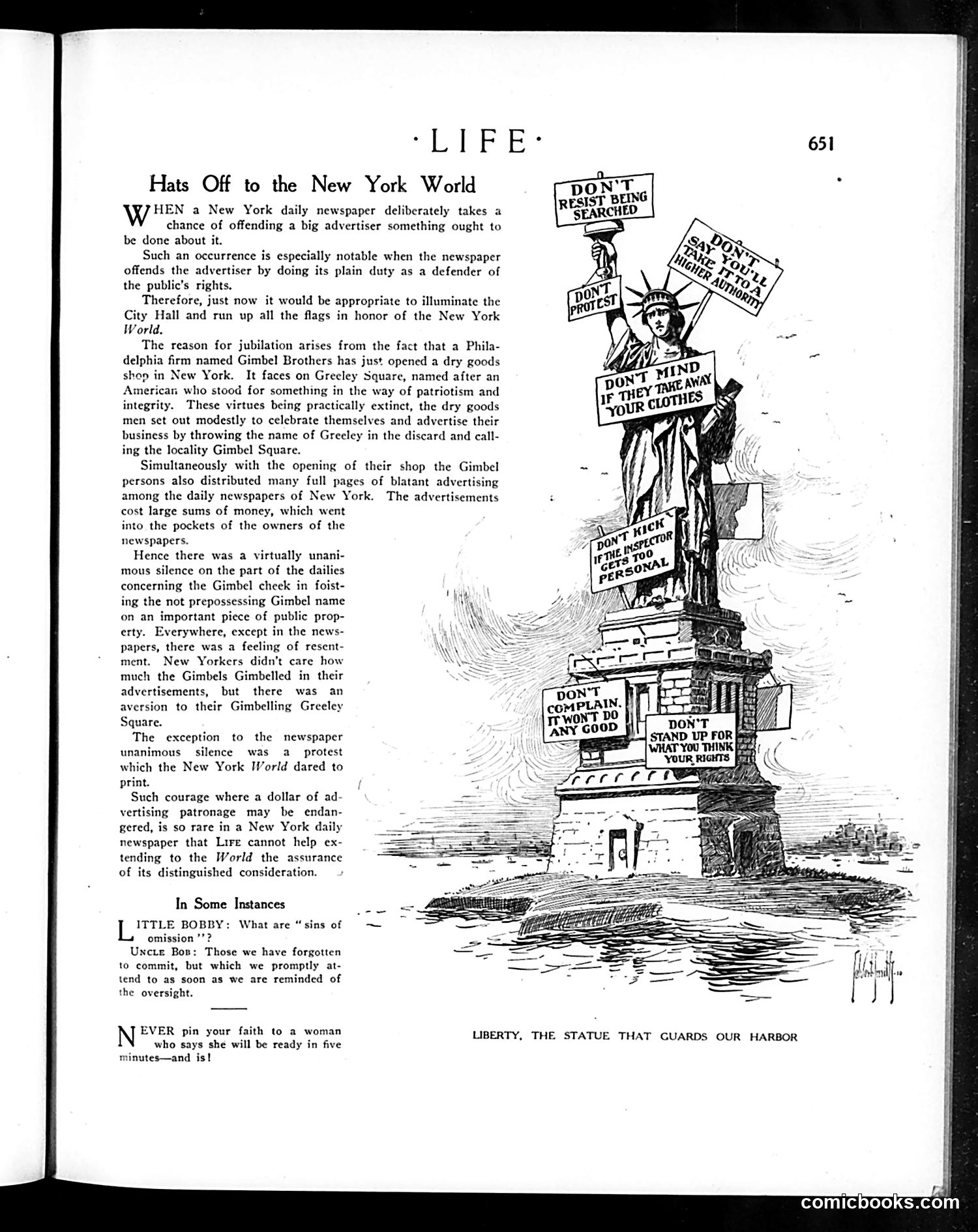
This page satirizes the New York *World* newspaper's principled stance against the Gimbel Brothers department store. The *World* refused to run the Gimbels' advertisements after they renamed Greeley Square to "Gimbel Square" without permission—an affront to public property and the memory of Horace Greeley. The cartoon depicts the Statue of Liberty covered with protest signs ("Don't Resist Being Searched," "Don't Mind if They Take Your Advertising," etc.), sarcastically suggesting the *World* has compromised American values by advertising despite their principles. The satire criticizes how financial incentives ("a dollar of advertising patronage") can undermine editorial integrity and free speech protections—core democratic ideals Liberty symbolizes.
📄 Transcribed text from this page (OCR, searchable)
Machine-transcribed from the original scan — historical spelling and the odd misread are preserved.
“LIFE: Hats Off to the New York World HEN a New York daily newspaper deliberately takes a chance of offending a big advertiser something ought to be done about it. Such an occurrence is especially notable when the newspaper offends the advertiser by doing its plain duty as a defender of the public’s rights. Therefore, just now it would be appropriate to illuminate the City Hall and run up all the flags in honor of the New York World. The reason for jubilation arises from the fact that a Phila- delphia firm named Gimbel Brothers has just opened a dry goods shop in New York. It faces on Greeley Square, named after an American who stood for something in the way of patriotism and integrity. These virtues being practically extinct, the dry goods men set out modestly to celebrate themselves and advertise their business by throwing the name of Greeley in the discard and call- ing the locality Gimbel Square. Simultaneously with the opening of their shop the Gimbel persons also distributed many full pages of blatant advertising among the daily newspapers of New York. The advertisements cost large sums of money, which went into the pockets of the owners of the newspapers. Hence there was a virtually unai mous silence on the part of the dailies concerning the Gimbel cheek in foist- ing the not prepossessing Gimbel name on an important piece of public prop- erty. Everywhere, except in the news- papers, there was a feeling of resent- ment. New Yorkers didn’t care how much the Gimbels Gimbelled in their advertisements, but there was an aversion to their Gimbelling Greeley Square. The exception to the newspaper unanimous silence was a_ protest which the New York World dared to print. Such courage where a dollar of ad vertising patronage may be endan- gered, is so rare in a New York daily newspaper that Lire cannot help ex- tending to the World the assurance of its distinguished consideration. In Some Instances ITTLE BOBBY: What are “sins of omission '’? Uxcre Bop: Those we have forgotten to commit, but which we promptly at- tend to as soon as we are reminded of the oversight. NEVER pin your faith to a woman LIBERTY, THE STATUE THAT GUARDS OUR HARBOR who says she will be ready in five minutes—and is! ‘ L comicbooks.com