
Life, 1910-10-20 · page 28 of 44
Life — October 20, 1910 — page 28: what you’re looking at
What you’re looking at
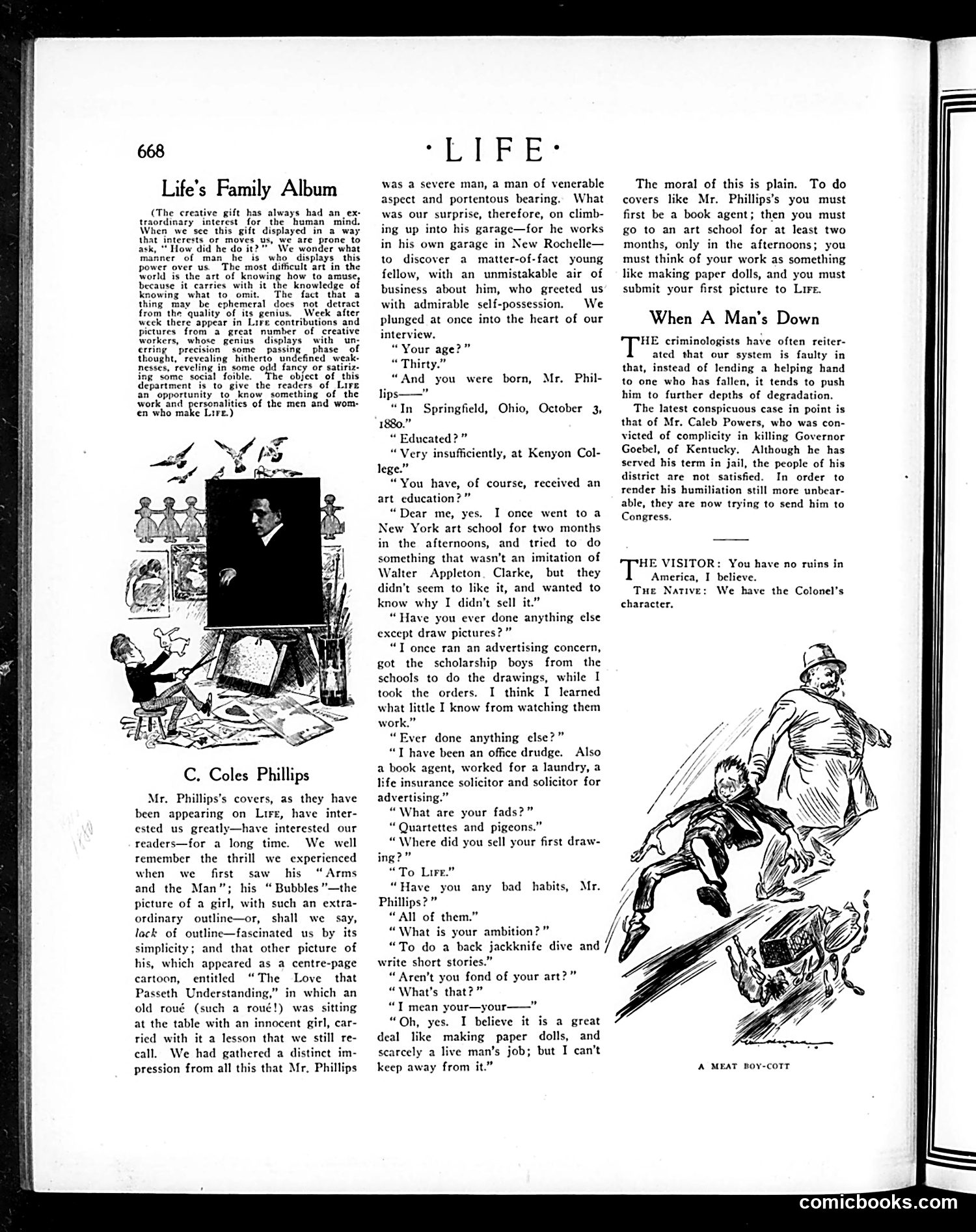
This page profiles illustrator C. Coles Phillips through an interview format. Phillips was Life's celebrated cover artist known for distinctive, minimalist line work and sophisticated compositions. The text reveals the magazine's surprise that this "severe man" of "venerable aspect" was actually a casual thirty-year-old from Ohio with minimal formal art training. The humor lies in the contrast between Phillips's refined artistic output and his mundane résumé—advertising work, office drudgery, laundry jobs, insurance soliciting. His dismissive attitude toward his own art ("like making paper dolls...scarcely a live man's job") yet compulsive need to create satirizes artistic pretension while celebrating raw talent over credentials. The right-side cartoon "A Meat Boy-Cott" appears unrelated—likely satirizing consumer boycotts of the era.
📄 Transcribed text from this page (OCR, searchable)
Machine-transcribed from the original scan — historical spelling and the odd misread are preserved.
668 Life’s Family Album (The creative gift has always had an ex- traordinary interest for the human mind. When we see this gift displayed in a way that interests or moves us, we are prone to ask, “‘ How did he do it?" We wonder what manner of man_he is who displays this power over us The most difficult art in the world is the art of knowing how to amuse, because it carries with it the knowledge of knowing what to omit. The fact that a thing may be ephemeral docs not detract from the quality of its genius. Week after week there appear in Lire contributions and pictures from a great number of creative workers, whose genius displays with un- erring ‘precision some passing phase ol thought, revealing hitherto. undefined ke nesses, reveling in some ogd fancy or satiriz- ing some social foible. The object of this department is to give the readers of Lire an’ opportunity to know something of the work and personalities of the men and wom- en who make Lire.) C. Coles Phillips Mr. Phillips's covers, as they have been appearing on Lire, have inter- ested us greatly—have interested our readers—for a long time. We well remember the thrill we experienced when we first. saw his “Arms and the Man”; his “ Bubbles "—the picture of a girl, with such an extra- ordinary outline—or, shall we say, lock of outline—fascinated us by its simplicity; and that other picture of his, which appeared as a centre-page cartoon, entitled “The Love that Passeth Understanding,” in which an old roué (such a roué!) was sitting at the table with an innocent girl, car- ried with it a lesson that we still re- call. We had gathered a distinct im- pression from all this that Mr. Phillips oD ee hd ely was a severe man, a man of venerable aspect and portentous bearing. What was our surprise, therefore, on climb- ing up into his garage—for he works in his own garage in New Rochelle— to discover a matter-of-fact young fellow, with an unmistakable air of business about him, who greeted us with admirable self-possession. We plunged at once into the heart of our interview. “Your age?” “Thirty.” “And you were born, lips——” Springfield, Ohio, October 3, Mr. Phil- “In 1880.” “ Educated?” “Very insufficiently, at Kenyon Col- lege.” You have, of course, received an art education?” “Dear me, yes. I once went to a New York art school for two months in the afternoons, and tried to do something that wasn’t an imitation of Walter Appleton. Clarke, but they didn’t seem to like it, and wanted to know why I didn’t sell it.” “Have you ever done anything clse except draw pictures?” “T once ran an advertising concern, got the scholarship boys from the schools to do the drawings, while I took the orders. I think I learned what little I know from watching them work,” ver done anything else?” “T have been an office drudge. Also a book agent, worked for a laundry, a life insurance solicitor and solicitor for advertising.” “What are your fads?” “Quartettes and pigeons.” “Where did you sell your first draw- ing?” “To Lire.” “Have you Phillips?” “All of them.” “What is your ambition?” “To do a back jackknife dive and write short stories.” “Aren't you fond of your art?” “What's that?” “T mean your—your—’ “Oh, yes. I believe it is a great deal like making paper dolls, and scarcely a live man’s job; but I can’t keep away from it.” any bad habits, Mr. The moral of this is plain. To do covers like Mr. Phillips’s you must first be a book agent; then you must go to an art school for at least two months, only in the afternoons; you must think of your work as something like making paper dolls, and you must submit your first picture to Lire. When A Man’s Down HE criminologists have often reiter- ated that our system is faulty in that, instead of lending a helping hand to one who has fallen, it tends to push him to further depths of degradation. The latest conspicuous case in point is that of Mr. Caleb Powers, who was con- victed of complicity in killing Governor Goebel, of Kentucky, Although he has served his term in jail, the people of his district are not satisfied. In order to render his humiliation still more unbear- able, they are now trying to send him to Congress. HE VISITOR: You have no ruins in America, I believe. Tue Native: We have the Colonel's character. A MEAT BoY-COTT comicbooks.com