
Life, 1910-10-20 · page 20 of 44
Life — October 20, 1910 — page 20: what you’re looking at
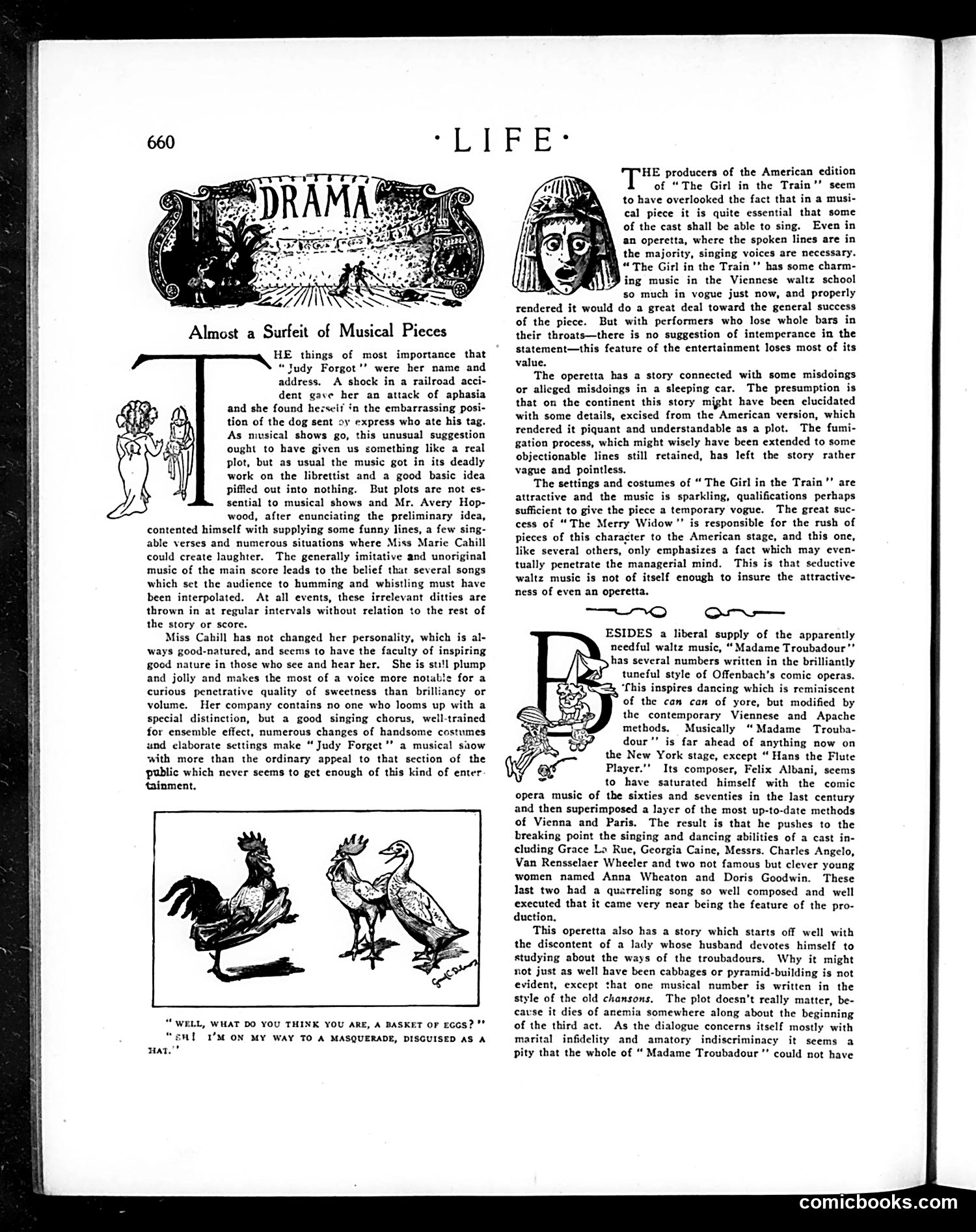
What you’re looking at
This page contains two theatrical reviews from Life magazine's "Drama" section, critiquing contemporary musical productions. **"Judy Forgot"** stars Marie Cahill in a show with a thin premise: a woman loses her memory in a railroad accident. The critic acknowledges the interesting setup but complains the plot dissolves into disconnected musical numbers. He praises Cahill's charm and comedic timing but notes the music appears to be interpolated songs with little relation to the story—a common practice in early 1900s musical theater where popular songs were inserted regardless of narrative fit. **"The Girl in the Train"** is criticized more harshly for poor casting: performers cannot sing properly despite the operetta requiring vocal talent. The critic notes the original Continental version likely contained risqué sleeping-car plot details removed for American audiences, leaving the story "vague and pointless." He attributes the show's existence to the enormous success of "The Merry Widow," suggesting producers chased that waltz-opera trend without understanding that seductive music alone cannot sustain a weak production.
📄 Transcribed text from this page (OCR, searchable)
Machine-transcribed from the original scan — historical spelling and the odd misread are preserved.
Almost a Surfeit of Musical Pieces HE things of most importance that “Tudy Forgot’? were her name and address. A shock in a railroad acci- dent gave her an attack of aphasia and she found hezseif in the embarrassing posi- tion of the dog sent oy express who ate his tag. As musical shows go, this unusual suggestion ought to have given us something like a real plot, but as usual the music got in its deadly work on the librettist and a good basic idea piffied out into nothing. But plots are not es- sential to musical shows and Mr. Avery Hop- wood, after enunciating the preliminary idea, contented himself with supplying some funny lines, a few sing- able verses and numerous situations where Miss Marie Cahill could create laughter. The generally imitative and unoriginal music of the main score leads to the belief that several songs which sct the audience to humming and whistling must have been interpolated. At all events, these irrelevant ditties are thrown in at regular intervals without relation to the rest of the story or score. Miss Cahill has not changed her personality, which is al- ways good-natured, and scems to have the faculty of inspiring good nature in those who see and hear her. She is stil plump and jolly and makes the most of a voice more notable for a curious penetrative quality of sweetness than brilliancy or volume. Her company contains no one who looms up with a special distinction, but a good singing chorus, well-trained for ensemble effect, numerous changes of handsome costumes und elaborate settings make “ Judy Forget '’ a musical saow with more than the ordinary appeal to that section of the public which never seems to get enough of this kind of enter tainment. “WELL, WHAT DO YOU THINK YOU ARE, A BASKET oF EGGS? "* “SML I’M ON MY WAY TO A MASQUERADE, DISGUISED AS A wat.” HE producers of the American edition of “The Girl in the Train’? seem to have overlooked the fact that in a musi- cal piece it is quite essential that some of the cast shall be able to sing. Even in an operetta, where the spoken lines are in the majority, singing voices are necessary. “The Girl in the Train '’ has some charm- ing music in the Viennese waltz school so much in vogue just now, and properly rendered it would do a great deal toward the general success of the piece. But with performers who lose whole bars in their throats—there is no suggestion of intemperance in the statement—this feature of the entertainment loses most of its value. The operetta has a story connected with some misdoings or alleged misdoings in a sleeping car. The presumption is that on the continent this story might have been clucidated with some details, excised from the American version, which rendered it piquant and understandable as a plot. The fumi- gation process, which might wisely have been extended to some objectionable lines still retained, has left the story rather vague and pointless. The settings and costumes of “ The Girl in the Train’ are attractive and the music is sparkling, qualifications perhaps sufficient to give the piece a temporary vogue. The great suc- cess of “The Merry Widow ’’ is responsible for the rush of pieces of this character to the American stage, and this one, like several others, only emphasizes a fact which may even- tually penetrate the managerial mind. This is that seductive waltz music is not of itself enough to insure the attractive- ness of even an operetta. ESIDES a liberal supply of the apparently needful waltz music, “Madame Troubadour"’ has several numbers written in the brilliantly tuneful style of Offenbach’s comic operas. x, ‘fhis inspires dancing which is reminiscent of the can can of yore, but modified by the contemporary Viennese and Apache methods, Musically “Madame Trouba- dour’ is far ahead of anything now on the New York stage, except “ Hans the Flute Player.” Its composer, Felix Albani, scems to have saturated himself with the comic opera music of the sixties and seventies in the last century and then superimposed a layer of the most up-to-date methods of Vienna and Paris. The result is that he pushes to the breaking point the singing and dancing abilities of a cast in- cluding Grace La Rue, Georgia Caine, Messrs. Charles Angelo, Van Rensselaer Wheeler and two not famous but clever young women named Anna Wheaton and Doris Goodwin. These last two had a quarreling song so well composed and well executed that it came very near being the feature of the pro- duction, This operetta also has a story which starts off well with the discontent of a lady whose husband devotes himself to studying about the ways of the troubadours. Why it might not just as well have been cabbages or pyramid-building is not evident, except that one musical number is written in the style of the old chansons, The plot doesn’t really matter, be- cause it dies of anemia somewhere along about the beginning of the third act. As the dialogue concerns itself mostly with marital infidelity and amatory indiscriminacy it seems a pity that the whole of “ Madame Troubadour" could not have comicbooks.com