
Life, 1910-10-20 · page 14 of 44
Life — October 20, 1910 — page 14: what you’re looking at
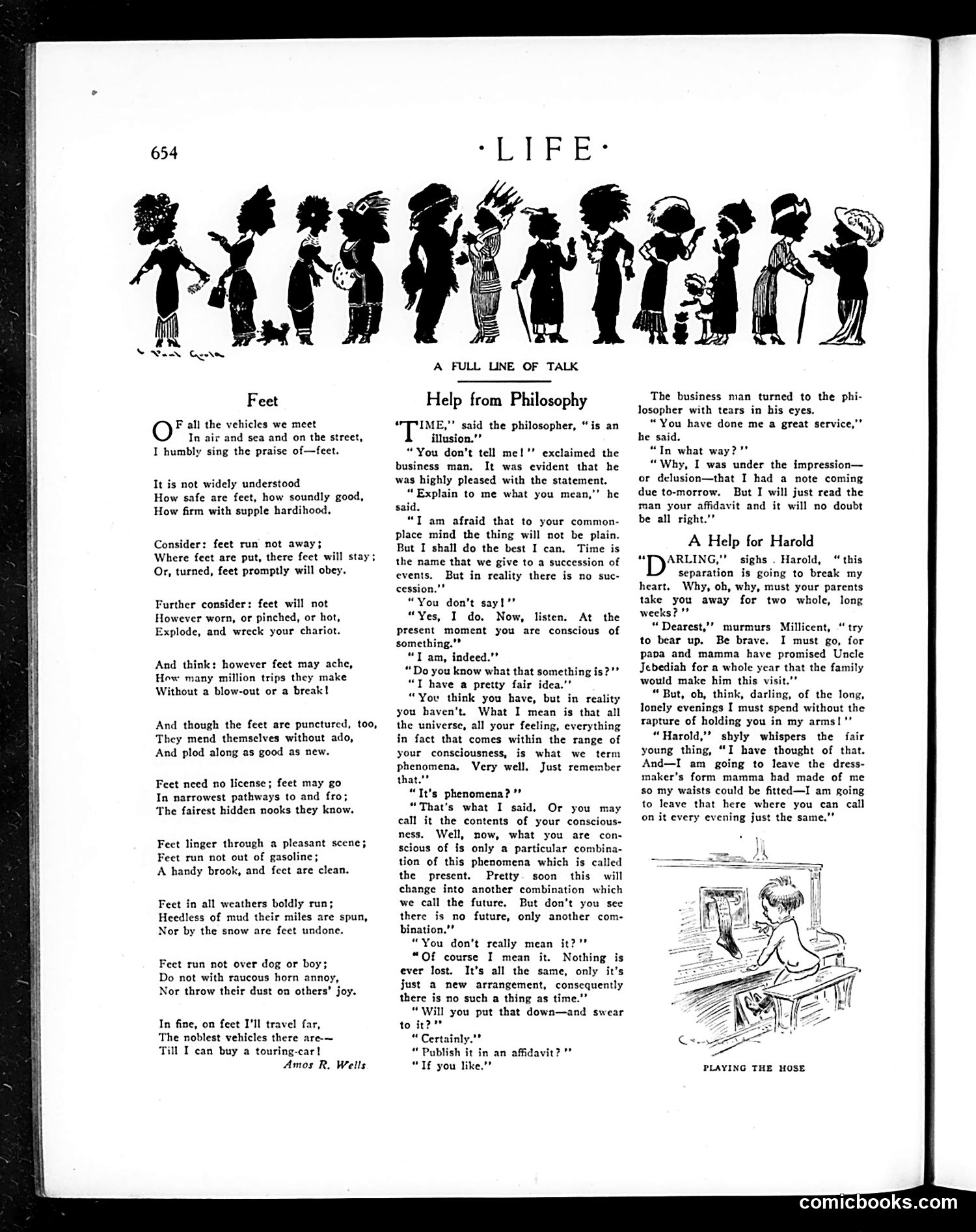
What you’re looking at
This Life magazine page contains three satirical pieces mocking contemporary attitudes: **"Feet"** (poem by Amos R. Wells): A humorous defense of walking over automobiles. The satire targets the era's car-culture obsession by praising feet as reliable, affordable, and practical—culminating in the joke that the speaker will walk "till I can buy a touring-car," mocking both pedestrians' envy of car owners and cars' unreliability (breakdowns, blow-outs). **"Help from Philosophy"**: Satirizes pseudo-intellectual philosophy and gullible businessmen. A philosopher uses elaborate jargon about "phenomena" and "illusion of time" to confuse a businessman, who then plans to use the philosopher's affidavit to dodge paying a debt. The joke mocks both pretentious philosophical talk and the businessman's desperation to exploit it. **"A Help for Harold"**: A brief romantic comedy where Harold laments his girlfriend Millicent leaving for two weeks, and she consoles him by promising... something (text cuts off). The satire targets melodramatic young love and sentimental separation anxieties.
📄 Transcribed text from this page (OCR, searchable)
Machine-transcribed from the original scan — historical spelling and the odd misread are preserved.
654 rt. SNe Conn Feet F all the vehicles we meet In air and sea and on the street, I humbly sing the praise of—feet. It is not widely understood How safe are feet, how soundly good, How firm with supple hardihood. Consider: feet run not away; Where feet are put, there feet will stay; Or, turned, feet promptly will obey. Further consider: feet will not However worn, or pinched, or hot, Explode, and wreck your chariot. And think: however feet may ache, How many million trips they make Without a blow-out or a break! And though the feet are punctured, too, They mend themselves without ado, And plod along as good as new. Feet need no license; feet may go In narrowest pathways to and fro; The fairest hidden nooks they know. Feet linger through a pleasant scene; Feet run not out of gasoline; A handy brook, and fect are clean, Feet in all weathers boldly run; Heedless of mud their miles are spun, Nor by the snow are feet undone. Feet run not over dog or boy; Do not with raucous horn annoy, Nor throw their dust on others’ joy. In fine, on feet I'll travel far, The noblest vehicles there are-~ Till I can buy a touring-car! Amos R, Wells A FULL LINE OF TALK Help from Philosophy “TIME,” said the philosopher, “is an illusion."* “You don’t tell me!’’ exclaimed the business man. It was evident that he was highly pleased with the statement. “Explain to me what you mean,’ he said. “Tam afraid that to your common- place mind the thing will not be plain. But I shall do the best I can. Time is the name that we give to a succession of events. But in reality there is no suc- cession,’” “You don’t say!’" “Yes, I do, Now, listen. At the Present moment you are conscious of something.”” “Tam, indeed.” “Do you know what that something is?’” “T have a pretty fair idea.” “You think you have, but in reality you haven't, What I mean is that all the universe, all your feeling, everything in fact that comes within the range of your consciousness, is what we term phenomena, Very well. Just remember that.” “It’s phenomena?” “That's what I said. Or you may call it the contents of your conscious- ness. Well, now, what you are con- scious of is only a particular combina- tion of this phenomena which is called the present. Pretty. soon this will change into another combination which we call the future. But don’t you see there is no future, only another com- Dination.’” “You don’t really mean it?’? “Of course I mean it. Nothing is ever lost. It’s all the same, only it’s just a new arrangement, consequently there is no such a thing as time.” “Will you put that down—and swear to it?” “ Certainly."” “ Publish it in an affidavit? '* “TE you like.” The business man turned to the phi- losopher with tears in his eyes. “You have done me a great service,’ he said. “In what way?’* “Why, I was under the impression— or delusion—that I had a note coming due to-morrow. But I will just read the man your affidavit and it will no doubt be all right.’” A Help for Harold i B ese sighs . Harold, “ this separation is going to break my heart. Why, ob, why, must your parents take you away for two whole, long weeks?” “ Dearest,’” murmurs Millicent, “try to bear up. Be brave. I must go, for papa and mamma have promised Uncle Jebediah for a whole year that the family would make him this visit.’" “ But, oh, think, darling, of the long, lonely evenings I must spend without the rapture of holding you in my arms! "’ “Harold,’’ shyly whispers the fair young thing, “I have thought of that. And—I am going to leave the dress- maker's form mamma had made of me so my waists could be fitted—I am going to leave that here where you can call on it every evening just the same.” PLAYING THE HOSE comicbooks.com