
A complete issue · 44 pages · 1910
Life — October 13, 1910
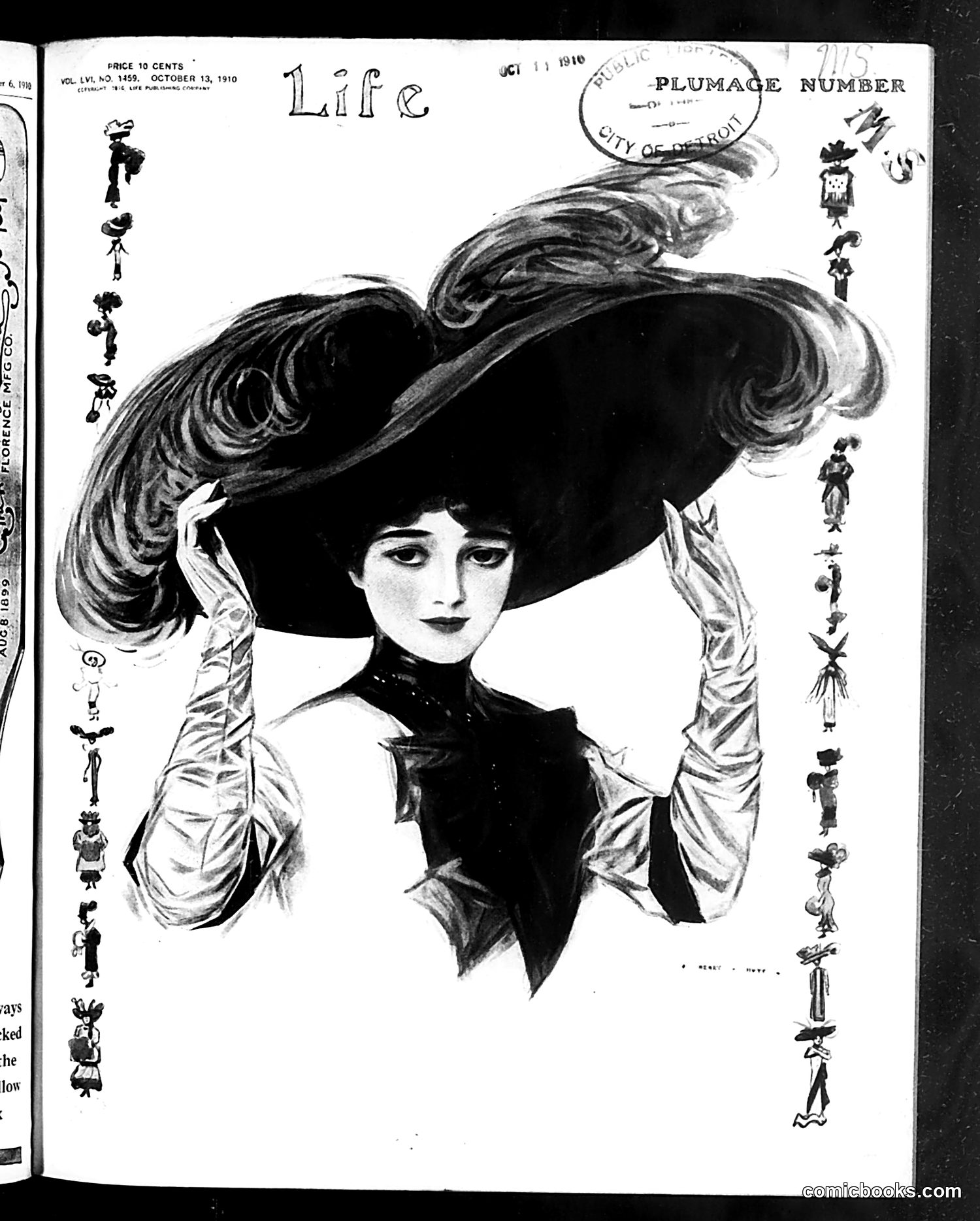
This is a **fashion illustration** rather than political satire. The cover features an elegant woman modeling the fashionable large, sweeping hat of the Edwardian era—characteristic of the 1910s "Gibson Girl" aesthetic. Her elaborate upswept hairstyle, long gloves, and high collar represent upper-class women's fashion of the period. The decorative border on the right appears to be **fashion-related illustrations**, likely showcasing various hat styles or women's accessories of the season. The "Plumage Number" stamp indicates this issue focused on **feathered hats and plumage fashion**—a major trend despite emerging conservation concerns about bird populations. The satire likely involves the extravagance and excess of fashionable hat designs rather than specific political commentary.
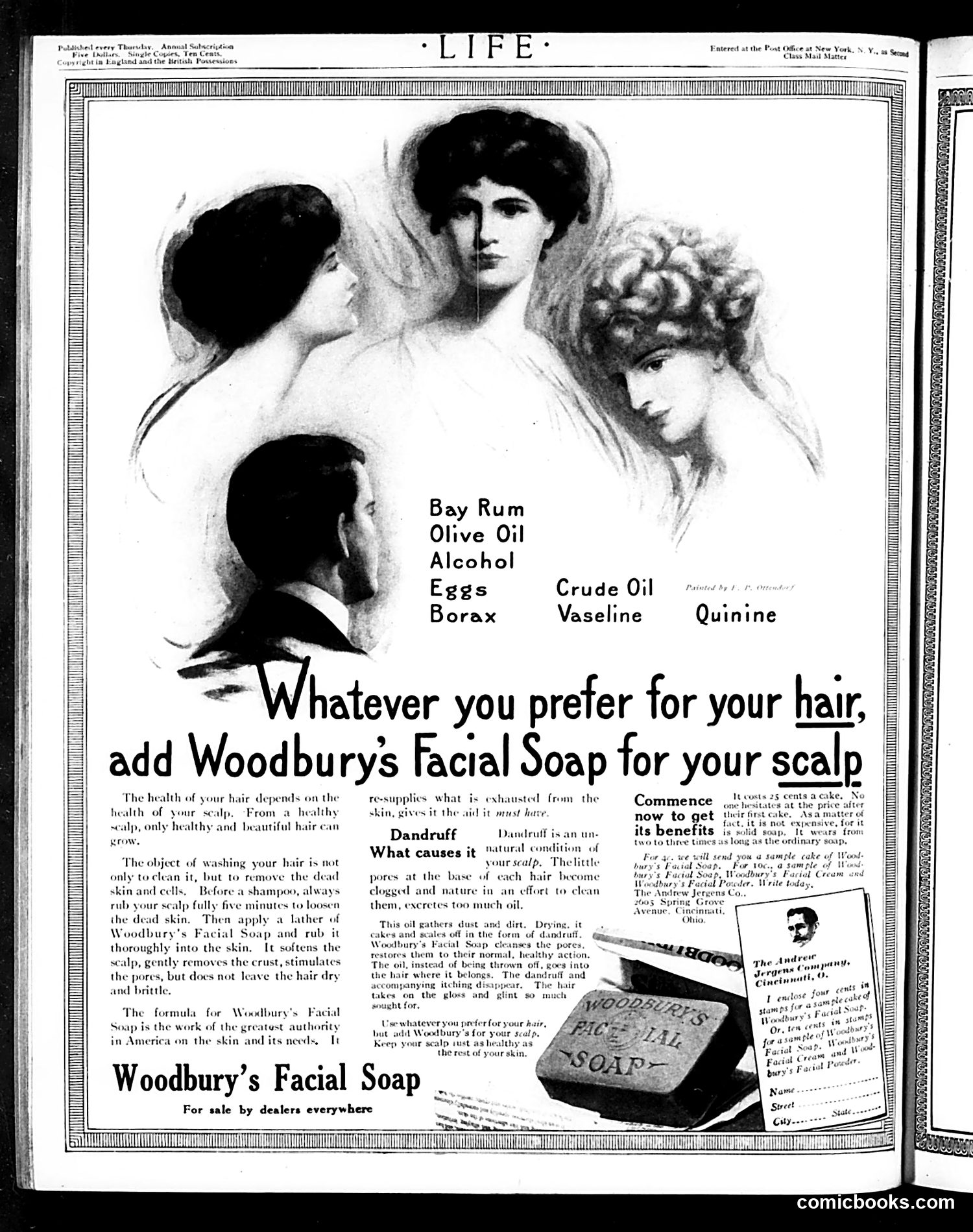
This page is **primarily an advertisement**, not political satire. It's a full-page ad for Woodbury's Facial Soap from the early 20th century. The ad features illustrated portraits of four women and uses a health-based sales pitch common to the era. It claims that healthy hair depends on scalp health, and lists competing hair treatments (Bay Rum, olive oil, borax, crude oil, vaseline, quinine) before arguing that Woodbury's Facial Soap is superior because it removes dandruff and cleanses pores. The "whatever you prefer" opening is a rhetorical device—the ad concedes competitors exist, then argues its product is what scalp health actually requires. A coupon appears on the right for product information. This reflects period advertising that emphasized scientific health claims to market cosmetics to women.
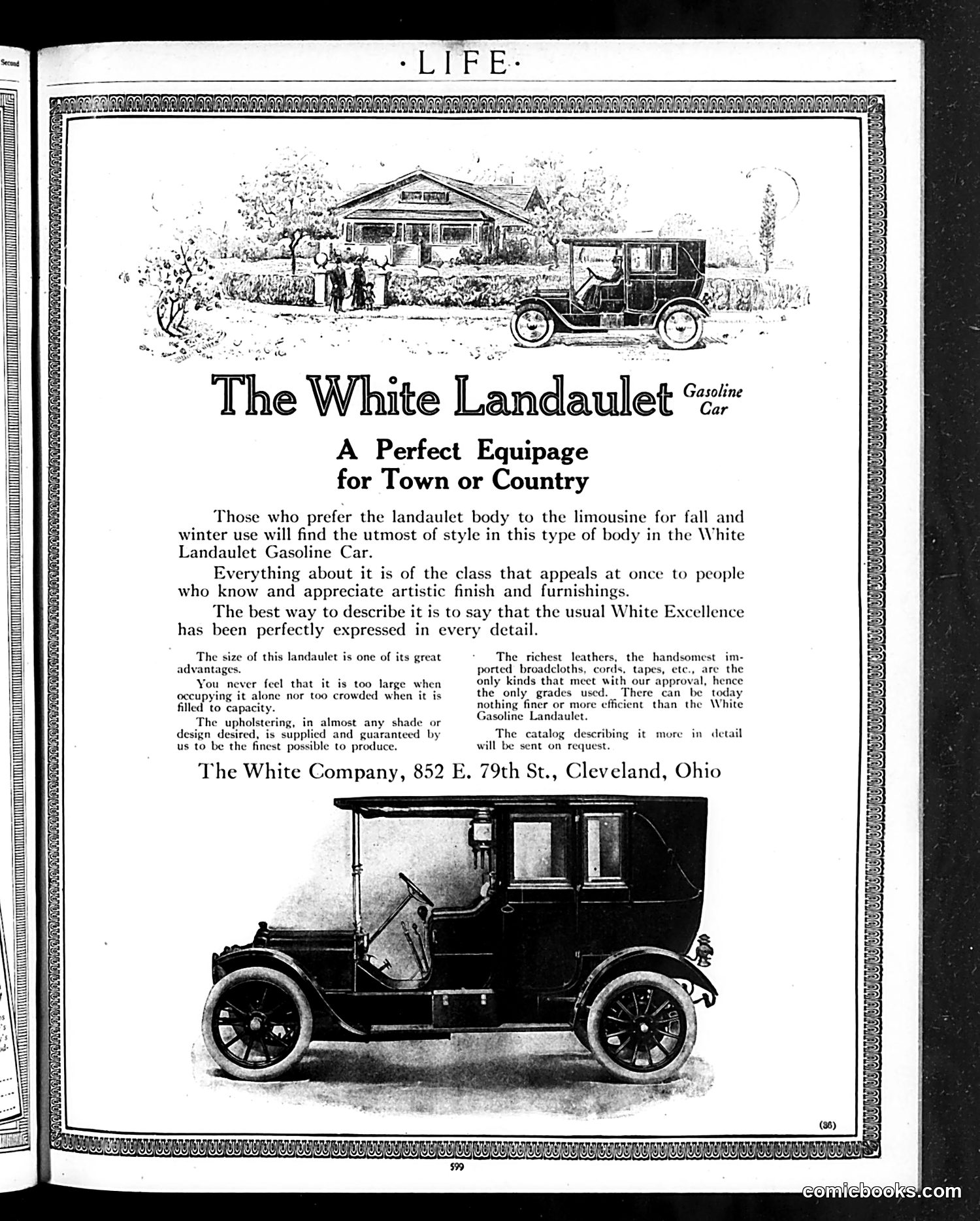
This is not a cartoon or satire—it's a **straightforward advertisement** for the White Landaulet, a gasoline-powered automobile manufactured by the White Company in Cleveland, Ohio. The page promotes the vehicle as ideal "for Town or Country," highlighting its landaulet body style (convertible top), spacious interior, quality leather upholstery, and versatility for different seasons. The two illustrations show the car from different angles to display its design. The marketing emphasizes the vehicle's appeal to people of refined taste and means, positioning it as a luxury product representing "White Excellence." This appears to be from an early automotive era when such vehicles were premium goods for affluent buyers.
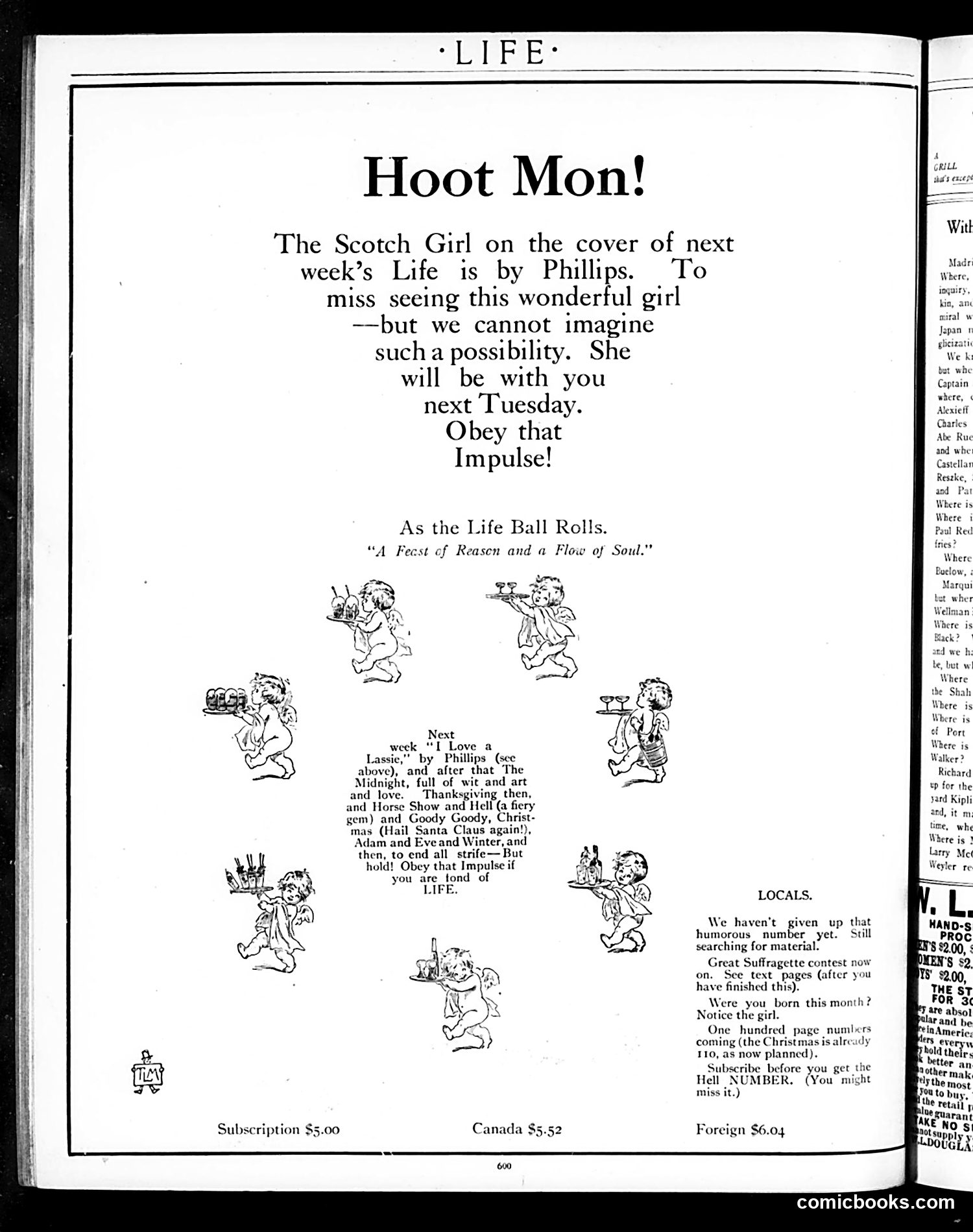
This page is primarily **promotional rather than political satire**. The main content advertises next week's cover feature—a illustration of "The Scotch Girl" by Phillips, with an enthusiastic call to readers ("Hoot Mon! Obey that Impulse!"). The central visual shows a repeating cartoon figure of a cherub or cupid-like character in various poses, arranged in a circle around text describing upcoming content. The phrase "As the Life Ball Rolls" suggests this is a recurring humor column. The "LOCALS" section on the right contains brief editorial notes about Life's content—mentioning a "Great Suffragette contest" and birthday notices. **This is essentially a table of contents/promotional page** rather than satirical commentary, typical of early 20th-century magazine layouts.
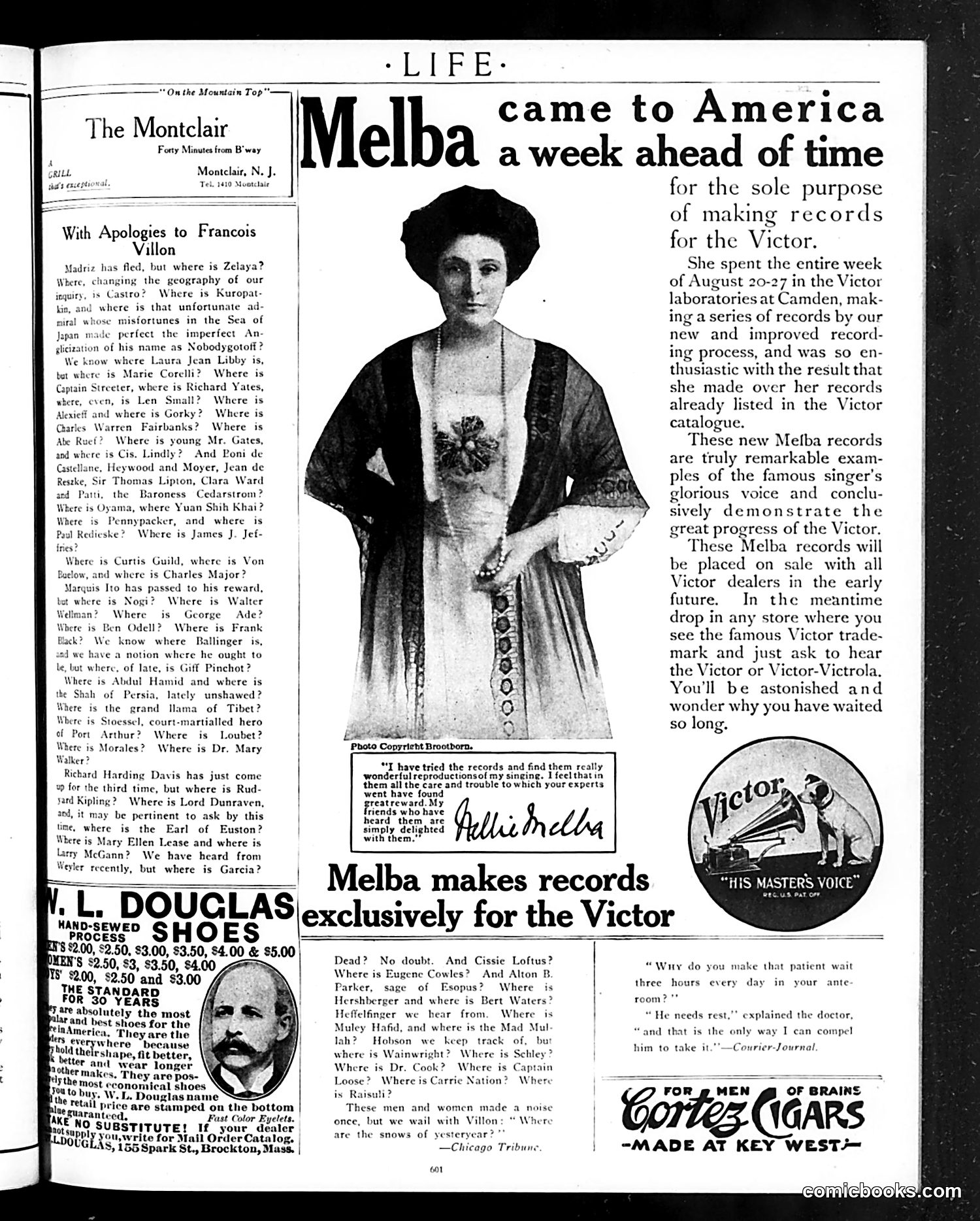
This page is primarily **advertising and entertainment content**, not political satire. The main feature celebrates **Nelba Melba**, the famous opera singer, who came to America to make phonograph records for Victor (now RCA Victor). The article describes how Melba spent August 20-27 in Victor's laboratories recording songs using "new and improved recording process." Her testimonial quote emphasizes her satisfaction with the recordings' quality. The page includes advertisements for **N.L. Douglas hand-sewn shoes** and **Cortez Cigars**, typical of early 20th-century magazine advertising. A sidebar piece titled "With Apologies to François Villon" appears to be humorous verse about missing or displaced celebrities—satirizing the era's celebrity culture through playful geographic confusion about famous figures' whereabouts.
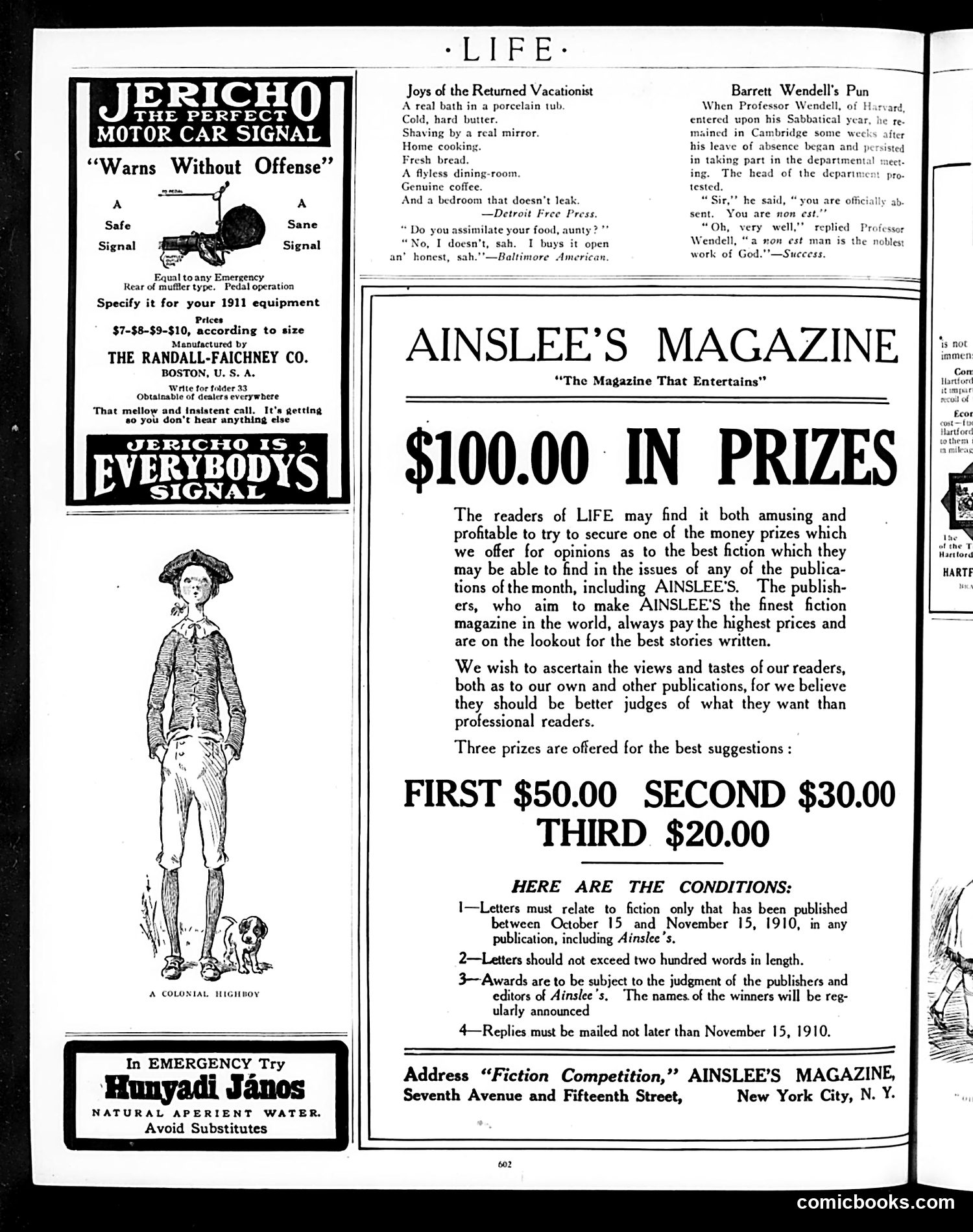
This page is primarily **advertising and editorial content** rather than political satire. The left side features ads for automobile signals and emergency water ("Flynabol Janos"), while the right showcases **Ainslee's Magazine's fiction competition**, offering $100 in total prizes ($50, $30, $20) to readers who submit opinions about the best fiction published between October-November 1910. The small illustrated figure labeled "A Colonial Highboy" appears to be a humorous visual pun—the furniture piece is drawn as a tall, thin man with a small dog, making a joke about the name's awkward phrasing. The page's tone reflects early 1900s magazine culture, when publications competed for reader engagement through contests and relied heavily on advertising revenue. The content suggests *Life* positioned itself as an arbiter of literary taste.
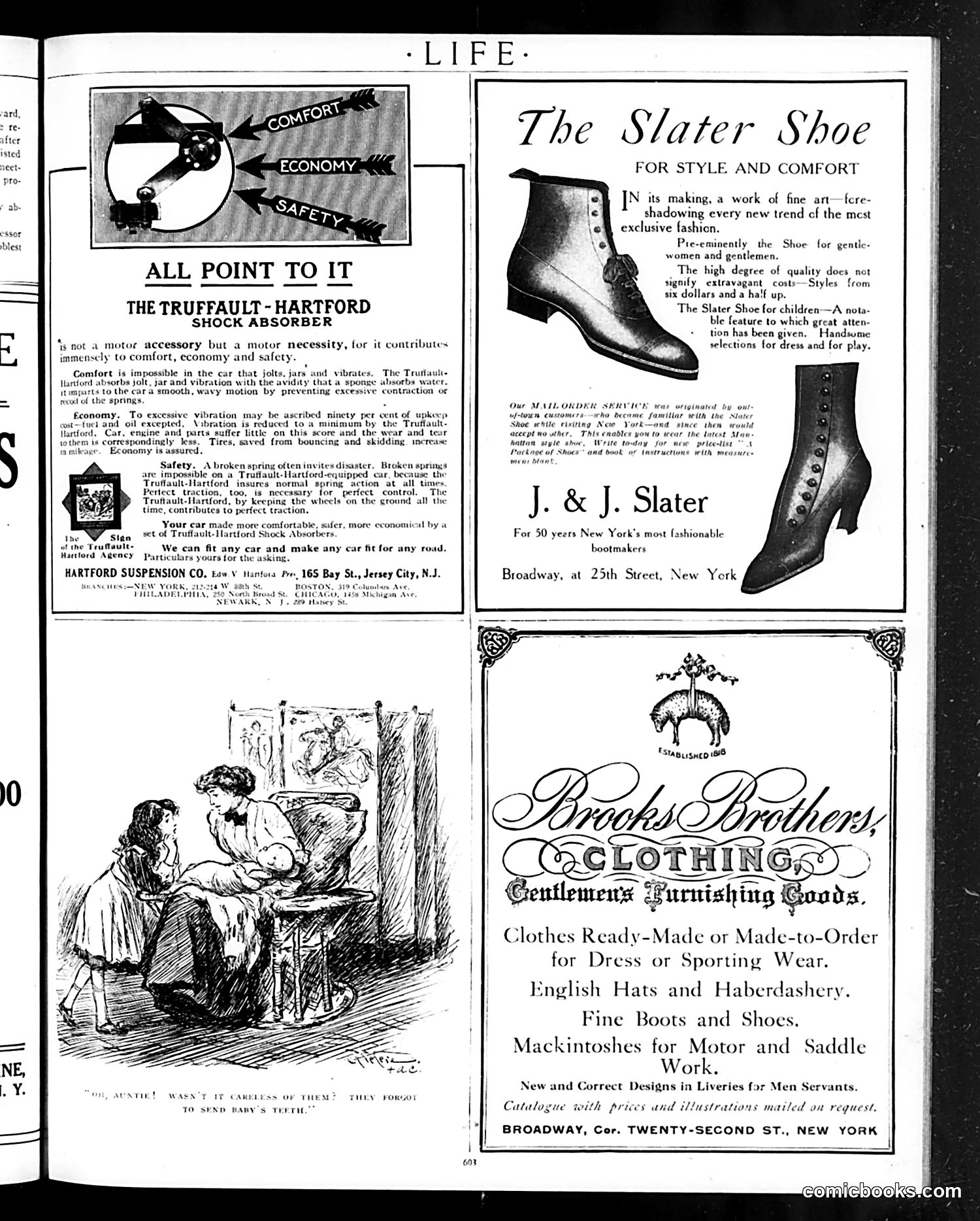
This page is primarily **advertising**, not satirical content. It contains three ads: 1. **Truffault-Hartford Shock Absorber** (left): A motor accessory ad emphasizing comfort, economy, and safety for automobiles—addressing the then-common problem of rough rides from poor suspension systems. 2. **J. & J. Slater Shoes** (right): A footwear advertisement for "style and comfort," targeting gentlemen and gentlewomen, highlighting 50 years as "New York's most fashionable bootmakers." 3. **Brooks Brothers** (bottom right): A clothing and furnishings merchant advertising ready-made or custom clothing, sporting wear, English hats, boots, shoes, and livery designs for servants. The lower left contains an illustration with caption about sending babies to the dentist—likely a humorous filler piece rather than satire.
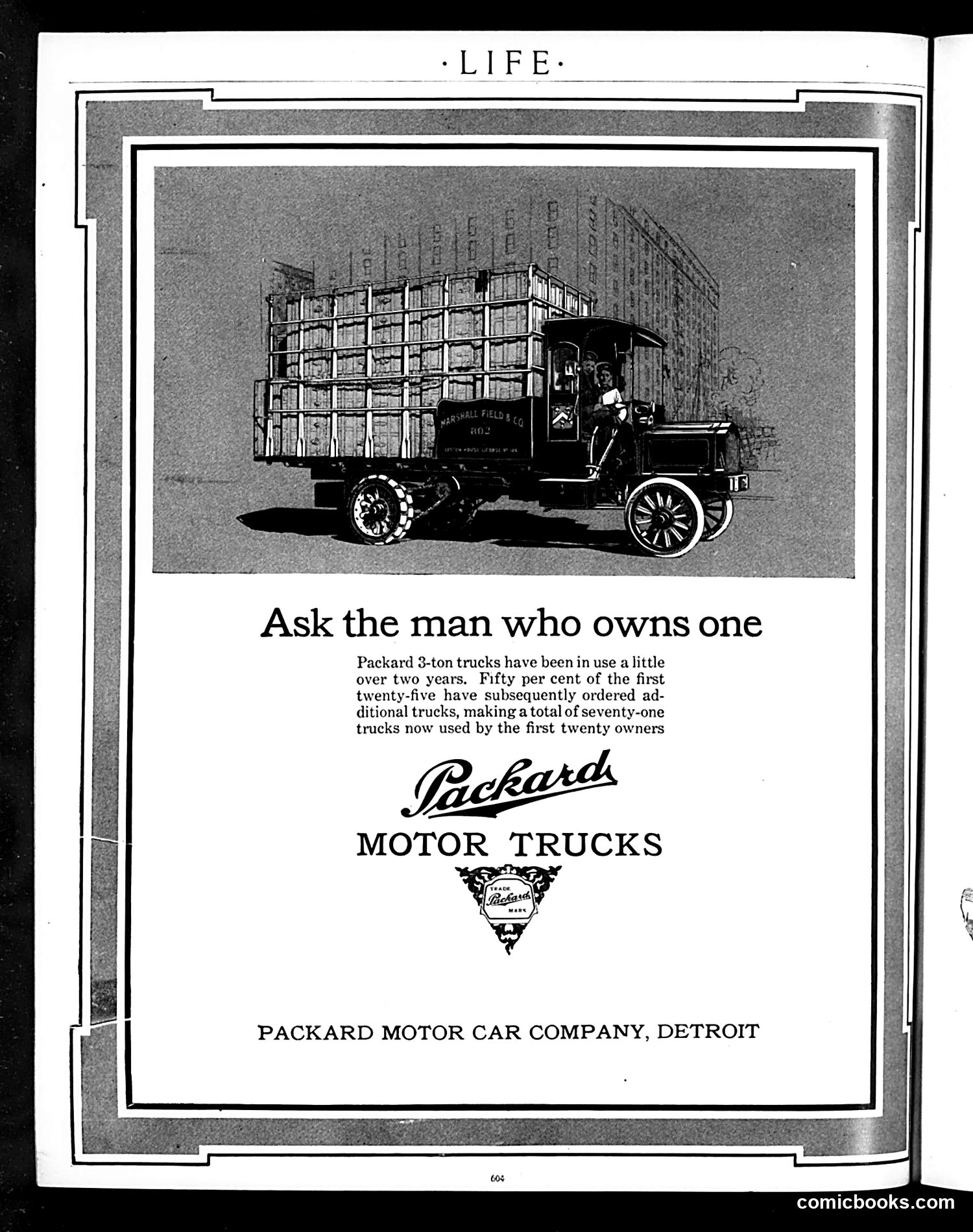
This is a **commercial advertisement**, not a political cartoon or satirical content. It promotes Packard Motor Trucks, manufactured by the Packard Motor Car Company in Detroit. The ad features an illustration of an early motorized delivery truck loaded with crates, with a driver visible in the cab. The headline "Ask the man who owns one" was Packard's famous advertising slogan, appealing to consumer testimonials. The body text emphasizes the truck's reliability and popularity: Packard 3-ton trucks had been in use for slightly over two years, and 50% of the first 25 owners had already ordered additional trucks—totaling 71 trucks among those original owners. This statistic was meant to demonstrate customer satisfaction and repeat business. This represents early 20th-century commercial truck advertising.
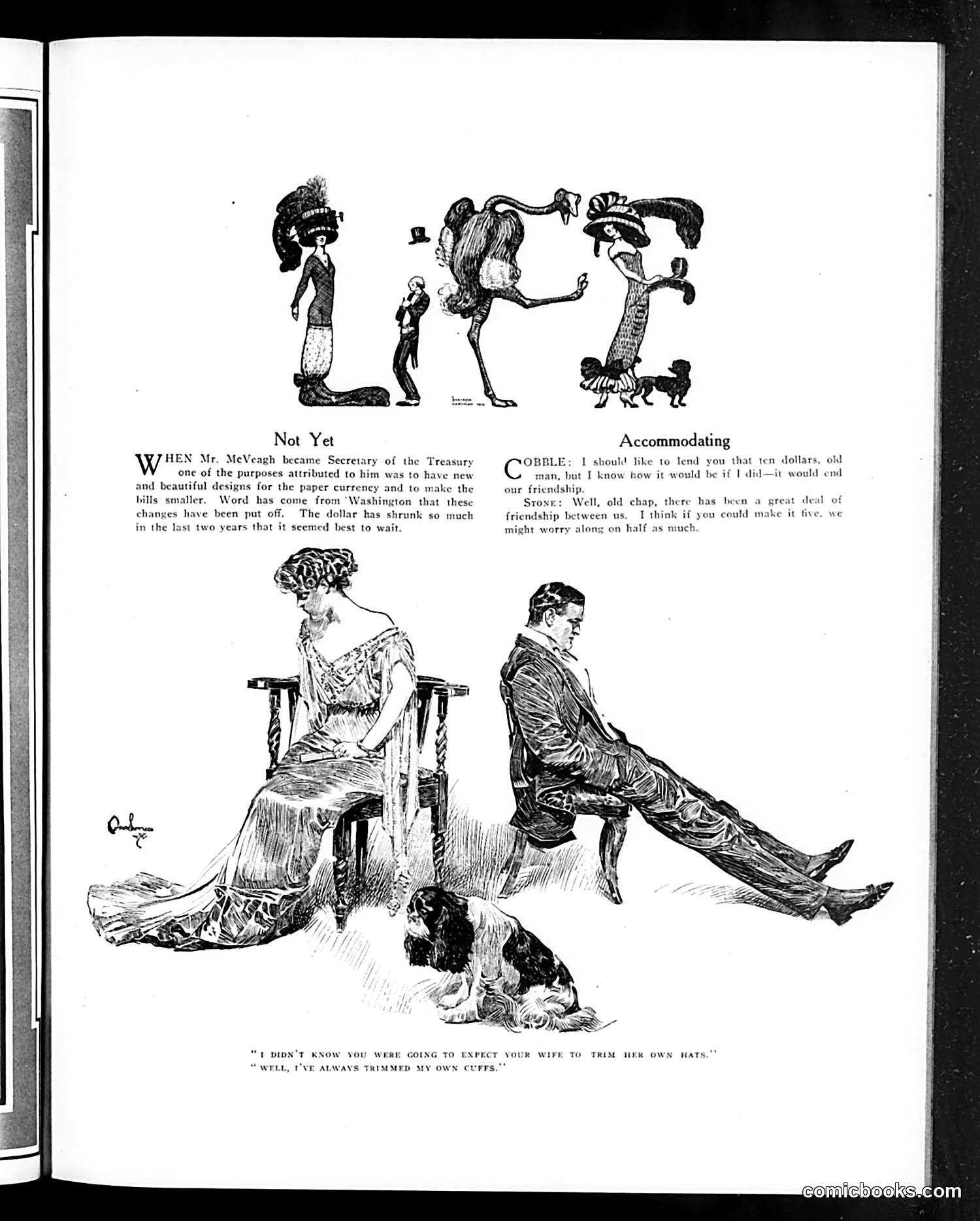
This page contains two satirical pieces from *Life* magazine: **"Not Yet"** references Secretary of the Treasury McVeagh's plans for new currency designs. The satire mocks how long the dollar has "shrunk" in value over two years, suggesting the wait for redesigned bills is pointless when the currency itself is deteriorating. **"Accommodating"** depicts a dialogue between a man seeking a ten-dollar loan and another who fears lending would damage their friendship. The joke plays on social awkwardness around money between friends—a timeless theme, though the specific ten-dollar amount reflects early 20th-century economics. The lower illustration shows a couple with a dog, captioned with banter about trimming hats versus cuffs, illustrating marital domestic negotiations.
This page satirizes New York State Democratic politics, specifically the 1910 gubernatorial race. The text discusses Colonel Roosevelt's refusal to openly support a candidate, leaving the party uncertain. The article criticizes the Democratic convention's inability to unite around a single nominee to oppose the Republican candidate. Key figures referenced include **Henry Stimson** (Roosevelt's choice for Governor) and **Charles Murphy** (Tammany Hall boss), who controlled Democratic voting blocs. The satire mocks Democratic disorganization—Murphy spent forty-eight hours trying to determine whom to nominate, suggesting party dysfunction. The cartoon (showing figures debating/negotiating) illustrates this internal chaos. The piece celebrates Murphy's eventual selection while criticizing Democratic Convention mismanagement compared to Republican efficiency under Roosevelt's influence.
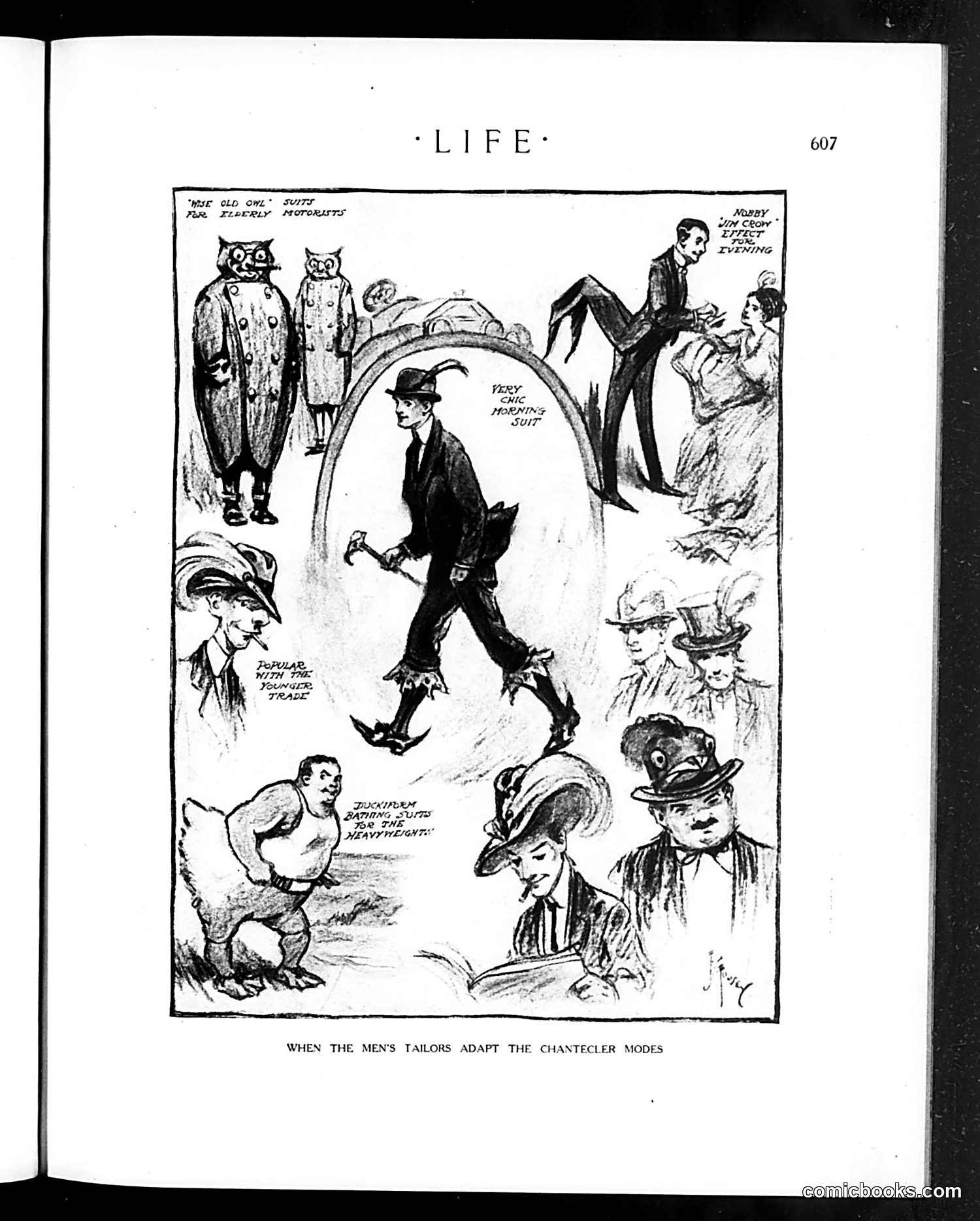
This satirical cartoon mocks men's fashion trends allegedly adopted from "Chanceler modes" (likely referring to German Chancellor Otto von Bismarck's distinctive style, given the period). The central figure wears exaggerated formal attire while surrounded by various character types labeled with fashion commentary: "Not Old Owl's Stiff Collar Prosperity," "Nervy Evening Effect," "Perry Chic Pressing Suit," "Popular With The Working Chap," and "Juncktion Sitting Suits For The Diligent." The cartoon satirizes how men's tailoring has become absurdly theatrical and affected, with owl-like figures and caricatured types embodying ridiculous sartorial choices. The joke targets the perceived pretentiousness of adopting governmental or aristocratic fashion affectations in everyday menswear.
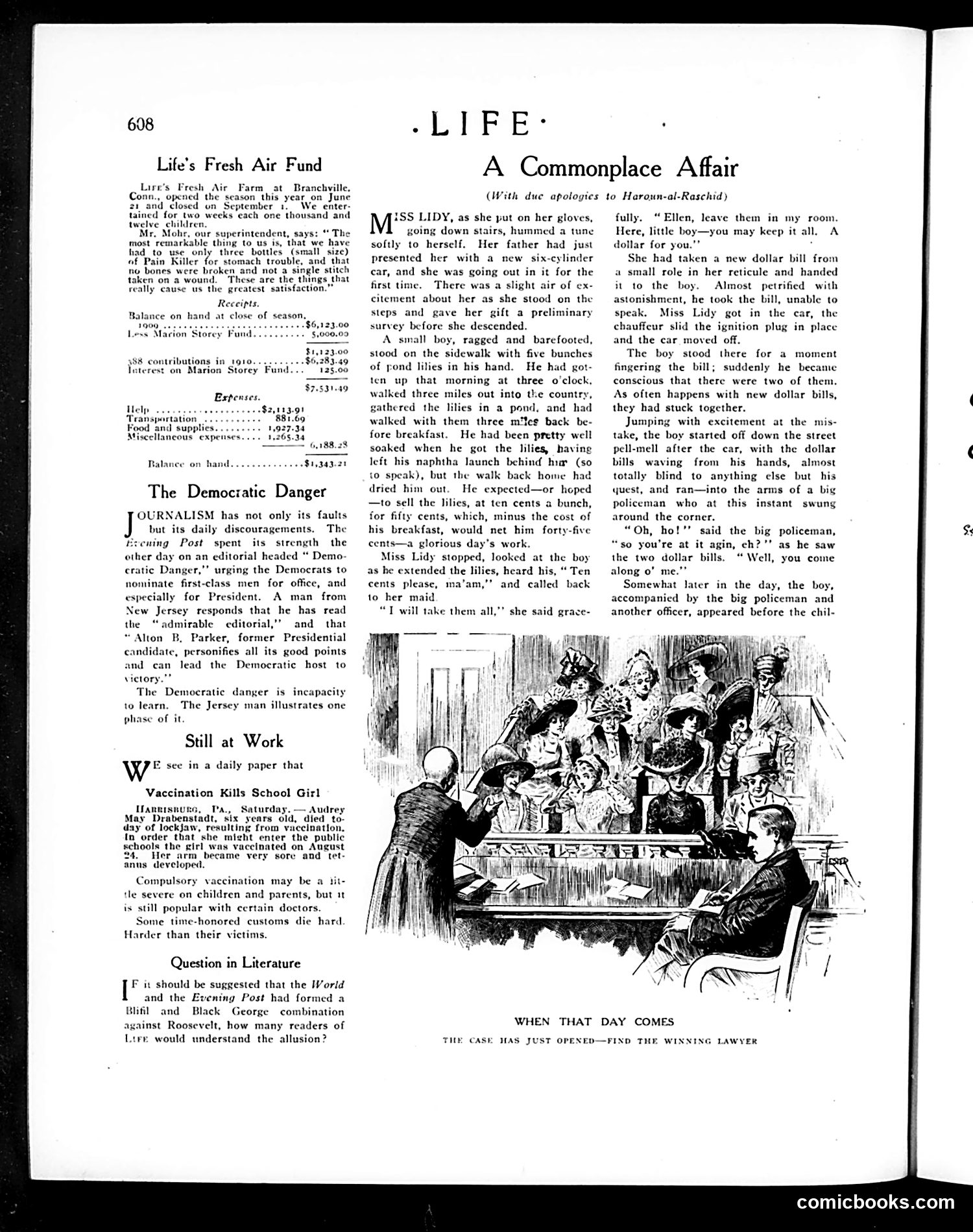
The main cartoon depicts a courtroom scene captioned "When That Day Comes—The Case Has Just Opened—Find the Winning Lawyer." It satirizes the proliferation of lawyers and litigation in America, showing a packed courtroom where finding competent legal representation has become comically difficult amid a crowd of advocates. The accompanying story "A Commonplace Affair" describes a child's everyday mishap with a new dollar bill and toy car—a trivial domestic incident. The juxtaposition suggests satire about American litigiousness: that even minor, ordinary accidents now risk becoming legal matters, reflecting societal concern about excessive lawsuits and the legal profession's growth during this period.
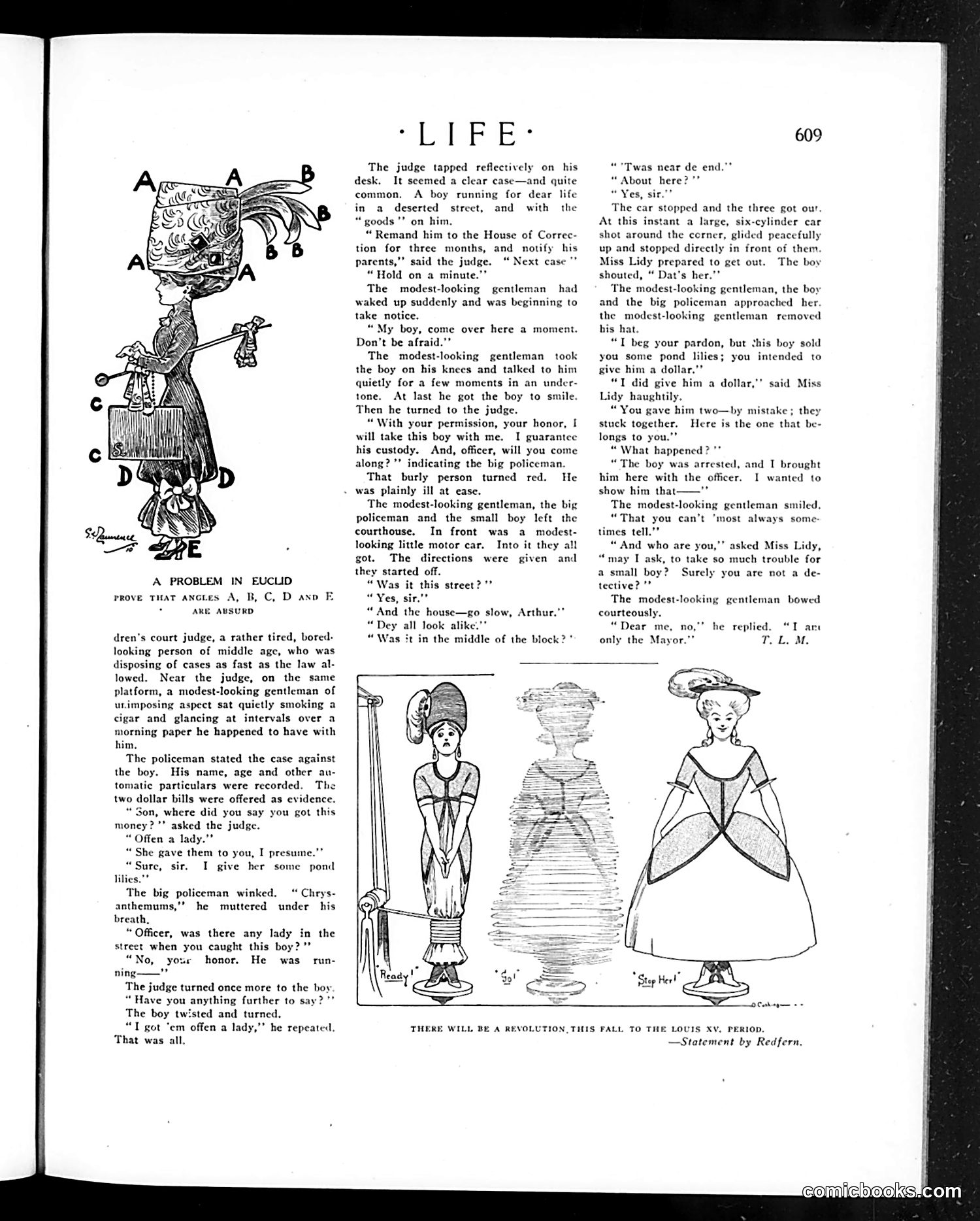
This page contains two distinct elements: **"A Problem in Euclid"** (left): A geometric puzzle presented as a satirical cartoon showing a disheveled figure with abstract geometric shapes, demonstrating a mathematical proof involving angles A, B, C, D, and E. **Main Story** (center-right): A courtroom narrative about a judge sentencing a boy to the House of Correction, interrupted when a "modest-looking gentleman" intervenes, claiming he'll take custody of the boy. The story plays on class distinctions and charitable interventions—the gentleman later reveals the boy stole from him, making the judge's quick decision appear foolish. **Fashion Illustrations** (bottom right): Three sketched women's dress designs, labeled as showing "a revolution" in Louis XV period fashion. The page satirizes judicial haste, class pretension, and the gullibility of authority figures accepting surface appearances.
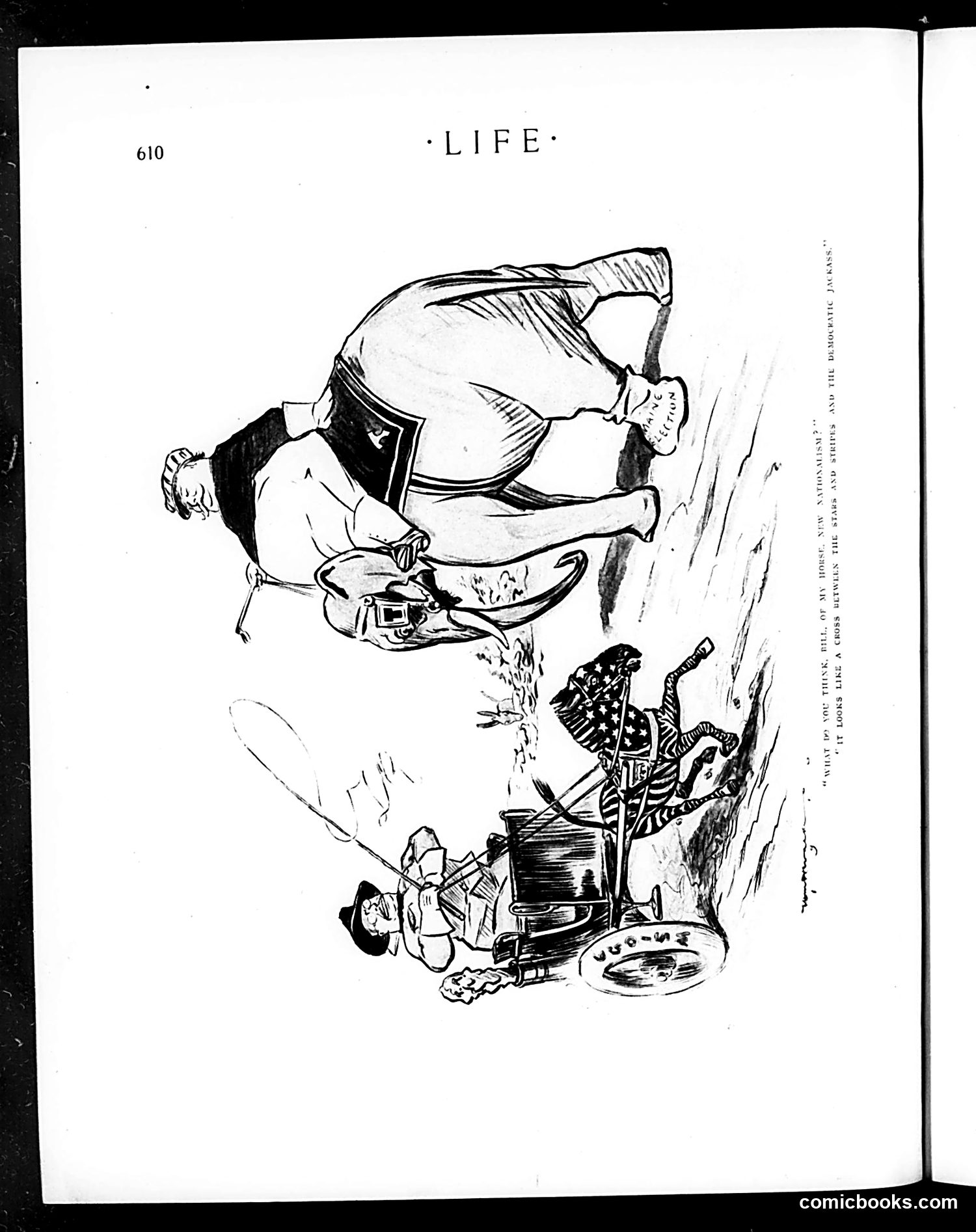
This appears to be a satirical cartoon from Life magazine (page 610), though the OCR text is largely corrupted and unreadable. The image shows two figures in what appears to be an inverted or topsy-turvy scene. There's a portly man in formal attire (top) and a smaller figure below with various objects scattered around, including what looks like a barrel or container marked with text. The cartoon's point seems to involve social or economic commentary—possibly depicting class relations, wealth disparity, or political hierarchy through the physical arrangement and relative sizes of the figures. The inverted perspective suggests role-reversal or upended social order. Without clearer OCR text or visible caption, I cannot definitively identify the specific political figures or historical event referenced. The style and composition suggest early-to-mid 20th century satirical commentary.
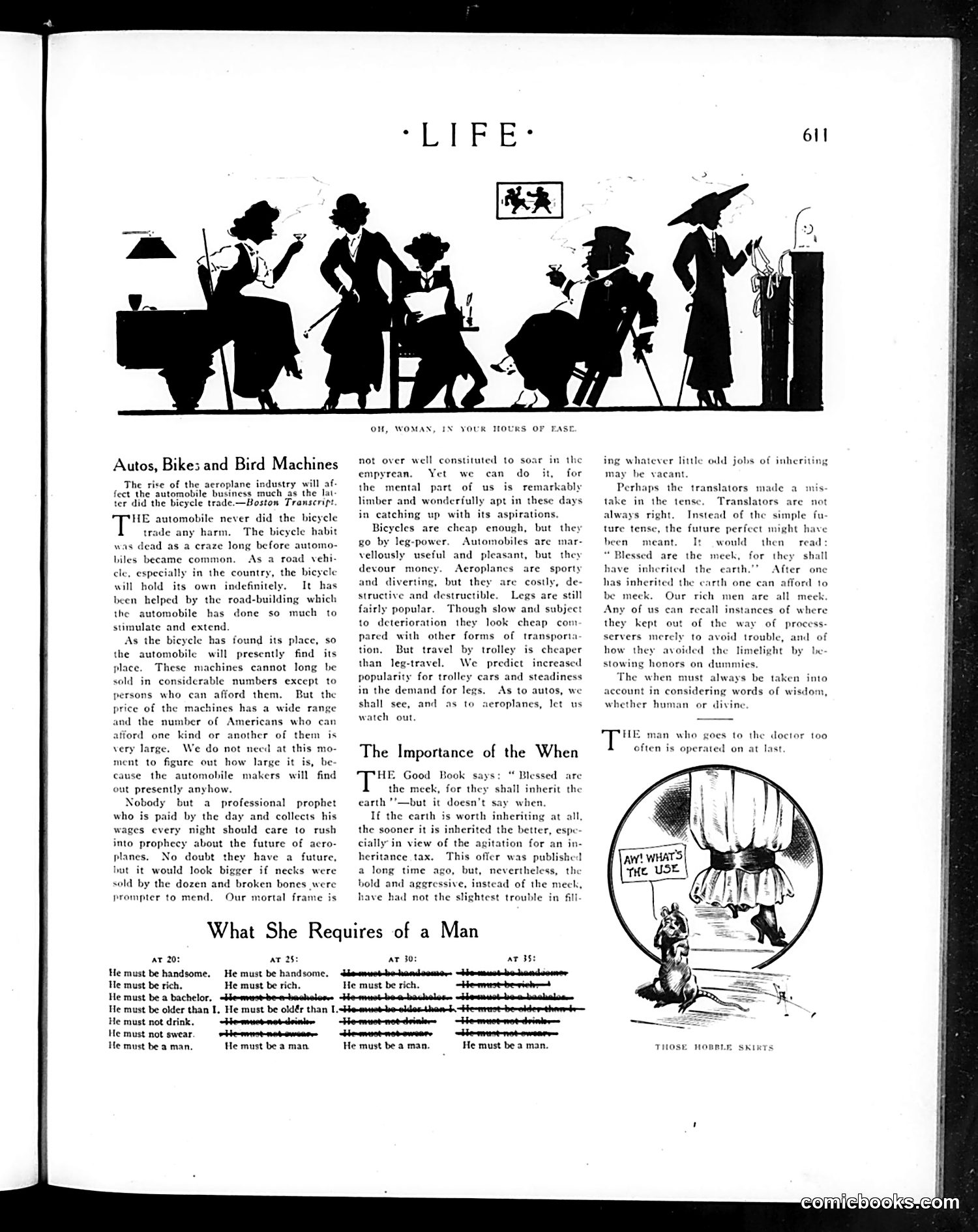
This page contains three distinct satirical pieces typical of early 20th-century American humor: **"Autos, Bikes and Bird Machines"**: A commentary on emerging transportation technology. The article dismisses predictions that automobiles will destroy bicycles (they already have), and skeptically views airplanes as impractical given human fragility. It predicts trolleys and walking will remain popular—satire of overconfident technological forecasting. **"The Importance of the When"**: Satirizes the biblical promise "blessed are the meek, for they shall inherit the earth" by pointing out it omits *when*. The joke: aggressive, wealthy people have actually inherited everything despite the scripture's prediction, making the promise meaningless. This mocks both religious platitudes and wealth inequality. **"What She Requires of a Man"**: A humorous chart showing how women's standards decline with age—at 20 she demands handsomeness, wealth, bachelorhood, sobriety, etc.; by 45 she only requires "he must be a man." This reflects period anxieties about unmarried women and aging. The silhouette illustration depicts women engaged in various activities, captioned "OH, WOMAN, IN YOUR HOURS OF EASE."
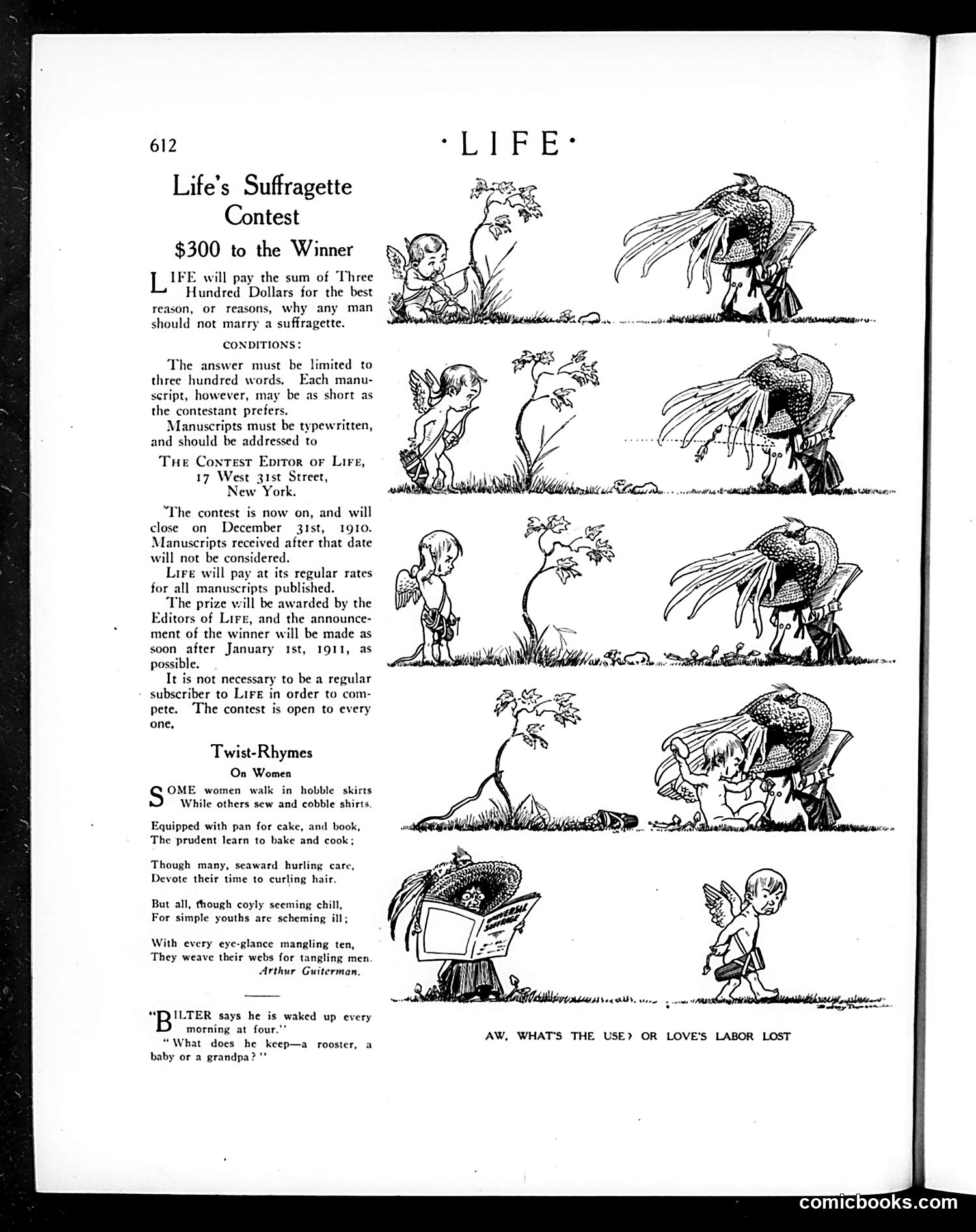
This page mocks the women's suffrage movement through a contest asking men to submit reasons *against* marrying suffragettes—offering $300 to the winner. The satire positions suffragists as undesirable marriage partners, reflecting anti-suffrage sentiment of the era. The accompanying poem "Twist-Rhymes on Women" reinforces stereotypes: women are portrayed as simultaneously domestic (baking, cooking) and deceptive ("scheming," "weaving webs for tangling men"). The final cartoon shows a woman reading a newspaper in a carriage while a cherub looks on confused—captioned "What's the Use? Or Love's Labor Lost"—suggesting women's political engagement wastes effort and threatens romance. The overall message: women seeking voting rights are painted as unnatural, manipulative, and a threat to traditional marriage and male authority. This represents mainstream editorial opposition to suffrage common in American magazines before women gained the vote in 1920.
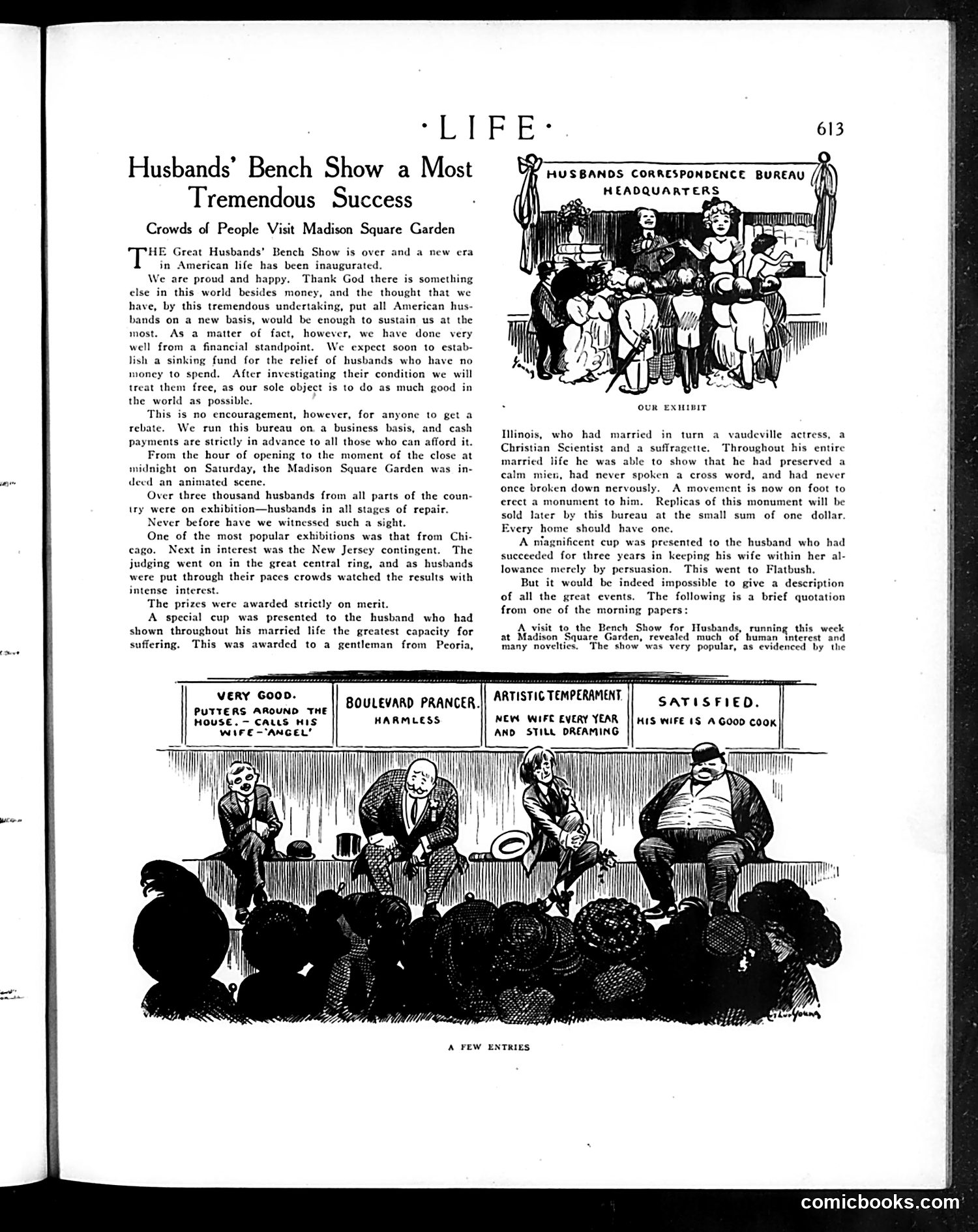
This satirical piece mocks the emerging "Husbands' Correspondence Bureau" by presenting husbands as livestock at an agricultural exhibition. The joke is that husbands—like cattle or dogs at a county fair—are being judged, graded, and displayed "in all stages of repair." The cartoon shows four husband "types" on exhibition benches, each labeled with satirical descriptions: one who "putters around the house," a "boulevard prancer" (likely a ladies' man), one with "artistic temperament" who wants a new wife yearly, and a "satisfied" husband with a good cook wife. The humor targets early-20th-century gender dynamics and marital frustration. By treating husbands as commodities to be evaluated and improved, Life satirizes both domestic dissatisfaction and the emerging bureaucratic "solutions" (the Correspondence Bureau) to personal problems. The prize for greatest "capacity for suffering"—awarded to a man married to an actress, Christian Scientist, and suffragette—particularly mocks wives' independent interests and husbands' expected patience with them.
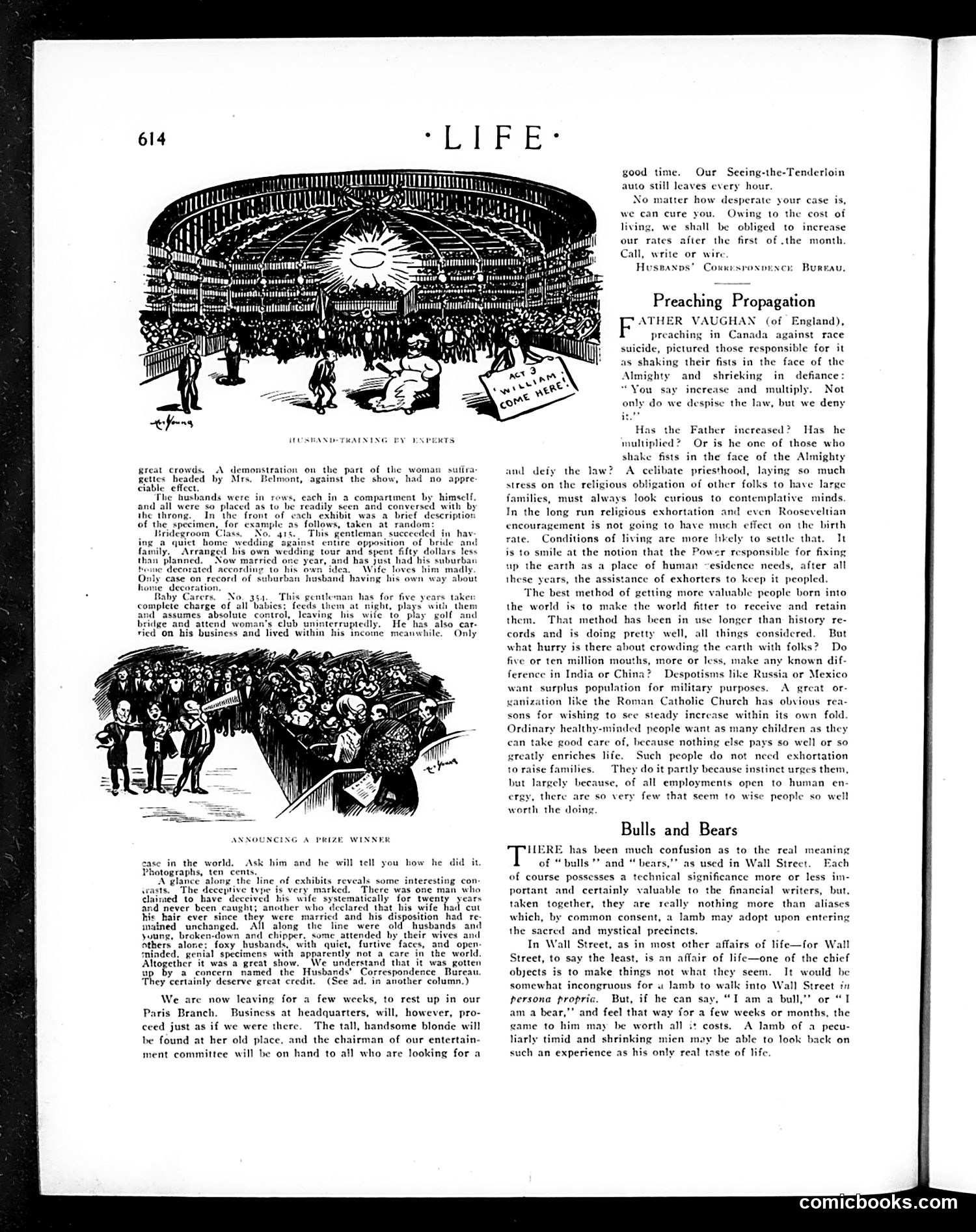
## Upper Cartoon: "Husband-Training by Experts" This satirizes a public exhibition displaying husbands as specimens—cataloged like zoo animals with descriptions of their "qualities" (obedience, faithfulness, financial responsibility). The cartoon mocks both the "Husbands' Correspondence Bureau" operating this show and the early 1900s women's suffrage movement (referencing Mrs. Belmont's suffragette protest against it). The joke targets anxious wives shopping for ideal husbands and the absurdity of treating marriage as a consumer transaction. It also lampoons the emerging "scientific" approach to domestic management. ## Lower Article: "Preaching Propagation" This criticizes Father Vaughan (English Catholic priest) for denouncing "race suicide" (voluntary childlessness) while he himself remains celibate. Life's satire is sharp: Vaughan demands large families from his congregation while refusing to "multiply" himself, making his moral authority hypocritical. The piece argues that economic conditions—not religious exhortation or even Theodore Roosevelt's encouragement—actually determine birth rates.
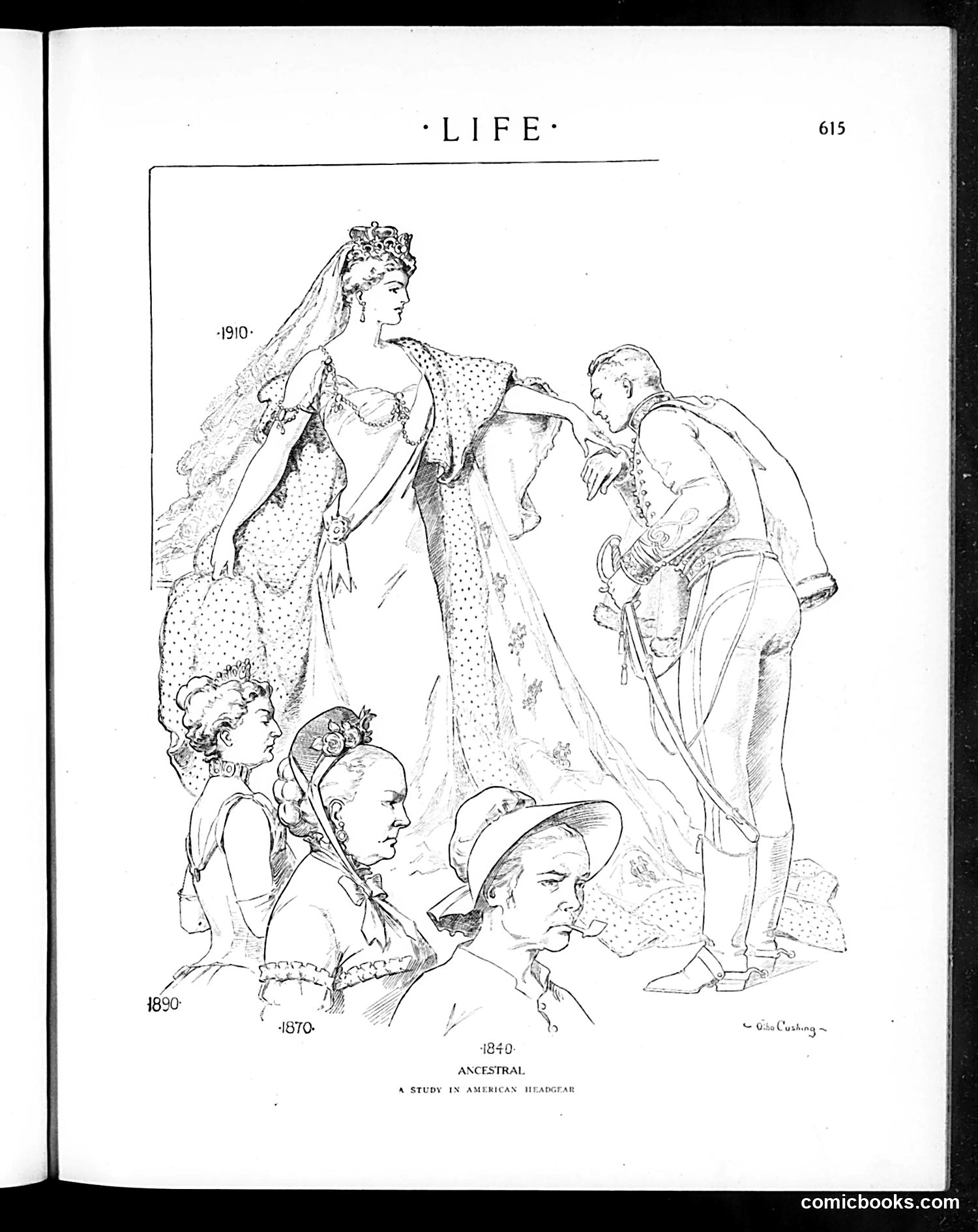
This satirical illustration by C. D. Sheridan traces the evolution of women's fashionable headwear across four decades (1840–1910). The central tall figure represents the 1910 style, while smaller figures below show progressively earlier fashions from 1890, 1870, and 1840. The joke critiques how women's hairstyles and headgear have become increasingly elaborate and impractical over time. By labeling it "ancestral" and presenting it as genealogical lineage, the cartoon mockingly suggests these ridiculous fashions are inherited like family traits. The 1910 bride's towering crowned headdress with veil represents the apex of this absurd evolution. This reflects common early-20th-century satire about the excesses of women's fashion, portraying changing styles as progressively more outlandish and frivolous.
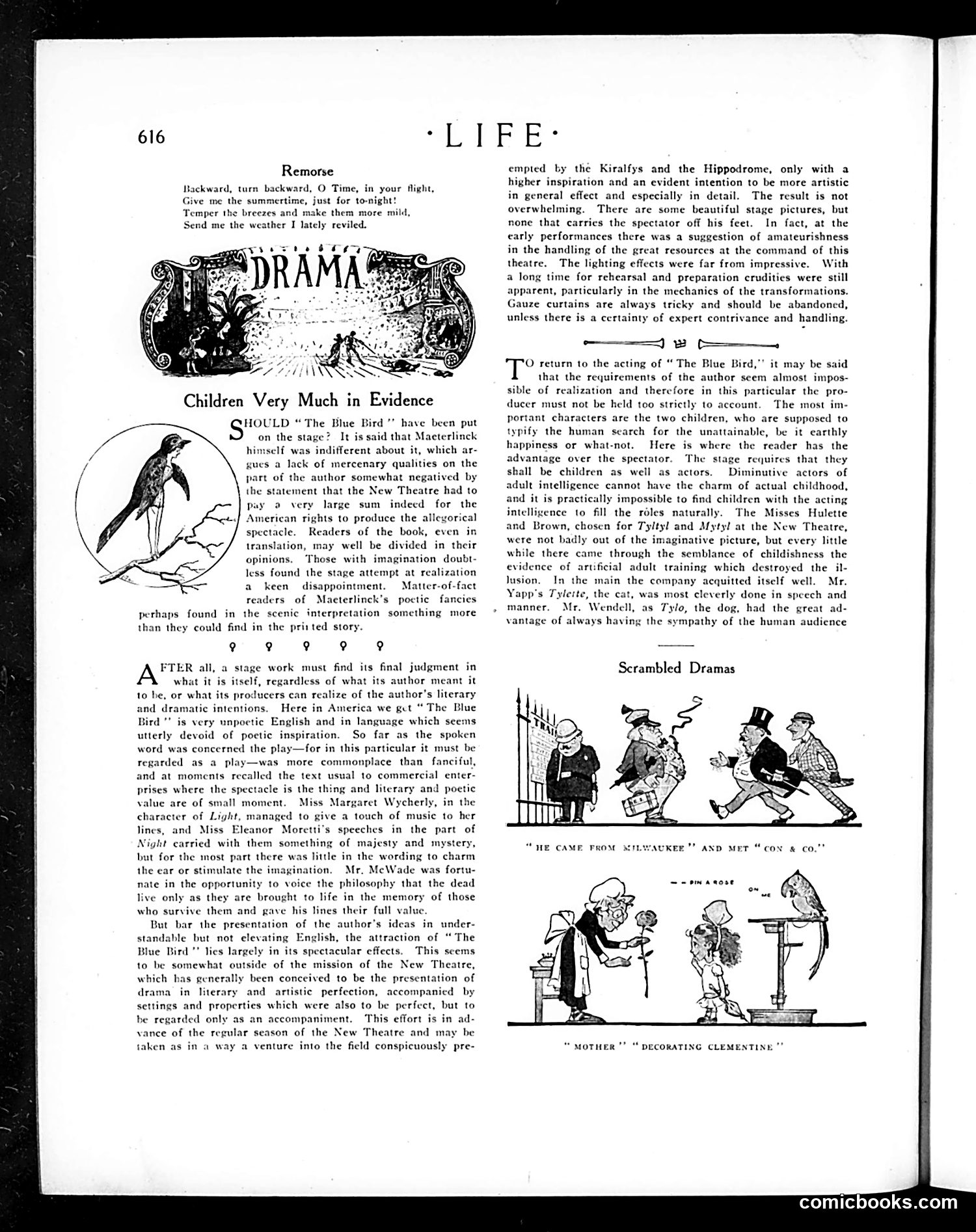
This page critiques the stage adaptation of Maurice Maeterlinck's allegorical play "The Blue Bird" at New York's New Theatre. The critic argues that while the production featured spectacular scenery, it lacked poetic merit—the dialogue was rendered mundane in English translation, and child actors (prominently featured) couldn't convey the philosophical depth the play requires. The reviewer suggests the New Theatre, conceived as a venue for literary and artistic perfection, instead descended into spectacle-driven entertainment resembling commercial ventures like the Kiralfy brothers' productions and the Hippodrome. The accompanying cartoons appear satirical but are difficult to identify specifically without clearer captions. The dramatic-arts critique reflects early 20th-century tensions between theatrical innovation and artistic integrity—a common Life magazine concern.
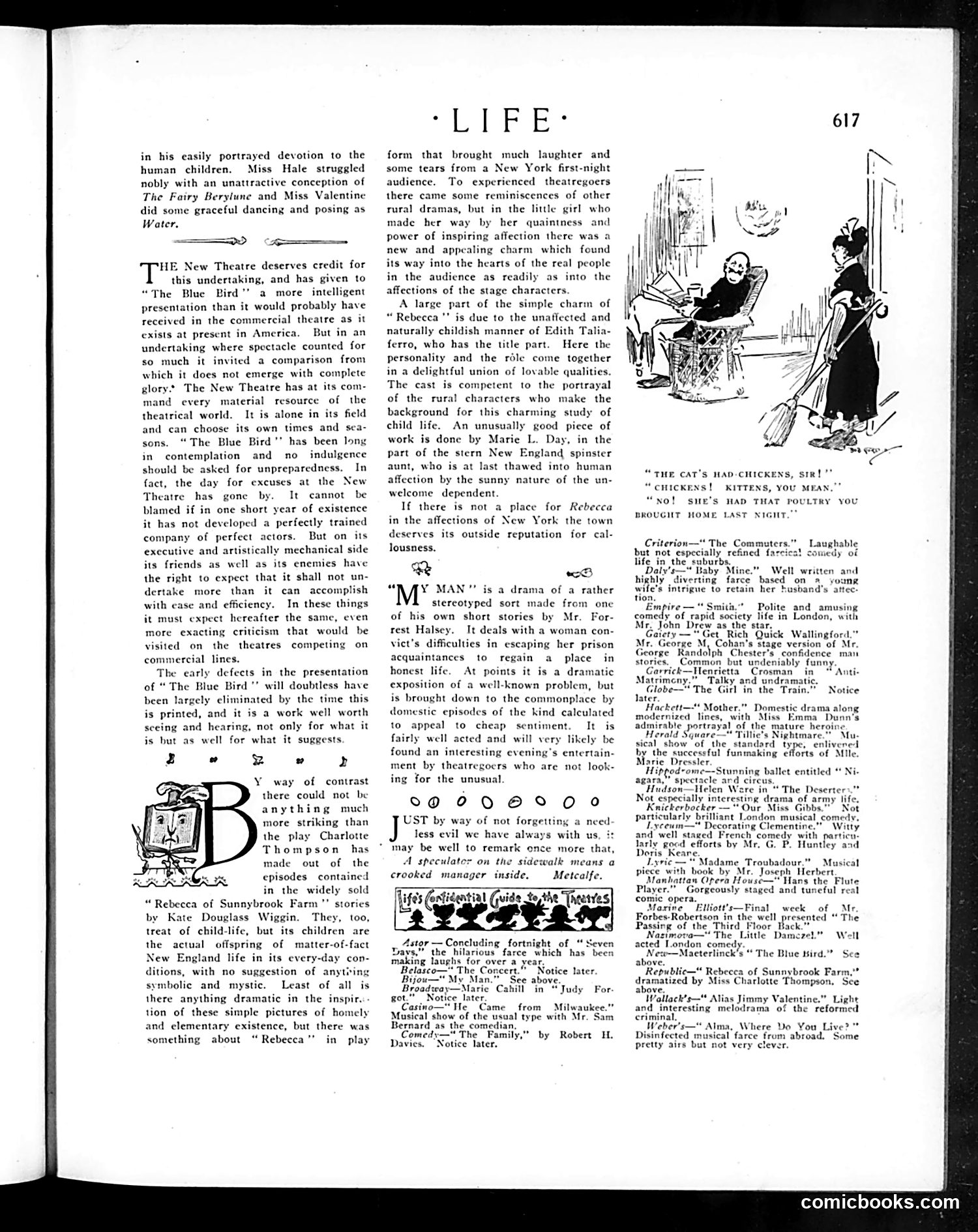
This page reviews three theatrical productions circa 1910-1912. The main illustrated cartoon (top right) shows a scene from "The Blue Bird," depicting an actress in an ethereal costume pose—likely representing the water character mentioned in the text. The reviews critique: 1. **"The Blue Bird"** — A elaborate production at the New Theatre with impressive spectacle but uneven execution. The critic notes the theater has resources but should be held to high standards, not excused for its first year. 2. **"Rebecca of Sunnybrook Farm"** — Adapted from Kate Douglass Wiggin's popular stories. The critic praises its charm and emotional impact, particularly actress Edith Talferro's naturalistic performance as the title character—a quaint New England girl who wins hearts through genuine affection rather than drama. 3. **"My Man"** — A domestic drama about a woman convict attempting to escape her past. The satire is gentle; the page celebrates theater that captures authentic human emotion over mere spectacle.
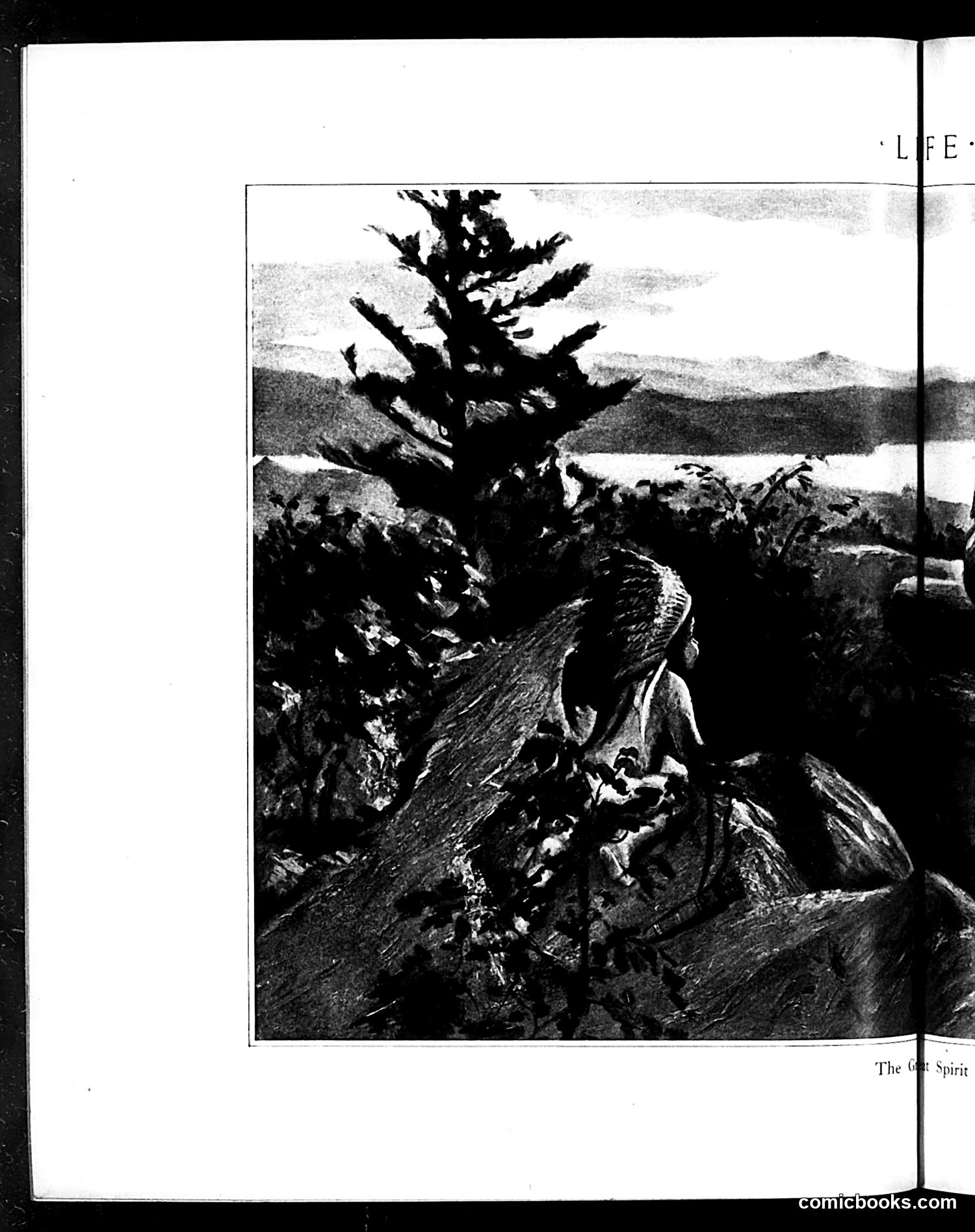
This appears to be a page from *Life* magazine featuring a photograph titled "The Out Spirit" (or possibly "The Old Spirit"). The image shows a gnarled, twisted tree or wooden form in a stark landscape with mountains and water visible in the background. The dramatic black-and-white photography emphasizes the contorted, almost skeletal appearance of the subject. Without additional context or visible caption text beyond the title, the specific satirical or political meaning is unclear. The image could be commentary on nature, decay, resilience, or possibly human struggle—themes common to early 20th-century *Life* magazine. However, I cannot definitively identify what particular contemporary event, figure, or social condition this photograph meant to critique or lampoon without more textual information.
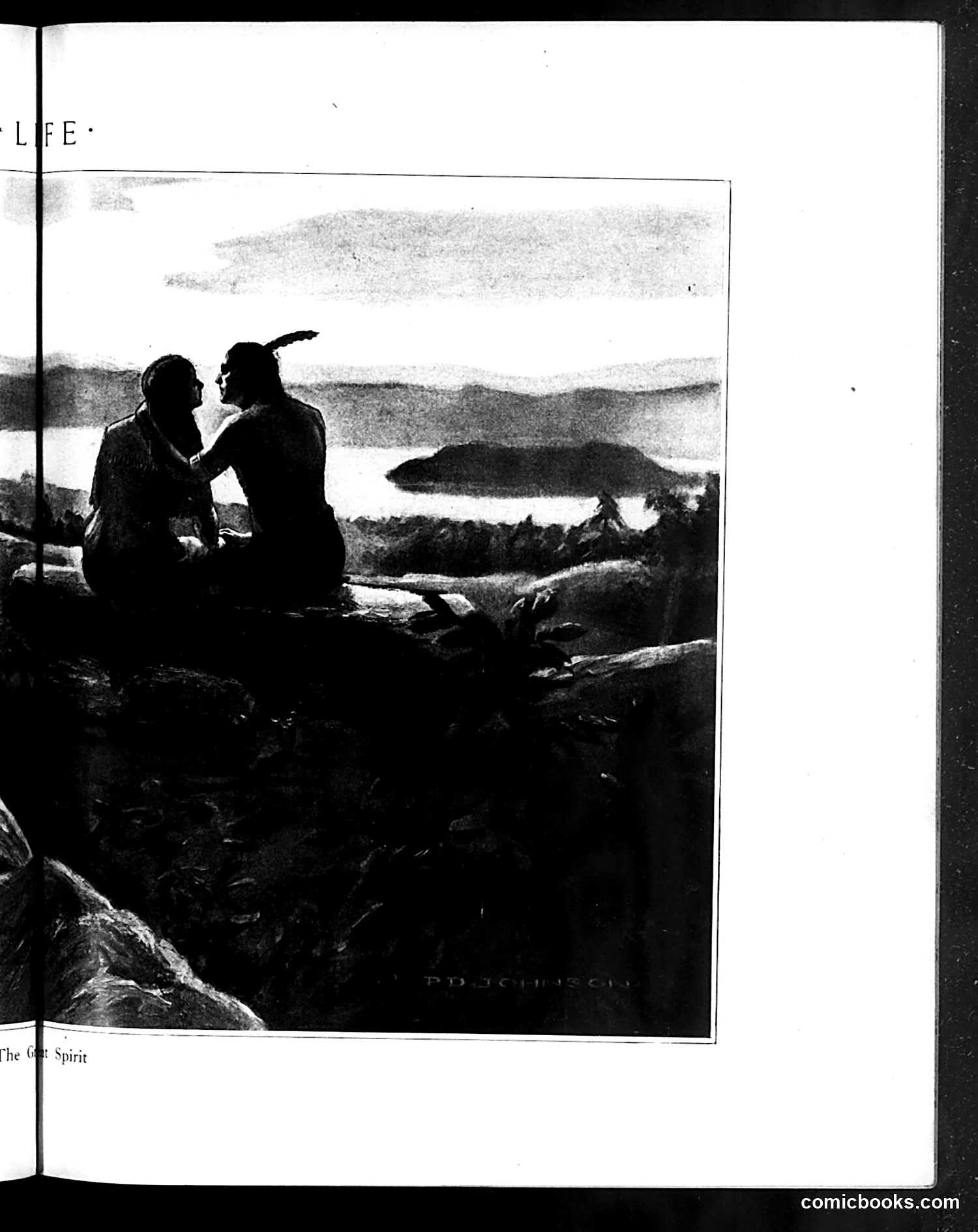
This black and white photograph shows two silhouetted figures on a rocky outcrop overlooking a lake or body of water with forested shores and an island. The caption reads "The God Spirit." Without additional context from the magazine issue, the image appears to be a romantic or contemplative scene rather than political satire. The composition—two figures gazing at a natural landscape—suggests themes of spirituality, nature, or human connection to the environment. The title "The God Spirit" likely invokes transcendentalist or spiritual themes popular in early-to-mid 20th century American thought. However, without seeing surrounding text or knowing the publication date, I cannot definitively explain the specific satirical point or social commentary this image was intended to convey.
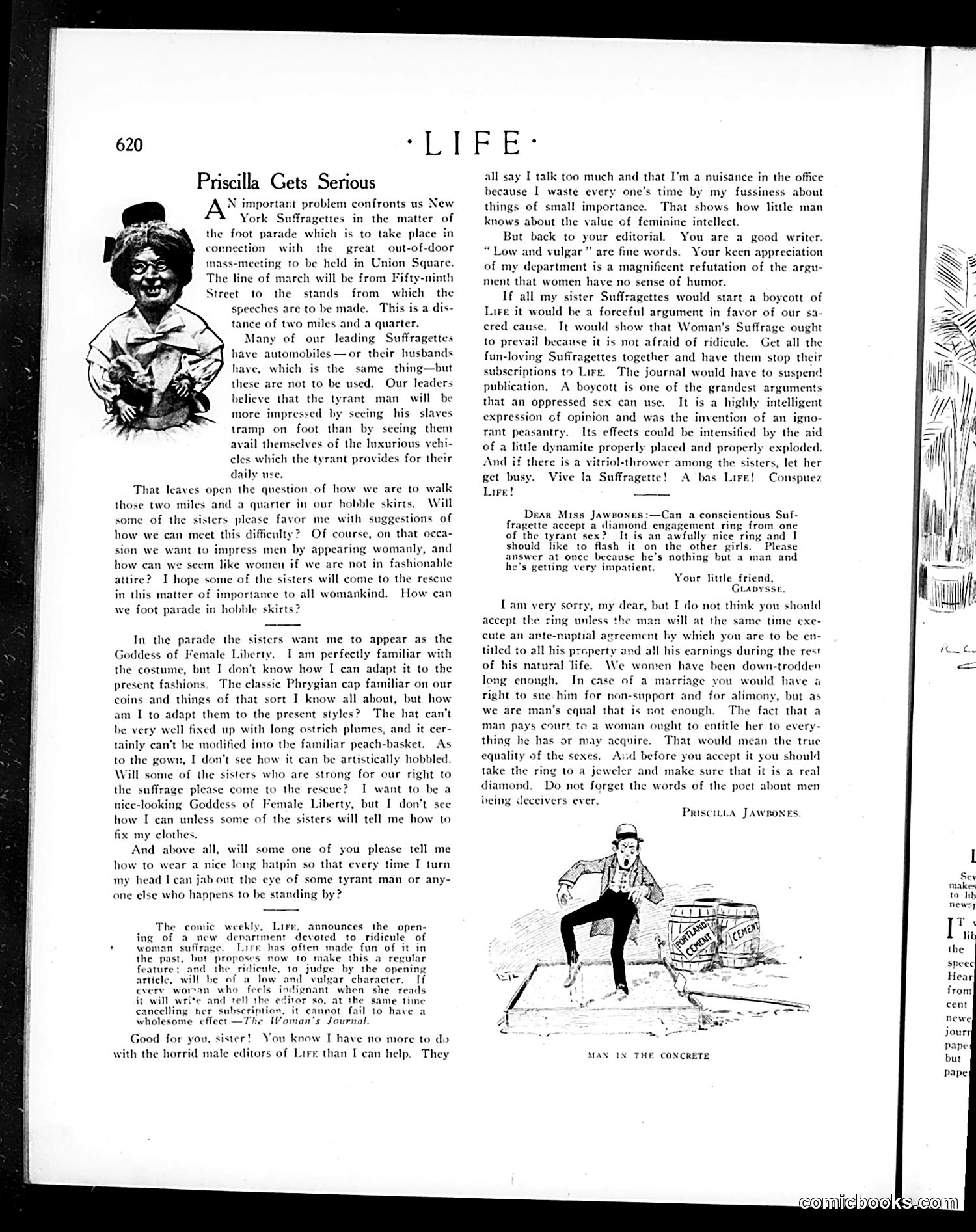
This page satirizes the women's suffrage movement through a fictional letter from "Priscilla," who humorously details practical problems facing New York suffragettes planning a major Union Square parade. The satire targets both the movement and its critics. Priscilla describes the physical contradiction between fashionable "hobble skirts" (restrictively tight skirts) and a two-mile march, and the difficulty of adapting classical "Goddess of Liberty" imagery to modern fashion. She also asks how to use long hatpins—contemporary women's accessories—as weapons against "tyrant men." The secondary content reports that *Life* magazine is launching a regular anti-suffrage ridicule column. The editor of *The Woman's Journal* sarcastically welcomes this, arguing suffragettes should boycott *Life*, framing mockery as a test of their cause's strength. The joke: Life ridicules suffragettes as impractical, fashion-obsessed, and prone to (joking) violence—while the suffrage movement itself attempts to use consumer boycotts as political leverage.
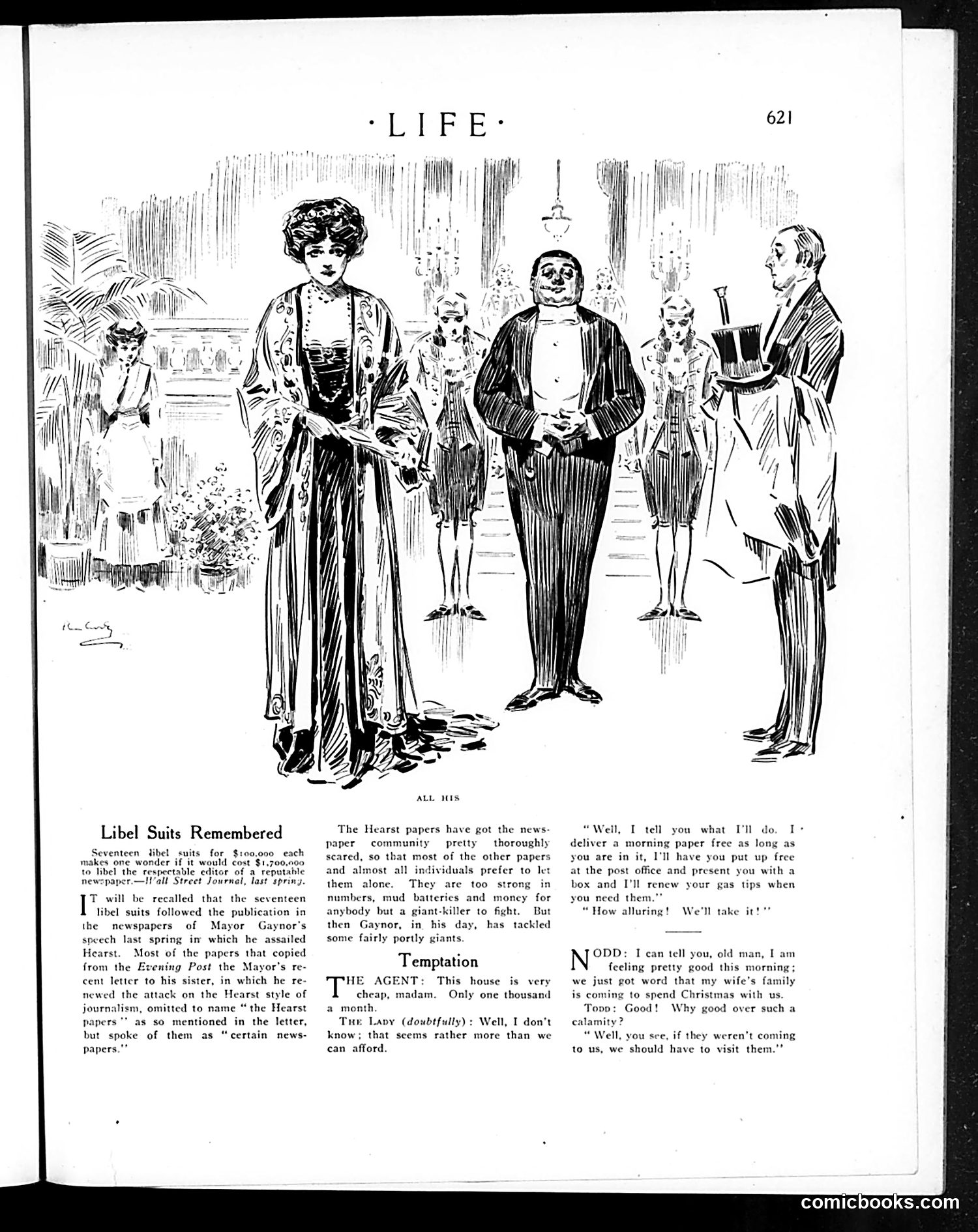
This 1910s *Life* magazine page contains two satirical pieces about power and media corruption. **"Libel Suits Remembered"** references Mayor Gaynor's public attack on newspaper magnate William Randolph Hearst. The article notes that Hearst's papers sued for libel aggressively ($1.7 million total), intimidating other newspapers into silence. The satire: other papers were so afraid of Hearst's legal and financial power that they wouldn't even name him when republishing the Mayor's criticism, referring vaguely to "certain newspapers" instead. The joke is that Hearst's dominance made honest press criticism impossible. **"Temptation"** is a domestic comedy sketch: a landlady considers renting to a tenant who offers free newspaper delivery, free lodging services, and free utilities—an absurdly generous deal. The punchline hinges on the tenant's final revelation: he's only friendly because his in-laws are visiting; normally he'd be miserable. Both pieces reflect early-20th-century anxieties about media monopolies and social pretense.
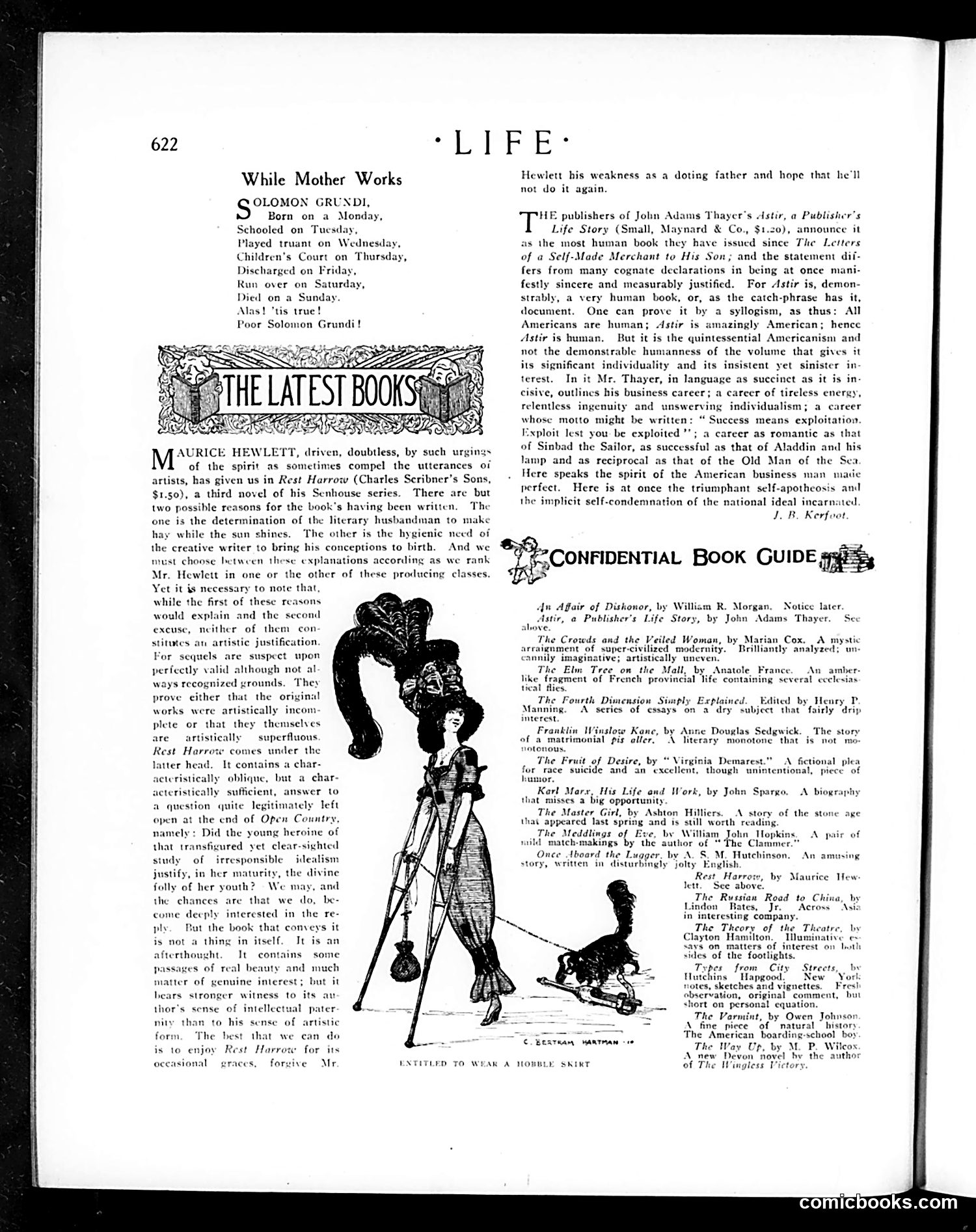
This page contains two book reviews and an unrelated children's rhyme. The main satirical content appears in the **"Astir" review** (right column), which critiques John Adams Thayer's autobiography about his business career. The reviewer uses sharp irony to skewer American capitalist ideology. Thayer's motto—"Success means exploitation. Exploit lest you be exploited"—is presented as the distilled essence of American business culture. The reviewer calls this simultaneously the "triumphant self-apotheosis and implicit self-condemnation of the national ideal incarnated," suggesting American capitalism contains the seeds of its own moral critique. The **cartoon** (center) titled "Entitled to Wear a Hobble Skirt" shows a woman struggling to walk in the restrictive garment while supervised, likely mocking the era's impractical women's fashion as a form of control. The left column reviews Maurice Hewlett's novel *Rest Harrow*, criticizing literary sequels as artistically superfluous—an "afterthought" revealing authorial weakness rather than artistic necessity.
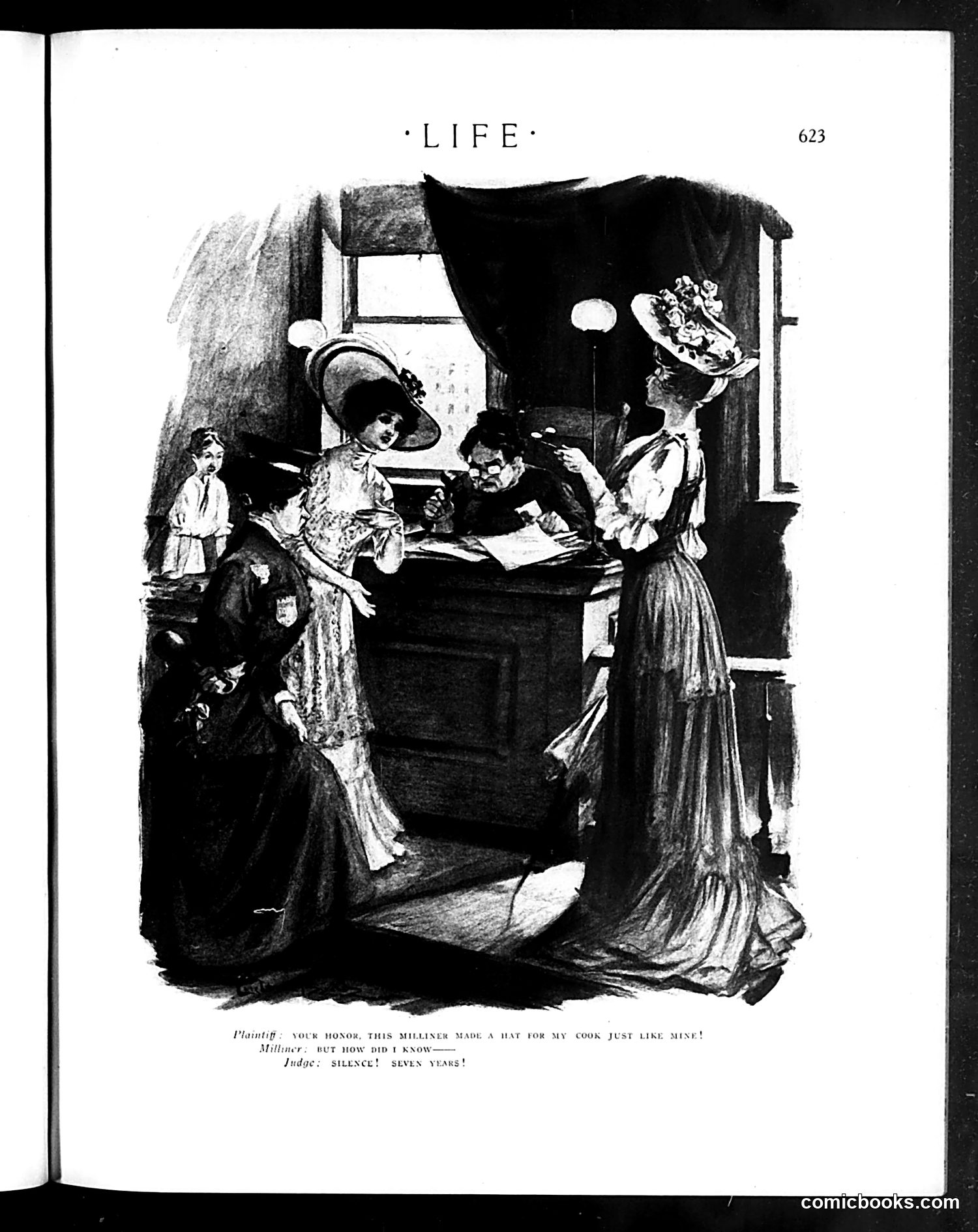
This is a courtroom scene satirizing a frivolous lawsuit. A plaintiff complains that a milliner (hat maker) created an identical hat for her cook as for herself—apparently viewing this as some kind of grievance worthy of legal action. The humor lies in the absurdity: the judge responds with mock severity, sentencing the milliner to "silence! seven years!"—treating a trivial fashion complaint as serious crime. This satirizes both the vanity of wealthy women obsessed with exclusive fashion and the judicial system's potential to waste time on ridiculous disputes. The cartoon mocks class pretension: the plaintiff's concern that her servant wore the same hat style represents shallow social anxiety about status markers. The exaggerated courtroom formality applied to this trivial matter is the joke—exposing the ridiculousness of taking hat ownership so seriously.
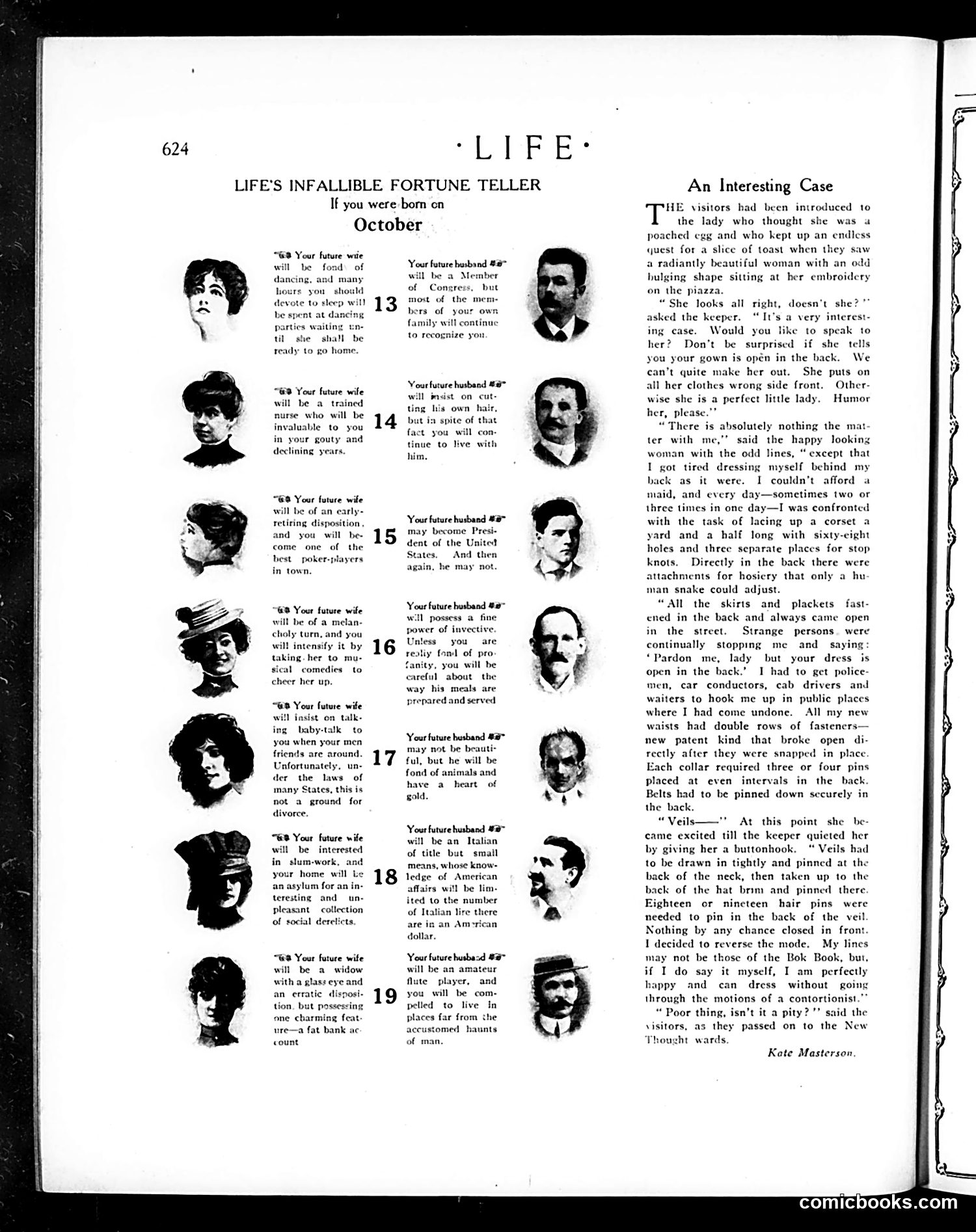
This *Life* magazine page combines two features: a "Fortune Teller" column (left) offering comedic predictions for people born in October, and a humorous article (right) titled "An Interesting Case." The right-hand story satirizes the absurd complexity of women's fashion in the early 1900s. A woman describes the maddening difficulty of Victorian-era clothing: a corset requiring lacing with 68 holes in multiple places, skirts and plackets that constantly came undone, collars needing pins, and veils requiring 18-19 hairpins. Strangers repeatedly stopped her on the street to inform her that her dress was open in back—a problem she couldn't fix herself because most fastenings were positioned behind her body. The satire targets the impracticality of women's fashion of the era, which required constant assistance from others and made independent dressing nearly impossible. The woman's solution—reversing the closings to the front—represents a practical rebellion against restrictive style conventions. The fortune-teller column uses generic, comedic predictions to mock the fortune-telling industry itself.
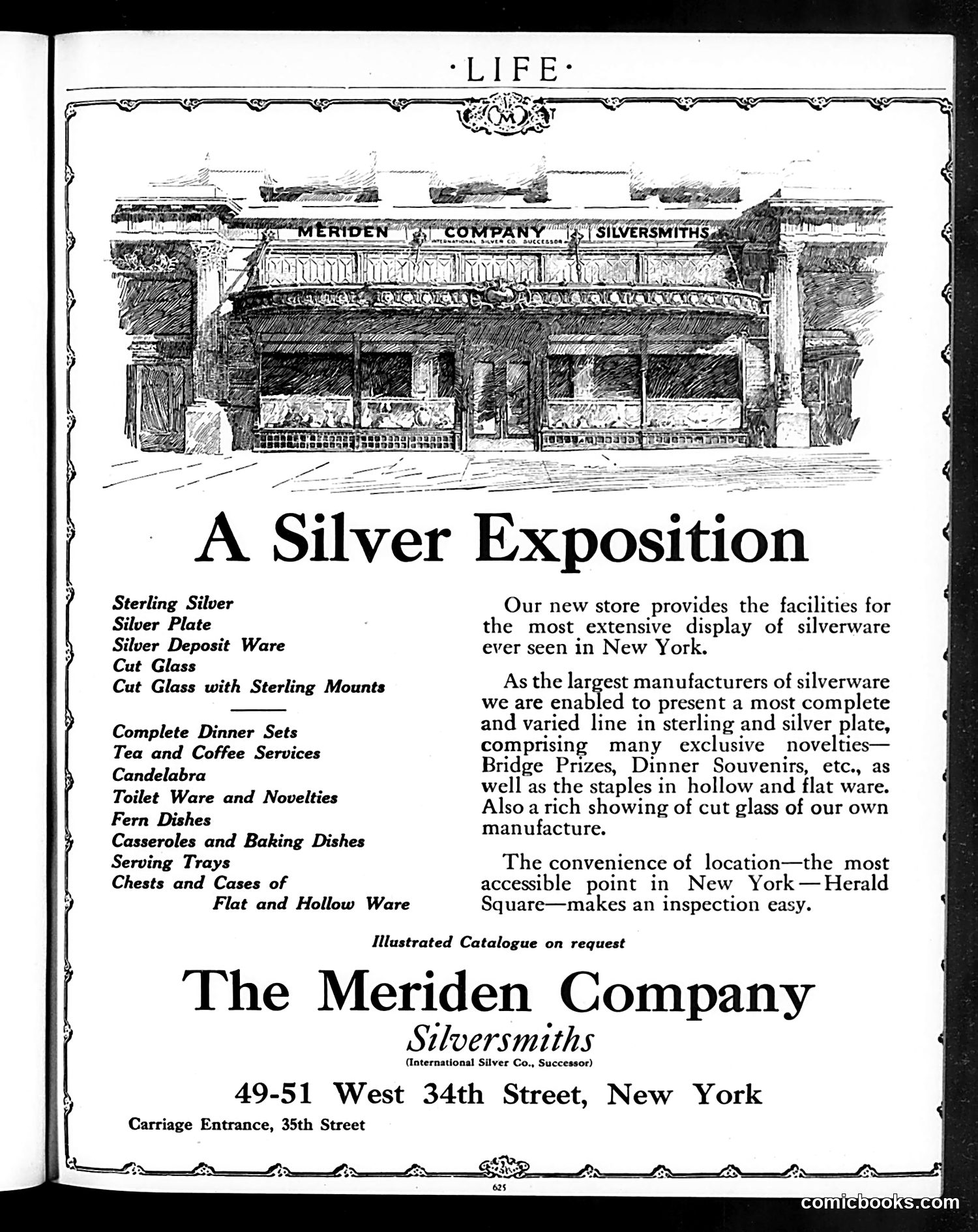
This is **not a cartoon or satirical content** — it's a full-page advertisement for The Meriden Company Silversmiths, appearing in *Life* magazine. The page features an architectural sketch of their storefront on West 34th Street in New York (near Herald Square), advertising their new showroom's extensive silverware display. The ad lists product categories: sterling silver, silver plate, cut glass, dinner sets, tea services, candelabra, and decorative items. The company emphasizes its credentials as "the largest manufacturers of silverware" offering exclusive novelties and "Bridge Prizes" (likely hostess gifts for bridge parties, a popular social activity of the era). They highlight the store's convenient Herald Square location to encourage customer visits. This represents typical early-20th-century *Life* magazine content: luxury retail advertising aimed at affluent readers interested in fine home furnishings and entertaining.
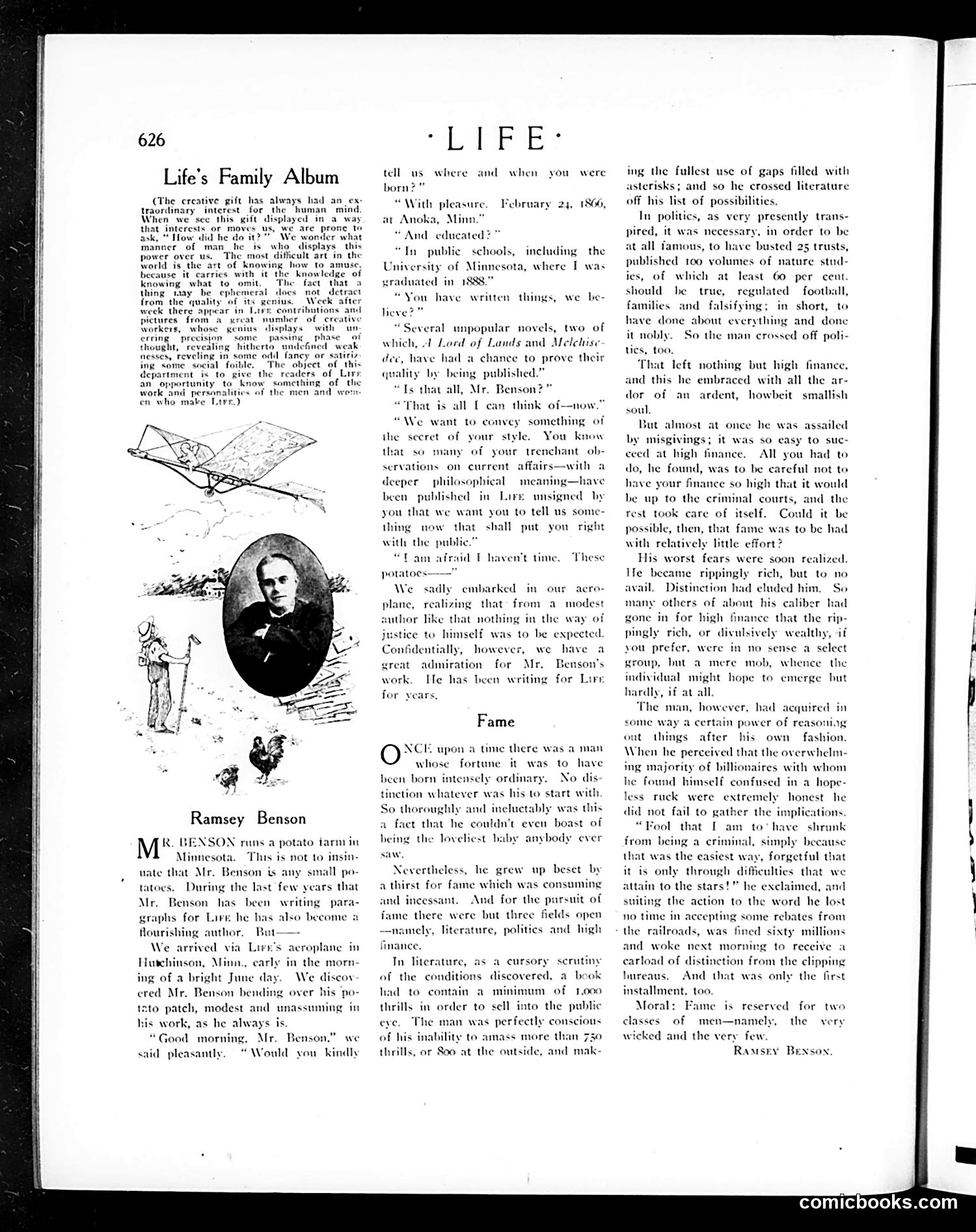
This page features two pieces about creative figures in "Life's Family Album," a recurring feature profiling artists and writers who contributed to the satirical magazine. **Ramsey Benson Profile:** The main subject is a Minnesota potato farmer and author/illustrator who writes paragraphs for *Life*. The piece is gentle biographical humor—capturing Benson's modest, practical nature through an interview conducted at his farm. The satire is affectionate: while he's created unpopular novels and philosophical observations, he's too busy with actual potatoes to discuss his art. **"Fame" Section:** This appears to be satirical commentary on achieving celebrity. It describes an ordinary man seeking fame through three paths—literature (requires 1,000 thrills minimum), politics (requires busting 25 trusts, publishing 100 books, etc.), or high finance. The point is mordant: the barriers to genuine fame are absurdly high and contradictory, making it nearly impossible for average people. The overall tone is *Life*'s characteristic gentle mockery of American ambition and the creative class.
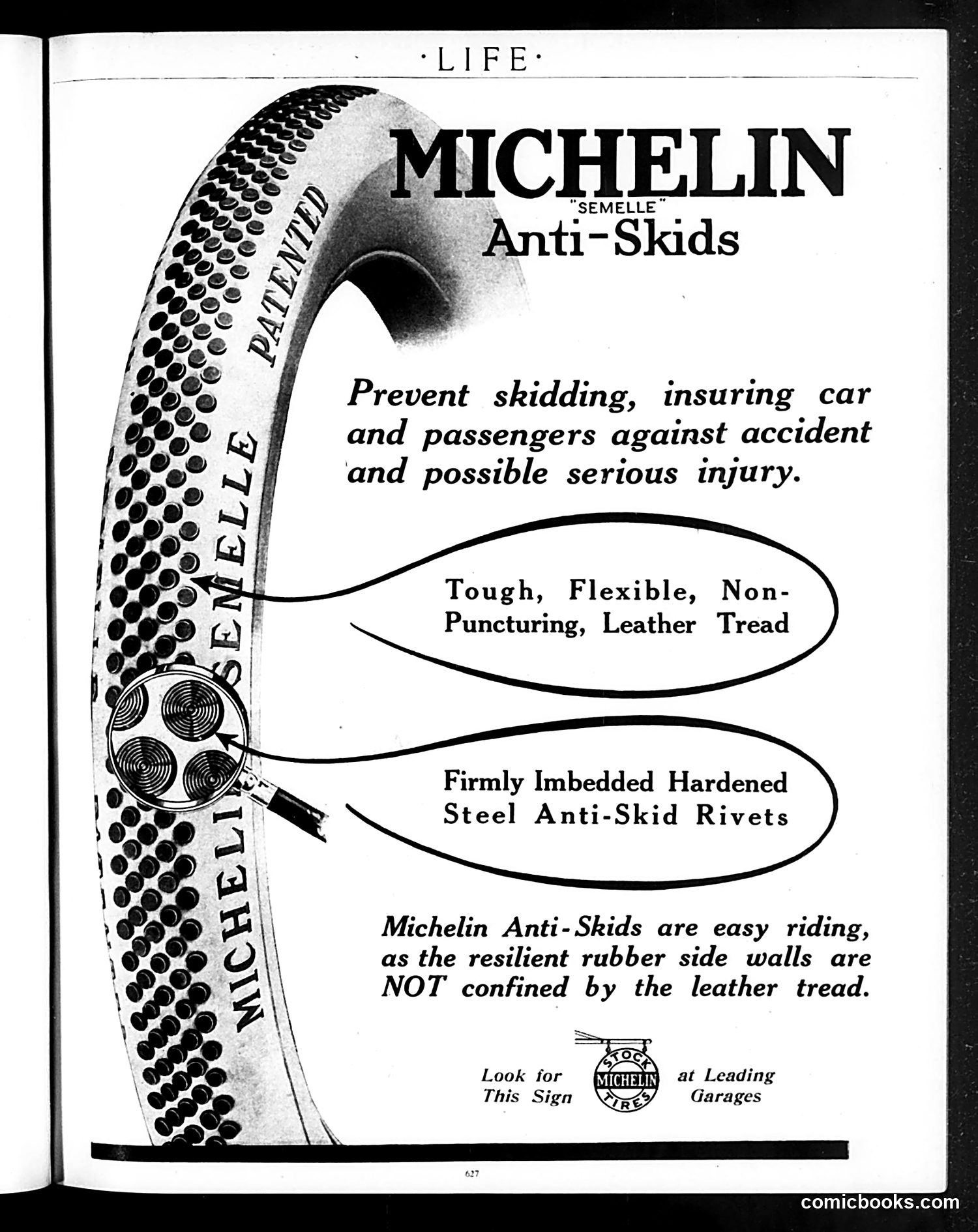
This is **not a cartoon or satire**—it's a **product advertisement** for Michelin "Semelle" Anti-Skids tires, published in *Life* magazine. The page features a technical diagram of a tire cross-section, with callouts explaining its safety features: a leather tread with embedded steel anti-skid rivets designed to prevent vehicle skidding and accidents. The advertisement appeals to early automotive safety concerns, emphasizing that the flexible rubber sidewalls provide a comfortable ride despite the protective metal components. The Michelin Man logo appears at the bottom. This is straightforward marketing for a tire product, not satirical content.
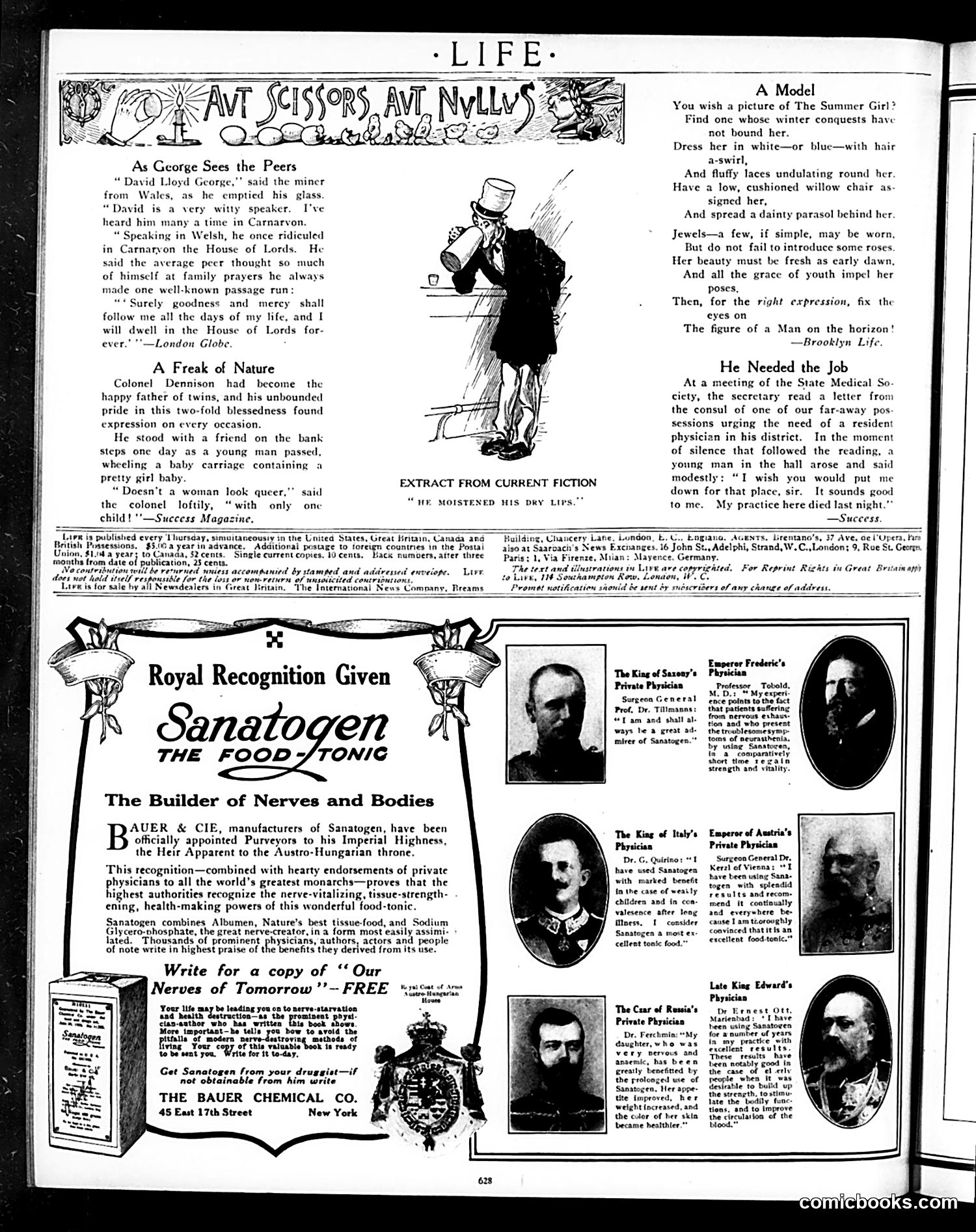
This page contains several satirical pieces and advertisements typical of early 20th-century Life magazine. **"As George Sees the Peers"** ridicules David Lloyd George (Welsh politician) through a anecdote: he allegedly mocked the House of Lords by suggesting peers were so self-centered they altered Bible passages to read "I will dwell in the House of Lords forever"—satirizing aristocratic vanity and irrelevance. **"A Freak of Nature"** jokes about Colonel Dennison's pride in twin boys, contrasting his boastfulness with a passing man wheeling a single girl baby. The colonel's dismissive comment about the man's choice ("Doesn't a woman look queer") satirizes outdated gender attitudes. **"He Needed the Job"** depicts dark humor: a desperate physician at a medical society meeting volunteers for a remote district position, admitting his local practice just collapsed. The page is dominated by a **Sanatogen advertisement** claiming royal endorsements as a health tonic—typical turn-of-the-century medicinal product marketing using aristocratic legitimacy to sell dubious tonics.
This is a **full-page advertisement**, not satire or editorial content. It promotes The Gorham Company's wedding invitation services, located on Fifth Avenue in New York. The ad emphasizes luxury and craftsmanship, claiming their invitations meet "the highest known authorities" and possess "unequalled refinement of execution." It appeals to wealthy clients seeking prestigious stationery through flattery about quality and artistic skill. This reflects early 20th-century advertising conventions targeting the upper class, where elaborate wedding invitations signaled social status. There are no political cartoons, caricatures, or satirical commentary on this page—it's straightforward commercial promotion in *Life* magazine.
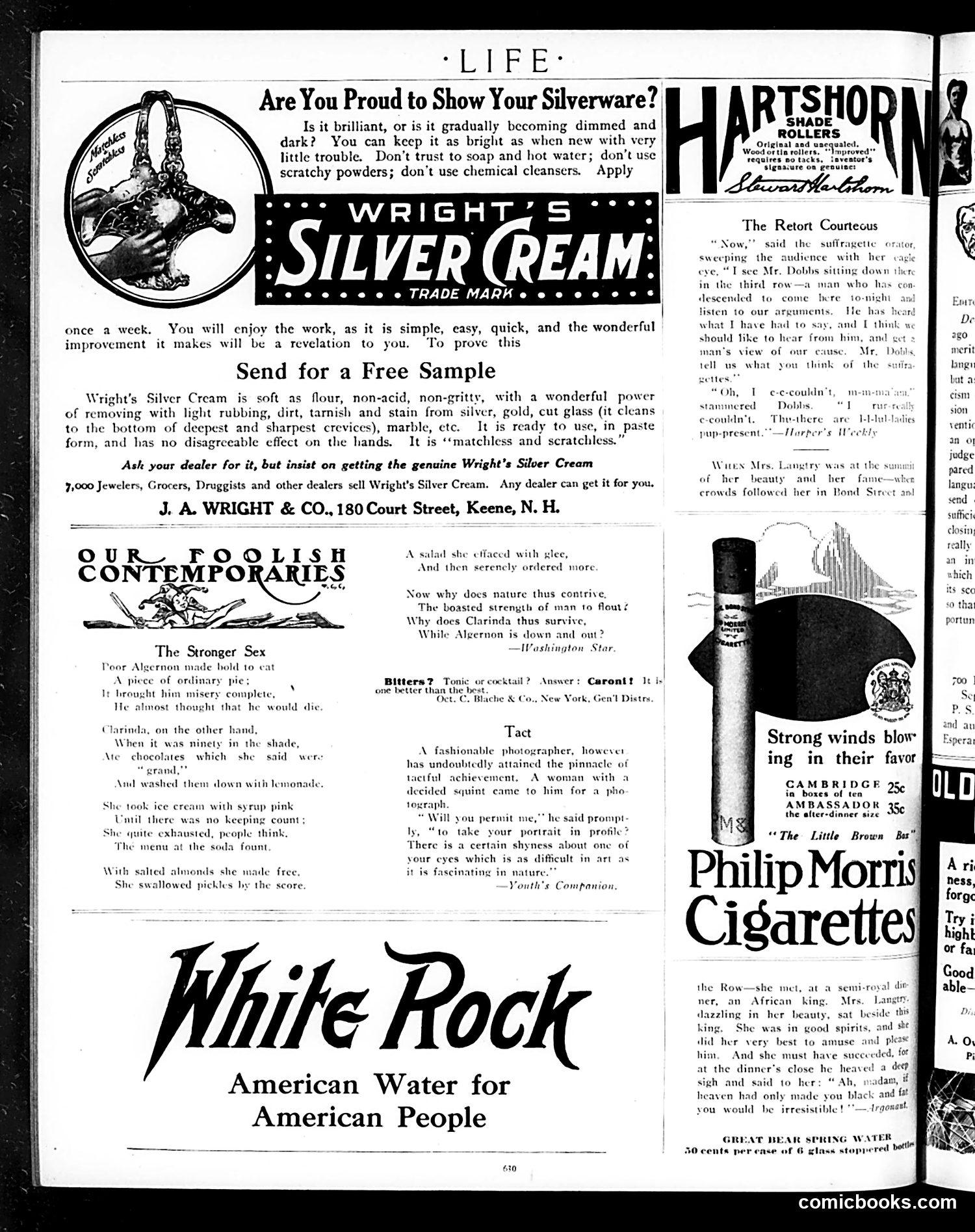
This page mixes advertising with satirical humor typical of early-20th-century Life magazine. **Main Content:** The centerpiece is "Our Foolish Contemporaries," a humor section featuring three brief satirical pieces: 1. **"The Stronger Sex"** contrasts a man (Algernon) made ill by eating one pie with a woman (Clarinda) who consumes enormous quantities of ice cream, pickles, and sweets without consequence. The joke plays on contemporary anxieties about female physical resilience versus male fragility—inverting expected gender stereotypes about strength. 2. **"The Retort Courteous"** depicts a suffragette orator challenging a man (Mr. Dobbs) in the audience. He stammers evasively rather than engage her arguments, suggesting men's discomfort confronting women's political activism. 3. **"Tact"** humorously presents a photographer's suggestion to photograph a woman in profile to hide a squinting eye. **Surrounding Advertisements** promote Wright's Silver Cream, Hartshorn Shade Rollers, Philip Morris Cigarettes, and White Rock water—typical period products. The satire reflects early-1900s social debates around women's rights and changing gender roles.
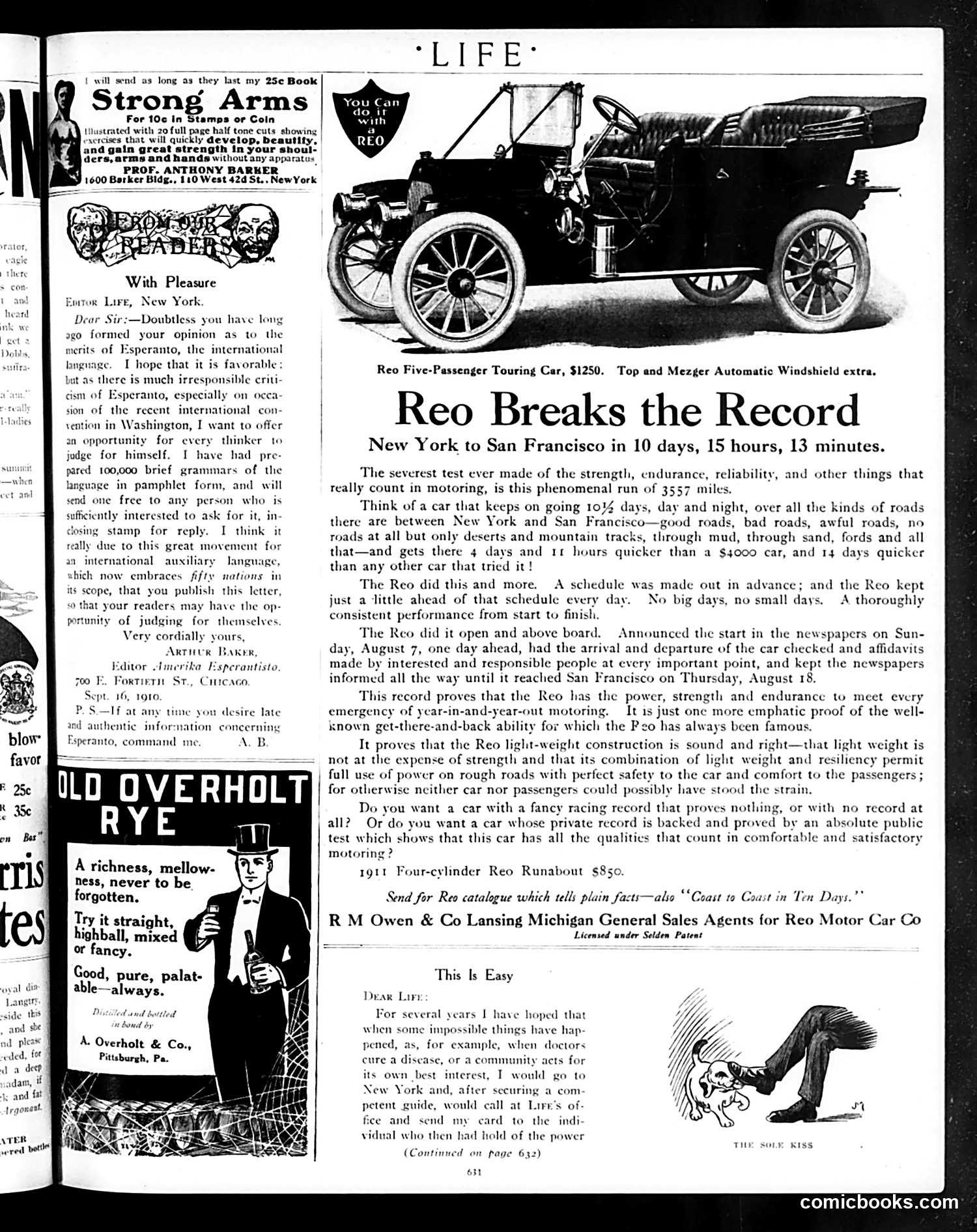
This page primarily consists of **advertisements and reader letters**, not political satire. The main content is a **Reo automobile advertisement** celebrating a cross-country speed record: New York to San Francisco in 10 days, 15 hours. The ad emphasizes the car's reliability, durability, and light-weight construction by contrasting it with more expensive competitors ($4,000 cars that took longer). Supporting advertisements include: - **Prof. Anthony Barker's "Strong Arms" mail-order fitness book** (10¢)—a typical early-1900s physical culture promotion - **Overholt Rye whiskey**—marketed as "rich, mellow" - **Old Overholt & Co.** branding Reader letters discuss **Esperanto**, the international auxiliary language movement (then active, having held a convention in Washington). The correspondent advocates for the language's adoption. There is **no political cartoon or satire** on this page. It reflects early-1910s American consumer culture: automobiles, fitness crazes, and progressive international movements alongside traditional whiskey marketing.
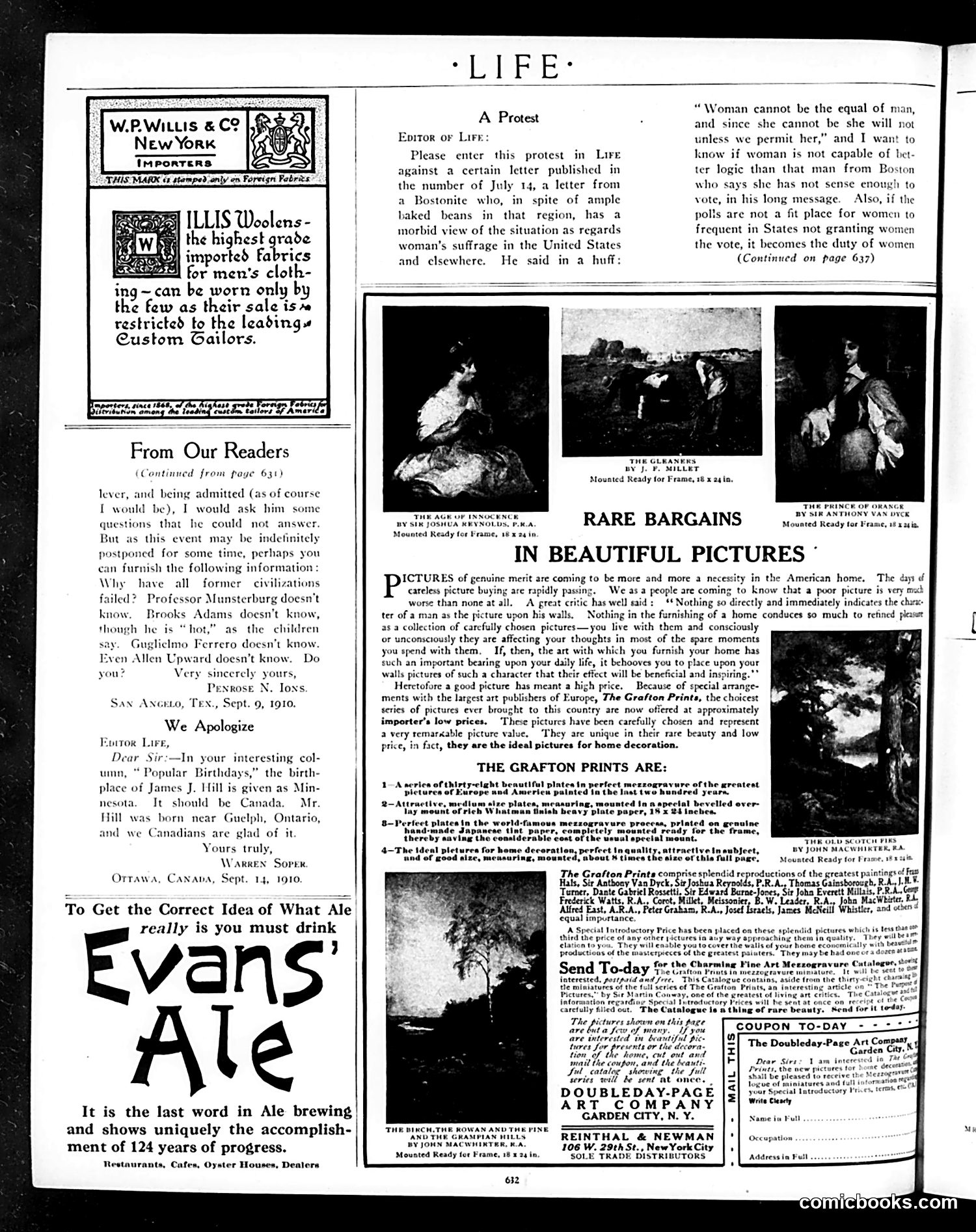
This page contains **reader letters and art advertisements**, not political cartoons. The notable content is a **women's suffrage debate**. A reader protests a previous letter from "a Bostonite" who opposed women's voting rights, arguing women lacked sufficient sense to vote. The protesting reader challenges this logic, asking sarcastically whether a woman couldn't reason better than a man claiming women are incapable—unless "we permit her." The reader also questions why polling places should be off-limits to women in non-suffrage states. This reflects the **pre-1920 suffrage movement**, when women's voting rights remained contested and actively debated in public forums like *Life* magazine. The tone suggests growing frustration with paternalistic arguments against female enfranchisement. The remainder consists of **advertisements**: wool fabrics for custom tailors, Evans' Ale, and notably, reproductions of classical paintings ("Grafton Prints") marketed as affordable home decoration—reflecting emerging middle-class consumer culture.
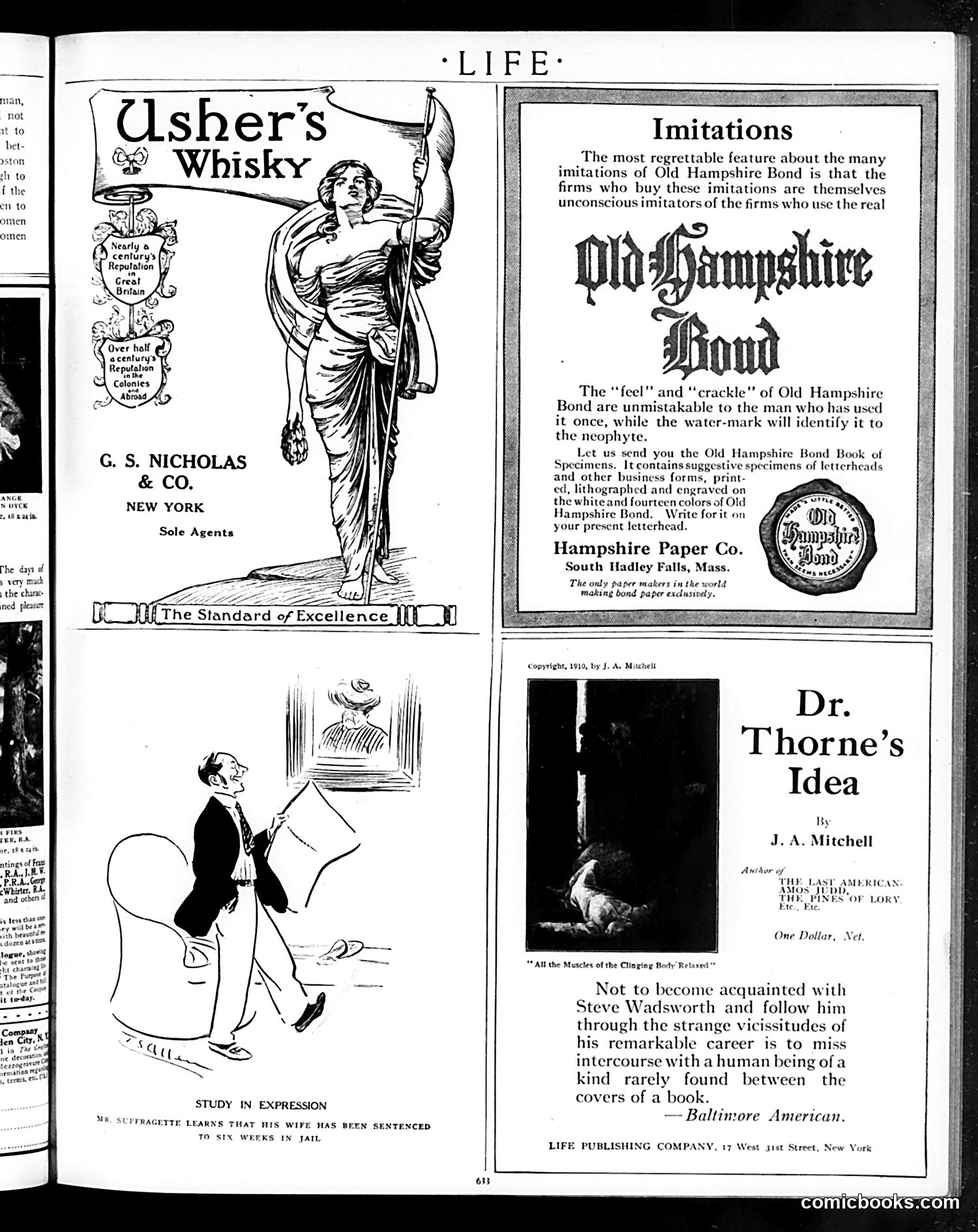
This page contains three distinct elements: **Top left: Usher's Whisky advertisement** featuring a classical female figure representing the product's "standard of excellence." **Bottom left: Political cartoon titled "Study in Expression"** satirizing the suffragette movement. It depicts a man (labeled a suffragette) receiving news that his wife has been sentenced to six weeks in jail—likely for suffrage activism. The joke targets male suffragists or husbands of suffragists, mocking their distressed reaction to their wives' legal consequences for political protest. **Right side: Two advertisements** for Old Hampshire Bond paper (emphasizing authentic versus counterfeit products) and Dr. Thorne's Idea (a book by J.A. Mitchell). The cartoon reflects early 20th-century resistance to women's suffrage, using humor to ridicule the movement and those associated with it.
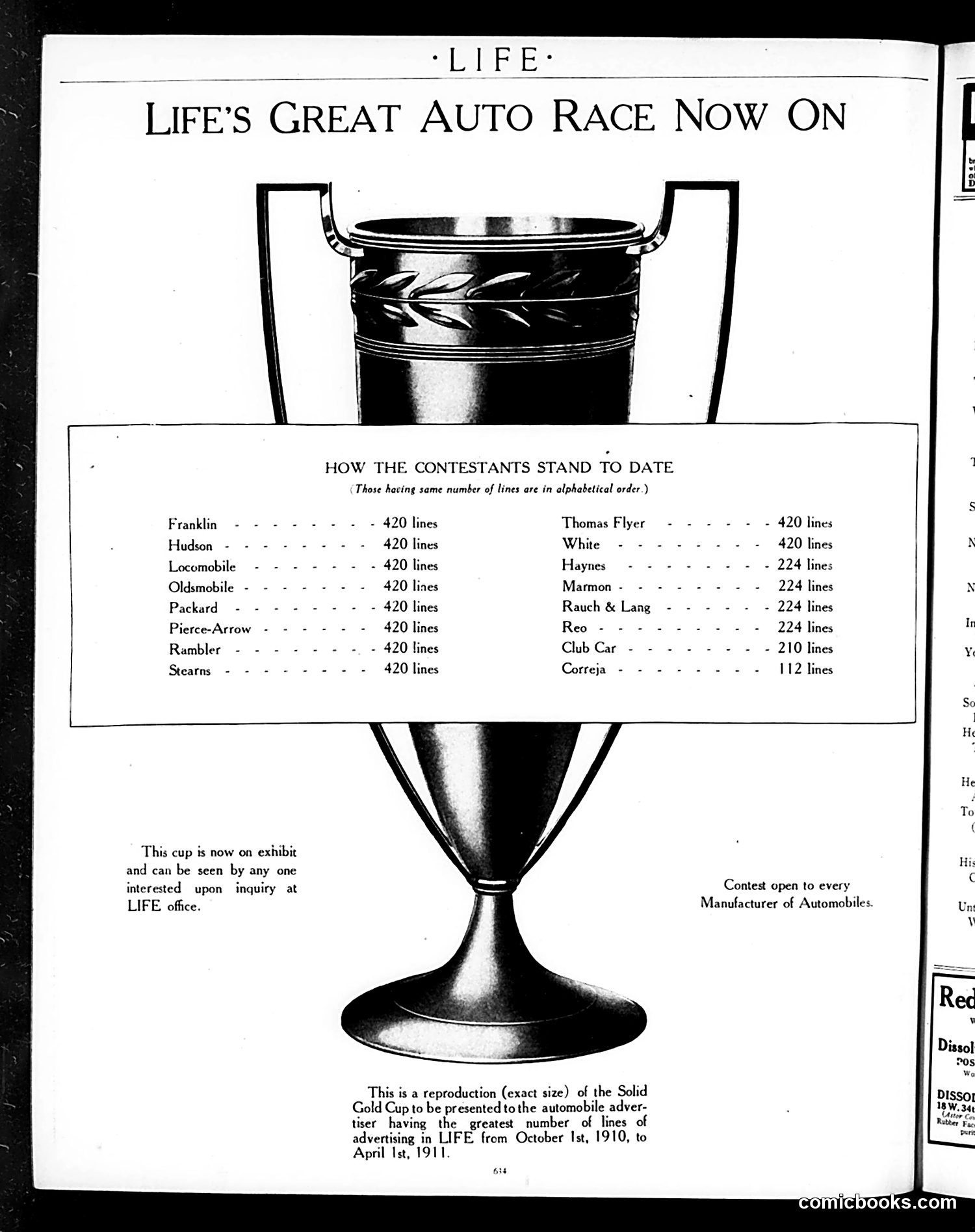
This page satirizes the competition among automobile manufacturers for advertising space in *Life* magazine. Rather than competing on the road, car companies compete for editorial prominence—measured in "lines" of advertising published between October 1910 and April 1911. The "race" is a humorous inversion: instead of speed or innovation, success means spending the most on ads. The trophy—a solid gold cup—goes to whichever auto maker purchases the most advertising. Companies like Franklin, Hudson, and Oldsmobile lead with 420 lines each, while Correja trails at 112 lines. The satire mocks both automotive industry marketing excess and *Life* magazine's own mercenary dependence on advertising revenue. By framing ad spending as competitive sport, the page wryly suggests that corporate advertising budgets—not engineering or customer preference—determine automotive "winners."
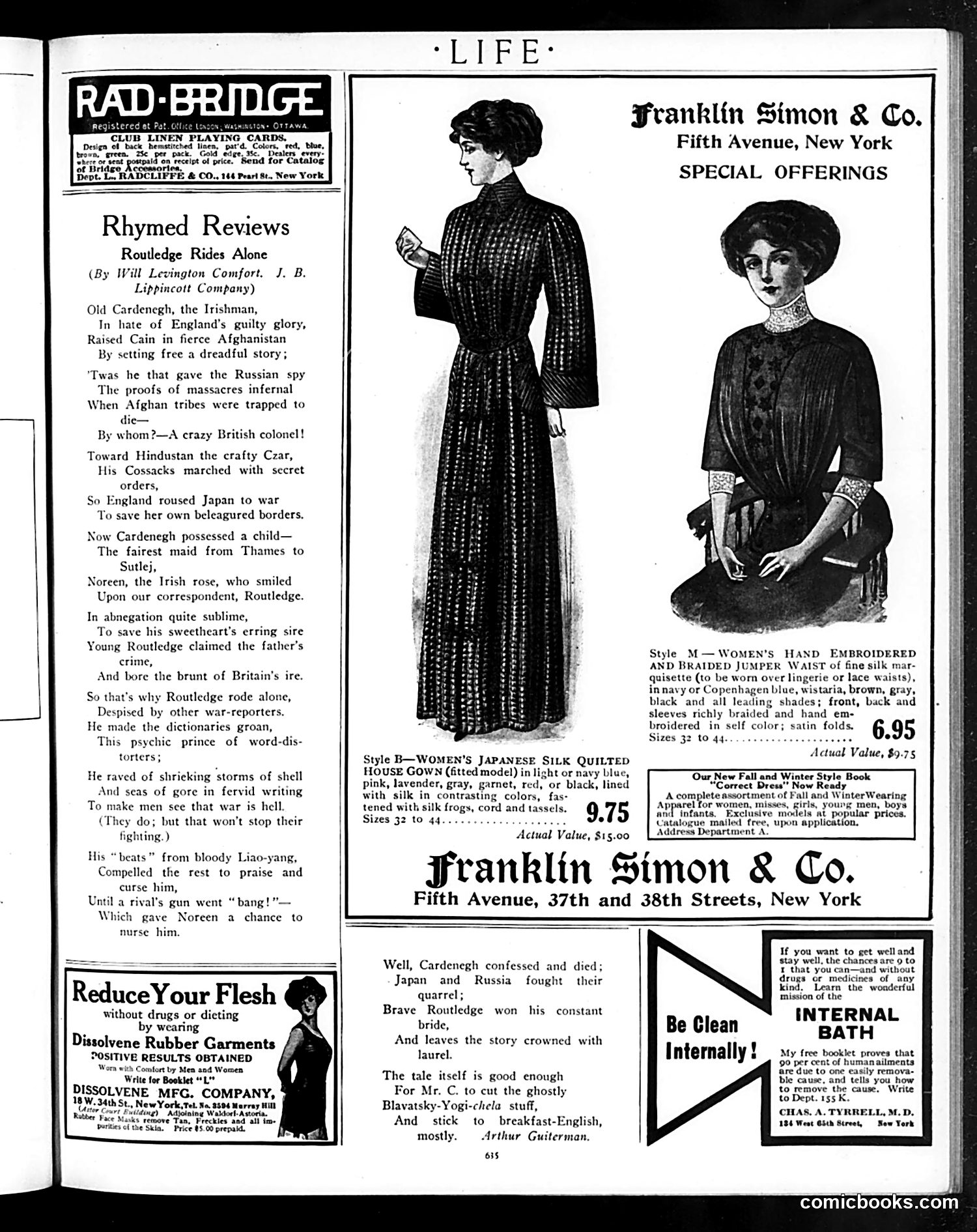
This page is primarily **advertising and book reviews**, not political satire. The main content is a rhymed book review of "Routledge Rides Alone" by Will Levington Comfort. The plot involves an Irish-born British correspondent named Routledge caught in imperial geopolitics: an Irish rebel (Cardenegh) leaks Russian secrets to embarrass England; Russia and Japan consequently go to war over colonial interests; Routledge sacrifices his reputation to protect Cardenegh's daughter (his love interest), eventually winning her hand. The review's satirical edge targets the book itself—critic Arthur Guiterman gently mocks Comfort for abandoning mystical "Blavatsky-Yogi-chela stuff" to write straightforward adventure fiction. The poem doesn't attack real political figures but rather critiques overwrought war correspondence and imperial rivalries as plot devices. The surrounding ads (rubber weight-loss garments, women's clothing, wellness products) are typical period advertisements unrelated to the review's content.
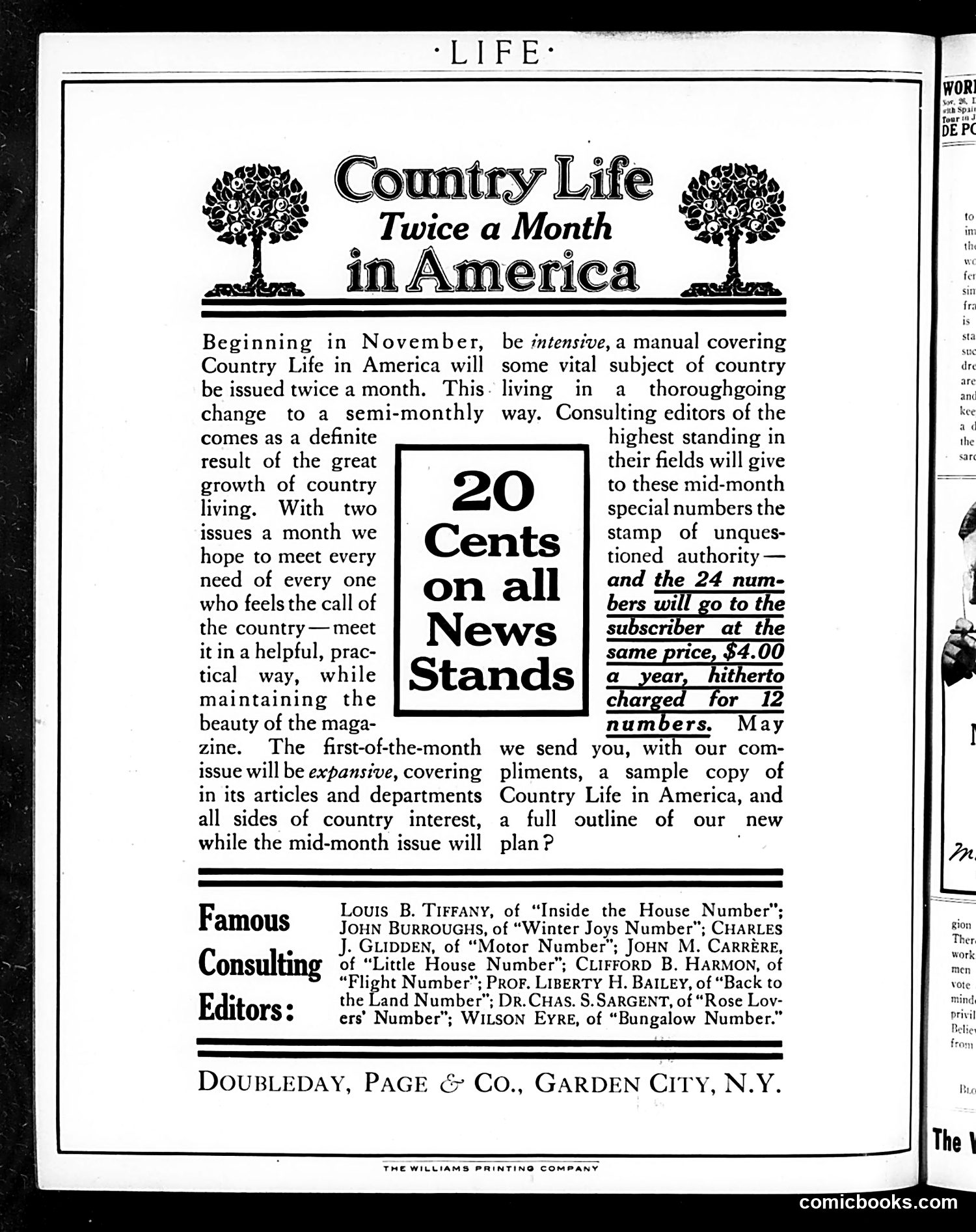
This is **not a cartoon or satire**, but rather a **straightforward advertisement/announcement** from *Life* magazine. The page announces that *Country Life in America* magazine will shift from monthly to twice-monthly publication beginning November. The two-issue format will split content: the first-of-month issue covers diverse country topics broadly ("expansive"), while the mid-month issue focuses deeply on single subjects ("intensive"). The key selling point: subscribers still pay $4.00 annually for 24 issues instead of 12—essentially doubling content at the same price. The "Famous Consulting Editors" listed (Louis Tiffany, John Burroughs, Charles Glidden, etc.) lend authority by featuring prominent names in their respective fields: interior design, nature writing, automobiles, architecture, aviation, horticulture, and landscape design. **For modern readers**: This reflects early 1900s aspirational marketing targeting America's growing middle-class interest in rural living, home improvement, and country estates—positioning the magazine as an authoritative guide to this lifestyle.
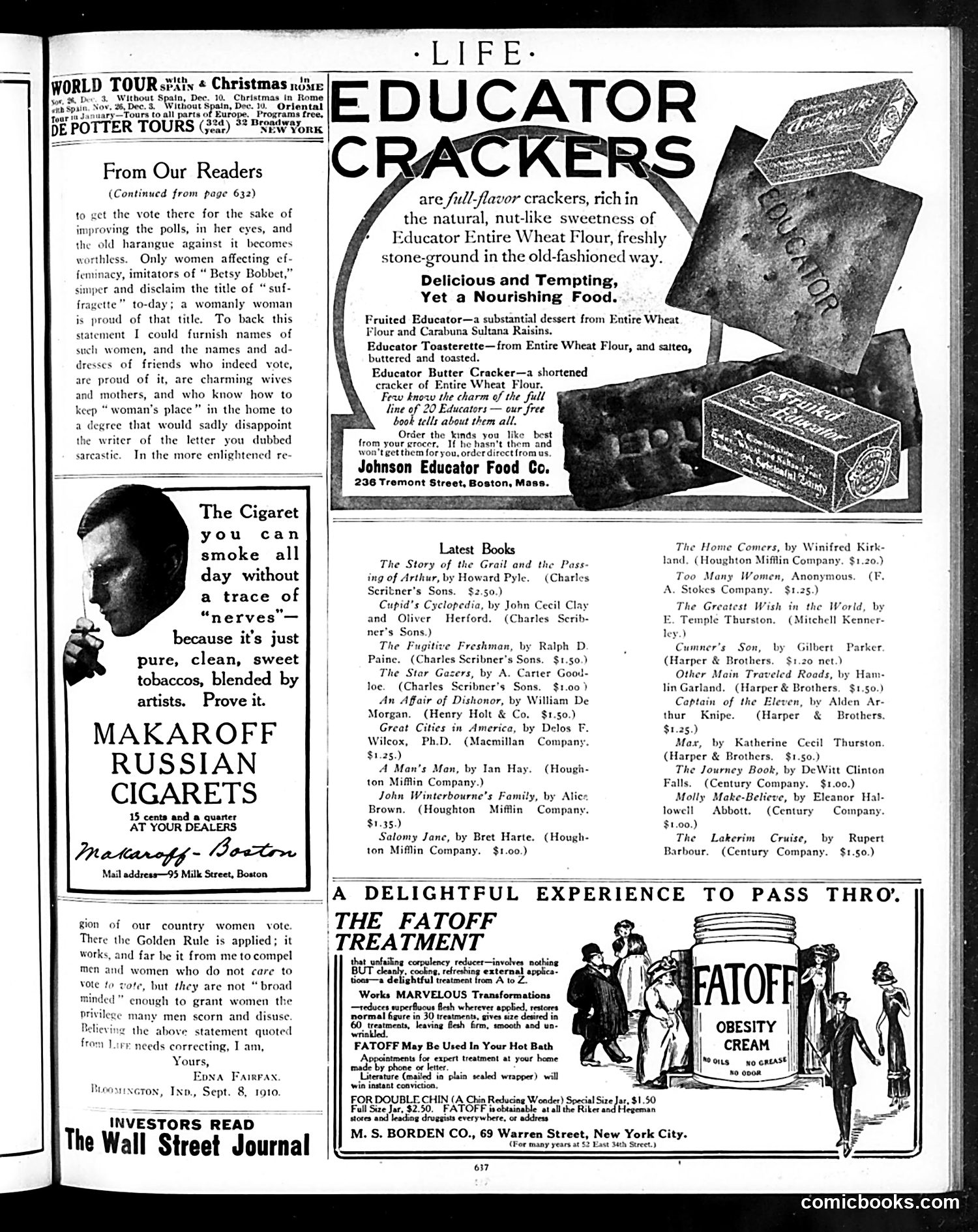
This page is primarily **advertising and book reviews** with minimal editorial content. The notable elements: **"From Our Readers"** column: A letter from "Edna Fairfax" (Bloomington, Indiana, Sept. 8, 1910) defends women's suffrage against critics. She argues that women who vote are still capable wives and mothers, refuting the claim that voting women are "unfeminine." She criticizes opponents as insufficiently "broad minded" for denying women voting rights while many men ignore their own voting privilege. **Advertisements dominate the page:** - Makaroff Russian Cigarettes - Educator Crackers (positioned as healthful, "nourishing food") - Fatoff Obesity Cream (weight-loss treatment) The suffrage letter reflects the **1910 women's voting rights debate** in America, still a decade before the 19th Amendment (1920). The context shows anti-suffrage arguments centered on femininity and "woman's place," which this reader directly challenges.
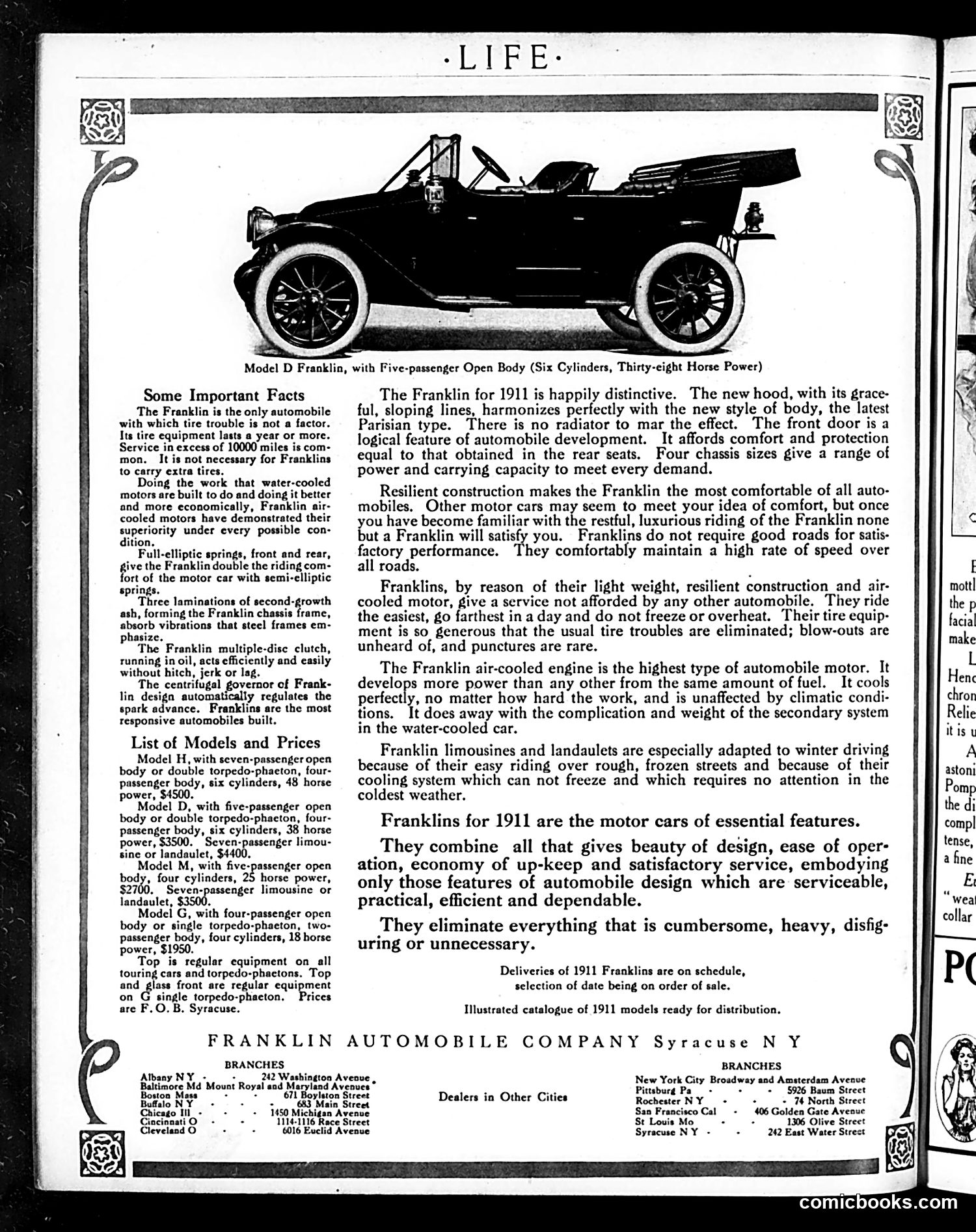
This page is entirely an advertisement for Franklin automobiles, not satire or political commentary. It showcases the Model D Franklin—a five-passenger touring car with six cylinders and 38 horsepower. The ad emphasizes Franklin's distinctive engineering features: air-cooled (rather than water-cooled) engines, resilient suspension, durable tires requiring no spares, and French-inspired body styling. The copy targets affluent buyers concerned with comfort, reliability, and low maintenance on early 1900s roads. Notably, the ad addresses practical concerns of the era: tire failures, engine overheating, and rough road conditions. Prices range from $1,950 to $4,500—substantial sums in 1911. The company lists multiple branches and dealers across major American cities, indicating Franklin's national market presence. This reflects the pre-assembly-line automotive industry, when numerous manufacturers competed before Ford's dominance.
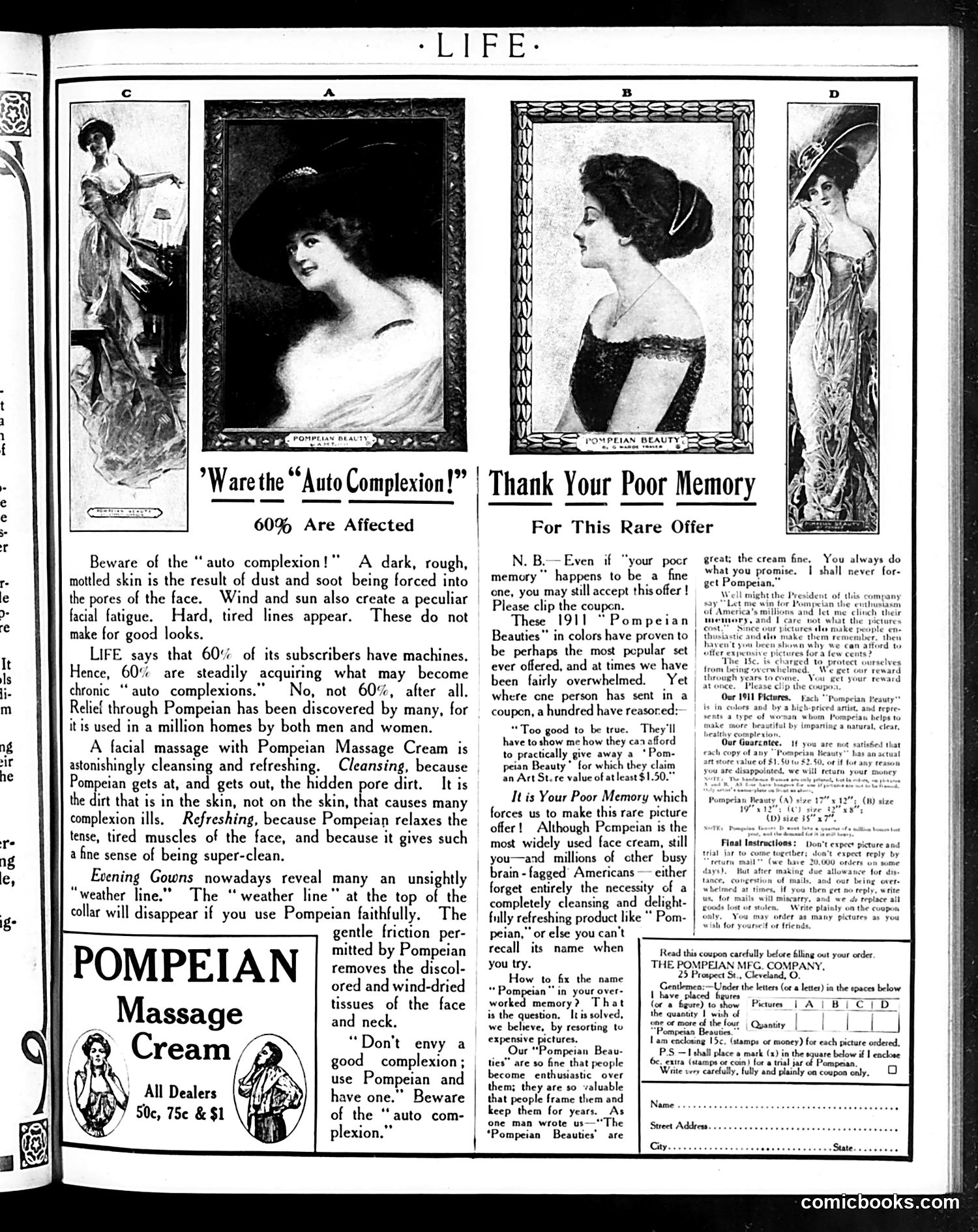
This page is primarily **advertising for Pompeian Massage Cream**, not satire. However, it uses social commentary to market the product. The "auto complexion" concept satirizes a modern problem: the automobile. Life notes that 60% of its subscribers own cars, and driving exposes faces to dust, soot, wind, and sun—creating dark, rough, prematurely aged skin. This was a **genuine concern of the early 1910s**, when automobiles were still novelties and driving was an open-air experience without protective glass. The right panel offers free "Pompeian Beauty" portrait pictures as promotional incentive, humorously suggesting people have "poor memory" and forget to use the product. The portraits (images A-D) display idealized female beauty standards of the era—fashionably dressed, smooth-skinned women. The satire lies in the irony: modern technology (automobiles) creates a beauty problem that requires purchasing a cosmetic solution. It's gentle mockery of both automotive culture and consumer anxiety about appearance.
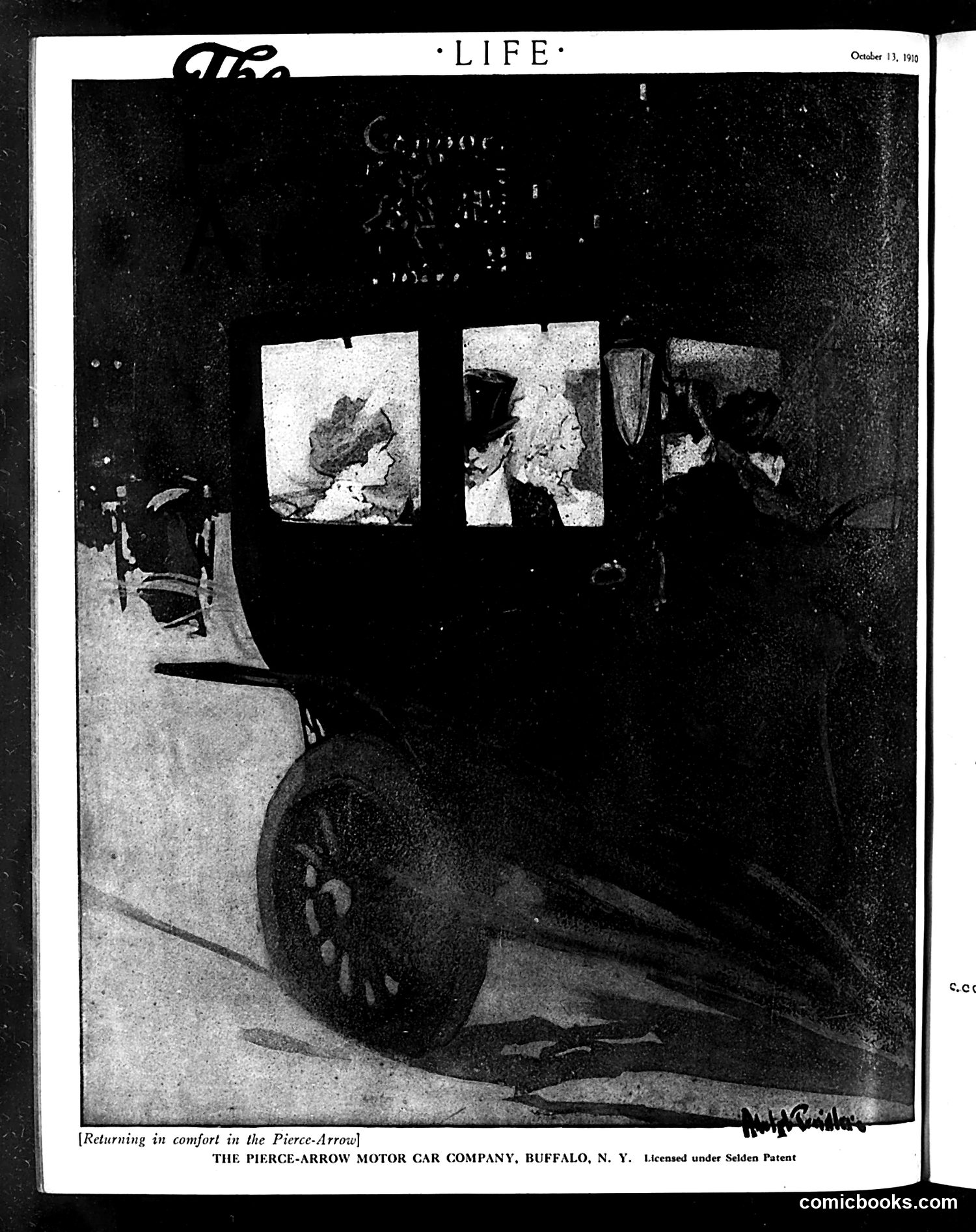
This is an advertisement for the Pierce-Arrow Motor Car Company of Buffalo, New York. The image shows a luxurious automobile with passengers viewing what appears to be an art exhibition or display through windows mounted on the vehicle's side. The caption reads "Returning in comfort in the Pierce-Arrow," suggesting the ad's message: that Pierce-Arrow vehicles provide refined, comfortable transportation. The displayed artwork visible through the windows implies cultured, leisured travel—passengers can enjoy cultural attractions while traveling in style. This reflects early 1910s advertising strategy: positioning automobiles as symbols of sophistication and comfort for the wealthy. The reference to "Selden Patent" indicates Pierce-Arrow's licensing under this foundational automotive patent, which was significant in the industry during this period.