
Life, 1910-10-13 · page 10 of 44
Life — October 13, 1910 — page 10: what you’re looking at
What you’re looking at
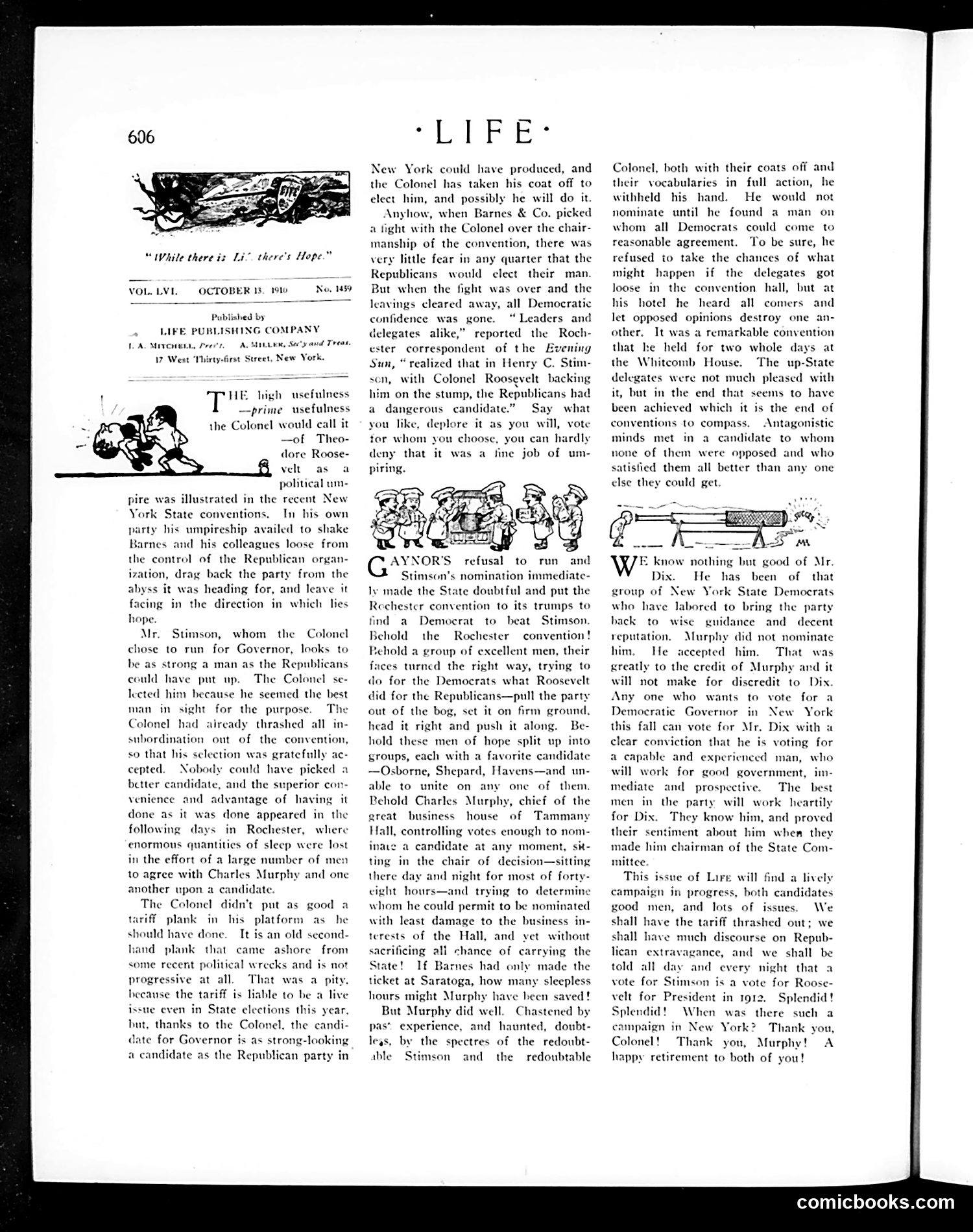
This page satirizes New York State Democratic politics, specifically the 1910 gubernatorial race. The text discusses Colonel Roosevelt's refusal to openly support a candidate, leaving the party uncertain. The article criticizes the Democratic convention's inability to unite around a single nominee to oppose the Republican candidate. Key figures referenced include **Henry Stimson** (Roosevelt's choice for Governor) and **Charles Murphy** (Tammany Hall boss), who controlled Democratic voting blocs. The satire mocks Democratic disorganization—Murphy spent forty-eight hours trying to determine whom to nominate, suggesting party dysfunction. The cartoon (showing figures debating/negotiating) illustrates this internal chaos. The piece celebrates Murphy's eventual selection while criticizing Democratic Convention mismanagement compared to Republican efficiency under Roosevelt's influence.
📄 Transcribed text from this page (OCR, searchable)
Machine-transcribed from the original scan — historical spelling and the odd misread are preserved.
“While there is Li’ there's Hope.” VOL. LVL. No. 1459 OCTOBER 18. 19t0 lished by IEE PUBLISHING COMPANY IAL Meventna, Preece AL MILLUK, Sec’ aud Treas, 17 West ‘Thirty-first Street, New York, HE high usefulness —prime usefulness the Colonel would call it —of Theo- dore Roose- velt as a political um- pire was illustrated in the recent New York State conventions. In his own party his umpireship availed to shake Barnes and his colleagues loose from the control of the Republican organ- ization, drag back the party from the abyss it was heading for, and leave it facing in the direction in which lies hope. Mr. Stimson, whom the Colonel chose to run for Governor, looks to be as strong a man as the Republicans could have put up. The Colonel se- lected him because he seemed the best man in sight for the purpose. The Colonel had aiready thrashed all in- subordination out of the convention, so that his selection was gratefully ac- cepted. Nobody could have picked a better candidate, and the superior con- venience and advantage of having it done as it was done appeared in the following days in Rochester, where enormous quantities of sleep were lost in the effort of a large number of men to agree with Charles Murphy and one another upon a candidate. The Colonel didn’t put as good a iriff plank in should have done. hand plank that some recent political wrecks and is not progressive at all. That was a pity, because the tariff is liable to be a live issue even in State elections this year, but, thanks to the Colonel, the candi- date for Governor is as strong-looking a candidate as the Republican party in his platform as he It is an old second- came ashore from *LIFE* New York could have produced, and the Colonel has taken his coat off to elect him, and possibly he will do it. Anyhow, when Barnes & Co. picked a tight with the Colonel over the chair- manship of the convention, there was very little fear in any quarter that the Republicans would elect their man. But when the fight was over and the Ieavings cleared away, all Democratic confidence gone. “Leaders and reported the Roch- ester correspondent of the Evening Sun, “realized that in Henry C. Stim- son, with Colonel Roosevelt backing him on the stump, the Republicans had a dangerous candidate.” Say what you like, deplore it as you will, vote for whom you choose, you can hardly deny that it was a fine job of um- piring. G*Y SOR’S refusal to run and Stimson’s nomination immediate- ly made the State doubtful and put the Rechester convention to its trumps to tind a Democrat to beat Stimson. Behold the Rochester convention! Behold a group of excellent men, their faces turned the right way, trying to do for the Democrats what Roosevelt did for the Republicans—pull the party out of the bog, set it on firm ground, head it right and push it along. Be- hold these men of hope split up into groups, each with a favorite candidate —Osborne, Shepard, Havens—and un- able to unite on any one of them. Behold Charles Murphy, chief of the great business house of Tammany Hall, controlling votes enough to nom- inace a candidate at any moment, sik- ting in the chair of decision—sitting there day and night for most of forty- eight hours—and trying to determine whom he could permit to be nominated with least damage to the business in- terests of the Hall, and yet without sacrificing all chance of carrying the State! ticket at hours might Murphy have heen saved! But Murphy did well. Chastened by pas’ experience, and haunted, doubt- leas, by the spectres of the redoubt- thle Stimson and the redoubtable If Barnes had only made the ‘atoga, how many sleepless Colonel, hoth with their coats off and their vocabularies in full action, he withheld his hand. He would not nominate until he found a man on whom all Democrats could come to reasonable agreement. To be sure, he refused to take the chances of what might happen if the delegates got loose in the convention hall, but at his hotel he heard all comers and let opposed opinions destroy one an- other, It was a remarkable convention that he held for two whole days at the Whitcomb The up-State delegates were not much pleased with it, but in the end that seems to have been achieved which it is the end of conventions to compass. minds none of them were opposed and who satisfied them all better than any one else they could get House, Antagonistic met in a candidate to whom 2 know nothing but good of Mr. Di: He has been of that group of New York State Democrats who have labored to bring the party back to wise guidance and decent reputation. Murphy did not nominate him, He accepted him. That was greatly to the credit of Murphy and it will not make for discredit to Dix Any one who wants to vote for a Democratic Governor in New York this fall can vote for Mr. Dix with a clear conviction that he is voting for a capable and experienced man, who will work for good government, im- mediate and The best men in the party will work heartily for Dix. They know him, and proved their sentiment about him when they made him chairman of the State Com- mittee. This issue of Lire will find a lively campaign in progress, both candidates good men, and lots of issues. We shall have the tariff thrashed out; we shall have much discourse on Repub- lican extravagance, we shall be told all day and every night that a vote for Stimson is a vote for Roose- velt for President in 1912. Splendid! Splendid! When was there such a campaign in New York? Thank you, Colonel! Thank you, Murphy! A happy retirement to both of you! prospective. and comicbooks.com