
Life, 1910-10-13 · page 26 of 44
Life — October 13, 1910 — page 26: what you’re looking at
What you’re looking at
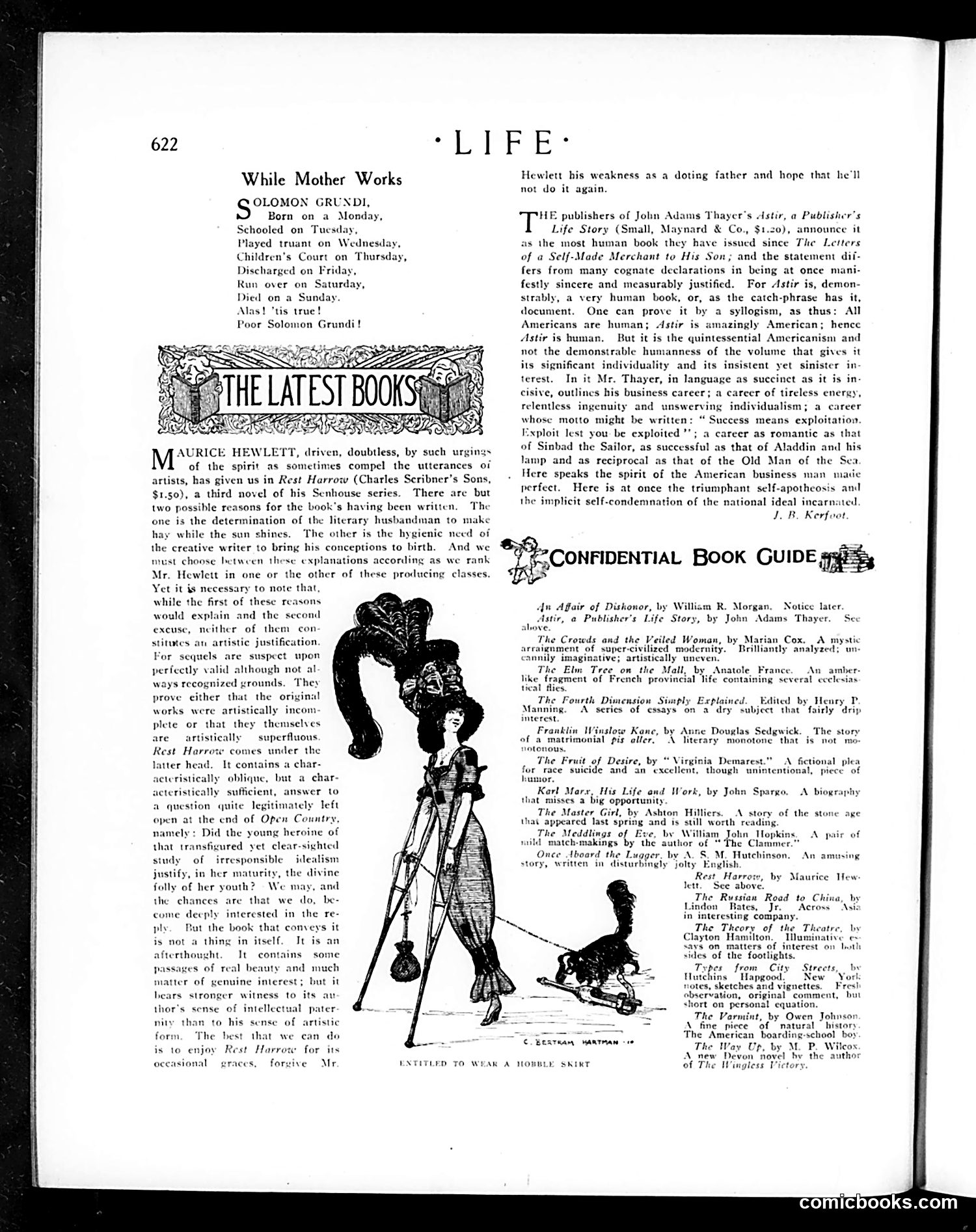
This page contains two book reviews and an unrelated children's rhyme. The main satirical content appears in the **"Astir" review** (right column), which critiques John Adams Thayer's autobiography about his business career. The reviewer uses sharp irony to skewer American capitalist ideology. Thayer's motto—"Success means exploitation. Exploit lest you be exploited"—is presented as the distilled essence of American business culture. The reviewer calls this simultaneously the "triumphant self-apotheosis and implicit self-condemnation of the national ideal incarnated," suggesting American capitalism contains the seeds of its own moral critique. The **cartoon** (center) titled "Entitled to Wear a Hobble Skirt" shows a woman struggling to walk in the restrictive garment while supervised, likely mocking the era's impractical women's fashion as a form of control. The left column reviews Maurice Hewlett's novel *Rest Harrow*, criticizing literary sequels as artistically superfluous—an "afterthought" revealing authorial weakness rather than artistic necessity.
📄 Transcribed text from this page (OCR, searchable)
Machine-transcribed from the original scan — historical spelling and the odd misread are preserved.
“LPP E * While Mother Works OLOMON GRUNDI, Born on a Monday, Schooled on Tuesd Played truant on Wednesday, Children’s Court on Thursday, Discharged on Friday, Run over on Saturday, sunday. st ‘tis true! Poor Solomon Grundi! AURICE HEWLETT, driven, doubtless, by such urgings of the spirit as sometimes compel the utterances of artists, has given us in Rest Harrow (Charles Scribner's Sons, $1.50), a third novel of his Senhouse series. There are but two possible reasons for the book's having been written. The is the determination of the literary husbandman to make while the sun The other is the hygienic need of the creative writer to bring his conceptions to birth. And we must choose hetween these explanations according as we rank Mr. Hewlett in one or the other of these producing classes. Yet it is necessary to note that, while the first of these reasons would explain and the second excuse, neither of them stitutes an artistic justification For sequels are suspect upon perfectly valid although not al ways recognized grounds. They prove cither that the works were artistically incom plete or that they themselves are artistically superfluous Rest Harrow comes under th latter head. It contains a char- cteristically oblique, but a char- sufficient, answer to a question quite legitimately left the end of Open Country, Did the young heroine of that transfigured yet clear-sighted study of idealism justify, in her maturity, the divine folly of her youth? We may the are that come d interested in the re- Rut the book that conveys it It is an some one hay ines. original acteristically irresponsible chances we do, ply is not a thing in itself It co 1 beauty and much wine interest; but it afterthought. ins: passages of rea matter of hears stronger witness to its au intellectual to his sense of artistic that Rest Harr for thor’s sense ¢ pater nity than form. The best we can do is 10 enjoy for its occasional graces, ve Mr BD TO WEAR A Hewlett bis weakness as a doting father and hope that he'll not do it again. HE publishers of John Adams Thayer's stir, a Publisher's Life Story (Small, Maynard & Co., $1.20), announce it as the most human book they have issued since The Letters of a Self-Made Merchant to His Son; and the statement dii- fers from many cognate declarations in being at once mani- festly sincere and measurably justified. For Astir is, demon- strably, a very human book, or, as the catch-phrase has it, document. One can prove it by a syllogism, as thus: All Americans are human; Astir is amazingly American Astir is human. But it is the quintessential Americanism and not the demonstrable humanness of the volume that gives it its significant individuality and its insistent yet sinister in terest. In it Mr. Thayer, in language as succinct as it is in cisive, outlines his business career; a carcer of tireless energy, relentless ingenuity and unswerving individualism; a career whose motto might be written: “ Success means exploitation Exploit lest you be exploited"; a career as romantic as that of Sinbad the Sailor, as successful as that of Aladdin and his lamp and as reciprocal as that of the Old Man of the Sca Here speaks the spirit of the American business man mad perfect. Here is at once the triumphant self-apotheosis and the implicit self-condemnation of the national ideal in IR. hence nes arnated Kerfuot “feConnpenriat Book GUIDE gsi, dn Affair of Dishonor, by Willist R. Morgan. Notice later. Astir, @ Publisher's Life Story, by John Adams Thayer € The Crowds and the Veiled Woman, by Marian Cox. arraignment of Super-civilized. modernity. cannily imaginative; artistically uneve The Ebn Tree on the Mall, by Anatole France like fragment of French provincial tical flies. The Fourth Dim Manning. interest See A mystic Brilliantly analyzed; un- A _ An amber life containing several ccelesias imension Simply Explained. Edited by Henry P. A series of essays on a dry subject that fairly drip Franklin Winslow Kane, by Anne Douglas Sedgwick of a matrimonial pis aller.” A ‘literary. monotone. that otonous The Fruit of Desire, by “ Virgini for race suicide and an excellent, t humor. Karl Marx, His Life and Work, by John Spargo. that misses a big opportunity The Master Girl, by Ashton Hilliers. y that appeared last spring and is still worth’ readin The Meddlings of Eve, by William John Hopkins, A match-makings by the author of “The Clammer.” Once Aboard the Lugger, by A. 8. M. Hutchinson. story, written in disturbingly jolty English. Rest. Harrow, by lett. See above. The Russian Road to China Lindon Rates, Jr. Across in interesting company. The Theory of the Theatre, Clayton Hamilton. Mluminative e~ says on matters of interest on bot! sides of the footlights. Types from City Streets, Hutchins “Hapgood: New ‘Yor notes, sketches and vignettes. Fres! observation, original comment, but short on personal equation, The Varmint, by Owen Johnsor A fine piece of natural history The American boarding-school boy The Way Up, by M Anew Devon novel bv of The Wingless Victory he story is not mo Demarest.” A fictional plea ough unintentional, piece of A biography A sto: of the stone age of An amusing Maurice Hew hy Asio C.BeaTaam MARTMAN the MOMBLE SKIRT comicbooks.com