
Life, 1910-10-13 · page 20 of 44
Life — October 13, 1910 — page 20: what you’re looking at
What you’re looking at
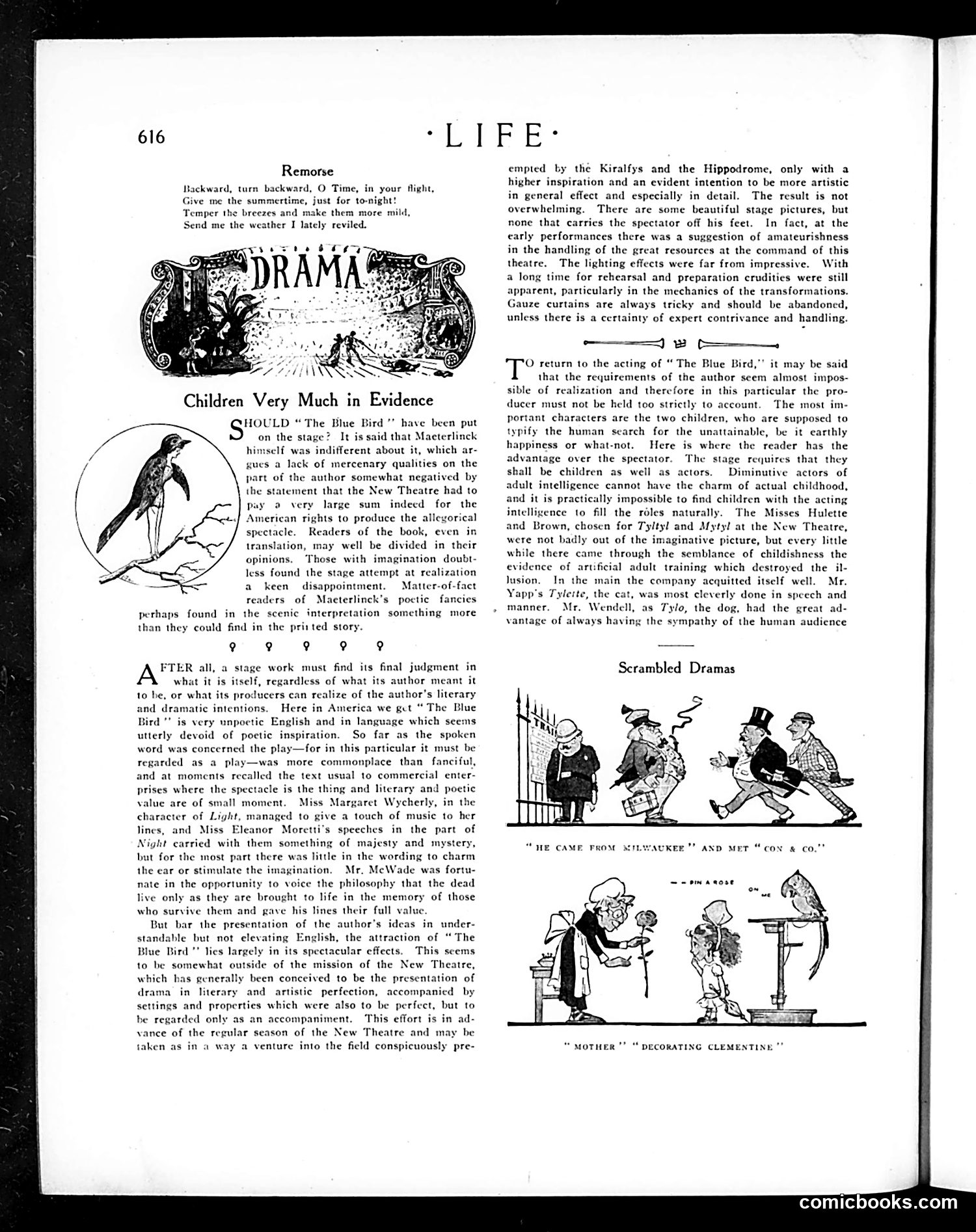
This page critiques the stage adaptation of Maurice Maeterlinck's allegorical play "The Blue Bird" at New York's New Theatre. The critic argues that while the production featured spectacular scenery, it lacked poetic merit—the dialogue was rendered mundane in English translation, and child actors (prominently featured) couldn't convey the philosophical depth the play requires. The reviewer suggests the New Theatre, conceived as a venue for literary and artistic perfection, instead descended into spectacle-driven entertainment resembling commercial ventures like the Kiralfy brothers' productions and the Hippodrome. The accompanying cartoons appear satirical but are difficult to identify specifically without clearer captions. The dramatic-arts critique reflects early 20th-century tensions between theatrical innovation and artistic integrity—a common Life magazine concern.
📄 Transcribed text from this page (OCR, searchable)
Machine-transcribed from the original scan — historical spelling and the odd misread are preserved.
“LIFE: Remorse Backward, turn backward, O Time, in your fight, Give me the summertime, just for to-night! Temper the breezes and make them more 1 Send me the weather I lately reviled. Children Very Much in Evidence HOULD “The Blue Bird’ have been put on the stage? It is said that Macterlinck himself was indifferent about it, which ar- gues a lack of mercenary qualities on the part of the author somewhat negatived by the statement that the New Theatre had to pay a very large sum indeed for the merican rights to produce the allegorical spectacle. Readers of the book, even in translation, may well be divided in their opinions. Those with imagination doubt- less found the stage attempt at realization a keen disappointment. Matter-of-fact readers of Macterlinck’s poctic fancies n something more oe SS perhaps found in the scenic interprets than they could find in the pritted story. g 9 g 9 2 FTER all, a stage work must find its final judgment in what it is itself, regardless of what its author meant it to he, or what its producers can realize of the author's literary and dramatic intentions. Here in America we get “The Blue Bird "" is very unpoctic English and in language which seems utterly devoid of poctic inspiration. So far as the spoken word was concerned the play—for in this particular it must be regarded as a play—was more commonplace than fanciful, and at moments recalled the text usual to commercial enter- prises where the spectacle is the thing and literary and poetic value are of small moment. Miss Margaret Wycherly, in the character of Light, managed to give a touch of music to her lines, and Miss Eleanor Moretti’s speeches in the part of Night carried with them something of majesty and mystery, but for the most part there was little in the wording to charm the ear or stimulate the imagination. Mr, MeWade was fortu- nate in the opportunity to voice the philosophy that the dead live only as they are brought to life in the memory of those who survive them and gave his lines their full value. But bar the presentation of the author's ideas in under- standable but not elevating English, the attraction of “The Blue Bird" lies largely in its spectacular effects. This seems to be somewhat outside of the mission of the New Theatre, which has generally been conceived to be the presentation of drama in literary and artistic perfection, accompanied by settings and properties which were also to be perfect, but to be regarded only as an accompaniment. This effort is in ad- vance of the regular season of the New Theatre and may be taken as in a way a venture into the field conspicuously pre- empted by the Kiralfys and the Hippodrome, only with a higher inspiration and an evident intention to be more artistic in general effect and especially in detail. The result is not overwhelming. There are some beautiful stage pictures, but none that carrics the spectator off his feet. In fact, at the early performances there was a suggestion of amateurishness in the handling of the great resources at the command of this theatre. The lighting effects were far from impressive. With a long time for rehearsal and preparation cruditics were still apparent, particularly in the mechanics of the transformations. Gauze curtains are always tricky and should be abandoned, unless there is a certainty of expert contrivance and handling. ——S 2 ‘O return to the acting of “ The Blue Bird,” it may be said that the requirements of the author seem almost impos- sible of realization and therefore in this particular the pro- ducer must not be held too strictly to account. The most im- portant characters are the two children, who are supposed to typify the human search for the unattainable, be it earthly happiness or what-not. Here is where the reader has the advantage over the spectator. The stage requires that they shall be children as well as actors. Diminutive actors of adult intelligence cannot have the charm of actual childhood, and it is practically impossible to find children with the acting intelligence to fill the réles naturally. The Misses Hulette and Brown, chosen for Tylty! and Myty! at the New Theatre, were not badly out of the imaginative picture, but every little while there came through the semblance of childishness the evidence of artificial adult training which destroyed the i lusion. In the main the company acquitted itself well. Mr. Yapp's Tyleite, the cat, was most cleverly done in speech and manner. Mr. Wendell, as Tylo, the dog, had the great vantage of always having the sympathy of the human audience Scrambled Dramas “HWE CAME FROM MILWAUKEE’? AND MET “con & CO." som acose “ MOTHER '’ “ DECORATING CLEMENTINE "* comicbooks.com