
Life, 1910-10-13 · page 21 of 44
Life — October 13, 1910 — page 21: what you’re looking at
What you’re looking at
This page reviews three theatrical productions circa 1910-1912. The main illustrated cartoon (top right) shows a scene from "The Blue Bird," depicting an actress in an ethereal costume pose—likely representing the water character mentioned in the text. The reviews critique: 1. **"The Blue Bird"** — A elaborate production at the New Theatre with impressive spectacle but uneven execution. The critic notes the theater has resources but should be held to high standards, not excused for its first year. 2. **"Rebecca of Sunnybrook Farm"** — Adapted from Kate Douglass Wiggin's popular stories. The critic praises its charm and emotional impact, particularly actress Edith Talferro's naturalistic performance as the title character—a quaint New England girl who wins hearts through genuine affection rather than drama. 3. **"My Man"** — A domestic drama about a woman convict attempting to escape her past. The satire is gentle; the page celebrates theater that captures authentic human emotion over mere spectacle.
📄 Transcribed text from this page (OCR, searchable)
Machine-transcribed from the original scan — historical spelling and the odd misread are preserved.
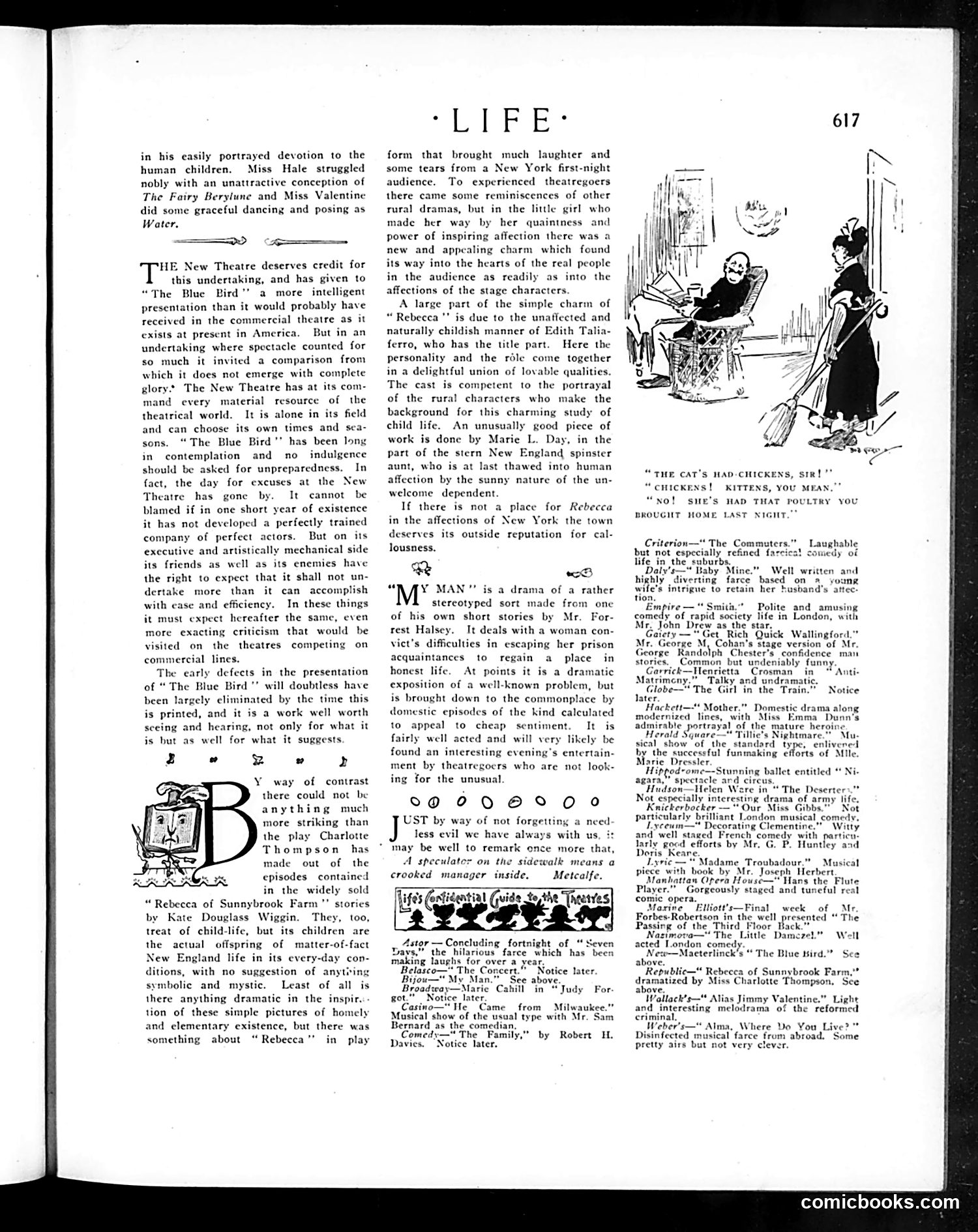
in his easily portrayed devotion to the human children, Miss Hale struggled nobly with an unattractive conception of The Fairy Berylune and Miss Valentine did some graceful dancing and posing as Water. = HE New Theatre deserves credit for this undertaking, and has given to “The Blue Bird’? a more intelligent presentation than it would probably have received in the commercial theatre as it exists at present in America. But in an undertaking where spectacle counted for so much it invited a comparison from which it does not emerge with complete glory. The New Theatre has at its com- mand every material resource of the theatrical world. It is alone in its field and can choose its own times and sea- sons. “The Blue Bird’? has been long in contemplation and no indulgence should be asked for unpreparedness. In fact, the day for excuses at the New Theatre has gone by. It cannot be blamed if in one short year of existence it has not developed a perfectly trained company of perfect actors. But on its executive and artistically mechanical side its friends as well as its enemies have the right to expect that it shall not un- dertake more than it can accomplish with ease and efficiency. In these things it must expect hereafter the same, even more exacting criticism that would be isited on the theatres competing on commercial lines. The early defects in the presentation of “The Blue Bird"? will doubtless have been largely eliminated by the time this is printed, and it is a work well worth sceing and hearing, not only for what it is but as well for what it suggests. z ” 2 Y way of contrast there could not be anything much more striking than the play Charlotte Thompson has made out of the episodes contained in the widely sold “ Rebecca of Sunnybrook Farm’ stories by Kate Douglass Wiggin. They, too, treat of child-life, but its children are the actual offspring of matter-of-fact New England life in its every-day con- ditions, with no suggestion of anyting symbolic and mystic. Least of all is there anything dramatic in the inspir.- tion of these simple pictures of homely and elementary existence, but there was something about “Rebecca” in play "LIFE form that brought much laughter and some tears from a New York first-night audience. To experienced theatregoers there came some reminiscences of other rural dramas, but in the little girl who made her way by her quaintness and power of inspiring affection there was a new and appealing charm which found its way into the hearts of the real people in the audience as readily as into the affections of the stage characters A large part of the simple charm of “ Rebecca "’ is due to the unatiected and naturally childish manner of Edith Tal ferro, who has the title part. Here the personality and the rdle come together in a delightful union of lovable qualities. The cast is competent to the portrayal of the rural characters who make the background for this charming study of child life. An unusually good piece of work is done by Marie L. Day, in the part of the stern New England spinster aunt, who is at last thawed into human affection by the sunny nature of the un- welcome dependent. If there is not a place for Rebecca in the affections of New York the town deserves its outside reputation for ca lousness. Re <8 “NAY MAN"? is a drama of a rather stereotyped sort made from one of his own short stories by Mr. For- rest Halsey. It deals with a woman con- vict's difficulties in escaping her prison acquaintances to regain a place in honest life. At points it is a dramatic exposition of a well-known problem, but is brought down to the commonplace by domestic episodes of the kind calculated to appeal to cheap sentiment. It is fairly well acted and will very likely be found an interesting evening's entertain- ment by theatregoers who are not look- ing for the unusual. S°09Q0 68900 UST by way of not forgettin less evil we have always with us may be well to remark once more that, A speculater on the sidewalk means a crooked manager inside. Metcalfe. ies Gaizentigh Guide to the Taretves Astor —Concluding fortnight of “ Seven Days,” the hilarious farce which has be making laughs for over a year, Belasco—* The Concert.” Notice later. Bijou—" My Man." See above. Broadway—Marie Cahill in “Judy For: got. ‘otice later. Casino—" He Came from Milwaukee.” Musical show of the usual type with Mr. Sam Bernard as the comedian. Comedy—" The Family,” by Robert H. Davies. “Notice later. “THE CAT'S HAD-CHICKE “CHICKENS! KITTENS, YOU MEAN,”” “No! sie’s HAD THAT POULTRY YoU BROUGHT HOME LAST NIGHT. Criterion—* The Commuters.” Laughable but not especially refined farcica! comedy of life in the suburbs. Daly's—" Baby Mine." Well written and highly diverting farce based on ang wife's intrigue to retain her husband's ‘atte tio: Empire —“ Smith." Polite and amusing comedy of rapid society life in London, with Mr, John Drew as the sta et Rich Quick Wallingford.”* Mr. George M, Cohan's stage version of Mr. George Randolph Chester's confidence man stories. Common but undeniably funny. Garrick—Henrietta, Crosman. in“ Anti- Matrimeny,”"Talky and undramatic, obe—" The Girl in the Train.” later. Hackett—** Mother.” Domestic drama along modernized lines, with Miss Emma Dunn's admirable portrayal of the mature he Herald Square—" Tillie’s Nightmare." Mus sical show of the standard type, enlivened by the successful funmaking efforts of Mlle. Marie Dressler. odrome Notice tunning ballet entitled “ Ni- agara,” spectacle ard circus, Hudson—Helen Ware in“ The Deserters."* Not especially interesting drama of army life. Knickerbocker *Our Miss Gibbs.” Not particularly brilliant London mu: Lyceun— rating Clementine.” and well staged ench comedy with tien. iarly good efforts by Mr. G. P. Huntley and Doris Keane _Lxric—“ Madame Troubadour.” | Musical piece with book by Mr. Joseph Herbert Manhattan Opera House—" Hans the Flute Player.” Gorgeously staged and tuneful real comic opera. Maxine Elliott's—Final week of | Mr. Forbes-Robertson in the well presented The Passing of the Thitd Floor Tack Nasimova—" The Little Damcrel."” Well acted London comedy. New—Maeterlinck’s “ The Blue tsird.” See above. Republic— Rebecca of Sunnybrook Farm.”* dramatized by Miss Charlotte Thompson, Sce above. Wallack’s—"* Alias Jimmy Valentine.” Light and interesting melodrama of the reformed criminal, Weber’s—" Alma, Where Vo You Live?” Disinfected musical farce from abroad. Some pretty airs but not very clever. comicbooks.com