
Life, 1910-10-13 · page 13 of 44
Life — October 13, 1910 — page 13: what you’re looking at
What you’re looking at
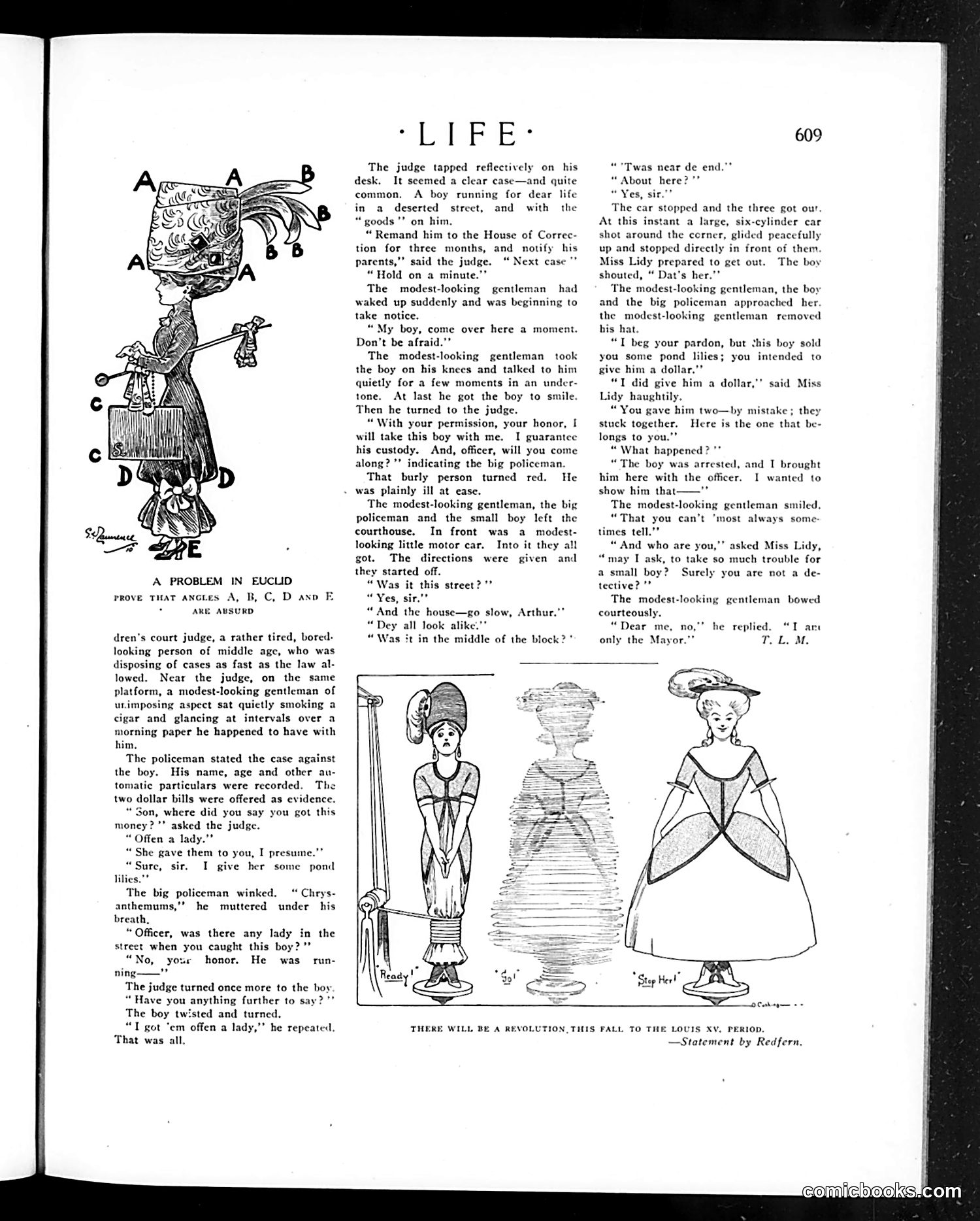
This page contains two distinct elements: **"A Problem in Euclid"** (left): A geometric puzzle presented as a satirical cartoon showing a disheveled figure with abstract geometric shapes, demonstrating a mathematical proof involving angles A, B, C, D, and E. **Main Story** (center-right): A courtroom narrative about a judge sentencing a boy to the House of Correction, interrupted when a "modest-looking gentleman" intervenes, claiming he'll take custody of the boy. The story plays on class distinctions and charitable interventions—the gentleman later reveals the boy stole from him, making the judge's quick decision appear foolish. **Fashion Illustrations** (bottom right): Three sketched women's dress designs, labeled as showing "a revolution" in Louis XV period fashion. The page satirizes judicial haste, class pretension, and the gullibility of authority figures accepting surface appearances.
📄 Transcribed text from this page (OCR, searchable)
Machine-transcribed from the original scan — historical spelling and the odd misread are preserved.
A PROBLEM IN EUCLID B,C, D axp E dren's court judge, a rather tired, bored- looking person of middle age, who was disposing of cases as fast as the law al- lowed. Near the judge, on the same platform, a modest-looking gentleman of urimposing aspect sat quietly smoking a cigar and glancing at intervals over a morning paper he happened to have with him. The policeman stated the case against the boy. His name, age and other au- tomatic particulars were recorded. The two dollar bills were offered as evidence. Son, where did you say you got this money? ’? asked the judge. “ Offen a lady.” “ She gave them to you, I presume.’* “Sure, sir. I give her some pond lilies."* The big policeman winked. anthemums,"* breath, “ Officer, was there any lady in the et when you caught this boy?” No, your honor. He was ning——"” The judge turned once more to the boy “ Have you anything further to say ? The boy twisted and turned, “T got ‘em offen a lady,” he repeated, That was all, “ Chrys- he muttered under his run- "LIP EB The judge tapped reflectively on his desk. It seemed a clear case—and quite common. A boy running for dear life in a deserted street, and with the “ goods '’ on him. “Remand him to the House of Correc- tion for three months, and notify his parents,"’ said the judge. “ Next case" “Hold on a minute.” The modest-looking gentleman had waked up suddenly and was beginning to take notice. “My boy, come over here a moment. Don’t be afraid."’ The modest-looking gentleman took the boy on his knees and talked to him quietly for a few moments in an under- tone. At last he got the boy to smile. Then he turned to the judge. “With your permission, your honor, I will take this boy with me, I guarantee his custody. And, officer, will you come along?” indicating the big policeman. That burly person turned red. He was plainly ill at ease. The modest-looking gentleman, the big policeman and the small boy left the courthouse. In front was a modest- looking little motor car. Into it they all got. The directions were given and they started off. Was it this street?’ “Yes, sir.” “And the house—go slow, Arthur,’* “Dey all look alike.” “Was it in the middle of the block? * “Twas near de end.”* “About here? “Yes, sir.”” The car stopped and the three got our. At this instant a large, six-cylinder car shot around the corner, glided peacefully up and stopped directly in front of them. Miss Lidy prepared to get out. The boy shouted, “ Dat’s her.”* ‘The modest-looking gentleman, the boy and the big policeman approached her. the modest-looking gentleman remove: his hat. “T beg your pardon, but chis boy sold you some pond lilies; you intended to give him a dollar.”” “1 did give him a dollar,” said Miss idy haughtily. “You gave him two—by mistake; they stuck together. Here is the one that be- longs to you “What happened? "* “The boy was arrested, and T brought him here with the officer. I wanted to show him that—" The modest-looking gentleman smiled. “That you can’t ‘most always some- times tell.”” “ And who are you,’’ asked Miss Lidy, “may I ask, to take so much trouble for a small boy? Surely you are not a de- tective? "? The modest-looking gentleman bowed courteously. “Dear me, no,” only the Mayor.”” he replied. “I Cohay + THERE WILL BE A REVOLUTION, THIS FALL TO THE LOUIS XV, PERIOD. —Statement by Redfern.