
A complete issue · 36 pages · 1910
Life — March 10, 1910
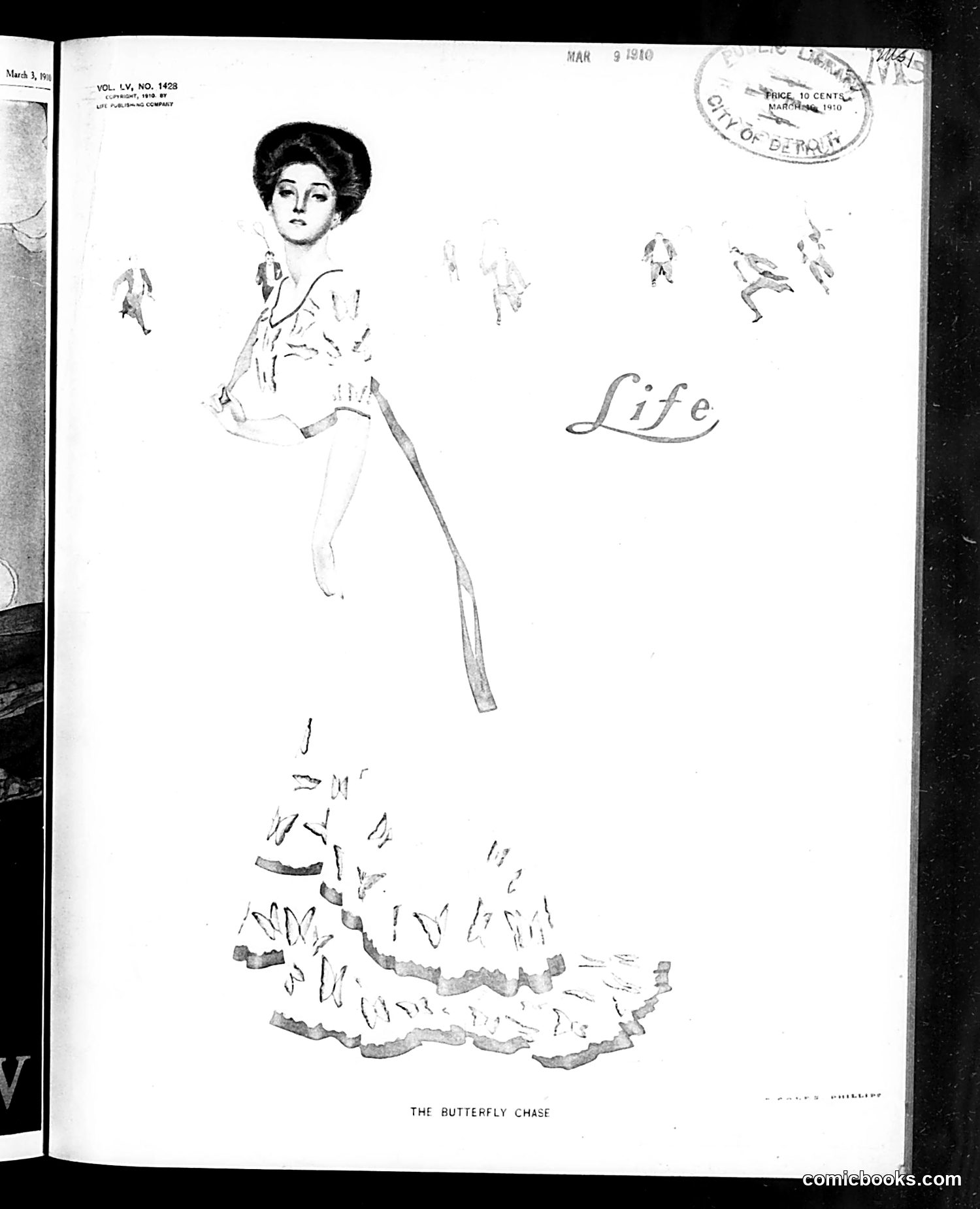
This satirical illustration depicts a fashionable Edwardian-era woman in an elegant gown chasing small male figures represented as butterflies. The title "The Butterfly Chase" suggests commentary on courtship or romantic pursuits of the period. The image likely satirizes women's social behavior—specifically the idea of women actively pursuing romantic or matrimonial interests, which would have been considered unconventional or humorous to early 1900s audiences. The woman's graceful, predatory pose contrasts with the tiny fleeing men, inverting typical gender dynamics of courtship where men were expected to be the pursuers. The satire plays on anxieties about changing women's social roles and independence during this era, presenting female pursuit humorously while the woman's fashionable appearance emphasizes her status.
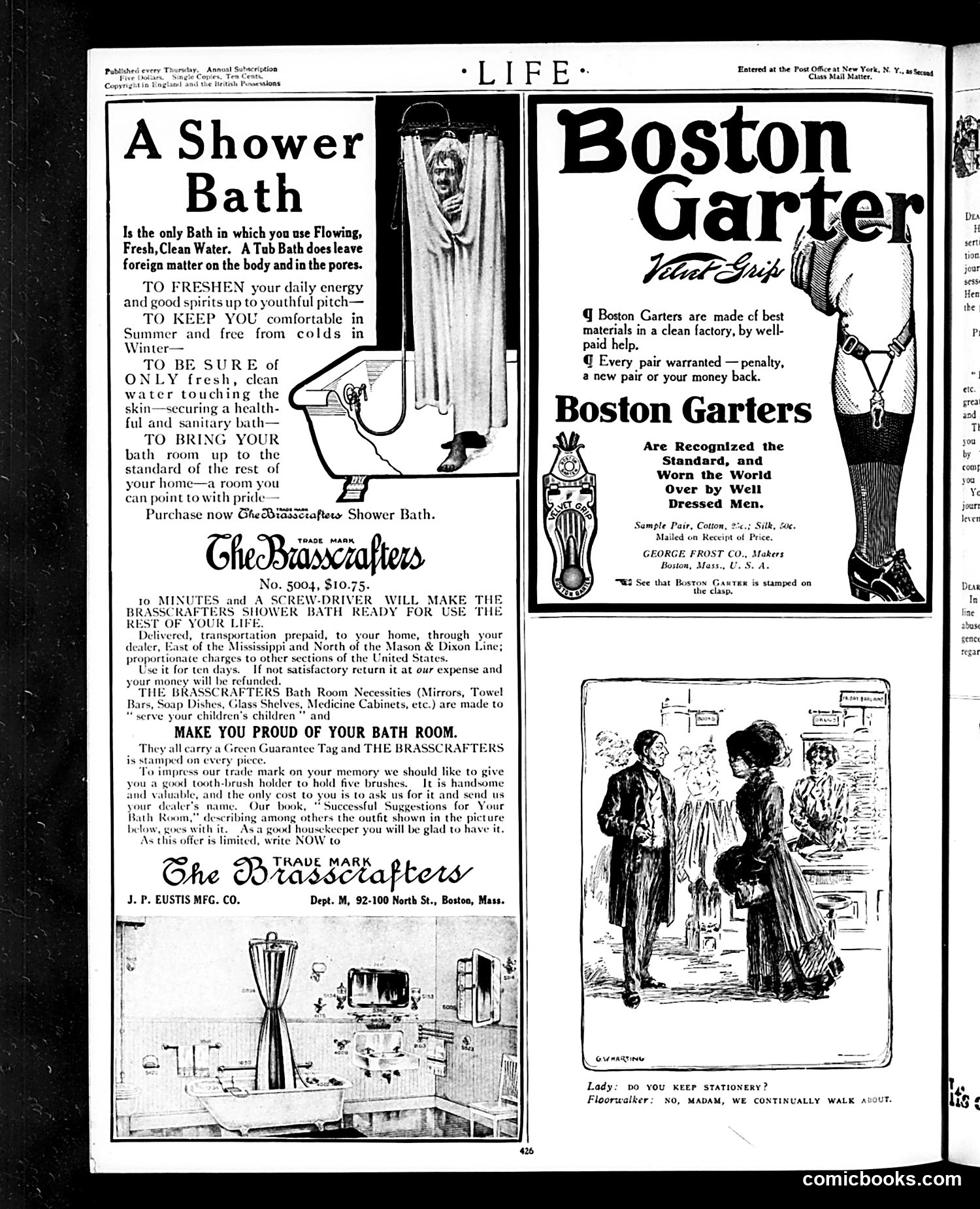
This page is primarily **advertising**, not satire or political commentary. It contains two commercial ads: 1. **"A Shower Bath"** (left): Promotes the Brasscraft Shower Bath, emphasizing hygiene benefits—fresh water, cleanliness, health—over traditional tub bathing. The product positioning reflects early 20th-century sanitization concerns. 2. **"Boston Garter"** (right): Advertises men's garters, claiming they're "recognized the Standard, and Worn the World Over by Well Dressed Men." Made by George Frost Co. in Boston. A small cartoon captioned "Lady: Do you keep stationery? Floorwalker: No, madam, we continually walk about" provides mild humor unrelated to these ads. The page reflects consumer culture and bathroom modernization trends of the era, with no political content.
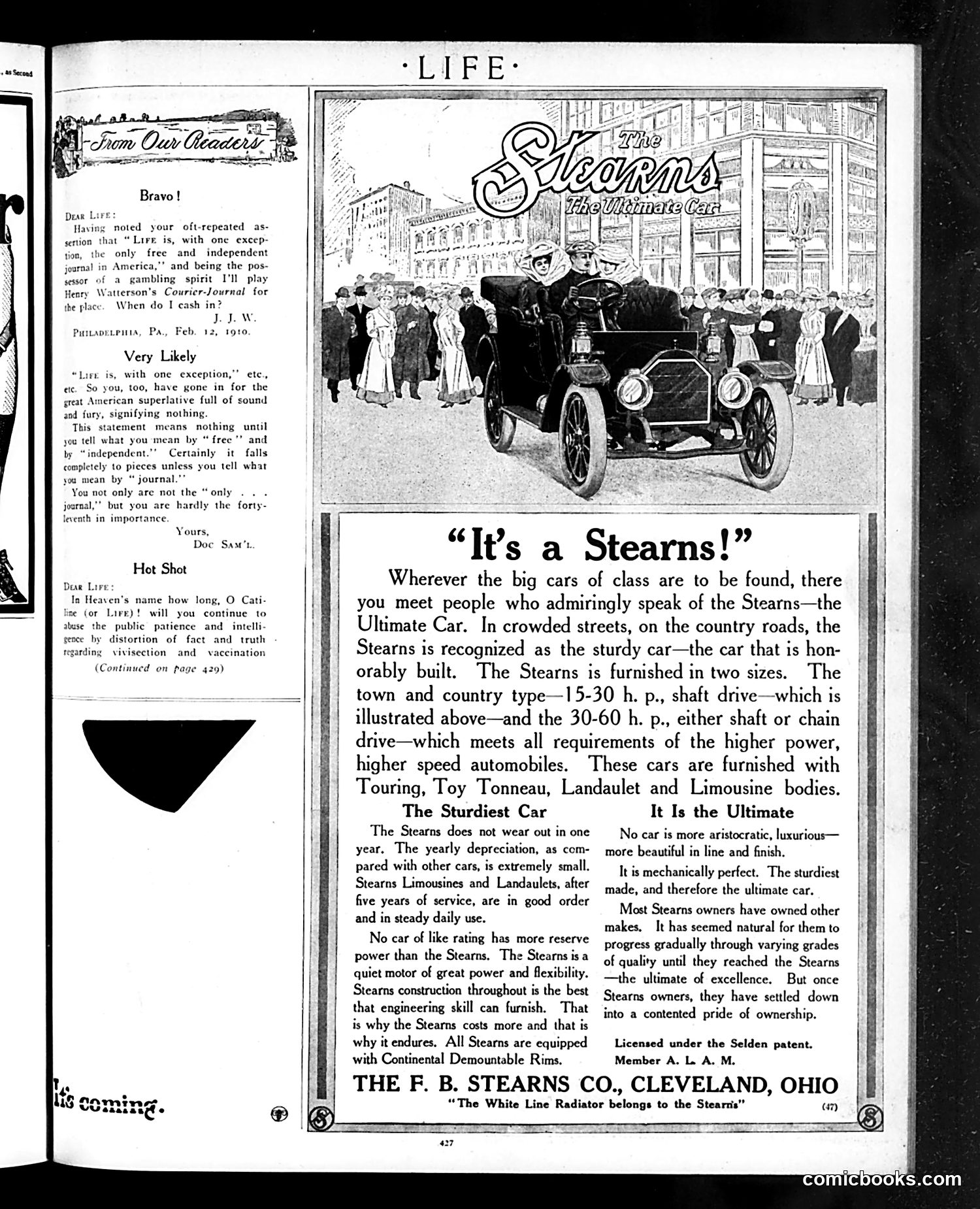
This page is primarily **advertising, not satire or political commentary**. The left column contains readers' letters to *Life* magazine under "From Our Readers," addressing the publication's editorial stance on journalism independence—standard magazine correspondence. The dominant right-side content is a **full-page advertisement for Stearns automobiles** manufactured by The F.B. Stearns Co. in Cleveland, Ohio. The ad features an illustration of an early 1900s motorcar surrounded by well-dressed pedestrians and includes marketing copy emphasizing the Stearns as "The Ultimate Car"—durable, powerful, and aristocratic. There is **no political cartoon or social satire** on this page. The image simply illustrates a luxury vehicle advertisement typical of the era, promoting the car's engineering quality and prestige to wealthy consumers.
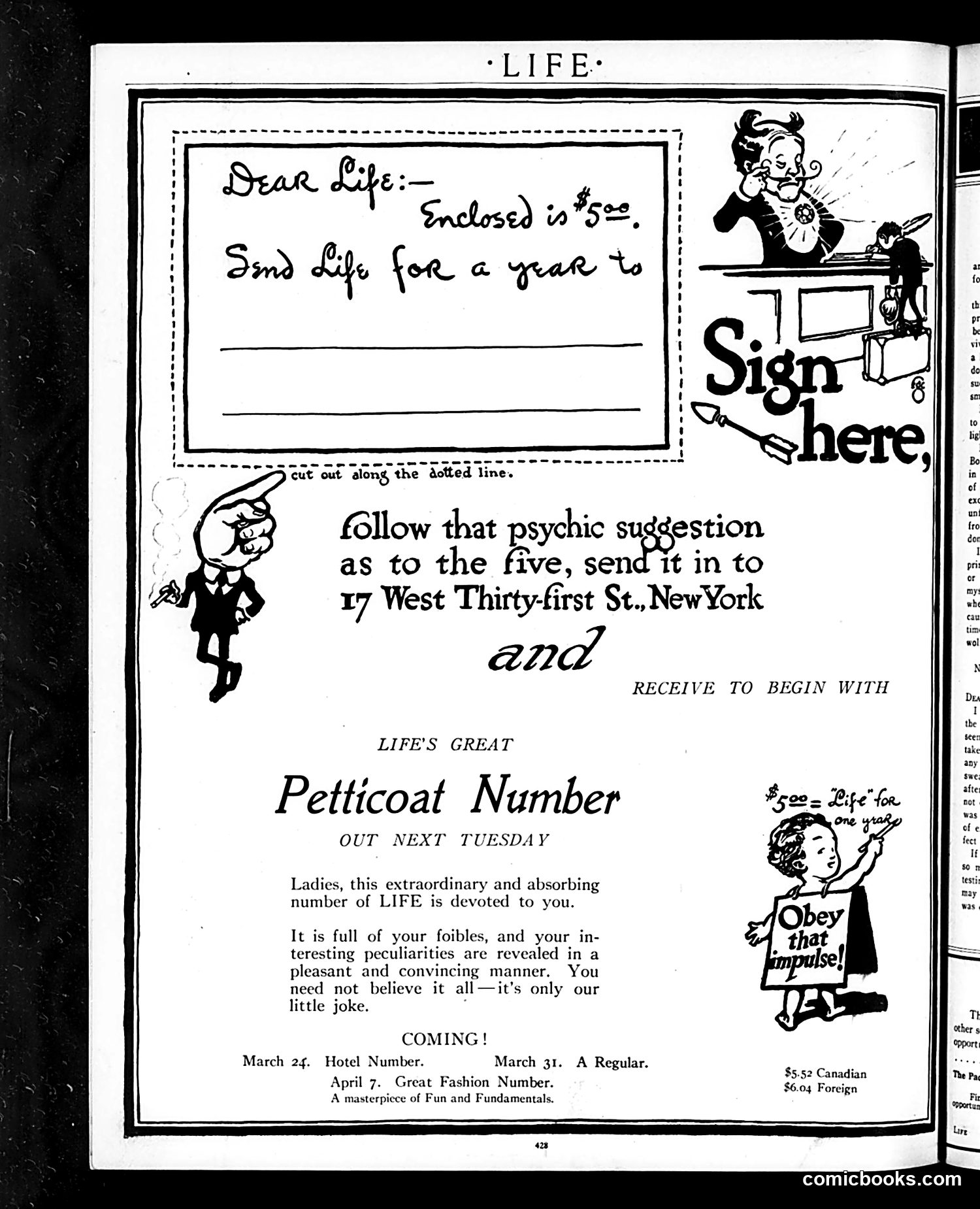
This page is primarily **advertising and promotional content** for Life magazine itself, not political commentary. The main feature advertises an upcoming "Petticoat Number" issue (coming next Tuesday), described as devoted to women readers and full of "foibles" and "interesting peculiarities." The tone is lighthearted, self-aware satire about gender stereotypes—the magazine jokes that readers "need not believe it all—it's only our little joke." The decorative cartoons flanking the text show stylized figures typical of 1920s-era comic illustration. The "Sign here" figure appears to be a devil or mischievous character soliciting subscriptions. The page includes a subscription offer ($5 for one year) and lists upcoming issue themes: Hotel Number (March 24), Regular issue (March 31), and Fashion Number (April 7). This reflects early 20th-century magazine marketing strategies targeting female audiences.
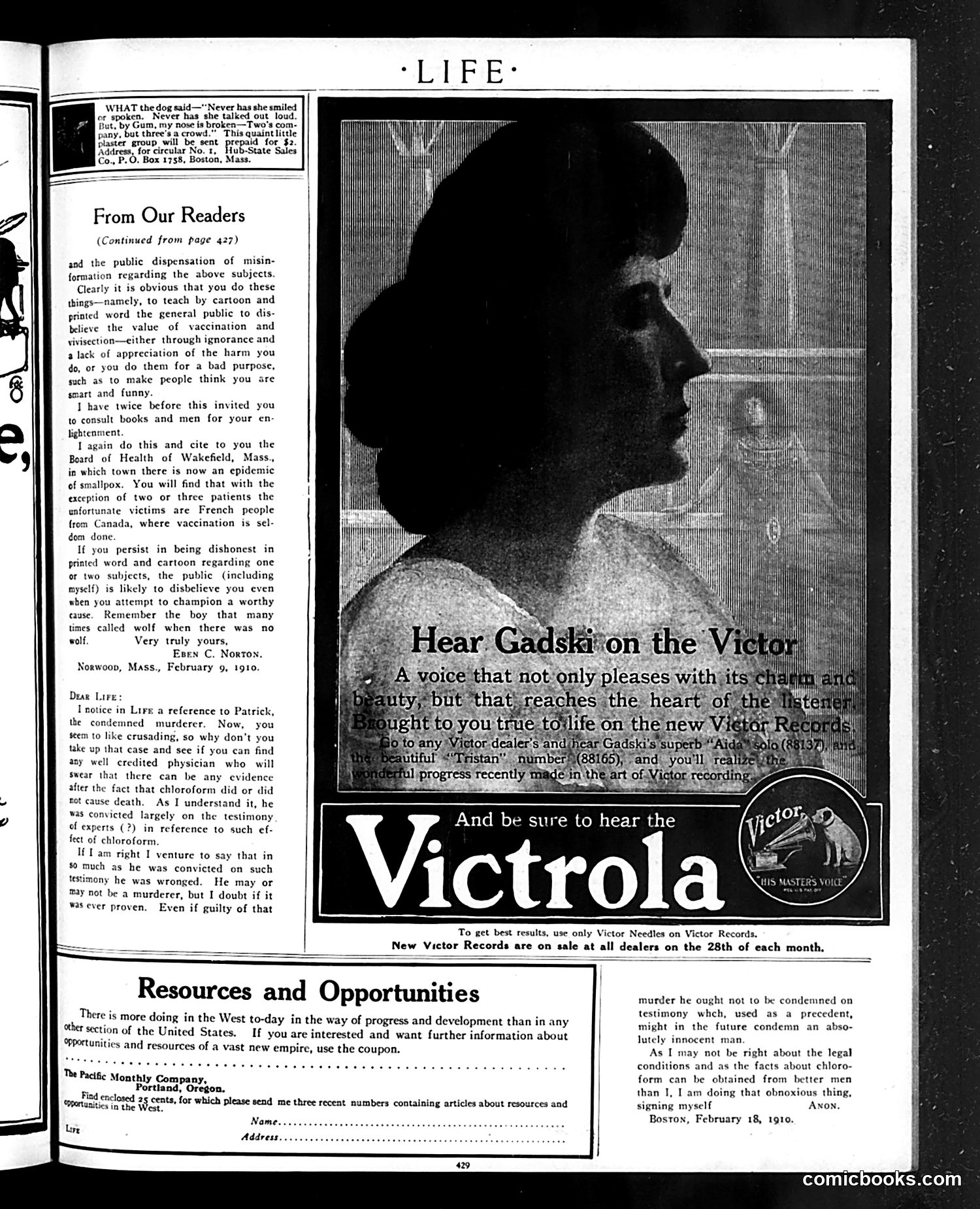
This page is primarily **advertising** for Victor Victrola phonographs, featuring an operatic performer (Gadski) promoting the device's sound quality. The ad emphasizes that Victor Records are sold on the 28th of each month. The left column contains reader letters debating **vaccination and public health**. One correspondent criticizes Life's use of cartoons mocking vaccination efforts, arguing it undermines genuine public health concerns during a smallpox epidemic in Wakefield, Massachusetts. Another defends criticism of a physician's chloroform use in a criminal case, referencing Patrick Cronin's murder trial. The page primarily addresses **medical/scientific credibility** and public trust in health authorities—the satire challenges whether Life should mock health interventions during genuine disease crises.
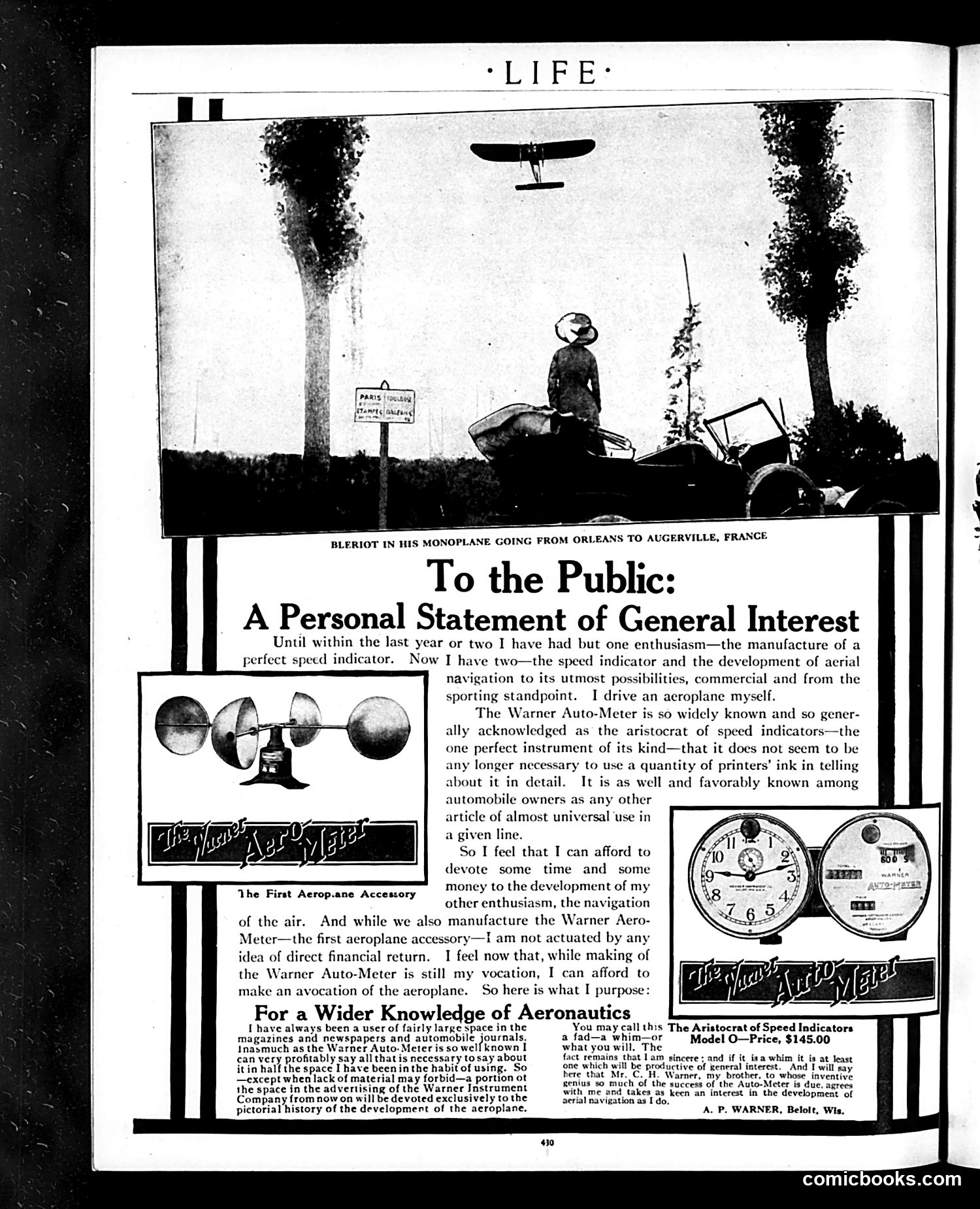
This page is primarily **advertising, not satire or political commentary**. The main content is a paid statement by A. P. Warner of Beloit, Wisconsin, promoting the Warner Auto-Meter—a speed indicator for automobiles. Warner uses the image of aviator Louis Blériot's monoplane flying from Orleans to Augerville, France to associate his product with aviation progress and modernity. The advertisement claims the Auto-Meter is "the aristocrat of speed indicators" and positions it as essential for automobile owners. The text expresses Warner's enthusiasm for aeronautical development, suggesting he uses aviation imagery to lend prestige to his automotive accessory. This represents early 20th-century commercial advertising strategy: leveraging fascination with cutting-edge aviation technology to market mundane products.
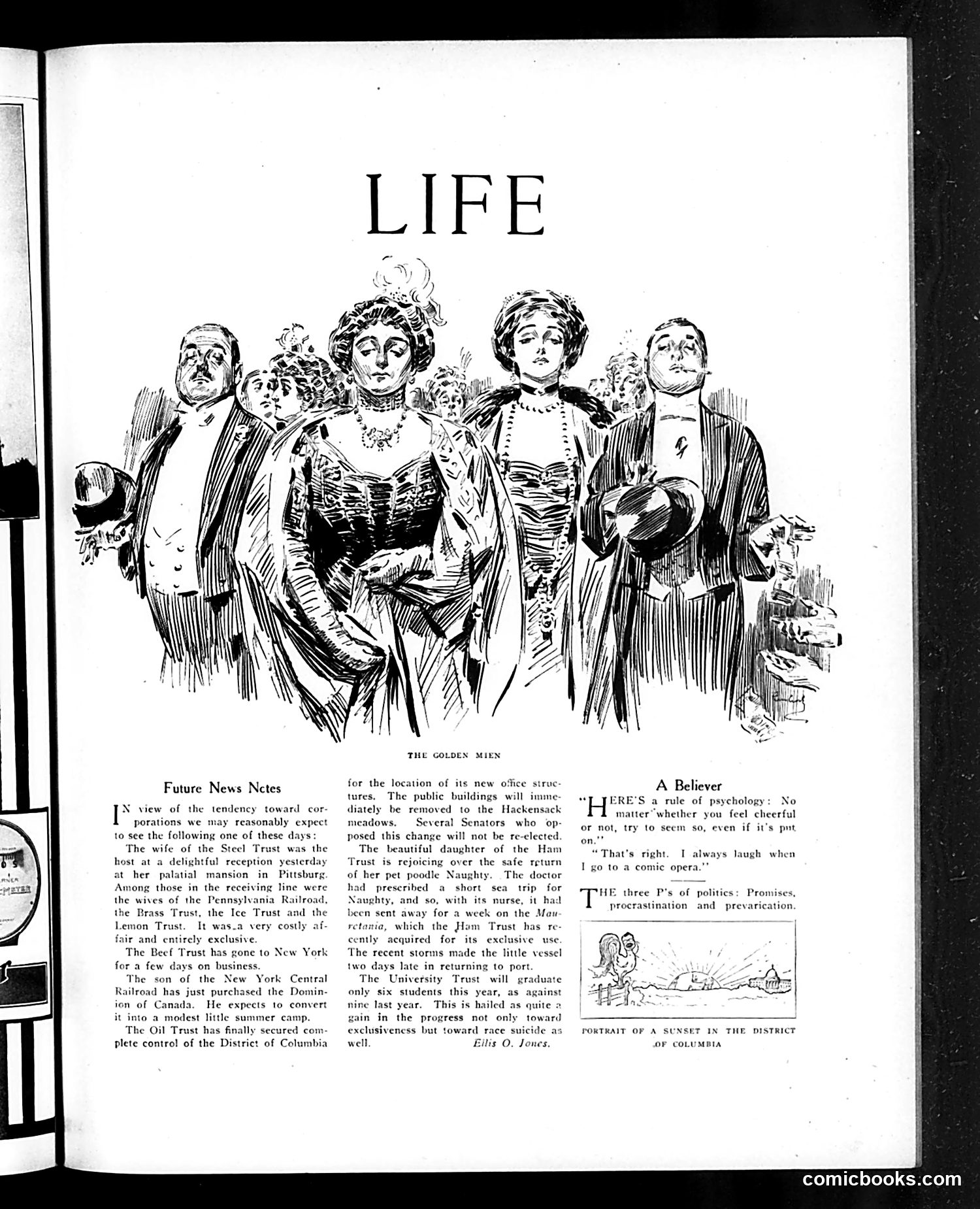
This page features the masthead "LIFE" with an illustration titled "THE GOLDEN MILE" depicting elegantly dressed figures in formal attire. The text contains two articles: "Future News Notes" discusses corporate trusts (Steel Trust, Beef Trust, Pennsylvania Railroad, Lemon Trust, Bell Trust, Oil Trust, and University Trust), satirizing their expansion and influence. The author notes these trusts are acquiring summer camps and controlling District of Columbia resources. "A Believer" is a brief comedic piece about someone finding humor at the opera. The humor targets **monopolistic corporations and industrial trusts** that dominated early 20th-century American business. By listing various "trusts" controlling everything from meat to universities to entertainment venues, the magazine mocks the pervasive corporate consolidation of the era—a major progressive-era concern about unregulated business power.
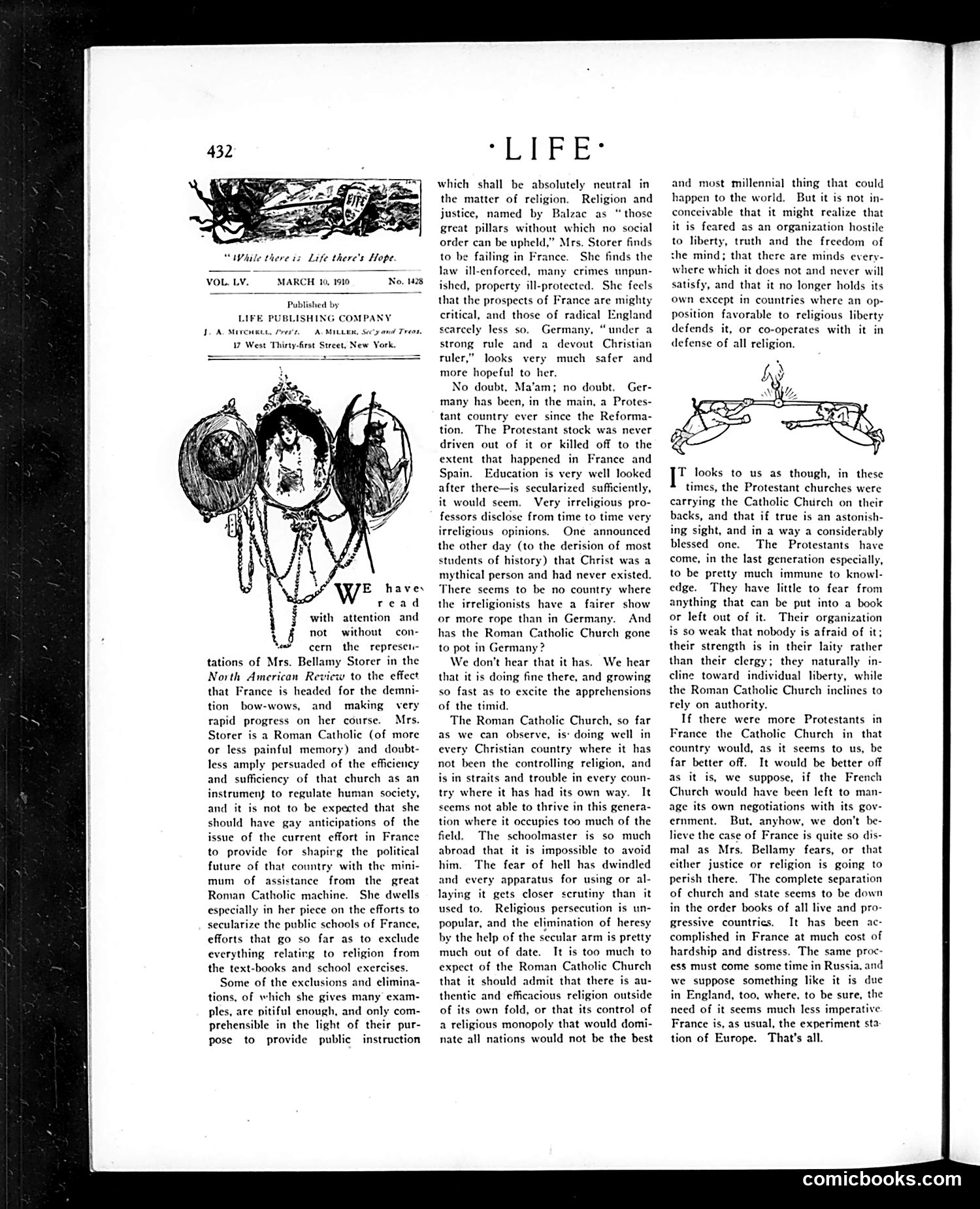
The page contains two political cartoons critiquing religious institutions in Europe. The left illustration depicts three grotesque heads on pikes labeled with symbols suggesting the Catholic Church and religious authority structures—appearing to mock the institutional power of organized religion. The main text discusses Mrs. Bellamy Storer's observations about religion and governance in France, Germany, and Spain. The article argues that Protestant countries manage religion-state separation better than Catholic nations, where the Church allegedly wields excessive political influence. The cartoons satirize what the author views as the dangerous concentration of ecclesiastical power, particularly the Roman Catholic Church's role in European politics. The grotesque imagery emphasizes the author's disdain for religious institutions interfering in secular governance.
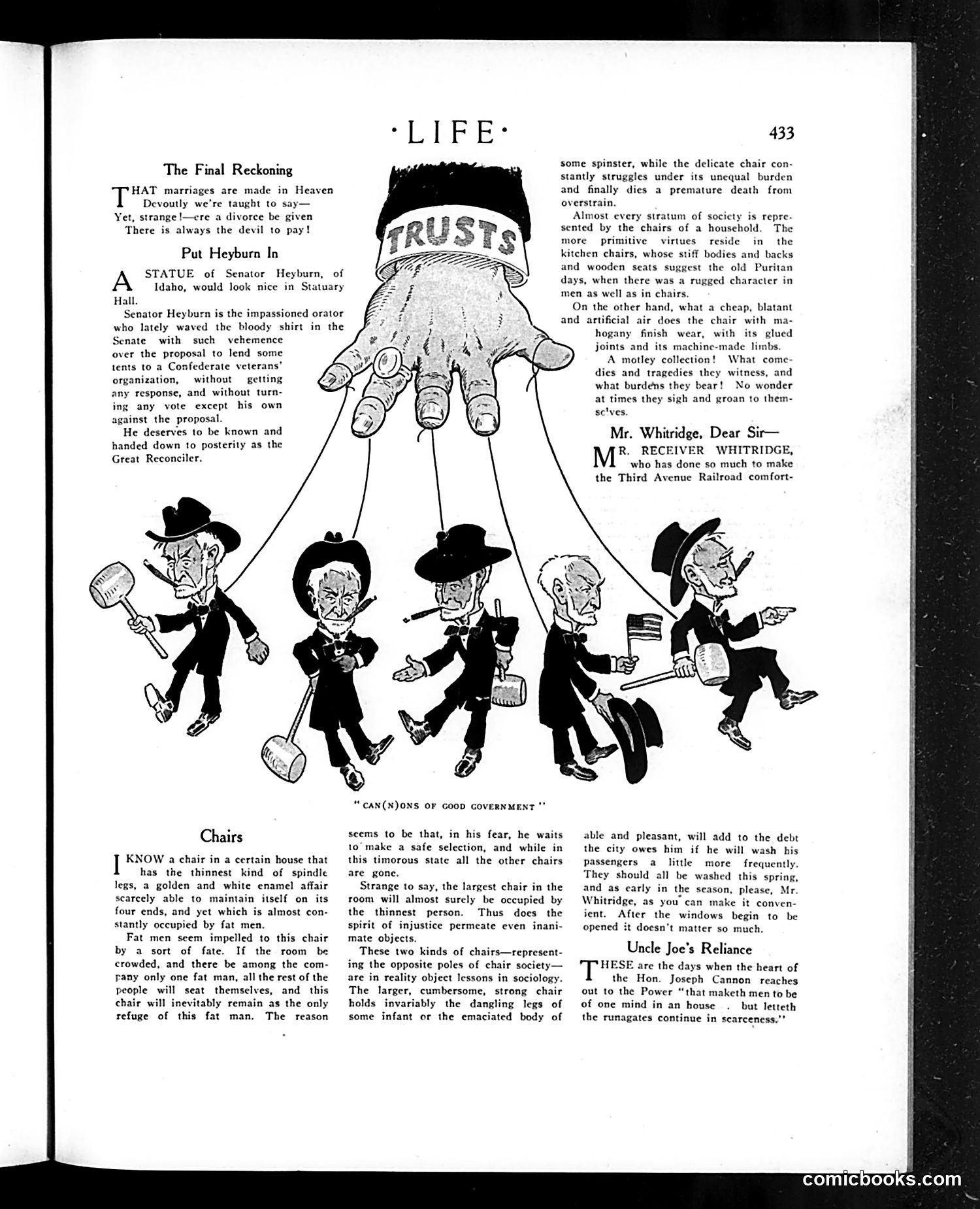
This cartoon satirizes political corruption and corporate influence, showing five caricatured figures manipulated by a giant hand labeled "TRUSTS" above them. The figures appear to be politicians or government officials literally controlled like puppets by monopolistic business interests. The satire suggests that major trusts (large corporations) control government decision-making rather than elected officials serving the public interest. This reflects early 20th-century Progressive Era concerns about unchecked corporate power and monopolies. The accompanying articles about Senator Heyburn and railroad receiver Whitridge reinforce this theme of political figures either opposing or benefiting from trust influence. The cartoon's central message: American government is corrupted by corporate manipulation of those supposedly serving the people.
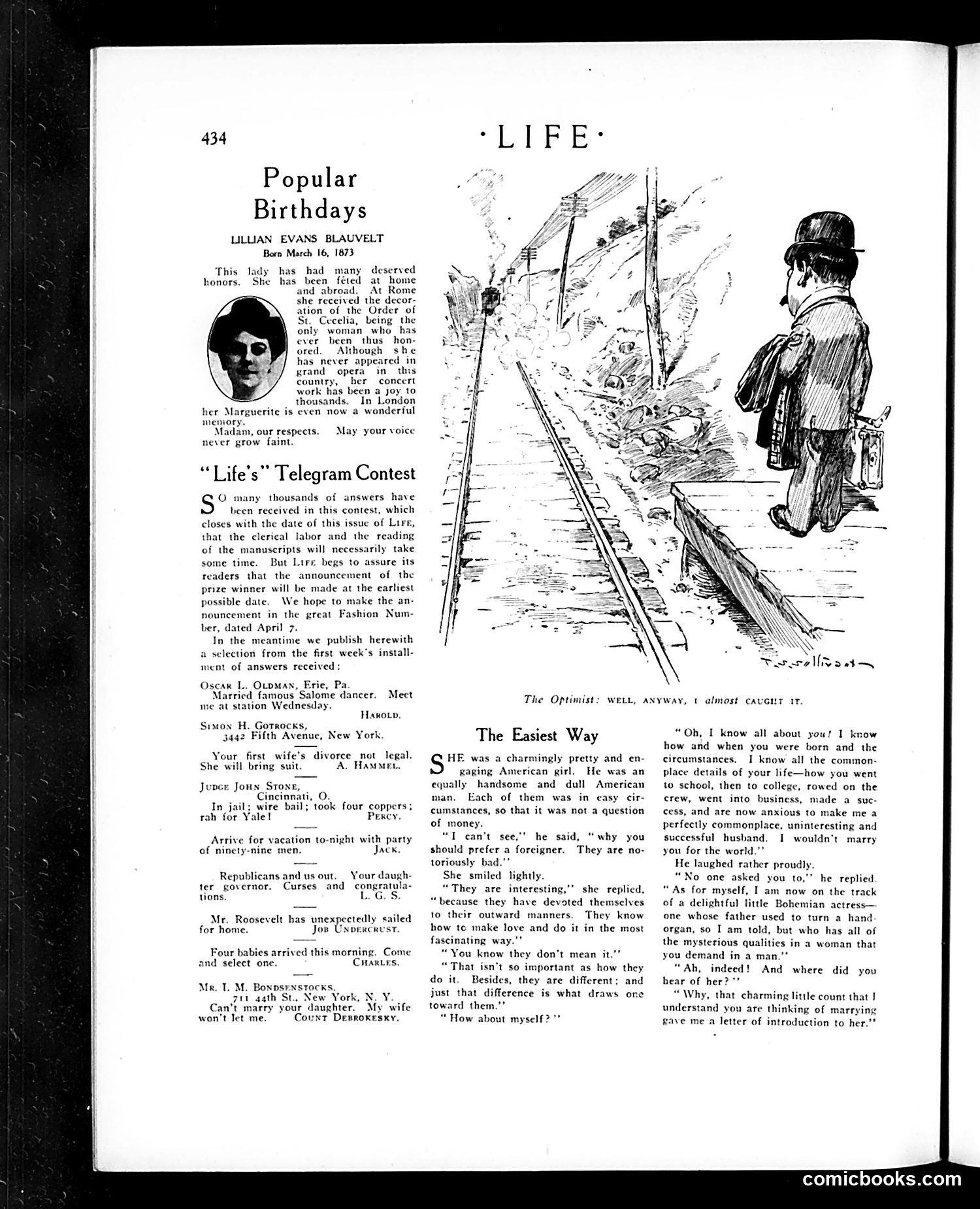
The cartoon depicts a man in a bowler hat standing beside railroad tracks, looking optimistic despite an apparent train wreck or disaster in the background. The caption reads: "WELL, ANYWAY, I ALMOST CAUGHT IT." This is a joke about forced optimism in the face of failure. The man has missed his train (evident from the wreckage), yet he's finding a silver lining by claiming he "almost" caught it. The satire targets a particular American character type: someone who maintains cheerful self-deception rather than confronting actual misfortune. The humor lies in the absurdity of celebrating a near-miss when the consequences (the wrecked train) are visible behind him, suggesting his optimism is misplaced or delusional.
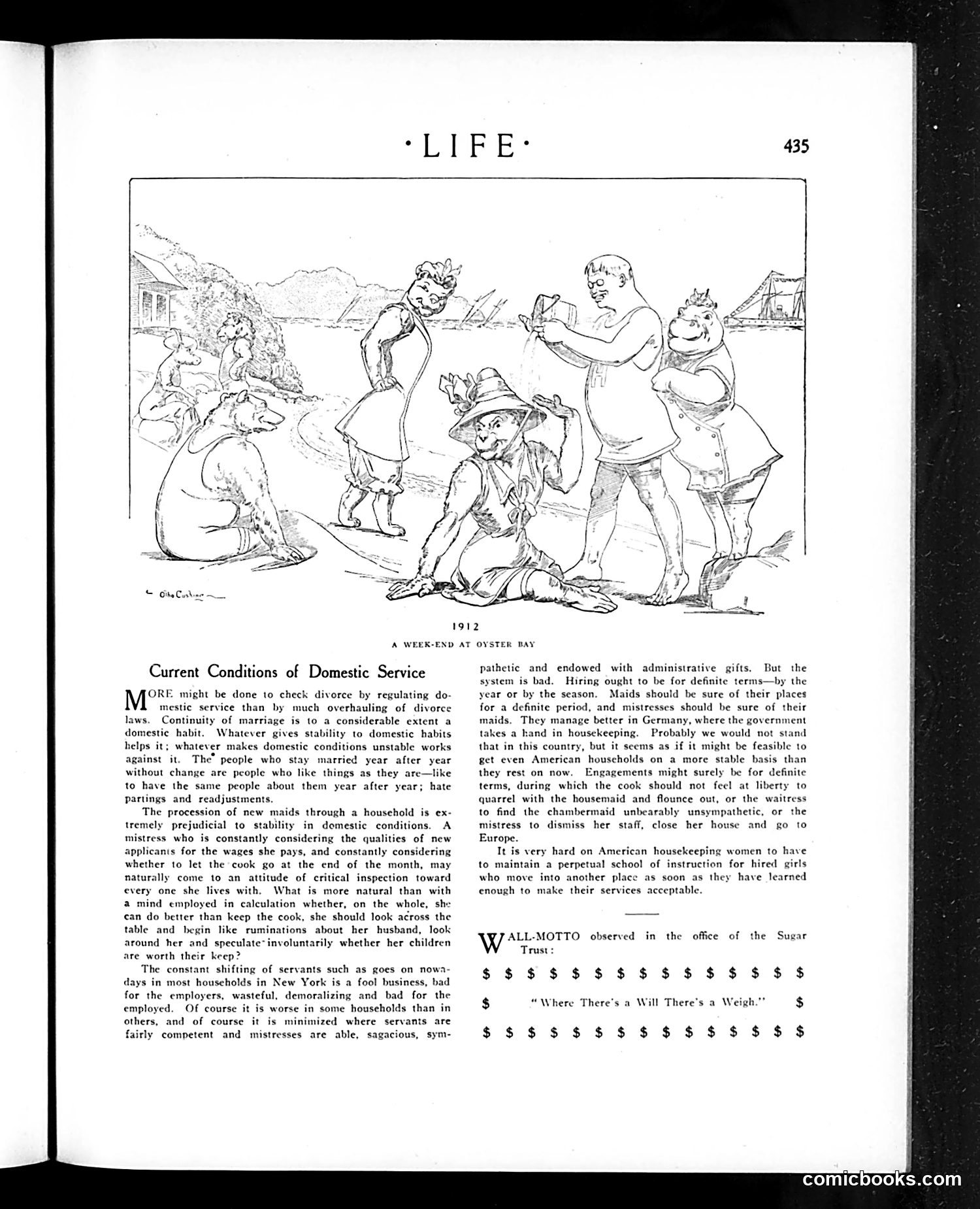
The cartoon titled "A Week-End at Oyster Bay" depicts what appears to be children at a seaside gathering, though the specific identities aren't entirely clear from the image alone. The accompanying article, "Current Conditions of Domestic Service," critiques the instability of American household employment. The text argues that frequent servant turnover stems from poor working conditions, lack of defined employment terms, and dismissive treatment of domestic staff. The author advocates for fixed hiring periods and more respectful employer-employee relationships, noting that American housekeeping standards suffer compared to European practices due to this constant staff disruption. The satirical angle appears to target wealthy American households' mismanagement of domestic labor.
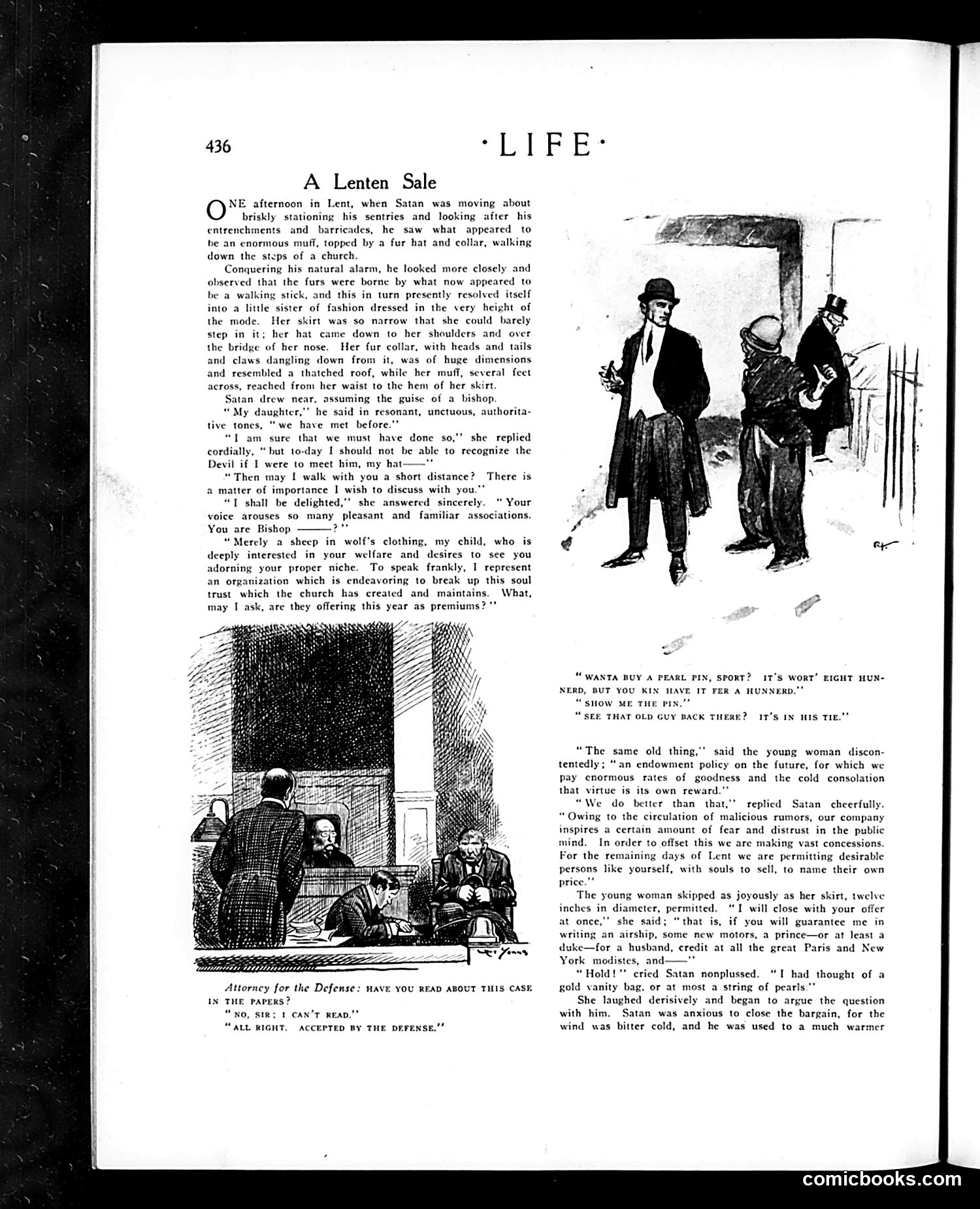
This satirical piece depicts Satan posing as a bishop during Lent, tempting a young woman with worldly goods—a pearl pin, motorcar, yacht, and Paris fashions—in exchange for her soul. The joke targets the Church's practice of selling indulgences and making "concessions" during Lent. The cartoon criticizes institutional religion as corrupt, suggesting the Church itself functions like Satan's agent, hawking spiritual forgiveness while encouraging material desire. The "Attorney for the Defense" caption at bottom adds ironic commentary—the Church defends its mercenary practices as acceptable doctrine. The satire mocks both ecclesiastical hypocrisy and the era's consumer culture, suggesting Lenten piety masks capitalist temptation. The young woman's eager bargaining underscores how easily religious conviction yields to material promise.
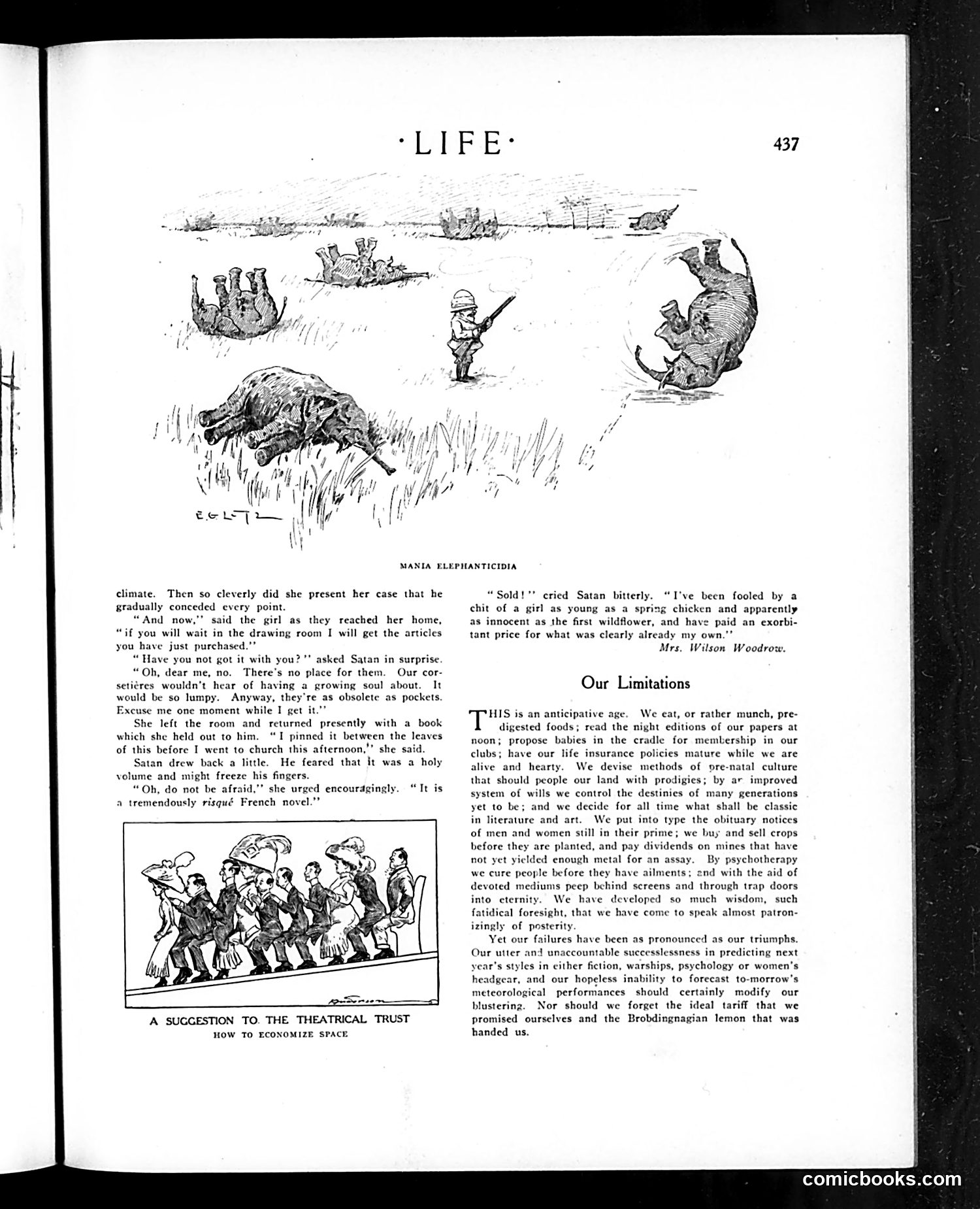
This page from *Life* magazine contains two distinct elements: **Top Section:** An illustrated story titled "MANIA ELEPHANTICIDIA" featuring a narrative about a girl and her elephants. The sketch shows a colonial or exotic setting with boats and hunting scenes. The story involves a character named Satan and concerns over a valuable book. This appears to be satirical fiction rather than political commentary. **Bottom Section:** A cartoon titled "A SUGGESTION TO THE THEATRICAL TRUST—HOW TO ECONOMIZE SPACE" depicts crowded theater performers packed tightly together. This satirizes the "Theatrical Trust" (likely the dominant theater monopoly of the era) by suggesting absurdly cramped staging to save money—mocking corporate greed and poor working conditions for actors. The article "Our Limitations" critiques American overconfidence in predictions and planning.
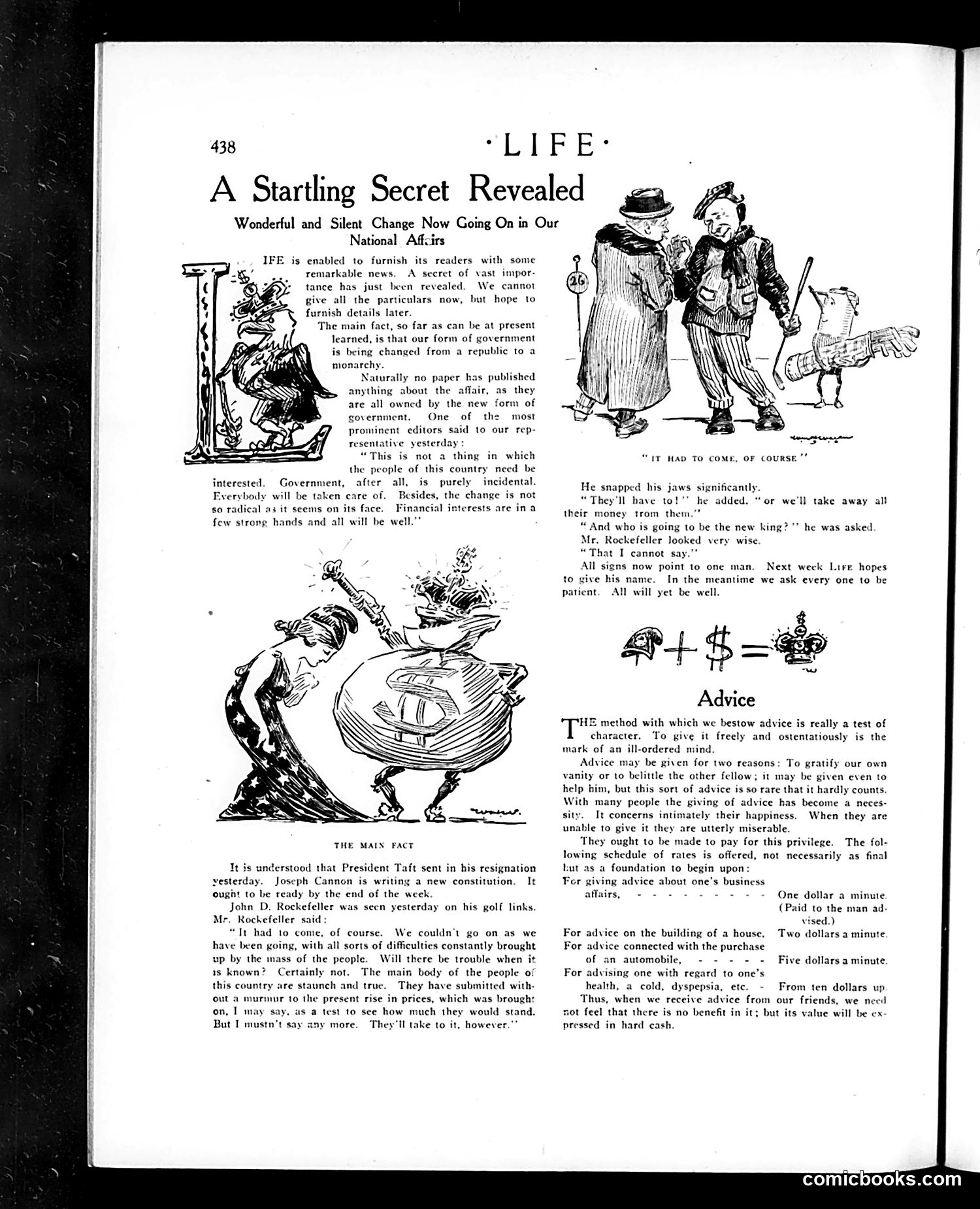
This page satirizes the political power of wealthy industrialists and corporate interests in early 20th-century America. The main cartoon mocks the supposed secret that the U.S. government is transitioning from republic to monarchy, with President Taft allegedly resigning, Joseph Cannon drafting a new constitution, and John D. Rockefeller positioned as the hidden power broker—"the new king." The satire targets how financial elites controlled politics despite democratic pretenses. Rockefeller's quoted remarks about the public's passivity ("They have submitted without a murmur") and threats to seize citizens' money reveal the magazine's critique: the wealthy brazenly exercise power while newspapers (owned by these same interests) suppress the truth. The secondary "Advice" column continues the satirical tone, commodifying wisdom as a mercenary act—fitting commentary on a society where everything, including governance itself, appears for sale to the highest bidder.
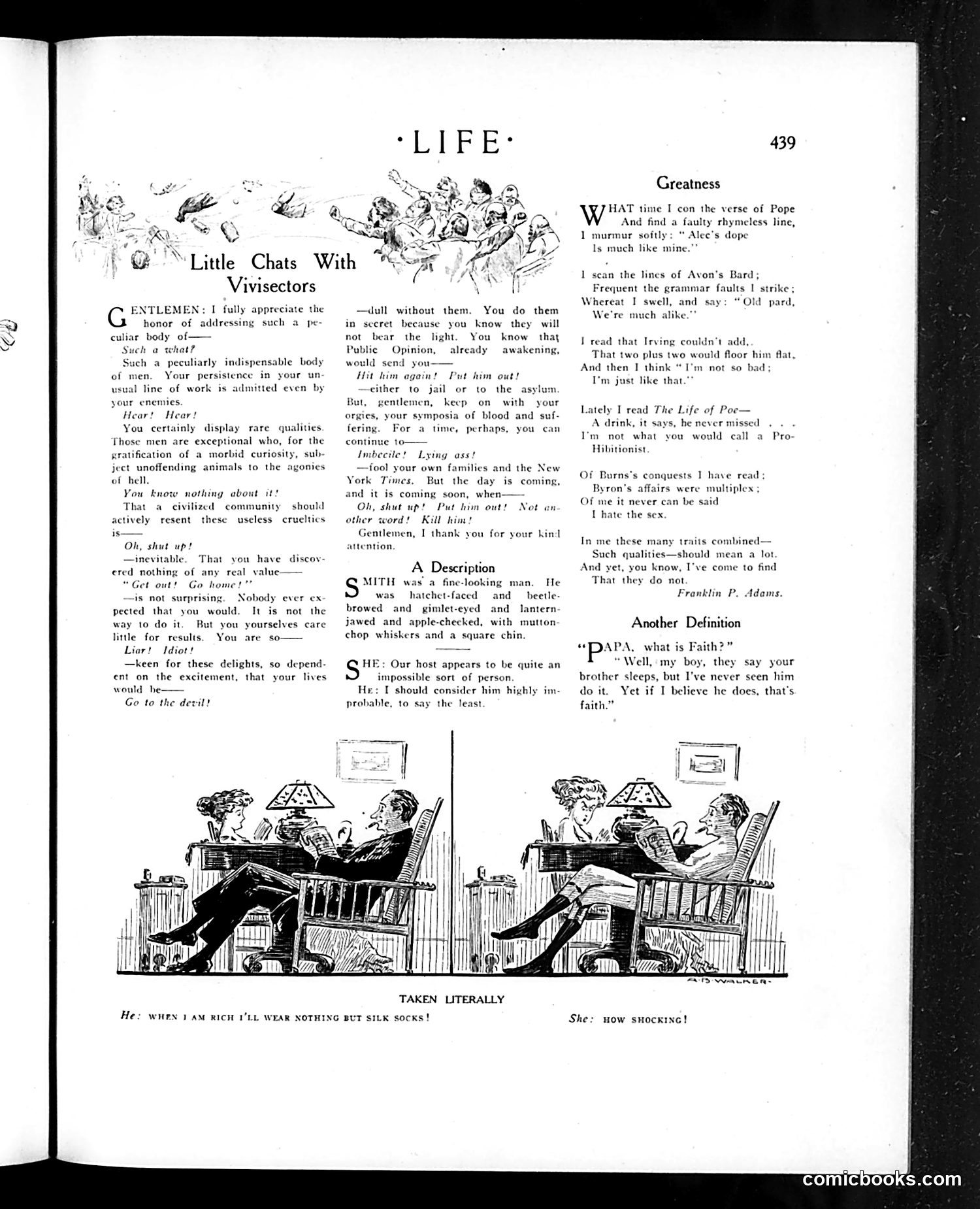
This *Life* magazine page contains two distinct pieces of social satire: **"Little Chats With Vivivisectors"** (left): A pointed attack on animal testing. A speaker addresses a hostile audience of vivisectionists (animal researchers), accusing them of torturing animals for mere curiosity while hiding from public scrutiny and "Public Opinion." The heckling crowd—repeatedly shouting "Shut up!" and "Kill him!"—reveals the satirist's view of experimenters as brutal and anti-intellectual. The piece reflects early-20th-century animal welfare activism. **"Taken Literally"** (bottom): A comic misunderstanding where a man's boast about wearing silk socks when rich is interpreted literally—his wife imagines him wearing *only* silk socks. The joke mocks husbands' impractical bragging. **"Greatness"** and **"Another Definition"** (right): Brief humorous pieces about pretension and faith, using self-deprecating wit. The page reflects *Life*'s role as a vehicle for progressive social criticism wrapped in humor and satire.
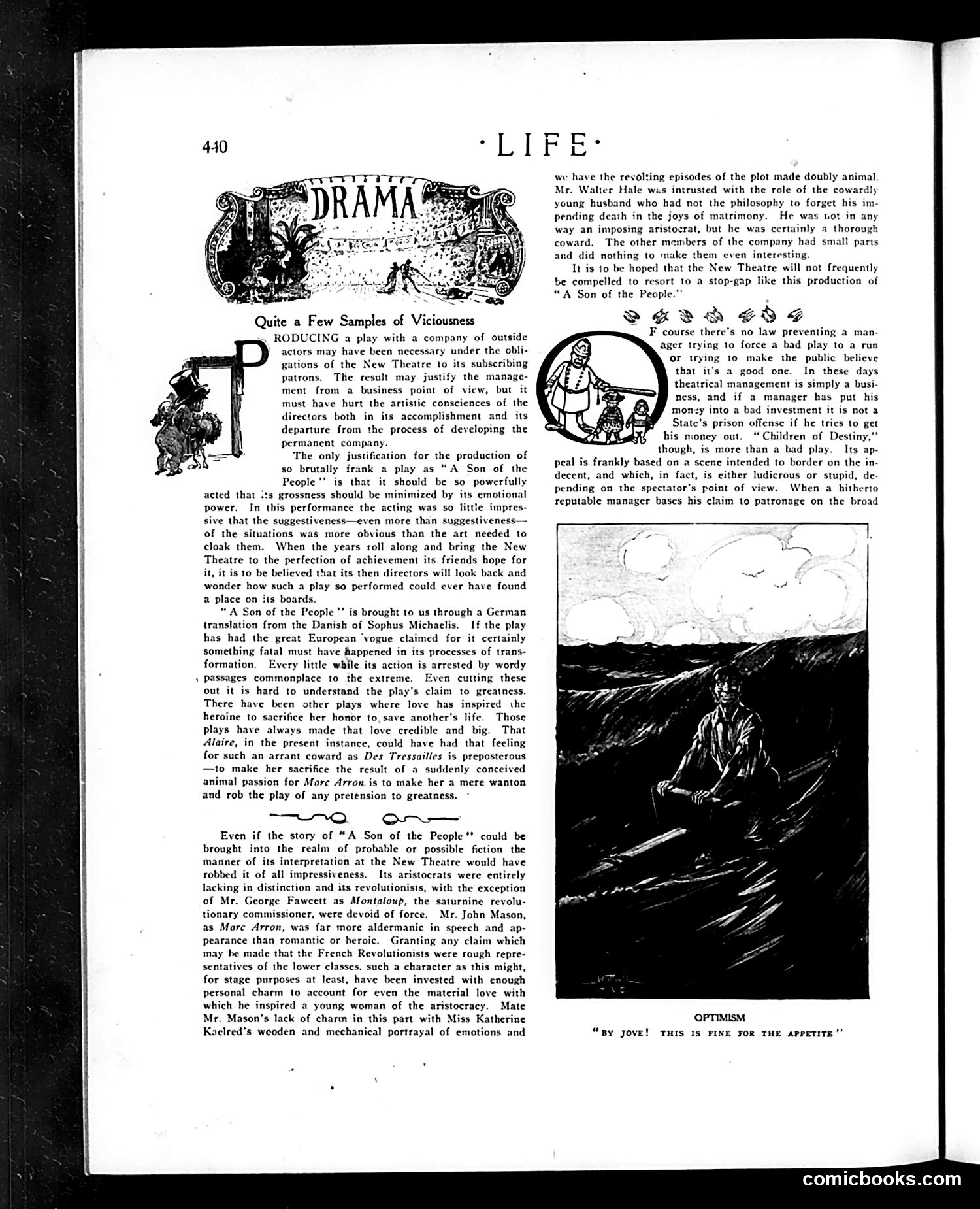
This page reviews "A Son of the People," a play performed at the New Theatre. The critic harshly evaluates both the production choices and the acting quality. **Key Points:** The review criticizes the New Theatre for producing an outside company's play rather than developing its own permanent troupe. The play itself—a German translation of a Danish work by Sophus Michaelis—is deemed "brutally frank" but poorly executed. **The Satire:** The critic argues the play's central premise is implausible: that an aristocratic woman (Alaire) would sacrifice her honor for Marc Arron, portrayed as an uncharismatic coward rather than a compelling romantic hero. The acting undermines any potential impact—performers lack distinction, charm, or force. **Notable Performances Criticized:** John Mason's Marc Arron is ridiculed as "aldermanic" (bureaucratic, dull) rather than heroic. Katherine Kaelred's performance is called "wooden and mechanical." The only praise goes to George Fawcett as the revolutionary commissioner Montaloup. The cartoon's caption—"By Jove! This is fine for the appetite"—likely mocks the play as intellectual junk food, empty of real substance.
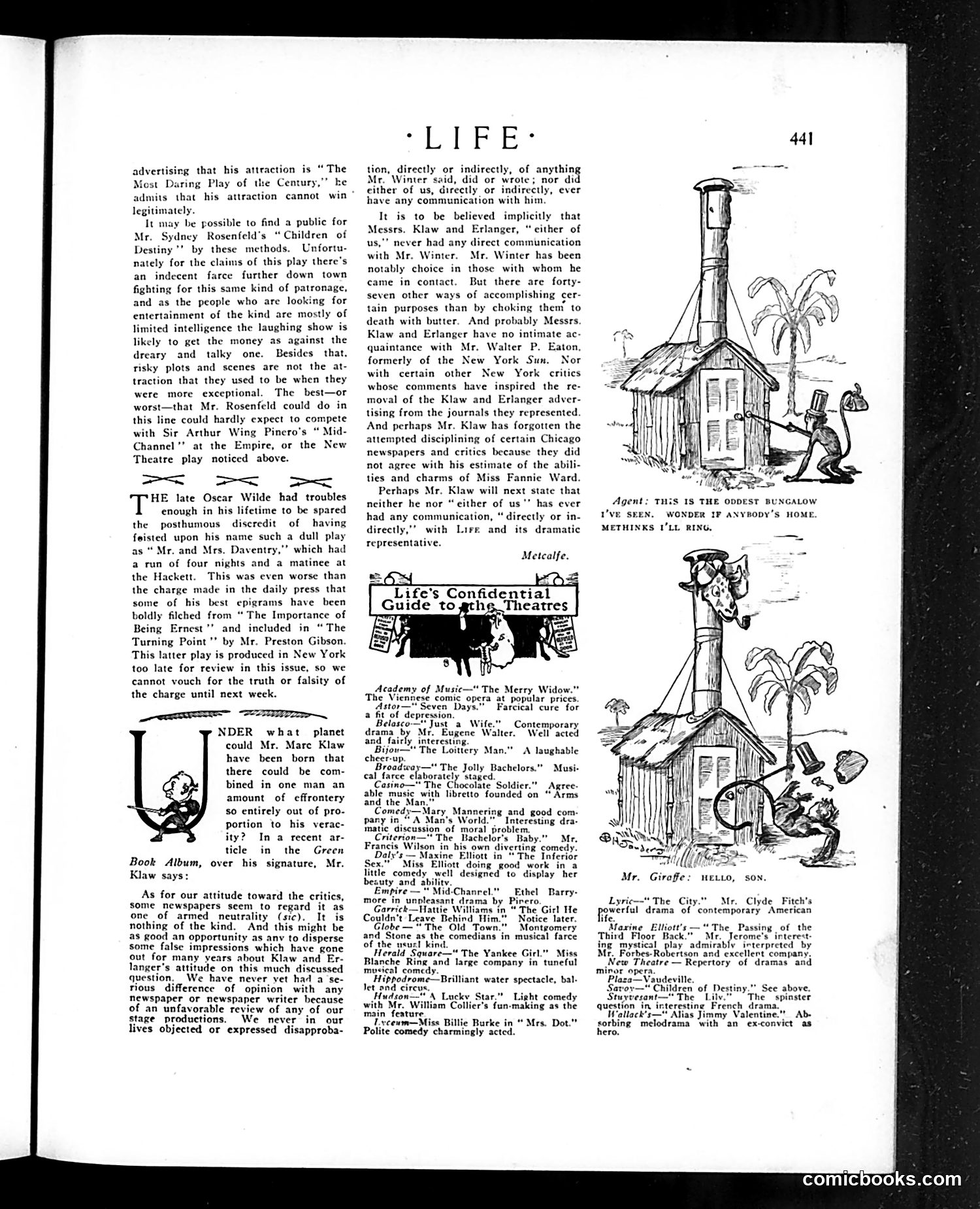
This page satirizes **Marc Klaw**, a powerful Broadway theater producer/manager, for claiming he and his partner Abraham Erlanger never interfered with theater critics or retaliated against unfavorable reviews. The author (identified as "Metcalfe," Life's drama critic) directly contradicts Klaw's public statement in *Green Book Album*. Metcalfe documents specific instances where Klaw and Erlanger allegedly: - Removed advertising from newspapers giving bad reviews - Attempted to discipline Chicago papers critical of actress Fannie Ward - Maintained hostile relationships with critics like William Winter and Walter P. Eaton The satire's point: Klaw's denial is transparently false—his record shows systematic retaliation against critics. The exaggerated language ("amount of effrontery so entirely out of proportion to his veracity") mocks his audacity in making provably untrue claims. This reflects early 20th-century tensions between powerful theatrical monopolies and independent critical voices.
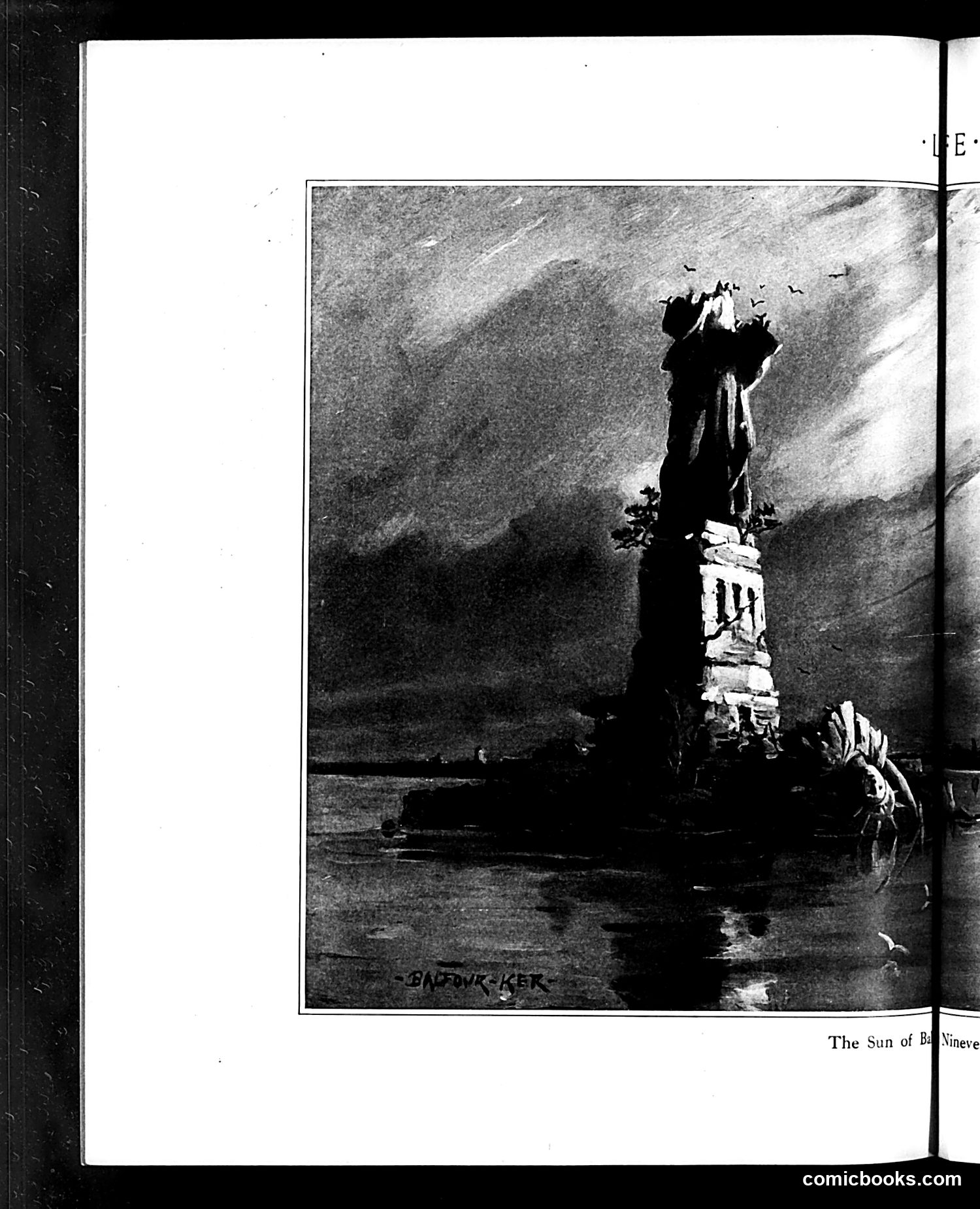
This page contains a dramatic black and white illustration signed by what appears to be "Balfour Ker." The image depicts a tall monument or statue on a pedestal silhouetted against a stormy sky with birds flying overhead. The caption reads "The Sun of B[...]ineye" (text cut off). The illustration employs Gothic, ominous imagery—dark clouds, turbulent weather, and a solitary monument—suggesting commentary on a political figure or regime. However, without the complete caption and publication date, I cannot definitively identify which historical figure or event this satirizes. The artistic style and dramatic treatment suggest criticism of an authoritarian or fallen leader, but further context is needed for precise interpretation.
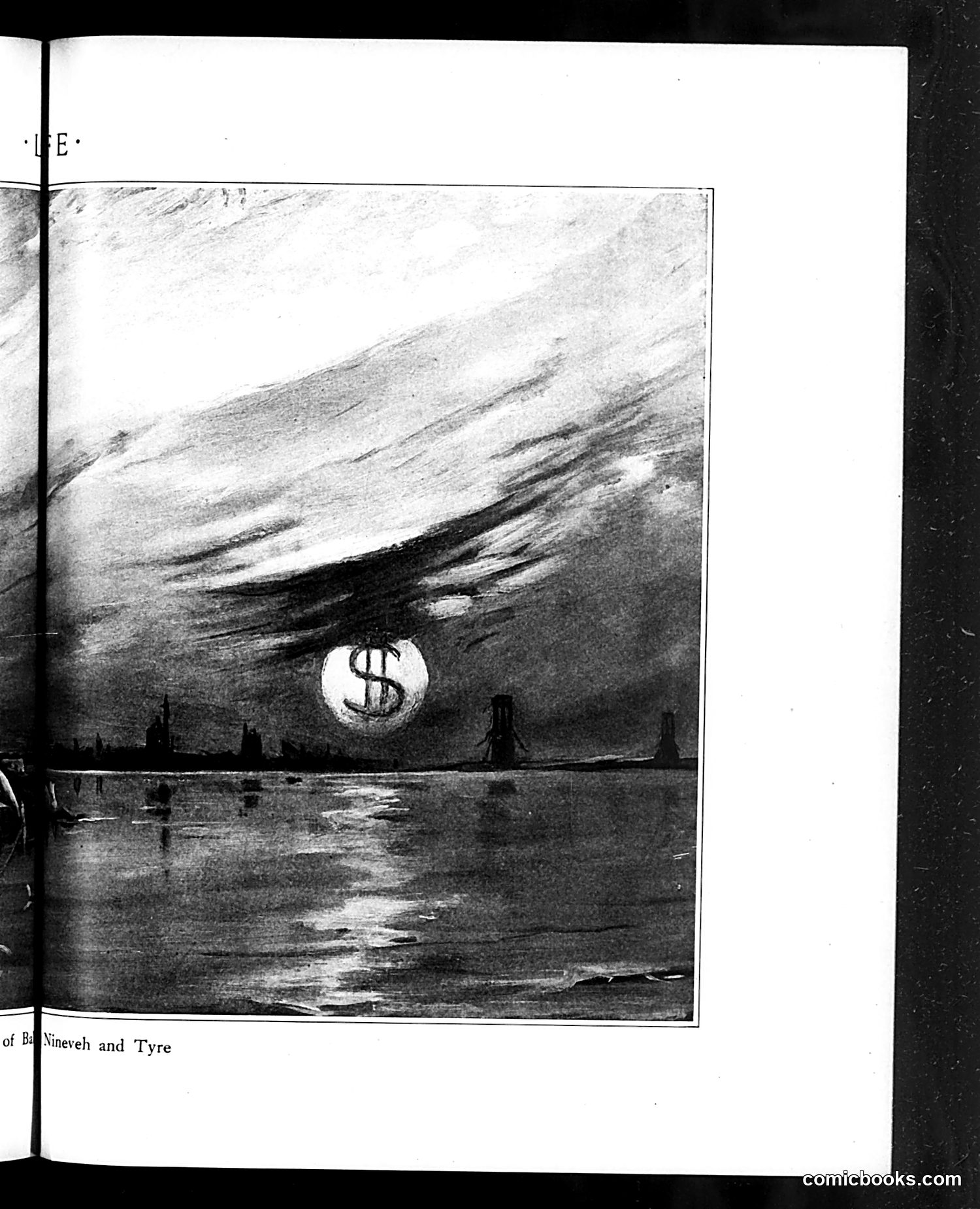
This appears to be a satirical illustration depicting the fall of ancient civilizations. The image shows a dramatic sky with a dollar sign ($) symbol replacing the sun over a darkened cityscape with industrial smokestacks reflected in water below. The caption references "Nineveh and Tyre"—ancient prosperous cities that fell into ruin. The substitution of the dollar sign for the sun suggests the satire: that American commerce and materialism have become all-consuming, like a false god. The industrial landscape and dark atmosphere imply a warning about unchecked capitalism leading to civilizational decline, paralleling the fates of historical empires. This likely dates from an era when Life magazine frequently critiqued American economic excess and materialism.
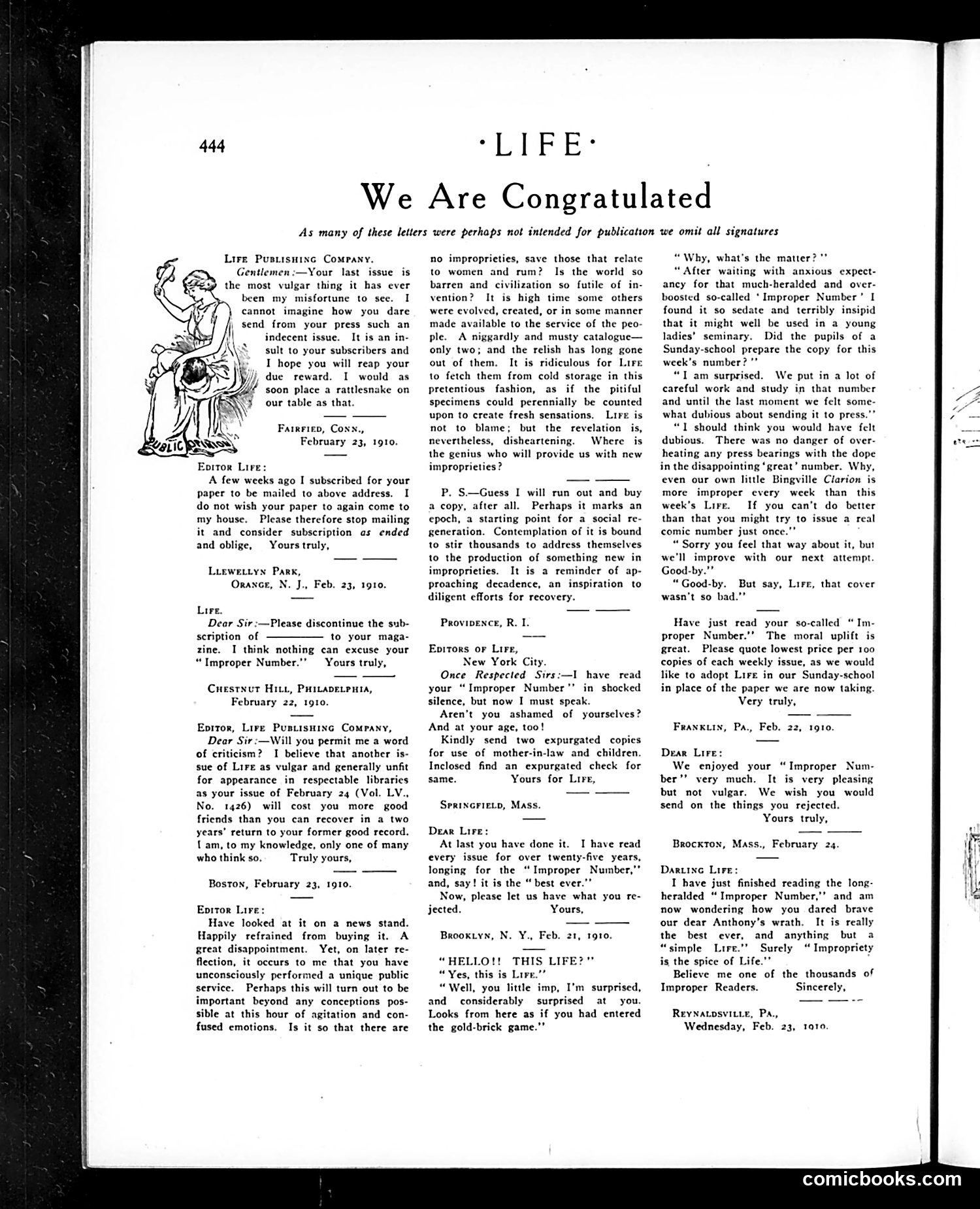
This page showcases reader responses to Life's recent "Improper Number" issue, which apparently contained risqué content. The letters display a split reaction: some subscribers denounce the issue as vulgar and demand cancellation; others, while mock-scandalized, actually praise it or request more. The small cartoon at bottom shows a telephone conversation where someone accuses Life of entering the "gold-brick game" (a confidence scheme)—suggesting the magazine manufactured outrage to boost sales. Life's satirical point: moral gatekeepers publicly condemn the "improper" content while secretly enjoying it. The page mocks Victorian prudishness and hypocrisy. One letter even admits the writer will "run out and buy a copy, after all," undercutting the complaint. The joke is that scandal sells, and respectable people's protests are performative.
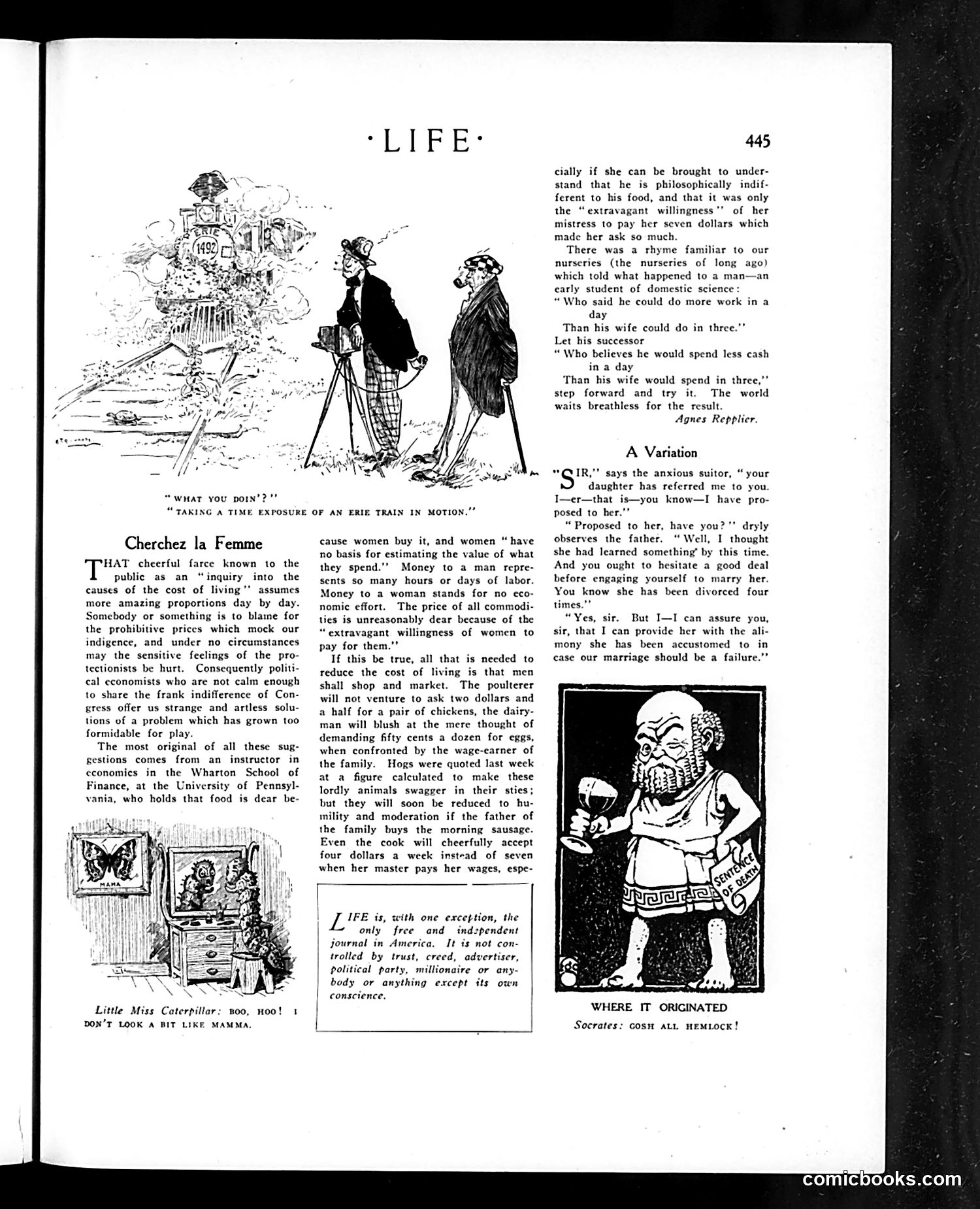
**"Cherchez la Femme" (Seek the Woman)** This article satirizes an economist from Wharton School who blamed high living costs on women's poor spending judgment. The satire mocks his theory that women lack economic understanding of money's value (unlike men who understand labor hours). The author, Agnes Repplier, ridicules this notion by pointing out that if men took over shopping, prices wouldn't magically drop—using a nursery rhyme about a man claiming he could do more work than his wife in a day, then proposing a male equivalent about spending less. **Top Cartoon** Two figures photograph a moving Erie Train with a time-exposure camera—a technical joke about the train's notorious slowness. **"A Variation"** A suitor proposes to a woman; her father dryly notes she's been divorced four times. The suitor's reply: he can afford the alimony payments if this marriage also fails—a dark joke about serial divorce and financial arrangements. **"Little Miss Caterpillar"** A child's joke about appearance.
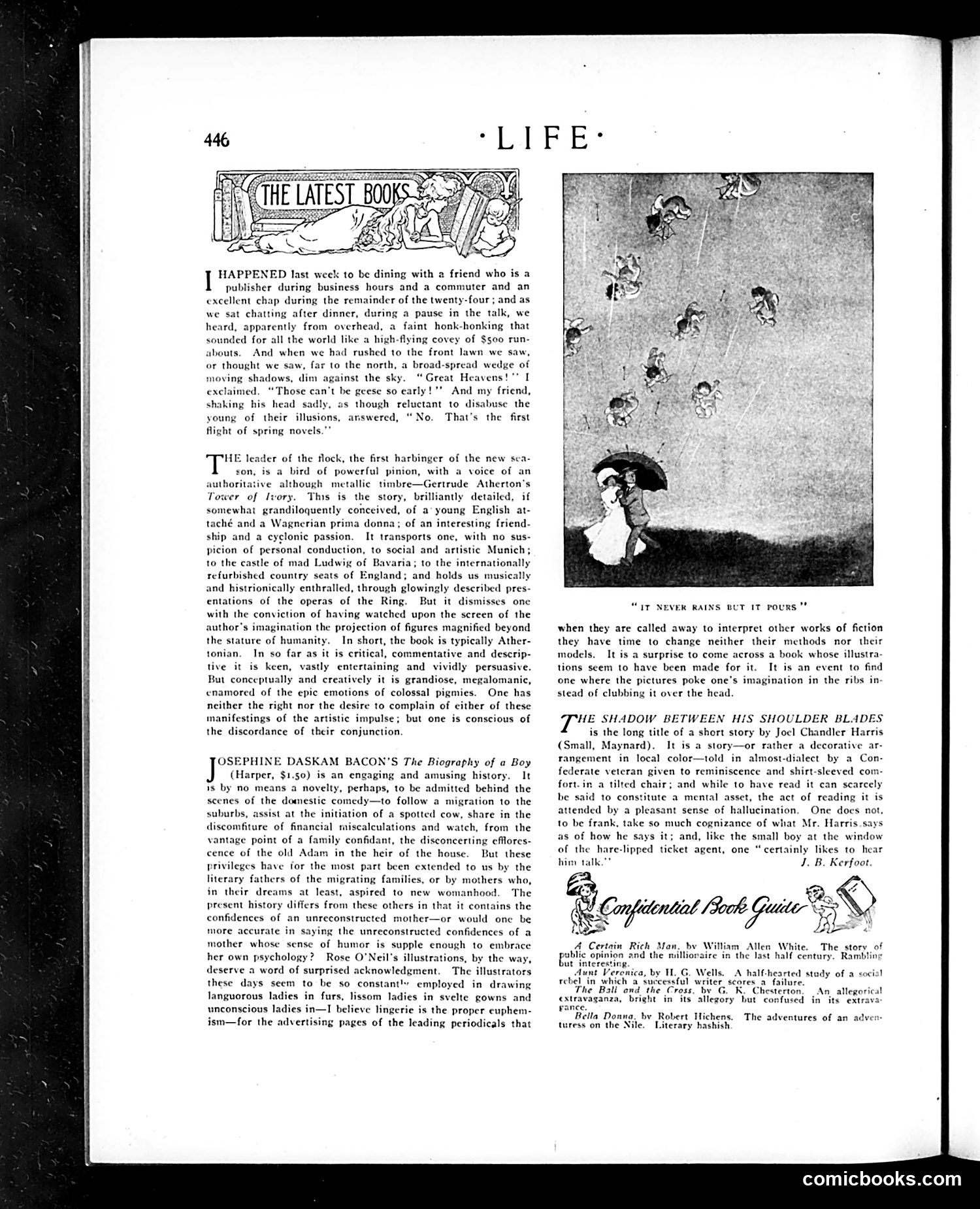
This page satirizes the annual spring publishing season through an extended metaphor. The opening anecdote describes what appears to be migrating geese overhead—but the publisher friend reveals they're actually "the first flight of spring novels," a joke about the predictable deluge of new books released each spring. The illustration shows geese in formation, visualizing this literary conceit. The text then reviews three such "spring novels," including Gertrude Atherton's *Tower of Ivory*, which the critic describes as grandiloquent and megalomanic—emotionally overblown despite technical skill. The satire targets both publishers' marketing practices (flooding the market seasonally) and certain authors' tendency toward overwrought, pretentious prose. For modern readers: this is essentially mockery of "beach read" season and literary pretension dressed in overwrought language.
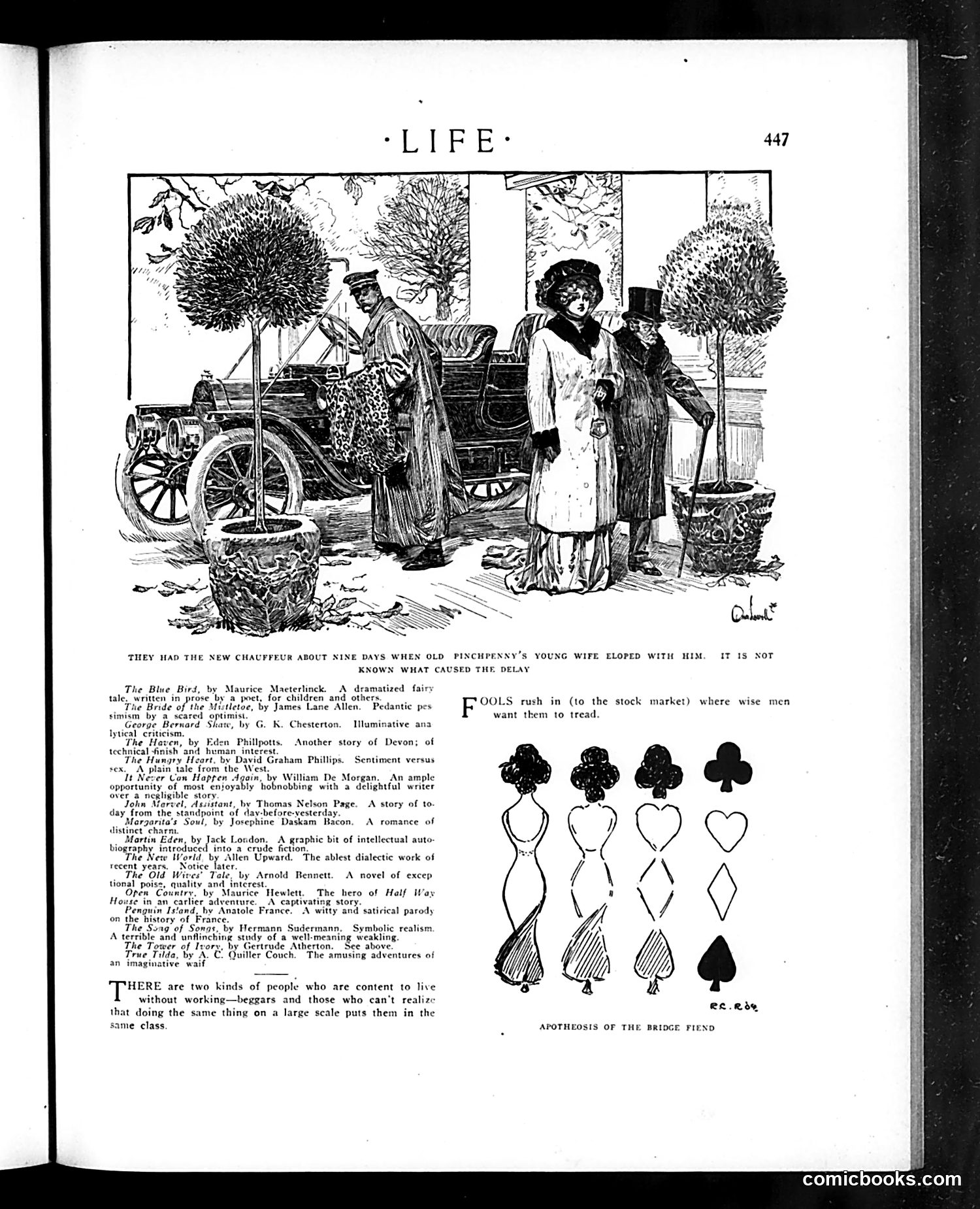
The page contains two distinct satirical elements: **Top Cartoon:** A social comedy about class and infidelity. A wealthy man ("Old Pinchpenny") has hired a new chauffeur. His young wife elopes with the chauffeur after only nine days—the caption's joke being that we don't know what caused the *delay* in her leaving. The satire mocks both the elderly miser with a young wife and the predictable outcome of such May-December marriages among the wealthy. **Bottom Section:** "Apotheosis of the Bridge Fiend" shows playing cards transformed into female figures, satirizing women's obsession with the card game bridge, which was enormously popular in early 20th-century society. The progression suggests bridge addiction consuming women entirely. **Text Block:** A sardonic observation that beggars and wealthy idlers who don't work are in the same class—both live without labor. This reflects Progressive Era critique of inherited wealth and leisure. The surrounding text lists contemporary book reviews, typical of Life's literary criticism features.
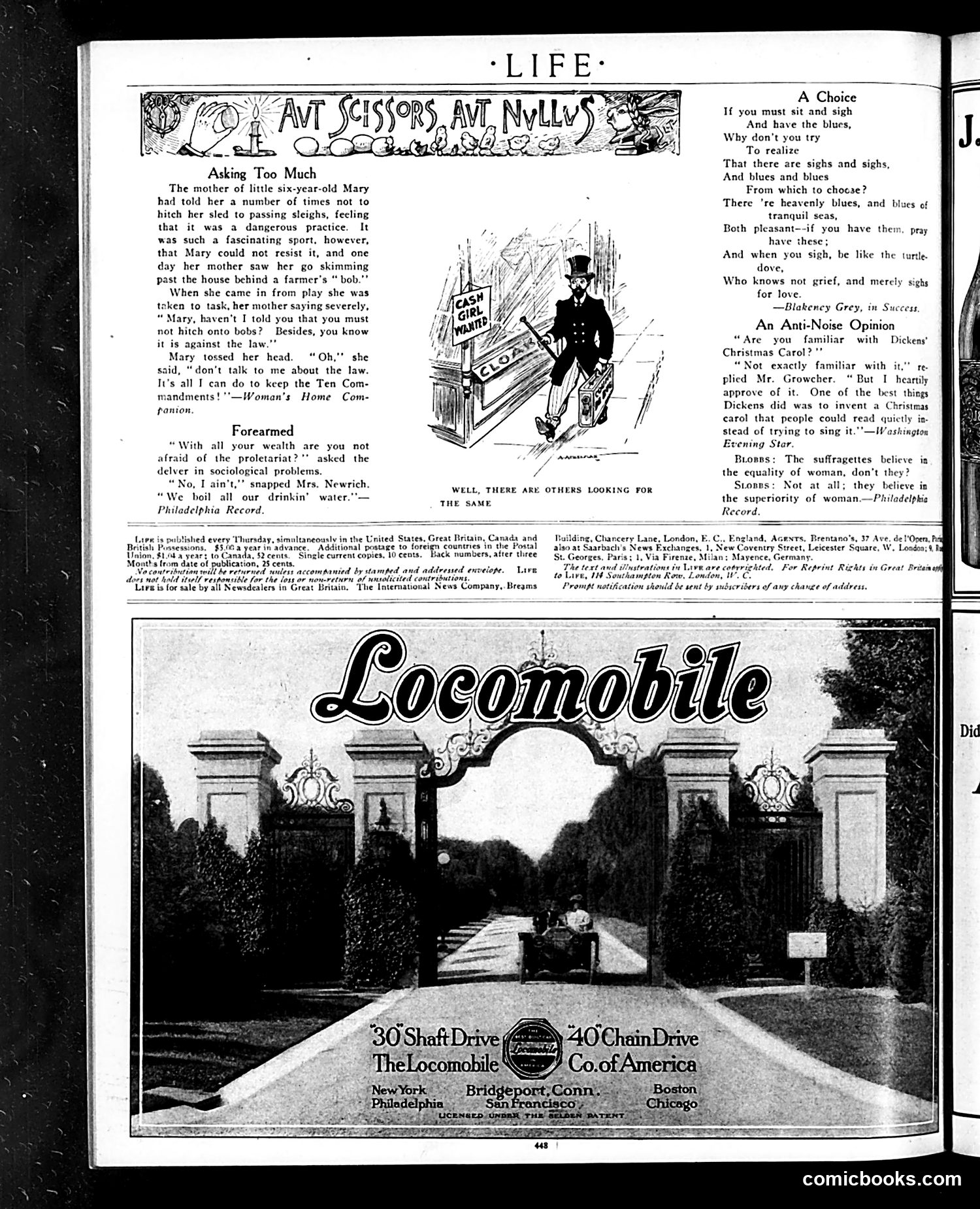
This page contains three brief humorous anecdotes typical of early 20th-century American satire: **"Asking Too Much"**: A six-year-old girl defies her mother's safety warnings about hitching her sled to passing sleighs. When scolded that it's "against the law," she dismisses rules by saying she can barely manage the Ten Commandments—satirizing children's selective obedience and the gap between moral and civil laws. **"Forearmed"**: A wealthy woman (Mrs. Newrich—a caricature name suggesting nouveau riche pretension) dismisses fears of socialist "proletariat" uprising by claiming she boils her drinking water. The joke mocks both the era's class anxieties about working-class revolution and the absurd notion that sanitation prevents political upheaval. **"An Anti-Noise Opinion"**: Mr. Growcher appreciates Dickens' *Christmas Carol* because people can *read* it quietly rather than sing carols aloud—satirizing the character's curmudgeonly preference for silence over festive noise. The page primarily advertises Locomobile automobiles below these brief comedic pieces.
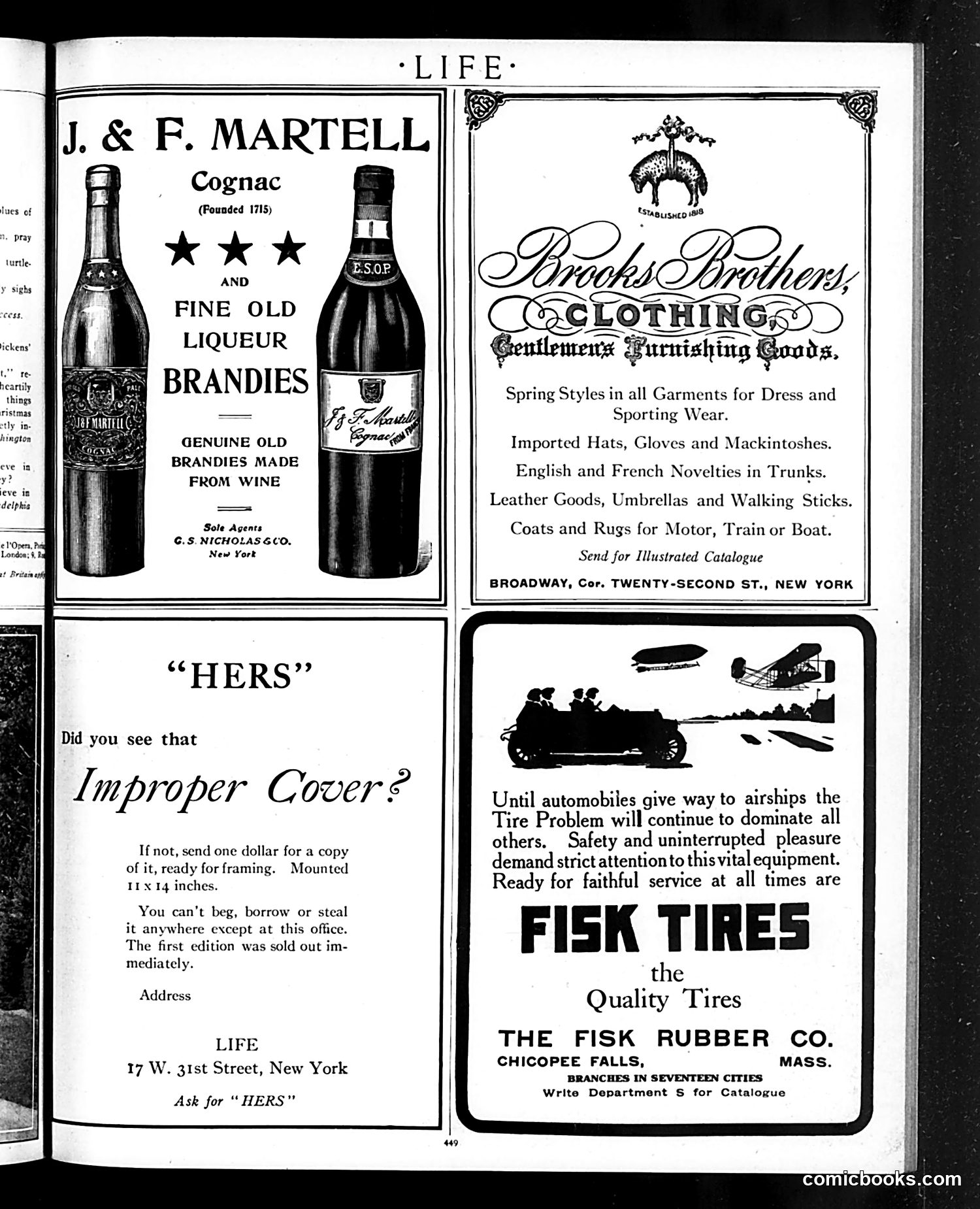
This is primarily an **advertising page** from Life magazine, not a political cartoon. It contains four distinct advertisements: 1. **J. & F. Martell Cognac**: Promotes French brandy, emphasizing its founding date (1715) and quality, with sole U.S. agents listed. 2. **Brooks Brothers**: A clothier advertisement for gentlemen's furnishings, listing imported goods and seasonal styles. 3. **"HERS" Cover Advertisement**: Life magazine's self-promotion for a controversial cover issue. The phrase "Improper Cover" suggests the magazine published something considered scandalous or risqué by contemporary standards—likely involving women or sexuality. The ad boasts it sold out immediately, using scarcity to drive demand for reprints. 4. **Fisk Tires**: Advertises automobile tires, notably referencing early aviation ("until automobiles give way to airships"), indicating this page dates to the early aviation era, likely 1910s-1920s. The page reflects early 20th-century consumer culture and what Life considered newsworthy or controversial regarding women's representation.
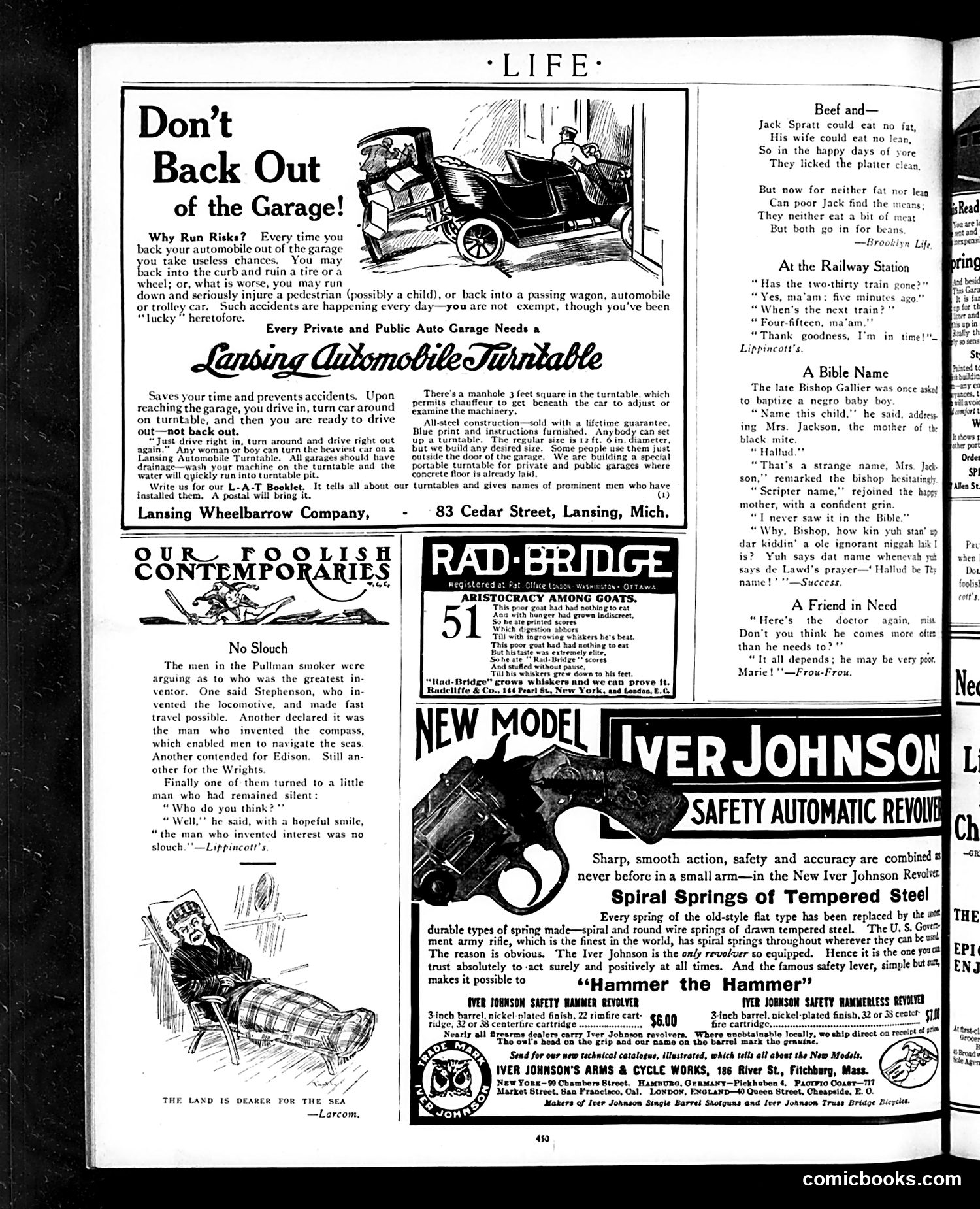
This page from *Life* magazine contains primarily **advertisements and light humor pieces**, not political cartoons. The main content is an ad for the **Lansing Automobile Turntable**—a garage device that lets drivers turn their cars around rather than backing out, preventing accidents. This reflects genuine early-automobile safety concerns: backing collisions with pedestrians, trolleys, and other vehicles were common and serious problems. The smaller humor pieces are period jokes: - "No Slouch" compares great inventors; the punchline credits whoever "invented interest" (financial interest/loans) - "A Bible Name" features dialect humor where a Black mother names her child "Hallud," claiming it's from scripture—the joke being she's referencing "Hallowed be Thy name" from the Lord's Prayer (reflecting era-typical stereotyping) - Other brief items use gentle wordplay The **Iver Johnson revolver ad** and other commercial content occupy significant space. This is fundamentally a **consumer magazine page**, not satirical commentary on contemporary politics or events.
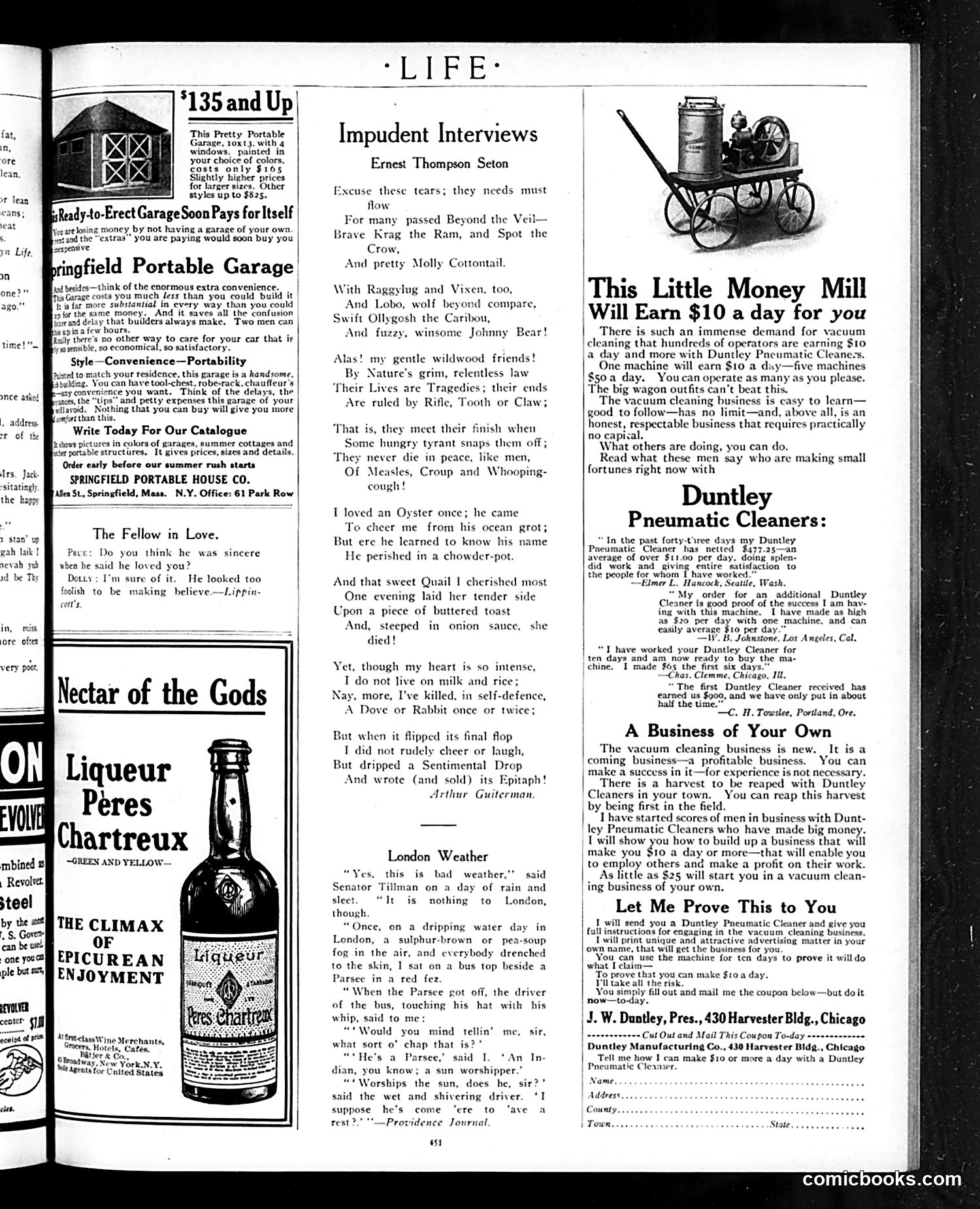
This page from the satirical magazine *Life* contains mostly **advertisements and light humor pieces**, not political cartoons. The main content includes: **"Impudent Interviews"** by Ernest Thompson Seton—a humorous poem mocking Seton's sentimental nature writing about animals. The satire targets his romanticization of wildlife (naming animals like "Krag the Ram" and "Molly Cottontail") while acknowledging he actually hunts them. The joke: he kills animals in "self-defence" but writes tearful epitaphs for them—exposing the contradiction between his sentimental persona and practical reality. **"London Weather"** is a brief anecdote about Senator Tillman describing London fog, culminating in a joke about a Parsee sun-worshipper enduring rainy English weather—absurdist humor based on religious stereotype. The remainder is **commercial advertising**: portable garages, liqueur, and cleaning equipment—typical of *Life*'s revenue model. A small "Fellow in Love" joke about romantic sincerity appears as filler. No significant political satire is present on this page.
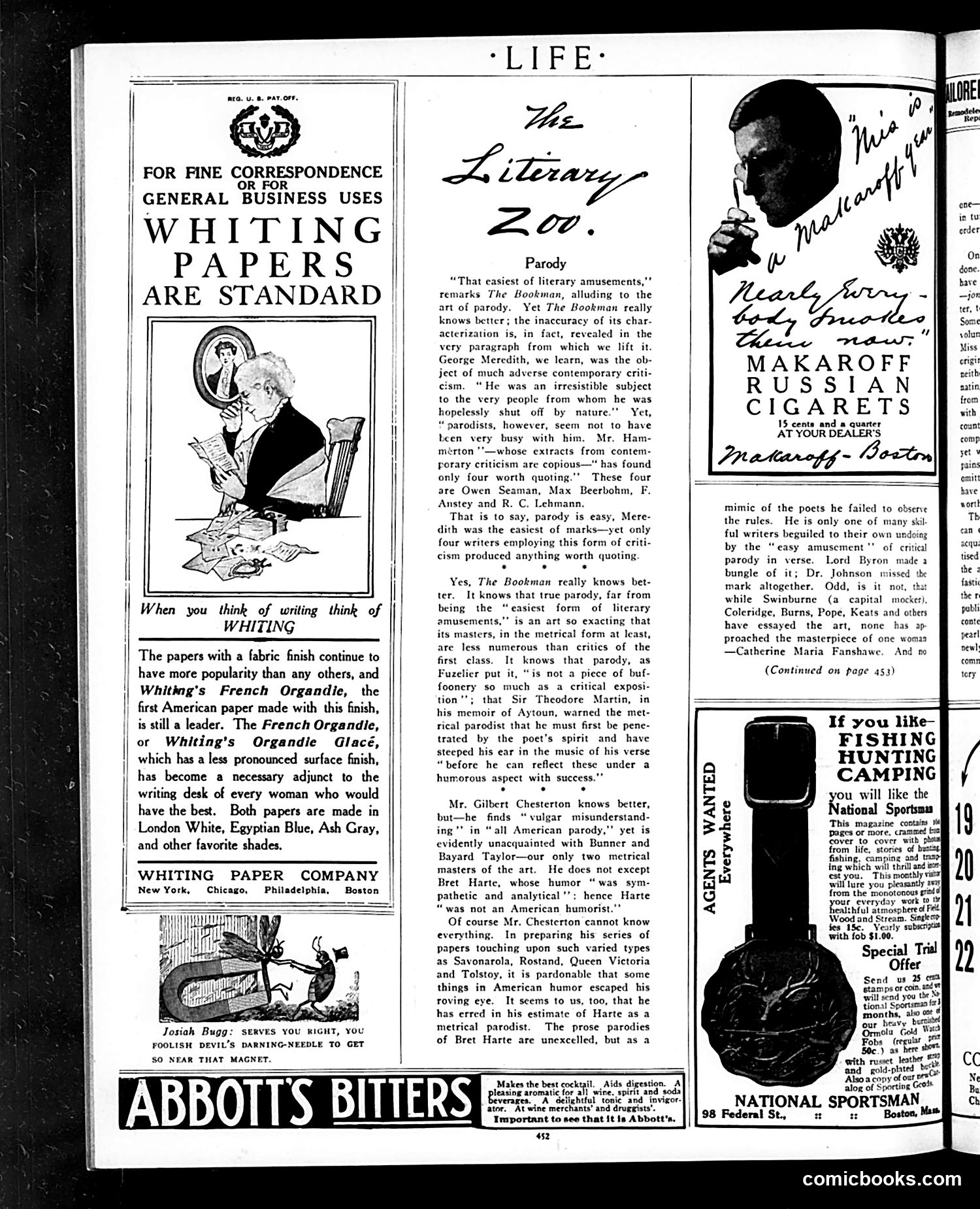
This page is primarily **advertising with a literary article**, not political satire. The main content is "The Literary Zoo," an essay critiquing literary parody. The author argues against *The Bookman* magazine's claim that parody is "easy"—contending it's actually a difficult art requiring mastery of the parodied writer's style. The piece discusses whether American writers like Bret Harte, Gilbert Chesterton, and Lord Byron succeeded or failed at metrical parody, ultimately praising Catherine Maria Fanshawe as the finest parodist. The left sidebar shows a **Josiah Bugg cartoon** (a recurring Life character), though its caption is partially cut off, making its specific joke unclear. The page is dominated by **advertisements**: Whiting Papers, Makaroff Russian Cigarettes, Abbott's Bitters, and a National Sportsman magazine ad. **For modern readers**: This reflects late 19th/early 20th-century literary culture's serious engagement with parody as artistic criticism—a form largely forgotten today.
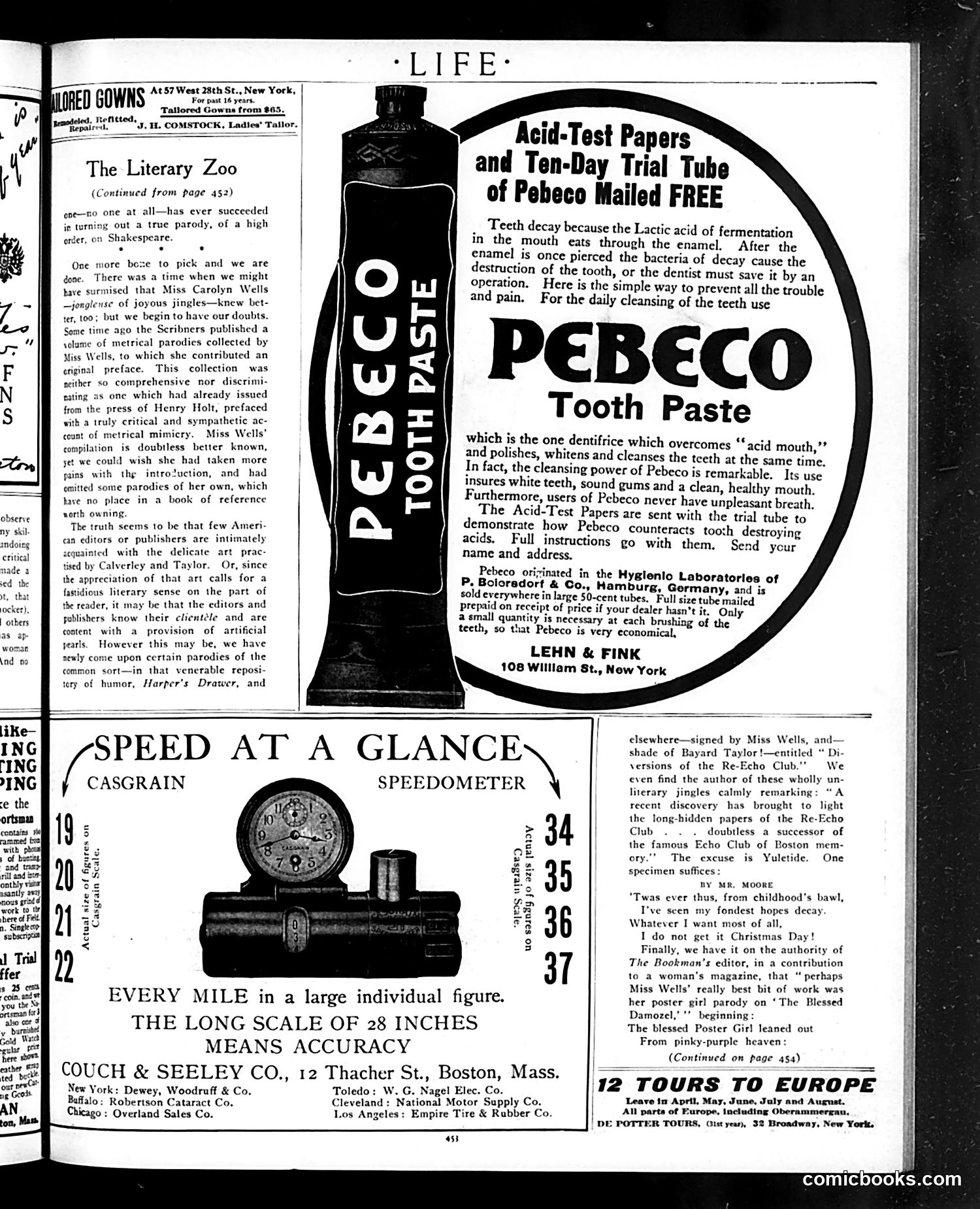
This page mixes editorial content with advertisements typical of early 20th-century magazines. **"The Literary Zoo" (left column):** A critical essay reviewing poet/anthologist Carolyn Wells's collection of metrical parodies. The author argues Wells's compilation lacks the sophistication of an earlier Holt edition and faults her introductory essay. The piece dismisses some of her original parodies as unworthy of a reference book, suggesting American editors underestimate readers' literary taste or knowingly cater to mass audiences with "artificial pearls." **Advertisements:** The page features three product ads—a tailored gowns service, Pebeco Tooth Paste (emphasizing scientific acid-prevention), and a Casgrain speedometer. These reflect period consumer marketing emphasizing scientific claims and precision engineering. **"Speed at a Glance":** Below the speedometer ad, a brief literary note mentions Wells again, noting a humorous fictional "Re-Echo Club" in her writing. The page reflects Life's dual role: sophisticated literary criticism alongside accessible consumer advertising.
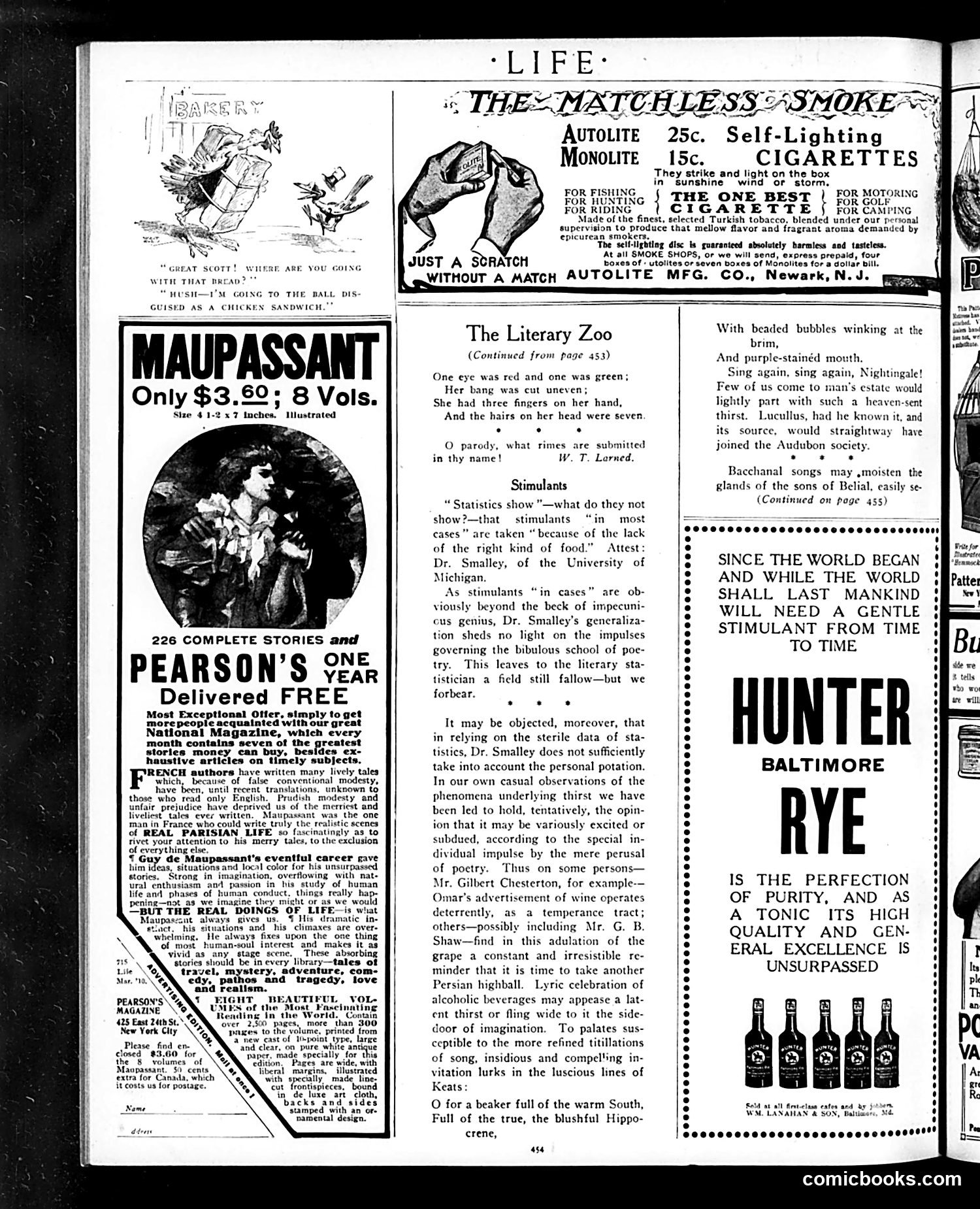
**The cartoon** (top left) shows a man heading to a ball dressed as a "chicken sandwich"—a nonsensical, absurd costume choice. The joke is simply surreal humor: the other person's bewildered response ("Great Scott! Where are you going with that bread?") highlights how ridiculous this disguise is. **The page is primarily advertising**, promoting: 1. **Maupassant's collected works** (8 volumes for $3.60)—marketed as "real" stories of Parisian life, with a barely-veiled pitch that they contain risqué content previously censored in English translations 2. **Autolite self-lighting cigarettes**—marketed for various leisure activities (fishing, golf, camping), emphasizing their convenience and "mellow flavor" 3. **Hunter Baltimore Rye whiskey**—claiming "perfection of purity" **The "Literary Zoo"** is an editorial column mocking bad poetry submissions and discussing whether stimulants (alcohol) fuel artistic inspiration—somewhat ironic given the whiskey ad directly below. This page reflects early 1900s advertising targeting middle-class leisure and consumption.
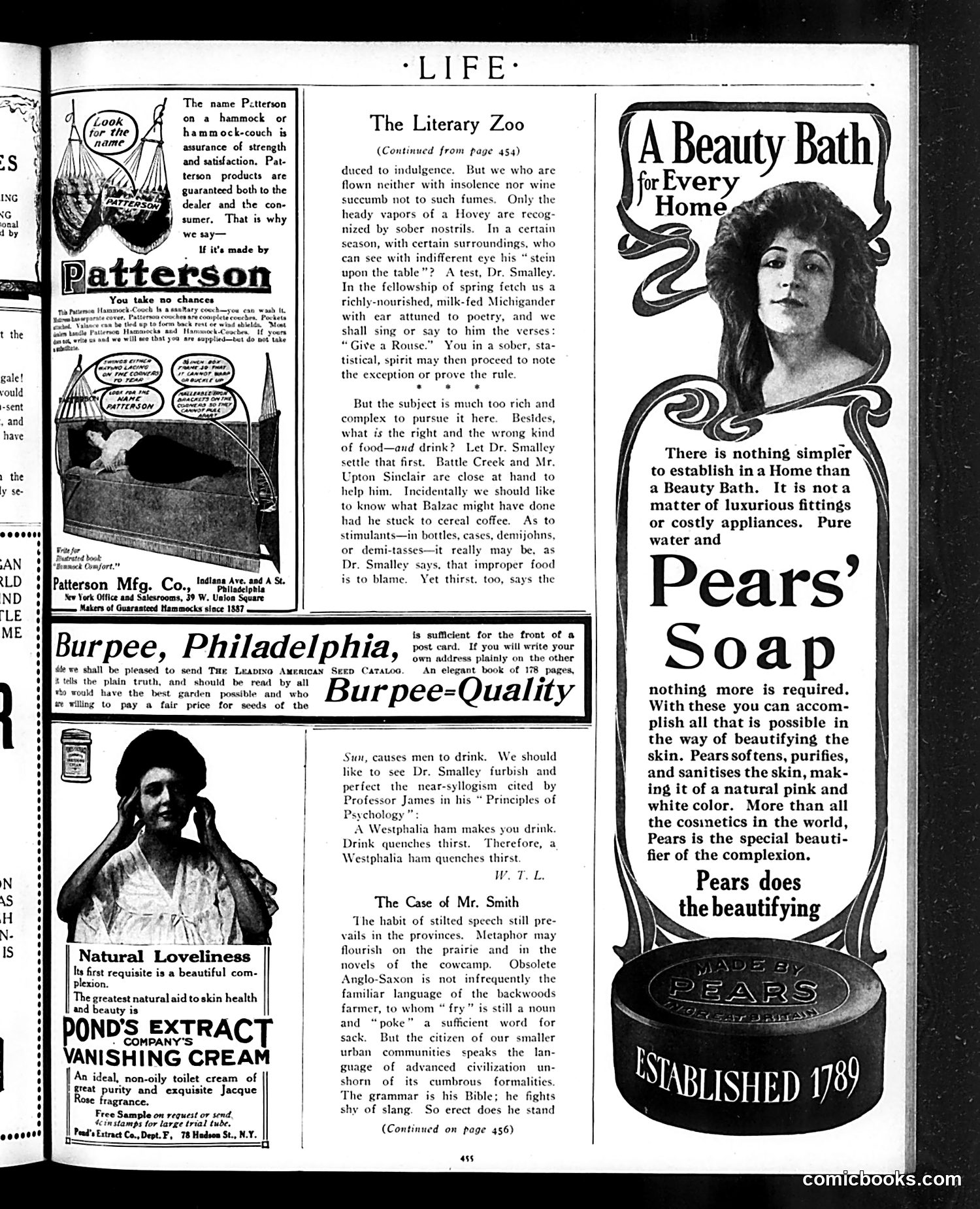
This page primarily consists of **advertisements interspersed with literary satire**, rather than political cartoons. **"The Literary Zoo" (center)** is a humorous essay mocking pretentious literary and intellectual discourse. It satirizes overly complicated discussions about food, drink, and morality—referencing real figures like Upton Sinclair (food safety reformer) and Battle Creek (sanitarium movement). The piece ridicules both excessive indulgence and sanctimonious sobriety, suggesting intellectuals overthink simple matters. **"The Case of Mr. Smith" section** continues this satire, mocking rural Americans' use of archaic Anglo-Saxon speech patterns ("fry" as noun, "poke" for sack) while also poking fun at urban pretension—how city dwellers artificially "correct" their grammar to seem civilized. The **advertisements** (Patterson hammocks, Burpee seeds, Ponds Extract, Pears Soap) occupy substantial space, typical of Life's business model. These ads emphasize quality, natural beauty, and respectability—reflecting early 20th-century consumer values. The page satirizes **class anxiety and affectation** across American society—mocking both rural "backwardness" and urban snobbishness equally.
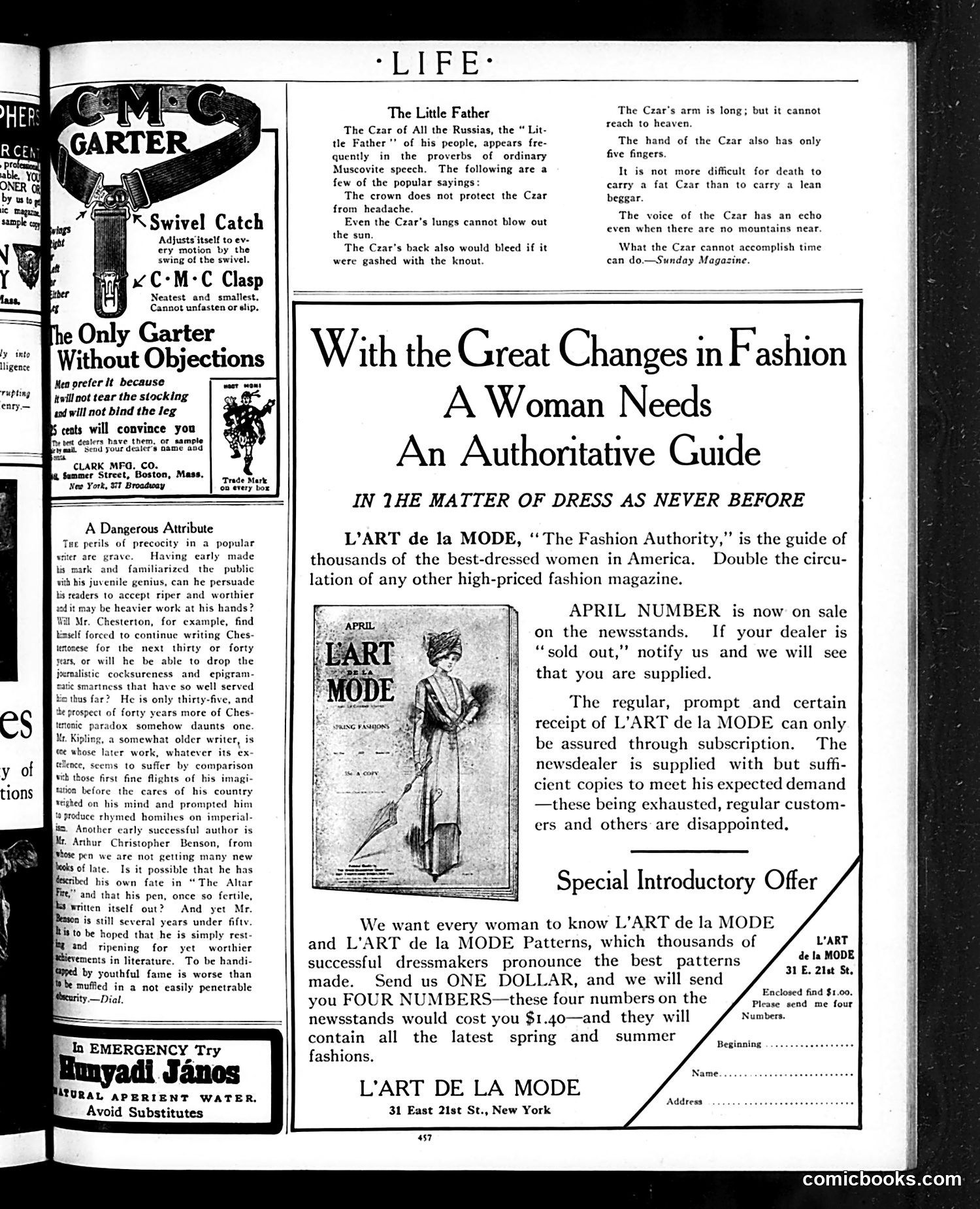
This page is primarily **advertising and editorial content** rather than political satire. The left column contains **product advertisements** (garters, clasps) and an essay titled "A Dangerous Attribute" discussing whether precocious young writers—specifically **G.K. Chesterton** and **Rudyard Kipling**—can sustain their creative output beyond their early success. It's a literary critique questioning whether their youthful brilliance will fade as they age and face life's responsibilities. Below that is a brief satirical piece called "The Little Father," listing Russian proverbs about the Czar that undercut his absolute power—suggesting even an emperor cannot control nature, death, or heaven. This appears to be commentary on limitations of autocratic rule, likely contemporaneous with early-20th-century Russian upheaval. The majority of the page is a **fashion magazine advertisement** for *L'ART de la MODE*, promoting subscription to a high-end fashion publication. The text emphasizes the magazine's authority on women's dress and offers a discounted introductory subscription rate.
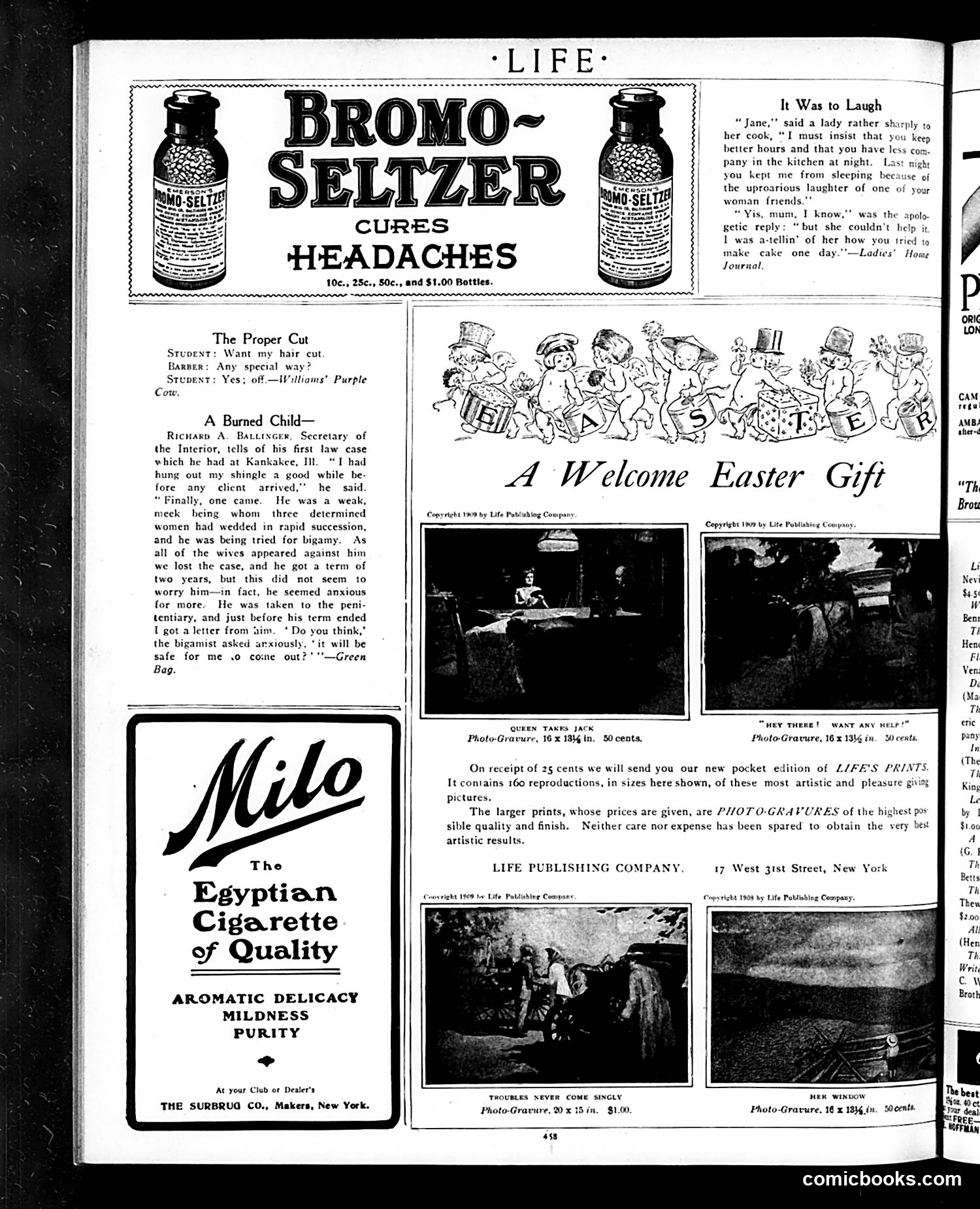
This page is primarily **advertising and filler content** rather than political satire. It contains: **Advertisements:** Bromo-Seltzer (headache cure), Milo Egyptian cigarettes, and Life Publishing Company's print offers dominate the layout. **Humor Columns:** Three brief jokes appear: - A cook's employer complains about kitchen noise; the cook reveals the laughter was about the employer's failed cake-baking - A barber/student exchange about a haircut style - Secretary of Interior Richard A. Ballinger recounts his first law case—defending a bigamist who seemed unconcerned about prison **Illustrations:** "A Welcome Easter Gift" section shows photogravure prints available for purchase, including images titled "Queen Takes Jack," "Troubles Never Come Singly," "Her Window," and others—typical sentimental period imagery. The Ballinger anecdote is the only item with potential political interest, as Ballinger was a controversial Interior Secretary during the Taft administration, though this piece presents him anecdotally without satirical intent.
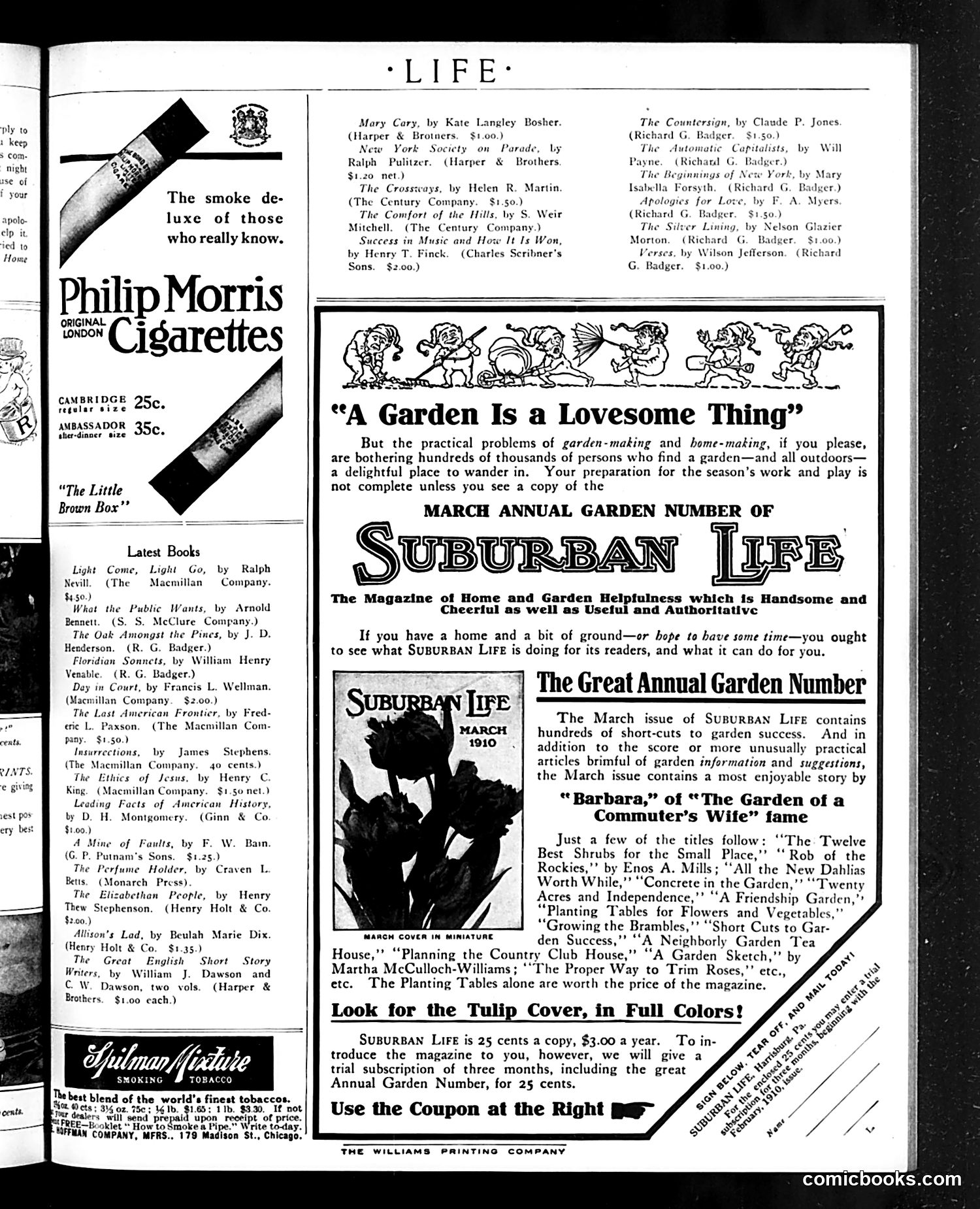
This page is primarily **advertising and book listings**, not political satire. The main content comprises: 1. **Book advertisements** listing newly published titles (Mary Cary, The Crossways, etc.) 2. **Cigarette ads** for Philip Morris and Spilman Mixture tobacco products—unremarkable for the era, when such advertising appeared regularly in mainstream magazines 3. **Magazine promotion** for *Suburban Life's* March garden issue, targeting early-20th-century homeowners interested in gardening and suburban living The decorative header showing cherub-like figures with gardening tools is purely ornamental, not satirical. **Historical context**: This reflects the period's growing interest in suburban domesticity and home gardening as aspirational middle-class pursuits. The emphasis on practical "garden-making and home-making" suggests marketing to wives of commuters—a new demographic emerging with suburban expansion. There are **no political cartoons or satire** visible on this page.
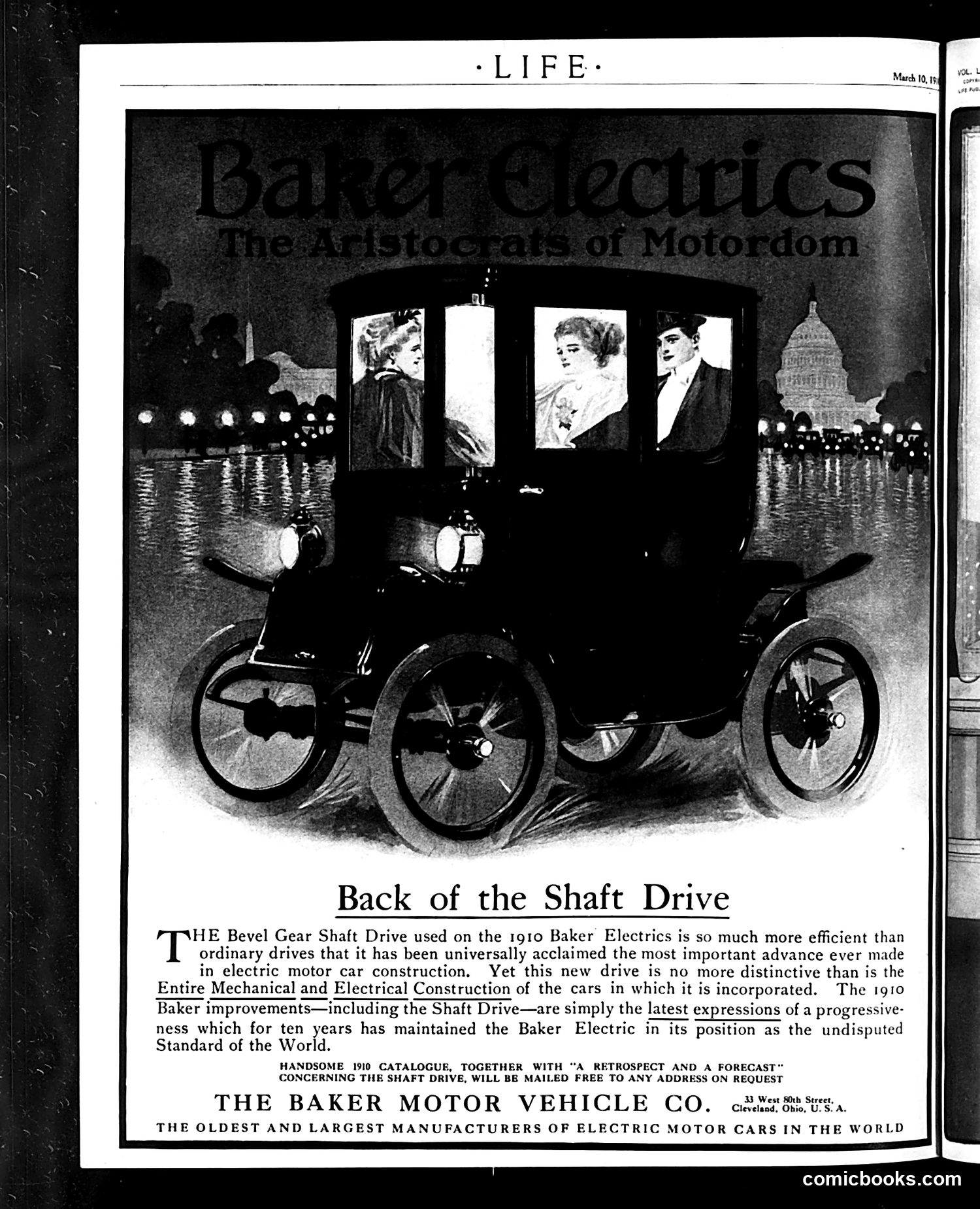
This is **not satire or political commentary**—it's a straightforward advertisement for Baker Motor Vehicle Company, a manufacturer of electric automobiles. The page promotes their 1910 models, emphasizing the innovative "Bevel Gear Shaft Drive" as a major mechanical advancement. The illustration shows an elegant electric car with four passengers (two women and two men in period dress) driving past illuminated landmarks including what appears to be the U.S. Capitol, suggesting prestige and American modernity. The text claims Baker maintains its position as "the undisputed Standard of the World" for electric vehicles. This reflects the early 1910s era when electric cars competed seriously with gasoline engines, targeting wealthy, urban consumers who valued quiet, clean operation. The aspirational imagery—fashionable passengers, nighttime city driving, monumental architecture—reinforces the product's association with refinement and progress.