
Life, 1910-03-10 · page 17 of 36
Life — March 10, 1910 — page 17: what you’re looking at
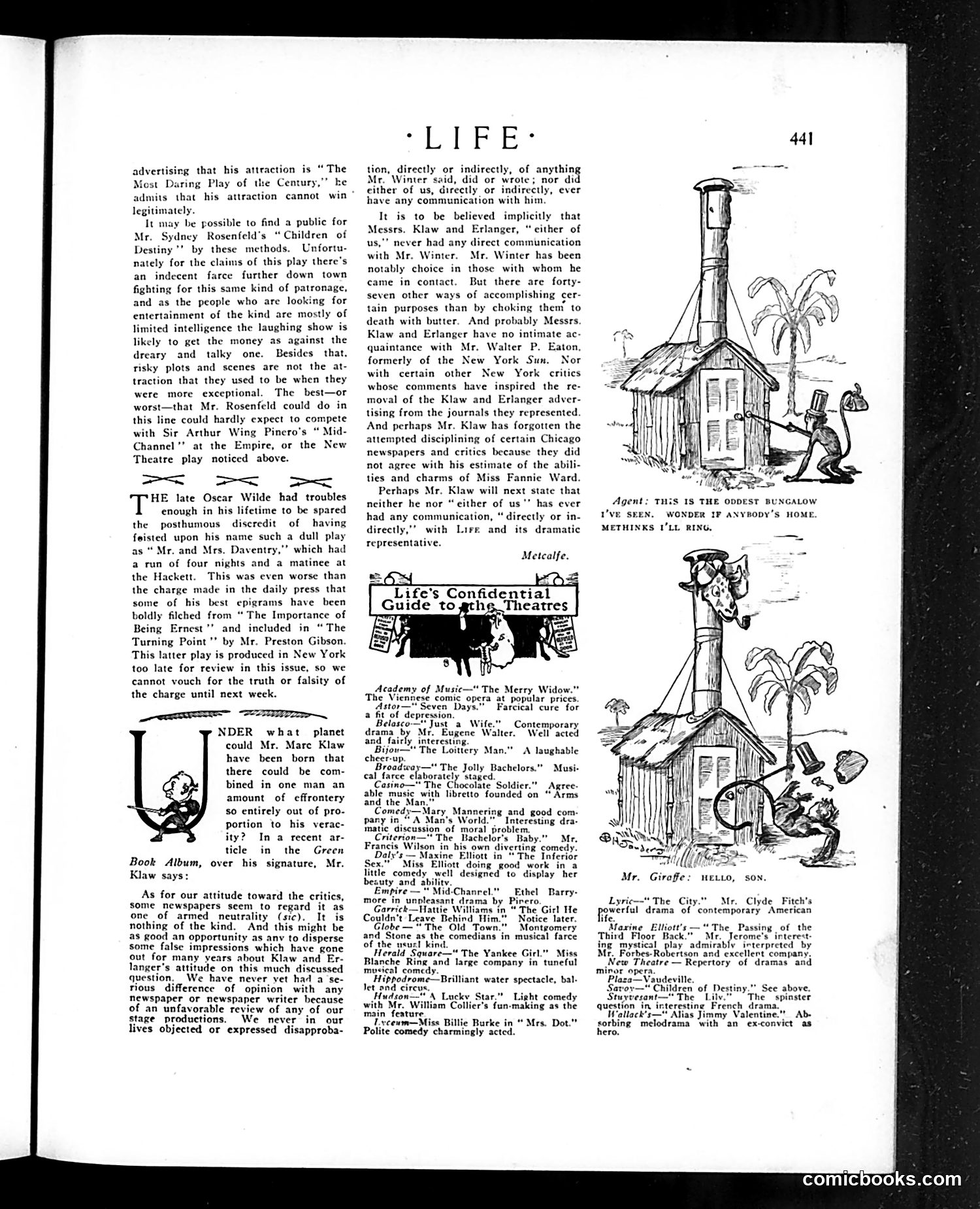
What you’re looking at
This page satirizes **Marc Klaw**, a powerful Broadway theater producer/manager, for claiming he and his partner Abraham Erlanger never interfered with theater critics or retaliated against unfavorable reviews. The author (identified as "Metcalfe," Life's drama critic) directly contradicts Klaw's public statement in *Green Book Album*. Metcalfe documents specific instances where Klaw and Erlanger allegedly: - Removed advertising from newspapers giving bad reviews - Attempted to discipline Chicago papers critical of actress Fannie Ward - Maintained hostile relationships with critics like William Winter and Walter P. Eaton The satire's point: Klaw's denial is transparently false—his record shows systematic retaliation against critics. The exaggerated language ("amount of effrontery so entirely out of proportion to his veracity") mocks his audacity in making provably untrue claims. This reflects early 20th-century tensions between powerful theatrical monopolies and independent critical voices.
📄 Transcribed text from this page (OCR, searchable)
Machine-transcribed from the original scan — historical spelling and the odd misread are preserved.
Most Daring Play of the Century, admits that his attraction cannot legitimately. be possible to find a public for dney Rosenfeld’s “Children of Destiny "’ by these methods. Unfortu- nately for the claims of this play there's an indecent farce further down town fighting for this same kind of patronage, and as the people who are looking for entertainment of the kind are mostly of limited intelligence the laughing show is likely to get the money as against the dreary and talky one. Besides that. risky plots and scenes are not the at- traction that they used to be when they were more exceptional. The best—or worst—that Mr. Rosenfeld could do in this line could hardly expect to compete with Sir Arthur Wing Pinero’s “ Mid- Channel’? at the Empire, or the New Theatre play noticed above. oma >= =~ HE late Oscar Wilde had troubles enough in his lifetime to be spared the posthumous discredit of having feisted upon his name such a dull play as“ Mr. and Mrs. Daventry,” which had a run of four nights and a matinee at the Hackett. This was even worse than the charge made in the daily press that some of his best epigrams have been boldly filched from “The Importance of Being Ernest ’’ and included in “The Turning Point’ by Mr. Preston Gibson. This latter play is produced in New York too late for review in this issue, so we cannot vouch for the truth or falsity of the charge until next week. ee SOT NDER what planet could Mr. Mare Klaw have been born that there could be com- bined in one man an amount of effrontery 80 entirely out of pro- portion to his verac- ity? In a recent ar- ticle in the Green Book Album, over his signature, Mr. Klaw says: Pa As for our attitude toward the critics, some newspapers seem to regard it as one of armed neutrality (sic). It is nothing of the kind. And this might be as good an opportunity as anv to disperse some false impressions which have gone out for many years about Klaw and Er- langer’s attitude on this much discussed question. We have never yet had a se- rious difference of opinion with any Newspaper or newspaper writer because of an unfavorable review of any of our stage productions. We never i lives objected or expressed win” *LIFE* tion, directly or indirectly, of anythin, Me Winter said, did or wrote; nor did cither of us, directly or indirectly, ever have any communication with him. It is to be believed implicitly that Messrs. Klaw and Erlanger, “cither of never had any direct communication with Mr. Winter. Mr. Winter has been notably choice in those with whom he came in contact. But there are forty- seven other ways of accomplishing cer- tain purposes than by choking them to death with butter. And probably Messrs. Klaw and Erlanger have no intimate ac- quaintance with Mr, Walter P. Eaton, formerly of the New York Sun, Nor with certain other New York critics whose comments have inspired the re- moval of the Klaw and Erlanger adver- tising from the journals they represented. And perhaps Mr. Klaw has forgotten the attempted disciplining of certain Chicago newspapers and critics because they did not agree with his estimate of the abi ties and charms of Miss Fannie Ward. Perhaps Mr. Klaw will next state that neither he nor “either of us"* has ever had any communication, “directly or in- directly,” with Lire and its dramatic representative. Metcalfe. Academy of Music—" The Merry Widow.” The Viennese comic opera at popular prices. Astor—" Seven Days.” Farcical cure for 'ssion. Just a Wife.” drama by Mr. Eugene Walter. interesting. The Loittery Man." Contemporary Well acted A laughable cheer-up. Broadway—" The Jolly Bachelors.” cal farce elaborately ‘staged. Casino—" The Chocolate Soldier.” Agree- able music with libretto founded on “ Arms and the Man.” Comedy—Mary, Mannering and good com- pany in “A Man's World.” Interesting dra- matic discussion of moral problem. _Criterion—" The Bachelor's Baby.” Mr. Francis Wilson in his own diverting comedy. : '$— Maxine Elliott in “The Inferior Sex." “Miss Elliott doing good work in a little comedy well designed to display her beauty and ability. Empire —" Mid-Chanrel." Ethel more in unpleasant drama by Pirero. Garrick—Hattie Williams in “ The Girl He Couldn't Leave Behind Hi Notice later. Globe — The Old Town.” Montgomery and Stone as the comedians in musical farce of the nsusl kind Herald Square—" The Yankee Girl.” Miss Blanche Ring and large company in tuneful musical comedy. Hippodrome—Brilliant water spectacle, bal- Jet and circus Hudson: Musi- Barry- i “4 Lucky Star.” Light comedy with Mr. William Collier's fun-making as the main feature T.vceum—Mise Billie Burke in “ Mrs. Dot.” Polite comedy charmingly acted. VVE SEEN Mr. Lyric life. Maxine Elliott's Third Floor Back lay admirably Mr, Forhes-Robertson and excellent company, New Theatre — Repertory of dramas and ing mystical WONDER IF ANYBODY’S HOME. METHINKS ILL RING. Giraffe : ‘audeville, Children of Destiny.” See above. Stuyvesant—" The question in interesting Wallack’s— sorbing melodrama with an ex-convict as hero, Alias HELLO, yric—" The City.” werful drama of contemporary American SON Mr. Clyde Fi “The Passing of the | t. Jerome's interest: | rpreted by } The ench drama. my Valentine. ster Ab. i comicbooks.com