
Life, 1910-03-10 · page 21 of 36
Life — March 10, 1910 — page 21: what you’re looking at
What you’re looking at
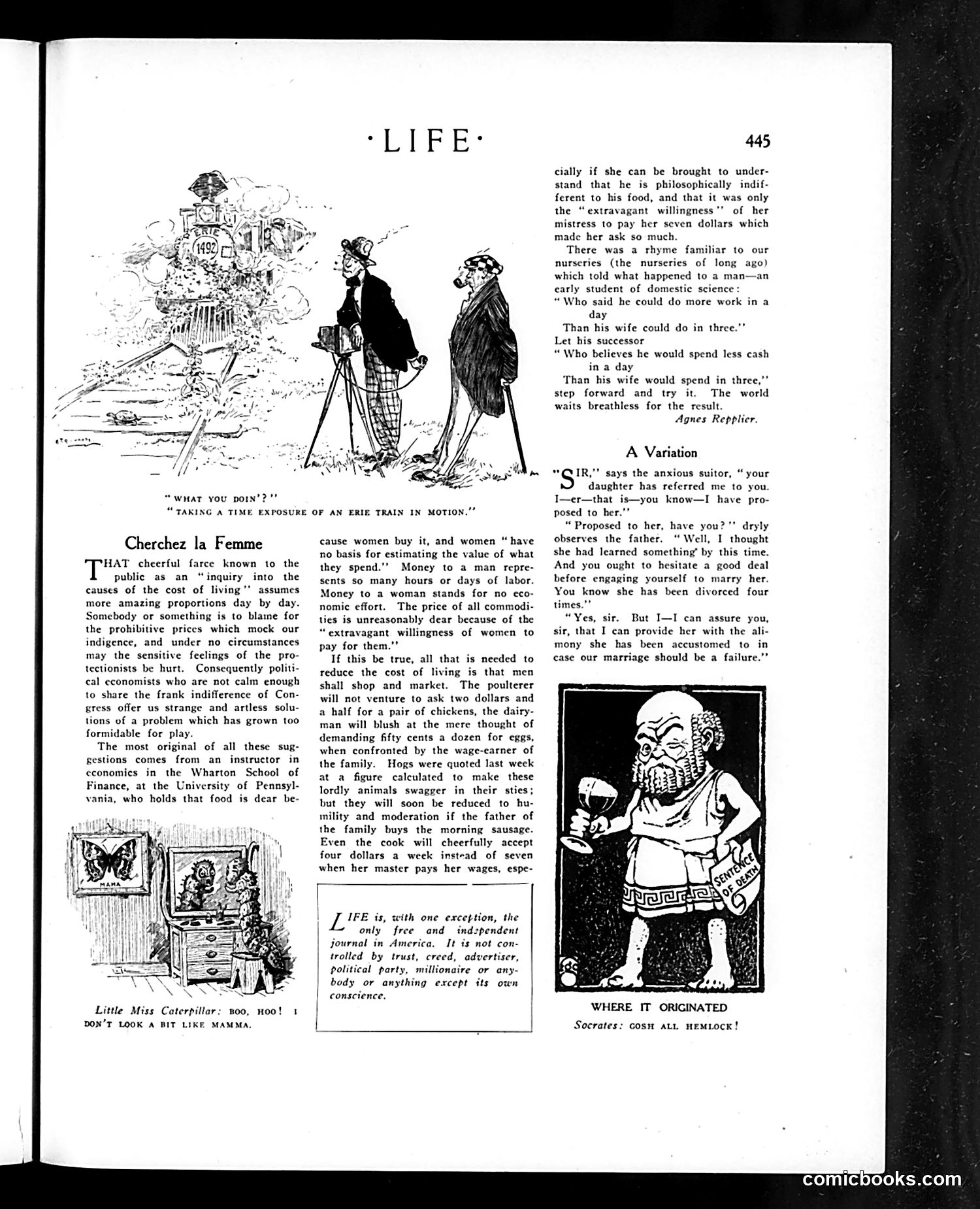
**"Cherchez la Femme" (Seek the Woman)** This article satirizes an economist from Wharton School who blamed high living costs on women's poor spending judgment. The satire mocks his theory that women lack economic understanding of money's value (unlike men who understand labor hours). The author, Agnes Repplier, ridicules this notion by pointing out that if men took over shopping, prices wouldn't magically drop—using a nursery rhyme about a man claiming he could do more work than his wife in a day, then proposing a male equivalent about spending less. **Top Cartoon** Two figures photograph a moving Erie Train with a time-exposure camera—a technical joke about the train's notorious slowness. **"A Variation"** A suitor proposes to a woman; her father dryly notes she's been divorced four times. The suitor's reply: he can afford the alimony payments if this marriage also fails—a dark joke about serial divorce and financial arrangements. **"Little Miss Caterpillar"** A child's joke about appearance.
📄 Transcribed text from this page (OCR, searchable)
Machine-transcribed from the original scan — historical spelling and the odd misread are preserved.
“wnat you poINn’?’? “TAKING A TIME EXPOSURE OF AN ERIE TRAIN IN MOTION. Cherchez la Femme Te cheerful farce known to the public as an “inquiry into the causes of the cost of living’ assumes more amazing proportions day by day. Somebody or something is to blame for the prohibitive prices which mock our indigence, and under no circumstances may the sensitive feelings of the pro- tectionists be hurt. Consequently politi- cal economists who are not calm enough to share the frank indifference of Con- gress offer us strange and artless solu- tions of a problem which has grown too formidable for play. The most original of all these sug- gestions comes from an instructor in cconomics in the Wharton School of Finance, at the University of Pennsyl- vania, who holds that food is dear be- Little Miss Caterpillar: 800, noo! DON’T LOOK A BIT LIKE MAMA, cause women buy it, and women “have no basis for estimating the value of what they spend.” Money to a man repre- sents so many hours or days of labor. Money to a woman stands for no eco- nomic effort. The price of all commodi- ties is unreasonably dear because of the “extravagant willingness of women to pay for them If this be true, all that is necded to reduce the cost of living is that men shall shop and market. The poulterer will not venture to ask two dollars and a half for a pair of chickens, the dairy- man will blush at the mere thought of demanding fifty cents a dozen for eggs, when confronted by the wage-earner of the family. Hogs were quoted last week at a figure calculated to make these lordly animals swagger in their sties; but they will soon be reduced to hu- mility and moderation if the father of the family buys the morning sausage. Even the cook will cheerfully accept four dollars a week instead of seven when her master pays her wages, espe- IFE is, with one exception, the only free and indzpendent journal in America. It is not con- trolled by trust, creed, advertiser, political party, millionaire or any- body or anything except its own | conscience. 445, cially if she can be brought to under- stand that he is philosophically indif- ferent to his food, and that it was only the “extravagant willingness” of her mistress to pay her seven dollars which made her ask so much. There was a rhyme familiar to our nurseries (the nurseries of long ago) which told what happened to a man—an carly student of domestic science “Who said he could do more work in a day Than his wife could do in three.” Let his successor “ Who believes he would spend less cash in a day ‘Than his wife would spend in three,” step forward and try it. The world waits breathless for the result. Agnes Repplicr. A Variation “QIR," says the anxious suitor, “ your daughter has referred me to you I—er—that is—you know—I have pro- posed to her.”* “ Proposed to her, have you?" dryly observes the father. “Well, I thought she had learned something’ by this time. And you ought to hesitate a good deal before engaging yourself to marry her. You know she has been divorced four times.”” “Yes, sir. But I—I can assure you, sir, that I can provide her with the al mony she has been accustomed to in case our marriage should be a failure.”” WHERE IT ORIGINATED Socrates: cosn att nemiock! comicbooks.com