
Life, 1910-03-10 · page 22 of 36
Life — March 10, 1910 — page 22: what you’re looking at
What you’re looking at
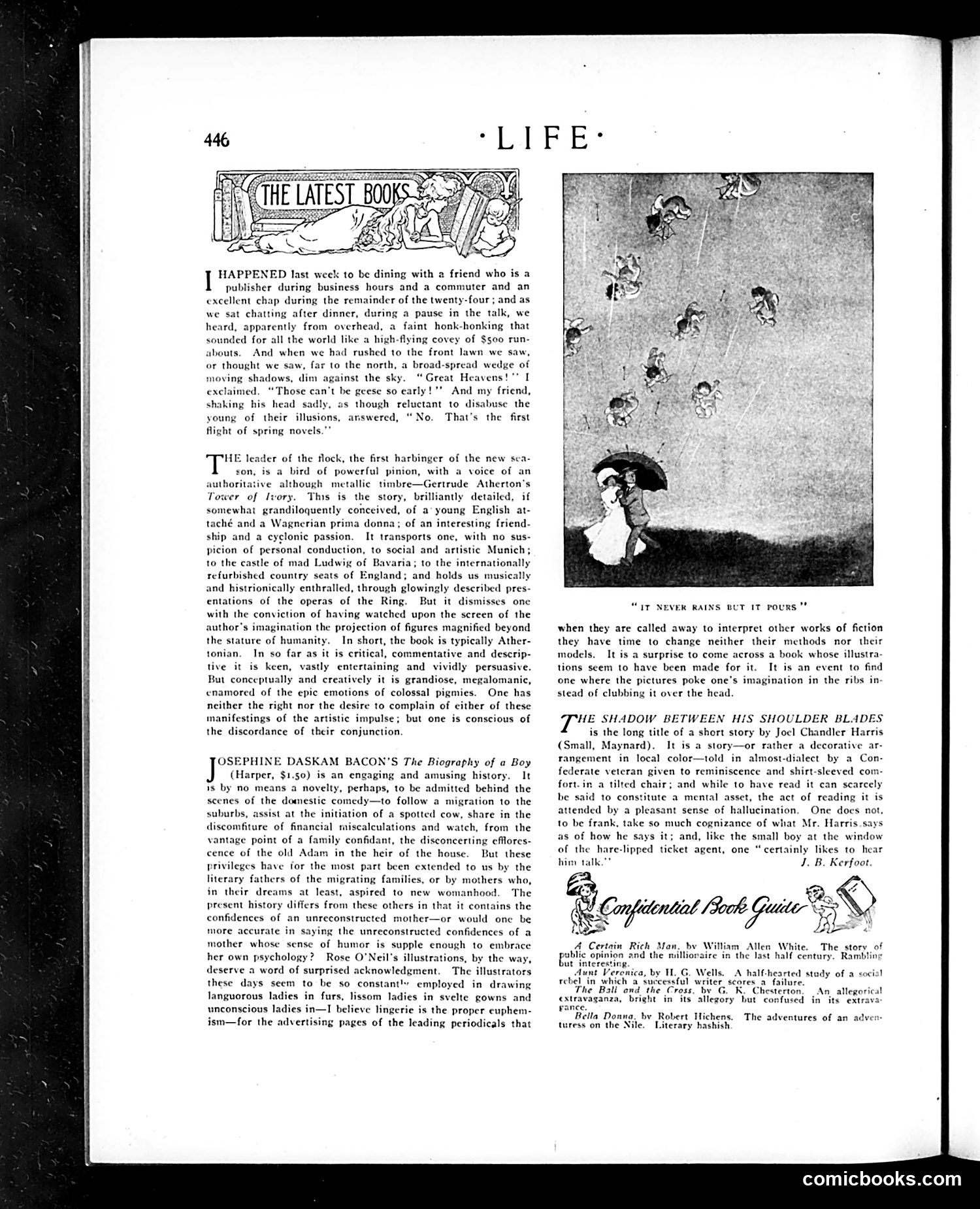
This page satirizes the annual spring publishing season through an extended metaphor. The opening anecdote describes what appears to be migrating geese overhead—but the publisher friend reveals they're actually "the first flight of spring novels," a joke about the predictable deluge of new books released each spring. The illustration shows geese in formation, visualizing this literary conceit. The text then reviews three such "spring novels," including Gertrude Atherton's *Tower of Ivory*, which the critic describes as grandiloquent and megalomanic—emotionally overblown despite technical skill. The satire targets both publishers' marketing practices (flooding the market seasonally) and certain authors' tendency toward overwrought, pretentious prose. For modern readers: this is essentially mockery of "beach read" season and literary pretension dressed in overwrought language.
📄 Transcribed text from this page (OCR, searchable)
Machine-transcribed from the original scan — historical spelling and the odd misread are preserved.
HAPPENED last week to be dining with a friend who is a publisher during business hours and a commuter and an excellent chap during the remainder of the twenty-four; and as we sat chatting after dinner, during a pause in the talk, we heard, apparently from overhead, a faint honk-honking that sounded for all the world like a high-flying covey of $500 run- abouts. And when we had rushed to the front lawn we saw, or thought we saw, far to the north, a broad-spread wedge of “Great Heavens!" I Those can’t be geese so carly!’” And my friend, shaking his head sadly, as though reluctant to disabuse the young of their illusions, answered, “No. That’s the first flight of spring novels.” moving shadows, dim against the sky exclaimed. HE leader of the flock, the first harbinger of the new sca son, is a bird of powerful pinion, with a voice of an authoritative although metallic timbre—Gertrude Atherton’s Tower of Ivory. This is the story, brilliantly detailed, if somewhat grandiloquently conceived, of a’ young English at- taché and a Wagnerian prima donna; of an interesting friend- ship and a cyclonic passion. It transports one, with no sus- picion of personal conduction, to social and artistic Munich; to the castle of mad Ludwig of Bavaria; to the internationally refurbished country seats of England; and holds us musically and histrionically enthralled, through glowingly described pres- entations of the operas of the Ring. But it dismisses one with the conviction of having watched upon the screen of the author's imagination the projection of figures magnified beyond the stature of humanity, In short, the book is typically Ather- tonian. In so far as it is critical, commentative and descrip- tive it is keen, vastly entertaining and vividly persuasive. But conceptually and creatively it is grandiose, megalomanic, enamored of the epic emotions of colossal pigmies. One has neither the right nor the desire to complain of cither of these manifestings of the artistic impulse; but one is conscious of the discordance of their conjunction. OSEPHINE DASKAM BACON'S The Biography of a Boy J (Harper, $1.50) is an engaging and amusing history. It is by no means a novelty, perhaps, to be admitted behind the scenes of the domestic comedy—to follow a migration to the suburbs, assist at the initiation of a spotted cow, share in the discomfiture of financial miscalculations and watch, from the vantage point of a family confidant, the disconcerting efflores- cence of the old Adam in the heir of the house. But these privileges have for the most part been extended to us by the literary fathers of the migrating families, or by mothers who, in their dreams at least, aspired to new womanhood. The present history differs from these others in that it contains the confidences of an unreconstructed mother—or would one be more accurate in saying the unreconstructed confidences of a mother whose sense of humor is supple enough to embrac her own psychology? Rose O’Neil’s illustrations, by the way, deserve a word of surprised acknowledgment. The illustrators these days seem to be so constant!’ employed in drawing Janguorous ladies in furs, lissom ladies in svelte gowns and unconscious ladies in—I believe lingerie is the proper euphem- ism—for the advertising pages of the leading periodicals that “IT NEVER RAINS BUT IT PouRS "* when they are called away to interpret other works of fiction they have time to change neither their methods nor their models. It is a surprise to come across a book whose illustra- tions seem to have been made for it. It is an event to find one where the pictures poke one’s imagination in the ribs in stead of clubbing it over the head ‘HE SHADOW BETWEEN HiS SHOULDER BLAD is the long title of a short story by Jocl Chandler Harris (Small, Maynard), It is a story—or rather a decorative ar- rangement in local color—told in almost-dialect by a Con- federate veteran given to reminiscence and shirt-sleeved com- fort.in a tilted chair; and while to have read it can scarcely be said to constitute a mental asset, the act of reading it is attended by a pleasant sense of hallucination. One docs not, to be frank, take so much cognizance of what Mr. Harris says as of how he says it; and, like the small boy at the window of the hare-lipped ticket agent, one “certainly likes to hear him tallk.”” J.B. Kerfoot ah 4 Certain Rich v William Allen White. The story. o pablic opinion and the millionaire in the last half century. Rambline ut interesting. Aunt Veronica, by UH. G. Wells. A half-hearted stady of a social rebel in which a successful writer scores a failure. The Bali ond the Cross, by G. K. Chesterton. _An_ allegorical extravaganza, bright in its’ allegory but confused in its ext nee. Rella Donna. by Robert Hichens. turess on the Nile, Literary hashish The adventures of an a¢ comicbooks.com