
Life, 1910-03-10 · page 28 of 36
Life — March 10, 1910 — page 28: what you’re looking at
What you’re looking at
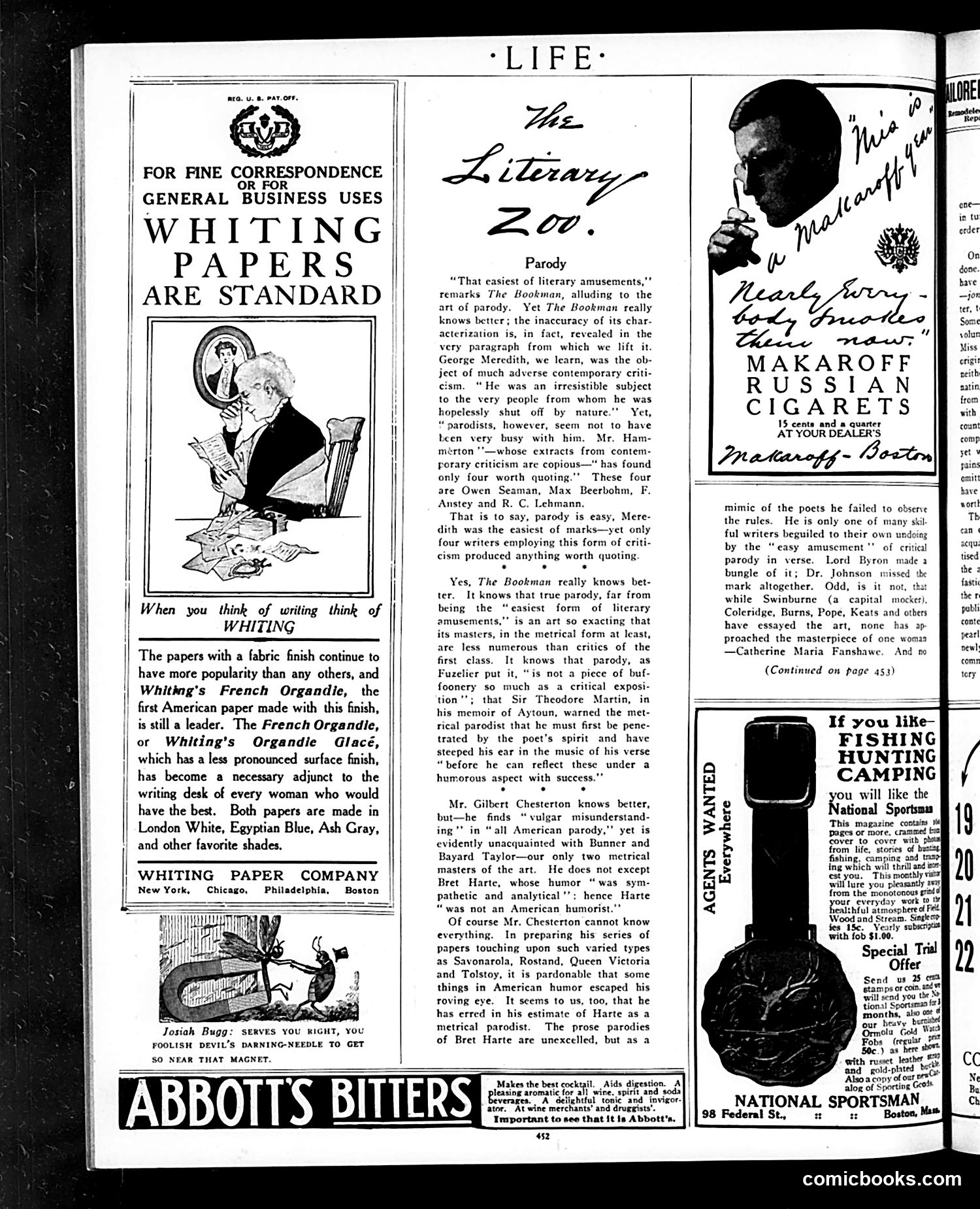
This page is primarily **advertising with a literary article**, not political satire. The main content is "The Literary Zoo," an essay critiquing literary parody. The author argues against *The Bookman* magazine's claim that parody is "easy"—contending it's actually a difficult art requiring mastery of the parodied writer's style. The piece discusses whether American writers like Bret Harte, Gilbert Chesterton, and Lord Byron succeeded or failed at metrical parody, ultimately praising Catherine Maria Fanshawe as the finest parodist. The left sidebar shows a **Josiah Bugg cartoon** (a recurring Life character), though its caption is partially cut off, making its specific joke unclear. The page is dominated by **advertisements**: Whiting Papers, Makaroff Russian Cigarettes, Abbott's Bitters, and a National Sportsman magazine ad. **For modern readers**: This reflects late 19th/early 20th-century literary culture's serious engagement with parody as artistic criticism—a form largely forgotten today.
📄 Transcribed text from this page (OCR, searchable)
Machine-transcribed from the original scan — historical spelling and the odd misread are preserved.
ra. U. 8. PAT.OFF. % FOR FINE CORRESPONDENCE | GENERAL ‘BUSINESS USES WHITING PAPERS ARE STANDARD When you think of writing think of WHITING The papers with a fabric finish continue to || have more popularity than any others, and || Whiting’s French Organdie, the | first American paper made with this finish, is still a leader. The French Organdie, | or Whiting’s Organdie Glacé, which has a less pronounced surface finish, has become a necessary adjunct to the writing desk of every woman who would have the best. Both papers are made in London White, Egyptian Blue, Ash Gray, and other favorite shades, WHITING PAPER COMPANY || | New York, Chicago, Philadelphia, Boston | L ——— Josiah Bugg: SERVES you RIGHT, You FOOLISH DEVIL’S DARNING-NEEDLE TO GET Parody “That casiest of literary amusements,” remarks The Bookman, alluding to the art of parody. Yet The Bookman really knows better; the inaccuracy of its char- acterization is, in fact, revealed in the very paragraph from which we lift it. George Meredith, we learn, was the ob- ject of much adverse contemporary criti- cism. “He was an irresistible subject to the very people from whom he was hopelessly shut off by nature." Yet, “ parodists, however, scem not to have been very busy with him. Mr. Ham- mérton ''—whose extracts from contem- porary criticism are copious—" has found only four worth quoting.”” These four are Owen Seaman, Max Beerbohm, F. Anstey and R. C. Lehmann. That is to say, parody is easy, Mere- dith was the easiest of marks—yet only four writers employing this form of criti- cism produced anything worth quoting . ° . Yes, The Bookman really knows bet- ter, It knows that true parody, far from being the “easiest form of literary amusements,’’ is an art so exacting that its masters, in the metrical form at least, are less numerous than critics of the first class. It knows that parody, as Fuzelier put it, “is not a piece of buf- foonery so much as a critical exposi- tion’’; that Sir Theodore Martin, in his memoir of Aytoun, warned the met- rical parodist that he must first be pene- trated by the poet's spirit and have steeped his ear in the music of his verse “before he can reflect these under a humorous aspect with success."” Mr. Gilbert Chesterton knows better, but—he finds “vulgar misunderstand- ing’? in “all American parody,’’ yet is evidently unacquainted with Bunner and Bayard Taylor—our only two metrical masters of the art. He does not except Bret Harte, whose humor “was sym- pathetic and analytical’; hence Harte “was not an Ameri humorist.”” Of course Mr. Chesterton cannot know everything. In preparing his series of papers touching upon such varied types as Savonarola, Rostand, Queen Victoria and Tolstoy, it is pardonable that some things in American humor escaped his roving eye. It seems to us, too, that he has erred in his estimate of Harte as a metrical parodist. The prose parodies of Bret Harte are unexcelled, but as a Maw, MAKAROFF RUSSIAN CIGARETS 15 cents and a quarter AT YOUR DEALER'S Pnratiaropy~ loc mimic of the poets he failed to observe the rules. He is only one of many skil ful writers beguiled to their own undoing by the “easy amusement"? of critical parody in verse. Lord Byron made a bungle of it; Dr. Johnson missed the mark altogether. Odd, is it not, while Swinburne (a capital mocker) Coleridge, Burns, Pope, Keats and otbers have essayed the art, none has ap- proached the masterpiece of one woma2 —Catherine Maria Fanshawe. And no (Continued on page 453) volun Miss corigit from with count comp yet sain nit have vor Tb ean equ tised the : fast ther pobli cont pearl ew! com tory SO NEAR THAT MAGNET. Makes the best cock! pleasing aromatic for all in verages. A delightful tonic . At wine merchants’ and druggist maportant to seo that it 1s Abbott's. If you like- FISHING HUNTING CAMPING ou will like the ational Sportsam This magazine contains ia ing Fick wil you. This moothly vie] rill lure you pleasantly 2 from the monotonous gred8] Everywhere AGENTS WANTED Woodand Stream. $i Ise. Yearly saber frien fob $1.00. me fora belt alog of £Spbeaoe cot NATIONAL SPORTSMAN, 98 Federal St., t aE 19 =} 1) ll 1) comicbooks.com