
Life, 1910-03-10 · page 8 of 36
Life — March 10, 1910 — page 8: what you’re looking at
What you’re looking at
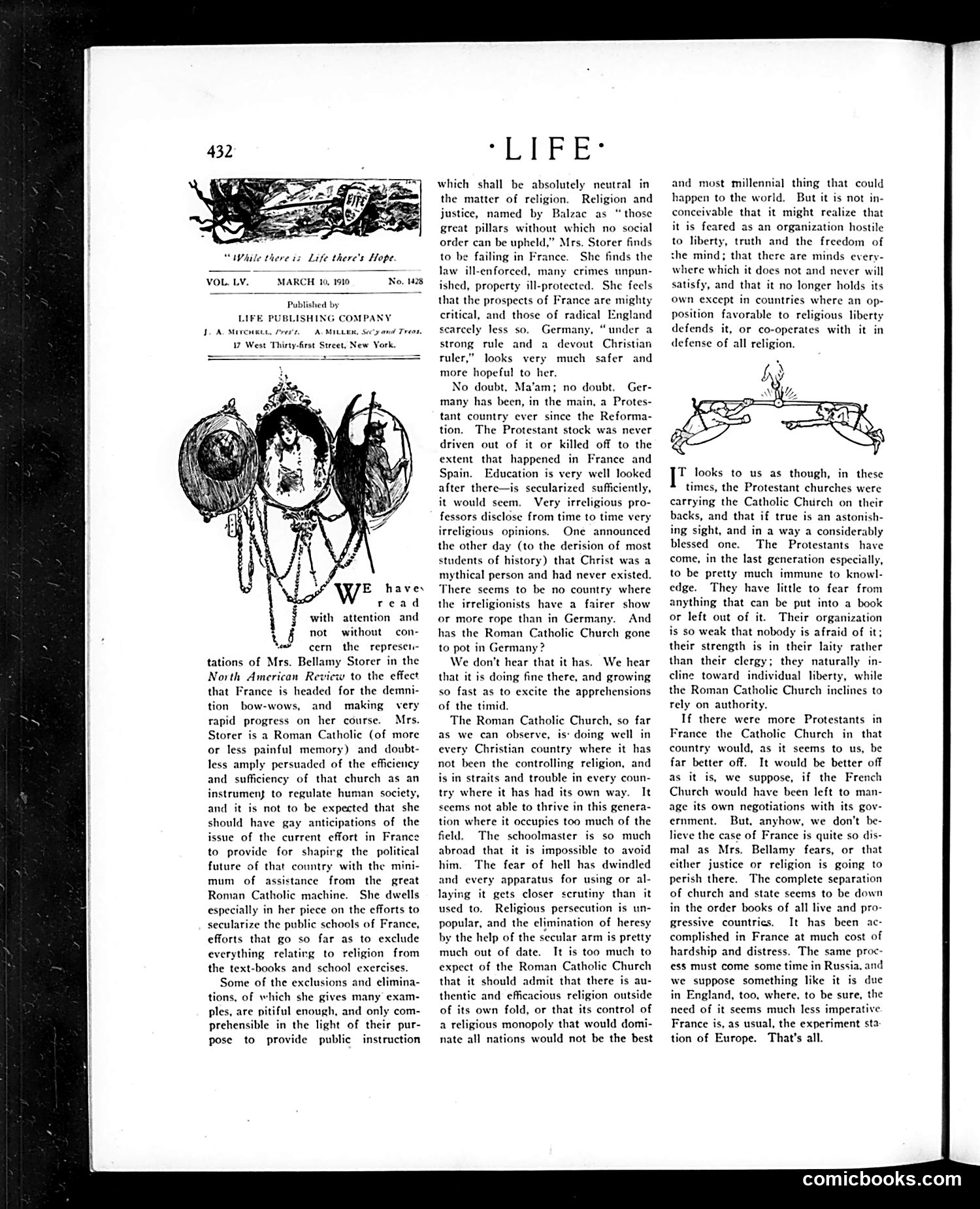
The page contains two political cartoons critiquing religious institutions in Europe. The left illustration depicts three grotesque heads on pikes labeled with symbols suggesting the Catholic Church and religious authority structures—appearing to mock the institutional power of organized religion. The main text discusses Mrs. Bellamy Storer's observations about religion and governance in France, Germany, and Spain. The article argues that Protestant countries manage religion-state separation better than Catholic nations, where the Church allegedly wields excessive political influence. The cartoons satirize what the author views as the dangerous concentration of ecclesiastical power, particularly the Roman Catholic Church's role in European politics. The grotesque imagery emphasizes the author's disdain for religious institutions interfering in secular governance.
📄 Transcribed text from this page (OCR, searchable)
Machine-transcribed from the original scan — historical spelling and the odd misread are preserved.
VOL. LY. MARCH 10, 1910 Published by LIFE PUBLISHING COMPANY J. A. Merenmen, Pres. W West Thirty-first Street, New York. A MILLER, See’y and Treas. read with attention and not without con- cern the repres tations of Mrs. Bellamy Storer in the North American Review to the effect that France is headed for the demni- tion bow-wows, and making very rapid progress on her course. Mrs. Storer is a Roman Catholic (of more or less painful memory) and doubt- less amply persuaded of the efficiency and sufficiency of that church as an instrument to regulate human society, and it is not to be expected that she should have gay anticipations of the issue of the current effort in France to provide for shapirg the political future of that country with the mi mum of assistance from the great Roman Catholic machine. She dwells especially in her piece on the efforts to secularize the public schools of France, efforts that go so far as to exclude everything relating to religion from the text-books and school exercises. Some of the exclusions and elimina- tions, of which she gives many exam- ples, are pitiful enough, and only com- prehensible in the light of their pur- pose to provide public instruction “LIP E* which shall be absolutely neutral in the matter of religion. Religion and justice, named by Balzac as “ those great pillars without which no social order can be upheld,” Mrs. Storer finds to be failing in France. She finds the law ill-enforced, many crimes unpun- ished, property ill-protected. She feels that the prospects of France are mighty critical, and those of radical England scarcely less so, Germany, “under a strong rule and a devout Christian ruler,” looks very much safer and more hopeful to her. No doubt, Ma’am; no doubt. Ger- many has been, in the main, a Protes- tant country ever since the Reforma- tion. The Protestant stock was never driven out of it or killed off to the extent that happened in France and Spain. Education is very well looked after there—is secularized sufficiently, it would seem. Very irreligious pro- fessors disclose from time to time very irreligious opinions. One announced the other day (to the derision of most students of history) that Christ was a mythical person and had never existed. There seems to be no country where the irreligionists have a fairer show or more rope than in Germany. And has the Roman Catholic Church gone to pot in Germany ? We don’t hear that it has. We hear that it is doing fine there, and growing so fast as to excite the apprehensions of the timid. The Roman Catholic Church, so far as we can observe, is: doing well in every Christian country where it has not been the controlling religion, and is in straits and trouble in every coun- try where it has had its own way. It seems not able to thrive in this genera- tion where it occupies too much of the field. The schoolmaster is so much abroad that it is impossible to avoid him. The fear of hell has dwindled and every apparatus for using or al- laying it gets closer scrutiny than it used to. Religious persecution is un- popular, and the elimination of heresy by the help of the secular arm is pretty much out of date. It is too much to expect of the Roman Catholic Church that it should admit that there is au- thentic and efficacious religion outside of its own fold, or that its control of a religious monopoly that would domi- nate all nations would not be the best and most millennial thing that could happen to the world. But it is not in- conceivable that it might realize that it is feared as an organization hostile to liberty, truth and the freedom of the mind; that there are minds every- where which it does not and never will satisfy, and that it no longer holds its own except in countries where an op- position favorable to religious liberty defends it, or co-operates with it in defense of all religion. T looks to us as though, in these times, the Protestant churches were carrying the Catholic Church on their backs, and that if true is an astonish- ing sight, and in a way a considerably blessed one. The Protestants have come, in the last generation especially, to be pretty much immune to knowl- edge. They have little to fear from anything that can be put into a book or left out of it. Their organization is so weak that nobody is afraid of it; their strength is in their laity rather than their clergy; they naturally in- cline toward individual liberty, while the Roman Catholic Church inclines to rely on authority. If there were more Protestants in France the Catholic Church in that country would, as it seems to us, be far better off. It would be better off as it is, we suppose, if the French Church would have been left to man- age its own negotiations with its gov- ernment. But, anyhow, we don’t be- lieve the case of France is quite so dis- mal as Mrs. Bellamy fears, or that either justice or religion is going to perish there. The complete separation of church and state seems to be down in the order books of all live and pro- gressive countries. It has been ac- complished in France at much cost of hardship and distress. The same proc- ss must come some time in Russia, and we suppose something like it is due in England, too, where, to be sure, the need of it seems much less imperative. France is, as usual, the experiment sta tion of Europe. That's all. comicbooks.com