
Life, 1910-03-10 · page 11 of 36
Life — March 10, 1910 — page 11: what you’re looking at
What you’re looking at
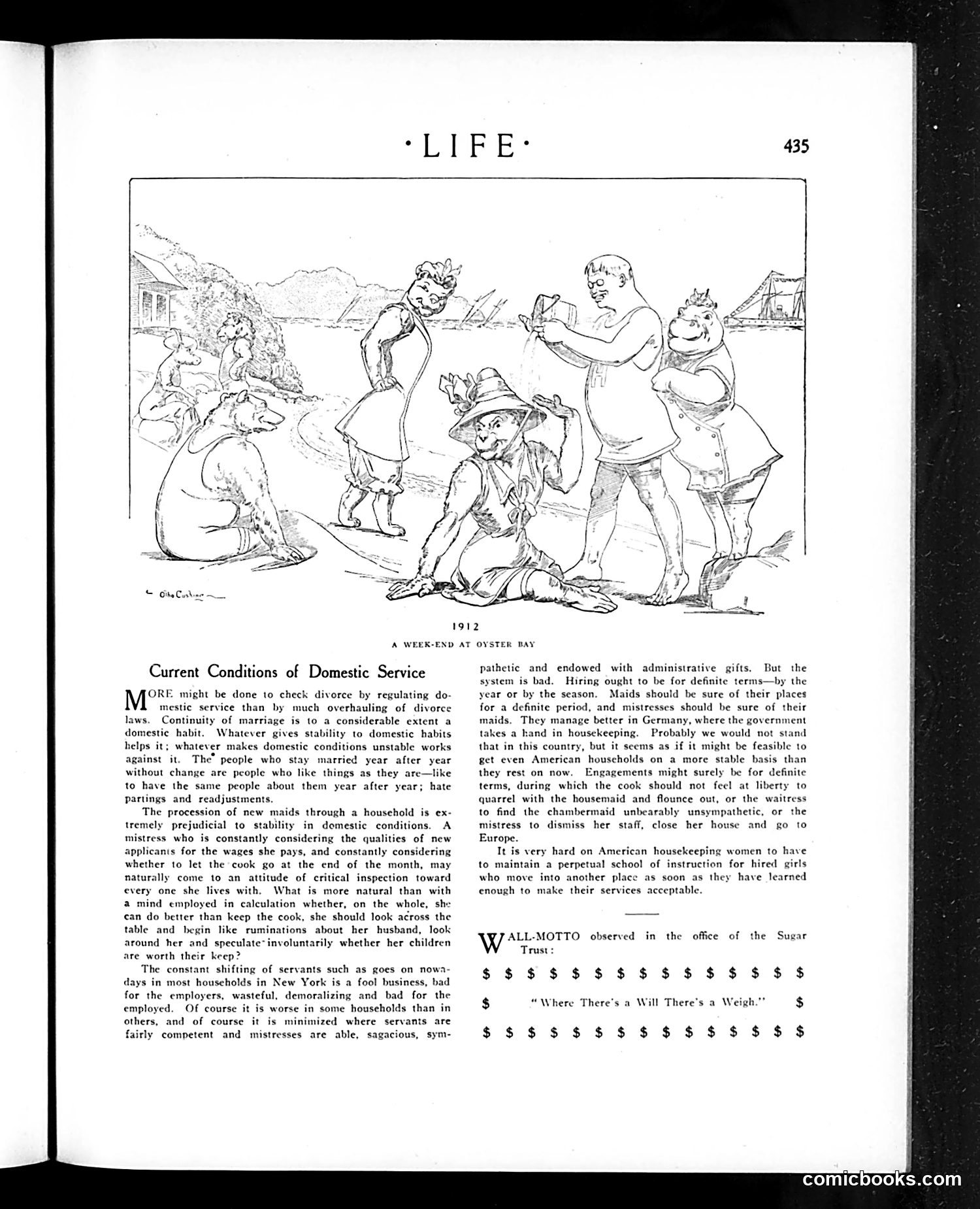
The cartoon titled "A Week-End at Oyster Bay" depicts what appears to be children at a seaside gathering, though the specific identities aren't entirely clear from the image alone. The accompanying article, "Current Conditions of Domestic Service," critiques the instability of American household employment. The text argues that frequent servant turnover stems from poor working conditions, lack of defined employment terms, and dismissive treatment of domestic staff. The author advocates for fixed hiring periods and more respectful employer-employee relationships, noting that American housekeeping standards suffer compared to European practices due to this constant staff disruption. The satirical angle appears to target wealthy American households' mismanagement of domestic labor.
📄 Transcribed text from this page (OCR, searchable)
Machine-transcribed from the original scan — historical spelling and the odd misread are preserved.
A WEEK-END AT OYSTER BAY Current Conditions of Domestic Service ORE might be done to check divorce by regulating do- mestic service than by much overhauling of divorce laws. Continuity of marriage is to a considerable extent a domestic habit. Whatever gives stability to domestic habits helps it; whatever makes domestic conditions unstable works against it. The” people who stay married year after year without change are people who like things as they are—like to have the same people about them year after year; hate Partings and readjustments, The procession of new maids through a household is ex- tremely prejudicial to stability in domestic conditions. A mistress who is constantly considering the qualities of new applicants for the wages she pays, and constantly considering whether to let the cook go at the end of the month, may naturally come to an attitude of critical inspection toward every one she lives with. What is more natural than with a mind employed in calculation whether, on the whole, she can do better than keep the cook, she should look across the table and begin like ruminations about her husband, look around her and speculate’ involuntarily whether her children are worth their keep? The constant shifting of servants such as goes on nowa- days in most households in New York is a fool business, bad for the employers, wasteful, demoralizing and bad for the employed. Of course it is worse in some households than in others, and of course it is minimized where servants are fairly competent and mistresses are able, sagacious, sym- pathetic and endowed with administrative gifts, But the system is bad. Hiring ought to be for definite terms—by the year or by the season. Maids should be sure of their places for a definite period, and mistresses should be sure of their maids. They manage better in Germany, where the government takes a hand in housekeeping. Probably we would not stand that in this country, but it seems as if it might be feasible to get even American houscholds on a more stable basis than they rest on now, Engagements might surely be for definite terms, during which the cook should not fe liberty to quarrel with the housemaid and flounce out, or the waitress to find the chambermaid unbearably unsympathetic, or the mistress to dismiss her staff, close her house and go to Europe. It is very hard on American housekeeping women to have to maintain a perpetual school of instruction for hired girls who move into another place as soon as they have learned enough to make their services acceptable. ALL-MOTTO observed in the office of the Sugar Trust: $$$$$S$S$S$Ss$$ss §$ $ “Where There's a Will There's a Weigh.” $ $$$S$$S$S$S$H$S$S$ESHES SS comicbooks.com