
Life, 1910-03-10 · page 16 of 36
Life — March 10, 1910 — page 16: what you’re looking at
What you’re looking at
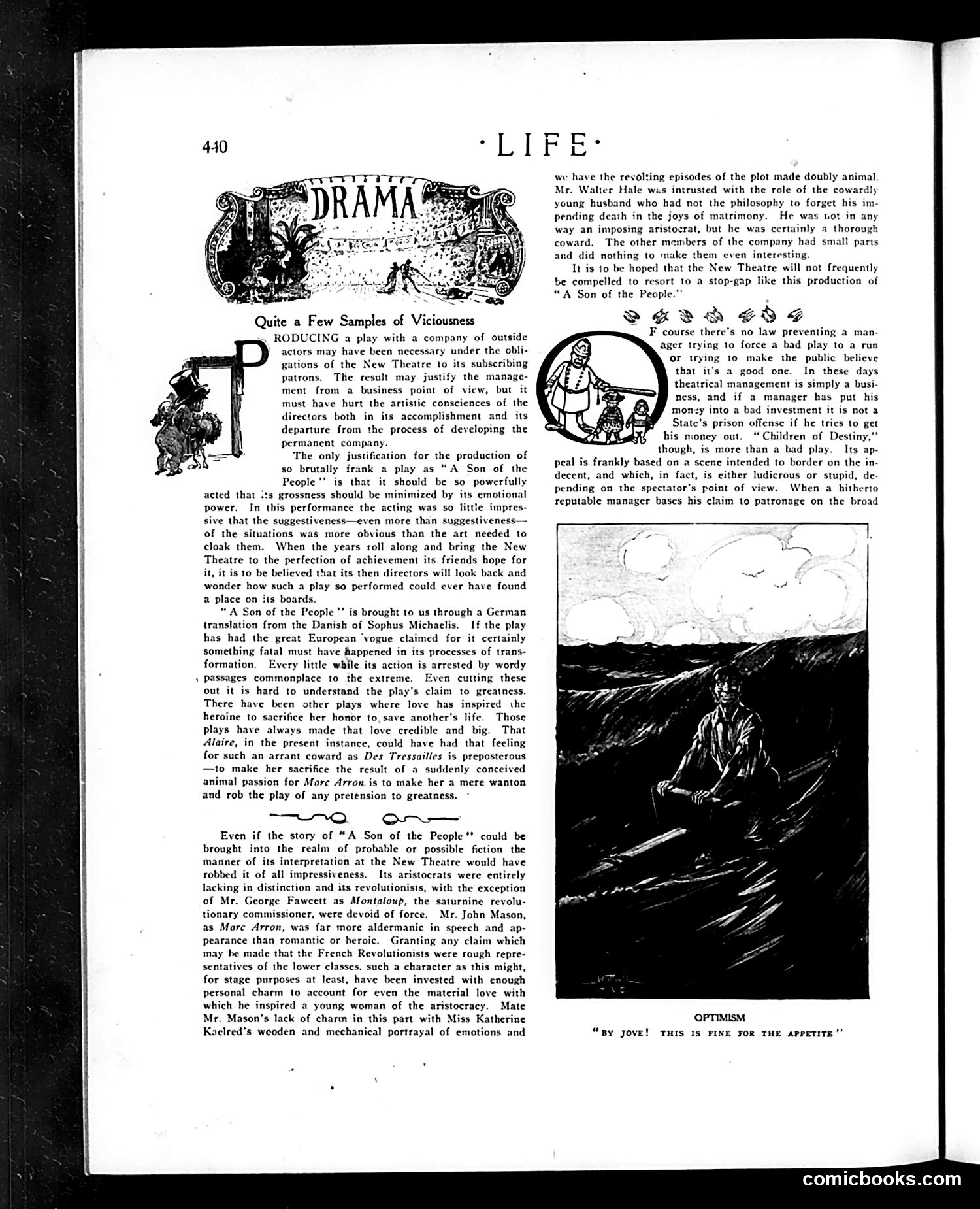
This page reviews "A Son of the People," a play performed at the New Theatre. The critic harshly evaluates both the production choices and the acting quality. **Key Points:** The review criticizes the New Theatre for producing an outside company's play rather than developing its own permanent troupe. The play itself—a German translation of a Danish work by Sophus Michaelis—is deemed "brutally frank" but poorly executed. **The Satire:** The critic argues the play's central premise is implausible: that an aristocratic woman (Alaire) would sacrifice her honor for Marc Arron, portrayed as an uncharismatic coward rather than a compelling romantic hero. The acting undermines any potential impact—performers lack distinction, charm, or force. **Notable Performances Criticized:** John Mason's Marc Arron is ridiculed as "aldermanic" (bureaucratic, dull) rather than heroic. Katherine Kaelred's performance is called "wooden and mechanical." The only praise goes to George Fawcett as the revolutionary commissioner Montaloup. The cartoon's caption—"By Jove! This is fine for the appetite"—likely mocks the play as intellectual junk food, empty of real substance.
📄 Transcribed text from this page (OCR, searchable)
Machine-transcribed from the original scan — historical spelling and the odd misread are preserved.
Quite a Few Samples of Viciousness - RODUCING a play with a company of outside actors may have been necessary under the obli- gations of the New Theatre to its subscribing patrons. The result may justify the manage- ment from a business point of view, but it must have hurt the artistic consciences of the directors both in its accomplishment and its departure from the process of developing the permanent company. The only justification for the production of so brutally frank a play as “A Son of the People" is that it should be so powerfully acted that ‘3s grossness should be minimized by its emotional power, In this performance the acting was so little impres- ¢ that the suggestiveness—even more than suggestiveness— of the situations was more obvious than the art needed to cloak them. When the years roll along and bring the New Theatre to the perfection of achievement its friends hope for it, it is to be believed that its then directors will look back and wonder how such a play so performed could ever have found a place on its boards. “A Son of the People "* is brought to us through a German translation from the Danish of Sophus Michaelis. If the play has had the great European ‘vogue claimed for it certainly something fatal must have Bappened in its processes of trans- formation. ery little while its action is arrested by wordy passages commonplace to the extreme. Even cutting these out it is hard to understand the play’s claim to greatness. There have been other plays where love has inspired ihe heroine to sacrifice her honor to, save another's life. Those plays have always made that love credible and big. That Alaire, in the present instance, could have had that feeling for such an arrant coward as Des Tressailles is preposterous —to make her sacrifice the result of a suddenly conceived animal passion for Marc Arron is to make her a mere wanton and rob the play of any pretension to greatness. Sa. ou Even if the story of “A Son of the People’ could be brought into the realm of probable or possible fiction the manner of its interpretation at the New Theatre would have robbed it of all impressiveness. Its aristocrats were entirely lacking in distinction and its evolutionists, with the exception of Mr. George Fawcett as Montaloup, the saturnine revolu- tionary commissioner, were devoid of force. Mr. John Mason, as Marc Arron, was far more aldermanic in speech and ap- pearance than romantic or heroic. Granting any claim which may he made that the French Revolutionists were rough repre- sentatives of the lower classes. such a character as this might, for stage purposes at least, have been invested with enough personal charm to account for even the material love with which he inspired a young woman of the aristocracy. Mate Mr. Mason’s lack of charm in this part with Miss Katherine Kaclred’s wooden and mechanical portrayal of emotions and we have the revolting episodes of the plot made doubly animal. Mr. Walter Hale wis intrusted with the role of the cowardly young husband who had not the philosophy to forget his im- pending death in the joys of matrimony. He was tiot in any way an imposing aristocrat, but he was certainly a thorough coward. The other members of the company had small parts and did nothing to make them even interesting. It is to be hoped that the New Theatre will not frequently be compelled to resort to a stop-gap like this production of “A Son of the People.”” Sar, d gGdIEG F course there’s no law preventing a man- ager trying to force a bad play to a run or trying to make the public believe that it’s a good one. In these days theatrical management is simply a busi- ness, and if a manager has put his his moncy out. “C though, is more than a bad play. Its ap- peal is frankly based on a scene intended to border on the in- decent, and which, in fact, is either ludicrous or stupid, de pending on the spectator’s point of view. When a hitherto reputable manager bases his claim to patronage on the broad OPTIMISM “sy Jove! THIS IS FINE FOR THE APPETITE" comicbooks.com