
A complete issue · 44 pages · 1906
Life — October 4, 1906
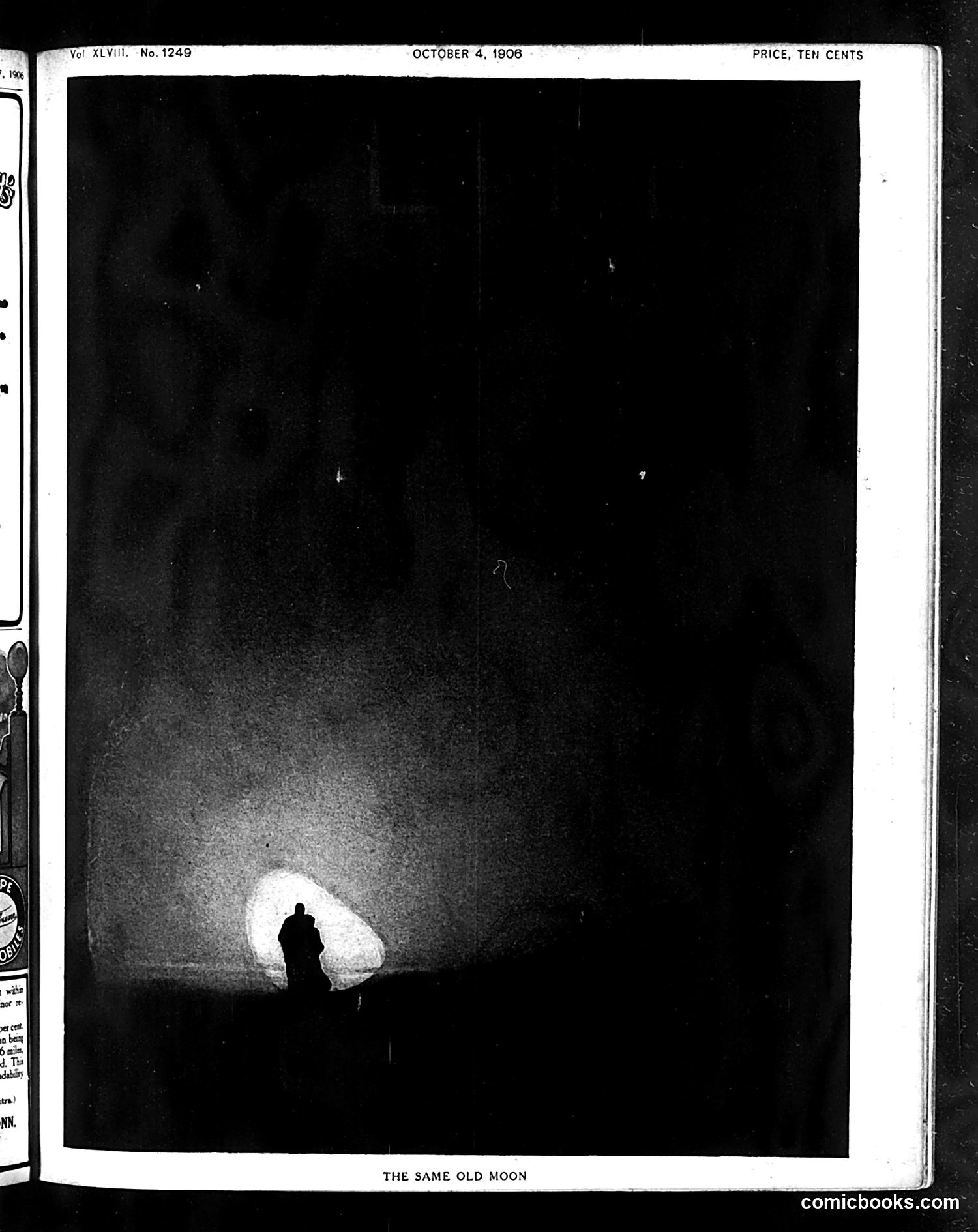
This page from Life magazine (October 4, 1908) features a silhouetted figure gazing at a large, glowing moon against a dark sky. The caption reads "THE SAME OLD MOON." Without additional context or accompanying text visible on this page, the cartoon's specific political or social meaning is unclear. However, given the 1908 date—a U.S. presidential election year—it likely contains satirical commentary about contemporary politics or society. The image's contemplative tone and emphasis on constancy ("the same old moon") might suggest resignation about unchanging political circumstances, cyclical problems, or the repetitive nature of electoral politics. The exact targets or references require additional contextual information from the magazine's other content or advertisements to interpret with certainty.
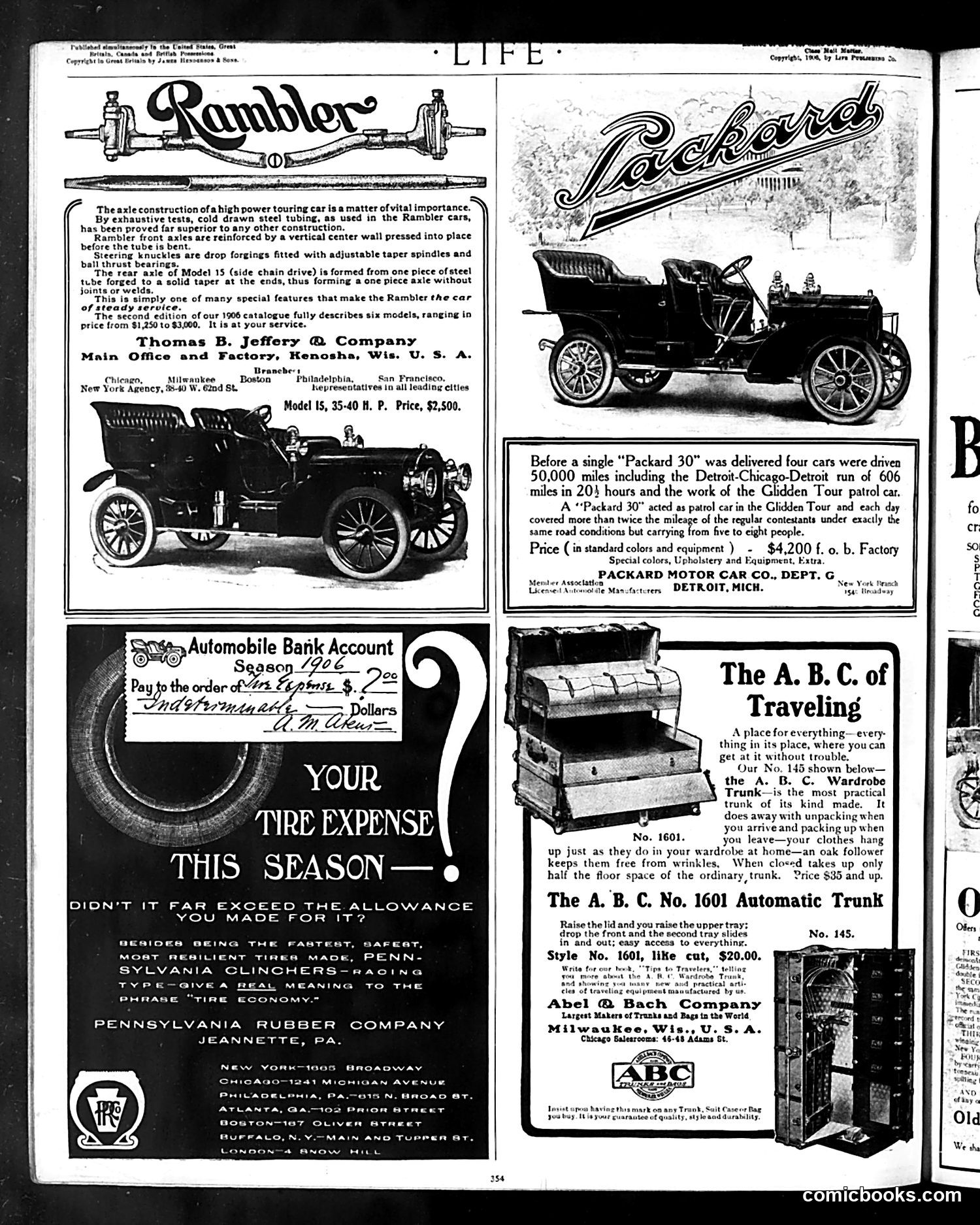
This page from *Life* magazine consists entirely of **automobile advertisements** from circa 1906-1908, with no political cartoons or satire present. The ads feature early automobiles (Rambler, Packard, and accessories) and related products. One advertisement addresses tire expenses with a question "DIDN'T IT FAR EXCEED THE ALLOWANCE YOU MADE FOR IT?" — humorously acknowledging that tire costs were unexpectedly high during this era of early motoring. The Pennsylvania Rubber Company uses this relatable consumer complaint to promote their tires as a solution. Other ads showcase travel trunks and automobile banking services, reflecting the novelty and expense of early automobile ownership among wealthy Americans. This is straightforward commercial advertising rather than satirical content.
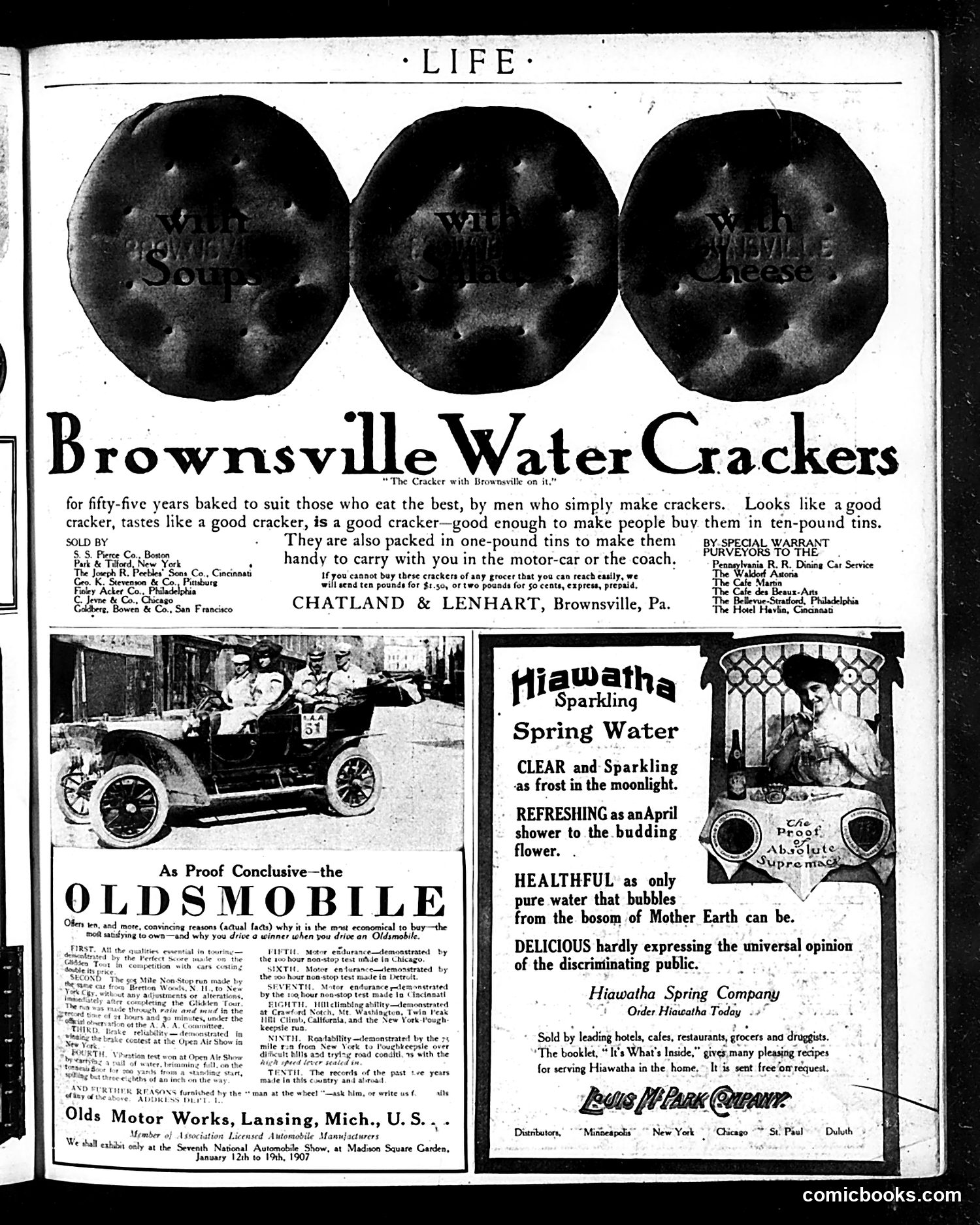
This page is primarily **advertising**, not political satire. It contains three product advertisements from the early 1900s: 1. **Brownsville Water Crackers** - promoting a 55-year-old cracker brand with images of the product 2. **Oldsmobile automobiles** - emphasizing reliability with performance records and featuring a vintage motor car 3. **Hiawatha Sparkling Spring Water** - marketing "pure water" with health claims The Oldsmobile ad references actual racing/endurance tests ("Proof Conclusive") to demonstrate vehicle superiority—a common early automotive marketing tactic. The Hiawatha ad uses romantic imagery and health benefit claims typical of period patent medicine/bottled water marketing. There is **no political cartoon or satire** on this page. It reflects early 1900s consumer culture and advertising approaches.
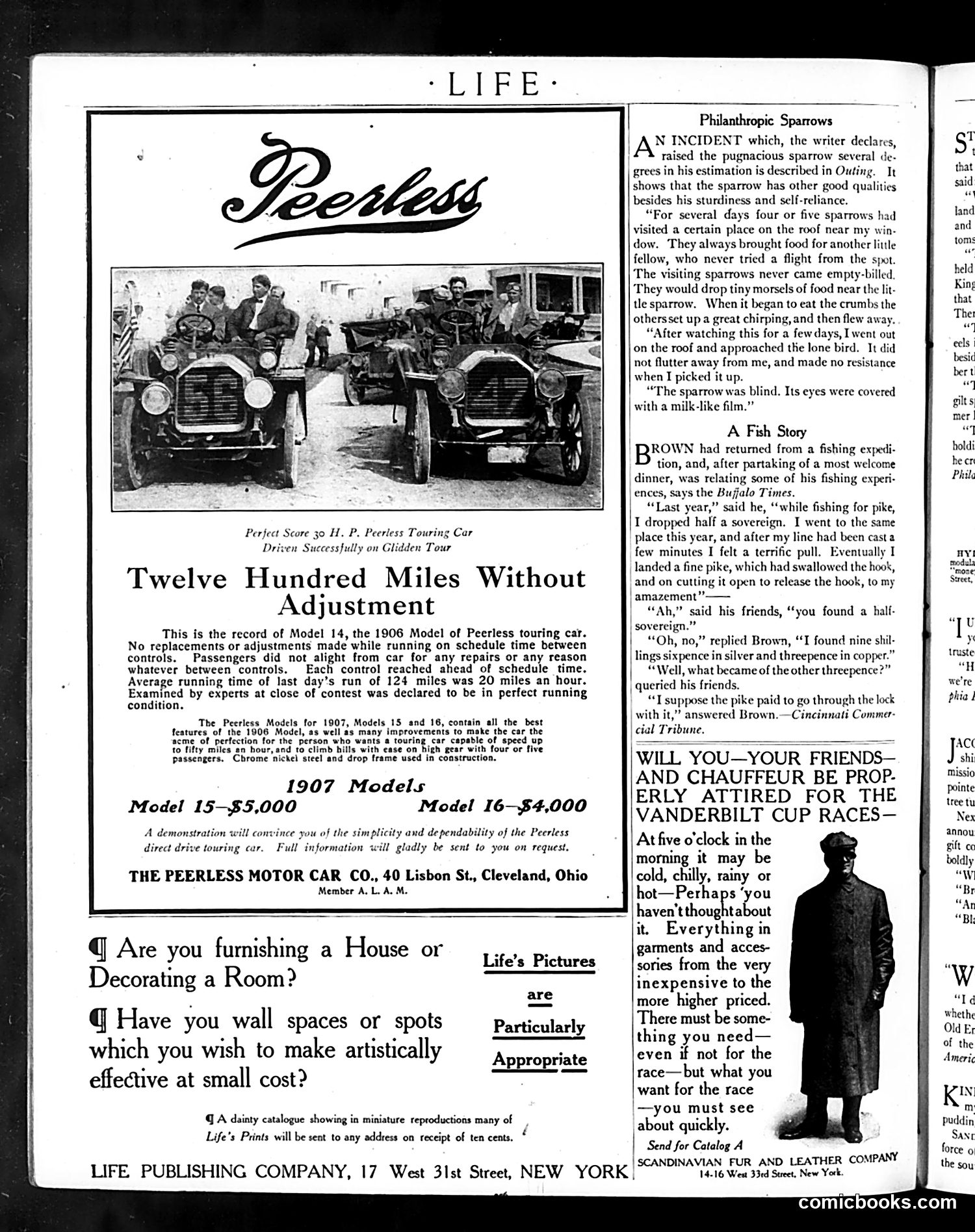
This page is **primarily advertising**, not satire or political commentary. The dominant content advertises the Peerless automobile, featuring a 1906 touring car that completed "Twelve Hundred Miles Without Adjustment." The ad emphasizes reliability and minimal maintenance—key selling points for early automobiles when mechanical failure was common. The page also includes two anecdotes ("Philanthropic Sparrows" and "A Fish Story") that are humorous but non-political observations about animal behavior and fishing mishaps. A secondary advertisement promotes the Scandinavian Fur and Leather Company, encouraging readers to purchase winter coats for the Vanderbilt Cup Races. There is **no political cartoon** on this page. The content reflects early 1900s consumer culture and automotive innovation.
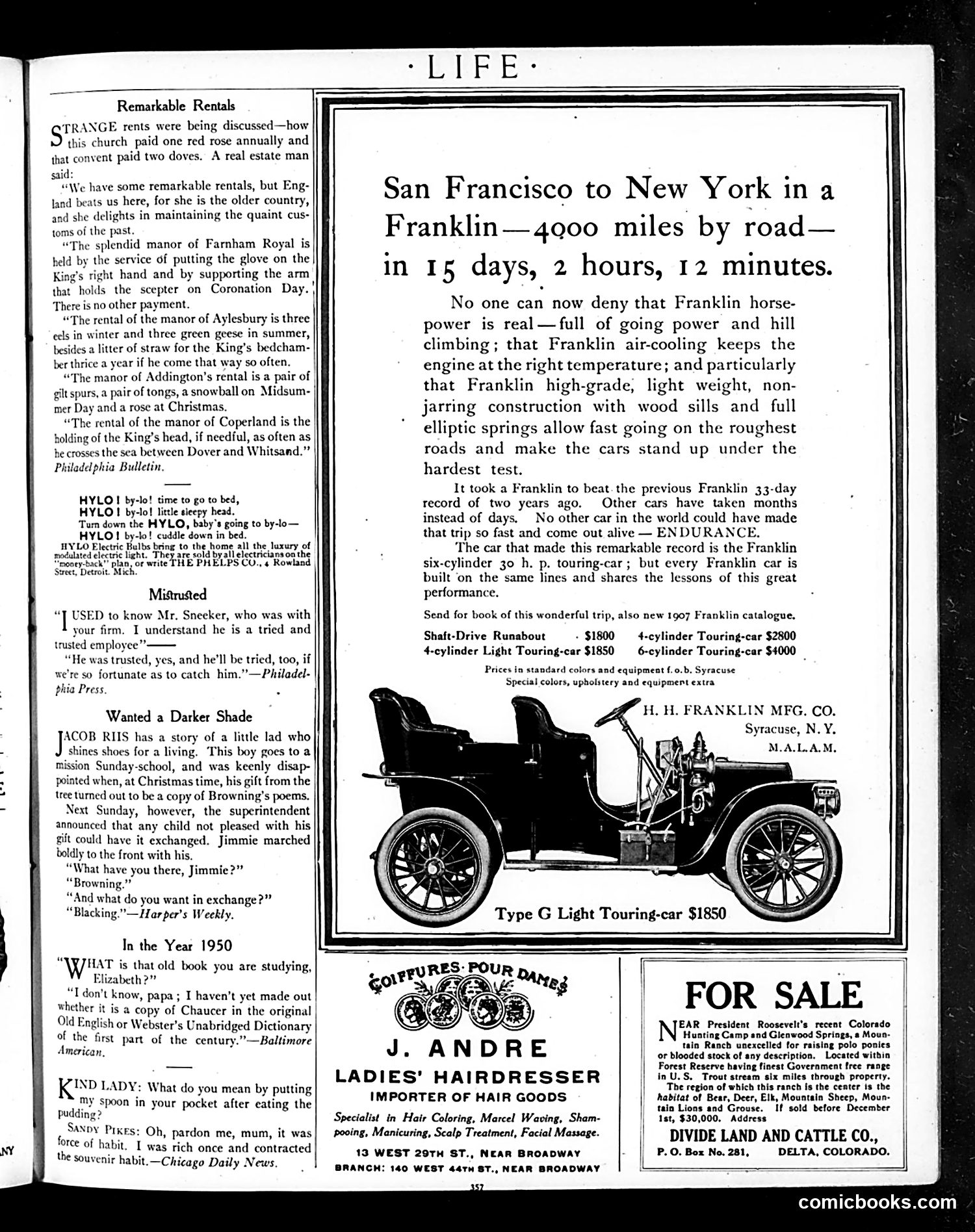
This page is **primarily advertising** rather than political satire. The dominant content is a large Franklin automobile advertisement celebrating a cross-country journey from San Francisco to New York completed in 15 days, 2 hours, 12 minutes—emphasizing the car's reliability and performance. The left column contains brief humorous anecdotes under headings like "Remarkable Rentals," "Mistrusted," and "Wanted a Darker Shade"—typical Life magazine filler content poking gentle fun at everyday situations (churches' odd rental practices, an employee's trustworthiness, a disappointed child). Below the Franklin ad are smaller advertisements for a hairdresser and Colorado ranch property. There is **no significant political cartoon or satire** on this page—it represents standard early 20th-century magazine layout mixing humor, editorial content, and advertising.
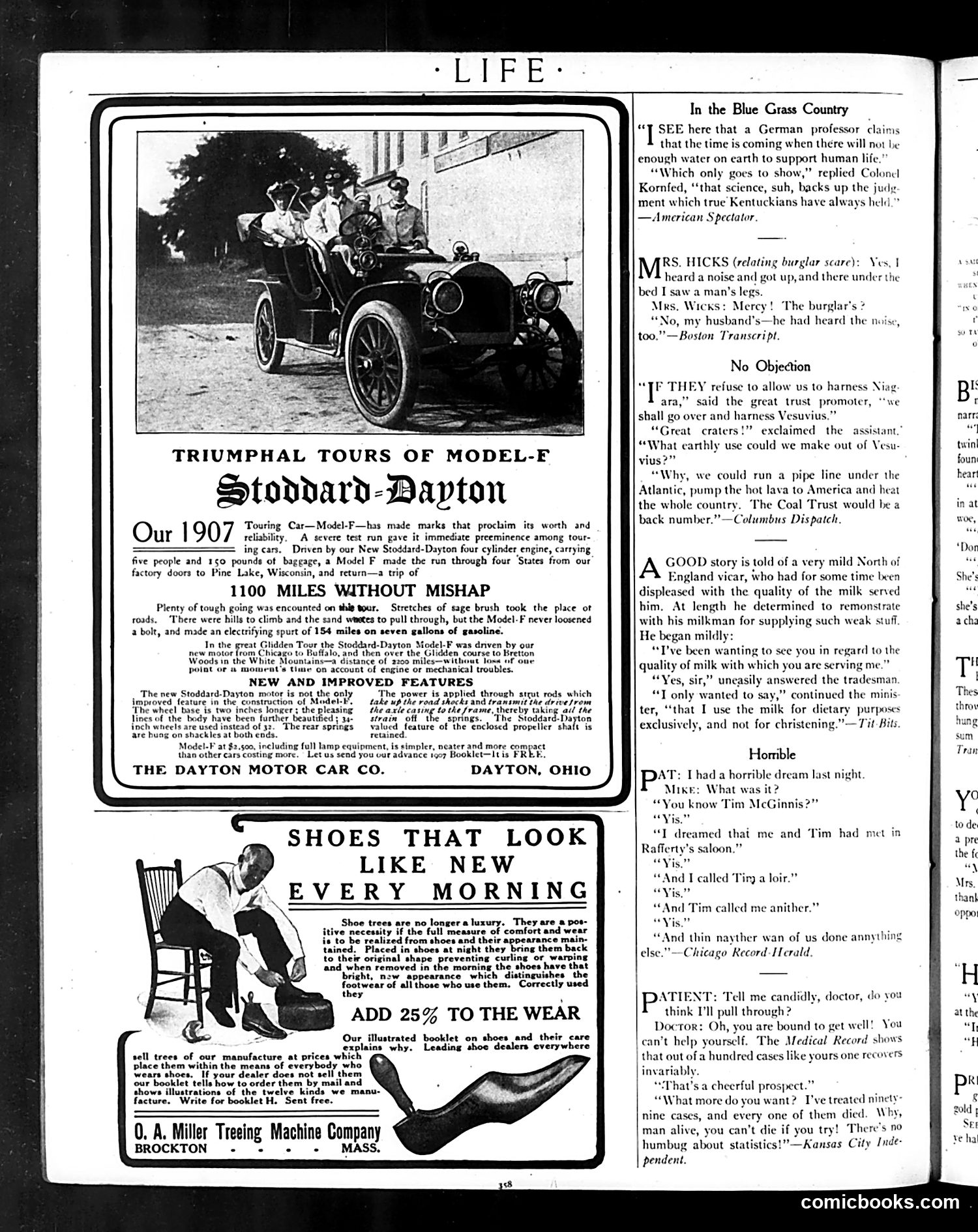
This page is primarily **advertising**, not political satire. The dominant content features: 1. **Stoddard-Dayton automobile ad** (top): Promotes a 1907 touring car emphasizing reliability—it completed 1100 miles without mishap. This reflects early automotive industry competition and consumer concerns about vehicle dependability. 2. **O.A. Miller Treeing Machine Company ad** (bottom): A shoe-care device advertisement promising shoes will "look like new every morning" by preventing curling and warping. The text emphasizes durability and proper maintenance—practical concerns for consumers. The small text items scattered between are humorous anecdotes and jokes typical of Life's satirical content, but they're incidental to the page's primary function as paid advertising space. No significant political cartooning or social commentary appears here.
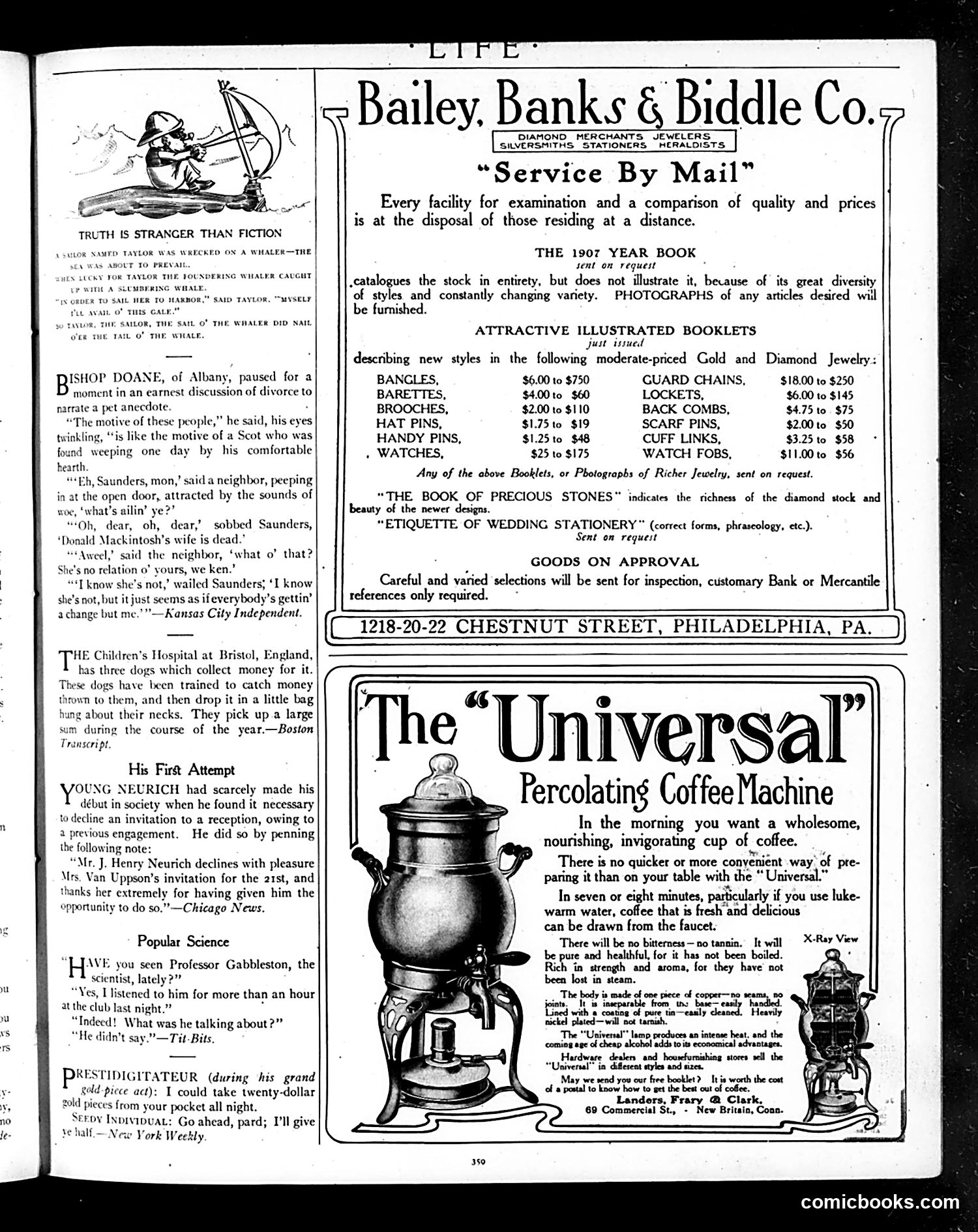
This page is primarily **advertising and light humor** rather than political satire. The content includes: **Left column stories:** - "Truth is Stranger Than Fiction": A anecdote about a sailor named Taylor rescued from a whale - "Bishop Doane of Albany": A divorce discussion anecdote about remarriage - Humorous brief items about dogs collecting money and a young man declining a social invitation **Right side:** Large advertisements for Bailey, Banks & Biddle Co. (jewelry by mail) and the "Universal" Percolating Coffee Machine. The page reflects early 1900s consumer culture and genteel humor typical of *Life* magazine's satirical approach—poking gentle fun at social etiquette and contemporary life rather than addressing serious political issues. The advertisements showcase mail-order shopping convenience for wealthy readers.
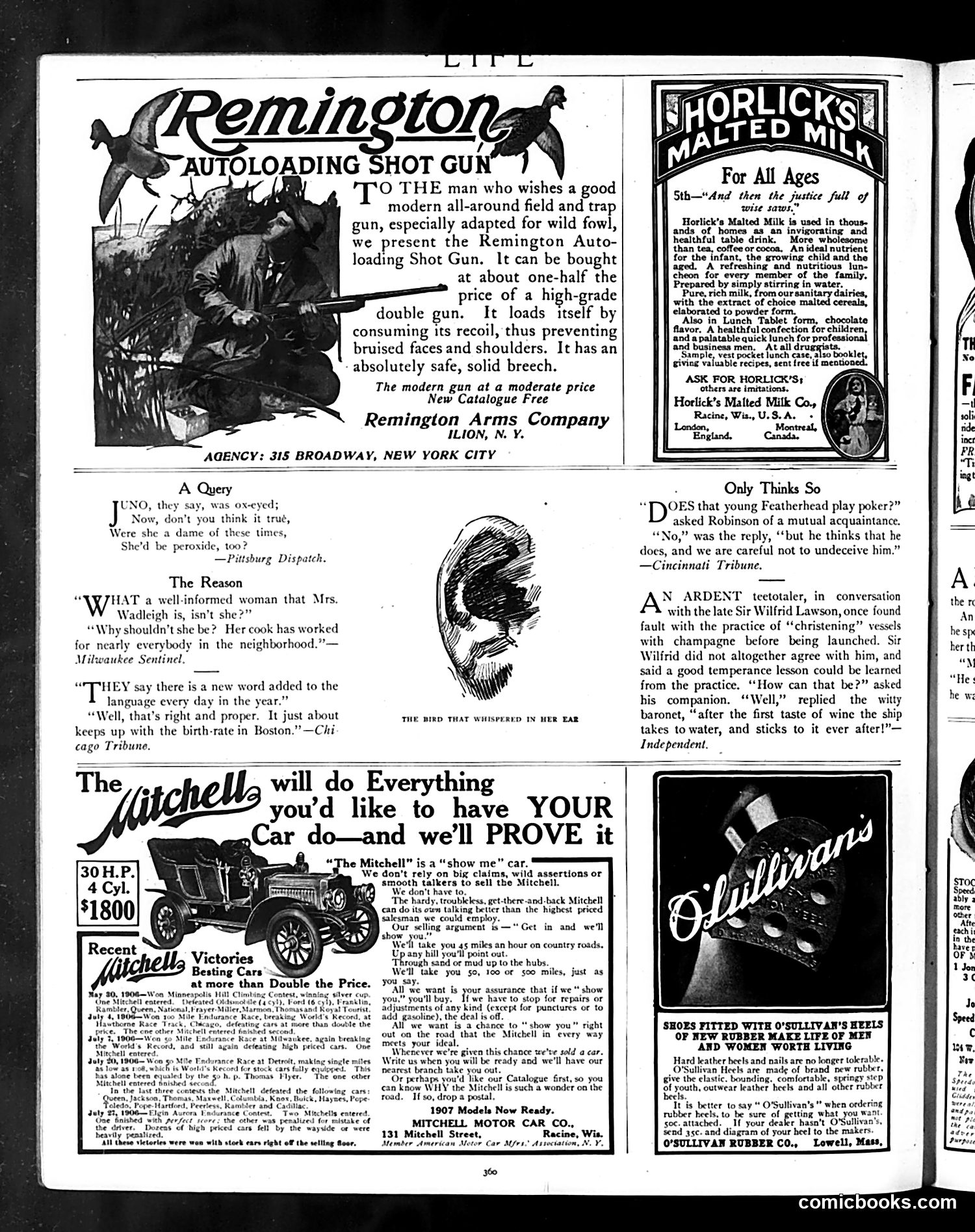
This page consists primarily of **advertisements** rather than political satire. The main content includes: 1. **Remington Autoloading Shot Gun** ad—marketing a self-loading firearm for hunting 2. **Horlick's Malted Milk** ad—promoting a nutritional drink for "all ages" 3. **Mitchell Motor Car** ad—advertising an automobile at $1,800 The humorous section titled **"Only Thinks So"** contains brief joke items sourced from various newspapers. These are light social commentary pieces—one mocks a young man's poker skills, another satirizes a baronet's temperance advice about champagne. The humor is gentle and domestic rather than political. The **sketch of "The Bird That Whispered in Her Ear"** appears to be a humorous illustration accompanying these brief anecdotes. This page reflects early 20th-century Life magazine's mix of advertising and light social satire.
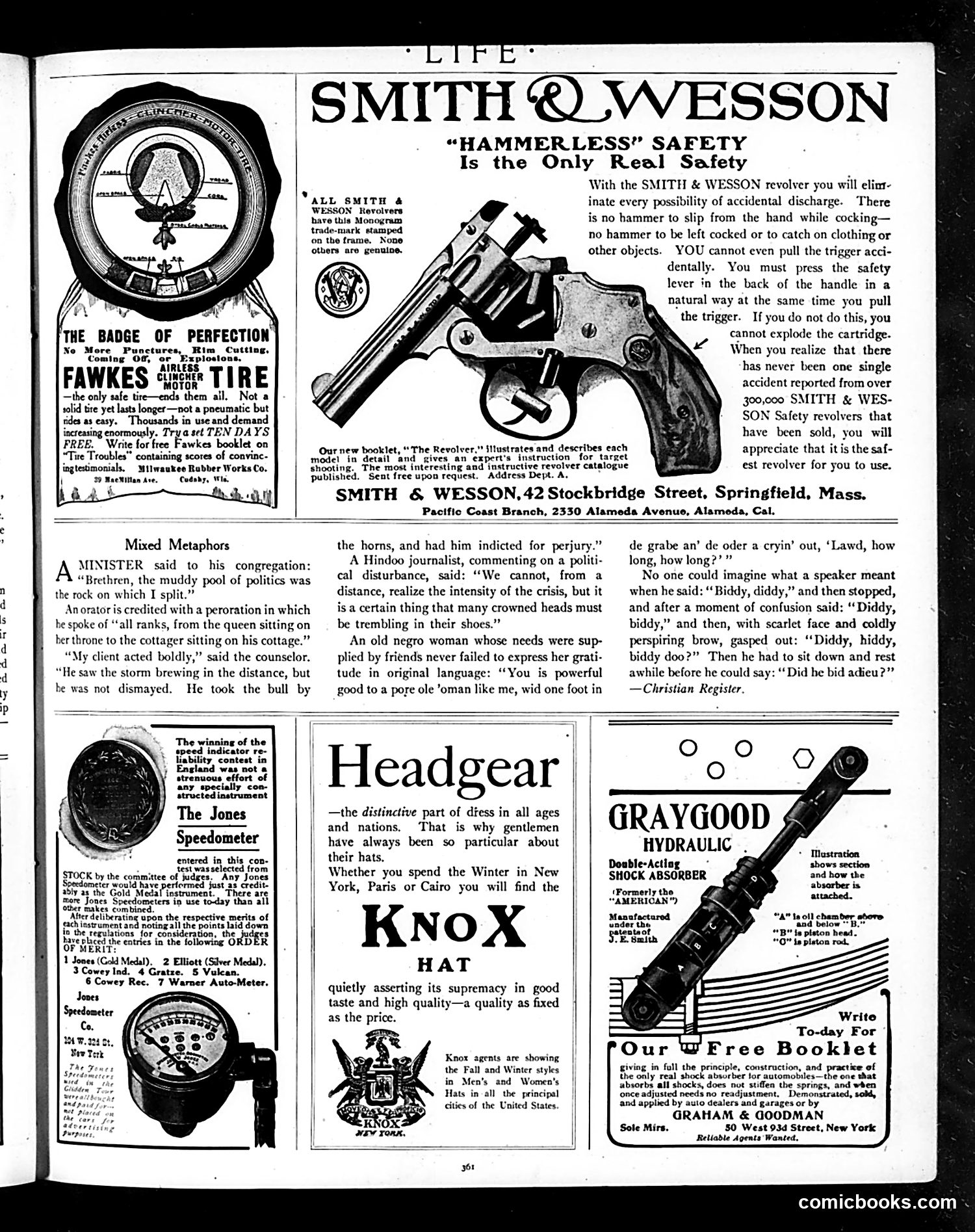
This page is primarily **advertising and filler content** rather than political satire. The main elements are: 1. **Smith & Wesson revolver ad** (top right): Emphasizes the "hammerless" safety feature—a selling point distinguishing their revolvers from competitors. The text assures buyers the gun cannot accidentally discharge. 2. **"Mixed Metaphors" section** (center left): A short humor piece showing public figures using contradictory or nonsensical language—a lighthearted jab at politicians and speakers who speak carelessly. 3. **Product advertisements**: Knox Hat, Jones Speedometer, and Graygood Hydraulic Shock Absorber fill the remaining space. The page reflects early 20th-century concerns: gun safety, automotive accessories, and gentle mockery of political speech. No specific political figure or event is targeted—it's general-purpose satirical humor.
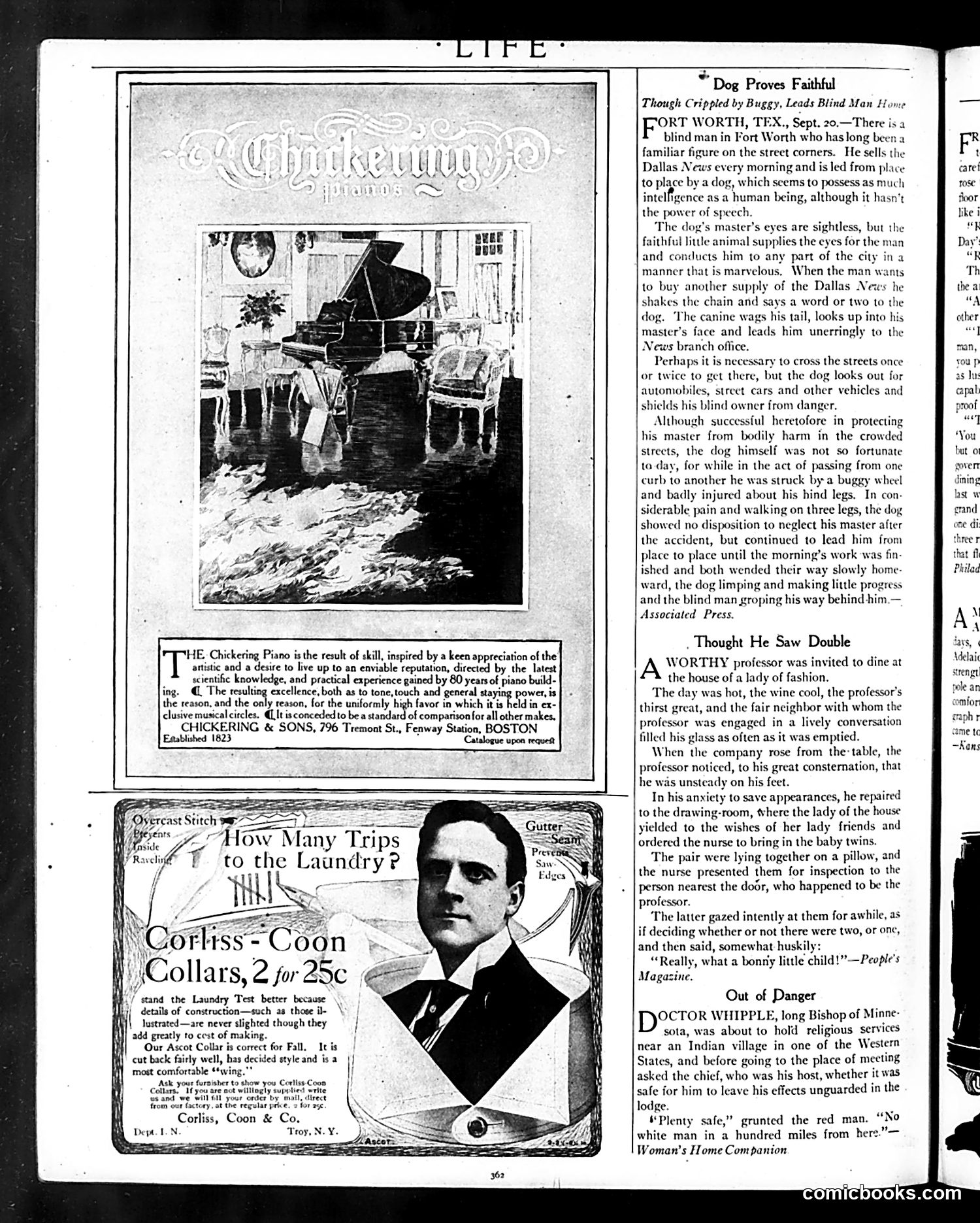
This page contains three distinct items: 1. **"Dog Proves Faithful"** (top right): A human-interest story about a blind man in Fort Worth, Texas, whose dog guides him through city streets despite being struck by a buggy. The narrative emphasizes the dog's intelligence and loyalty—contemporary sentimental journalism celebrating animal devotion. 2. **"Chickering Piano" advertisement** (left): A piano company ad emphasizing craftsmanship and 80 years of building expertise. 3. **"Corliss-Coon Collars" advertisement** (bottom left): A laundry-related product ad featuring a portrait of a man, promoting detachable collars as practical for frequent washing. The page is primarily **advertising and human-interest content** rather than satirical cartoons, typical of Life's mixed editorial-commercial format from this era.
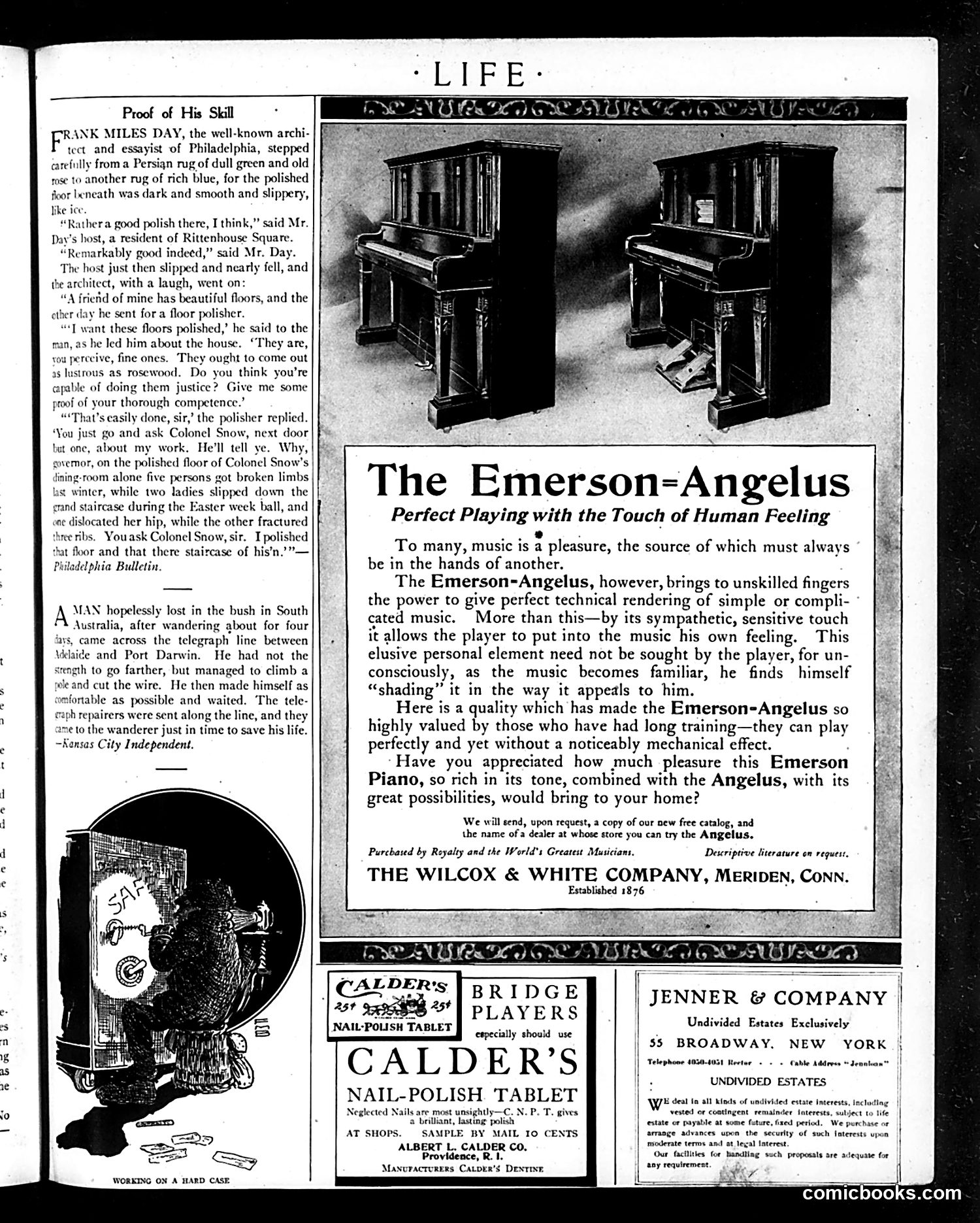
This page is primarily **advertising content** rather than satirical cartoons. The main feature is a large ad for the **Emerson-Angelus piano**, highlighting its "sympathetic, sensitive touch" that allows unskilled players to produce professional-quality music. The only cartoon present is a small illustration labeled "WORKING ON A HARD CASE" showing what appears to be a figure at a desk or workbench—likely a humorous caption about dealing with difficult tasks. The remaining space contains ads for **Calders Nail-Polish Tablet** and **Jenner & Company** (an estate services firm in New York). The page reflects early 20th-century magazine advertising conventions, mixing editorial content with commercial promotion. No specific political satire or social commentary is evident.
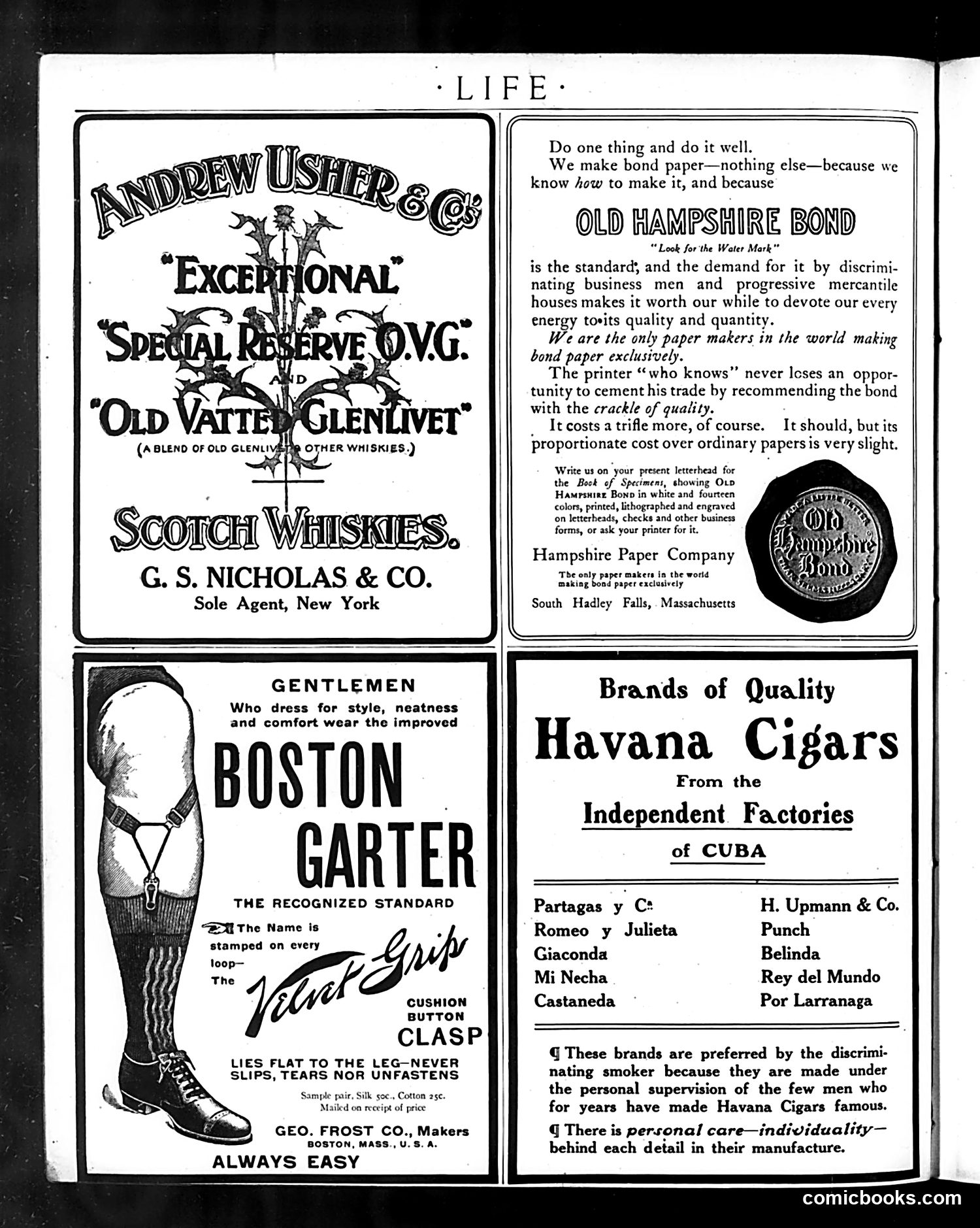
This page consists primarily of **advertisements, not satirical cartoons**. It contains four ads from the early 20th century: 1. **Andrew Usher whisky** - promoting Scotch brands 2. **Hampshire Paper Company** - emphasizing their exclusive bond paper product 3. **Boston Garter** - a men's garter with a "Velvet Grip" cushion button clasp 4. **Havana Cigars** - advertising Cuban cigar brands from independent factories The Boston Garter ad includes an illustration of a leg wearing the product. These are straightforward commercial pitches highlighting product quality and prestige—typical of *Life* magazine's advertising content during this era. There is **no political satire or social commentary** present on this page.
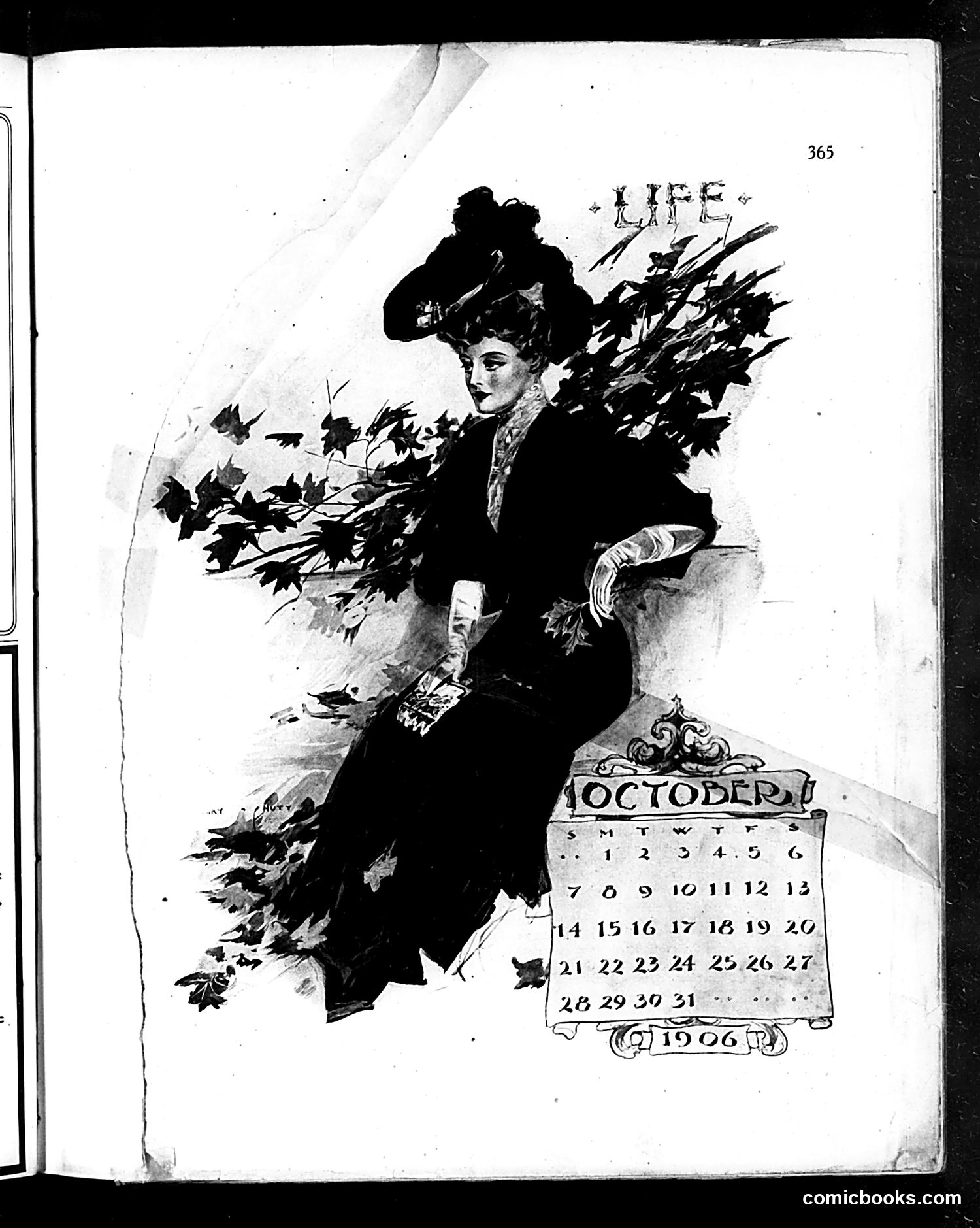
This is a calendar page for October 1906 from *Life* magazine (page 365). The illustration depicts an elegantly dressed woman in Edwardian fashion—featuring a large feathered hat, dark coat, and white gloves—carrying autumn foliage. The word "LIFE" appears at the top. The satire likely plays on the *aesthetic* of "Life" itself—the woman personifies the magazine's sophisticated, fashionable sensibility. Her association with fall leaves suggests the seasonal theme of October. The elaborate dress and styling reflect early 1900s upper-class aesthetics that *Life* both celebrated and gently mocked through satirical commentary on contemporary society and fashion. The page serves primarily as a decorative calendar rather than presenting obvious political commentary.
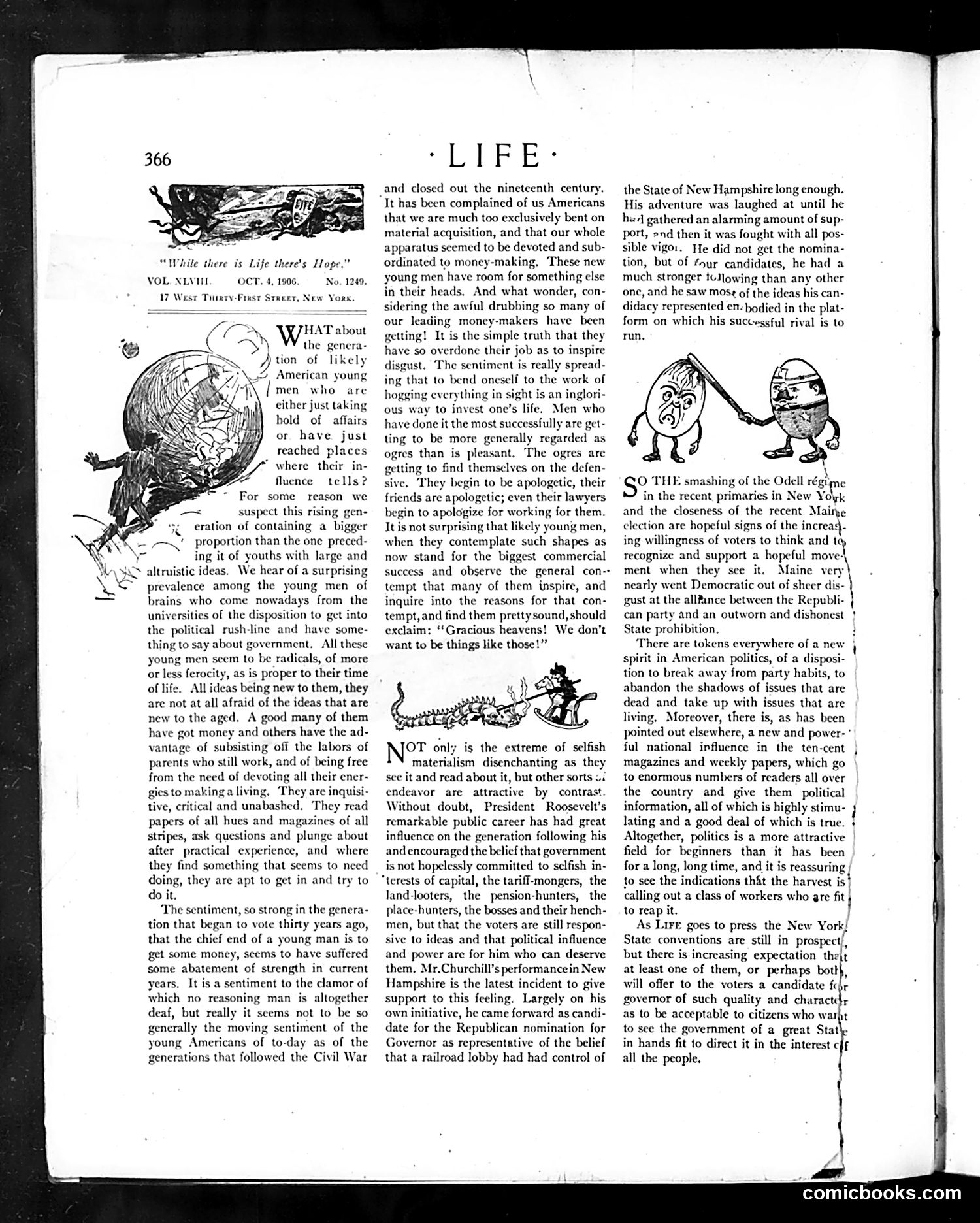
This editorial page celebrates a new generation of young American men entering politics and business with idealistic, reform-minded values—a striking departure from their predecessors' single-minded pursuit of wealth. The cartoons depict caricatured figures representing old-guard materialism being challenged or displaced. The text praises young men from universities who question whether accumulating money is life's primary purpose, noting that prominent industrialists ("ogres") have become objects of contempt rather than admiration through their ruthless business practices. The piece credits President Theodore Roosevelt's public career with demonstrating that government can serve public interest rather than merely serving wealthy capitalists, tariff-makers, and political bosses. The author argues this has inspired younger voters to believe political influence and power should serve broader social good—a marked shift from the post-Civil War generation's materialism. The satire implicitly mocks the old robber-baron ethos while celebrating emerging Progressive Era idealism.
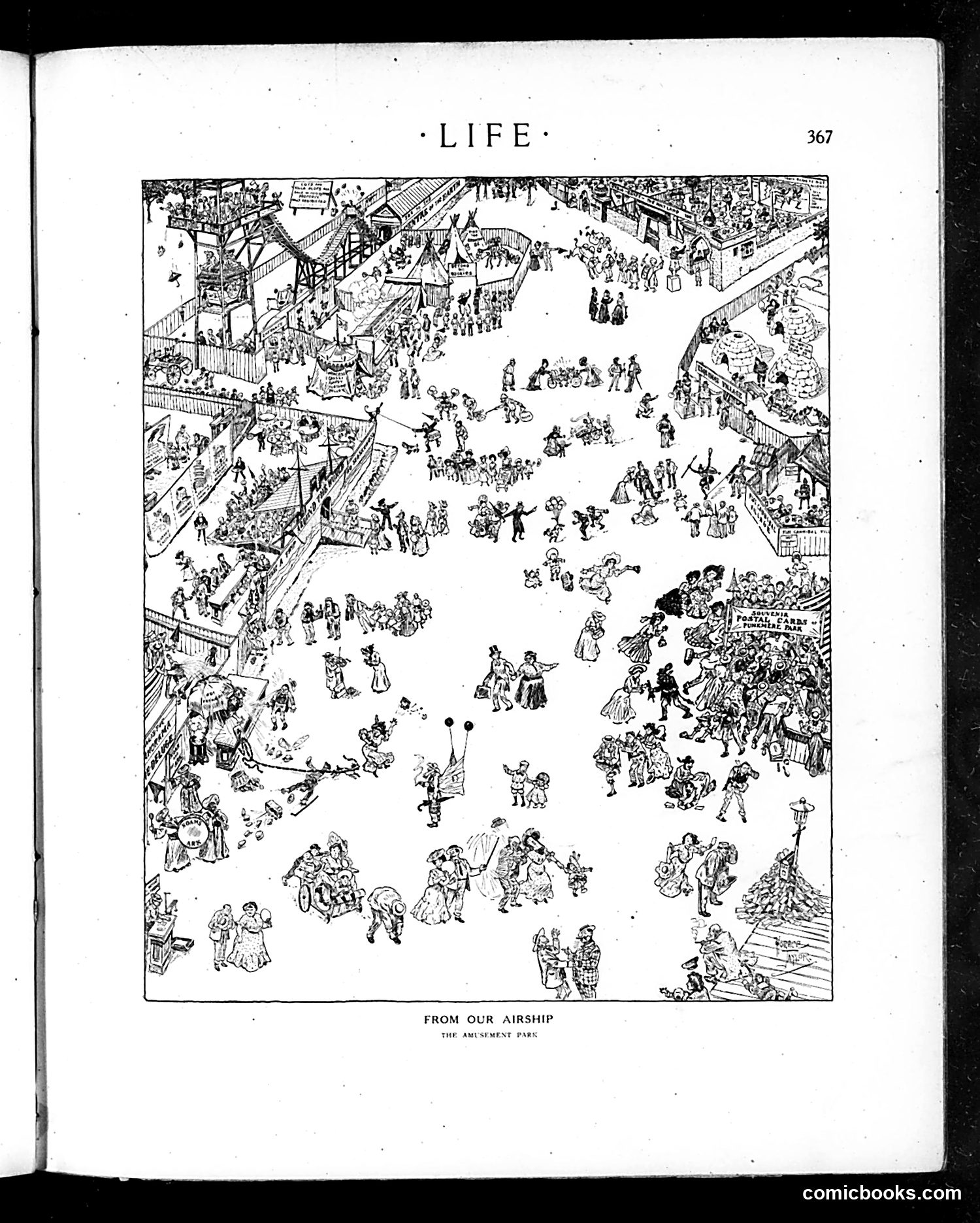
This is a bird's-eye view illustration of an amusement park, captioned as if drawn from an airship perspective. The densely packed scene shows hundreds of tiny figures enjoying various attractions—rides, games, food vendors, and gathering spaces scattered across the grounds. The satire likely mocks the chaotic, crowded nature of early 20th-century amusement parks, where masses of people congregated for entertainment. By presenting it from an aerial vantage point, the cartoon emphasizes the ant-like quality of the crowds and the commercialized sprawl of the park itself. The humor derives from the absurdist perspective of viewing human leisure and consumerism from above, highlighting how mechanized and impersonal modern entertainment had become.
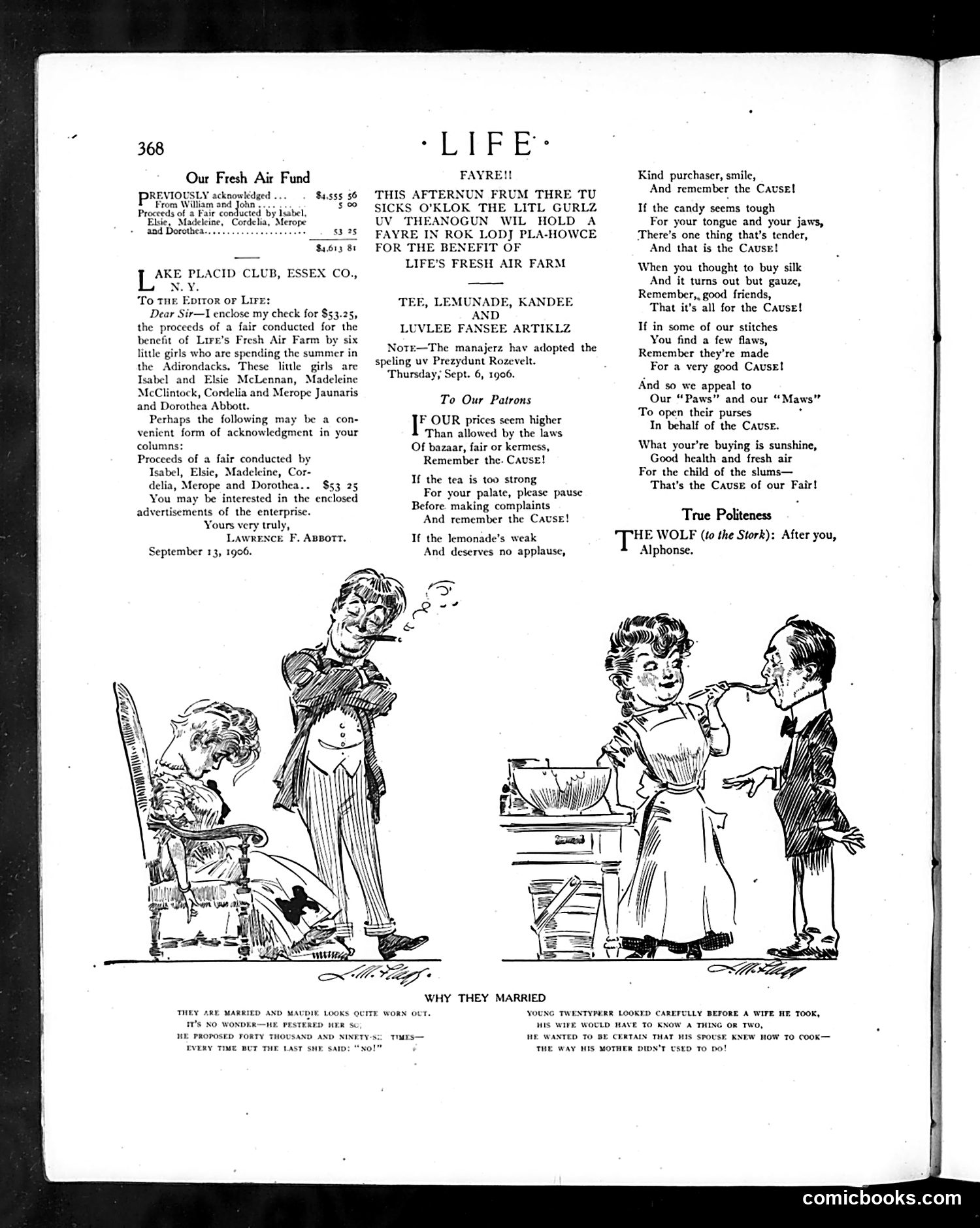
This page documents Life's charitable "Fresh Air Fund," which sent underprivileged urban children to the countryside for health and recreation—a major Progressive Era cause. **Upper content:** Letters acknowledging donations to the fund, including proceeds from a fair organized by six young girls in the Adirondacks. The fair's deliberately misspelled advertisement ("THRE TU SICKS O'KLOK," "FANSEE ARTIKLZ") parodies President Theodore Roosevelt's spelling reform campaign, a contemporary public debate. **"To Our Patrons" poem:** Gentle satire asking donors to overlook quality issues (weak tea, tough candy, poor stitching) and remember the charitable cause justifies the fair's imperfections. **Two cartoons below:** Unrelated social humor—"Why They Married" shows conventional courtship and domestic stereotypes (a man needed a wife who could cook properly). The page essentially blends fundraising with gentle satire of both Roosevelt's unpopular reforms and Edwardian courtship customs.
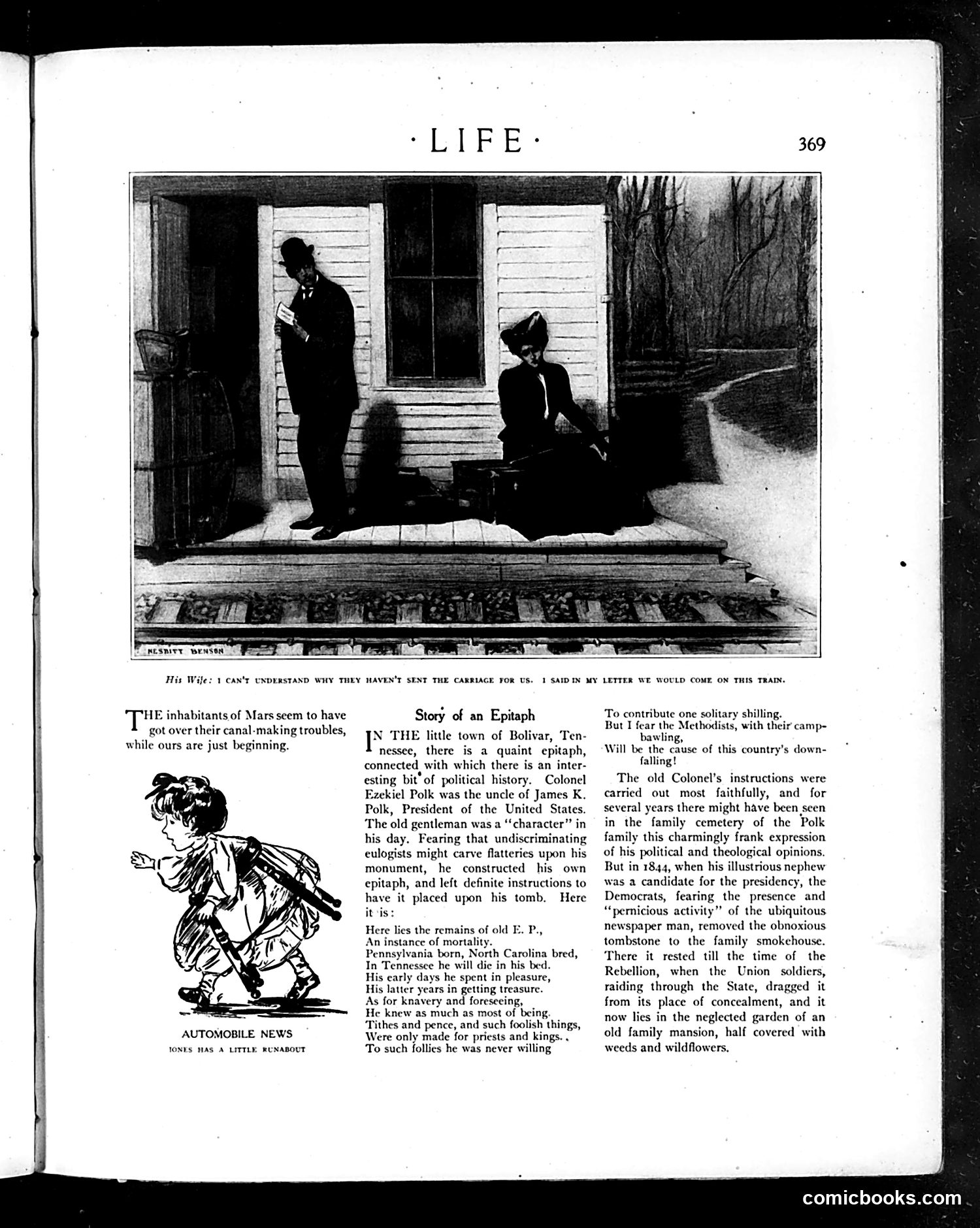
**Top Cartoon**: A domestic scene satirizing the emerging automobile era. A wife complains to her husband about an absent carriage, unaware they're waiting for a motorcar instead. The joke mocks how quickly automobiles were replacing horse-drawn carriages—the wife's outdated expectations humorously reflect society's slow adaptation to new technology. **"Automobile News" Section**: A brief quip suggesting cars are unreliable ("tones has a little runabout"), poking fun at early automobile quality and the fledgling auto industry. **"Story of an Epitaph"**: A humorous historical anecdote about Colonel Ezekiel Polk's self-written tombstone. His epitaph proudly declares his refusal to support religious institutions (Methodists) or pay tithes—blunt political and theological criticism. The story notes that in 1844, when his nephew James K. Polk ran for president, Democrats removed the embarrassing tombstone to a smokehouse, fearing negative press coverage. This satirizes political hypocrisy and image management.
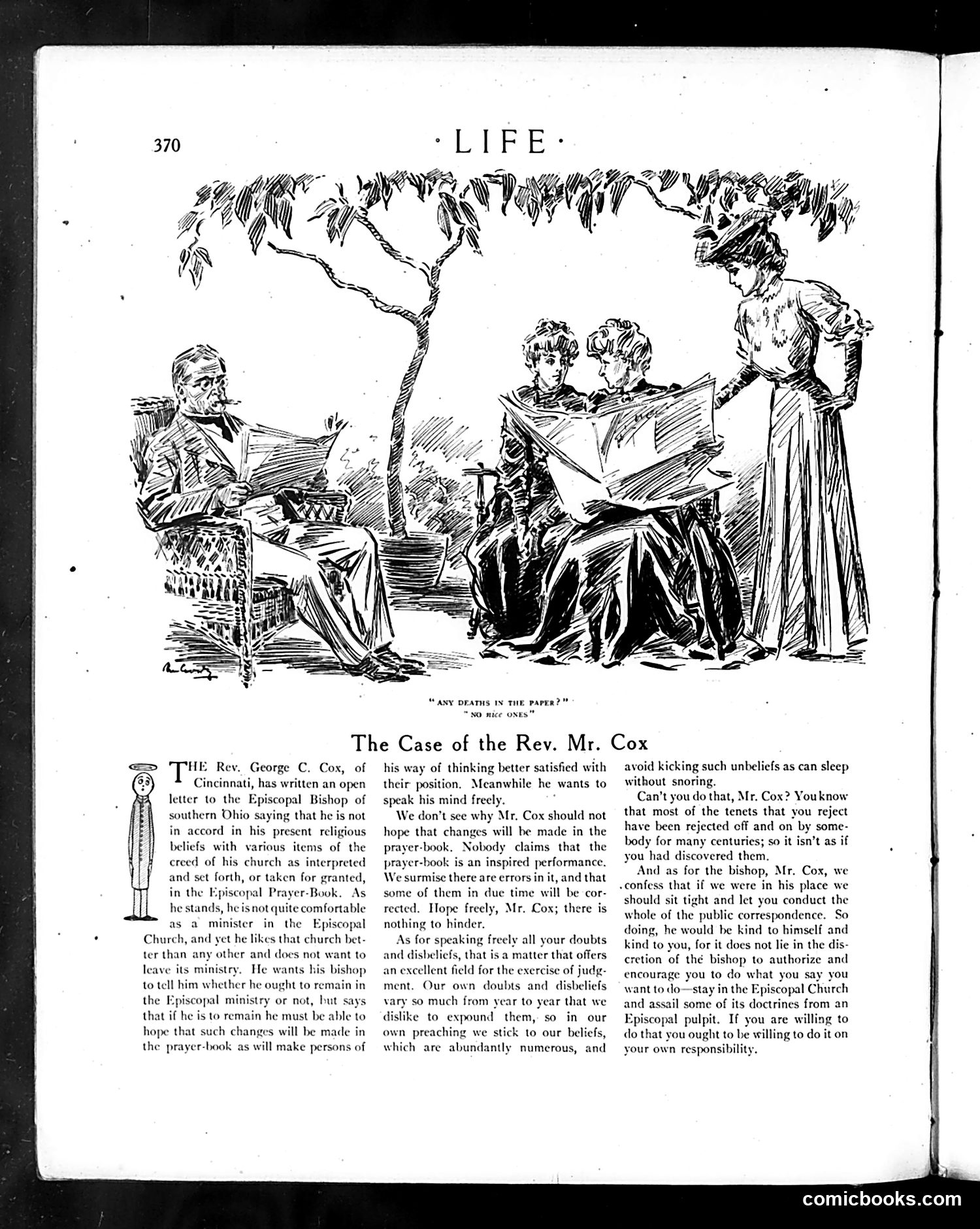
This is not a cartoon but an editorial commentary on a genuine religious controversy. Rev. George C. Cox of Cincinnati publicly challenged his Episcopal bishop, stating he disagreed with various church doctrines yet wished to remain a minister while speaking freely about his doubts. Life's satirical position: Cox should be free to *hope* for theological changes and to *think* privately as he wishes, but should not publicly preach heresies from an Episcopal pulpit while expecting the church's authorization. The editorial mocks Cox's apparent desire to have it both ways—remaining credentialed by the church while publicly assailing its doctrine. The illustration depicts a casual social gathering where presumably Cox and the bishop (or their representatives) discuss these matters under a tree, embodying the "civilized debate" the magazine sarcastically suggests should occur privately, not through public correspondence and pulpit preaching.
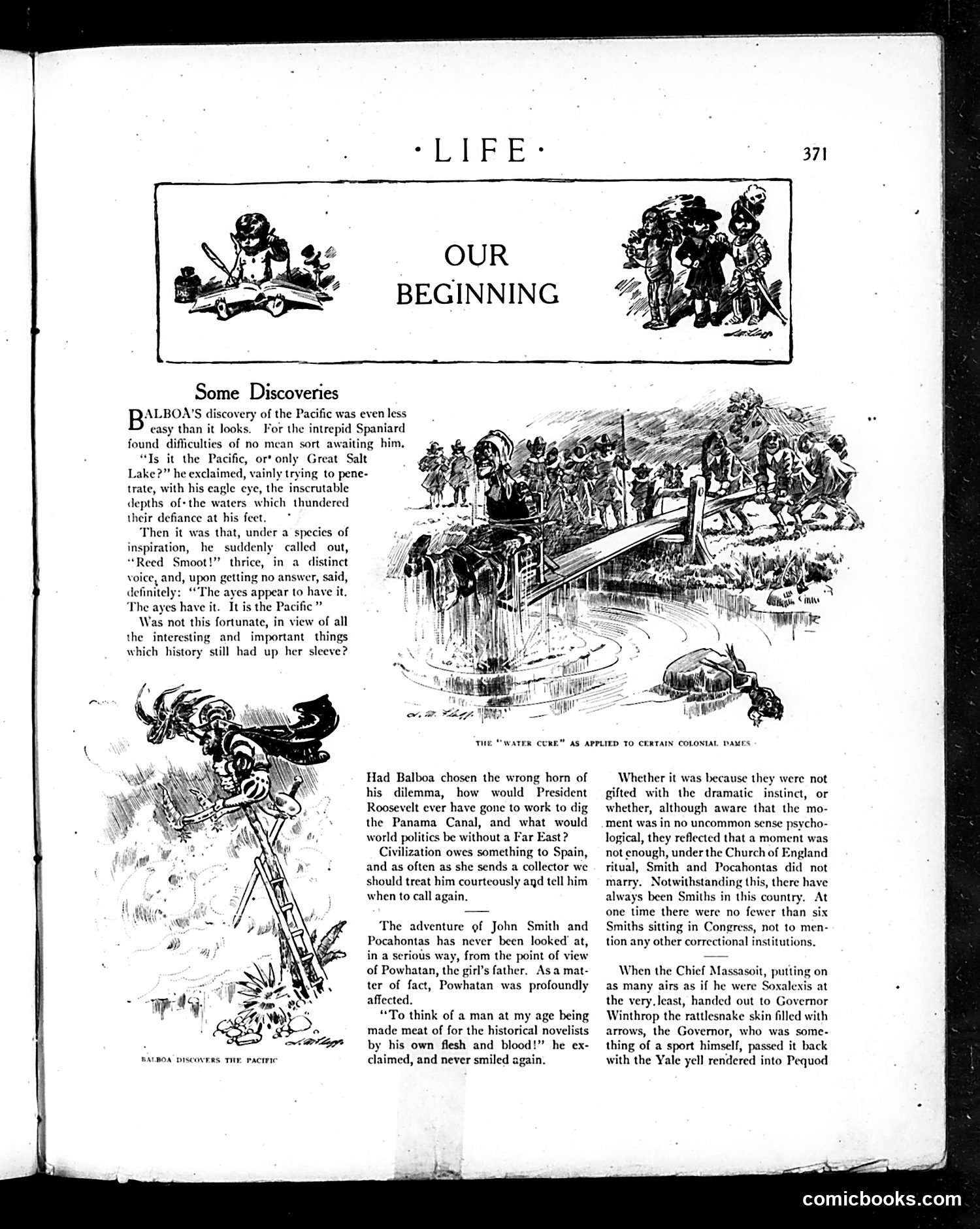
This page satirizes American founding myths through irreverent retellings. The main cartoon mocks Senator Reed Smoot (a prominent Republican) by having Balboa discover the Pacific by shouting his name—suggesting Smoot's prominence is absurdly inflated. The satire implies that even accidental American "discoveries" get credited to current politicians. The text then ironically reframes famous colonial encounters from Native American perspectives: Powhatan is devastated that his daughter Pocahontas becomes "meat for historical novelists," and Chief Massasoit's dignified gift of arrows becomes fodder for Yale-style joking. The "Water Cure" illustration (captioned as applied to "colonial dames") likely references torture methods, though the specific colonial reference is unclear. Overall, the page mocks how Americans mythologize their colonial past while ignoring indigenous suffering and agency.
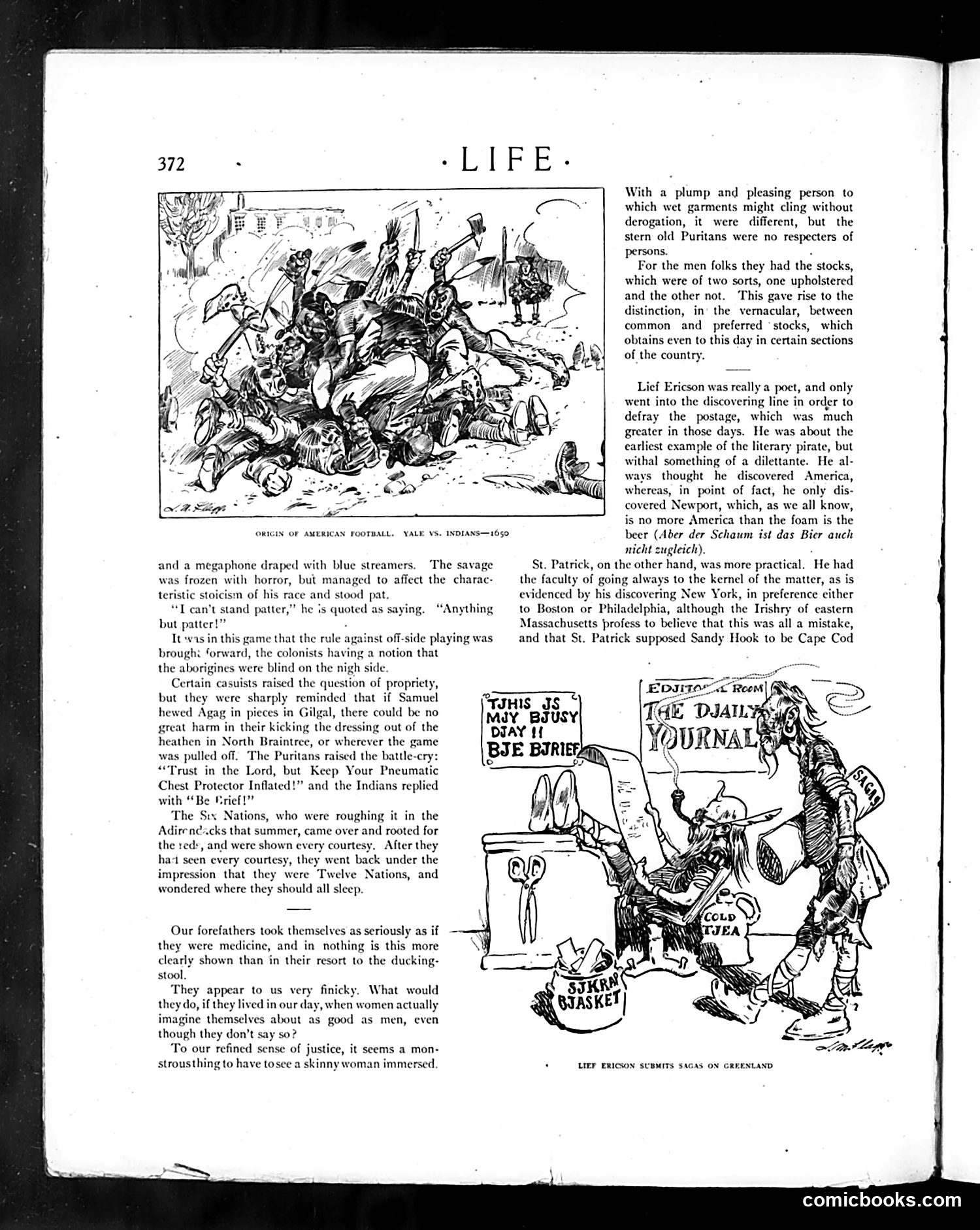
This page satirizes early American history through absurdist humor. The top illustration depicts the "Origin of American Football" as a violent clash between Yale students and Native Americans in 1659—a joke suggesting football's brutal nature has colonial roots. The text mocks Puritan severity, particularly their use of stocks (punishment devices) and ducking stools for women, presenting these as absurdly rigid moral enforcement. It ridicules the historical reverence for explorers Leif Ericson and St. Patrick, claiming Ericson was merely a "literary pirate" seeking postage reimbursement, while Patrick supposedly discovered New York by accident. The bottom cartoon shows Ericson submitting sagas from Greenland to "The Daily Journal," satirizing his status as a historical figure reduced to contributor. Overall, the page mocks both Puritan hypocrisy and Americans' mythologizing of their own history, using exaggeration and anachronism (modern journalism references) to deflate national pride.
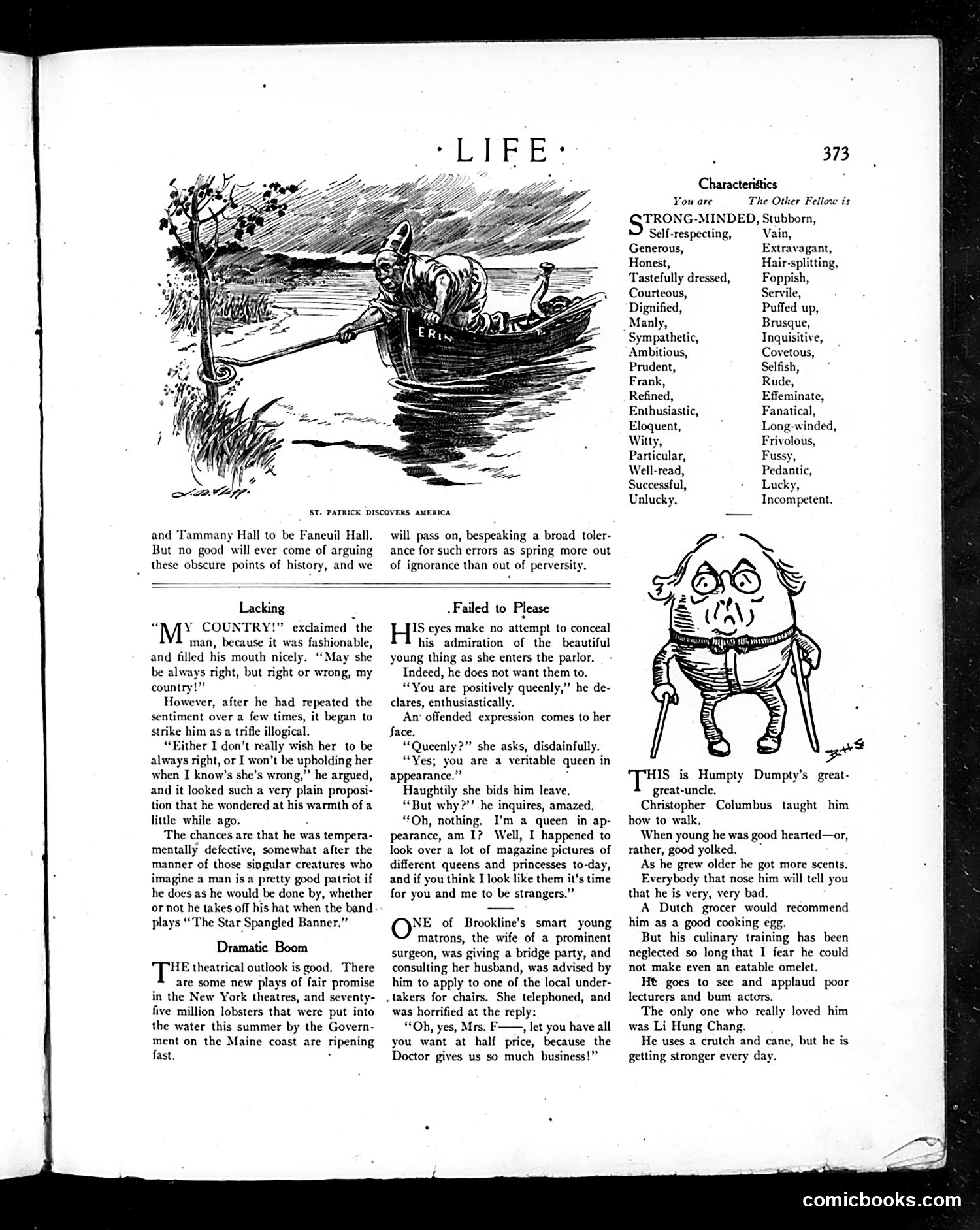
This page contains several brief satirical pieces typical of Life magazine's style: **"St. Patrick Discovers America"** (top): A humorous jab at historical inaccuracy, likely referencing confused Irish-American civic narratives conflating famous buildings or events. **"Lacking"**: Satirizes performative patriotism—a man mindlessly declaring "My country!" realizes the logical contradiction: he can't simultaneously wish his country always right while criticizing it. The piece mocks those who equate patriotism with unthinking loyalty. **"Failed to Please"**: A social comedy where a man compliments a woman as "queenly," but she takes offense, having just studied magazine photos of actual queens and finding the comparison insulting to her appearance. **Character Chart**: A humorous "You vs. The Other Fellow" comparison—self-serving satire implying readers are virtuous while others possess mirror-opposite vices. **Humpty Dumpty biography**: Absurdist nonsense humor about the nursery rhyme character. The page captures Life's focus on middle-class social pretension and the gap between stated values and actual behavior.
This appears to be an illustration depicting the destruction of the Roman city of Pompeii by Mount Vesuvius's eruption in 79 AD. The engraving shows panic-stricken citizens fleeing or collapsing as the catastrophe unfolds—bodies lie in the foreground while crowds gesture frantically toward the eruption visible above. Rather than political satire, this seems to be a historical or educational illustration from Life magazine. The dramatic composition emphasizes human suffering during the natural disaster. The style is consistent with 19th-century engravings meant to visualize classical historical events for readers. Without additional context from surrounding articles, the specific satirical intent—if any—remains unclear, though Life often used historical subjects to comment on contemporary issues.
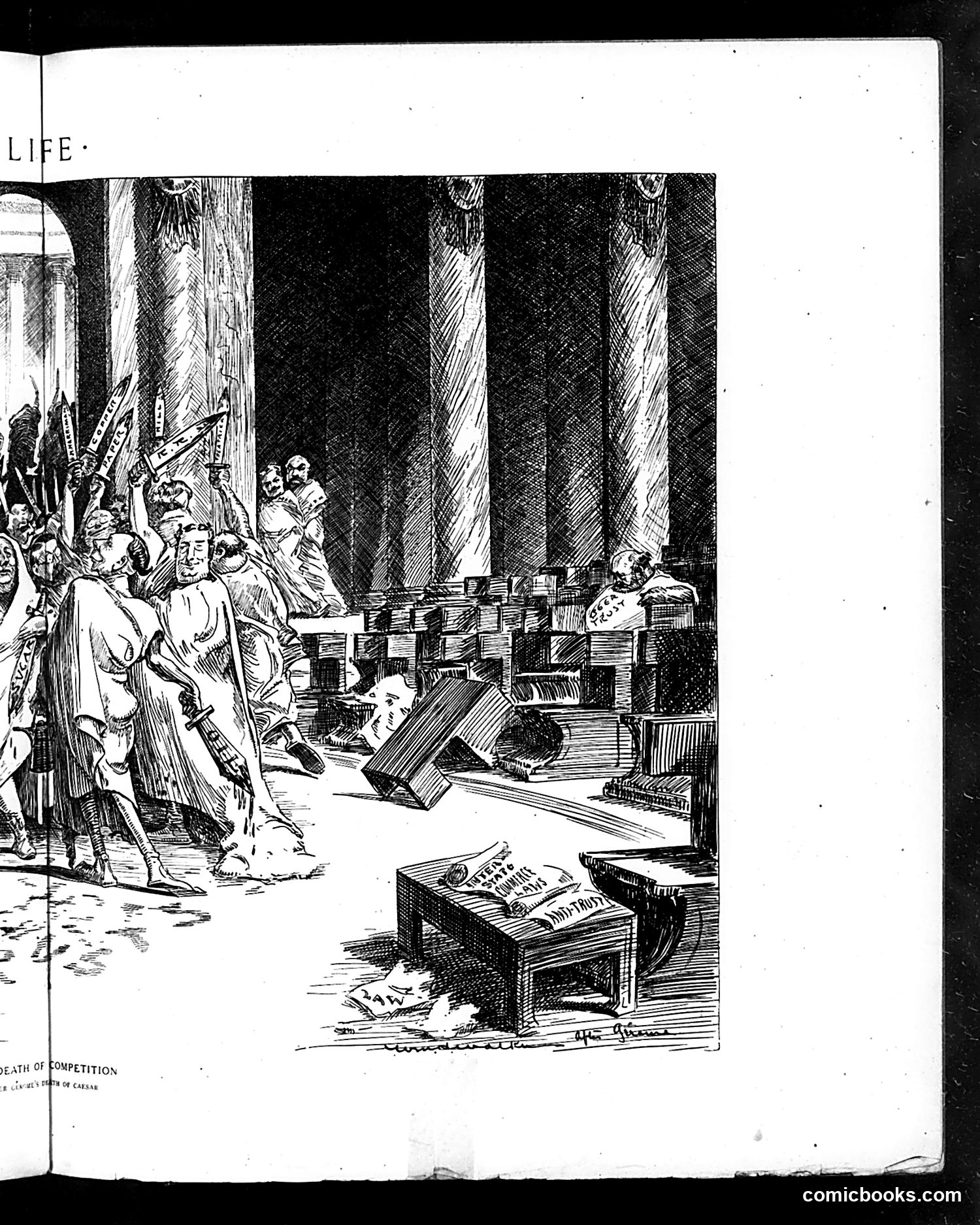
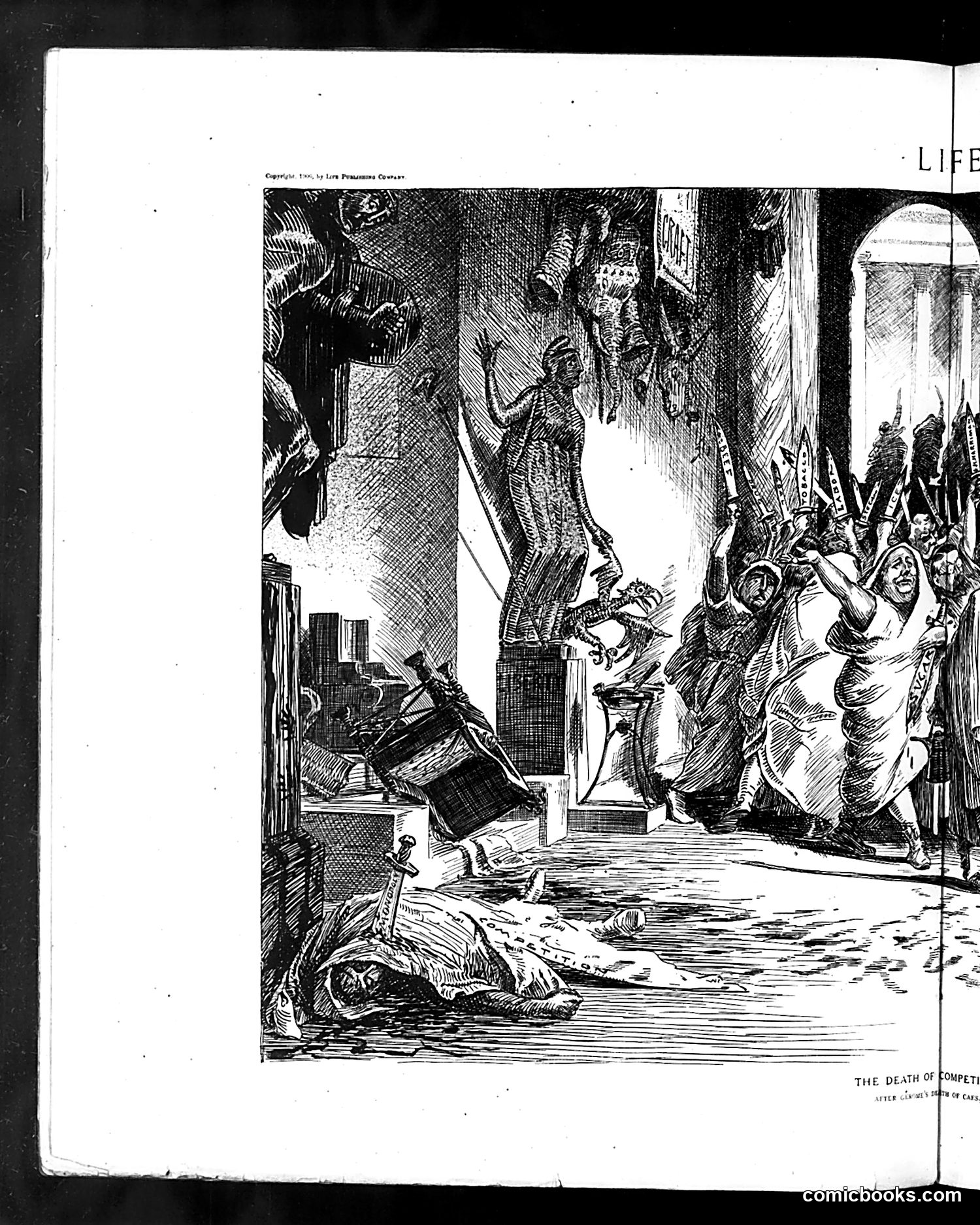
This appears to be a satirical illustration from *Life* magazine depicting a scene of economic or social competition. The image shows a grand interior space with tall columns and well-dressed figures on the left observing a central scene where figures appear to be struggling or engaged in conflict on the ground. The visible text fragment "COMPETITION" and the title "DEATH OF COMPETITION" (partially visible at bottom left) suggest this cartoon critiques competitive capitalism or market forces. The contrast between the leisurely, well-dressed spectators and the struggling figures below implies satire about how the wealthy or powerful view economic competition as entertainment while others suffer its consequences. The specific historical context and particular figures referenced remain unclear without additional text.
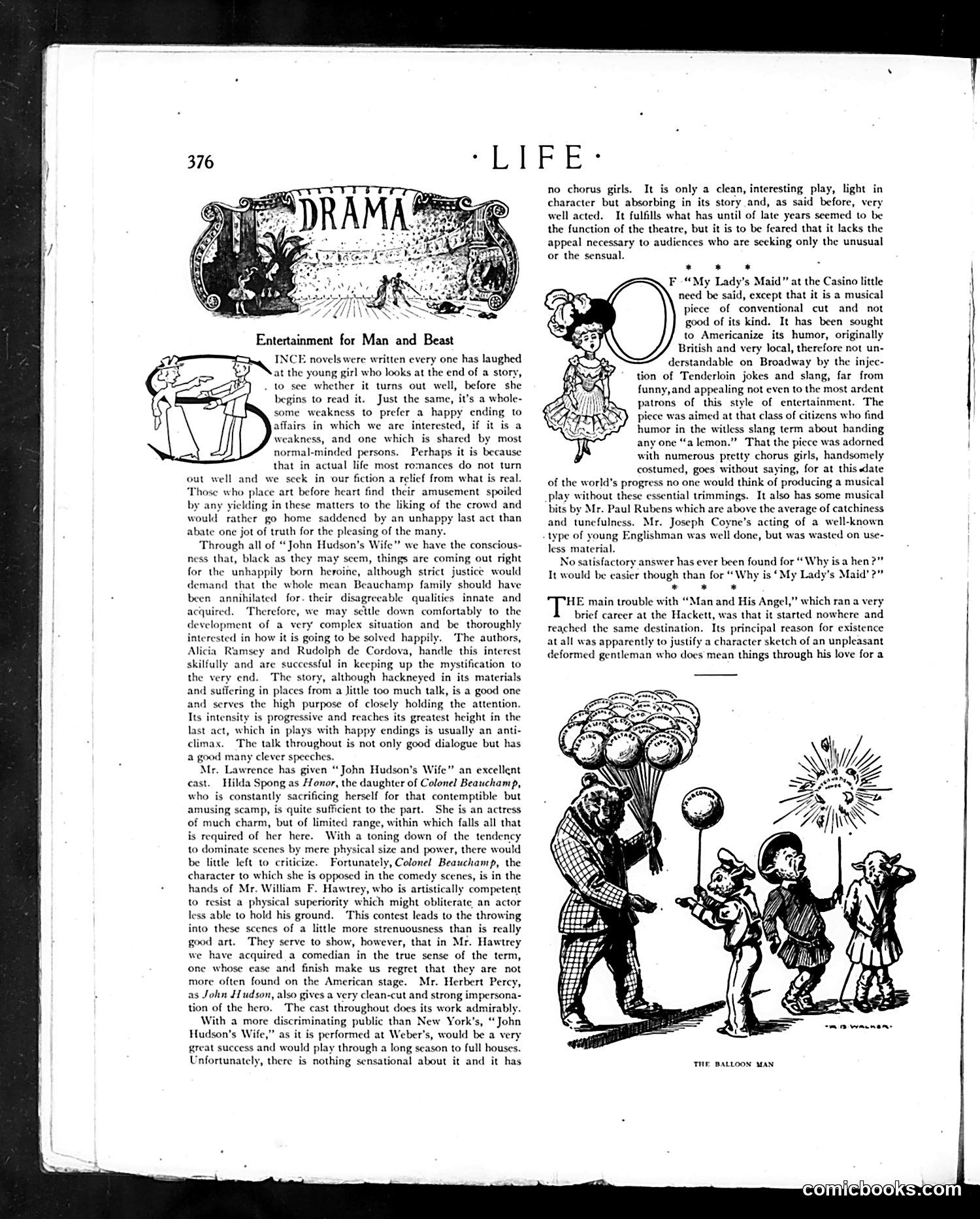
This page contains a theater review of "John Hudson's Wife," a play at Weber's theater starring actors including Hilda Spong and William F. Hawtrey. The accompanying cartoon, "The Balloon Man," appears to illustrate the article's central complaint: audiences prefer sensational entertainment over substantial drama. The review criticizes New York theatergoers for demanding "the unusual or the sensual" rather than appreciating "clean, interesting play[s]" with good acting. The text laments that while the play has merit—strong cast, clever dialogue, and emotional engagement—it lacks "sensational" elements like chorus girls, making it unlikely to draw full houses in New York despite succeeding elsewhere with "more discriminating" audiences. The cartoon's whimsical balloon vendor likely represents the frivolous entertainment audiences actually crave, contrasting with the serious theatrical drama the reviewer advocates for. This reflects turn-of-the-century debates about popular versus "high" art.
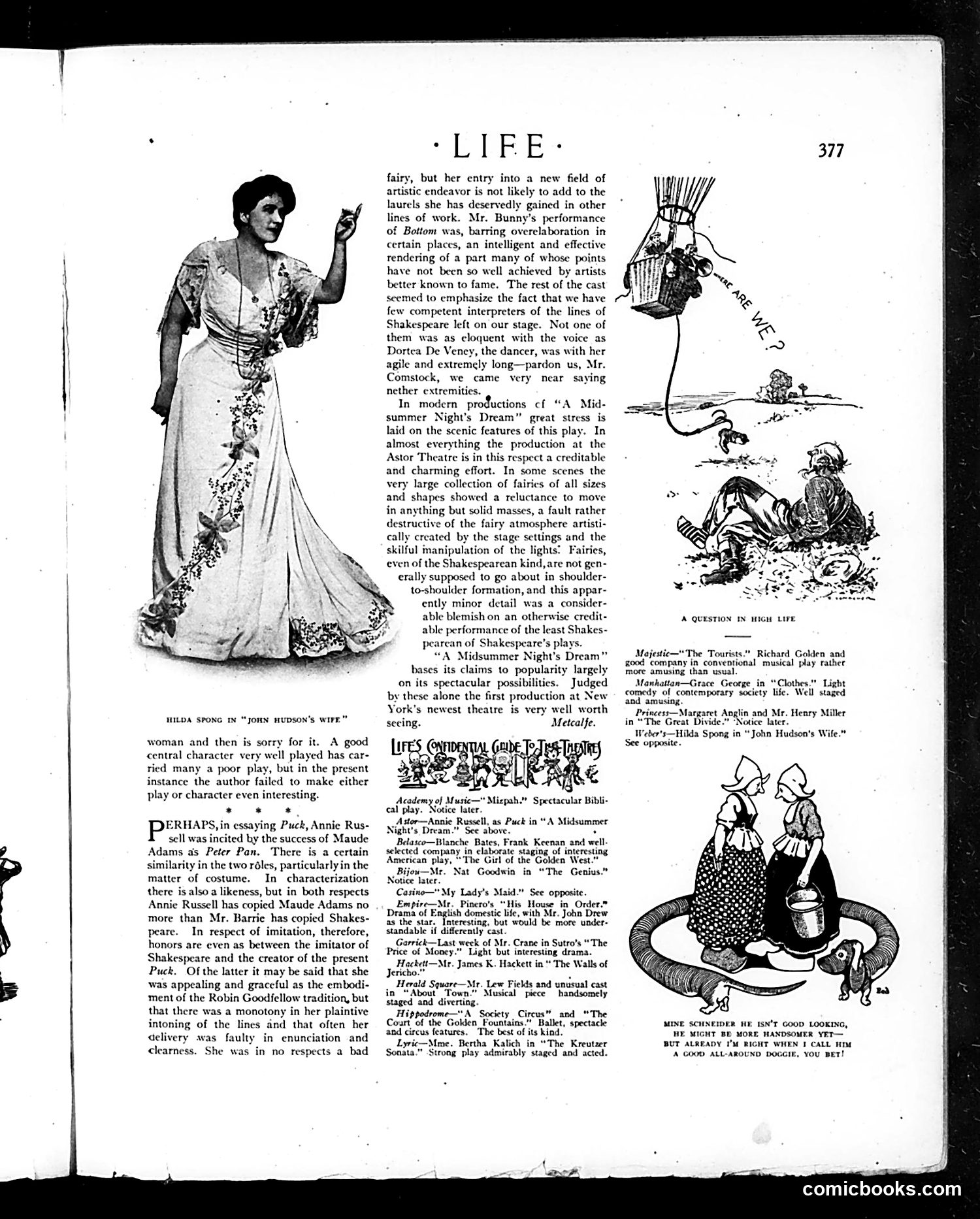
This page reviews theatrical productions, particularly focusing on Shakespeare adaptations on New York stages. The main critique concerns a production of "A Midsummer Night's Dream" at the Astor Theatre, starring actress Annie Russell as Puck. The reviewer (Metcalfe) praises the production's spectacular scenic design and lighting but criticizes a significant staging flaw: the fairies move in "solid masses" rather than individually, undermining the ethereal atmosphere Shakespeare requires. The critic notes this "apparently minor detail" damages an otherwise creditable performance. The page also reviews "John Hudson's Wife" (with Hilda Spong, pictured) and discusses Annie Russell's performance, comparing her favorably to Maude Adams in "Peter Pan" without implying imitation. The cartoons on the right mock theatrical conventions and audience behavior—one shows a critic evaluating a performance; another depicts a character's physical appearance becoming a distraction (likely referencing the reviewer's veiled comment about dancers' legs).
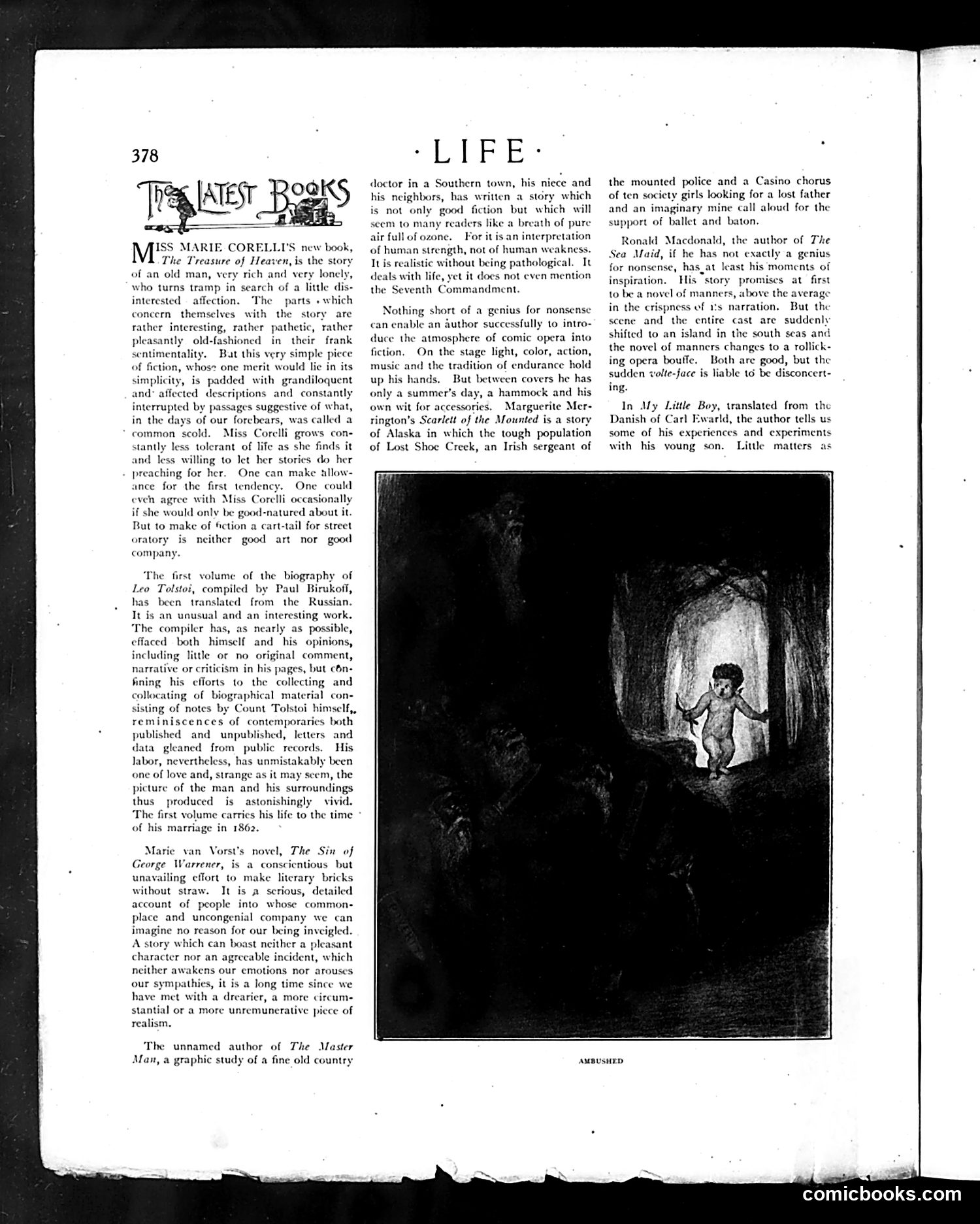
This page contains book reviews from *Life* magazine's "Latest Books" section. The reviews are critical assessments of contemporary fiction, including works by Marie Corelli, a biography of Leo Tolstoy, and novels by Marie van Vorst and others. The accompanying illustration (captioned "AMBUSHED") appears to depict a scene from one of the reviewed works—likely showing a dramatic moment of surprise or danger, typical of the adventure or romantic fiction being discussed. The reviews themselves are satirical in tone, particularly toward Corelli, whom the critic accuses of using her fiction as a vehicle for preaching rather than telling stories naturally. The reviewer also dismisses van Vorst's novel as dreary and unrealistic, while praising "The Master Man" for depicting human strength rather than weakness. The satire targets both overly sentimental Victorian fiction and pretentious literary realism of the era.
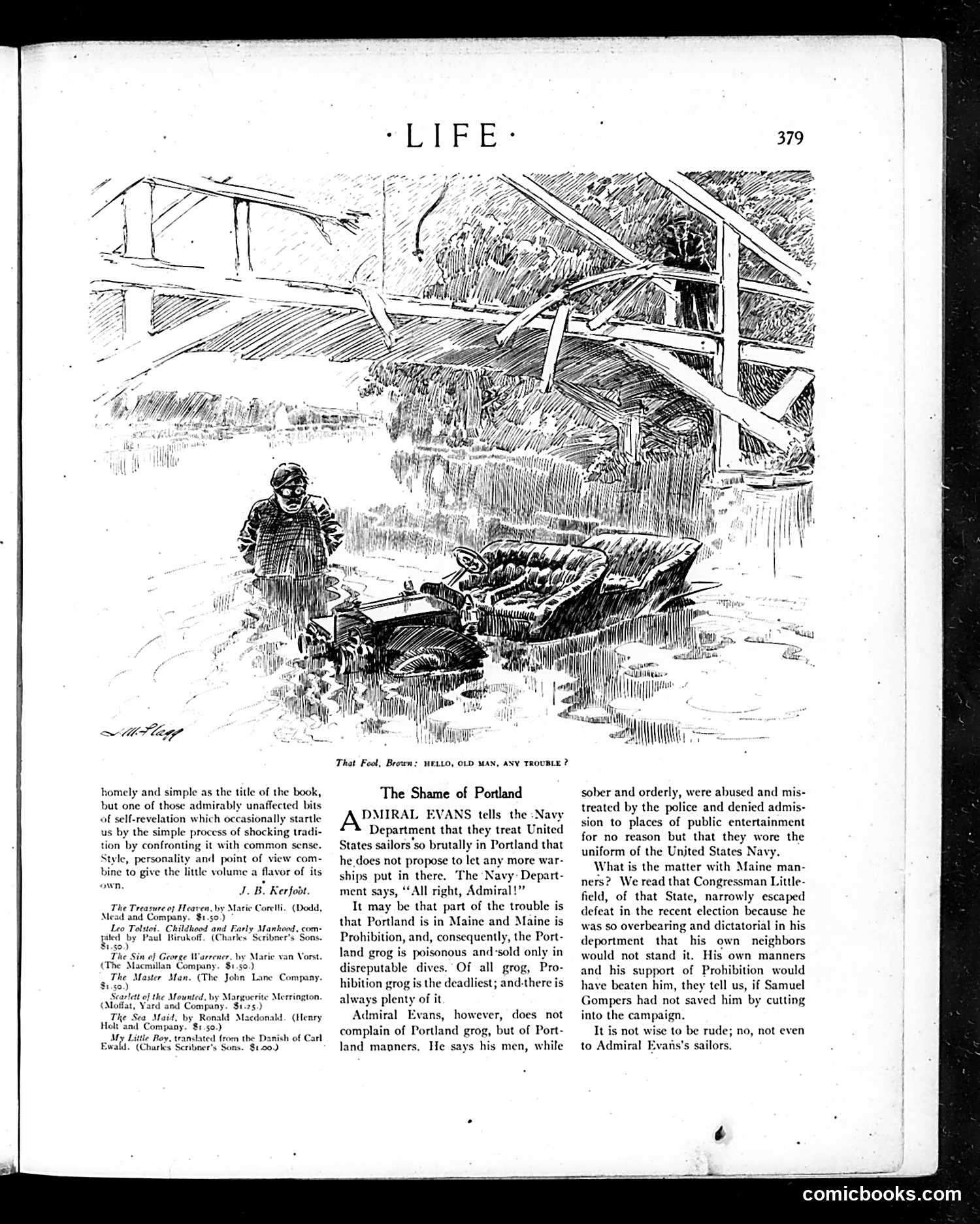
The cartoon depicts a confrontation between a sailor (representing Admiral Evans's men) and a civilian labeled "That Fool, Brown," who appears dismissive or hostile. The accompanying article criticizes Portland, Maine's treatment of U.S. Navy sailors. Admiral Evans reported that his men—though sober and orderly—were abused by police and denied entry to public establishments simply for wearing Navy uniforms. Life magazine satirizes this conduct by connecting it to Maine's Prohibition laws and the state's apparently poor manners generally. The piece cites Congressman Littlefield's recent near-electoral defeat, attributing it partly to his own overbearing demeanor, suggesting Mainers were hypocritical: enforcing strict moral standards (Prohibition) while treating military personnel rudely. The satire's point: Portland's inhospitable treatment of sailors contradicts American values of hospitality and respect for those in uniform, and Maine's self-righteous moralizing rings hollow given its citizens' actual conduct.
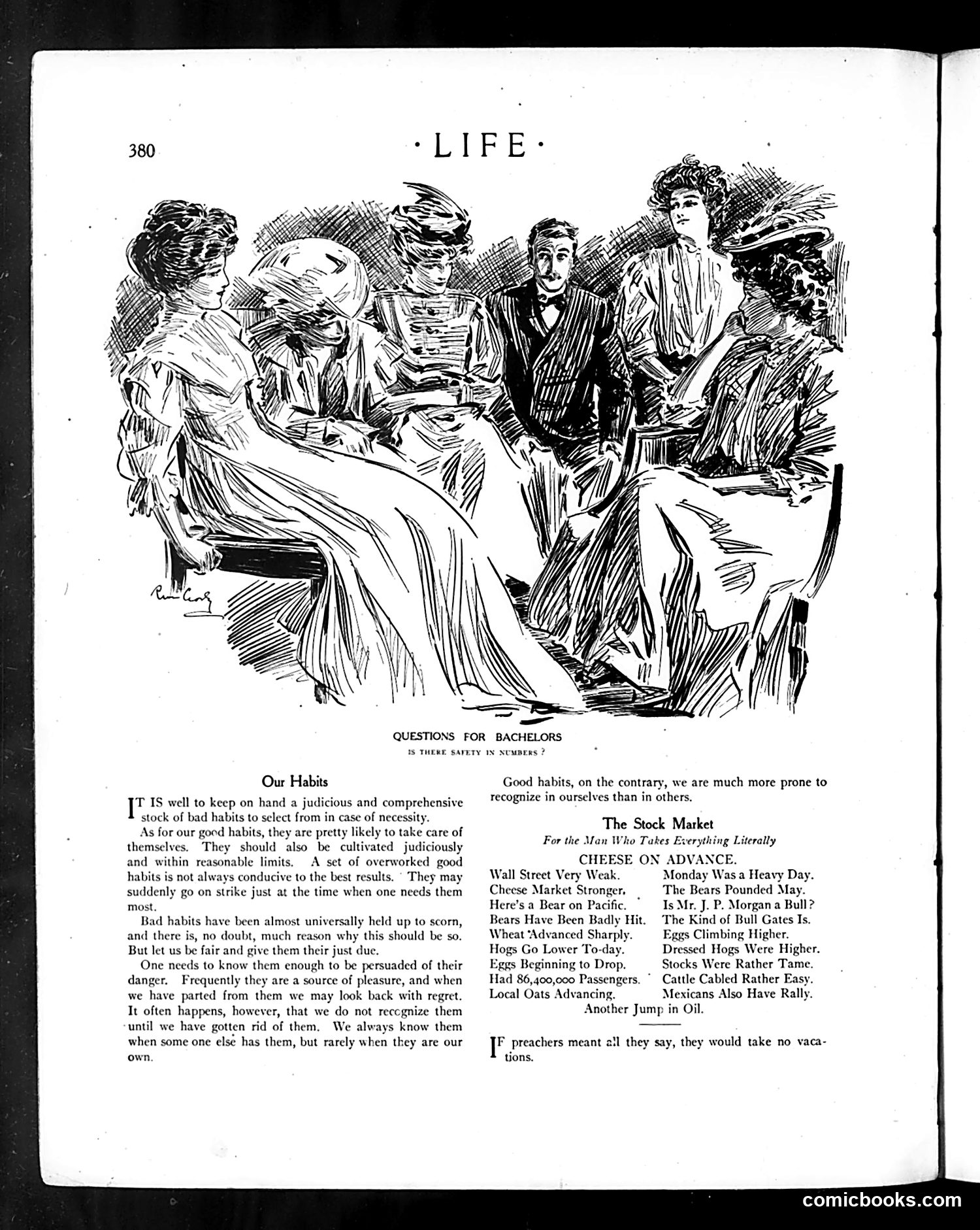
This page combines two satirical pieces targeting male readers of the era. **"Our Habits"** is a humorous essay addressing bachelors, arguing that bad habits deserve recognition alongside good ones. The author suggests bad habits provide pleasure and serve as useful warnings, while good habits are overrated and unreliable ("go on strike"). The piece satirizes masculine self-deception—men readily notice others' flaws but rarely their own. **"The Stock Market" section** is a clever wordplay joke exploiting literal meanings of financial terms. Phrases like "Bear on Pacific" and "Eggs Climbing Higher" work as both market language and absurdist humor, mocking readers who take Wall Street jargon literally. The accompanying sketch shows well-dressed men and women in social conversation, illustrating the bachelor lifestyle being discussed. The closing quip about preachers and vacations is unrelated moral commentary. Overall, the page targets educated male readers with gentle ribbing about their habits and financial literalism.
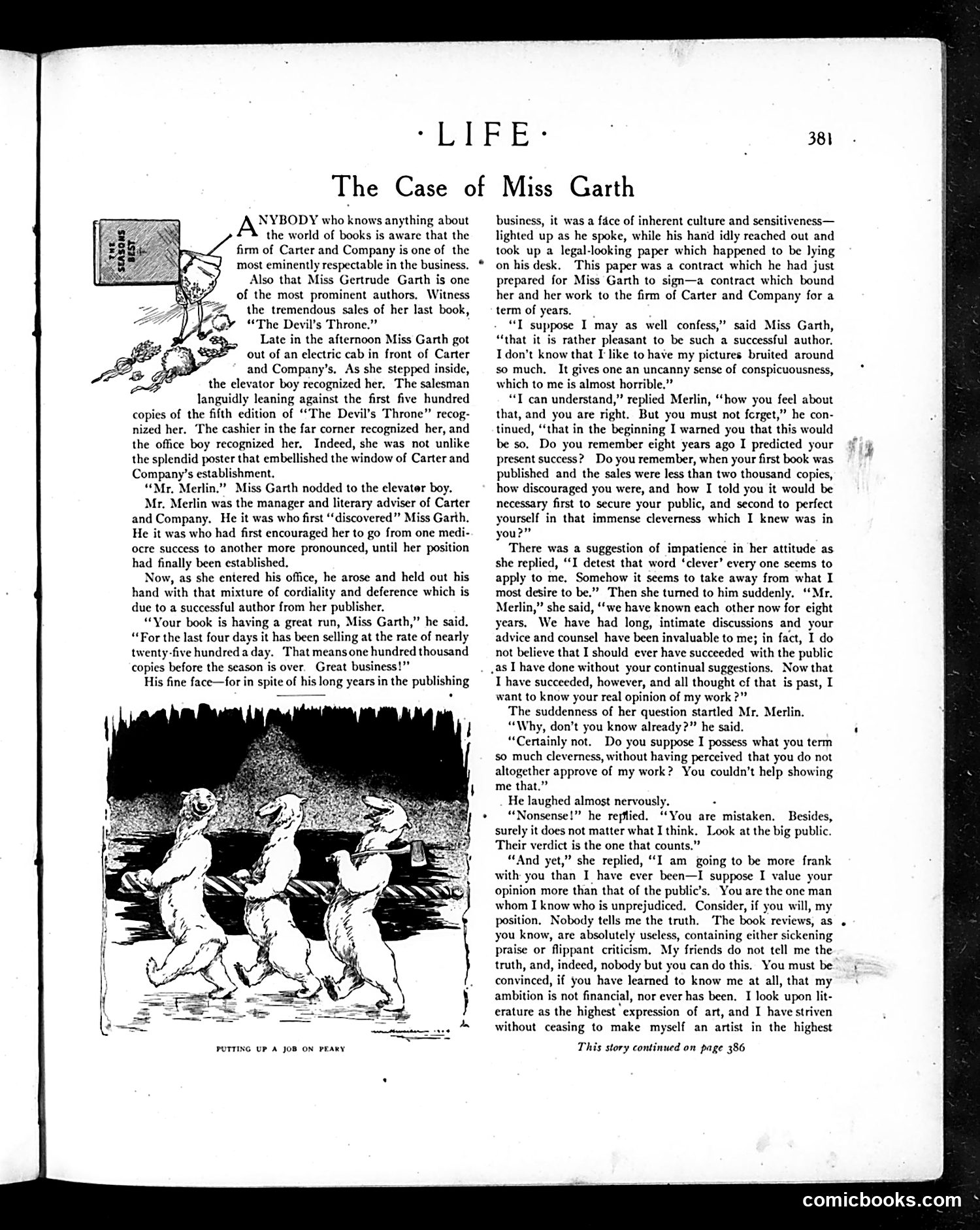
This is the opening of a serialized story (continued on page 386) about a successful female author and her publisher, not a political cartoon. The page contains two illustrations: one showing the publisher's office scene, and another labeled "PUTTING UP A JOB ON PEARY" depicting figures in water—likely an unrelated satirical cartoon about explorer Robert Peary, whose Arctic expeditions were controversial topics in early 20th-century Life magazine. The story itself explores the tension between Miss Garth's literary ambitions and commercial success. Publisher Mr. Merlin subtly manipulates her by taking credit for her success while she seeks honest artistic assessment rather than praise. The satire targets publishing industry dynamics and the gap between public persona and private artistic integrity in the era of mass marketing.
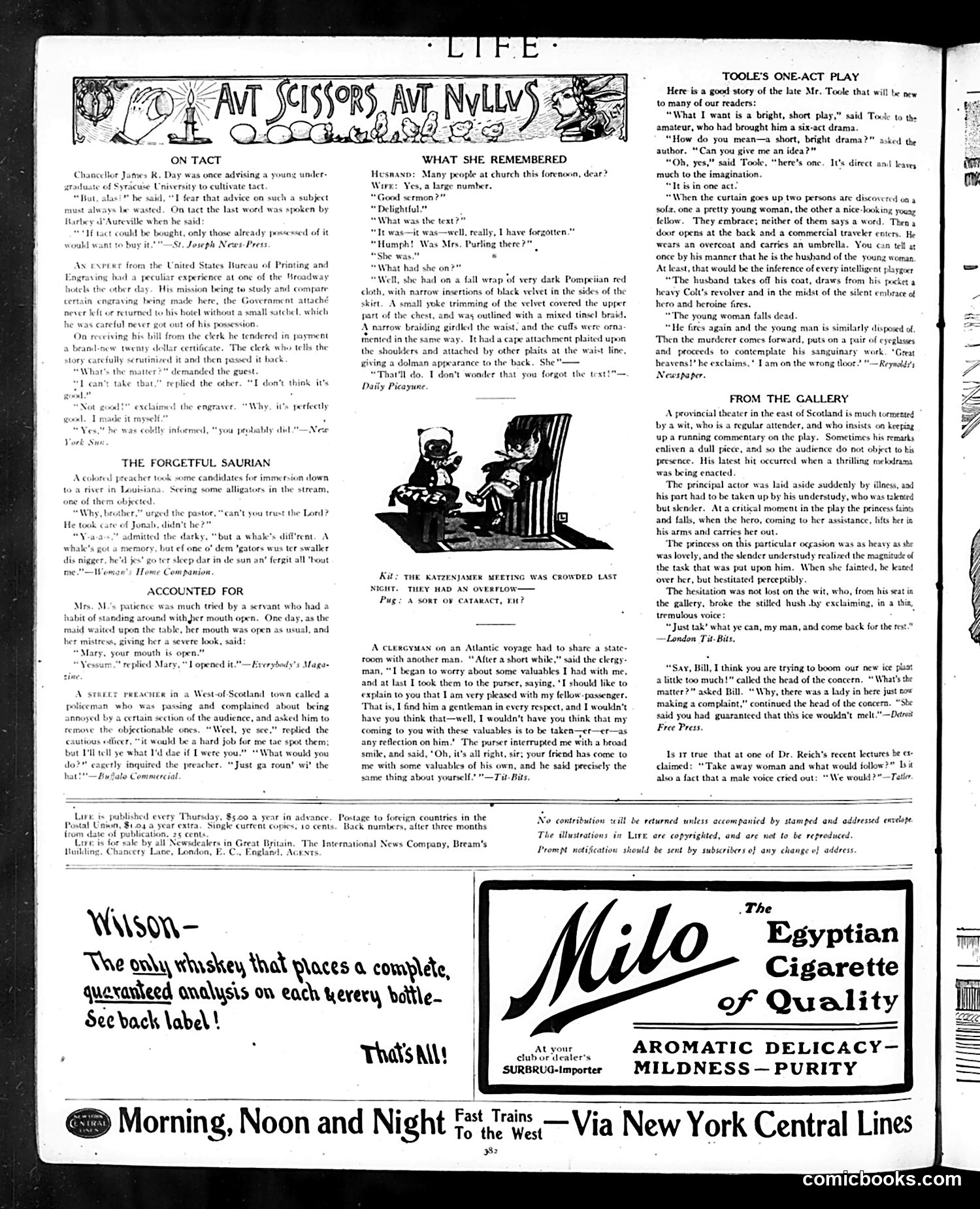
This page from *Life* magazine contains several brief humorous anecdotes and a cartoon, typical of the publication's satirical style. **"At Scissors, At Nullys"** (top): A illustrated story about a young undergrad learning "tact"—the joke being that tact cannot be taught; you either possess it or you don't. **Other anecdotes** include: - A Bureau of Engraving employee who cannot cash a new $20 bill because the clerk doesn't trust it - A preacher's wife who remembers only a guest's fashionable clothing from church, not the sermon - A "Forgetful Saurian" joke playing on racial stereotypes (a Black man hesitant about river baptism due to alligators) - Various other period jokes about servants, preachers, and clergymen **The cartoon** (bottom left) appears to reference the "Katzenjammer Kids," a popular comic strip of the era. The page reflects early 20th-century humor conventions, including casual racial stereotyping now considered offensive. The advertisements for whiskey and Egyptian cigarettes reflect the era's different regulatory standards.
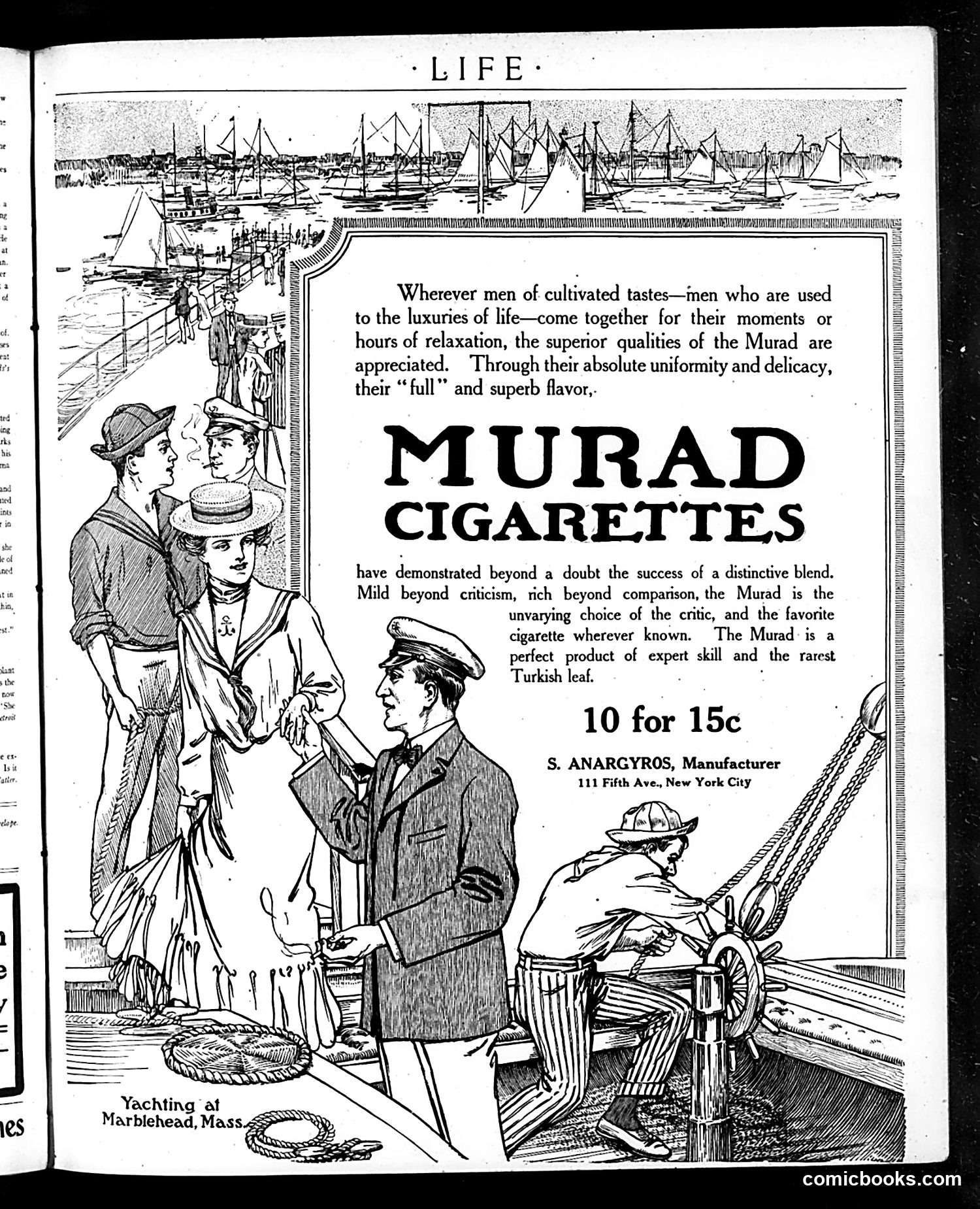
This is a **cigarette advertisement**, not satire or political commentary. The page shows a luxury brand targeting affluent consumers at leisure—depicted yachting at Marblehead, Massachusetts. The illustration features well-dressed figures (a woman in fashionable attire, a sailor, and a man in a suit) socializing on a yacht, establishing an association between Murad cigarettes and upper-class recreation and refinement. The ad's rhetoric emphasizes exclusivity: "men of cultivated tastes," "luxuries of life," and promises the cigarettes are "mild beyond criticism" and "rich beyond comparison." At "10 for 15c," the product positioned itself as premium. For modern readers: this represents early 20th-century cigarette marketing that openly associated smoking with sophistication, leisure, and social status—strategies now prohibited in advertising.
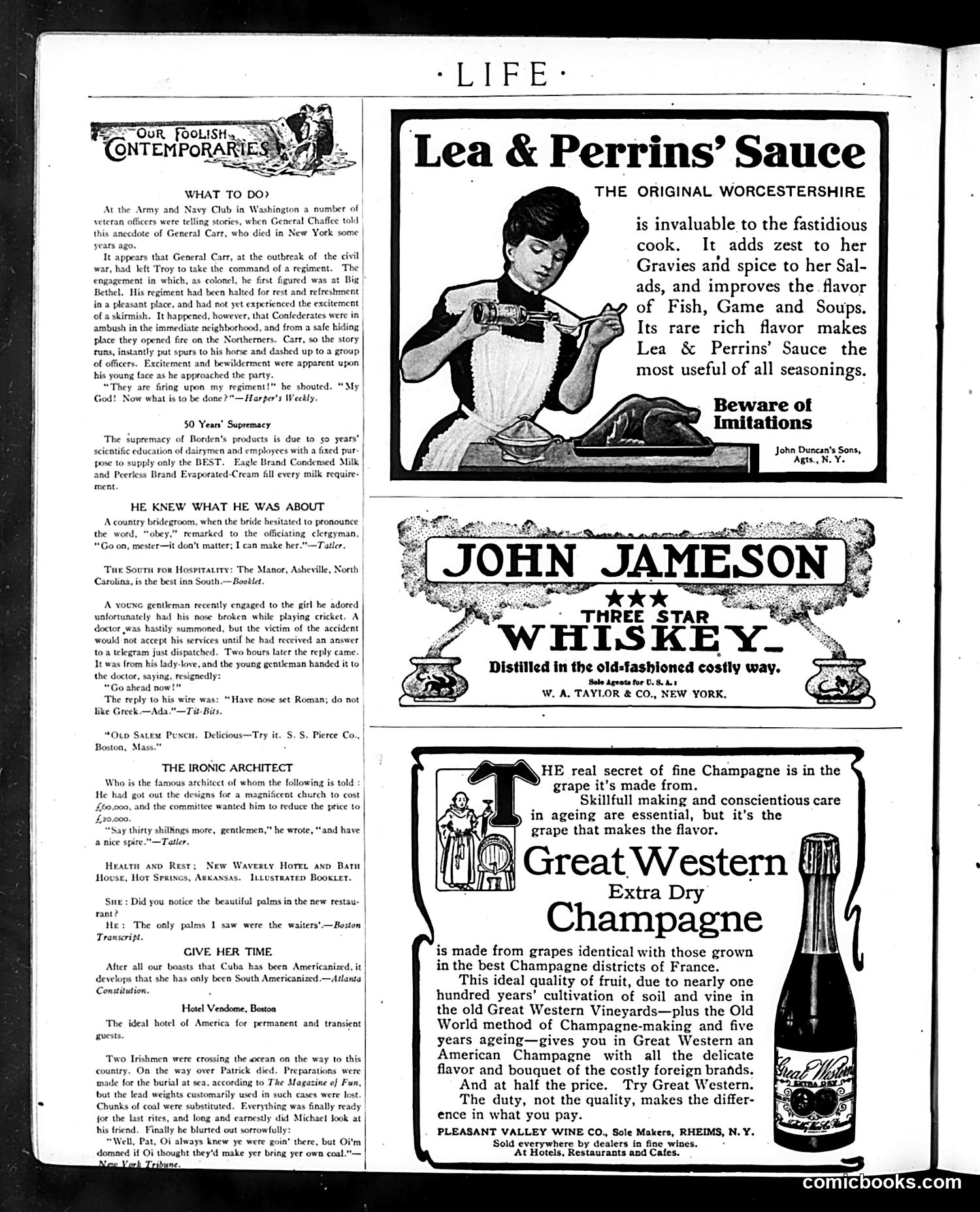
This page from *Life* magazine combines short humorous anecdotes with period advertisements. The main content includes: **"Our Foolish Contemporaries"** features brief jokes, including a Civil War anecdote about General Carr panicking when first encountering enemy fire, demonstrating his inexperience despite his rank. The humor relies on the contrast between military authority and actual combat readiness. Other jokes target contemporary social attitudes: a bridegroom coercing obedience from his reluctant bride; Irish immigrants depicted as simple-minded (a Michael mourning his friend Pat buried with coal instead of lead weights). **Advertisements** dominate the page, promoting luxury goods: Lea & Perrins' Worcestershire Sauce, John Jameson Whiskey, and Great Western Champagne—products marketed to affluent readers. The ads emphasize quality, tradition, and social refinement. The page reflects early 20th-century *Life* magazine's focus on satirizing contemporary manners, while assuming a wealthy, educated audience for both humor and consumer products.
This is primarily an **advertising and feature content page** from early 20th-century Life magazine. The satirical element is subtle: **The cartoon**: A large stylized "K" illustrating a Keiser Cravat advertisement. The accompanying text jokes that a man can maintain his appearance simply by changing his necktie—"a new cravat saves much heavier expenditure"—suggesting that updating one's wardrobe piece is a cheap way to look well-dressed. **Other notable advertisements**: - **Club Cocktails**: Emphasizes "uniformity" and scientific precision, satirizing American connoisseurship and the era's growing consumer culture - **Pond's Extract Soap**: Promotes the "New Beauty-Culture"—protective skincare for fall/winter **Feature articles**: - A serious piece about sheep-dog intelligence (actual content, not satire) - Description of an "ideal city" by a Vassar professor The page reflects Life's dual purpose: social commentary mixed with advertisements targeting affluent readers concerned with gentlemanly appearance and modern consumer goods.
This page is primarily **text fiction**, not a political cartoon. It's a serialized story titled "This story continued on page 388," featuring dialogue between two characters: **Merlin** (apparently a publisher or literary advisor) and **Miss Garth** (a female author). The satirical point concerns **literary merit and gender**. Merlin tellingly praises Garth as "the cleverest woman I have ever met," then crushes her by predicting her work will be forgotten because her very cleverness—her "style"—is fatal to lasting art. He invokes male authors (Henry James, George Meredith) as cautionary examples, then dismisses her comparison to female literary giants (George Eliot, George Sand) as exceptions. The satire exposes the **catch-22 for female writers**: told to cultivate talent, then penalized for doing so. Garth's refusal to sign the contract suggests she's rejected his patronizing judgment. This reflects early 20th-century attitudes about women's intellectual limitations and the devaluation of "clever" (feminine-coded) writing versus "crude" (masculine-coded) authenticity.
This page contains **no cartoons or satire**—it is primarily **advertising** from an early 20th-century *Life* magazine. The left column advertises Regina music boxes, emphasizing their quality and mechanical perfection as entertainment for all family members. The middle section promotes the New York Central Railroad's extensive network. The right side features a philosophical essay titled "The Best People," which defines genuine character as the ability to recognize authenticity in others and things, valuing substance over appearance or price. This essay **serves as promotional copy** for W. K. Cowan & Company, a Chicago furniture and art dealer. The implication is clear: "best people" shop at Cowan's for "genuine furniture and things." This reflects *Life*'s early advertising model, where editorial content and luxury advertising were intertwined. The piece appeals to readers' desire to be perceived as refined, discerning consumers—the kind of person who appreciates authenticity and avoids judging "by appearances" or "price."
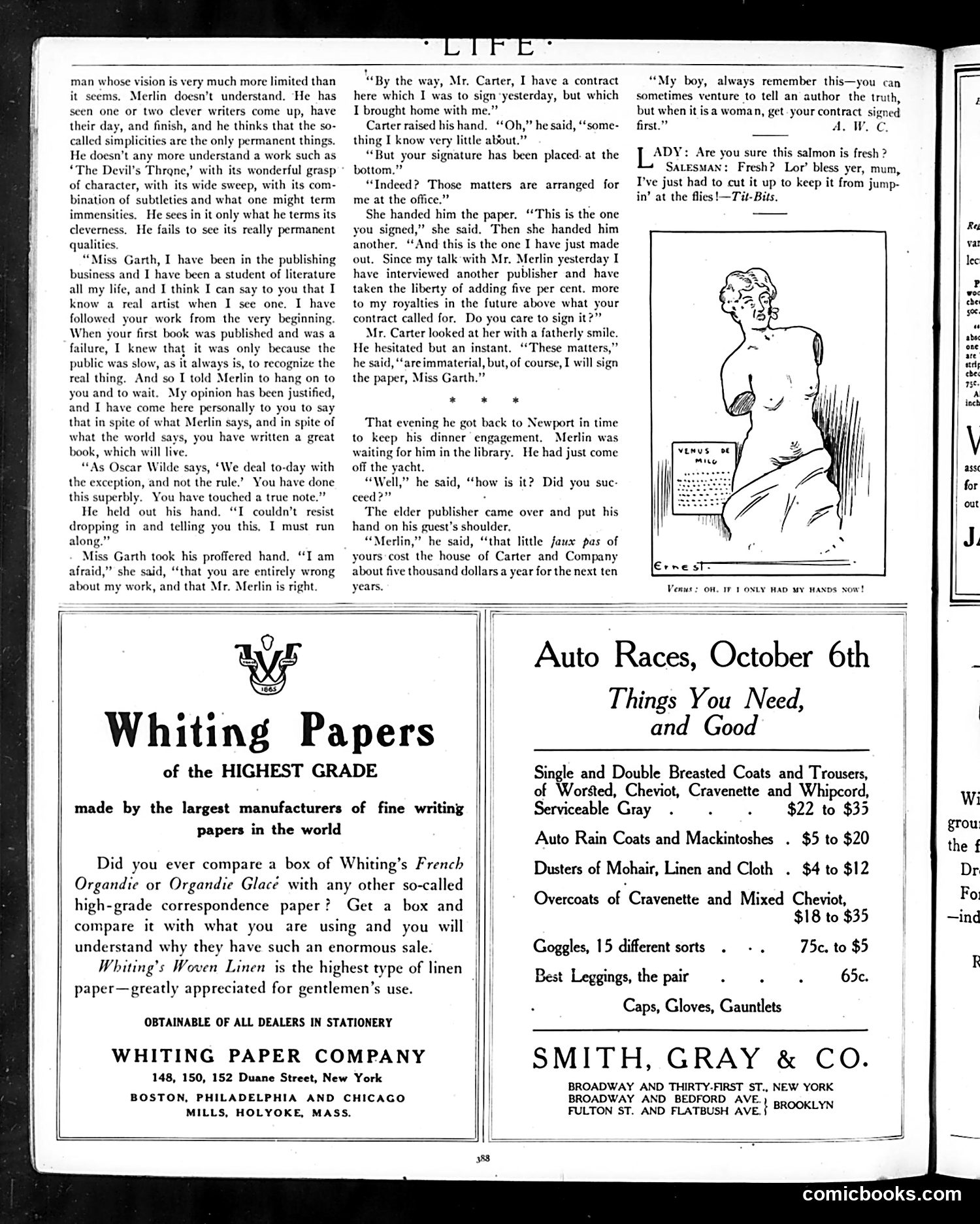
This page contains a serialized story about publishing and gender dynamics, alongside period advertisements. **The Main Story/Cartoon:** The narrative depicts an interaction between a female author (Miss Garth), two male publishers (Merlin and Carter), and illustrates a pointed lesson about business dealings with women. Carter praises Garth's literary work effusively but carelessly signs a contract modification that costs his company $5,000 annually for ten years—increasing her royalties by 5%. The punchline, delivered by Carter to Merlin, warns that while one may "venture to tell an author the truth," with a woman author you must "get your contract signed first"—implying women are shrewder negotiators or less trustworthy in business. **The Satire:** This reflects early 20th-century sexism: women writers are simultaneously underestimated artistically (Merlin dismisses her work) yet feared as cunning businesspeople. The cartoon mocks male publishers' contradictory attitudes toward female authors. **The Small Illustration:** Shows a woman with "Venus de Milo" caption—likely a humorous aside unrelated to the main story. **Advertisements:** Standard period product promotions (stationery, auto racing apparel).
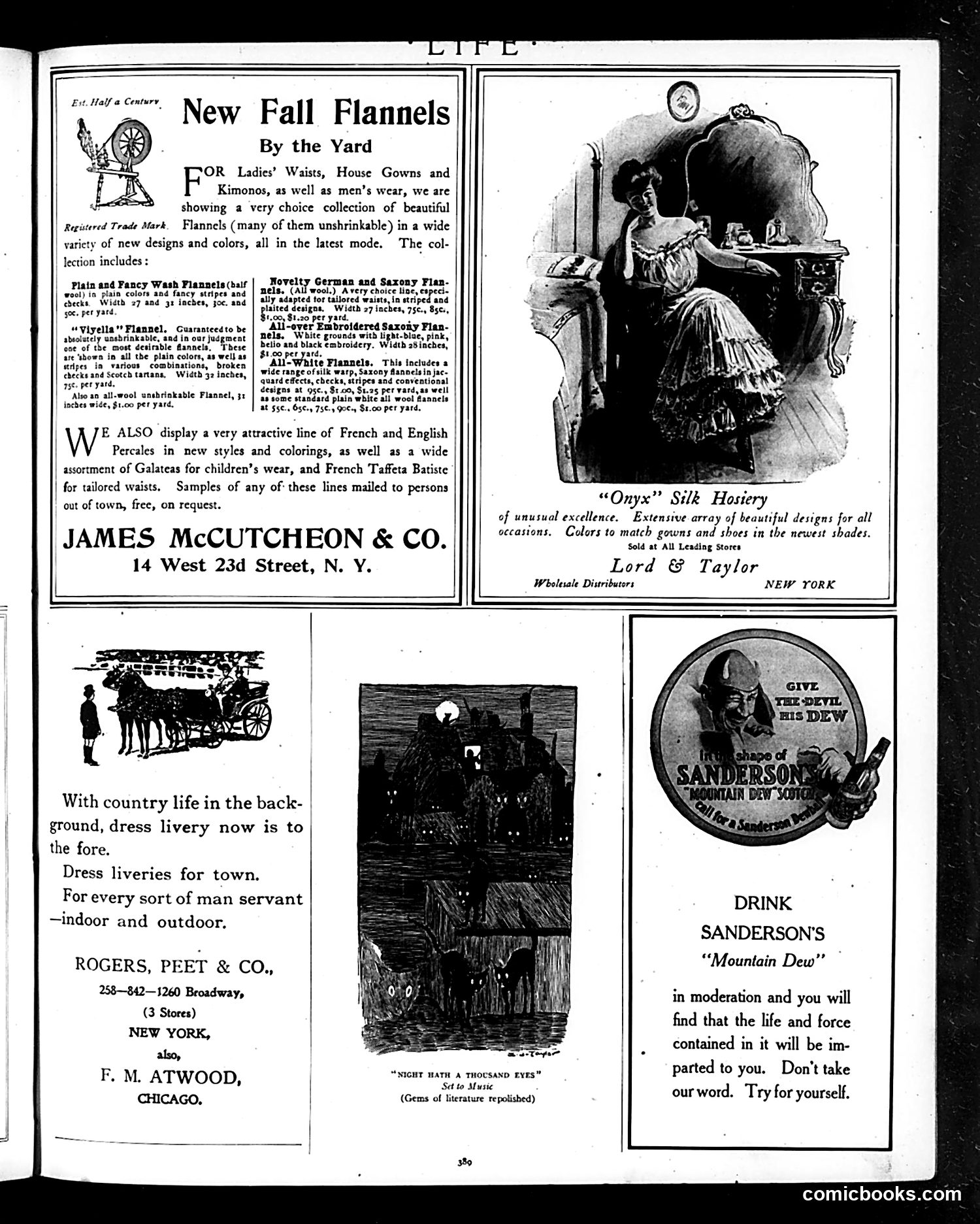
This page is primarily **advertising content** with minimal editorial/satirical material. The ads showcase turn-of-the-century luxury goods and services: **Main advertisements include:** - **James McCutcheon & Co.**: High-end fabrics (flannels, hosiery) for ladies' garments - **Lord & Taylor**: "Onyx" silk hosiery distributor - **Rogers, Peet & Co.**: Men's servant uniforms and livery services - **Sanderson's Mountain Dew**: A whiskey advertisement **The only cartoon** appears to be the small illustration titled "NIGHT HATH A THOUSAND EYES"—a literary reference (likely adapting a famous poem), shown "set to music" with modest illustration. **Social context**: The page reflects Gilded Age consumer culture—emphasizing imported fabrics, tailored domestic service uniforms, and alcohol. The repeated focus on "unshrinkable" flannels suggests this was a significant selling point to consumers concerned about garment durability. There is **no obvious satire or political commentary** on this page; it functions as a straightforward period advertisement.
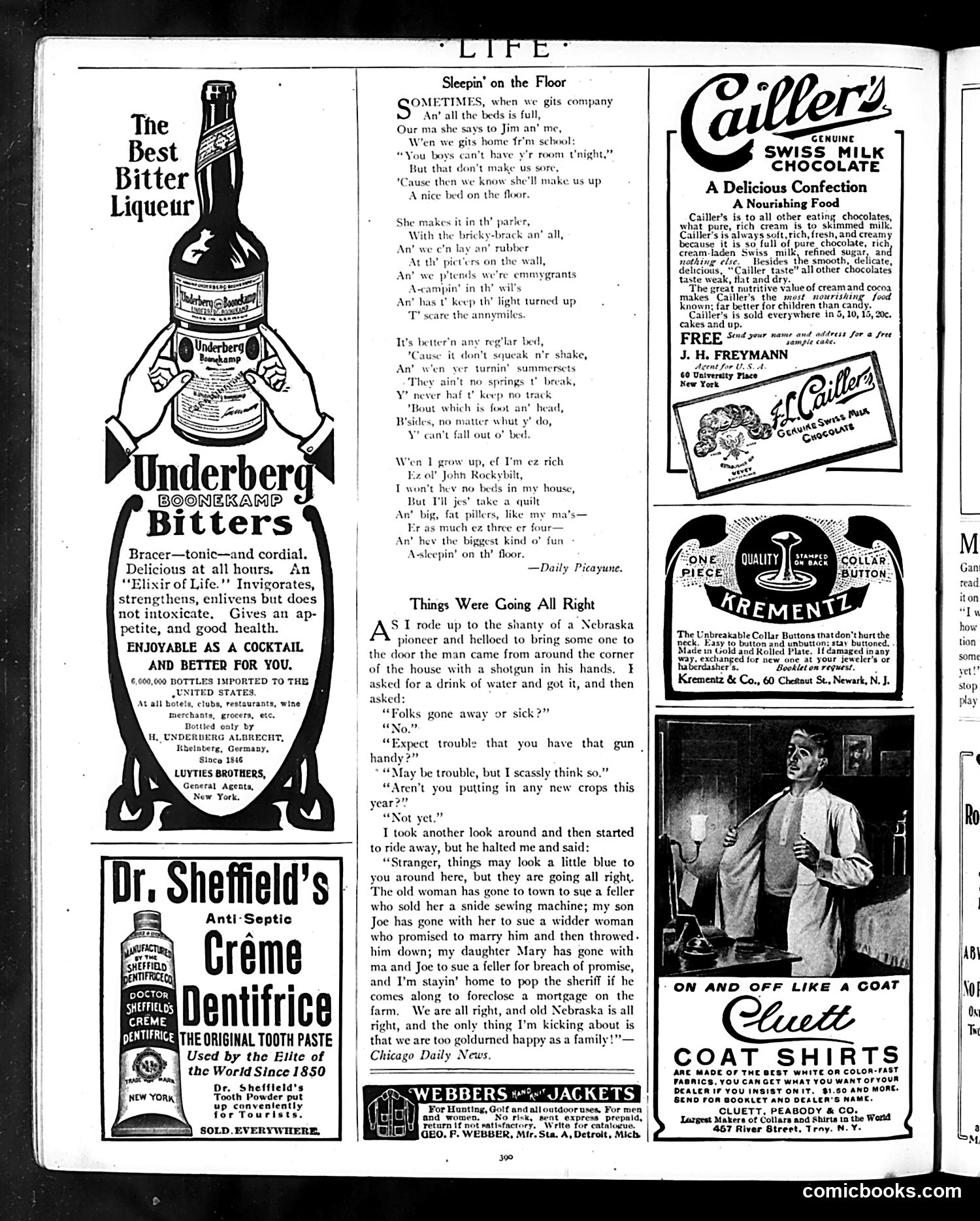
This page is primarily **advertisements** interspersed with two humorous dialect pieces typical of early 20th-century American humor magazines. **The cartoon content:** The two text pieces—"Sleepin' on the Floor" (attributed to *Daily Picayune*) and "Things Were Going All Right" (from *Chicago Daily News*)—are **rural/frontier humor** written in exaggerated dialect. They depict: 1. A poor farm boy describing sleeping on the parlor floor as better than a real bed—an attempt to make poverty seem charming through a child's innocent perspective. 2. A Nebraska pioneer farmer casually holding a gun, explaining away his family's litigious chaos (wife suing over a sewing machine, son's romantic troubles, daughter's breach-of-promise suit) as minor matters while threatening to "pop the sheriff" over mortgage foreclosure—dark humor about agricultural hardship during the Great Plains era. The satire targets **rural stereotypes** and **economic desperation disguised as contentment**, reflecting period attitudes toward frontier life and farm poverty.
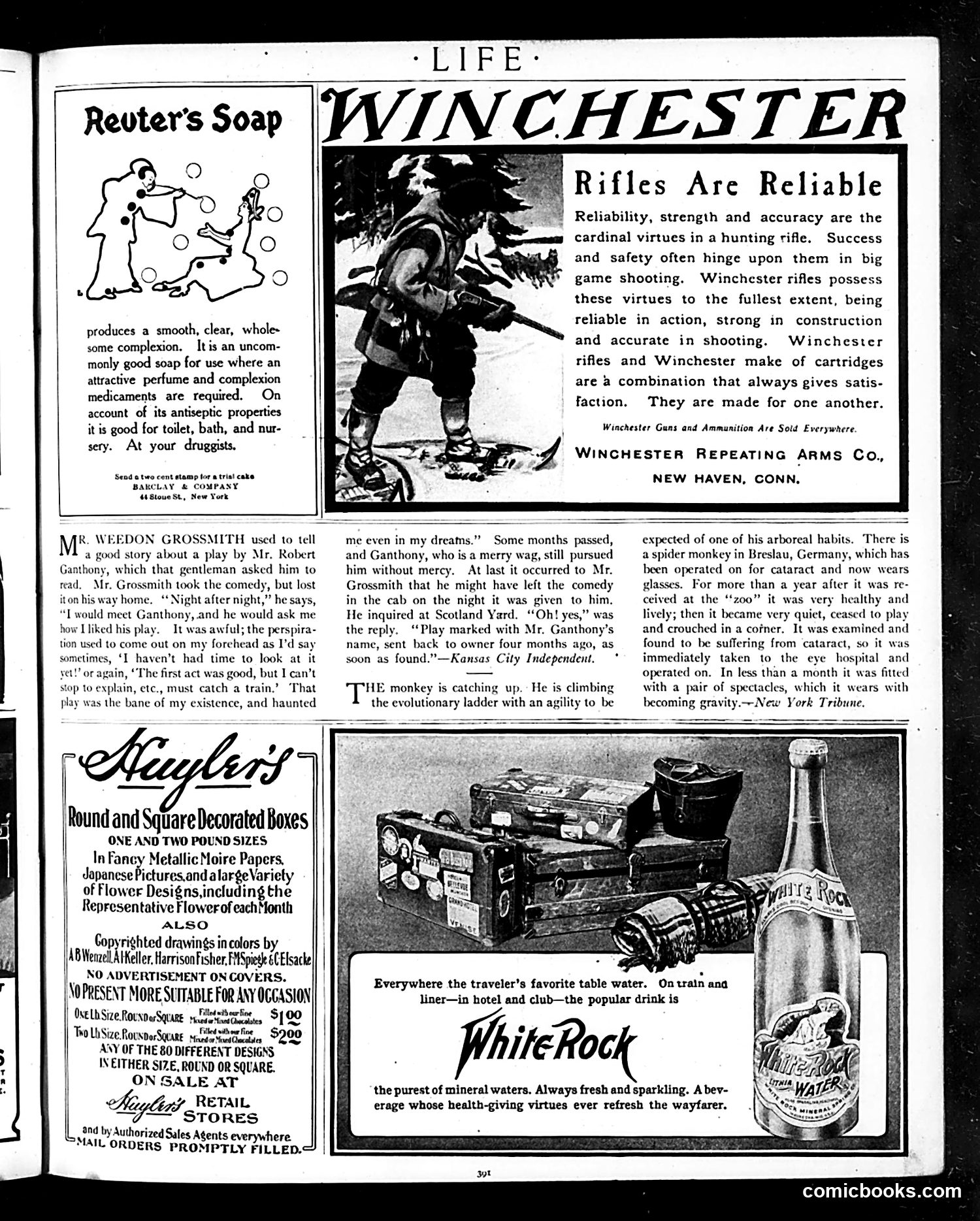
This page is primarily **advertising** rather than satirical content. It features four commercial advertisements typical of early 20th-century magazines: 1. **Reuter's Soap**: A hygiene product advertisement showing illustrated figures with soap bubbles, marketing the product for toilet and complexion care. 2. **Winchester Rifles**: A large advertisement emphasizing reliability, strength, and accuracy for hunting, featuring a dramatic illustration of a hunter with a rifle. 3. **Suylers Decorated Boxes**: Promotional copy for decorative candy or gift boxes in various sizes and designs. 4. **White Rock Water**: An advertisement for mineral water, showing vintage luggage and a bottle, marketed as "the traveler's favorite table water." The page also contains a brief humorous anecdote about playwright Robert Ganthony losing a comedy script in a cab, and a short mention of a spider monkey in a German zoo wearing glasses after cataract surgery. These are straightforward commercial promotions without political satire or social commentary.
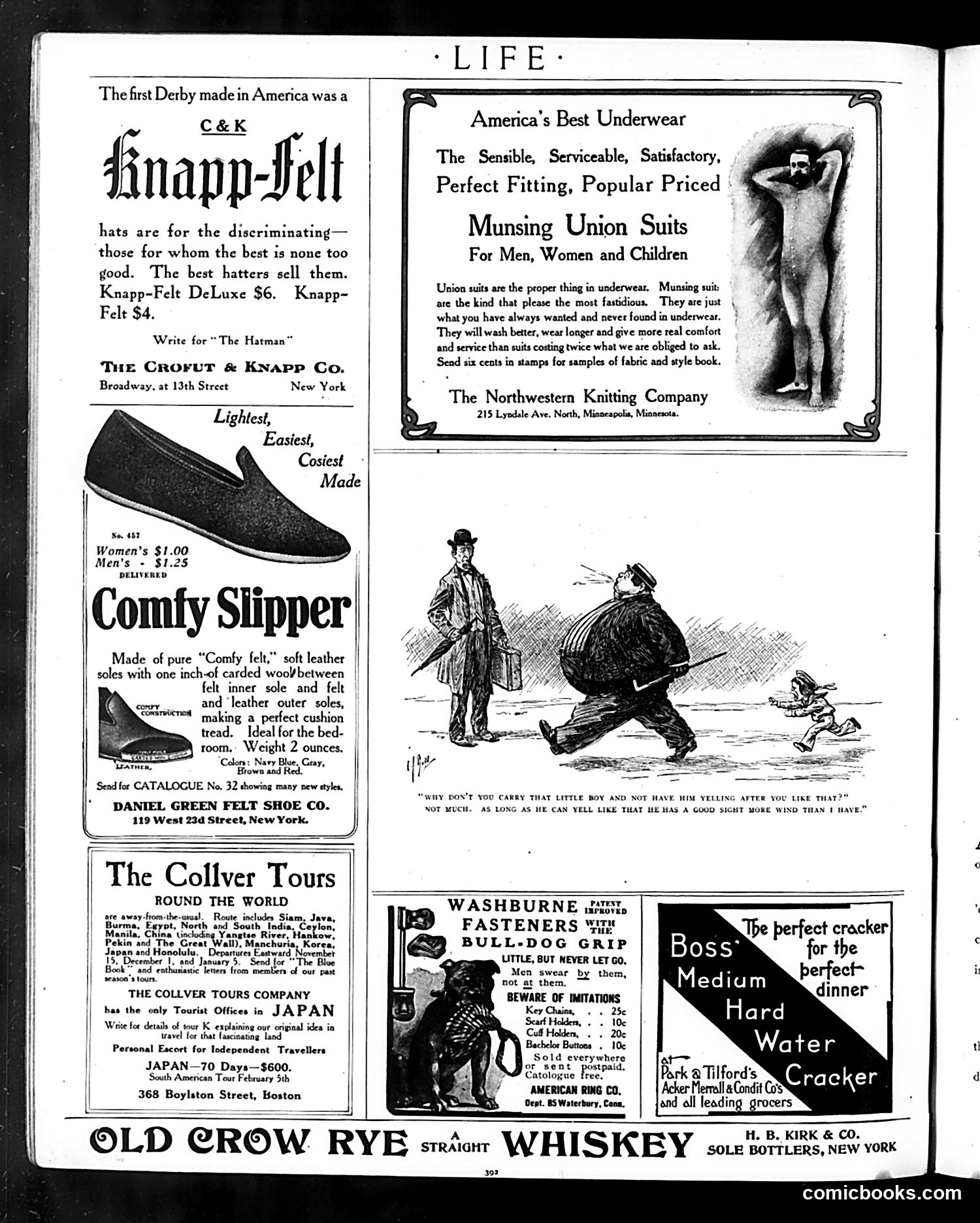
This page is primarily **advertisements** with one editorial cartoon. The cartoon depicts two men on a beach or shore—one carrying a small boy who is crying loudly. When advised to carry the child to stop his yelling, the man responds that the boy's loud cries prove he has "more wind" (lung capacity/health) than the adult himself. The joke appears to be about **parental tolerance of childhood noise**. It uses the child's vigorous yelling as proof of good health, reframing an annoying situation as a positive sign. The humor relies on the adult's resigned acceptance and inverted logic—he's actually *proud* of the child's vocal strength despite the discomfort it causes him. The cartoon likely satirizes either parenting attitudes of the era or reflects common frustrations with children in public spaces, using physical vigor as an ironic counter-argument to complaints about noise.
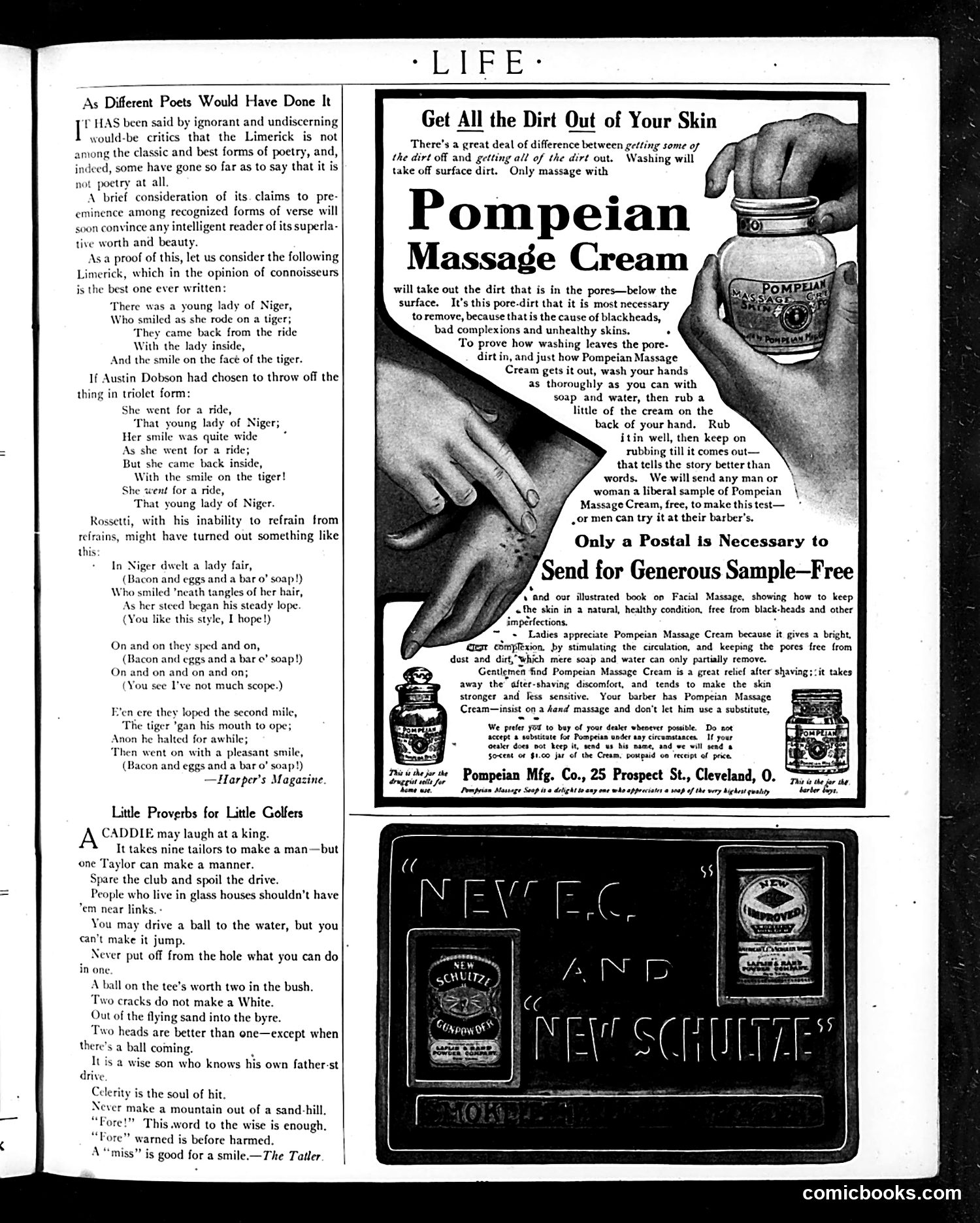
This page contains two distinct sections: **Left Side - "As Different Poets Would Have Done It":** This is satirical literary criticism. It mocks the limerick form by presenting increasingly absurd variations of the same poem about "a young lady of Niger" who rides a tiger. The joke escalates through parodies of different poetic styles—starting with a "perfect" limerick, then showing how Austin Dobson, Rossetti, and others would over-complicate the simple form with flowery language, repetitive structures, and forced rhymes like "(Bacon and eggs and a bar o' soap!)." The satire ridicules pretentious poets who cannot appreciate simple, effective verse. **Right Side - Advertisement:** A full-page ad for Pompeian Massage Cream emphasizing deep-pore cleansing superior to mere washing. Includes testimonial language and a free sample offer. **Bottom - "Little Proverbs for Little Golfers":** Golf-related aphorisms mimicking wisdom literature, likely continuing on another page. The page is primarily advertising with literary satire as secondary content.
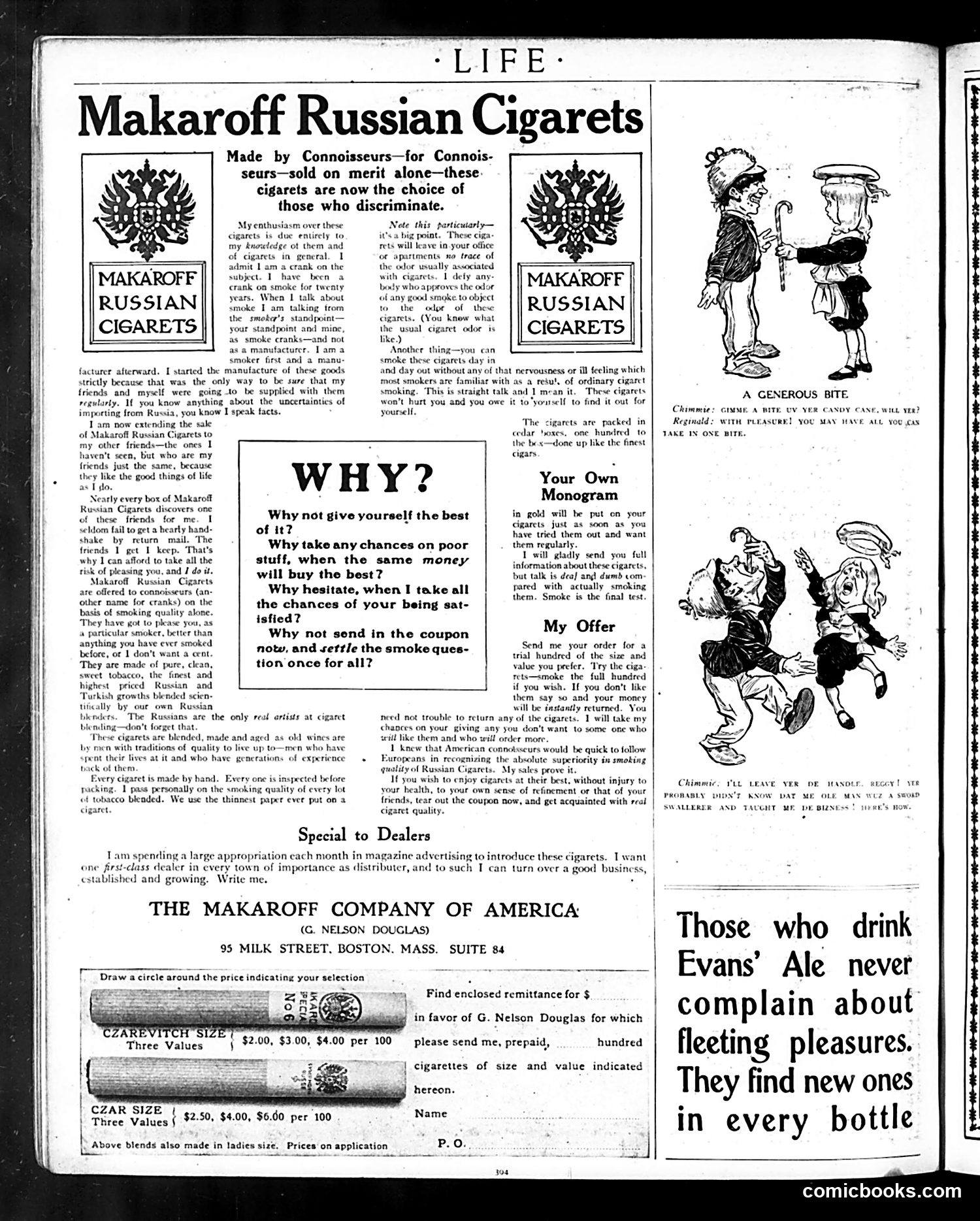
This is primarily a **cigarette advertisement** for Makaroff Russian Cigarets, not political satire. The small cartoons on the right ("A Generous Bite" and another untitled sketch) are humorous illustrations unrelated to the main ad's message. The advertisement's pitch emphasizes: - **Quality/connoisseurship**: Cigarets sold on "merit alone" to "those who discriminate" - **No lingering odor**: A major selling point—these won't leave smell in rooms or clothes - **Health claims**: Won't cause "nervousness or ill feeling" unlike ordinary cigarets - **Money-back guarantee**: Smoke the full hundred; if unsatisfied, keep them anyway The long testimonial from what appears to be the manufacturer positions him as a fellow "smoke crank" who manufactures these purely to satisfy his own exacting standards, not for profit. This was typical early-20th-century marketing: positioning products as premium goods for discriminating consumers. The cartoons are generic visual humor, likely just filling space on the advertisement page.
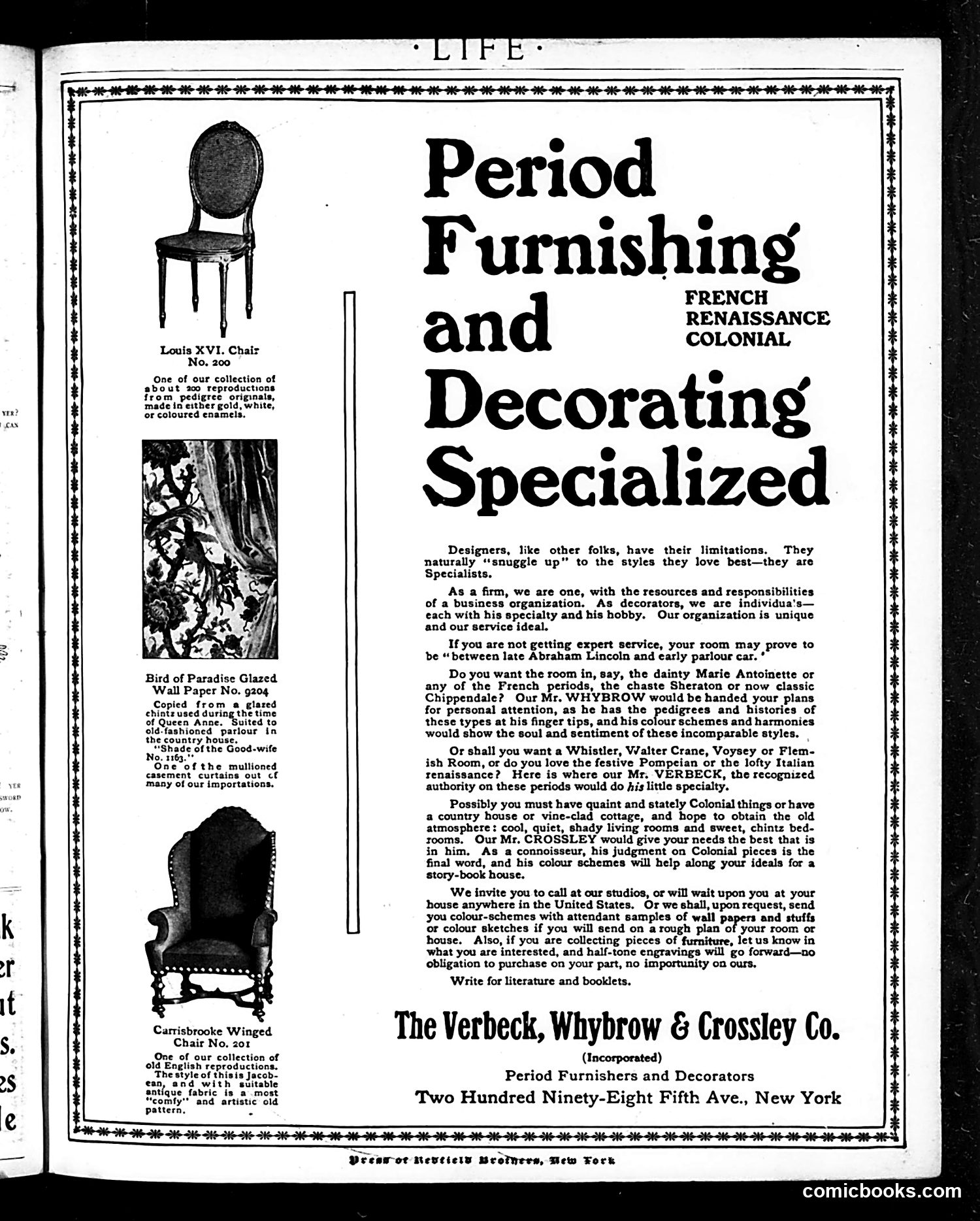
This is **not a cartoon or satire page**—it's a full-page advertisement for The Verbeck, Whybrow & Crossley Co., a high-end interior decorating firm in New York. The page showcases period furniture reproductions (Louis XVI chairs, Colonial pieces, etc.) and pitches specialized decorating services. The company claims each designer specializes in specific historical styles: Mr. Whybrow handles French periods and Chippendale, Mr. Verbeck covers Italian Renaissance and Pompeian, and Mr. Crossley specializes in Colonial design. The only hint of humor appears in the opening copy: a sardonic joke that poorly decorated rooms end up "between late Abraham Lincoln and early parlour car"—suggesting mismatched, unsophisticated design that blends incompatible eras. The advertisement uses this as a sales pitch: hire specialists to avoid such aesthetic disasters. This reflects early 20th-century marketing to wealthy clients seeking historically authentic, professionally curated interiors.
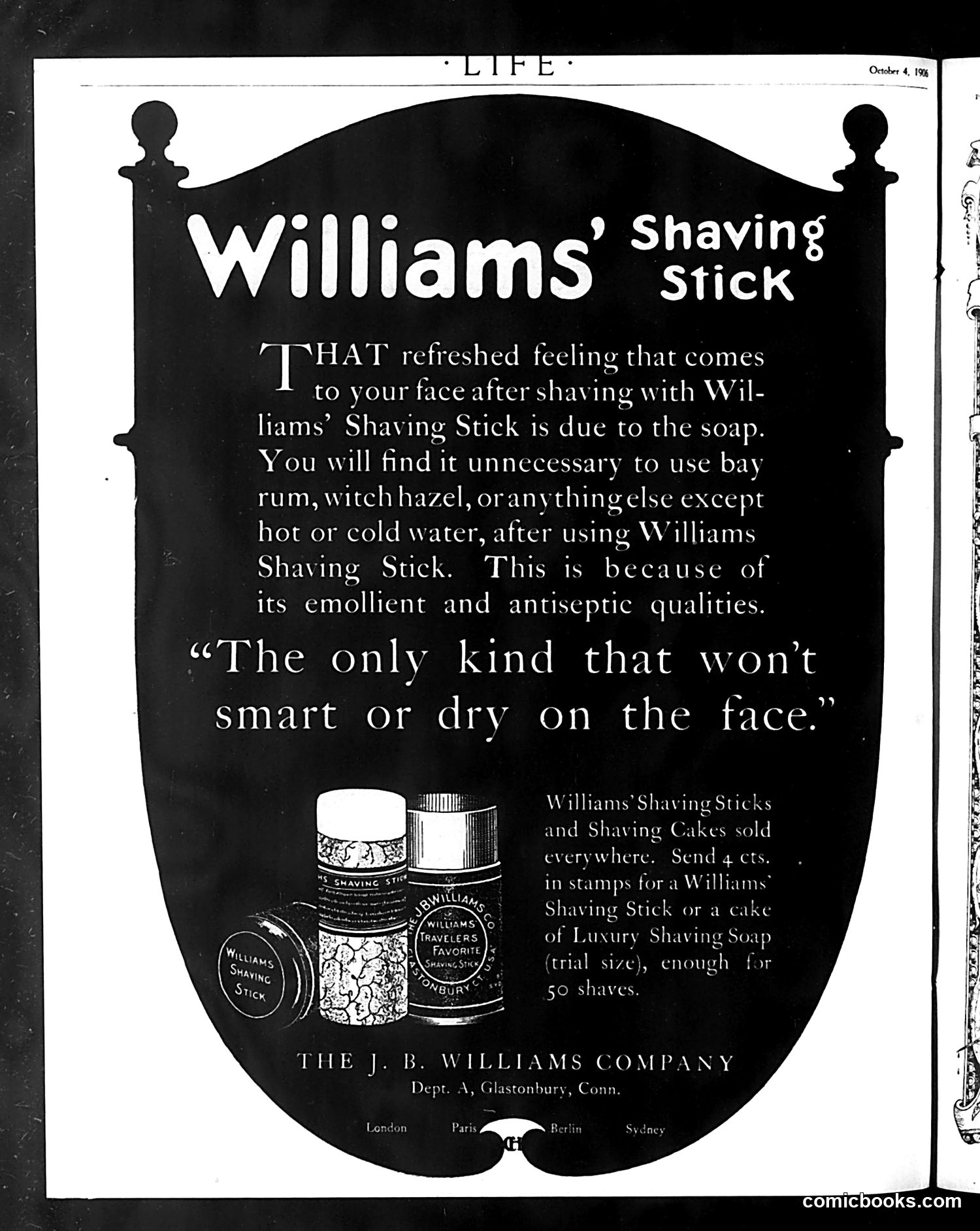
This is a **full-page advertisement**, not satire or political content. It promotes Williams' Shaving Stick, a grooming product from The J.B. Williams Company (based in Glastonbury, Connecticut). The ad makes product claims typical of early 20th-century marketing: the soap provides a "refreshed feeling" and contains "emollient and antiseptic qualities," eliminating the need for aftershave products like bay rum or witch hazel. The headline boasts it's "the only kind that won't smart or dry on the face." The layout features a large shield-shaped design with finial posts (decorative elements suggesting quality), and shows product images at the bottom. A call-to-action offers readers a trial-size shaving stick for 4 cents in stamps. The company had international distribution (London, Paris, Berlin, Sydney listed). This represents standard commercial advertising from Life magazine's era, not editorial content or satire.