
Life, 1906-10-04 · page 18 of 44
Life — October 4, 1906 — page 18: what you’re looking at
What you’re looking at
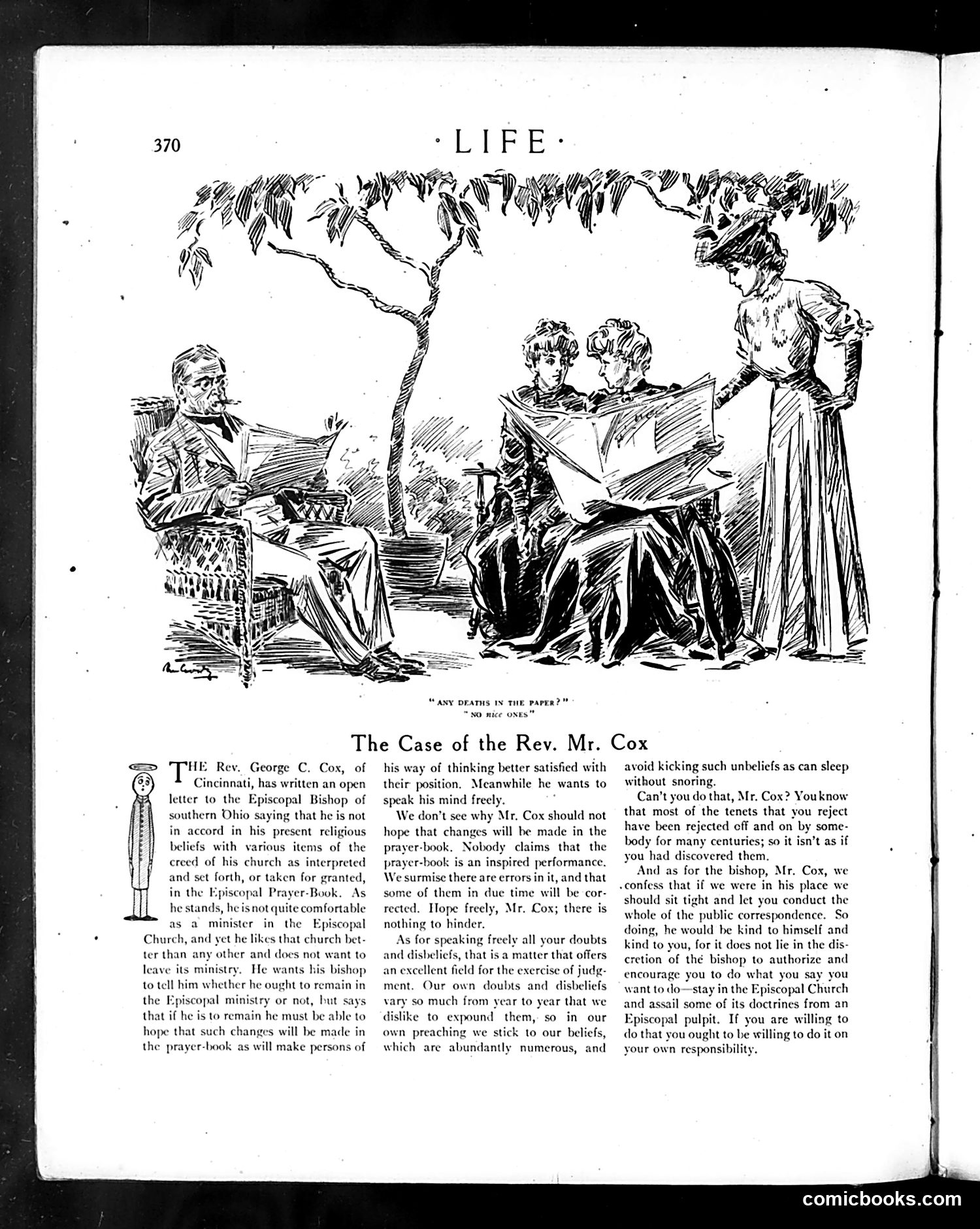
This is not a cartoon but an editorial commentary on a genuine religious controversy. Rev. George C. Cox of Cincinnati publicly challenged his Episcopal bishop, stating he disagreed with various church doctrines yet wished to remain a minister while speaking freely about his doubts. Life's satirical position: Cox should be free to *hope* for theological changes and to *think* privately as he wishes, but should not publicly preach heresies from an Episcopal pulpit while expecting the church's authorization. The editorial mocks Cox's apparent desire to have it both ways—remaining credentialed by the church while publicly assailing its doctrine. The illustration depicts a casual social gathering where presumably Cox and the bishop (or their representatives) discuss these matters under a tree, embodying the "civilized debate" the magazine sarcastically suggests should occur privately, not through public correspondence and pulpit preaching.
📄 Transcribed text from this page (OCR, searchable)
Machine-transcribed from the original scan — historical spelling and the odd misread are preserved.
“ANY DRATHS IN THE PAPER?" * NO mice ONES” The Case of the Rev. Mr. Cox => HE Rev. George C. Cox, of Cincinnati, has written an open letter to the scopal Bishop of southern Ohio saying that he is not in accord in his present religious beliefs with various items of the creed of his church as interpreted and set aken for granted, in the Episcopal Prayer-Book. As. he stands omfortable as a minister in the Episcopal Church, and yet he likes that church bet- ter than any other and does not want to leave its ministry. He wants his bishop to tell him whether he ought to remain in the Episcopal ministry or not, but says. that if he is to remain he must be able to hope that such changes will be made in the prayer-book as will make persons of , heisnot quit his way of thinking better satisfied with their position, Meanwhile he wants to speak his mind freely. . We don’t see why Mr, Cox should not hope that changes will be made in the prayer-book. Nobody claims that the book is an inspired performance. We surmise there are errors in it, and that some of them in due time will be cor- rected. Hope freely, Mr. Cox; there is nothing to hinder, As for speaking freely all your doubts and disbeliefs, that is a matter that offers an excellent field for the exercise of judg- ment. Our own doubts and disbeliefs vary so much from year to year that we dislike to expound them, so in our own preaching we stick to our beliefs, which are abundantly numerous, and avoid kicking such unbeliefs as can sleep without snoring. Can’t you do that, Mr, Cox? Youknow that most of the tenets that you reje have been rejected eff and on by some- body for many centuries; so it isn’t as if you had discovered them. And as for the bishop, Mr. Cox, we -confess that if we were in his place we should sit tight and let you conduct the whole of the public correspondence. So doing, he would be kind to himself and kind to you, for it does not lie in the dis- cretion of thé bishop to authorize and encourage you to do what you say you want to do—stay in the copal Church and assail some of its doctrines from an Episcopal pulpit. If you are willing to do that you ought to be willing to do it on your own responsibility. comicbooks.com