
Life, 1906-10-04 · page 36 of 44
Life — October 4, 1906 — page 36: what you’re looking at
What you’re looking at
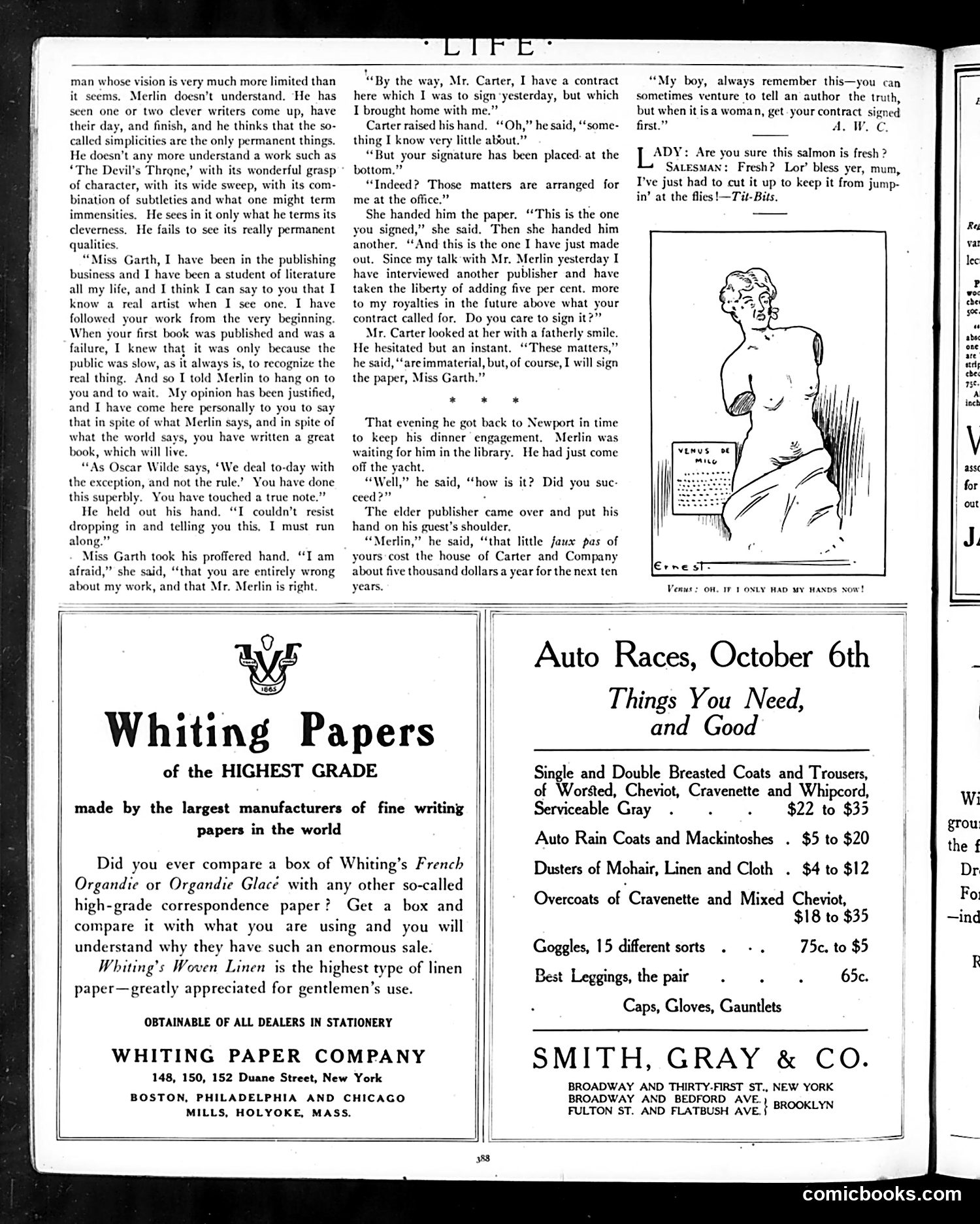
This page contains a serialized story about publishing and gender dynamics, alongside period advertisements. **The Main Story/Cartoon:** The narrative depicts an interaction between a female author (Miss Garth), two male publishers (Merlin and Carter), and illustrates a pointed lesson about business dealings with women. Carter praises Garth's literary work effusively but carelessly signs a contract modification that costs his company $5,000 annually for ten years—increasing her royalties by 5%. The punchline, delivered by Carter to Merlin, warns that while one may "venture to tell an author the truth," with a woman author you must "get your contract signed first"—implying women are shrewder negotiators or less trustworthy in business. **The Satire:** This reflects early 20th-century sexism: women writers are simultaneously underestimated artistically (Merlin dismisses her work) yet feared as cunning businesspeople. The cartoon mocks male publishers' contradictory attitudes toward female authors. **The Small Illustration:** Shows a woman with "Venus de Milo" caption—likely a humorous aside unrelated to the main story. **Advertisements:** Standard period product promotions (stationery, auto racing apparel).
📄 Transcribed text from this page (OCR, searchable)
Machine-transcribed from the original scan — historical spelling and the odd misread are preserved.
man whose vision is very much more limited than it seems. Merlin doesn’t understand. He has seen one or two clever writers come up, have their day, and finish, and he thinks that the sé called simplicities are the only permanent things. He doesn’t any more understand a work such as ‘The Devil's Thrgne,’ with its wonderful grasp of character, with its wide sweep, with its com- bination of subtleties and what one might term immensities. He sees in it only what he terms its cleverness. He fails to see its really permanent qualities. “Miss Garth, I have been in the publishing business and I have been a student of literature all my life, and I think I can say to you that I know a real artist when I see one. I have followed your work from the very beginning. When your first book was published and was a failure, I knew that it was only because the public was slow, as it always is, to recognize the real thing. And so I told Merlin to hang on to you and to wait. My opinion has been justified, and I have come here personally to you to say that in spite of what Merlin says, and in spite of what the world says, you have written a great book, which will “As Oscar Wilde says, ‘We deal to-day with the exception, and not the rule.’ You have done this superbly. You have touched a true note.” He held out his hand. “I couldn’t resist dropping in and telling you this, I must run along.” Miss Garth took his proffered hand. “I am afraid,” she said, “that you are entirely wrong about my work, and that Mr. Merlin is right. “By the way, Mr. Carter, I have a contract here which I was to sign yesterday, but which I brought home with me.” Carter raised his hand. ‘Oh,’ he said, ‘‘some- thing I know very little about.” “But your signature has been placed: at the bottom.” “Indeed? Those matters are arranged for me at the office.” She handed him the paper. “This is the one you signed,” she said. Then she handed him another, ‘And this is the one I have just made out. Since my talk with Mr. Merlin yesterday I have interviewed another publisher and have taken the liberty of adding five per cent. more to my royalties in the future above what y: contract called for. Do you care to sign it Mr. Carter looked at her with a fatherly smile. He hesitated but an instant. “These matters, he said, ‘are immaterial, but, of course, I will si the paper, Miss Garth.” * * & That evening he got back to Newport in time to keep his dinner engagement. Merlin was waiting for him in the library. He had just come off the yacht. “Well,” he said, “how is it? Did you suc- ceed?” : The elder publisher came over and put his hand on his guest’s shoulder. “Merlin,” he said, “that little faux pas of yours cost the house of Carter and Company about five thousand dollars a year for the next ten years. “My boy, always remember this—you can sometimes venture to tell an author the truth, but when it isa woman, get your contract signe first.” AW. C. N: Fresh? Lor’ bless yer, mum, I’ve just had to cut it up to keep it from jump- in’ at the flies!—Tit-Bits. Auto Races, October 6th Things You Need, and Good Whiting Papers of the HIGHEST GRADE made by the largest manufacturers of fine writing papers in the world Did you ever compare a box of Whiting’s French Organdie or Organdie Glacé with any other so-called high-grade correspondence paper? Get a box and compare it with what you are using and you will understand why they have such an enormous sale. Whiting’s Woven Linen is the highest type of linen paper—greatly appreciated for gentlemen’s use. OBTAINABLE OF ALL DEALERS IN STATIONERY WHITING PAPER COMPANY 148, 150, 152 Duane Street, New York BOSTON, PHILADELPHIA AND CHICAGO MILLS, HOLYOKE, MASS. Single and Double Breasted Coats and Trousers, of Worsted, Cheviot, Cravenette and Whipcord, Serviceable Gray . : . $22 to $35 Auto Rain Coats and Mackintoshes . $5 to $20 Dusters of Mohair, Linen and Cloth . $4 to $12 Overcoats of Cravenette and Mixed Cheviot, $18 to $35 75c, to $5 65c. Goggles, 15 different sorts . -. Best Leggings, the pair 6. Caps, Gloves, Gauntlets SMITH, GRAY & CO. BROADWAY AND THIRTY-FIRST ST., NEW YORK BROADWAY AND BEDFORD AVE. FULTON ST. AND FLATBUSH vet BROOKLYN comicbooks.com