
Life, 1906-10-04 · page 26 of 44
Life — October 4, 1906 — page 26: what you’re looking at
What you’re looking at
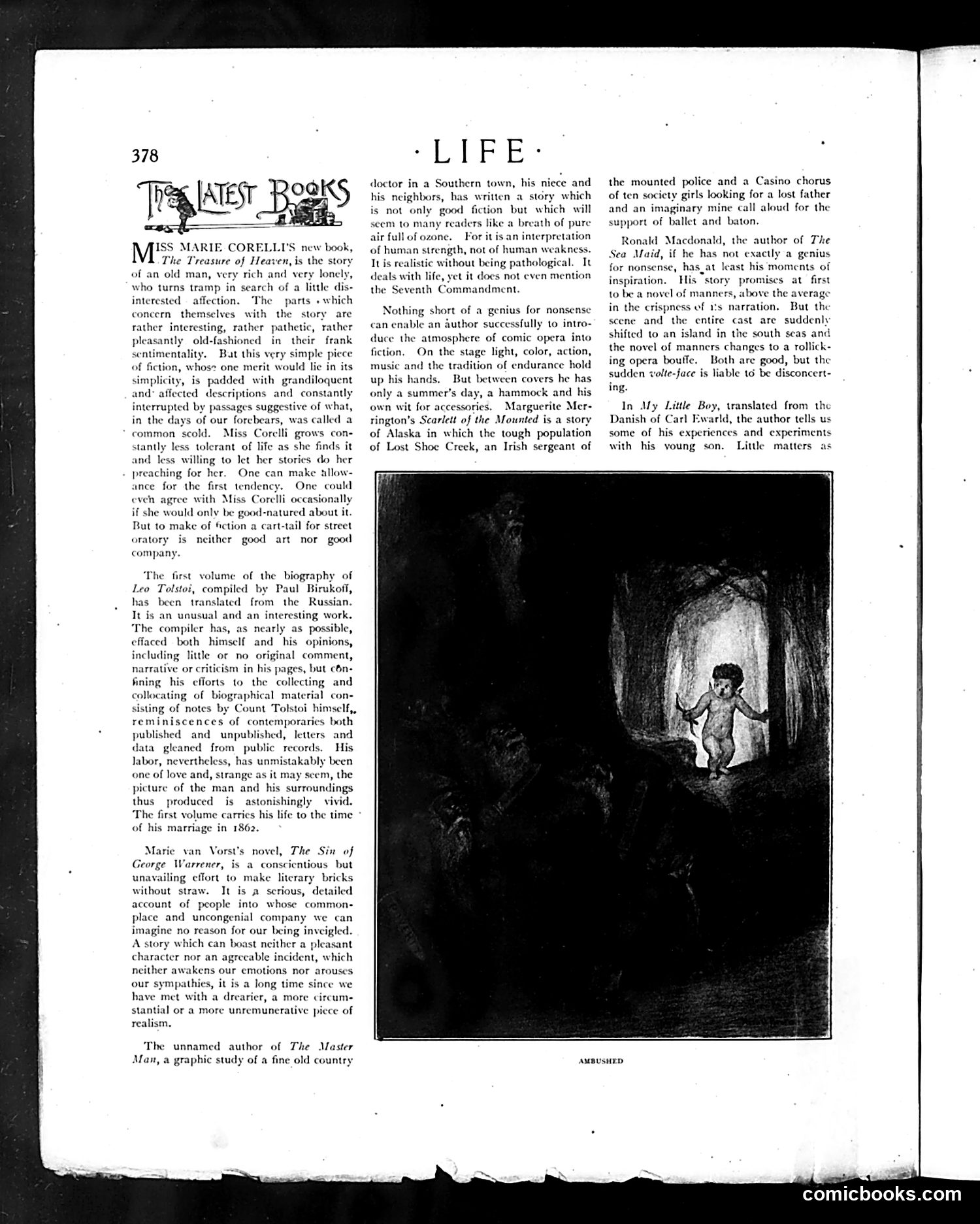
This page contains book reviews from *Life* magazine's "Latest Books" section. The reviews are critical assessments of contemporary fiction, including works by Marie Corelli, a biography of Leo Tolstoy, and novels by Marie van Vorst and others. The accompanying illustration (captioned "AMBUSHED") appears to depict a scene from one of the reviewed works—likely showing a dramatic moment of surprise or danger, typical of the adventure or romantic fiction being discussed. The reviews themselves are satirical in tone, particularly toward Corelli, whom the critic accuses of using her fiction as a vehicle for preaching rather than telling stories naturally. The reviewer also dismisses van Vorst's novel as dreary and unrealistic, while praising "The Master Man" for depicting human strength rather than weakness. The satire targets both overly sentimental Victorian fiction and pretentious literary realism of the era.
📄 Transcribed text from this page (OCR, searchable)
Machine-transcribed from the original scan — historical spelling and the odd misread are preserved.
ISS MARIE CORELLI'S new book, The Treasure of Heaven, is the story an old man, very rich and very lonely, who turns tramp in search of a little dis- interested affection. The parts « which concern themselves with the rather interesting, rather pathetic, rather pleasantly old-fashioned in their frank sentimentality. But this very simple piece of fiction, whos? one merit would | simplicity, is padded with grandiloquent and: affected descriptions and_ constantly interrupted by passages suggestive of what, in the days of our forebears, was called a Miss Corelli grows con- stantly less tolerant of life as she finds it and less willing to let her storics do her preaching for her. One can make nilow- ance for the first tendency. One could eveh agree with Miss Corelli occasionally if she would onlv be good-natured about it But to make of Action a cart-tail for street oratory is neither good art nor good company story are in its common scold. ‘The first volume of the biography of Leo Tolstoi, compiled by Paul Birukofl, has from the Russian. It is an unusual and an interesting work. ‘The compiler has, as nearly as possible, cfiaced both himself and his opinions, including little or no original comment, narrative or criticism in his pages, but con- fining his efforts to the collecting and collocating of biographical material con- sisting of notes by Count Tolstoi himself, reminiscences of contemporaries both published and unpublished, letters and data gleaned from public labor, nevertheless, has unmistakably been one of love and, strange as it may scem, the picture of the man and his surroundings thus produced is astonishingly vivid. The first volume carries his life to the time of his marriage in 1862. been translated records. His Marie van Vorst’s novel, The Sin of George Warrener, is a conscientious but unavailing effort to make literary bricks without straw. It is a serious, detailed account of people into whose common- place and uncongenial company we can imagine no reason for our being inveigled. A story which can boast neither a pleasant character nor an agrecable incident, which neither awakens our emotions nor arouses our sympathies, it is a long time since we have met with a drearier, a more circum- stantial or a more unremunerative piece of realism. ‘The unnamed author of The Master Man, a graphic study of a fine old country -LIFE: doctor in a Southern town, his niece and his neighbors, has written a story which is not only good fiction but which will seem to many readers like a breath of pure air full of ozone. For it isan interpretation of human strength, not of human weakness. It is realistic without being pathological. Tt deals with life, yet it docs not even mention the Seventh Commandment. Nothing short of a genius for nonsense can enable an author successfully to intro- duce the atmosphere of comic opera into fiction, On the stage light, color, action, music and the tradition of endurance hold up his hands. But between covers he has only a summer’s day, a hammock and his own wit for accessories. Marguerite Mer- rington's Scarlett of the Mounted is a story of Alaska in which the tough population of Lost Shoe Creek, an Irish sergeant of the mounted police and a Casino chorus of ten society girls looking for a lost father and an imaginary mine call aloud for the support of ballet and baton. Ronald Macdonald, the author of The Sea Maid, if he has not exactly a genius for nonsense, has_at least his moments of inspiration. His “story promises at first to be a novel of manners, above the average in the crispness of 11s narration, But the scene and the entire cast are suddenly shifted to an island in the south seas and the novel of manners changes to a rollick- ing opera boutfe. Both are good, but the sudden volte-face is liable to be disconcert- ing. In My Little Boy, translated from the Danish of Carl Ewarld, the author tells us some of his experiences and experiments with his young son. Little matters comicbooks.com