
Life, 1906-10-04 · page 14 of 44
Life — October 4, 1906 — page 14: what you’re looking at
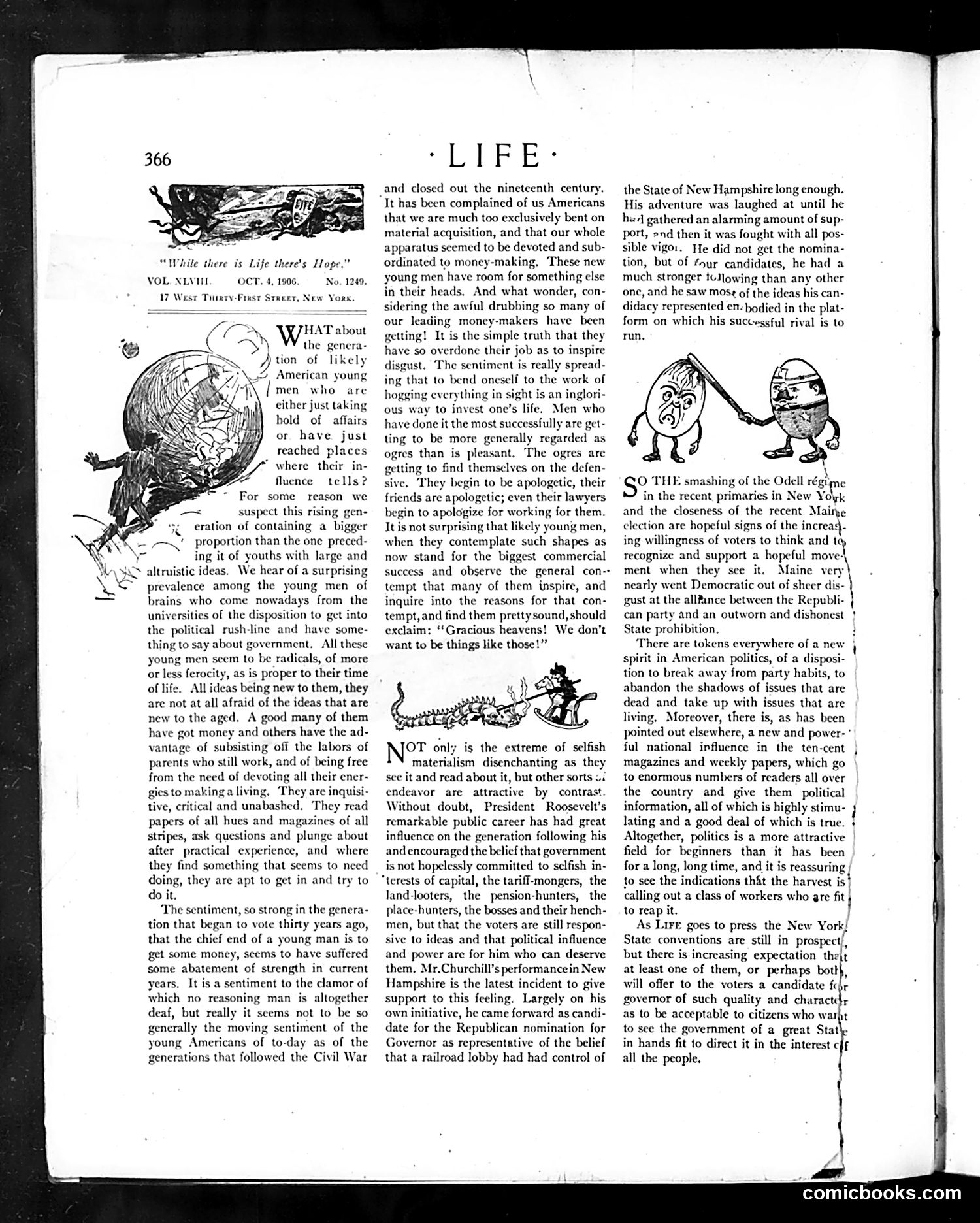
What you’re looking at
This editorial page celebrates a new generation of young American men entering politics and business with idealistic, reform-minded values—a striking departure from their predecessors' single-minded pursuit of wealth. The cartoons depict caricatured figures representing old-guard materialism being challenged or displaced. The text praises young men from universities who question whether accumulating money is life's primary purpose, noting that prominent industrialists ("ogres") have become objects of contempt rather than admiration through their ruthless business practices. The piece credits President Theodore Roosevelt's public career with demonstrating that government can serve public interest rather than merely serving wealthy capitalists, tariff-makers, and political bosses. The author argues this has inspired younger voters to believe political influence and power should serve broader social good—a marked shift from the post-Civil War generation's materialism. The satire implicitly mocks the old robber-baron ethos while celebrating emerging Progressive Era idealism.
📄 Transcribed text from this page (OCR, searchable)
Machine-transcribed from the original scan — historical spelling and the odd misread are preserved.
~ a \ NY We WS “While there is Life there’s Hope.” VOL. XLVUL OCT. 4, 1906. No. 1249. st Tiuery-Fiest Street, New York. a WiATabout FEIN WA tion of likely 4 American young men who either just taking hold of affairs or have just reached places * where their in- fluence tells? For some reason we suspect this rising gen- eration of containing a bigger * proportion than the one preced- ing it of youths with large and altruistic ideas. We hear of a surprising are prevalence among the young men of brains who come nowadays from the universities of the disposition to get into the political rush-line and have some- thing to say about government. All these young men seem to be radicals, of more or less ferocity, as is proper to their time of life. All ideas being new to them, they are not at all afraid of the ideas that are new to the aged. A good many of them have got moncy and others have the ad- vantage of subsisting off the labors of parents who still work, and of being free from the need of devoting all their ener- akinga living, ‘They are inquisi- tive, critical and unabashed. They read papers of all hues and magazines of all stripes, ask questions and plunge about after practical experience, and where they find something that seems to need doing, they are apt to get in and try to do it. The sentiment, so strong in the genera- tion that began to vote thirty years ago, that the chief end of a young man is to get some money, scems to have suffered some abatement of strength in current years. It is a sentiment to the clamor of which no reasoning man is altogether deaf, but really it seems not to be so generally the moving sentiment of the young Americans of to-day as of the generations that followed the Civil War -LIFE- and closed out the nineteenth century. “It has been complained of us Americans that we are much too exclusively bent on material acquisition, and that our whole apparatus seemed to be devoted and sub- ordinated to money-making. These new young men have room for something else in their heads. And what wonder, con- sidering the awful drubbing so many of our leading money-makers have been getting! It is the simple truth that they have so overdone their job as to inspire disgust. The sentiment is really spread- ing that to bend oneself to the work of hogging everything in sight is an inglori- ous way to invest one’s life. Men who have donc it the most successfully are get- ting to be more generally regarded as ogres than is pleasant. The ogres are getting to find themselves on the defen- sive. They begin to be apologetic, their friends are apologetic; even their lawyers begin to apologize for working for them. It is not surprising that likely young men, when they contemplate such shapes as now stand for the biggest commercial success and observe the general con-- tempt that many of them inspire, and inquire into the reasons for that con- tempt, and find them pretty sound, should exclaim: ‘‘Gracious heavens! We don’t want to be things like those!” OT only is the extreme of selfish materialism disenchanting as they and read about it, but other sorts oi endeavor are attractive by contrast Without doubt, President Roosevelt's remarkable public career has had great influence on the generation following his andencouraged the belief that government is not hopelessly committed to selfish in- “terests of capital, the tariff-mongers, the land-looters, the pension-hunters, the place-hunters, the bosses and their hench- men, but that the voters are still respon- sive to ideas and that political influence and power are for him who can deserve them. Mr.Churchill’s performancein New Hampshire is the latest incident to give support to this feeling. Largely on his own initiative, he came forward as candi- date for the Republican nomination for Governor as representative of the belief that a railroad lobby had had control of the State of New Hampshire long enough. His adventure was laughed at until he hed gathered an alarming amount of sup- port, ond then it was fought with all pos- sible vigor. He did not get the nomina- tion, but of four candidates, he had a much stronger towing than any other one, and he saw mose of the ideas his can- didacy represented en. bodied in the plat- form on which his successful rival is to run. O THE smashing of the Odell regi G in the recent, primaries in New Yoyk and the closeness of the recent Maine clection are hopeful signs of the increag. ing willingness of voters to think and ty recognize and support a hopeful move ment when they sce it. Maine vei nearly went Democratic out of sheer di gust at the allfince between the Republi- { can party and an outworn and dishonest } State prohibition, H here are tokens everywhere of a new j spirit in American politics, of a disposi- tion to break away from party habits, to abandon the shadows of issues that are dead and take up with issues that are living. Moreover, there is, as has been pointed out elsewhere, a new and power-* ful national influence in the ten-cent magazines and weekly papers, which go to enormous numbers of readers all over the country and give them political information, all of which is highly stimu- lating and a good deal of which is true. ¢ Altogether, politics is a more attractive field for beginners than it has been for a long, long time, and it is reassuring to sce the indications th&t the harvest is! calling out a class of workers who gre fity to reap it. ] As Lire goes to press the New York/ State conventions are still in prospect/, but there is increasing expectation thejt at least one of them, or perhaps botth, will offer to the voters a candidate for governor of such quality and charactdy as to be acceptable to citizens who warht to see the government of a great Stat in hands fit to direct it in the interest ff all the people. { m co icbooks.com