
Life, 1906-10-04 · page 25 of 44
Life — October 4, 1906 — page 25: what you’re looking at
What you’re looking at
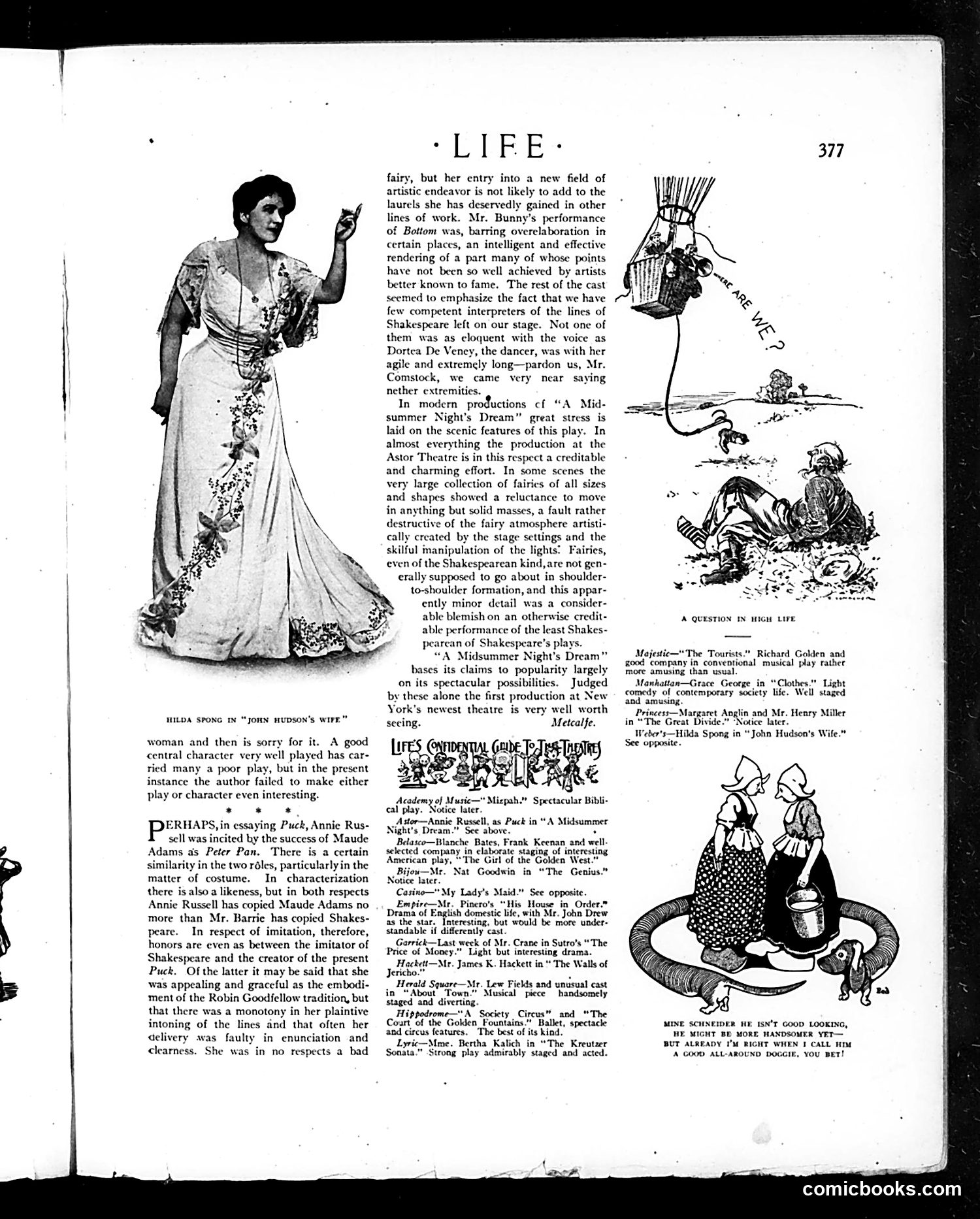
This page reviews theatrical productions, particularly focusing on Shakespeare adaptations on New York stages. The main critique concerns a production of "A Midsummer Night's Dream" at the Astor Theatre, starring actress Annie Russell as Puck. The reviewer (Metcalfe) praises the production's spectacular scenic design and lighting but criticizes a significant staging flaw: the fairies move in "solid masses" rather than individually, undermining the ethereal atmosphere Shakespeare requires. The critic notes this "apparently minor detail" damages an otherwise creditable performance. The page also reviews "John Hudson's Wife" (with Hilda Spong, pictured) and discusses Annie Russell's performance, comparing her favorably to Maude Adams in "Peter Pan" without implying imitation. The cartoons on the right mock theatrical conventions and audience behavior—one shows a critic evaluating a performance; another depicts a character's physical appearance becoming a distraction (likely referencing the reviewer's veiled comment about dancers' legs).
📄 Transcribed text from this page (OCR, searchable)
Machine-transcribed from the original scan — historical spelling and the odd misread are preserved.
HILDA SPONG IN “JOHN HUDSON'S WITT” woman and then is sorry for it. A good central character very well played has car- ried many a poor play, but in the present instance the author failed to make either play or character even interesting. s 8 8 ERHAPS, in essaying Puck, Annie Rus- sell was incited by the success of Maude Adams as Peter Pan. There is a certain similarity in the two réles, particularly in the matter of costume. In characterization there is also a likeness, but in both respects Annie Russell has copied Maude Adams no more than Mr. Barrie has copied Shakes- peare. In respect of imitation, therefore, honors are even as between the imitator of Shakespeare and the creator of the present Puck. Of the latter it may be said that she was appealing and graceful as the embodi- ment of the Robin Goodfellow tradition, but that there was a monotony in her plaintive intoning of the lines and that often her deliver, in enunciation and clearne s in no respects a bad fairy, but her entry into a new field of artistic endeavor is not likely to add to the laurels she has deservedly gained in other lines of work. Mr. Bunny's performance of Bottom was, barring overclaboration in certain places, an intelligent and effective rendering of a part many of whose points have not been so well achieved by artists better known to fame, The rest of the cast seemed to emphasize the fact that we have few competent interpreters of the lines of Shakespeare left on our stage. Not one of them was as cloquent with the voice as Dortca De Veney, the dancer, was with her agile and extremely long—pardon us, Mr. Comstock, we came very near saying nether extremities. In modern prouctions cf “A Mid- summer Night’s Dream” great stress laid on the scenic features of this play. In almost everything the production at the Astor Theatre is in this respect a creditable and charming effort. In some scenes the very large collection of fairies of all sizes and shapes showed a reluctance to move in anything but solid masses, a fault rather destructive of the fairy atmosphere artisti- cally created by the stage settings and the skilful manipulation of the lights! Fairies, even of the Shakespearean kind, are not gen- erally supposed to go about in shoulder- to-shoulder formation, and this appar- ently minor detail was a consider- able blemish on an otherwise credit- able performance of the least Shakes- pearcan of Shakespeare's plays. Midsummer Night’s Dream” bases its claims to popularity largely on its spectacular possibilities. Judged by these alone the first production at New York's newest theatre is very well worth seeing. Metcalfe. Tt Academy of Music: cal play. Notice later. Astor—Annie Russell, as Puck in “A Midsummer Night's Dream.” See above. . Belasco—Blanche Bates, Frank Keenan and well- selected company in elaborate staging of interesting American play, “The Girl of the Golden We: Bijow—Mr. Nat Goodwin in “The Genius.” Notice lat Casino—" My Lady’s Maid.” See opposite. Empire—Mr. Pinero's “His House in Order." Drama of English domestic life, with Mr. John Drew as the star. Interesting, but would be more under- standable if differently cast Garrich—Last week of Mr. Crane in Sutro’s "The Price of Money.” Light but interesting drama. Mr. James K. Hackett in“ The Walls of liepah.” Spectacular Bibli- Lew Fields and unusual cast Herald Square— Musical piece handsomely in “About Town. staged and diverting. Hippodrome—"'A Society Circus" and “The Court of the Golden Fountains.” Ballet, spectacle and circus features. The best of its kind. Lyric—Mme. Bertha Kalich in “The Kreutzer Sonata.” Strong play admirably staged and acted. A QUESTION IN IGM LIFE Majestic—" The Tourists.” Richard Golden and good company in conventional musical play rather more amusing than usual. Manhatan—Grace George in “Clothes.” Light comedy of contemporary society life. Well staged and amusing. Princess—Margaret Anglin and Mr. Henry Miller in “The Great Divide.” "Notice later. IWeter's—Hilda Spong in “John Hudson's Wife.” See opposite. MINE SCUNEIDER HE ISN'T GOOD LOOKING, NE MIGHT BE MORE HANDSOMER YET— BUT ALREADY I’M RIGHT WHEN 1 CALL Hn ‘A COOD ALL-AROUND DOGGIE, You BET!