
Life, 1906-10-04 · page 24 of 44
Life — October 4, 1906 — page 24: what you’re looking at
What you’re looking at
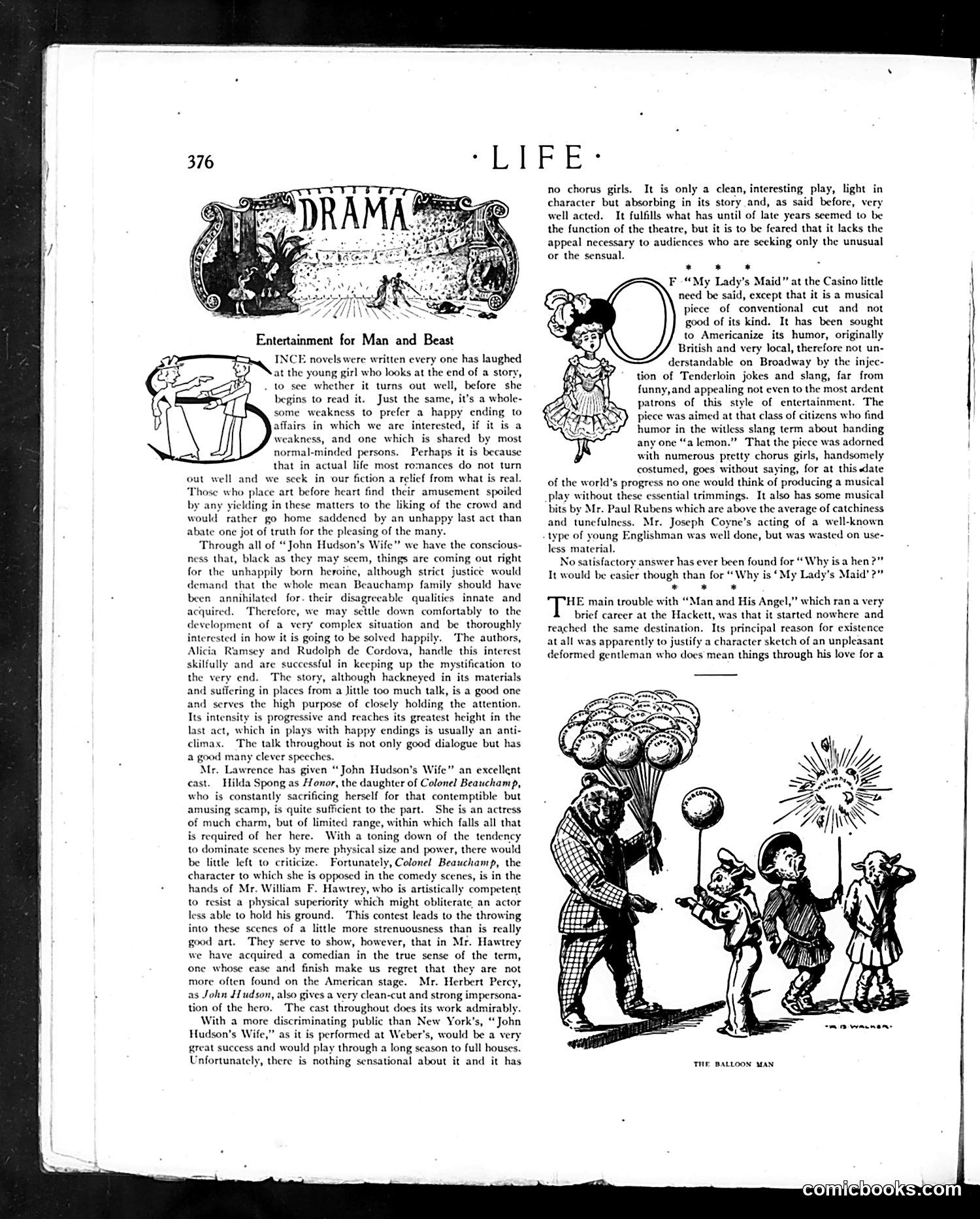
This page contains a theater review of "John Hudson's Wife," a play at Weber's theater starring actors including Hilda Spong and William F. Hawtrey. The accompanying cartoon, "The Balloon Man," appears to illustrate the article's central complaint: audiences prefer sensational entertainment over substantial drama. The review criticizes New York theatergoers for demanding "the unusual or the sensual" rather than appreciating "clean, interesting play[s]" with good acting. The text laments that while the play has merit—strong cast, clever dialogue, and emotional engagement—it lacks "sensational" elements like chorus girls, making it unlikely to draw full houses in New York despite succeeding elsewhere with "more discriminating" audiences. The cartoon's whimsical balloon vendor likely represents the frivolous entertainment audiences actually crave, contrasting with the serious theatrical drama the reviewer advocates for. This reflects turn-of-the-century debates about popular versus "high" art.
📄 Transcribed text from this page (OCR, searchable)
Machine-transcribed from the original scan — historical spelling and the odd misread are preserved.
Entertainment for Man and Beast INCE novels were written every one has laughed at the young girl who looks at the end of a story, . to see whether it turns out well, before she begins to read it. Just the same, it’s a whole- some weakness to prefer a happy ending to affairs in which we are interested, if it is a weakness, and one which is shared by most normal-minded persons. Perhaps it is because that in actual life most romances do not turn out well and we seek in our fiction a f from what is real. ‘Those who place art before heart find their amusement spoiled by any yielding in these matters to the liking of the crowd and would rather go home saddened by an unhappy last act than abate one jot of truth for the pleasing of the many. Through all of “John Hudson's Wife" we have the conscious- ness that, black as they may scem, things are coming out right for the unhappily born heroine, although strict justice would demand that the whole mean Beauchamp family should have been annihilated for. their disagreeable qualities innate and acquired. Therefore, we may settle down comfortably to the opment of a very complex situation and be thoroughly sted in how it is going to be solved happi ‘The authors, Alicia Ramsey and Rudolph de Cordova, handle this interest skilfully and are successful in keeping up the mystification to the very end. The story, although hackneyed in its materials and suffering in places from a Jittle too much talk, is a good one and serves the high purpose of closely holding the attention. Its intensity is progressive and reaches its greatest height in the ct, which in plays with happy endings is usually an anti- ax. The talk throughout is not only good dialogue but has a good many clever speeche Mr. Lawrence has given an excellent cast. Hilda Spong as Honor, the daughter of Colonel Beauchamp, who is constantly sacrificing herself for that contemptible but amusing scamp, is quite sufficient to the part. She is an actress of much charm, but of limited range, within which falls all that is required of her here. With a toning down of the tendency to dominate scenes by mere physical size and power, there would be little left to criticize. Fortunately, Colonel Beauchamp, the character to which she is opposed in the comedy scenes, is in the hands of Mr. William F. Hawtrey, who is artistically competent to resist a physical superiority which might obliterate, an actor less able to hold his ground. ‘This contest leads to the throwing into these scenes of a little more strenuousness than is really good art. They serve to show, however, that in Mr. Hawtrey we have acquired a comedian in the true sense of the term, one whose case and finish make us regret that they are not more often found on the American stage. Mr. Herbert Percy, as John Hudson, also gives a very clean-cut and strong impersona- tion of the hero. The cast throughout does its work admirably. With a more discriminating public than New York's, “John Hudson’s Wife,” as it is performed at Weber's, would be a y great success and would play through a long season to full houses. Unfortunately, there is nothing sensational about it and it has «LIFE no chorus girls. It is only a clean, interesting play, light in character but absorbing in its story and, as said before, well acted. It fulfills what has until of late years seemed to be the function of the theatre, but it is to be feared that it lacks the appeal necessary to audiences who are secking only the unusual or the sensual. * 8 « “My Lady’s Maid” at the Casino little need be said, except that it is a musical piece of conventional cut and not good of its kind. It has been sought to Americanize its humor, originally British and very local, therefore not un- derstandable on Broadway by the injec- tion of Tenderloin jokes and slang, far from funny,and appealing not even to the most ardent patrons of this style of entertainment. The piece was aimed at that class of citizens who find humor in the witless slang term about handing any one “a lemon.” That the piece was adorned with numerous pretty chorus girls, handsomely costumed, goes without saying, for at this date of the world’s progress no one would think of producing a musical play without these essential trimmings. It also has some musical bits by Mr. Paul Rubens which are above the average of catchiness and tunefulness. Mr. Joseph Coyne’s acting of a well-known type of young Englishman was well done, but was wasted on use- less material. No satisfactory answer has ever been found for “Why isa hen ?”” It would be easier though than for “ Why is ‘My Lady's Maid’ ?” * 8 HE main trouble with “Man and His Angel,” which ran a very brief career at the Hackett, was that it started nowhere and reached the same de: ion. Its principal reason for existence at all was apparently to justify a character sketch of an unpleasant deformed gentleman who does mean things through his love for a F THE BALLOON MAN