
Life, 1906-10-04 · page 17 of 44
Life — October 4, 1906 — page 17: what you’re looking at
What you’re looking at
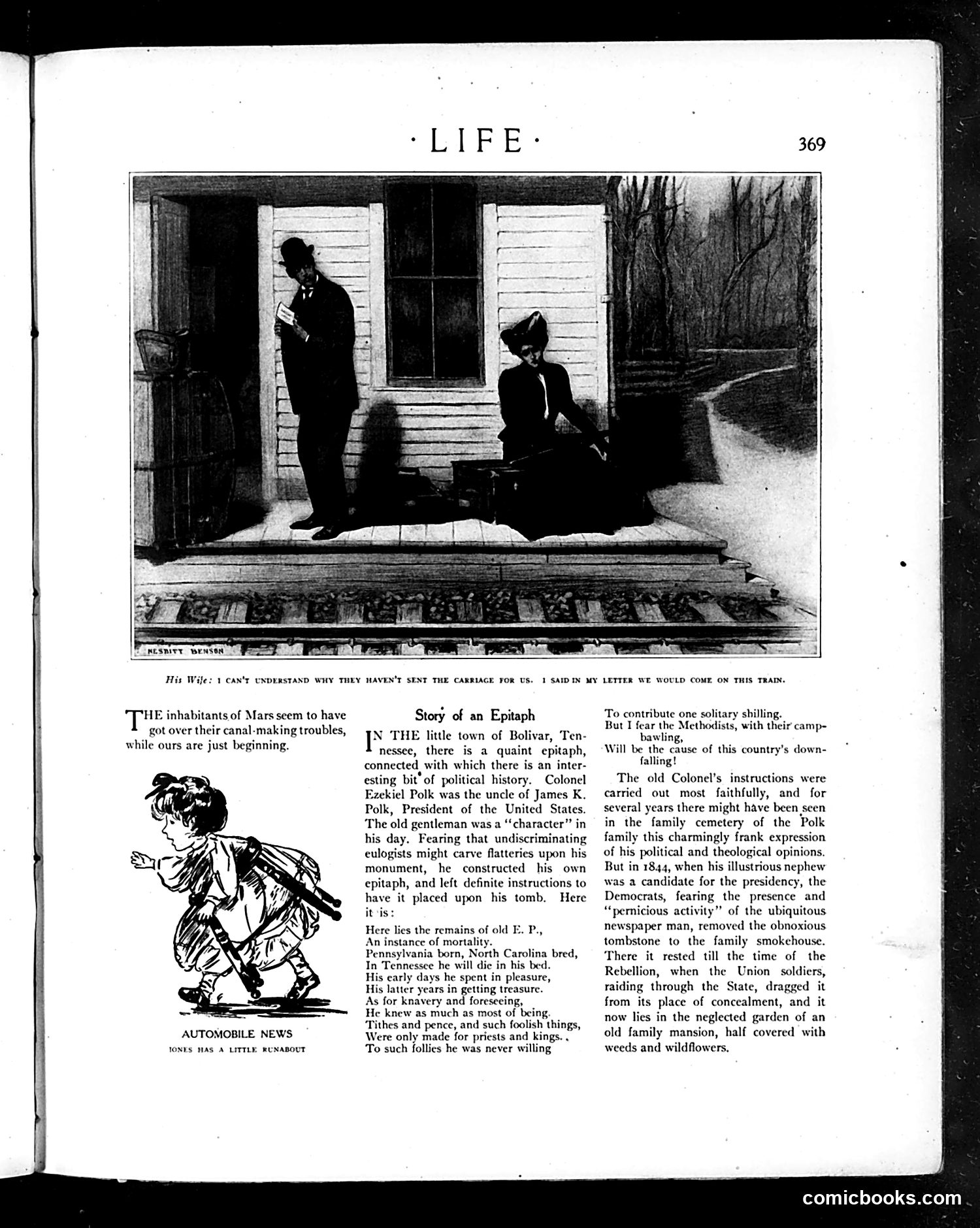
**Top Cartoon**: A domestic scene satirizing the emerging automobile era. A wife complains to her husband about an absent carriage, unaware they're waiting for a motorcar instead. The joke mocks how quickly automobiles were replacing horse-drawn carriages—the wife's outdated expectations humorously reflect society's slow adaptation to new technology. **"Automobile News" Section**: A brief quip suggesting cars are unreliable ("tones has a little runabout"), poking fun at early automobile quality and the fledgling auto industry. **"Story of an Epitaph"**: A humorous historical anecdote about Colonel Ezekiel Polk's self-written tombstone. His epitaph proudly declares his refusal to support religious institutions (Methodists) or pay tithes—blunt political and theological criticism. The story notes that in 1844, when his nephew James K. Polk ran for president, Democrats removed the embarrassing tombstone to a smokehouse, fearing negative press coverage. This satirizes political hypocrisy and image management.
📄 Transcribed text from this page (OCR, searchable)
Machine-transcribed from the original scan — historical spelling and the odd misread are preserved.
His Wife: 1 CAN'T UNDERSTAND WITY THEY HAVEN'T SENT THE CARRIAGE TOR US. 'HE inhabitants of Mars seem to have got over their canal-making troubles, while ours are just beginning. AUTOMOBILE NEWS TONES MAS A LITTLE: RUNABOUT Story of an Epitaph I THE little town of Bolivar, Ten- nessee, there is a quaint epitaph, connected, with which there is an inter- esting bit’ of political history. Colonel Ezekiel Polk was the uncle of James K. Polk, President of the United States. The old gentleman was a ‘“‘character” in his day. Fearing that undiscriminating eulogists might carve flatteries upon his monument, he constructed his own epitaph, and left definite instructions to have it placed upon his tomb. Here it is: Here lies the remains of old E. P., An instance of mortality. Pennsylvania born, North Carolina bred, In Tennessce he will dic in his bed. His early days he spent in pleasure, His latter years in getting treasure. As for knavery and foreseeing, He knew as much as most of being, ‘Tithes and pence, and such foolish things, Were only made for priests and kings. . To such follies he was never willing 1 SAIDIN MY LETTER WE WOULD COME ON THIS TRAIN. To contribute one solitary shilling. But I fear the Methodists, with their camp= bawling, Will be the cause of this country’s down- falling! The old Colonel's instructions were carried out most faithfully, and for several years there might have been seen in the family cemetery of the Polk family this charmingly frank expression of his political and theological opinions. But in 1844, when his illustrious nephew was a candidate for the presidency, the Democrats, fearing the presence and “pemicious activity” of the ubiquitous newspaper man, removed the obnoxious tombstone to the family smokchouse. There it rested till the time of the Rebellion, when the Union soldiers, raiding through the State, dragged it from its place of concealment, and it now lies in the neglected garden of an old family mansion, half covered with weeds and wildflowers, comicbooks.com