
Life, 1906-10-04 · page 29 of 44
Life — October 4, 1906 — page 29: what you’re looking at
What you’re looking at
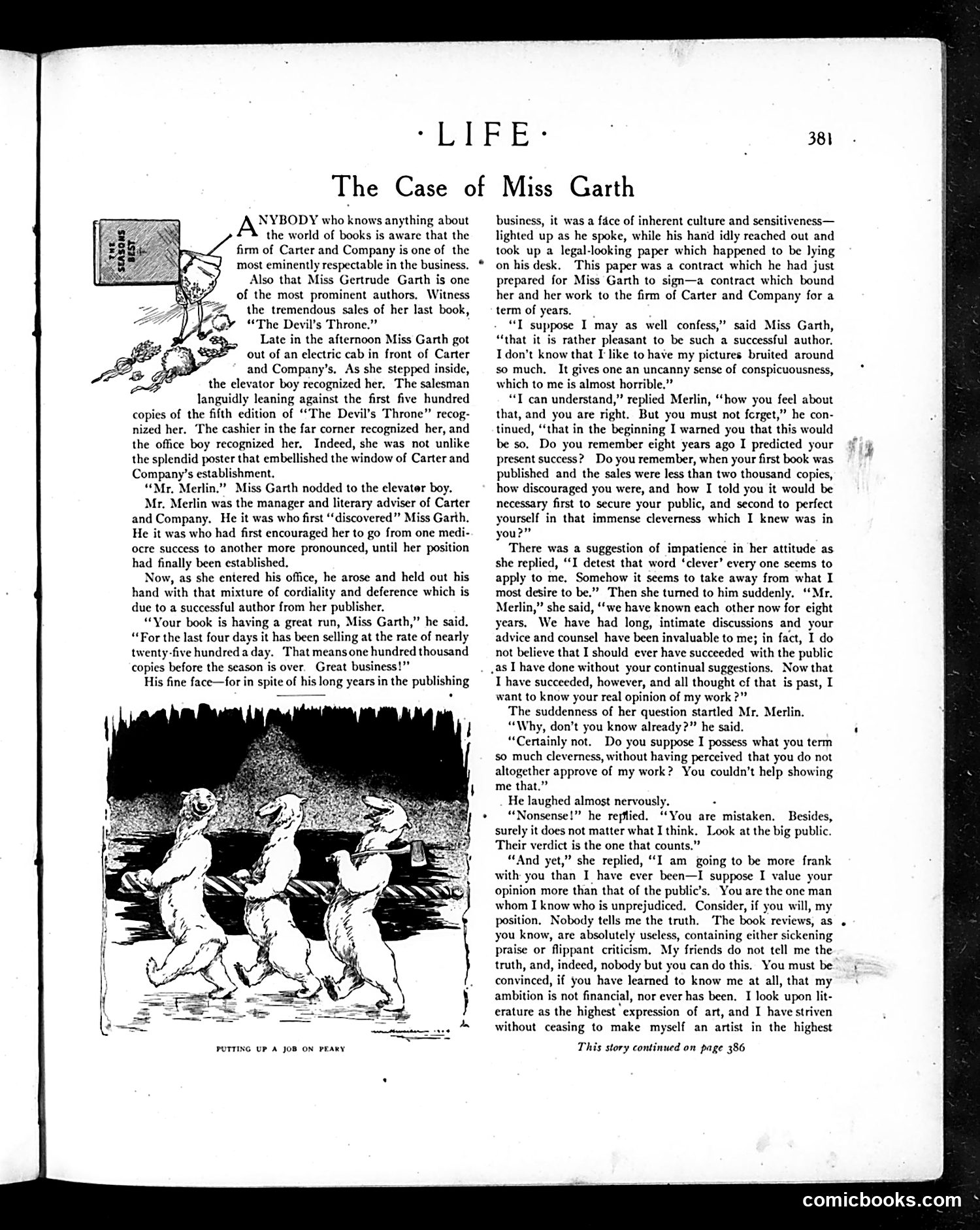
This is the opening of a serialized story (continued on page 386) about a successful female author and her publisher, not a political cartoon. The page contains two illustrations: one showing the publisher's office scene, and another labeled "PUTTING UP A JOB ON PEARY" depicting figures in water—likely an unrelated satirical cartoon about explorer Robert Peary, whose Arctic expeditions were controversial topics in early 20th-century Life magazine. The story itself explores the tension between Miss Garth's literary ambitions and commercial success. Publisher Mr. Merlin subtly manipulates her by taking credit for her success while she seeks honest artistic assessment rather than praise. The satire targets publishing industry dynamics and the gap between public persona and private artistic integrity in the era of mass marketing.
📄 Transcribed text from this page (OCR, searchable)
Machine-transcribed from the original scan — historical spelling and the odd misread are preserved.
*~LIFE: The Case of Miss Garth NYBODY who knows anything about the world of books is aware that the firm of Carter and Company is one of the most eminently respectable in the business. Also that Miss Gertrude Garth is one of the most prominent authors, Witness the tremendous sales of her last book, “The Devil's Throne.” Late in the afternoon Miss Garth got out of an electric cab in front of Carter and Company’s. As she stepped inside, the elevator boy recognized her. The salesman languidly leaning against the first five hundred copies of the fifth edition of ‘The Devil’s Throne” recog- nized her. The cashier in the far corner recognized her, and the office boy recognized her. Indeed, she was not unlike the splendid poster that embellished the window of Carter and Company’s establishment, “Mr. Merlin.” Miss Garth nodded to the elevater boy. Mr. Merlin was the manager and literary adviser of Carter and Company. He it was who first “discovered” Miss Garth. He it was who had first encouraged her to go from one medi- cre success to another more pronounced, until her position had finally been established. Now, as she entered his office, he arose and held out his hand with that mixture of cordiality and deference which is due to a successful author from her publisher. “Your book is having a great run, Miss Garth,” he said. “For the last four days it has been selling at the rate of nearly twenty-five hundred a day. That meansone hundred thousand copies before the season is over. Great business!” His fine face—for in spite of his long years in the publishing PUTTING UP A JOB ON PEARY business, it was a face of inherent culture and sensitiveness— lighted up as he spoke, while his hand idly reached out and took up a legal-looking paper which happened to be lying on his desk. This paper was a contract which he had just prepared for Miss Garth to sign—a contract which bound her and her work to the firm of Carter and Company for a term of years. “I suppose I may as well confess,” said Miss Garth, “that it is rather pleasant to be such a successful author. I don’t know that I like to have my pictures bruited around so much. It gives one an uncanny sense of conspicuousness, which to me is almost horrible.” “T can understand,” replied Merlin, “how you feel about that, and you are right. But you must not fcrget,” he con- tinued, “that in the beginning I warned you that this would be so. Do you remember eight years ago I predicted your present success? Do you remember, when your first book was published and the sales were less than two thousand copies, how discouraged you were, and how I told you it would be necessary first to secure your public, and second to perfect yourself in that immense cleverness which I knew was in you?” There was a suggestion of impatience in her attitude as she replied, “I detest that word ‘clever’ every one seems to apply to me. Somehow it seems to take away from what I most desire to be.”” Then she turned to him suddenly, “Mr. Merlin,” she said, ‘‘we have known each other now for eight years. We have had long, intimate discussions and your advice and counsel have been invaluable to me; in fact, I do not believe that I should ever have succeeded with the public .as I have done without your continual suggestions. Now that I have succeeded, however, and all thought of that is past, I want to know your real opinion of my work ?” The suddenness of her question startled Mr. Merlin. “Why, don’t you know already?” he said. “Certainly not. Do you suppose I possess what you term so much cleverness, without having perceived that you do not altogether approve of my work? You couldn’t help showing me that.” He laughed almost nervously. . “Nonsense!” he replied. ‘You are mistaken. Besides, surely it does not matter what I think. Look at the big public. Their verdict is the one that counts.”” “And yet,” she replied, “I am going to be more frank vith: you than I have ever been—I suppose I value your opinion more than that of the public’s. You are the one man whom I know who is unprejudiced. Consider, if you will, my position. Nobody tells me the truth. The book reviews, as you know, are absolutely useless, containing either sickening praise or flippant criticism, My friends do not tell me the truth, and, indeed, nobody but you can do this. You must be convinced, if you have learned to know me at all, that my ambition is not financial, nor ever has been. I look upon lit- erature as the highest ‘expression of art, and I have striven without ceasing to make myself an artist in the highest This story continued on page 386 comicbooks.com *