
A complete issue · 36 pages · 1922
Judge — September 30, 1922
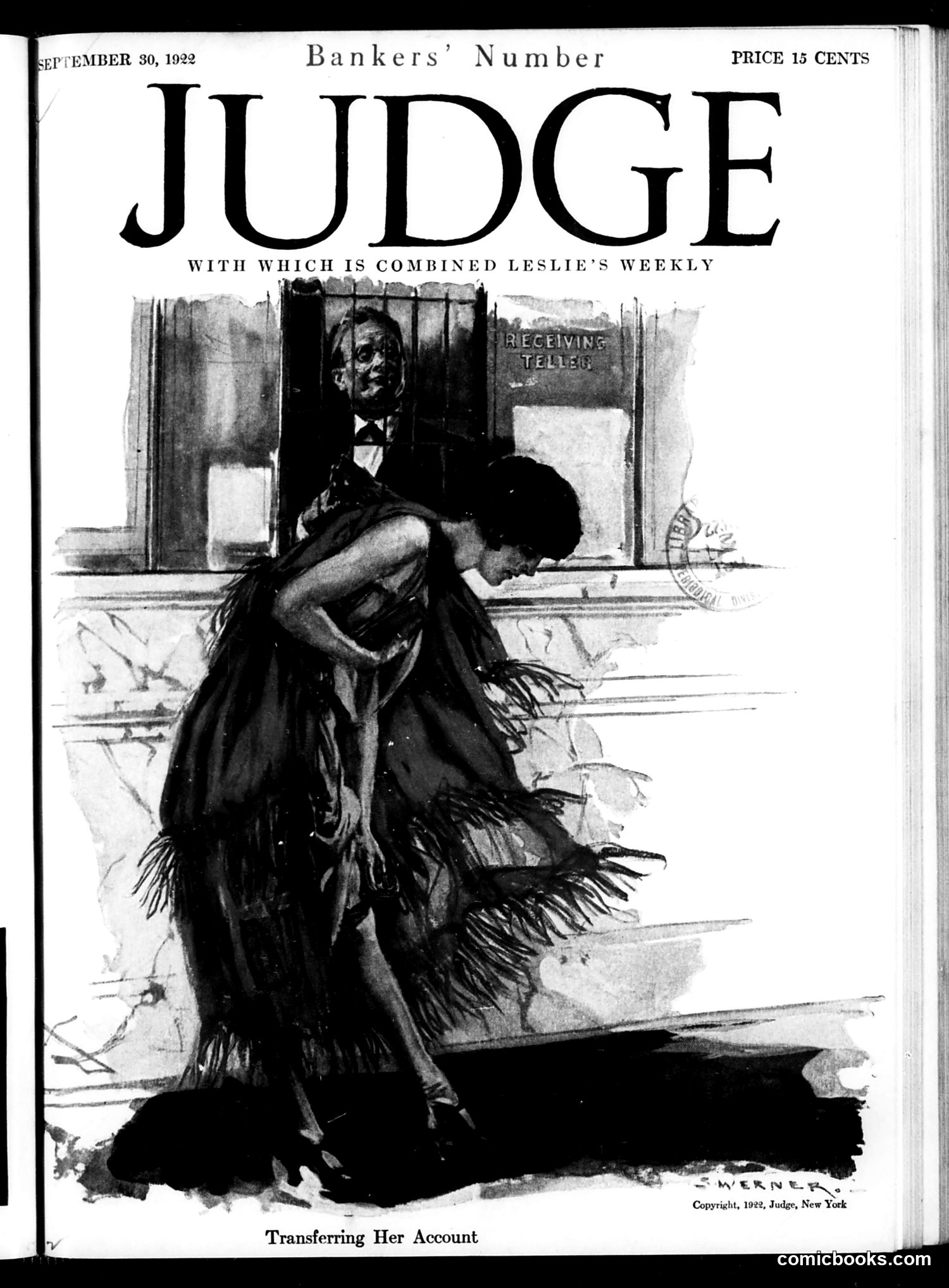
This cartoon satirizes the relationship between women and banking in the early 1920s. The illustration shows a woman in an elegant, feathered dress being literally carried by a bank teller from one window to another—specifically from a "Receiving Teller" window. The satire appears to mock the notion of women's financial dependence and agency in banking. The title "Transferring Her Account" plays on the dual meaning: both the literal transfer of her banking account and the physical transfer of the woman herself, as if she were property or cargo being moved between departments. This reflects 1920s attitudes about women's limited financial autonomy, even as women were gaining new rights during this era.
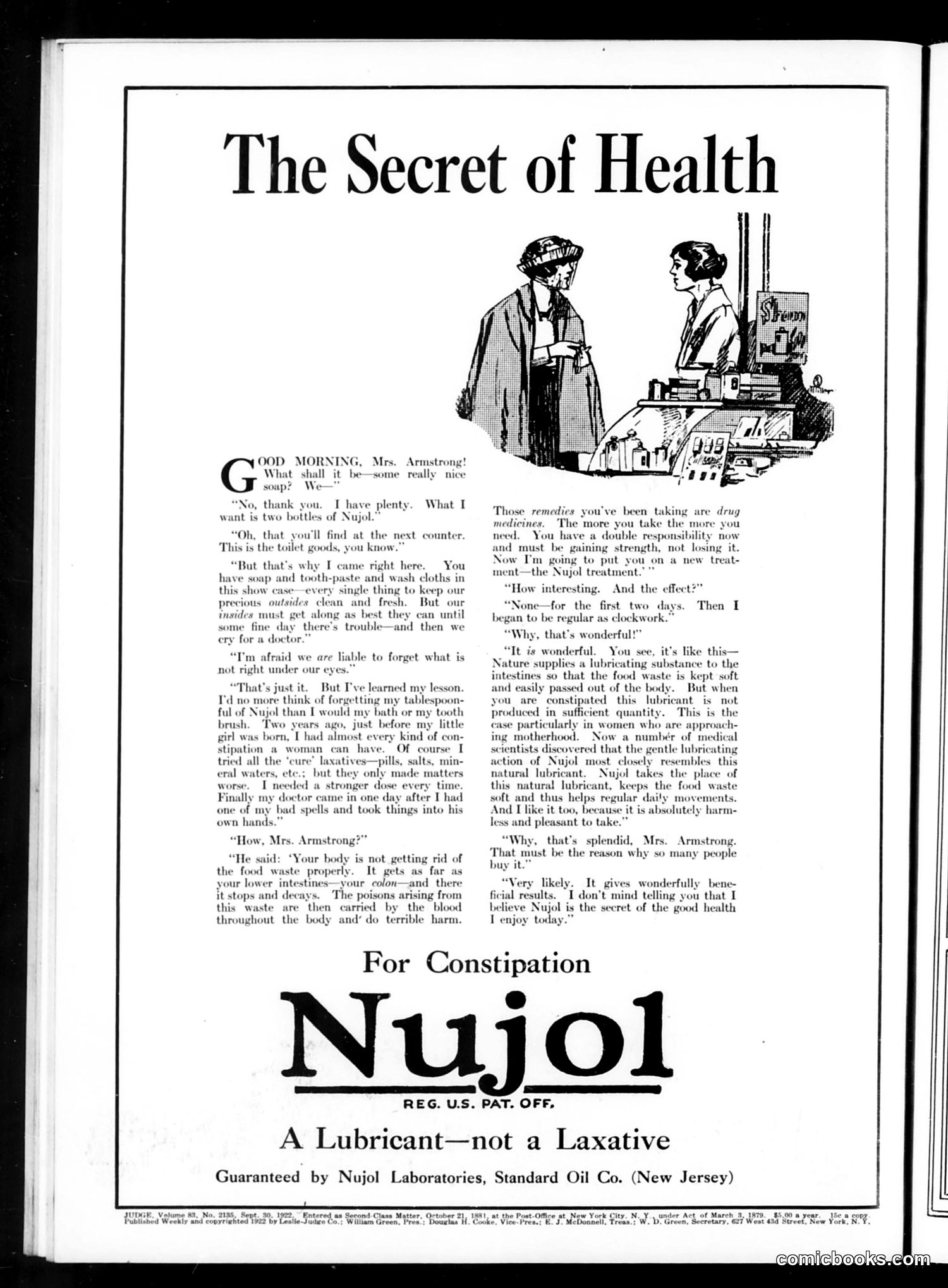
This page is primarily a **patent medicine advertisement** for Nujol, a laxative product marketed as a "lubricant" rather than a traditional purgative. The cartoon depicts a conversation between two women—Mrs. Armstrong (a customer) and what appears to be a pharmacist or health advisor. The dialogue humorously presents Nujol's supposed mechanism: it acts as a natural lubricant for the intestines, mimicking the body's own processes, rather than forcing evacuation like harsh laxatives. This reflects early 20th-century marketing that emphasized pseudo-scientific explanations to distinguish products in a crowded patent medicine market. The "secret" is simply regular bowel function through gentle lubrication—positioning Nujol as more sophisticated and health-conscious than competitor products. The advertisement targets health-conscious readers of *Judge* magazine.
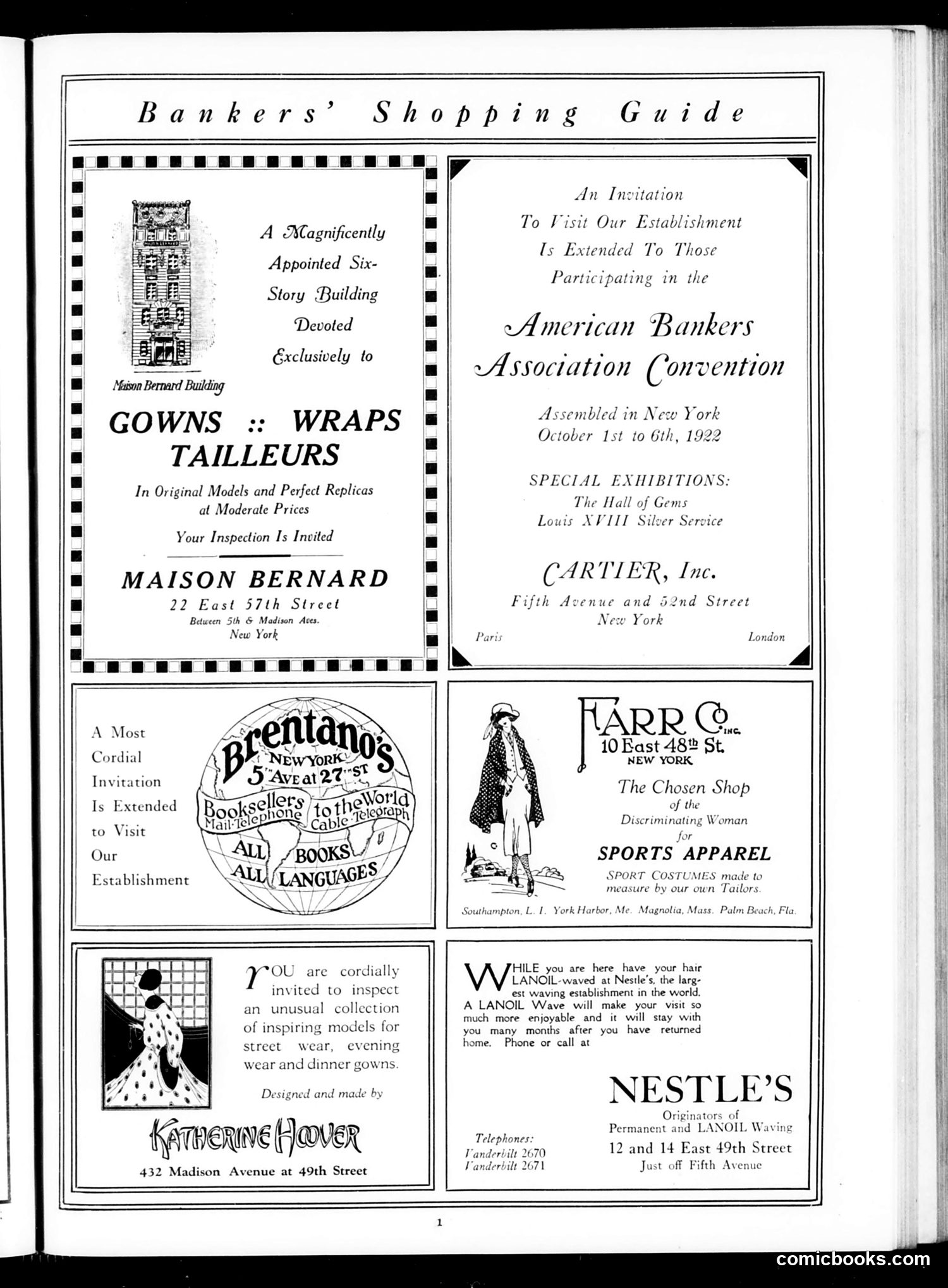
This page is primarily **advertising content**, not satire or editorial cartoons. It's a "Bankers' Shopping Guide" featuring six advertisements for upscale New York establishments circa 1922: 1. **Maison Bernard** - women's clothing (gowns, wraps, tailleers) 2. **Cartier, Inc.** - jewelry, advertising their exhibit at the American Bankers Association Convention 3. **Brentano's** - bookseller 4. **Harr Co.** - women's sports apparel 5. **Katherine Hauer** - designer of street and evening wear 6. **Nestle's** - hair permanent waving service The page targets wealthy bankers attending the 1922 ABA Convention in New York, directing them to luxury retailers. There is no political satire present—this is commercial promotion aimed at an affluent demographic.
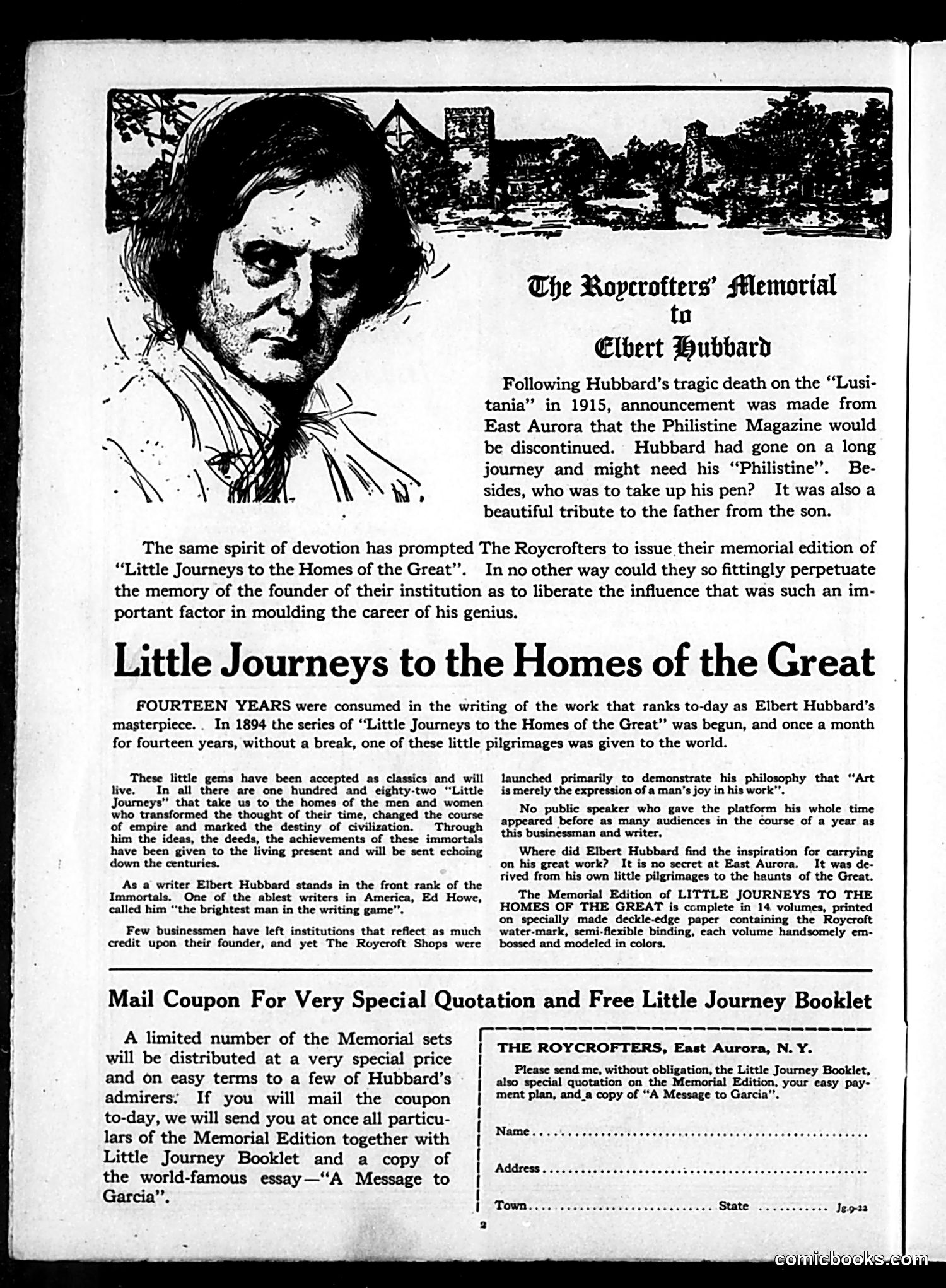
This page is primarily **promotional material rather than satire or political commentary**. It's a memorial advertisement for Elbert Hubbard, an American writer and philosopher who died in the 1915 sinking of the RMS Lusitania. The portrait shows Hubbard himself. The Roycrofters (his publishing institution) are issuing a memorial edition of his famous work, "Little Journeys to the Homes of the Great"—a 14-volume series written over fourteen years celebrating notable historical figures. The page emphasizes Hubbard's literary influence and philosophy that "Art is merely the expression of a man's joy in his work." **Bottom section:** A mail coupon invites readers to request a free Little Journey booklet and essay ("A Message to Garcia") in exchange for considering a memorial subscription set—a common early-20th-century direct-mail sales tactic.
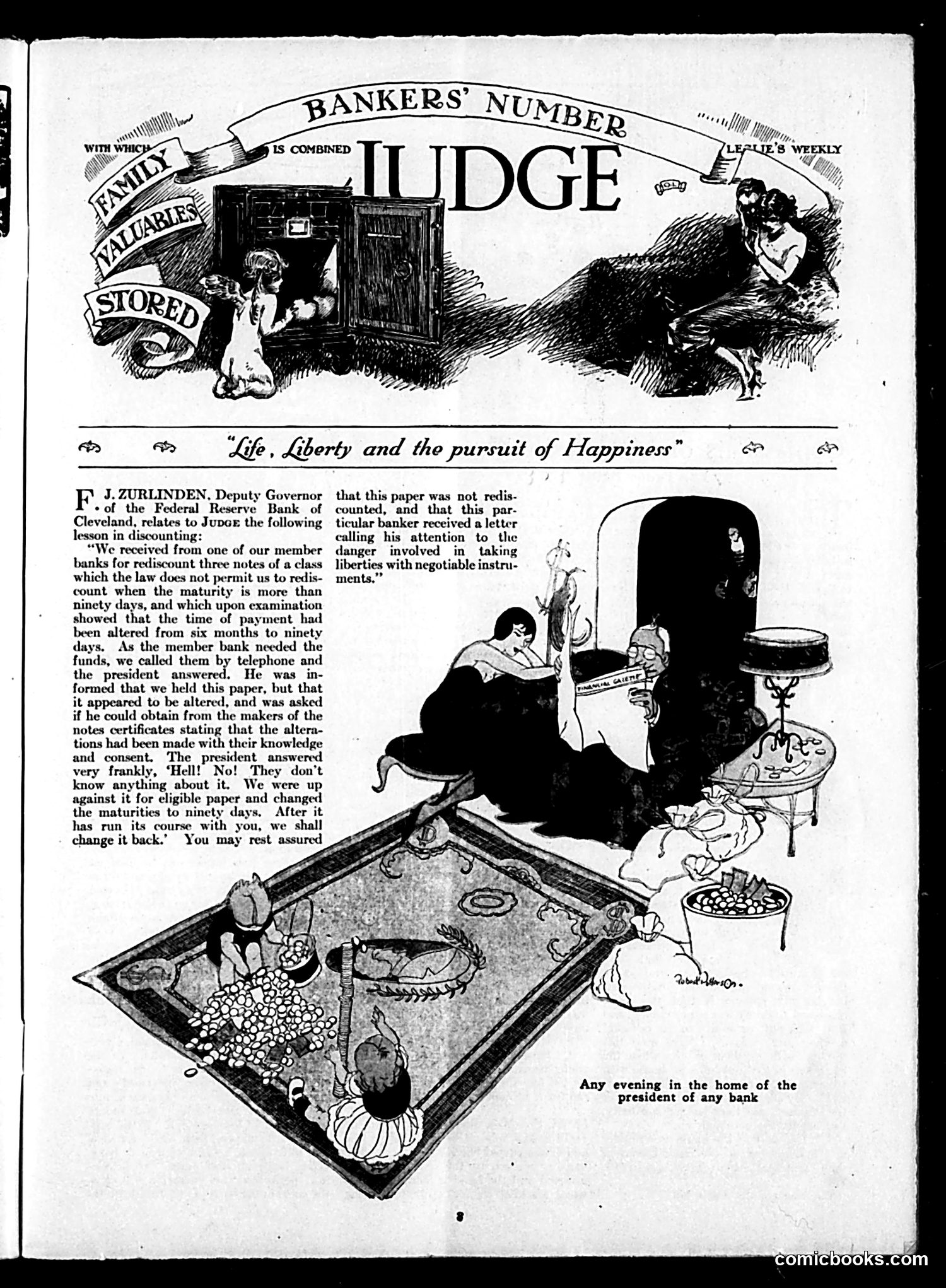
This page satirizes banking practices during the Federal Reserve era. The article features F.J. Zurlinden, Deputy Governor of the Federal Reserve Bank of Cleveland, describing a dispute where a member bank attempted to rediscount notes with altered maturity dates—changing them from six months to ninety days to obtain needed funds. The Federal Reserve refused, and the bank president allegedly claimed ignorance of the alterations. The illustration below captioned "Any evening in the home of the president of any bank" depicts a lavish dinner scene with wealthy figures and abundant food, satirizing bankers' opulent lifestyles. The implication is that despite claiming innocence about fraudulent paper alterations, bankers lived extravagantly—suggesting either dishonesty or gross negligence regarding their institutions' financial practices.
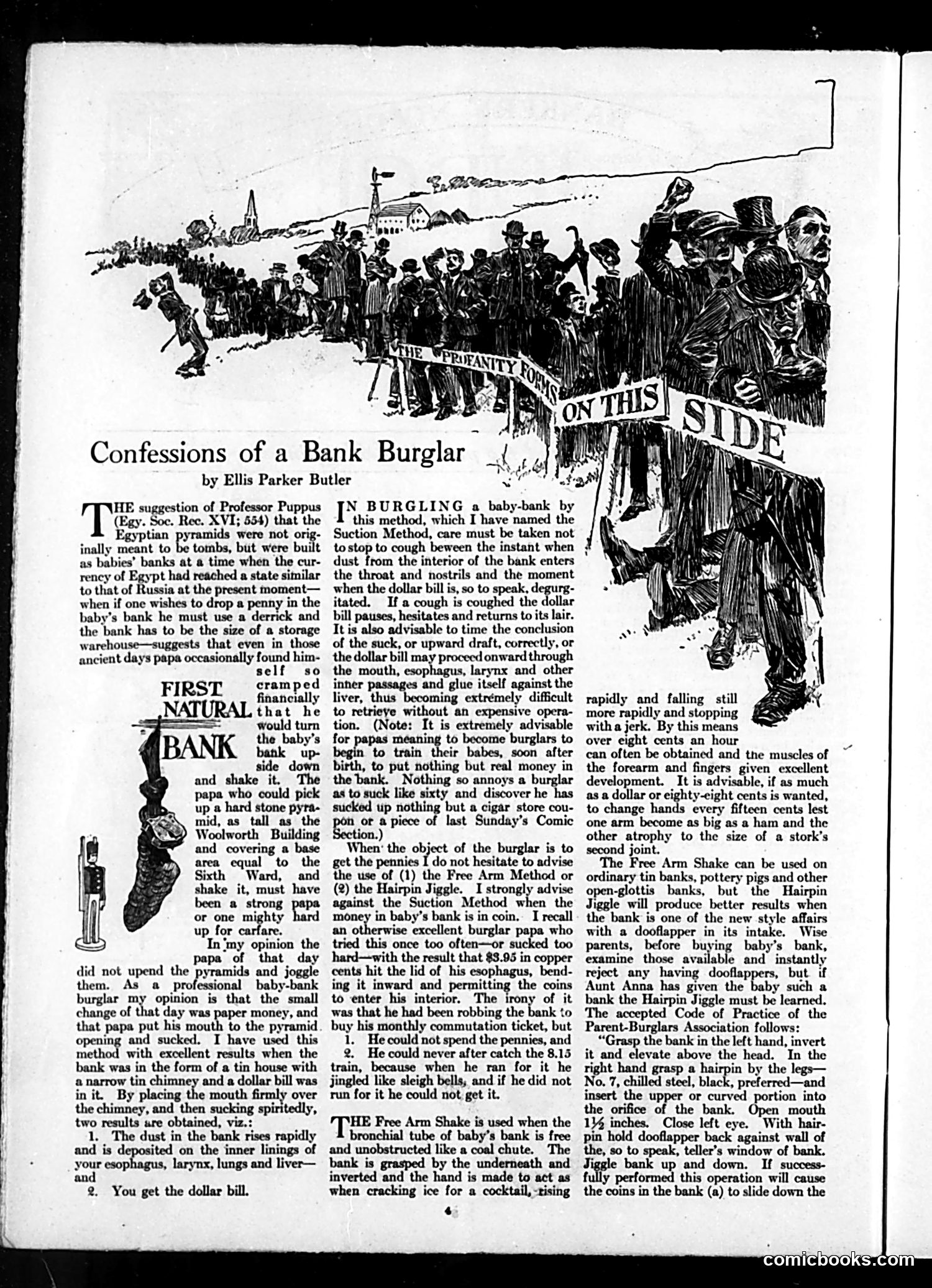
This satirical piece by Ellis Parker Butler mocks the supposed "scientific" methods that wealthy people recommended for teaching children financial responsibility. The cartoon illustrates the absurd concept of a "baby-bank"—a practice where infants supposedly learn to save by depositing coins. The satire targets upper-class parenting advice of the era, particularly the notion that children should be trained from birth to accumulate money. The accompanying illustration shows a crowd gathered around what appears to be an actual bank entrance, with the banner "HUMANITY FORWARD ON THIS SIDE," suggesting social pretension. The text humorously details various burglary techniques framed as lessons learned from these "baby-banks," implying that such training actually produces criminals rather than responsible citizens—a biting commentary on period wealth-building ideology.
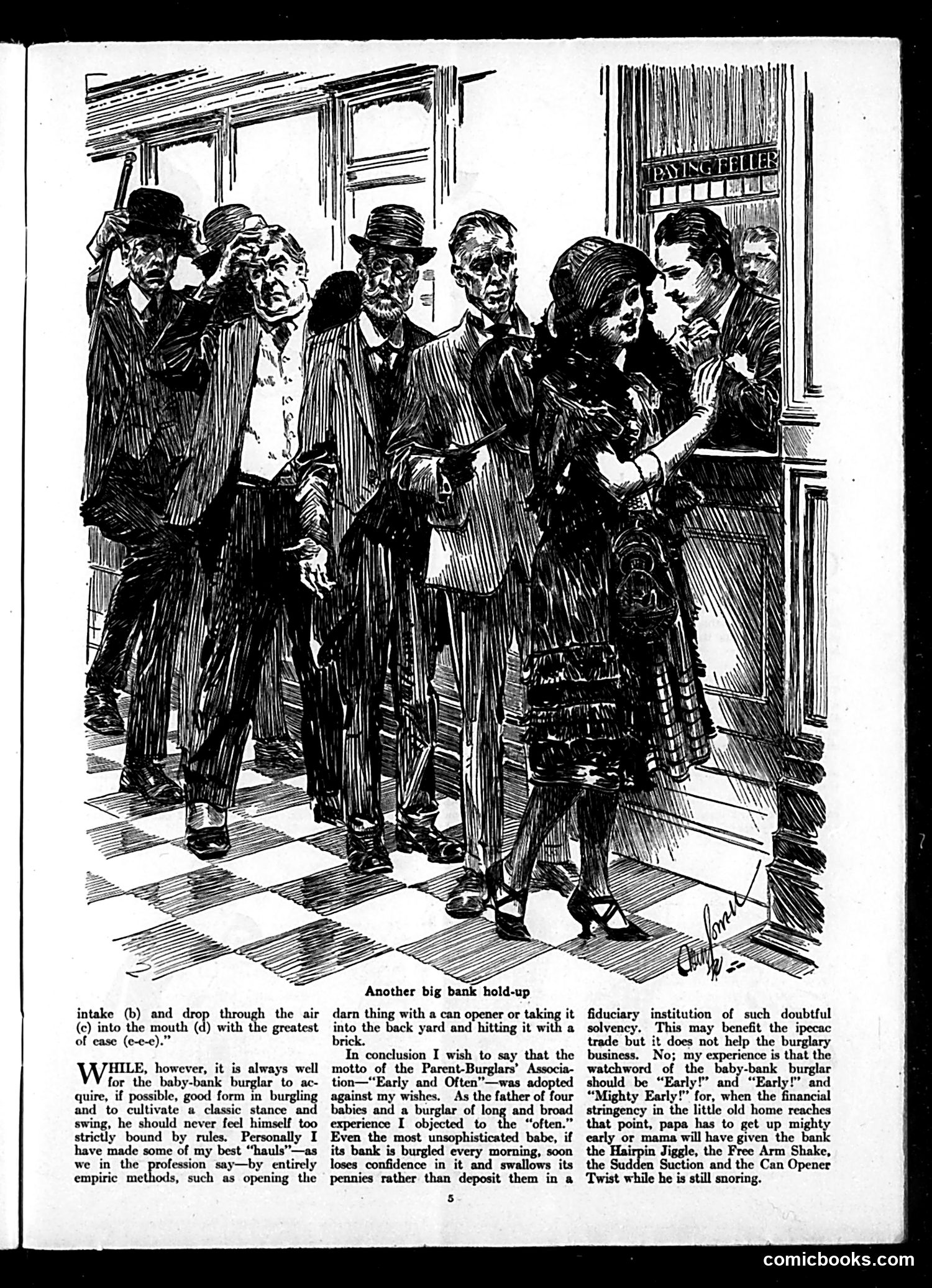
This satirical cartoon from *Judge* magazine uses absurdist humor to mock baby savings accounts and parental financial irresponsibility during an era of banking anxiety (likely early 20th century, given the references to "Parent-Burglars' Association"). The illustration shows a crowd at what appears to be a bank entrance. The accompanying text, written as advice from an experienced "baby-bank burglar," is satirizing parents who repeatedly raid their children's savings accounts. The joke operates on multiple levels: parents are portrayed as actual thieves stealing from piggy banks ("burgling"), while the text treats this as a professional skill with a "motto" ("Early and Often"). The satire critiques parental hypocrisy—teaching children financial responsibility while simultaneously undermining it through theft. References to the child losing "confidence" in the bank and preferring to swallow coins rather than save them underscore the damage such behavior causes. The cartoon likely reflects Depression-era or pre-Depression anxieties about financial instability and moral decay among the middle class.
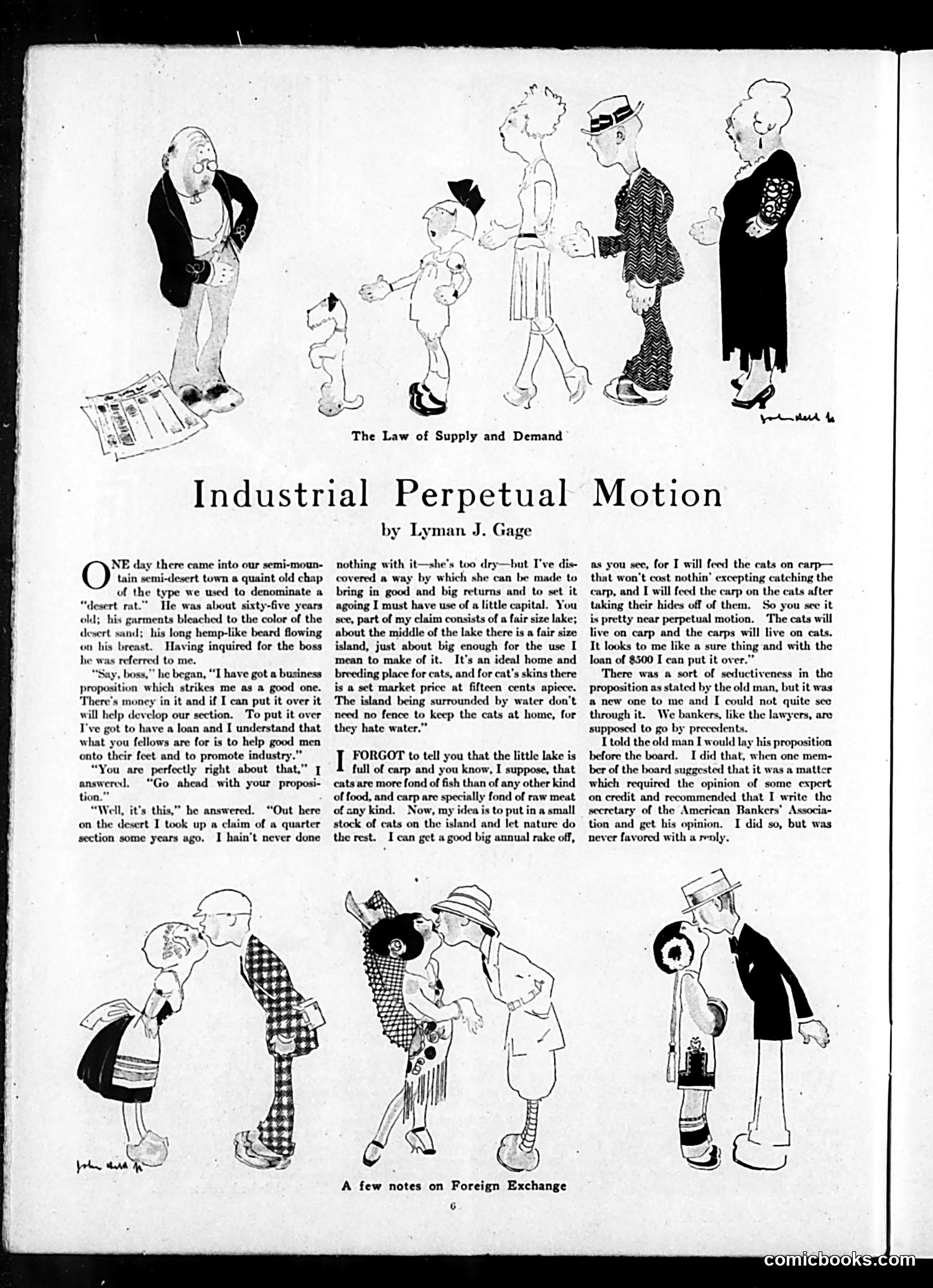
This satirical piece mocks both naive economic thinking and banking conservatism. A desert prospector pitches a banker a scheme: stock an island with cats that eat carp from an adjoining lake, then feed the carp the cats' remains—creating "perpetual motion" with no input costs. The satire works on multiple levels. The prospector represents get-rich-quick dreamers who misunderstand economic fundamentals. The banker (likely Gage himself, given the byline) represents institutional caution—he consults his board and writes to the American Bankers' Association rather than simply rejecting obvious nonsense. The top cartoon "Law of Supply and Demand" shows figures of increasing prosperity, illustrating the legitimate economic principle the scheme grotesquely parodies. The bottom section "Foreign Exchange" appears unrelated. The joke: both the charlatan and the bureaucrat are foolish—one for the impossible scheme, the other for treating it as requiring expert analysis rather than common sense.
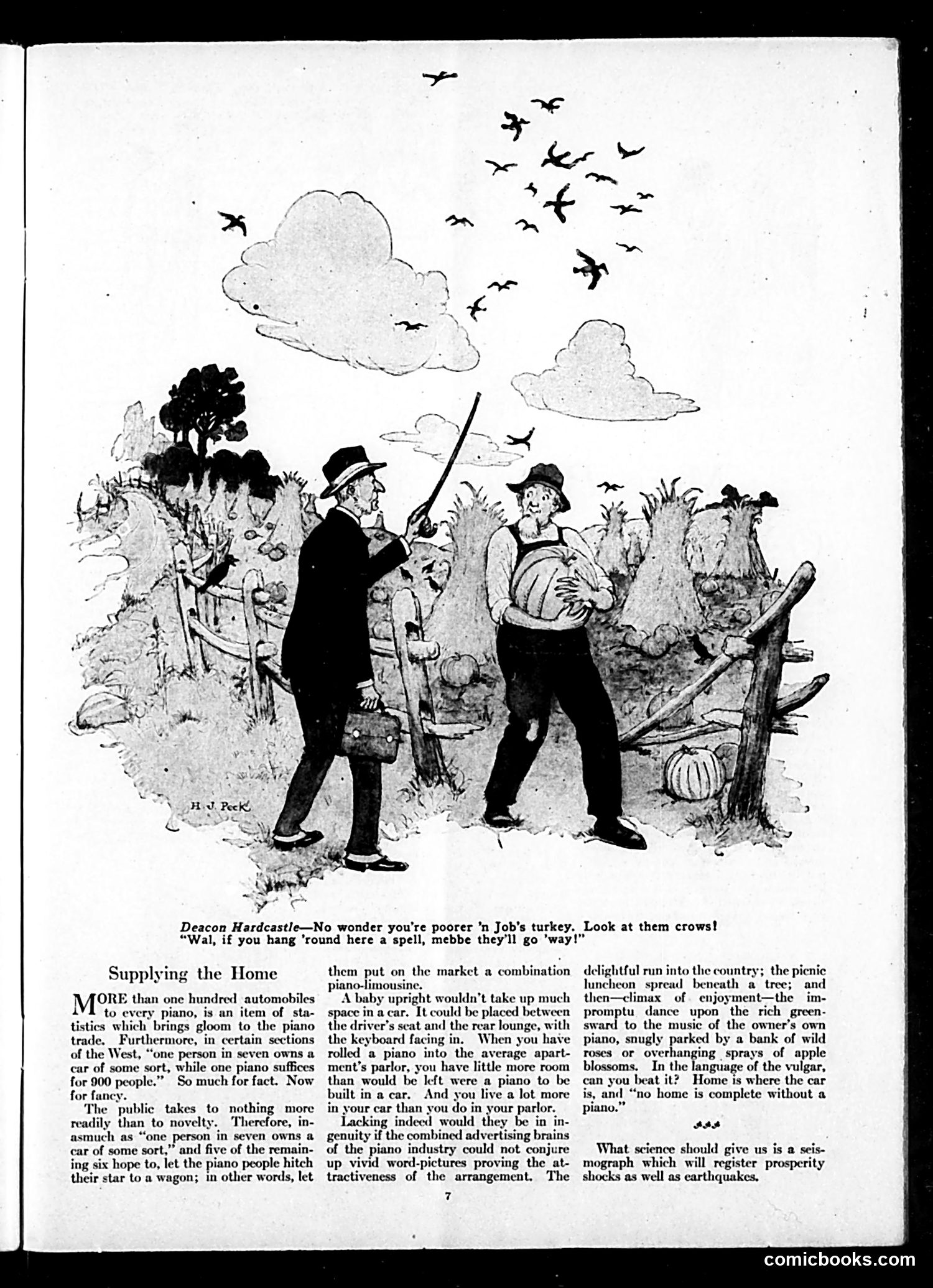
The cartoon depicts a rural farmer (Deacon Hardcastle) standing in a field damaged by crows, with another man suggesting he wait for the birds to leave. The visual joke: the farmer's crops are ruined, yet he seems resigned to inaction—a commentary on rural poverty and helplessness. The accompanying article satirizes the piano industry's response to declining sales. It proposes an absurd solution: a "combination piano-limousine"—placing a baby grand piano inside an automobile. The satire mocks both the piano industry's desperation and advertising's ability to spin fantasies (picnics with impromptu dances) to sell impractical products. The contrast is stark: automobiles vastly outnumber pianos (100+ cars per piano), yet the industry imagines forcing pianos into cars rather than accepting market reality. The final line about seismographs measuring "prosperity shocks" wryly suggests satire itself is the only honest measure of economic folly.
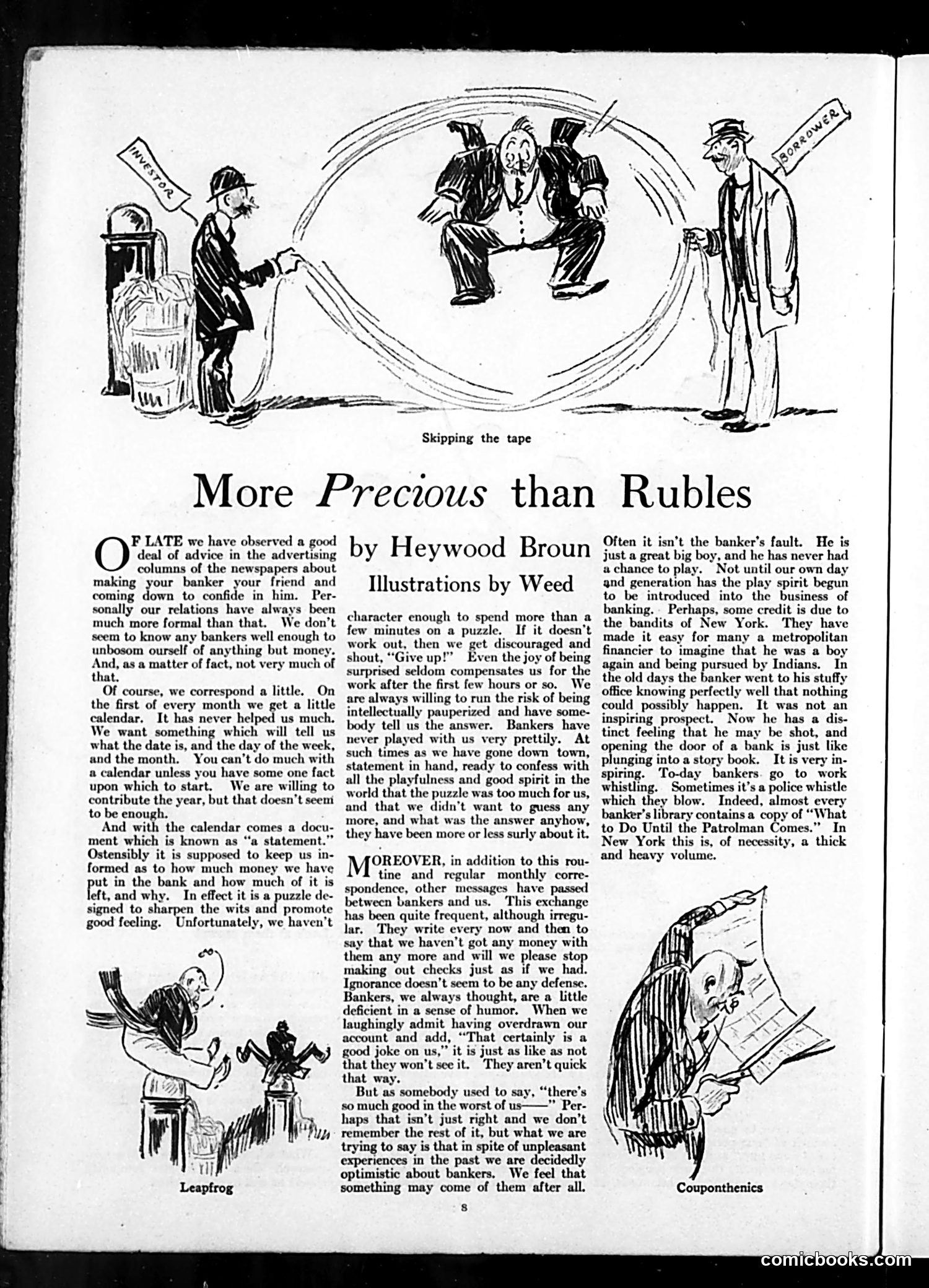
This page from *Judge* magazine contains a satirical essay by Heywood Broun about the awkward relationship between ordinary people and bankers, illustrated with humorous cartoons. **Main Points:** The essay mocks formal banking conventions—particularly monthly statements that are presented as "puzzles" the depositor must decipher, and confusing bank correspondence about overdrafts. Broun notes bankers lack humor; they don't appreciate jokes about overdrawing accounts. **The Satire:** The piece gently critiques both bankers' stuffiness and the public's financial ignorance. However, Broun's closing argument is ironic: he suggests bankers have become more interesting since New York's recent bank robberies—now they get excitement imagining being robbed ("pursued by Indians"), making their dull work feel like adventure stories. **The Cartoons:** The top illustration ("Skipping the tape") shows figures with a rope between them. The bottom illustrations ("Leapfrog" and "Coupothenics") appear to be separate humorous sketches, though their exact relevance is unclear from the visible text. This reflects early-20th-century middle-class anxieties about banking procedures and institutional formality.
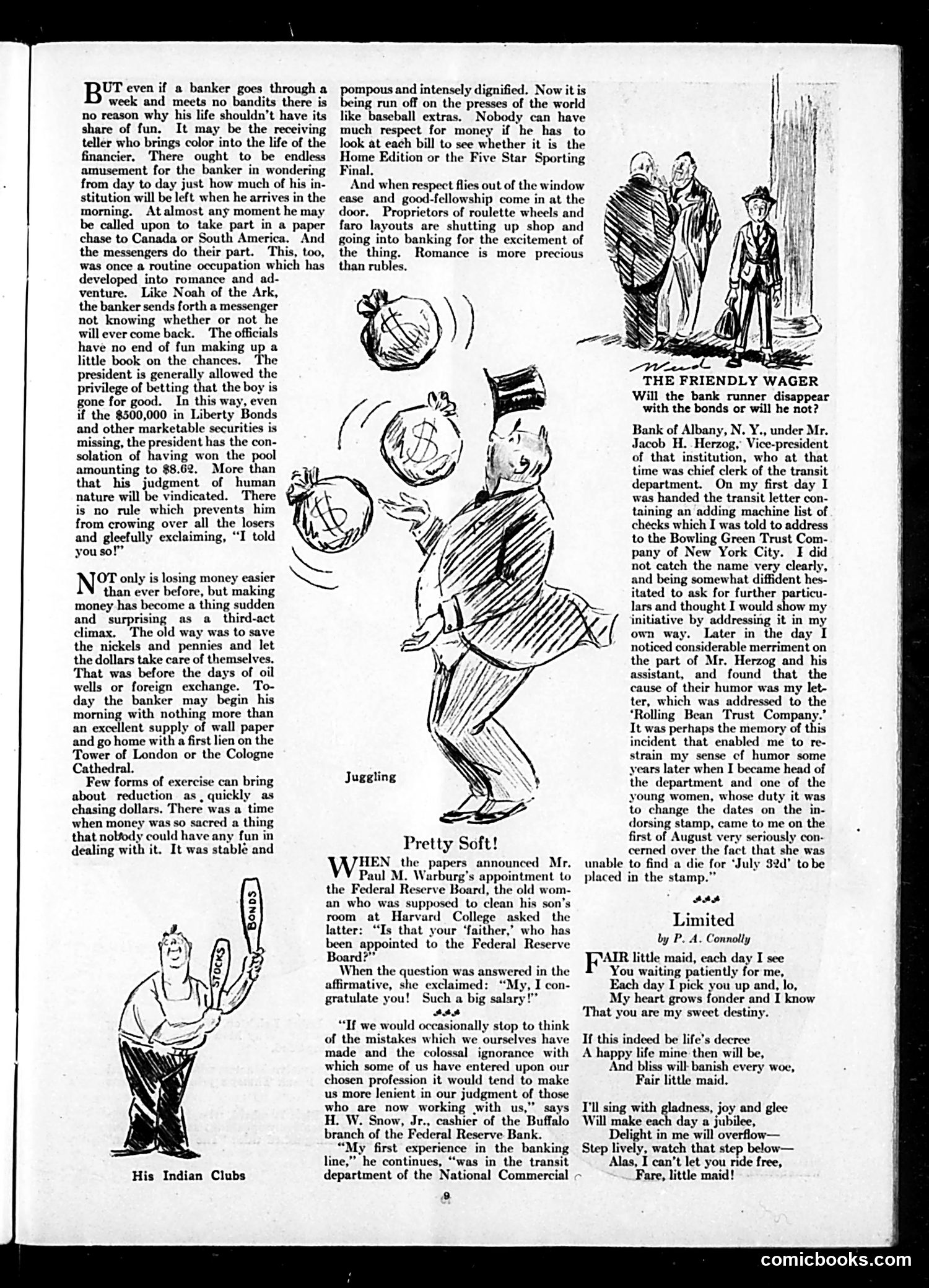
This page satirizes early 20th-century banking and financial instability. The main text mocks how bankers' routines have become chaotic—messengers might disappear with securities, money is printed like "baseball extras," and the profession has lost respectability. The piece suggests bankers now gamble on whether employees will abscond with bonds, treating it as entertainment. The "Juggling" cartoon (center-left) depicts a banker juggling money, visually representing the precarious, unstable nature of modern finance. A secondary anecdote mentions Paul M. Warburg's appointment to the Federal Reserve Board, treated humorously through a cleaning woman's naive reaction to his "big salary." The satire reflects anxiety about rapid financial change, currency instability, and post-WWI economic uncertainty, when banking seemed less dignified and more chaotic than traditional practice.
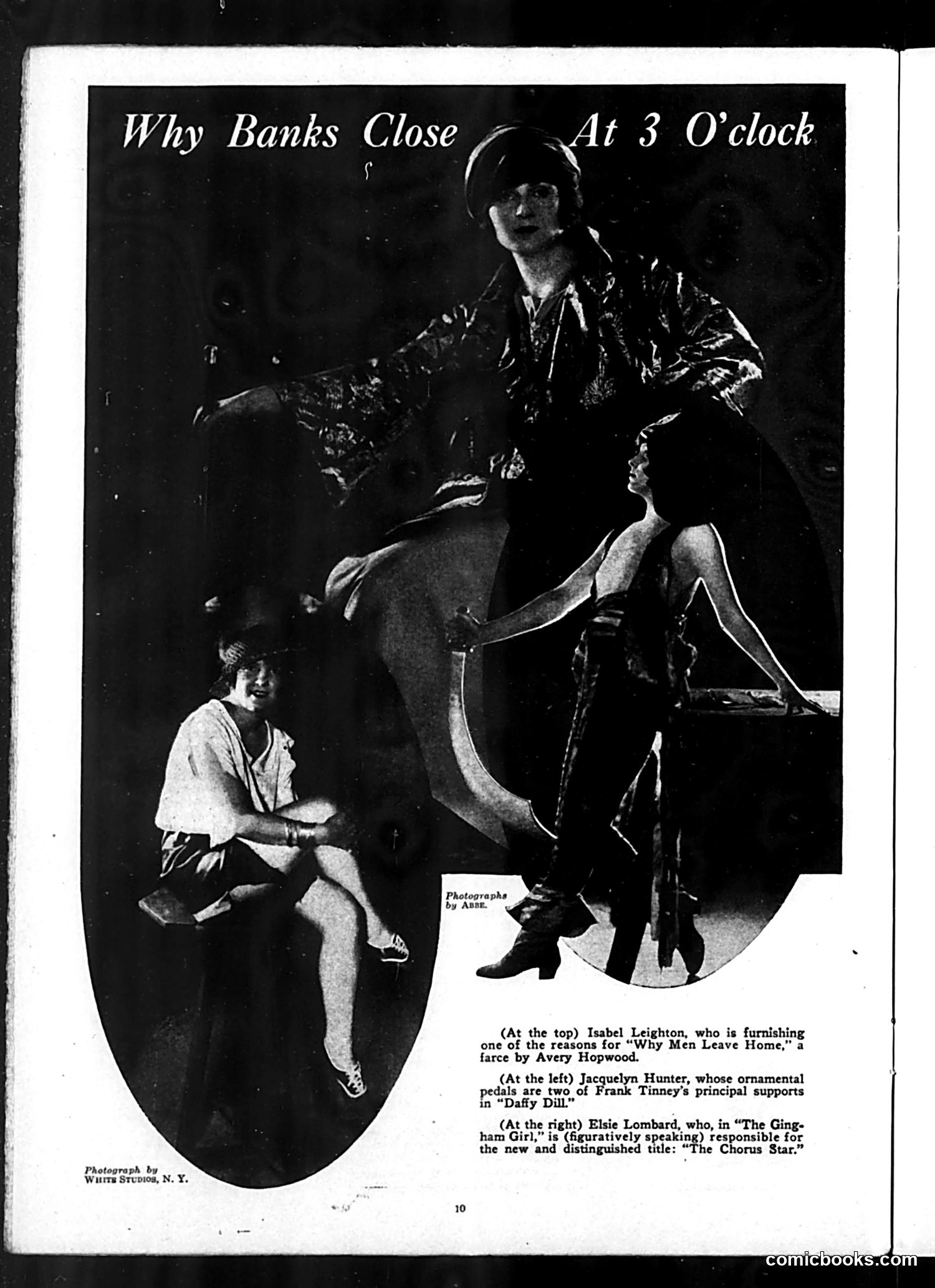
This is a lighthearted satire about attractive young women in theatrical productions. The joke plays on the phrase "banks close at 3 o'clock"—suggesting banks close early because male employees are distracted by these actresses. The page identifies three performers from Broadway farces and musicals: Isabel Leighton (from "Why Men Leave Home"), Jacquelyn Hunter (from "Daffy Dill"), and Elsie Lombard (from "The Gingham Girl"). The humor derives from the implication that their physical attractiveness would cause male bank employees to abandon work early to see shows featuring these women. This reflects early 20th-century theatrical culture and contemporary attitudes toward chorus girls and actresses as objects of male attention, presented here as mild, tongue-in-cheek comedy typical of Judge magazine's satirical approach.
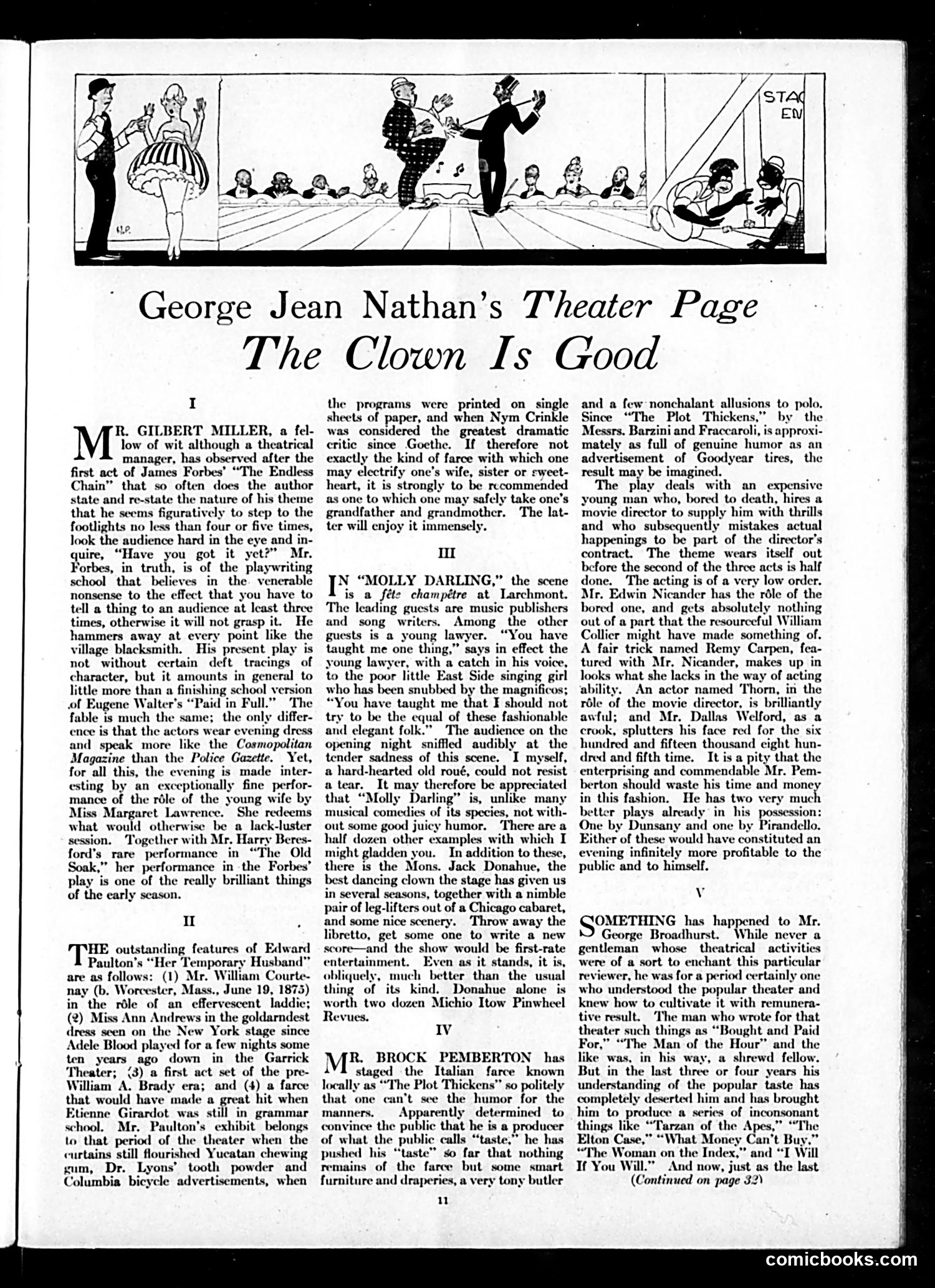
This is a theatrical review column, not a political cartoon. The header illustration depicts a stage scene with performers and audience, establishing the entertainment theme. Nathan critiques three Broadway productions: James Forbes' "The Endless Chain" (criticized for repetitive exposition), Edward Paulton's "Her Temporary Husband" (dismissed as old-fashioned farce from an earlier theatrical era), and "Molly Darling" (a musical comedy praised for balancing sentiment with humor). The reviews are characteristic of early 20th-century theater criticism—witty, sometimes condescending, and peppered with references to contemporary performers and outdated theatrical conventions. Nathan praises Miss Margaret Lawrence and Jack Donahue's dancing while mocking plays that rely on heavy-handed storytelling techniques and dated stage aesthetics (Columbia bicycle advertisements, Yucatan chewing gum promotions). The satire targets theatrical mediocrity and nostalgia for an earlier, cruder stage era.
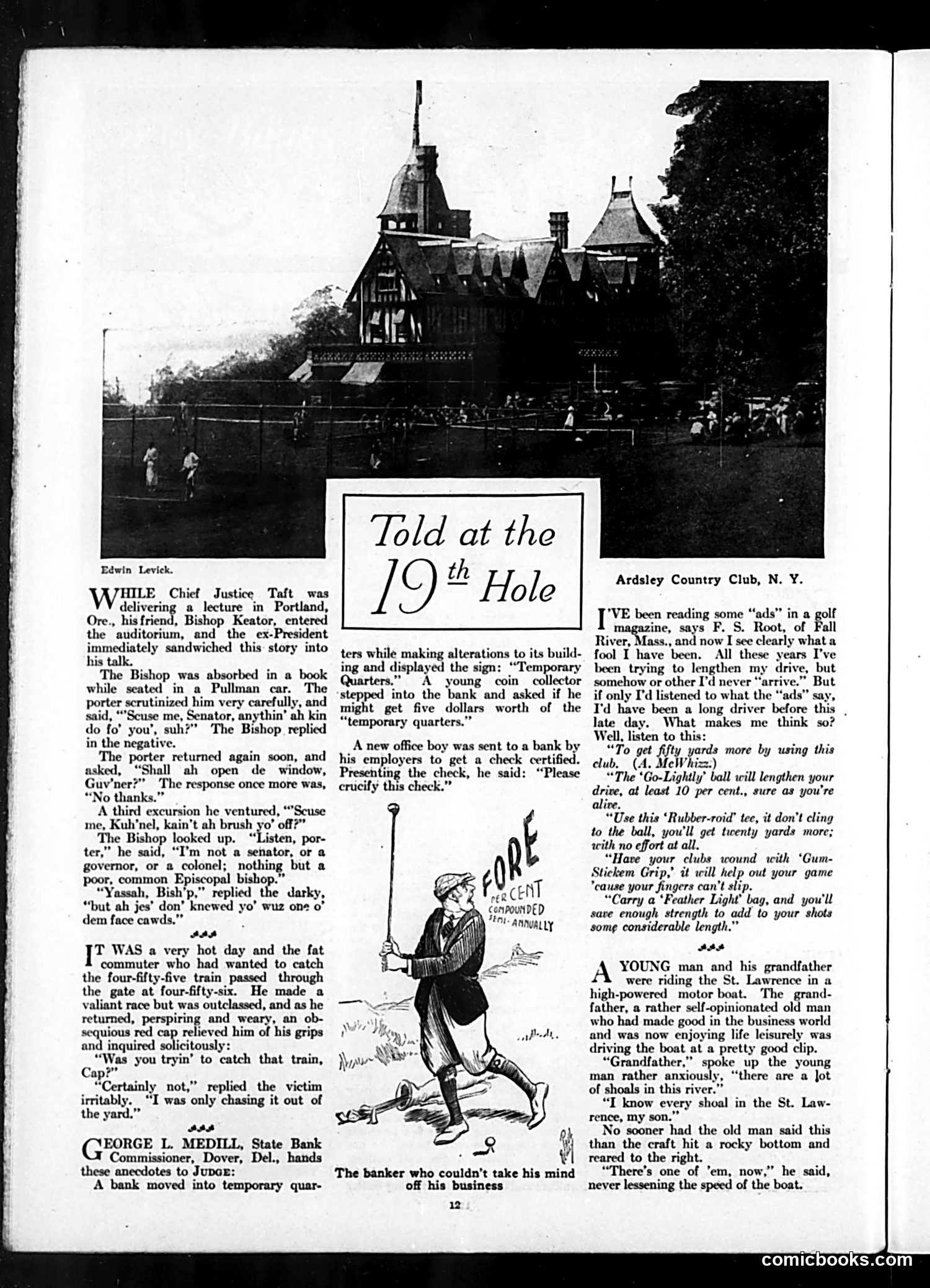
This Judge magazine page collects humorous anecdotes tied to golf and social observation. The main content consists of four joke stories: 1. **Chief Justice Taft anecdote**: A porter on a train repeatedly addresses a Bishop with increasingly grandiose titles (Senator, Governor, Colonel), misunderstanding his status. The humor relies on the porter's confusion and the Bishop's correction. 2. **The commuter's excuse**: A fat man misses his train, then claims he was "chasing it out of the yard"—obvious self-deception used for comedic effect. 3. **Banking puns**: Several short wordplay jokes about "temporary quarters" (coins vs. office space) and a boy saying "crucify" instead of "certify" a check. 4. **Golf equipment satire**: F.S. Root mocks golf equipment advertising that promises marginal improvements (50 yards, 10%, etc.), poking fun at consumerism and false advertising. 5. **The grandfather story**: An elderly self-made businessman ignores his grandson's warnings about river shoals, then hits one but maintains his arrogant composure. The page targets pretension, self-deception, and advertising hype through gentle satire typical of early 20th-century Judge magazine humor.
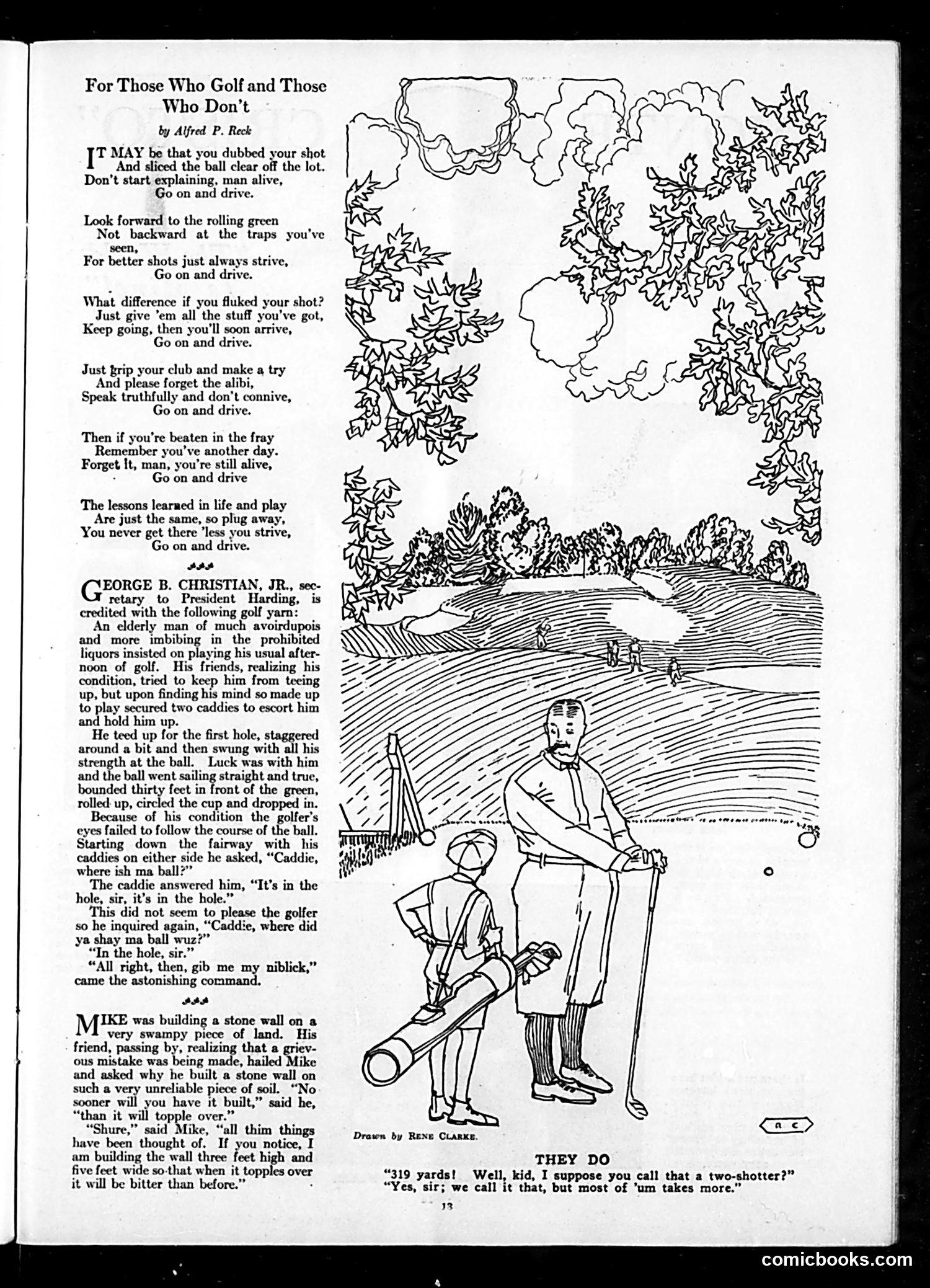
This Judge magazine page contains three separate humor pieces about golf and persistence: **"For Those Who Golf and Those Who Don't"** (poem): A motivational verse encouraging golfers to move forward despite poor shots, forget excuses, and persist—framing golf as a life metaphor about resilience and effort. **George B. Christian Jr. anecdote**: A story crediting Harding's secretary with this yarn about an intoxicated golfer who plays so poorly he's unaware his ball went in the hole on the first try. When told it's in the hole, he asks for a different club—the joke being his impaired judgment makes him doubt his own luck. **Mike's stone wall**: An Irish character (suggested by dialect "Shure") builds a deliberately unstable wall so it will be "better than before" when it collapses—absurdist humor about illogical reasoning. **Bottom cartoon**: A caddie tells a golfer his 319-yard drive is a "two-shotter" (should take two strokes), but notes most people's drives require more strokes—gentle ribbing about amateur golf abilities. The page celebrates golf as both sport and character-building metaphor, typical of 1920s American magazine humor.
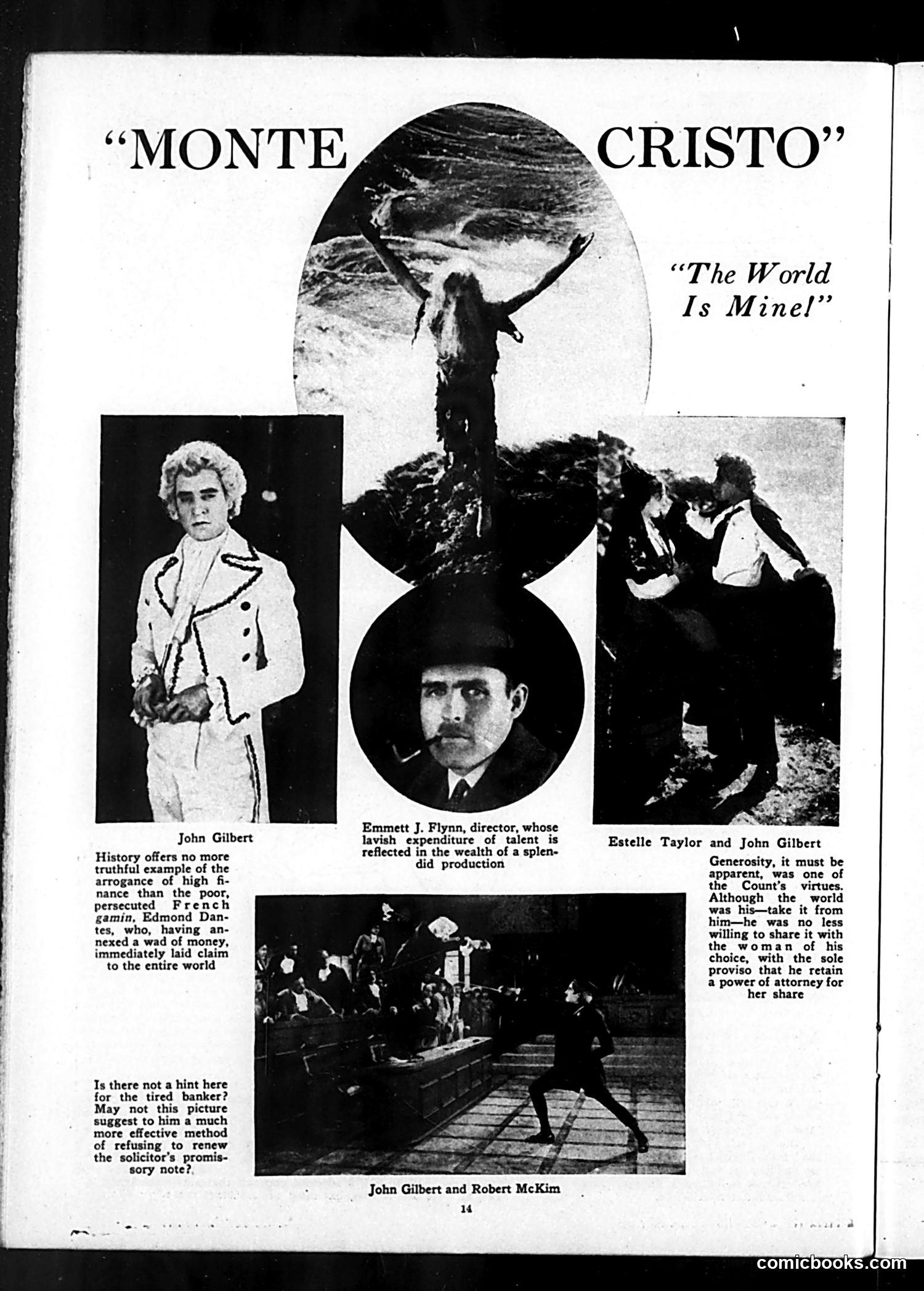
This page promotes the film adaptation of Alexandre Dumas's *The Count of Monte Cristo*, starring John Gilbert. The satire targets wealthy financiers by drawing a pointed parallel: the fictional Edmond Dantes, a poor French boy who acquires sudden wealth, immediately claims ownership of "the entire world." The joke suggests to "tired bankers" that Dantes's method of asserting dominance over debtors—through newfound riches rather than legal documents—might be more effective than traditional debt collection. The sarcastic closing remark about the Count's "generosity" in sharing the world with a woman (while retaining "power of attorney for her share") mocks both the protagonist's arrogance and, implicitly, wealthy men's control over women's finances. Director Emmett J. Flynn is credited for the "splendid production." The satire critiques how sudden wealth breeds entitlement and financial ruthlessness.
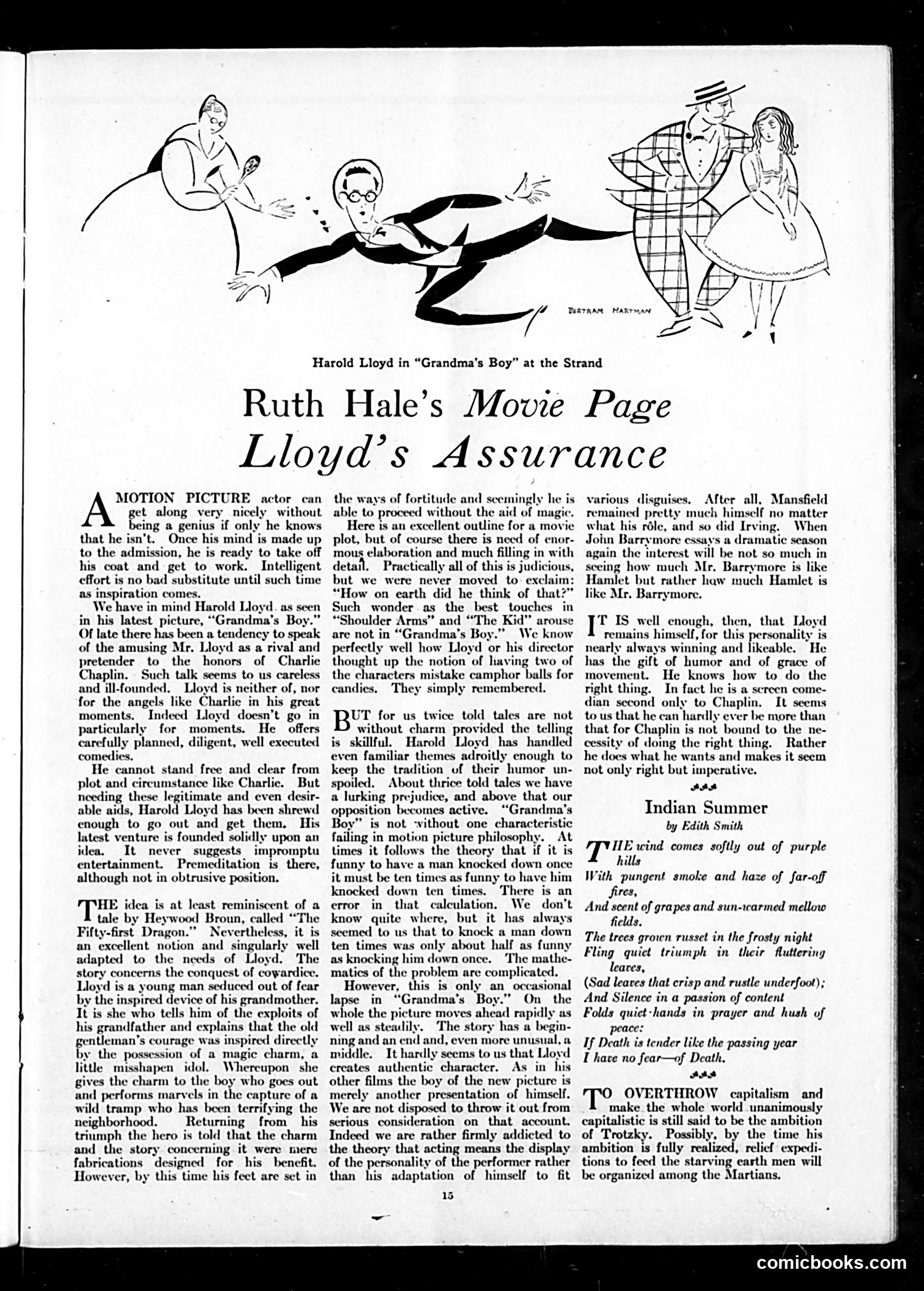
This is Ruth Hale's movie review column analyzing Harold Lloyd's film "Grandma's Boy," shown at the Strand Theatre. The cartoon at top depicts Lloyd performing his characteristic physical comedy—stretched horizontally in an exaggerated pose while flanked by supporting characters. Hale's review distinguishes Lloyd from Charlie Chaplin, the era's dominant comedy star. She argues Lloyd succeeds through careful, premeditated construction rather than Chaplin's spontaneous genius. The film's plot—a cowardly boy gains courage through a fake magical charm—derives from Heywood Broun's story "The Fifty-first Dragon." Hale praises Lloyd's competent execution but criticizes the film's repeated gag structure (knocking a man down ten times versus once). She notes Lloyd depends on plot and circumstance, unlike Chaplin's ability to create comedy from pure character. Overall, she finds "Grandma's Boy" a well-crafted but uninspired comedy that competently delivers entertainment without artistic brilliance.
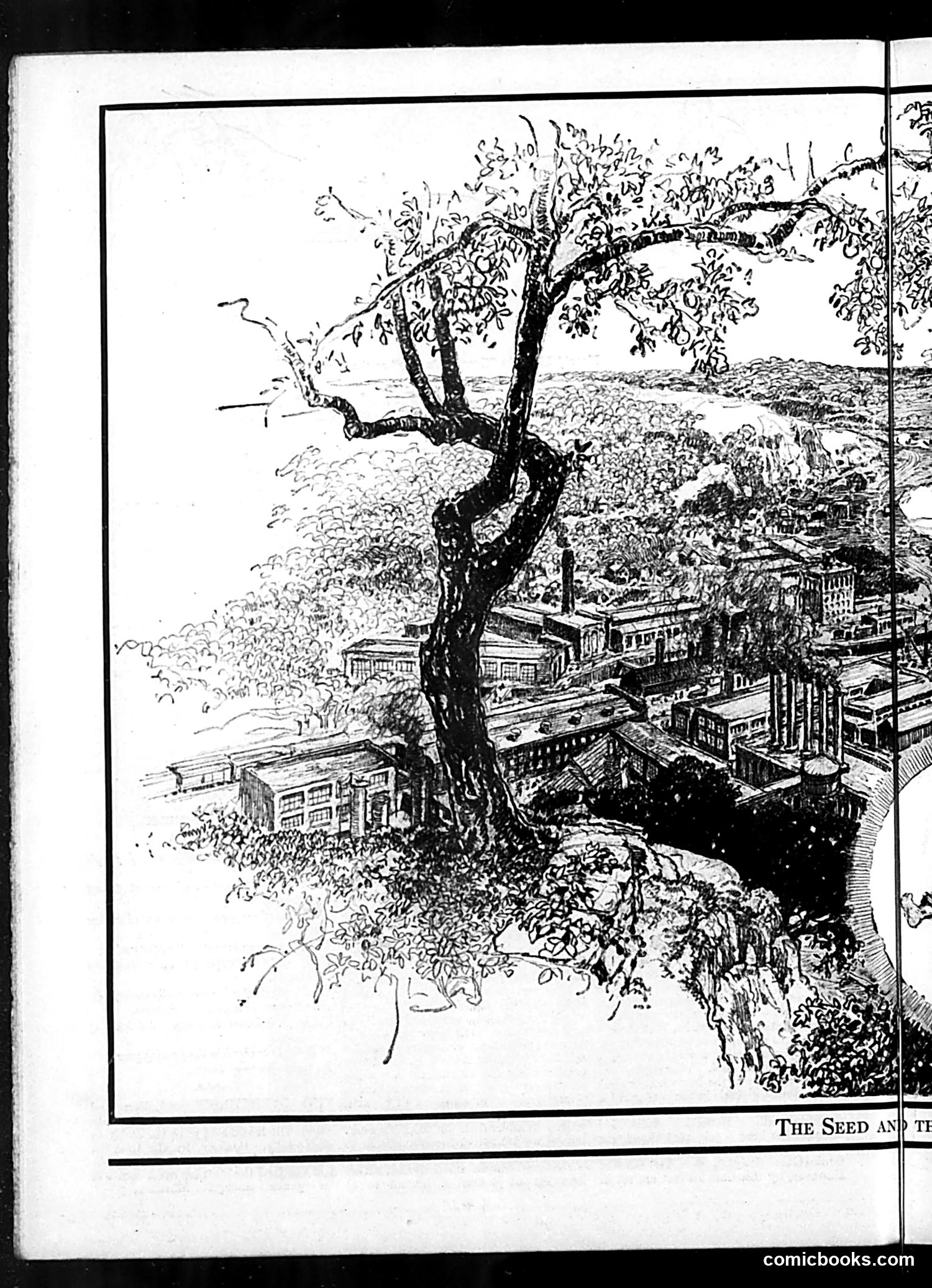
This appears to be an illustration from *Judge* magazine showing a gnarled, ancient tree overlooking a developed coastal town with buildings and structures below. The caption begins "The Seed and T[he]..." but is cut off. The image likely represents a commentary on **environmental change and development**—contrasting natural, long-established nature (the old tree) with modern urban expansion and industrialization (the buildings below). The tree's twisted, aged form suggests longevity and endurance, while the bustling settlement represents progress or encroachment. Without the complete caption or date, the specific satirical target remains unclear. However, this type of imagery was common in early 20th-century American satire, often critiquing rapid industrialization, land development, or the tension between preservation and progress.
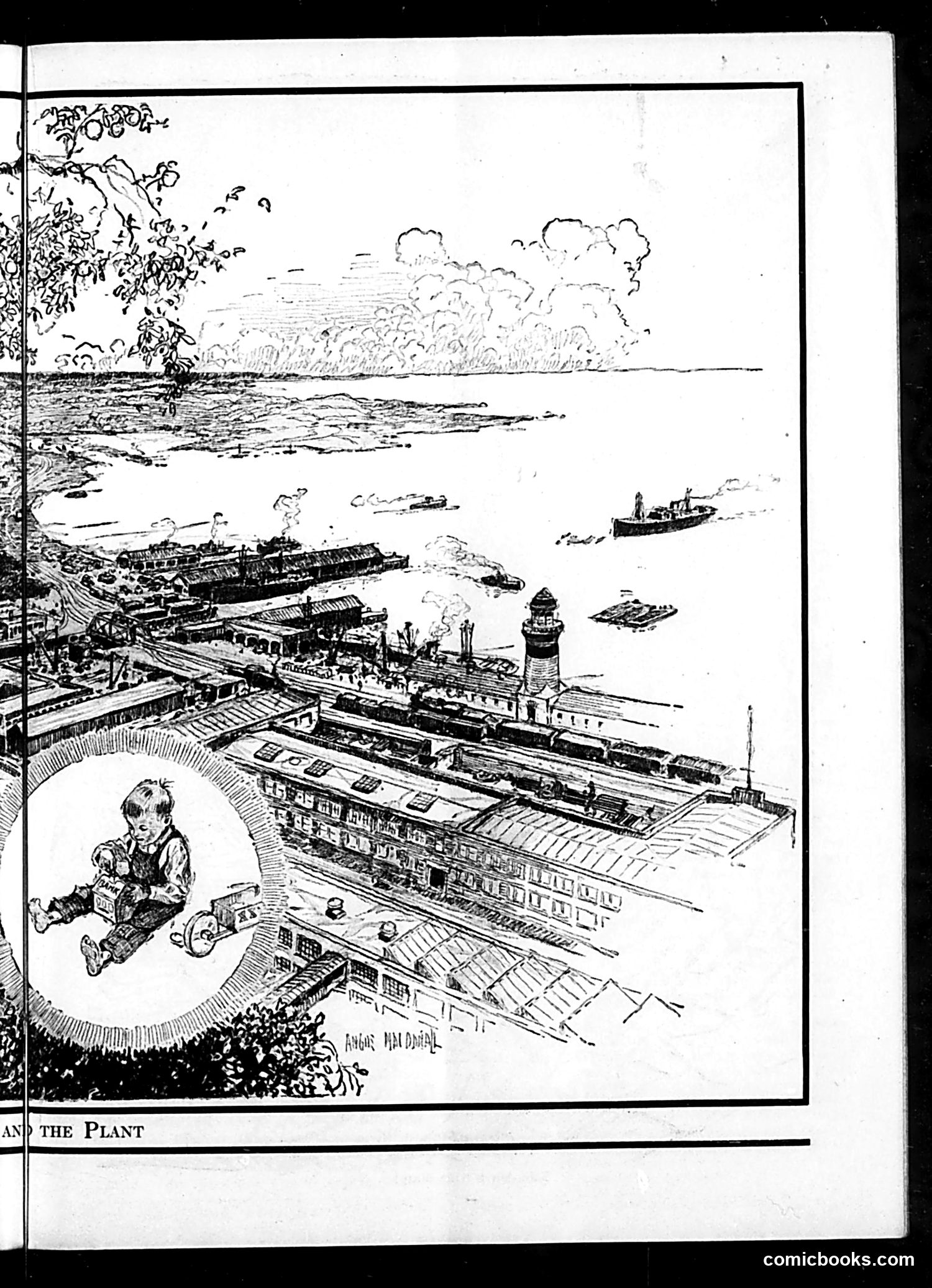
This page shows an industrial riverside facility, likely a factory or manufacturing plant. The detailed architectural drawing depicts buildings with smokestacks, railroad tracks, and ships on the water—typical of early 20th-century American industrial infrastructure. The inset illustration shows a young child playing with toys, appearing innocent and carefree. The juxtaposition suggests social commentary on child labor or industrial working conditions affecting children. Judge magazine frequently satirized labor practices and industrial exploitation of the era. The contrast between the child's play and the massive industrial machinery likely critiques either: the disconnect between childhood innocence and harsh factory realities, or perhaps child labor practices common in plants of this period. Without a visible date or title clarity, the exact industrial site or specific event referenced remains unclear.
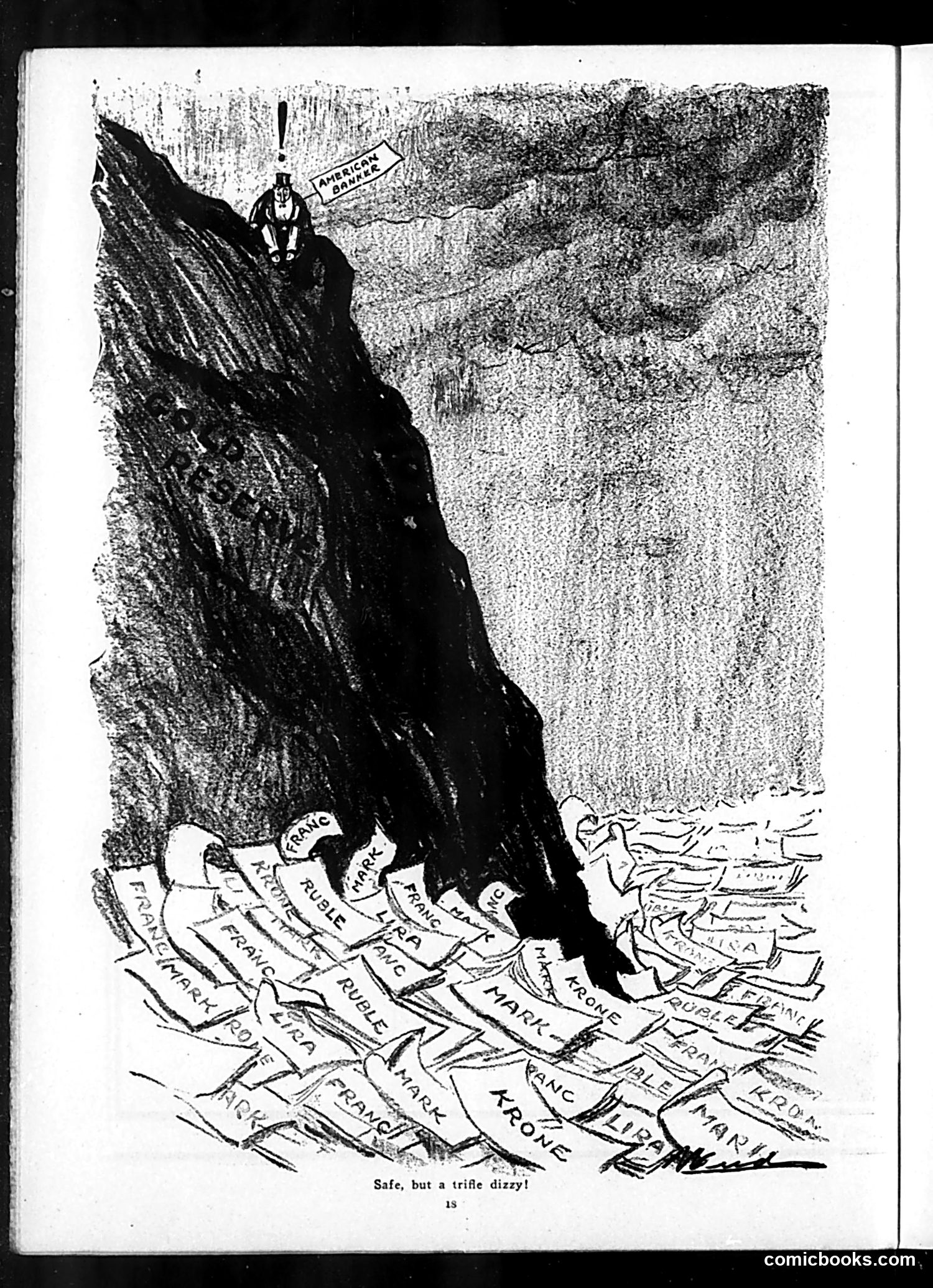
This is a political cartoon satirizing financial instability or market collapse. A dark, ominous figure (likely representing economic crisis or financial panic) stands atop a cliff, while below lies a foundation of scattered papers labeled with various bank and financial institution names (visible labels include "BANK," "MARK," "FRANC," "KRONE," and others—suggesting international currencies or banks). The caption "Safe, but a trifle dizzy!" delivers the joke: while the perched figure maintains precarious balance on financial institutions, the situation is technically "safe" but unstable and disorienting. This appears to critique post-World War I economic volatility, as the referenced currencies suggest European financial systems recovering from wartime disruption. The cartoon warns that apparent financial stability masks underlying dizzying uncertainty.
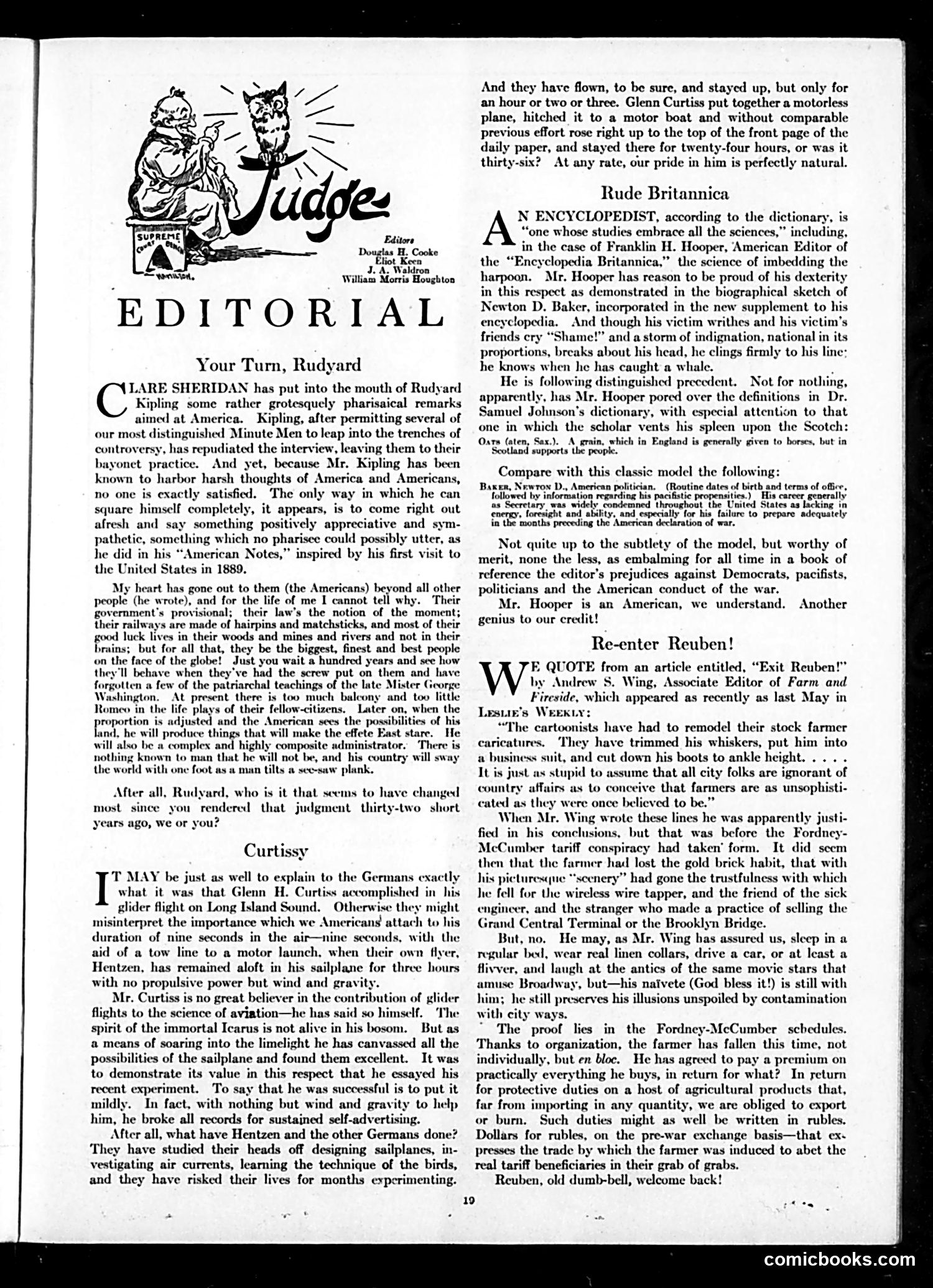
This editorial page from Judge magazine contains three distinct pieces satirizing prominent figures: **"Your Turn, Rudyard"** attacks author Rudyard Kipling for making critical remarks about America while previously praising Americans effusively. The editorial challenges Kipling to explain why his views have seemingly shifted, sarcastically noting that his 1889 prediction of American greatness appears validated. **"Curtissy"** mocks aviator Glenn Curtiss for his self-promotional stunt—a nine-second glider flight that generated massive press coverage. Judge contrasts this favorably to German aviator Hentzen's genuine three-hour unpowered flight achieved through serious engineering work. The satire suggests Curtiss prioritized publicity over scientific achievement: "he broke all records for sustained self-advertising." Both pieces reflect Progressive-era skepticism toward celebrity and self-promotion over genuine accomplishment, while maintaining ambivalence about American exceptionalism relative to European (particularly German) achievement.
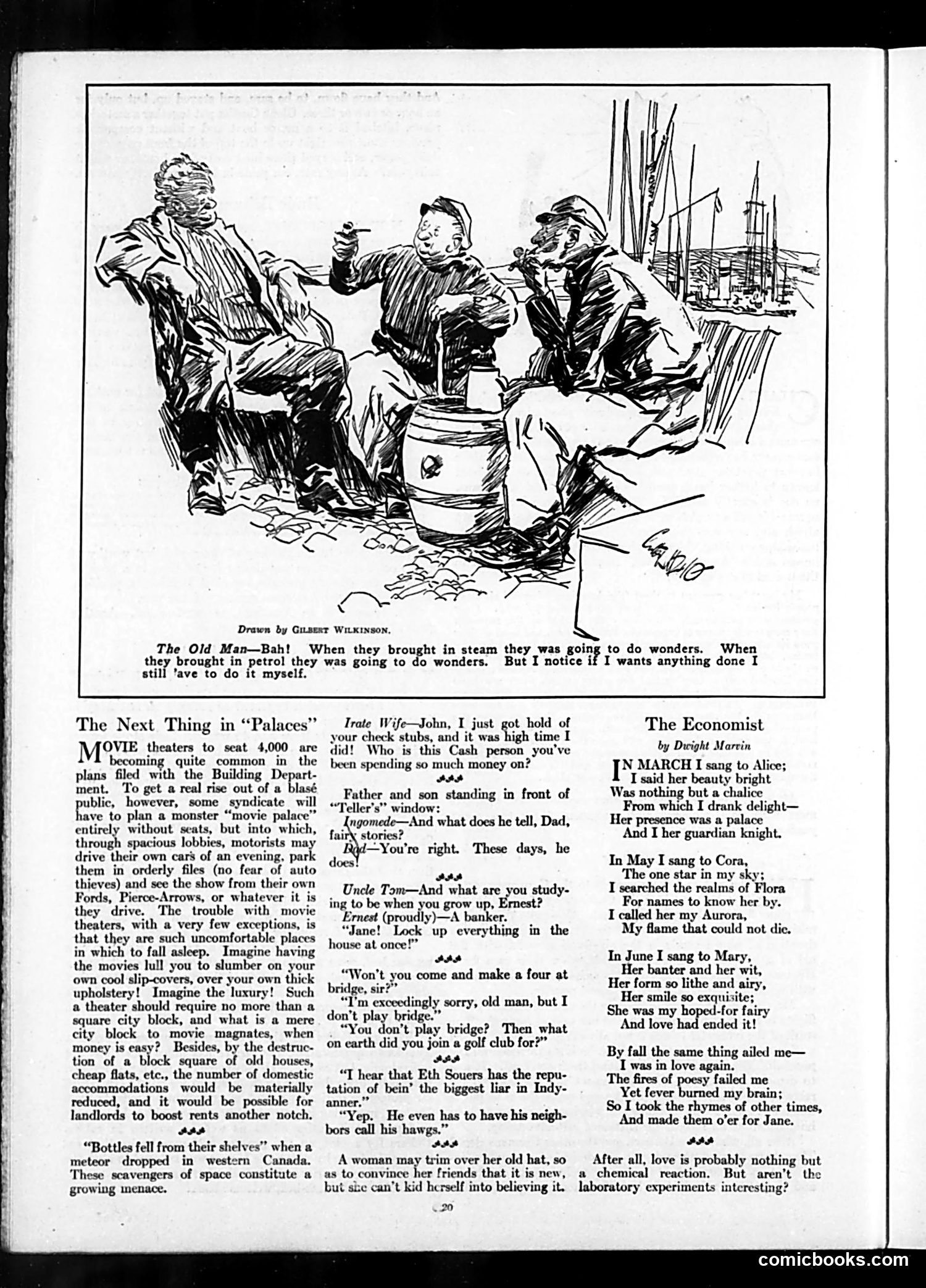
**The Main Cartoon** (top): An old man tells younger workers that despite new technologies like steam and petrol engines, he still has to do manual labor himself. It's a commentary on how industrial progress hasn't actually reduced working-class drudgery—machines promised wonders but workers remain essential. **"The Next Thing in Palaces"**: Satirizes the movie theater industry's escalating luxury competition. The article mockingly proposes an absurd "palace"—a drive-in theater where patrons watch films from their own cars parked in a city block. The satire works on two levels: ridiculing theater owners' excess and highlighting how this development would displace affordable housing, raising rents for the poor while catering to wealthy car owners. **Other Humor**: Various short jokes about banking, golf clubs, lying, and hat-trimming reflect period middle-class anxieties. **"The Economist"**: A poem mocking romantic men who recycle the same sentimental verses for different women, treating love as interchangeable rather than genuine. All content reflects 1910s-era American social concerns: technological disruption, real estate speculation, and class tensions.
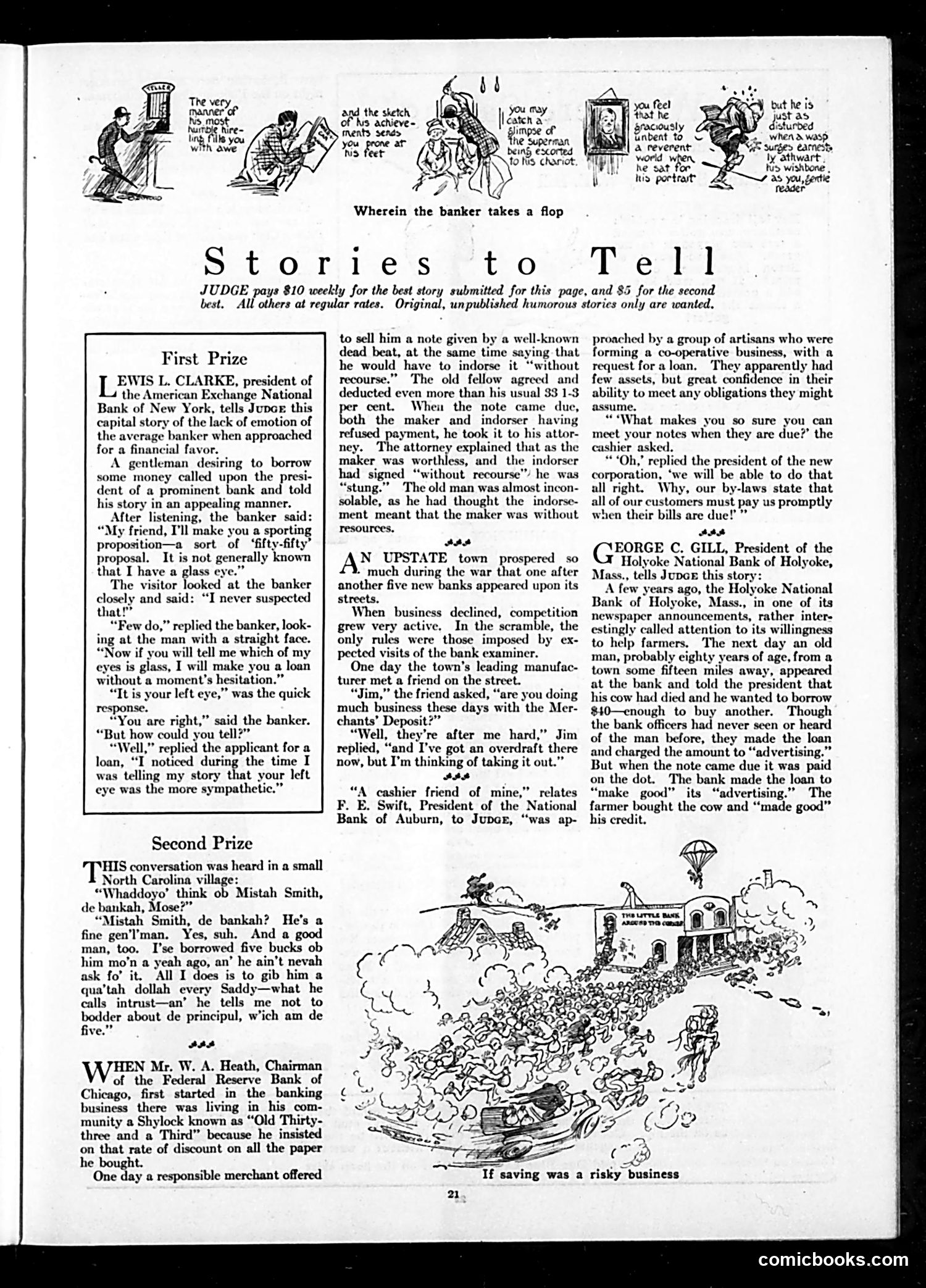
This page from *Judge* magazine presents humorous stories about bankers, satirizing their emotional coldness and questionable ethics during the early 20th century. **The Satire:** The first story mocks bankers' lack of sympathy—a loan applicant must identify which eye is glass (fake) to prove the banker has *any* capacity for feeling. The joke: the banker's "sympathetic" eye is the artificial one. **Social Context:** The other stories address banking practices and character. One depicts a naive Southern Black man praising a loan shark's generosity while unknowingly paying usurious interest. Another mocks an old moneylender ("Old Thirty-three and a Third") who doesn't understand loan contracts. A final story suggests banks compete aggressively, using suspicious practices during economic downturns. **The Point:** Collectively, these mock bankers as emotionally detached, dishonest, or incompetent—playing on public skepticism of financial institutions common in early-20th-century America, particularly following banking crises.
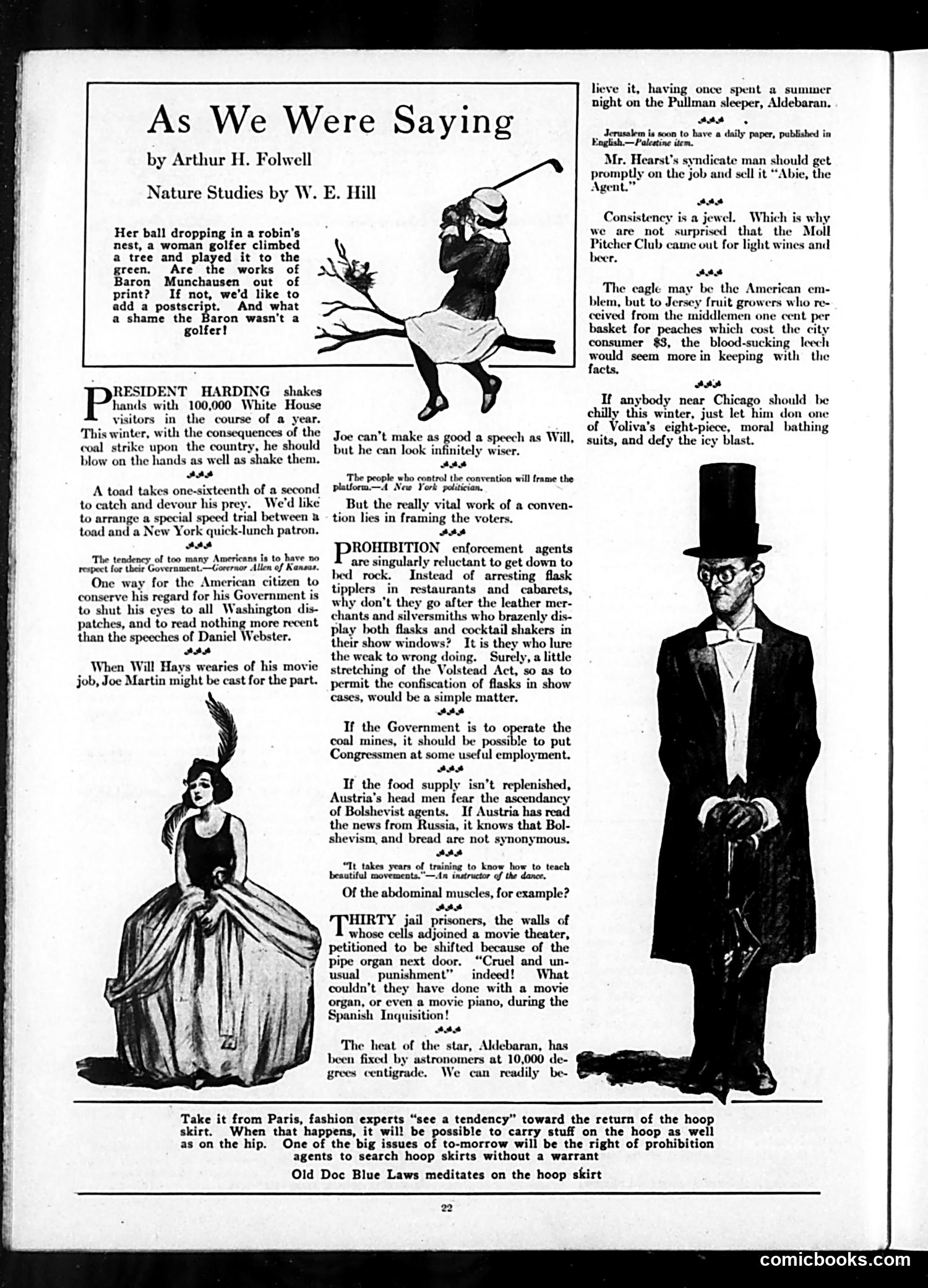
This page collects brief political and social commentary, typical of Judge's format. Key references include: **Political targets:** President Harding (mocked for shaking hands while ignoring coal-strike consequences); Will Hays (movie industry figure); Prohibition enforcement (satirized for targeting small offenders instead of manufacturers selling flasks openly); government coal-mine operation (suggesting idle Congressmen could run them). **Social satire:** References Prohibition's ineffectiveness, Austria's food crisis and Bolshevik fears, fashion trends (hoop skirts returning), a controversial religious leader named Voliva and his "moral bathing suits," and William Randolph Hearst's newspaper syndicate. **The illustrations** show a flapper and a formal gentleman, likely generic "modern types" rather than specific figures. The humor relies on absurdist logic and topical 1920s references—coal strikes, Prohibition enforcement, postwar Austria, and celebrity gossip—now requiring historical context to fully appreciate.
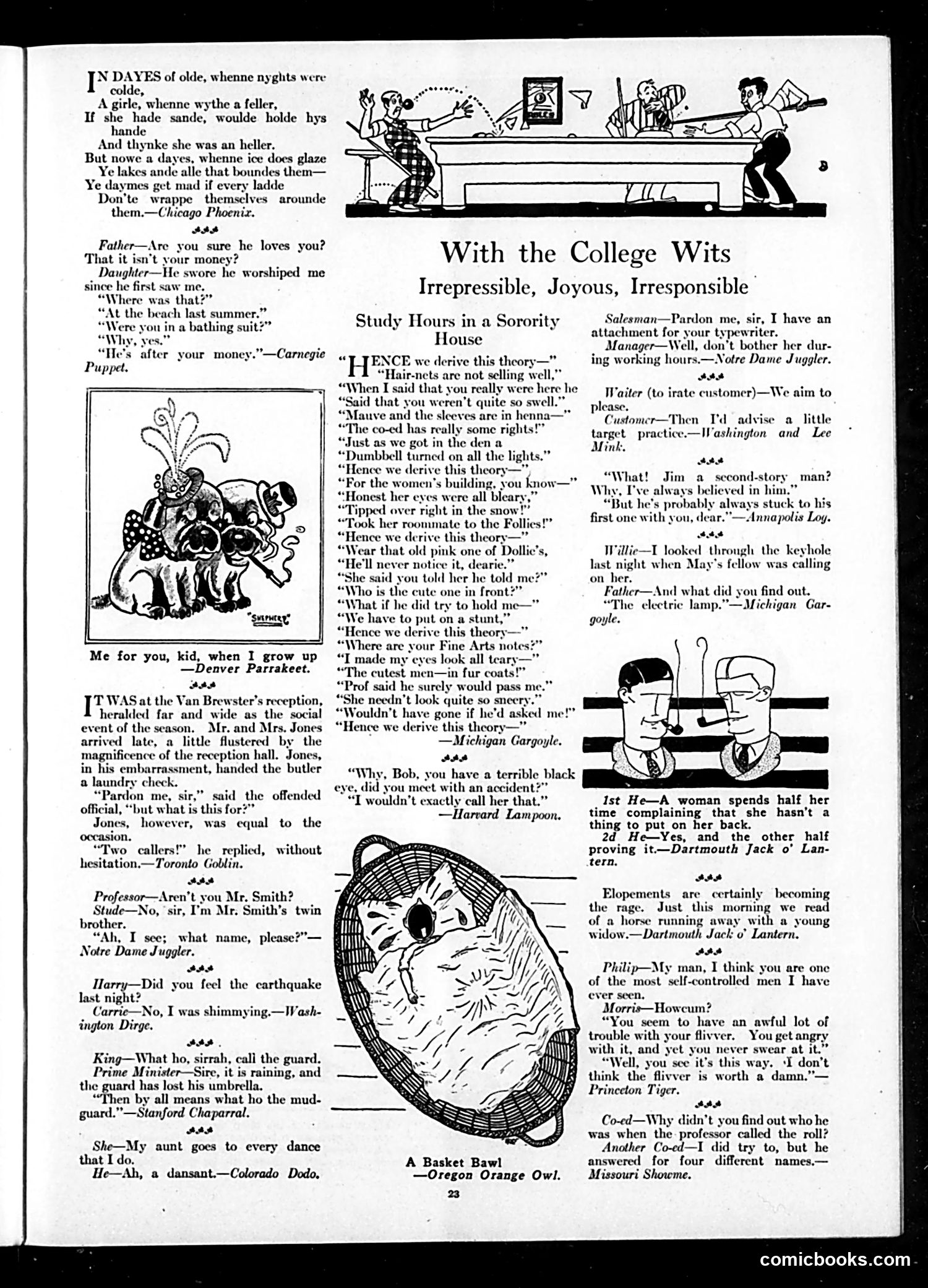
This page collects humorous quips from college newspapers, satirizing early 20th-century social life and dating customs. Key themes: **Dating/Romance Satire:** Multiple jokes mock young men's mercenary motives ("He's after your money") and women's fashion-consciousness at social events. The opening verse contrasts old-fashioned propriety with modern behavior. **College Life:** "Study Hours in a Sorority House" humorously depicts coeds distracted by gossip, fashion, and socializing rather than academics—a common complaint about women's higher education at the time. **Gender Humor:** Jokes about women's perpetual wardrobe anxiety and the "second-story man" reference (burglar joke with double meaning). **Social Embarrassment:** Stories like the Jones/laundry-check anecdote mock social climbing and faux pas at fancy receptions. The cartoons and quips represent collegiate humor from various universities' publications, showcasing period attitudes toward courtship, education, and gender roles.
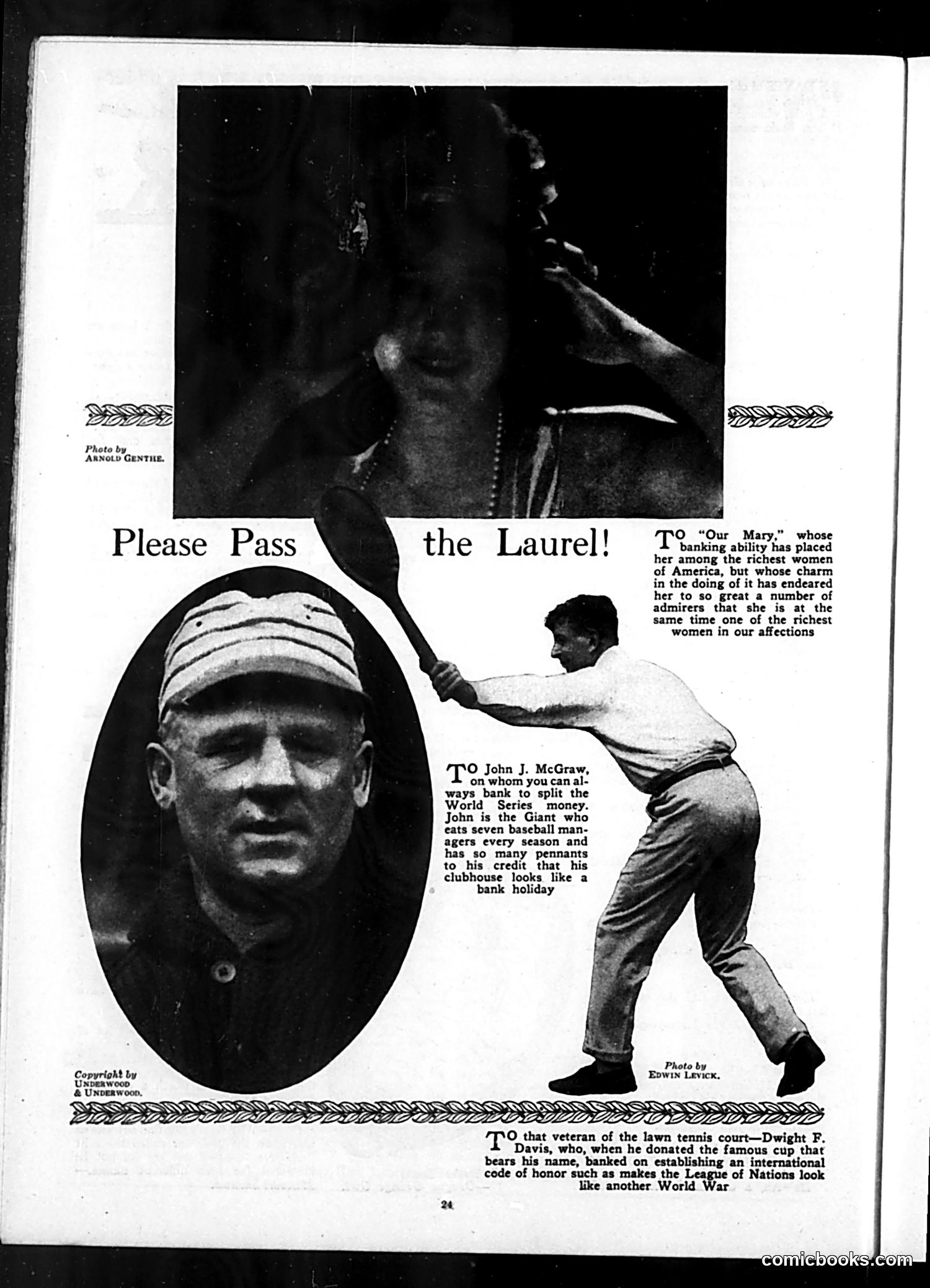
This page celebrates three wealthy American figures as financial titans. "Our Mary" (likely Mary Harriman Rumsey, a wealthy philanthropist and businesswoman) earns praise for combining banking acumen with charm. John J. McGraw, manager of the New York Giants baseball team, is humorously compared to a banker—he "splits" World Series money and has accumulated so many pennants his clubhouse "looks like a bank holiday." Dwight F. Davis, the tennis champion who donated the Davis Cup, is satirized for establishing an "international code of honor" through sport, implicitly contrasted with the failure of the League of Nations to prevent conflict. The satire suggests these wealthy elites use philanthropy and sports as vehicles for financial power and prestige. The recurring "banking" metaphor mocks their ability to profit from and control their respective domains while maintaining public admiration.
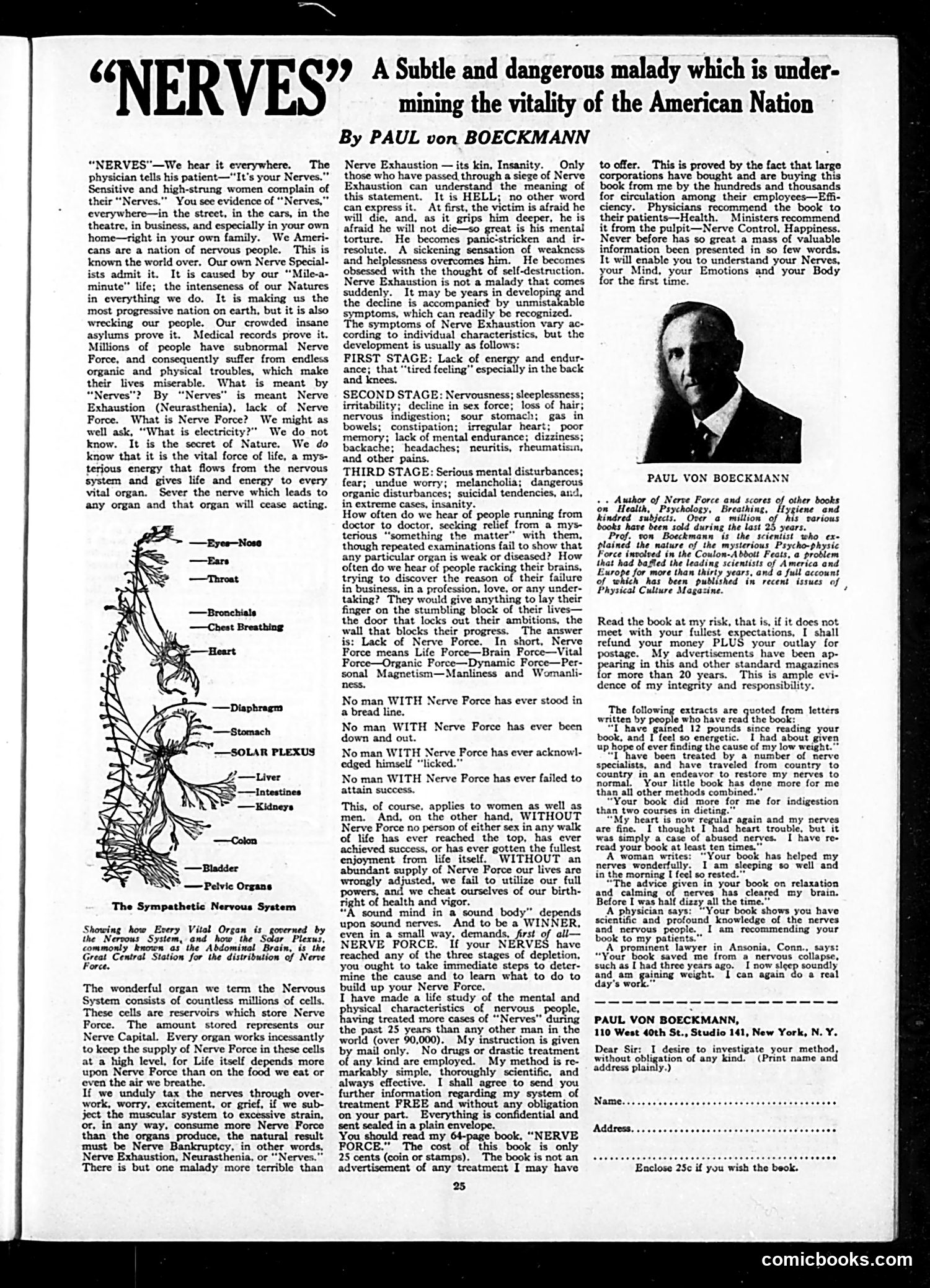
This is a **medical advertisement**, not satire or political commentary. Paul von Boeckmann promotes a book claiming to cure "Nerves" (neurasthenia)—a popular diagnosis in early 20th-century America for nervous exhaustion and anxiety. The page uses pseudoscientific language to describe how "Nerve Force" (undefined vital energy) depletes from modern life's stress, causing physical and mental illness. The anatomical diagram shows the nervous system's supposed central role in health. **The pitch**: American society's fast-paced "mile-a-minute" life causes widespread nerve depletion, filling asylums and causing misery. Boeckmann's 64-page book promises understanding and recovery—without drugs or drastic treatment. **Historical context**: "Nerves" was a catch-all diagnosis for stress-related conditions, particularly affecting affluent women and professionals. Such advertisements were standard in magazines like *Judge*, exploiting genuine anxiety about modernity and industrialization with dubious medical claims.
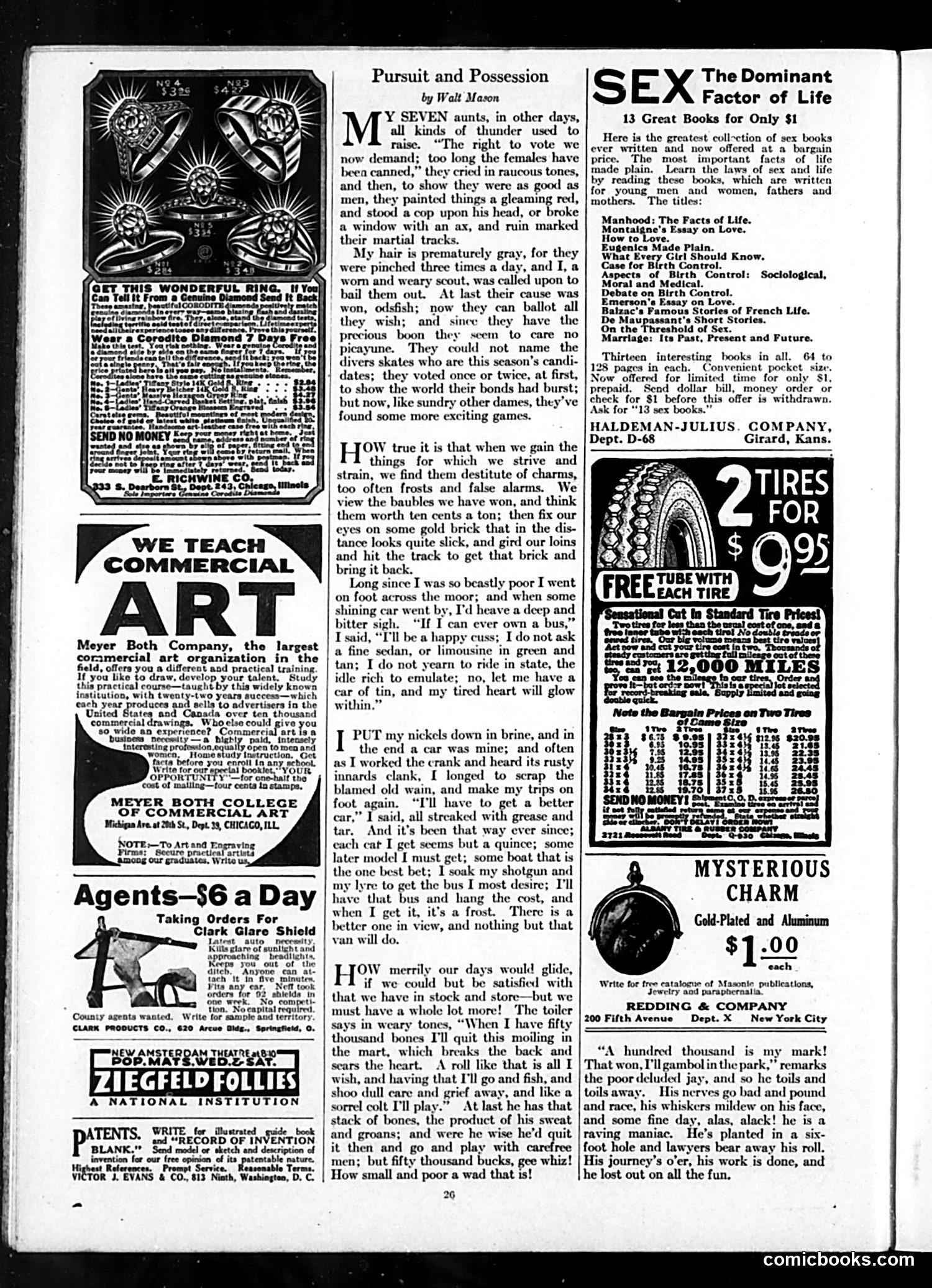
This page contains a prose poem by Walt Mason titled "Pursuit and Possession," which satirizes human nature through two examples: 1. **Women's Suffrage**: Mason mocks women who fought passionately for voting rights ("painted things a gleaming red, and stood a cop upon his head"), only to lose interest once they gained it. They now prefer "more exciting games" to actually voting, suggesting their activism was performative rather than principled. 2. **Consumer Materialism**: Mason illustrates the broader human pattern of obsessively desiring possessions, then losing interest once obtained. He describes longing for a car, finally acquiring one, then immediately wanting a better model—an endless cycle of dissatisfaction. The satire's point: humans don't truly value what they pursue; they value the *pursuit itself*. Once goals are achieved, the thrill vanishes. The humor lies in exposing this universal human weakness through relatable examples. The surrounding page contains advertisements for art schools, patent services, and auto accessories—typical of period magazines.
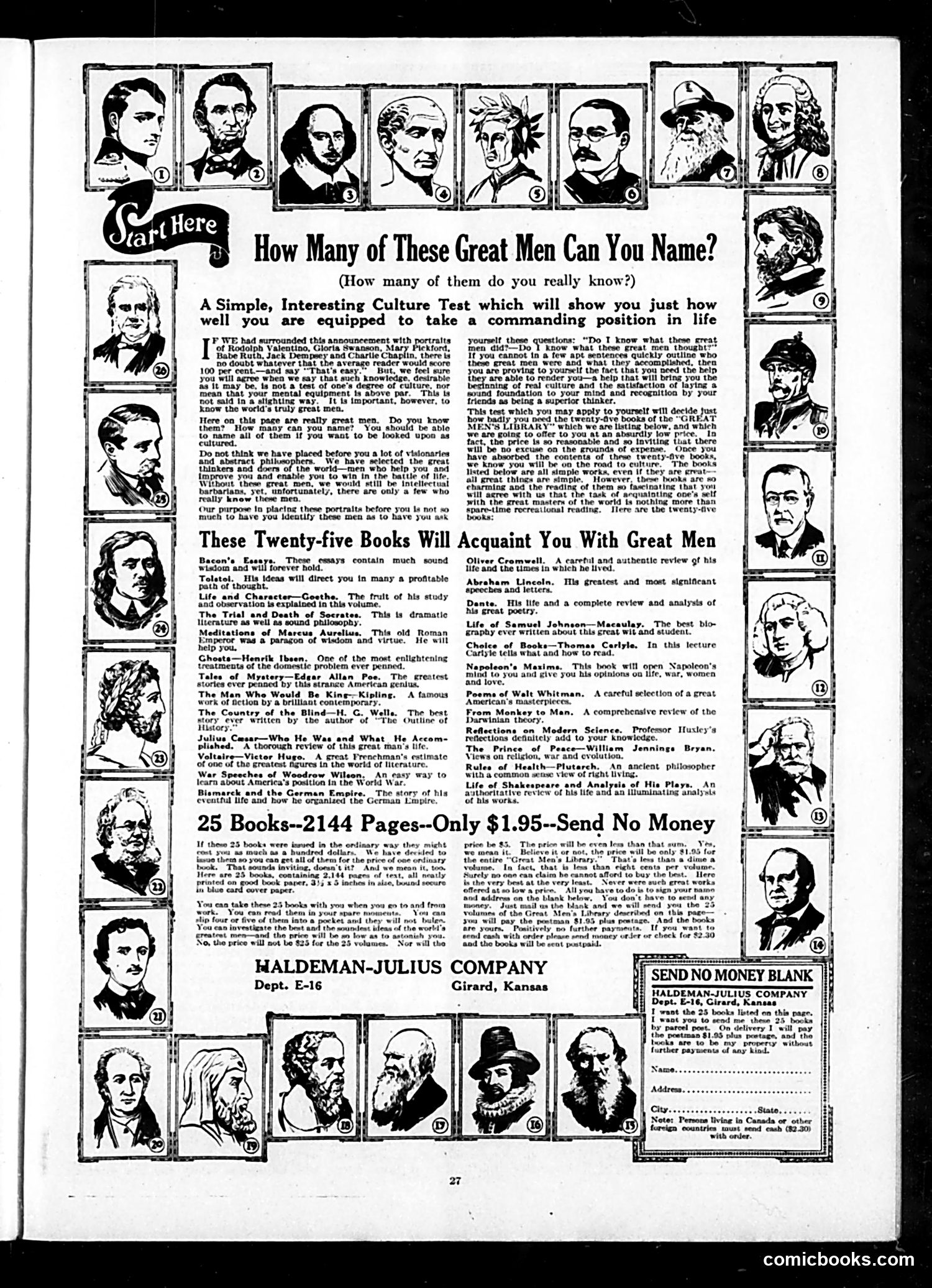
This page is primarily **advertising disguised as a culture test**, not political satire. The Haldeman-Julius Company uses a pedagogical hook—challenging readers to identify 25 portrait sketches of "great men"—to sell their "Little Blue Books" collection. The satirical *premise* mocks contemporary American culture: the text complains that people easily recognize movie stars (Valentino, Chaplin, Babe Ruth) but not historical intellectuals (Bacon, Tolstoy, Goethe, Marcus Aurelius). It's a **snobbish jab at mass entertainment culture** versus "serious" self-improvement. The actual identities of most portraits are unclear from the image alone, though the text references philosophers, writers, and statesmen. The marketing angle appeals to aspirational readers wanting to appear "cultured" by knowing important historical figures. This reflects 1920s **self-improvement publishing trends**—affordable educational materials marketed to working-class readers seeking intellectual status.
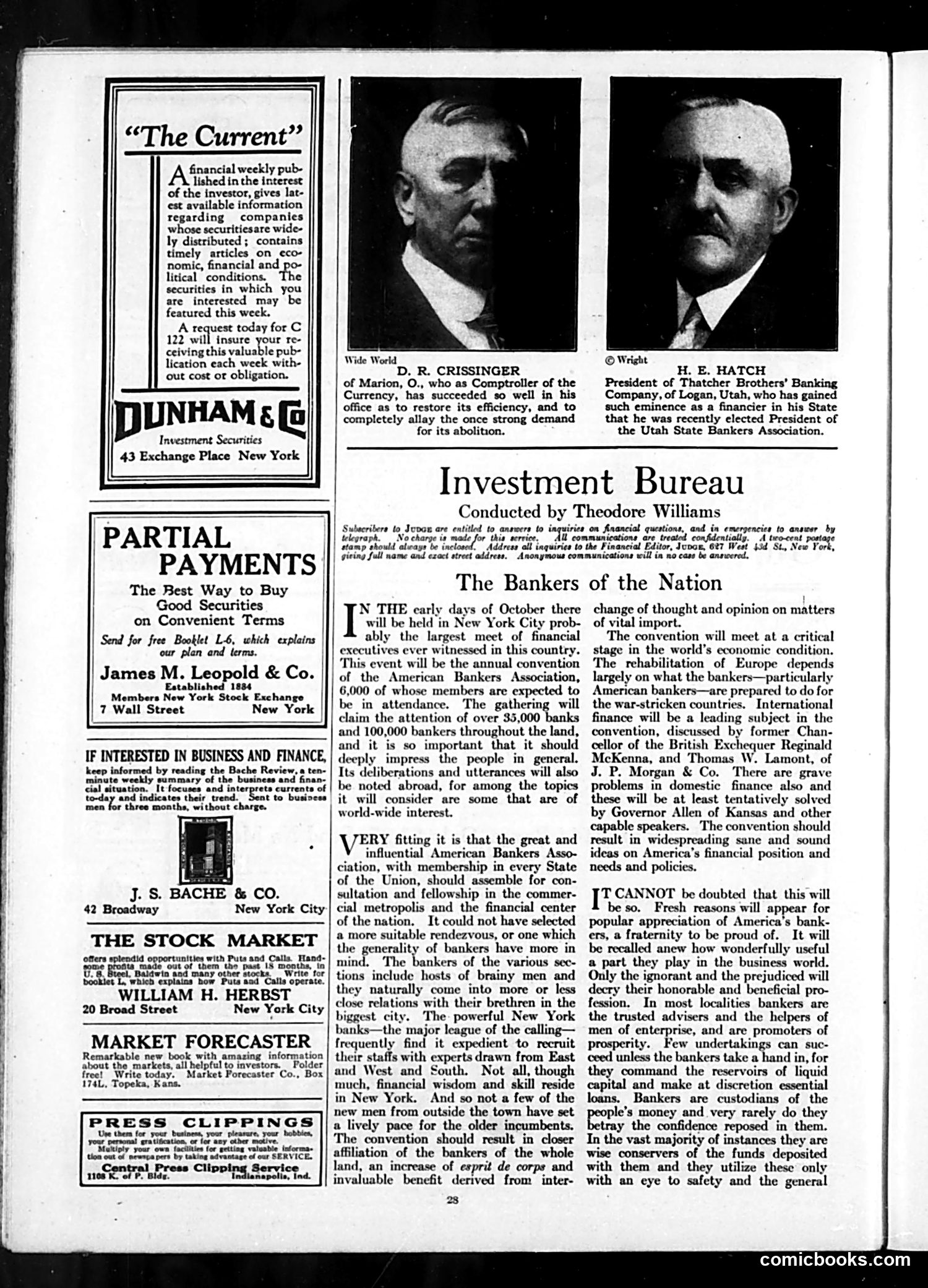
This is primarily a **financial services advertising page** with two photographic portraits and an editorial article about banking. **The Portraits:** The page features D. R. Crissinger (Comptroller of the Currency from Marion, Ohio) and H. E. Hatch (President of Thatcher Brothers' Banking Company, Utah). These appear to be straightforward professional portraits accompanying brief biographical captions—not satirical cartoons. **The Editorial Content:** Theodore Williams' "Investment Bureau" article discusses the upcoming American Bankers Association convention in New York City, expected to draw 6,000 members and over 100,000 bankers nationwide. The piece emphasizes the convention's importance for addressing "world-wide" economic issues and promoting unity among American bankers. **The Satire/Context:** The article's tone is earnest and promotional rather than satirical. Any satire would be subtle—perhaps implicit in the reverent treatment of bankers as national leaders during a period of economic importance. This page functions primarily as **financial advertising and industry news** rather than as satirical commentary.
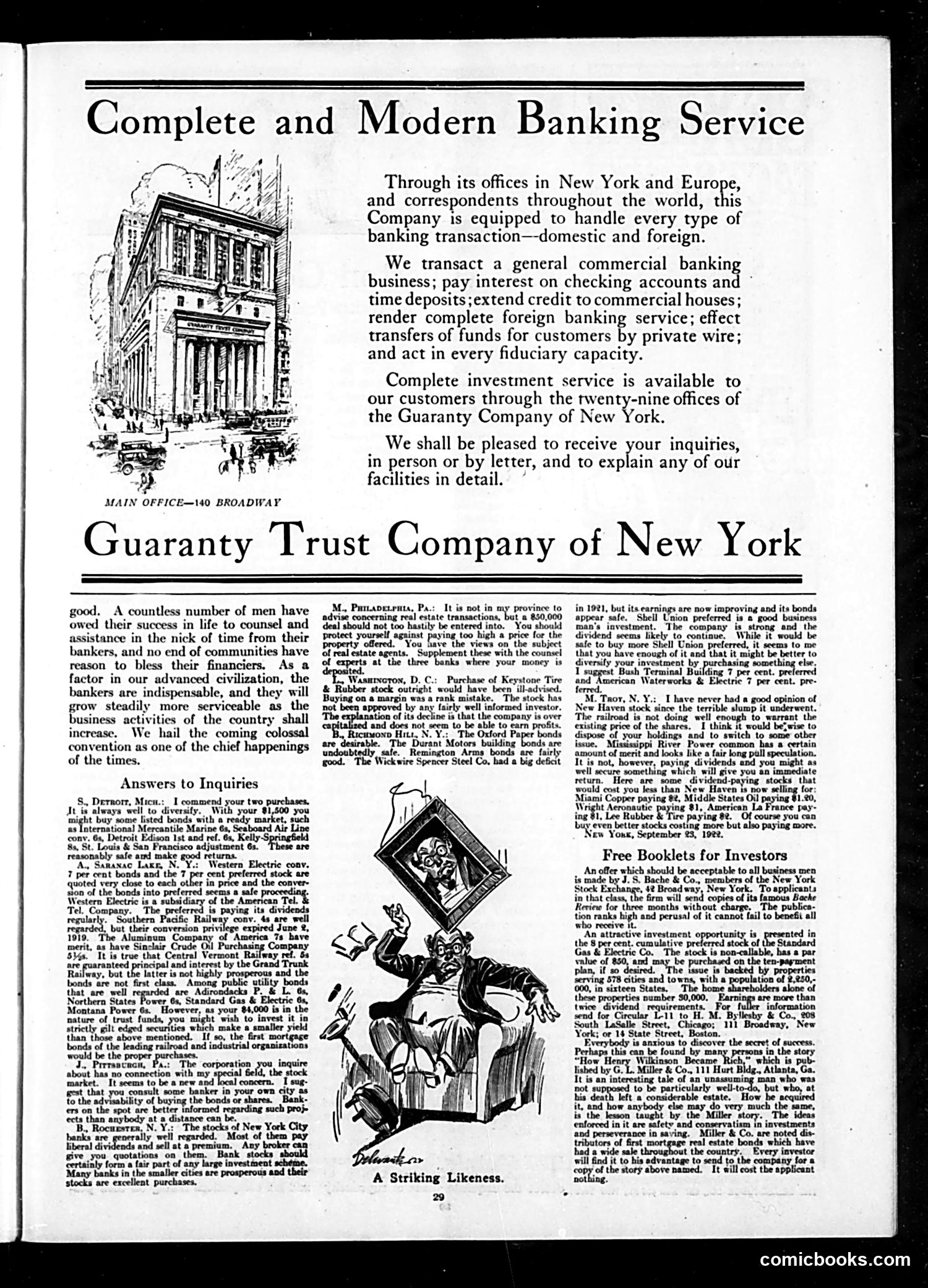
This page is primarily a **banking advertisement** for Guaranty Trust Company of New York, occupying the top half with corporate messaging about their financial services and international banking capabilities. The bottom half contains an **"Answers to Inquiries" investment advice column**—readers writing from various cities seeking guidance on purchasing bonds and stocks. The OCR text shows queries about securities like railroad bonds, utility stocks, and industrial shares, with responses recommending diversification and safety-conscious investing. The only illustration is a political cartoon titled **"A Striking Likeness"** (bottom center), though the OCR text provided doesn't clarify its subject or satirical point—it's unclear what or whom it depicts without seeing the caption clearly. The overall page reflects early 20th-century financial journalism: practical investment advice for middle-class readers, emphasis on "gilt-edged securities," and banker-as-trusted-advisor sentiment typical of the era before securities regulation existed.
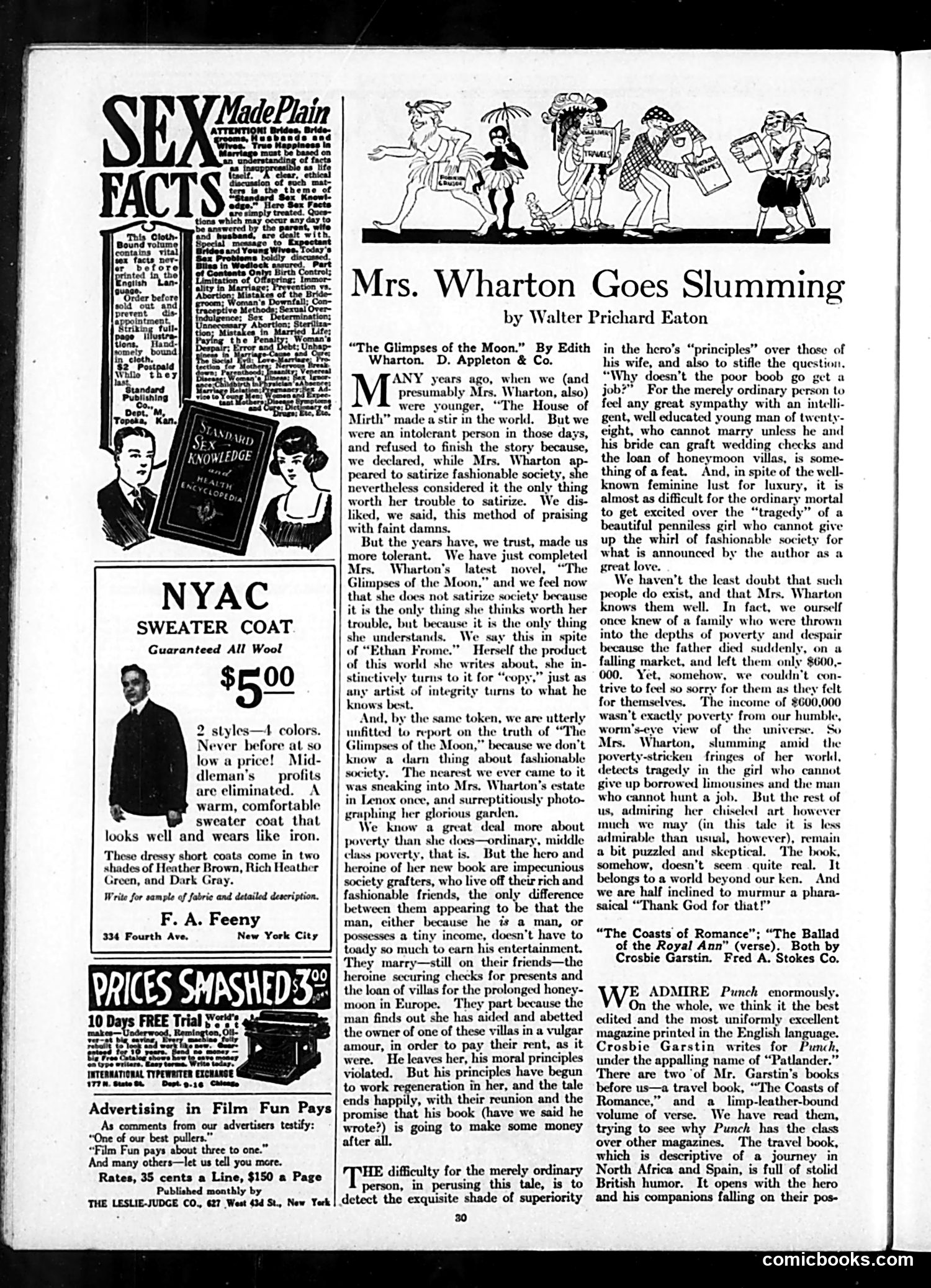
This page is primarily **literary criticism and advertising**, not political satire. The main article reviews Edith Wharton's novel "The Glimpses of the Moon." Reviewer Walter Prichard Eaton critiques Wharton for writing exclusively about fashionable society—the only world she understands. He notes the book's hero and heroine are impoverished social climbers living off wealthy friends' generosity. Eaton's central complaint: the moral conflict feels hollow to ordinary readers. The husband leaves his wife for helping a villa-owner with an affair to pay rent, then morally "regenerates" her. Eaton finds this superiority laughable—why doesn't the educated young man simply get a job instead of parasitically grafting "wedding checks and honeymoon villa loans"? The satire targets **Wharton's detachment from working-class reality**, not politics. The cartoon header showing fashionable people illustrates the book's subject matter. The page also advertises a $5 wool sweater coat and promotes advertising in "Film Fun" magazine.
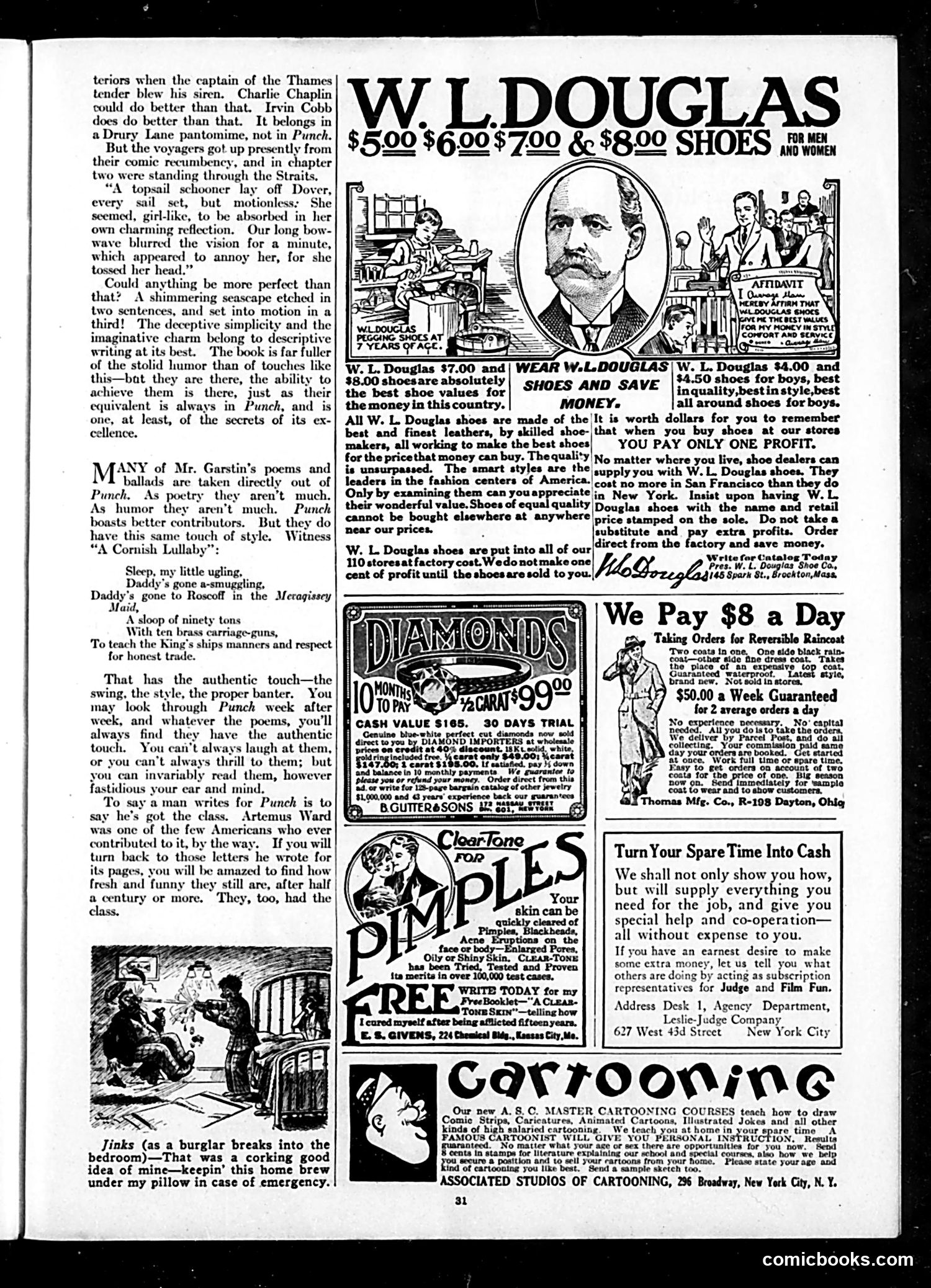
This page is primarily **advertising** rather than editorial or satirical content. The dominant features are commercial advertisements for W.L. Douglas shoes (multiple price points), a Diamonds mail-order offer, a "Clear-Tone for Pimples" skin treatment, a cartooning correspondence course, and a raincoat sales opportunity. The small editorial content at top discusses literary merit in *Punch* magazine, praising descriptive writing and the "authentic touch" of *Punch* contributors like Garstin. It includes a sample "Cornish Lullaby" poem about smuggling—presented as humorous verse with period charm. A single cartoon illustration (bottom left) appears to show a domestic scene with someone hiding "home brew" under a pillow—likely referencing Prohibition-era humor about illegal alcohol. The page reflects early 20th-century magazine economics: substantive editorial content sharing space with numerous direct-response advertisements targeting readers seeking shoes, romance, income, or self-improvement.
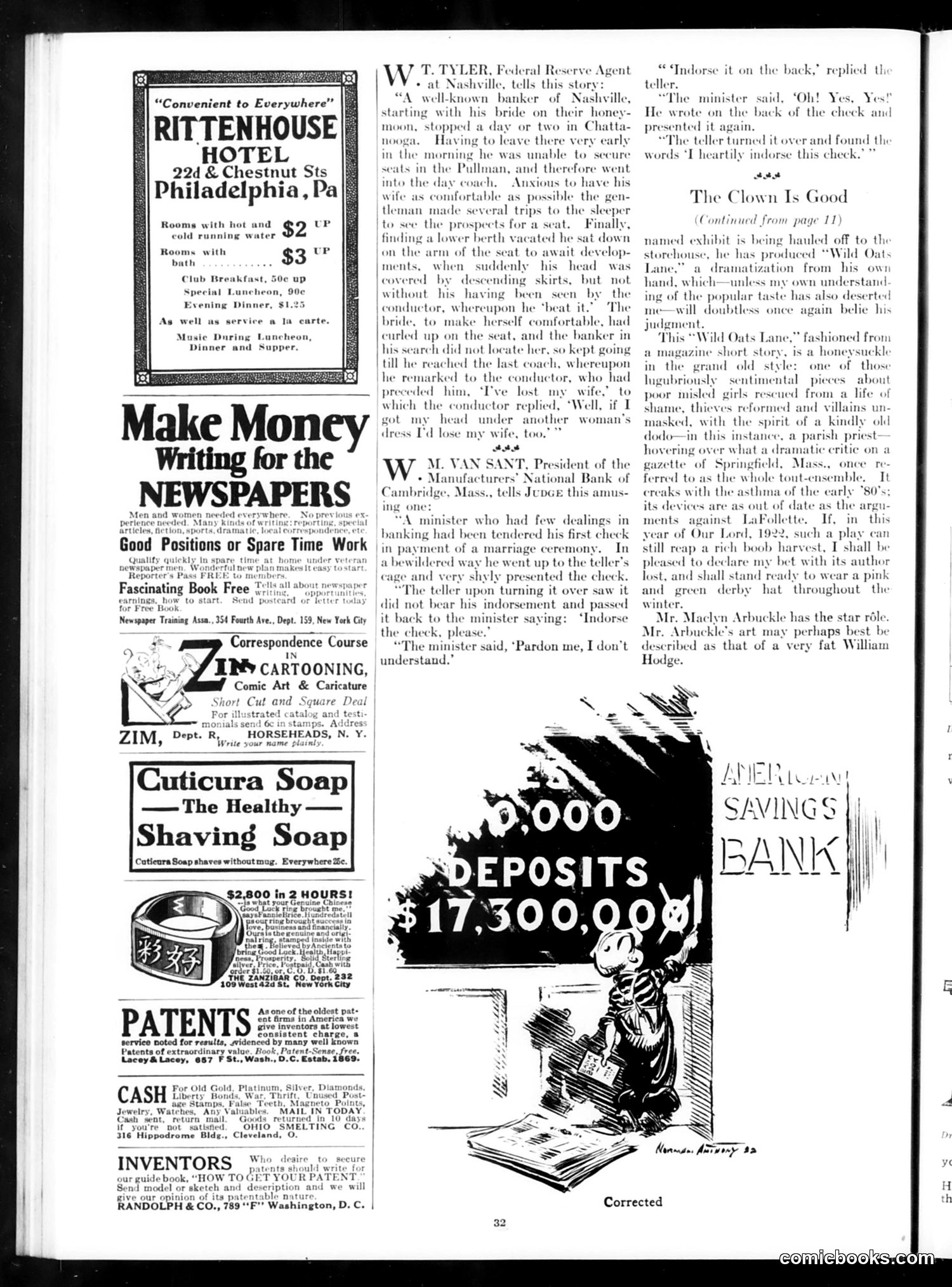
This page is primarily **advertising and miscellaneous content** rather than editorial satire or cartooning. The main feature is **three anecdotal stories** about bankers and financial figures encountering minor embarrassments: 1. **W.T. Tyler's story**: A banker's newlywed wife hides under descending skirts on a train; he searches unsuccessfully through cars looking for her—a comedic misunderstanding about train etiquette. 2. **M. Van Sant's story**: A minister receives his first check for performing a marriage ceremony, doesn't understand what "indorse" means, and literally writes "I heartily indorse this check" on the back instead of signing it—humor based on religious innocence about banking. 3. **"The Clown Is Good"** review discusses a theatrical production of "Wild Oats Lane," praising actor Maclyn Arbuckle's performance. These are gentle, domestic humor pieces typical of Judge's era—relying on innocent confusion rather than sharp political satire. The page otherwise contains standard classified ads (patents, soap, hotels, correspondence courses).
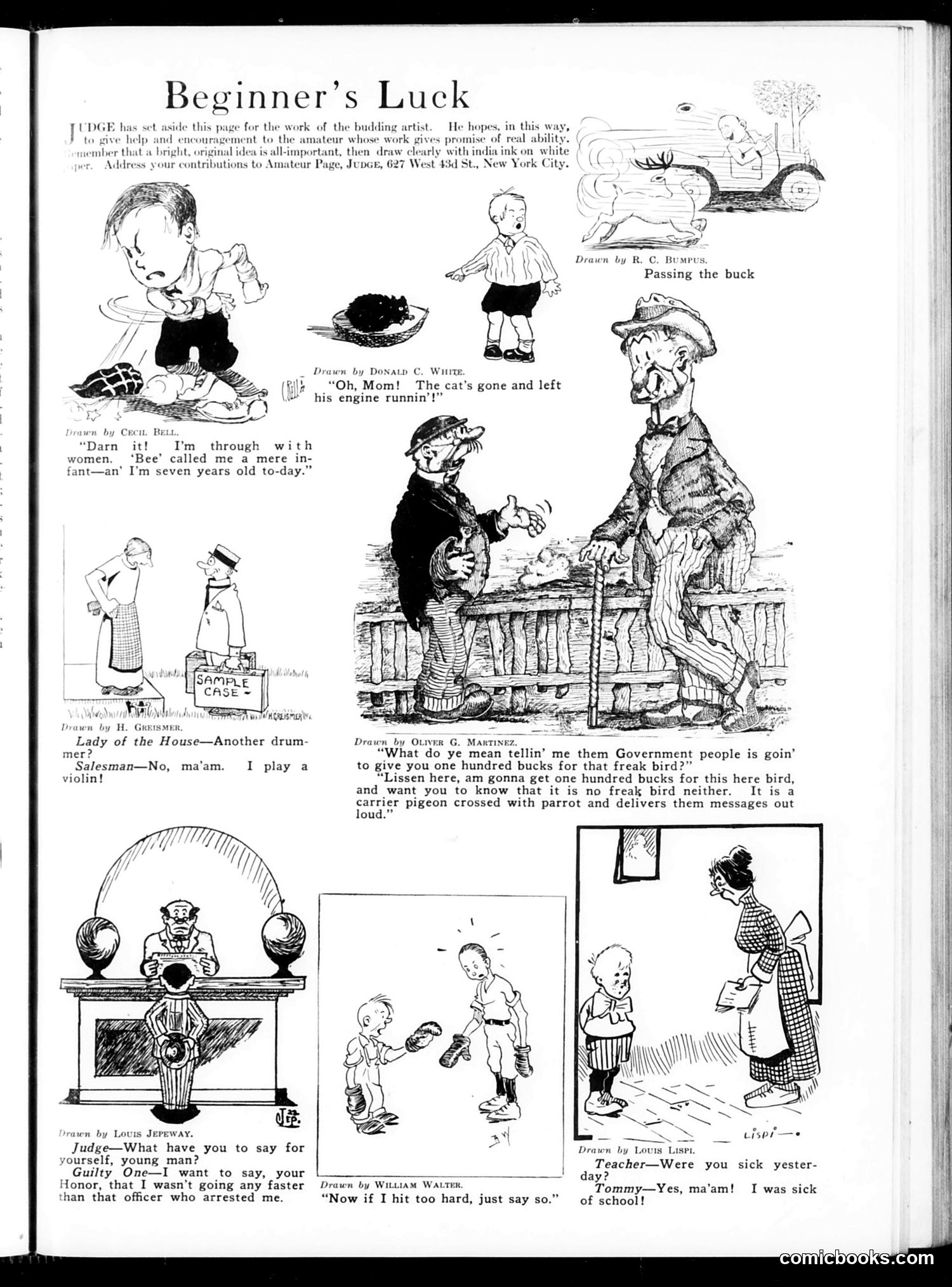
This page showcases amateur cartoonists' work on everyday humor topics. The jokes reflect early-20th-century domestic life and social situations: **Key cartoons include:** - A seven-year-old boy upset at being called a "mere infant" by a girl named "Bee"—poking fun at childhood romance and pride - A door-to-door salesman claiming to play violin (not drums)—playing on occupational stereotypes - A courtroom scene where a defendant defends himself by claiming the arresting officer was speeding too—absurdist deflection of guilt - A "freak bird" joke about a pigeon-parrot hybrid allegedly delivering messages—playing on gullibility and tall tales - A schoolboy admitting he faked illness to skip school—a timeless childhood deception The satire targets vanity, petty excuses, occupational pretension, and childhood mischief. These are gentle, observational humor pieces reflecting mundane American life rather than political commentary. The "Beginner's Luck" header indicates Judge actively encouraged amateur artists to submit original work.
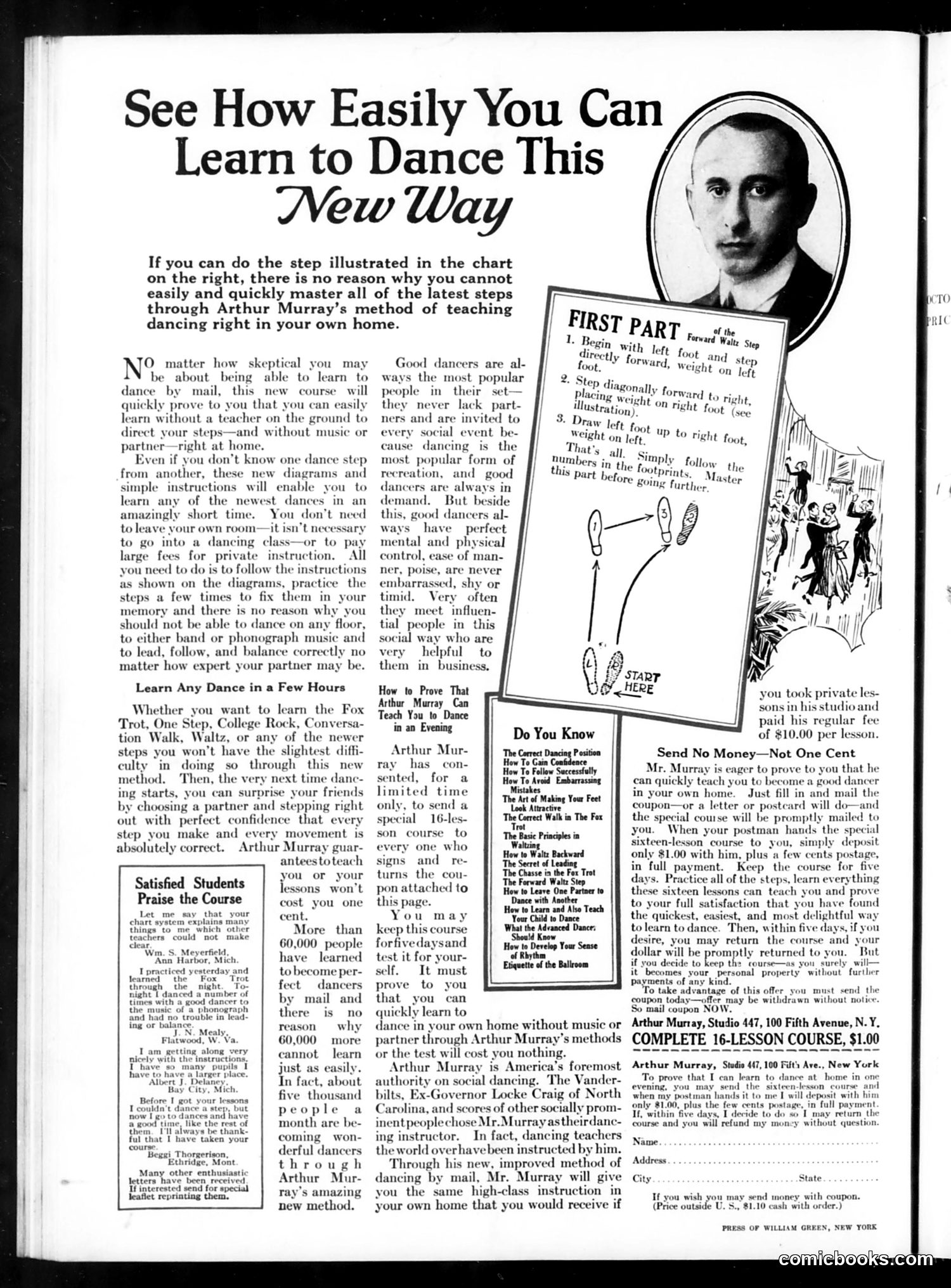
This is primarily **advertising, not satire or political content**. The page promotes Arthur Murray's new method for learning to dance by mail from home—a genuinely novel service for the 1920s era. The key pitch: anyone can master popular dances (Fox Trot, Waltz, One Step) using printed diagrams and instructions without a teacher, partner, or music. The simple footprint diagrams shown illustrate the method's accessibility. The testimonials from satisfied students ("Satisfied Students Praise the Course") establish credibility. Murray is identified as "America's foremost authority on social dancing" and claims elite clientele (Vanderbilts, Ex-Governor Locke Craig). The offer: a 16-lesson course for $1.00, with a five-day trial period where customers can test it risk-free—if dissatisfied, the cost is refunded. This reflects early 20th-century direct-mail marketing strategy. There is **no political satire or caricature** present on this page; it is straightforward period advertising.