
Judge, 1922-09-30 · page 13 of 36
Judge — September 30, 1922 — page 13: what you’re looking at
What you’re looking at
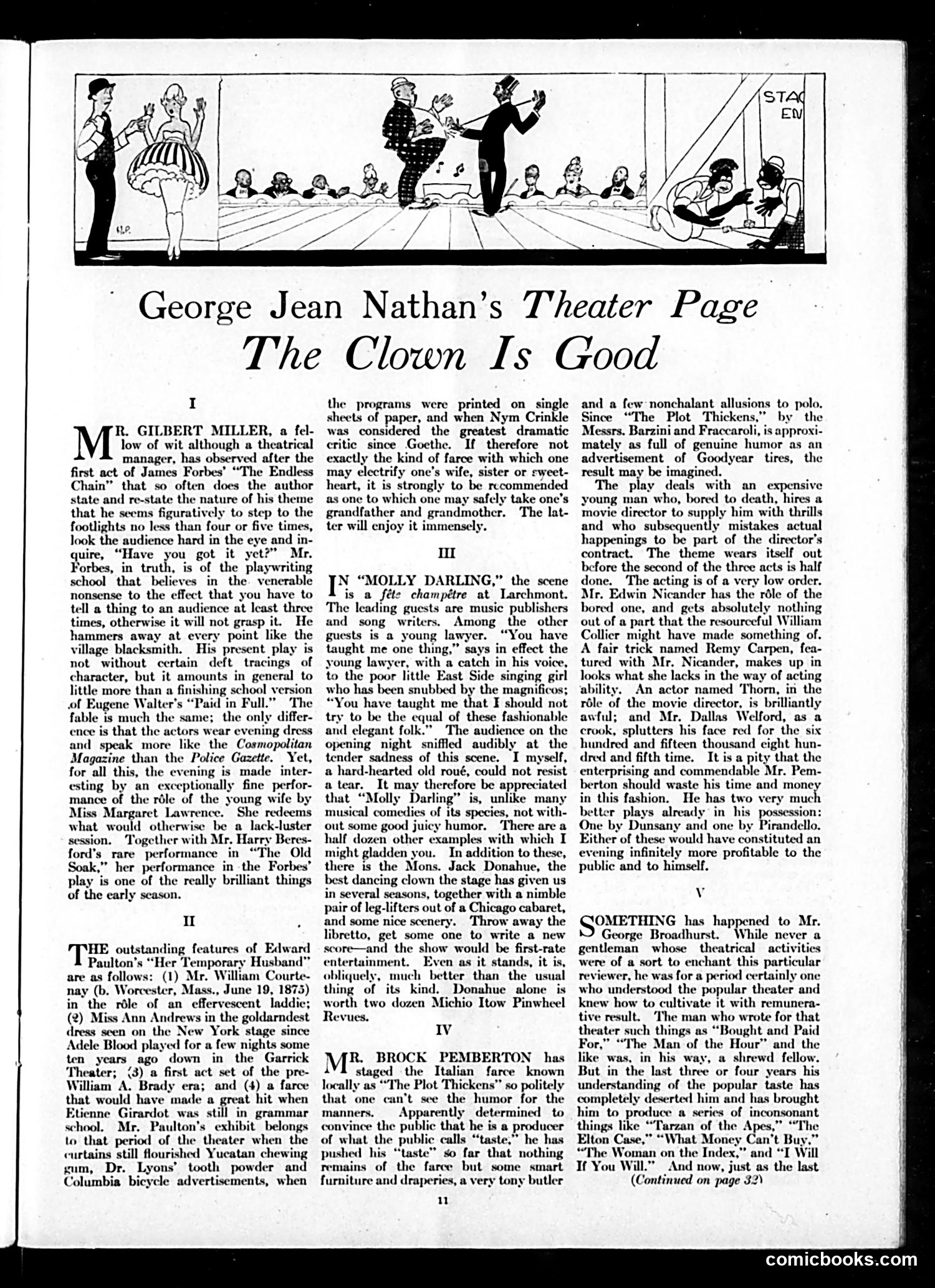
This is a theatrical review column, not a political cartoon. The header illustration depicts a stage scene with performers and audience, establishing the entertainment theme. Nathan critiques three Broadway productions: James Forbes' "The Endless Chain" (criticized for repetitive exposition), Edward Paulton's "Her Temporary Husband" (dismissed as old-fashioned farce from an earlier theatrical era), and "Molly Darling" (a musical comedy praised for balancing sentiment with humor). The reviews are characteristic of early 20th-century theater criticism—witty, sometimes condescending, and peppered with references to contemporary performers and outdated theatrical conventions. Nathan praises Miss Margaret Lawrence and Jack Donahue's dancing while mocking plays that rely on heavy-handed storytelling techniques and dated stage aesthetics (Columbia bicycle advertisements, Yucatan chewing gum promotions). The satire targets theatrical mediocrity and nostalgia for an earlier, cruder stage era.
📄 Transcribed text from this page (OCR, searchable)
Machine-transcribed from the original scan — historical spelling and the odd misread are preserved.
George Jean Nathan’s Theater Page The Clown Is Good and a few nonchalant allusions to polo, I R. GILBERT MILLER, a fel- low of wit although a theatrical manager, has observed after the first act of James Forbes’ “The Endless Chain” that so often does the author state and re-state the nature of his theme that he seems figuratively to step to the footlights no less than four or five times, look the audience hard in the eye and in- quire, “Have you got it yet?” Mr. Forbes, in truth, is of the playwriting school that believes in the. venerable nonsense to the effect that you have to tell a thing to an audience at Icast three times, otherwise it will not grasp it. He hammers away at every point like the village blacksmith. His present play is not without certain deft tracings of character, but it amounts in general to little more than a finishing school version Zugene Walter's “Paid in Full.” The fable is much the same; the only differ- ence is that the actors wear evening dress and speak more like the Cosmopolitan Magazine than the Police Gazette. Yet, for all this, the evening is made inter- esting by an exceptionally fine perfor- mance of the réle of the young wife by Miss Margaret Lawrence. She redeems what would otherwise be a_lack-luster session. Together with Mr. Harry Beres- ford’s rare performance in “The Old Soak,” her performance in the Forbes’ play is one of the really brilliant things of the early season. II HE outstanding features of Edward Paulton’s “Her Temporary Husband” are as follows: (1) Mr. William Courte- nay (b. Worcester, Mass., June 19, 1875) in the role of an effervescent laddic; (2) Miss Ann Andrews in the goldarndest dress seen on the New York stage since Adele Blood played for a few nights some ten years ago down in the Garrick Theater; (3) a first act set of the pre- William A. Brady era; and (4) a farce that would have made a great hit when Etienne Girardot was stil i in grammar school. Mr. Paulton’s exhibit belongs to that period of the theater when the curtains still flourished Yucatan chewing gum, Dr. Lyons’ tooth powder and Columbia bicycle advertisements, when the programs were printed on_ sin; ie sheets of paper, and when Nym Crin! was considered the greatest dramatic critic since Goethe. If therefore not exactly the kind of farce with which one may electrify one’s wife, sister or sweet- heart, it is strongly to be reccommended as one to which one may safely take one’s grandfather and grandmother. The lat- ter will enjoy it immensely. I N “MOLLY DARLING,” the scene is a féte champétre at Larchmont. The leading guests are music publishers and song writers. Among the other guests is a young lawyer. “You have taught me one thing,” sa: effect the young lawyer, with a cate! h in his voice, to the poor little East Side singing girl who has been snubbed by the magnificos; “You have taught me that F should not try to be the equal of these fashionable and elegant folk.” The audience on the opening night sniffled audibly at the tender sadness of this scene. I myself, a hard-hearted old roué, could not resist a tear. It may therefore be appreciated that “Molly Darling” is, unlike many musical comedies of its species, not with- out some good juicy humor. ere are a half dozen other examples with which I might gladden you. In addition to these, there is the Mons. Jack Donahue, the best dancing clown the stage has given us in several seasons, together with a nimble pair of leg-lifters out of a Chicago cabaret, and some nice scenery. Throw away the libretto, get some one to write a new score—and the show would be first-rate entertainment. Even as it stands, it is, obliquely, much better than the usual thing of its kind. Donahue alone is worth two dozen Michio Itow Pinwheel Revues. IV M R. BROCK PEMBERTON has a staged the Italian farce known locally as “The Plot Thickens” so politely that one can’t see the humor for the manners. Apparently determined to convince the public that he is a producer of what the public calls “taste,” he has pushed his “taste” so far that nothing remains of the farce but some smart furniture and draperies, a very tony butler u Since “The Plot Thickens,” by the Messrs. Barzini and Fraccaroli, is approxi- mately as full of genuine humor as an advertisement of Goodyear tires, the result may be imagined. The play deals with an expensive young man who, bored to death, hires a movie director to supply him with thrills and who subsequently mistakes actual happenings to be part of the director’s contract. The theme wears itself out before the second of the three acts is half done. The acting is of a very low order. Mr. Edwin Nicander has the rdle of the bored one, and gets absolutely nothing out of a part that the resourceful William Collicr might have made something of. A fair trick named Remy Carpen, fea- tured with Mr. Nicander, makes up in ks what she lacks in the way of acting y. An actor named Thorn, in the rile of the movie director, is brilliantly awful; and Mr. Dallas Welford, as a crook, splutters his face red for the six hundred and fifteen thousand eight hun- dred and fifth time. It is a pity that the enterprising and commendable Mr. Pem- berton should waste his time and money in this fashion. He has two very much better plays already in his possession: One by Dunsany and one by Pirandello. Either of these would have constituted an evening infinitely more profitable to the public and to himself. v SOMETHING has happened to Mr. George Broadhurst. While never a gentleman whose theatrical activities were of a sort to enchant this particular reviewer, he was for a period certainly one who understood the popular theater and knew how to cultivate it with remunera- tive result. The man who wrote for that theater such things as “Bought and Paid For,” “The Man of the Hour” and the like was, in his way, a shrewd fellow. But in the last three or four years his understanding of the popular taste has completely deserted him and has brought him to produce a series of incoi things like “Tarzan of the Apes, Elton Case,” “What Mone; “The Woman on the Index, vill If You Will.” And now, just as the last (Continued on page 3:2) comicbooks.com