
Judge, 1922-09-30 · page 8 of 36
Judge — September 30, 1922 — page 8: what you’re looking at
What you’re looking at
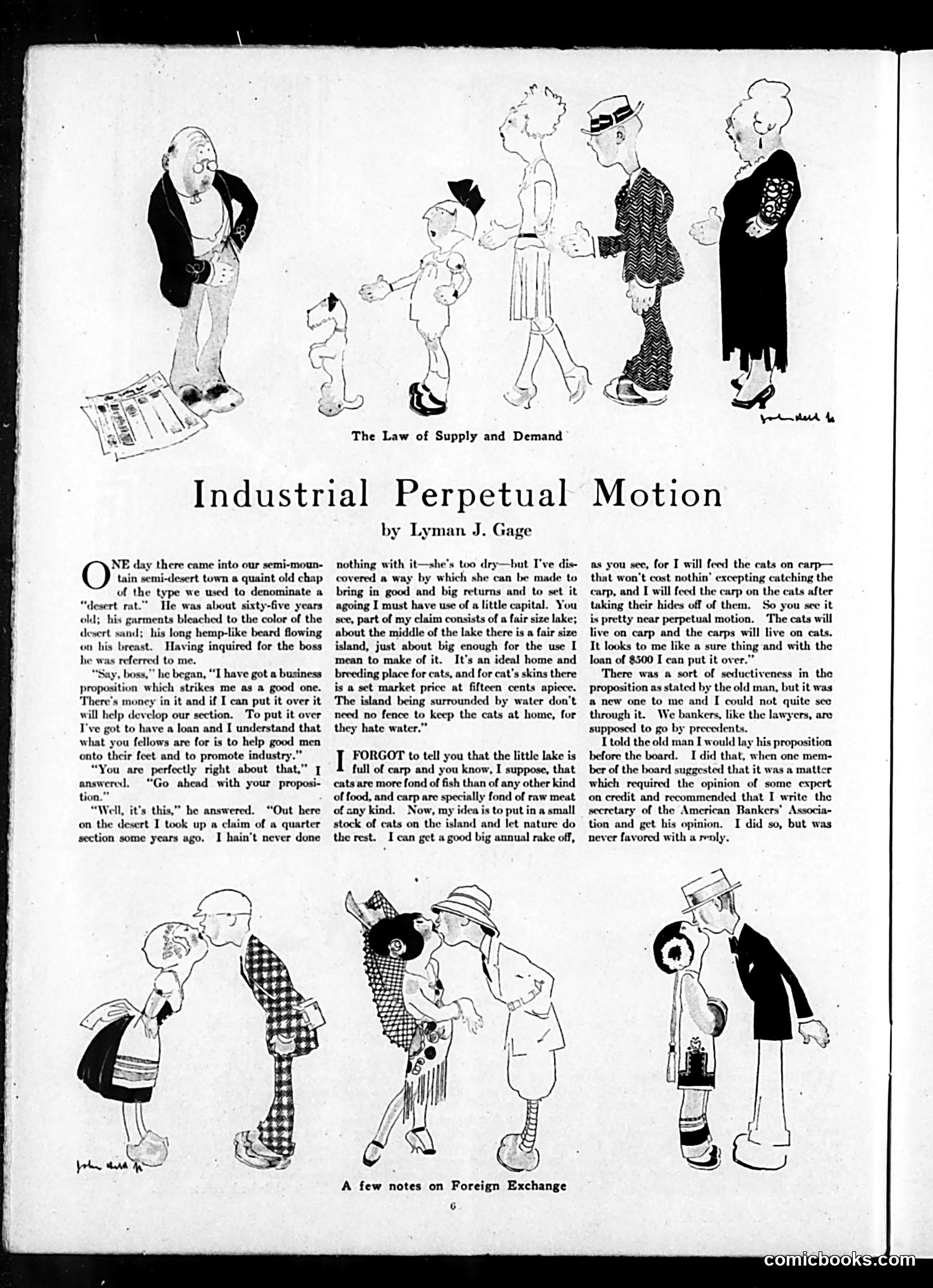
This satirical piece mocks both naive economic thinking and banking conservatism. A desert prospector pitches a banker a scheme: stock an island with cats that eat carp from an adjoining lake, then feed the carp the cats' remains—creating "perpetual motion" with no input costs. The satire works on multiple levels. The prospector represents get-rich-quick dreamers who misunderstand economic fundamentals. The banker (likely Gage himself, given the byline) represents institutional caution—he consults his board and writes to the American Bankers' Association rather than simply rejecting obvious nonsense. The top cartoon "Law of Supply and Demand" shows figures of increasing prosperity, illustrating the legitimate economic principle the scheme grotesquely parodies. The bottom section "Foreign Exchange" appears unrelated. The joke: both the charlatan and the bureaucrat are foolish—one for the impossible scheme, the other for treating it as requiring expert analysis rather than common sense.
📄 Transcribed text from this page (OCR, searchable)
Machine-transcribed from the original scan — historical spelling and the odd misread are preserved.
The Law of Supply and Demand Industrial Perpetual Motion NE day there came into our semi-moun- tain semi-desert town a quaint old chap of the type we used to denominate a “desert rat.” He was about sixty-five years old; his garments bleached to the color of the desert sand; his long hemp-like beard flowing on his breast. Having inquired for the boss he was referred to me. ‘ oss," he began, “I have got a business proposition which strikes me as a good one. There's money in it and if I can put it over it will help develop our section. To put it over I’ve got to have a loan and I understand that what you fellows are for is to help good men onto their feet and to promote industry.” “You are perfectly right about that,” | answered. “Go ahead with your proposi- tion.” “We on the section some years ago. this,” he answered. “Out here Jesert I took up a claim of a quarter I hain’t never done by Lyman J. Gage nothing with it—she's too dry—but T've dis- covered a way by which she can be made to bring in good and big returns and to set it agoing I must have use of a little capital. You sce, part of my claim consists of a fair size lake; about the middle of the lake there is a fair size island, just about big enough for the use I mean to make of it. It’s an ideal home and breeding place for cats, and for cat's skins there is a set market price at fifteen cents apiece. The island being surrounded by water don’t need no fence to keep the cats at home, for they hate water.” I FORGOT to tell you that the little lake is full of carp and you know, I suppose, that cats are more fond of fish than of any other kind of food, and carp are specially fond of raw meat of cny kind. Now, my idea is to put in a small stock of cats on the island and let nature do the rest. I can get a good big annual rake off, A few notes on Foreign Exchange 6 as you see, for I will feed the cats on carp— that won't cost nothin’ excepting catching the carp, and I will feed the carp on the cats after taking their hides off of them. So you see it is pretty near perpetual motion. ‘The cats will live on carp and the carps will live on cats. It looks to me like a sure thing and with the loan of $500 I can put it over.” There was a sort of seductiveness in the proposition as stated by the old man, but it was a new one to me and [ could not quite sce through it. We bankers, like the lawyers, are supposed to go by precedents. I told the old man I would lay his proposition before the board. I did that, when one mem- ber of the board suggested that it was a matter which required the opinion of some expert on credit and recommended that I write the secretary of the American Bankers’ Associa- tion and get his opinion. I did so, but was never favored with a woly,