
Judge, 1922-09-30 · page 32 of 36
Judge — September 30, 1922 — page 32: what you’re looking at
What you’re looking at
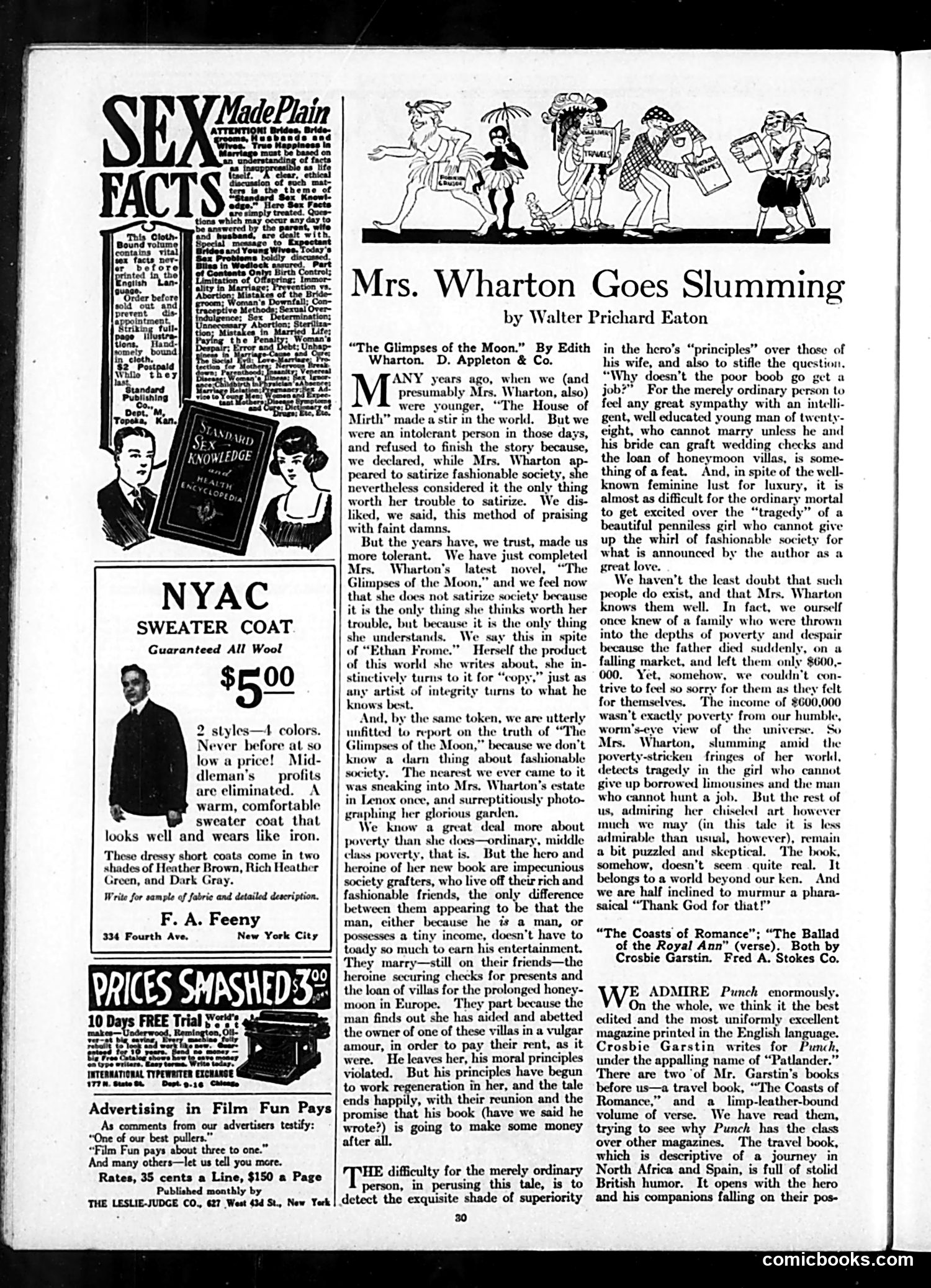
This page is primarily **literary criticism and advertising**, not political satire. The main article reviews Edith Wharton's novel "The Glimpses of the Moon." Reviewer Walter Prichard Eaton critiques Wharton for writing exclusively about fashionable society—the only world she understands. He notes the book's hero and heroine are impoverished social climbers living off wealthy friends' generosity. Eaton's central complaint: the moral conflict feels hollow to ordinary readers. The husband leaves his wife for helping a villa-owner with an affair to pay rent, then morally "regenerates" her. Eaton finds this superiority laughable—why doesn't the educated young man simply get a job instead of parasitically grafting "wedding checks and honeymoon villa loans"? The satire targets **Wharton's detachment from working-class reality**, not politics. The cartoon header showing fashionable people illustrates the book's subject matter. The page also advertises a $5 wool sweater coat and promotes advertising in "Film Fun" magazine.
📄 Transcribed text from this page (OCR, searchable)
Machine-transcribed from the original scan — historical spelling and the odd misread are preserved.
Sry. ) /] Sex PRD ] / KNOWLEDGE / SWEATER COAT Guaranteed All Wool Q@ $500 2 styles—4 colors. Never before at so low a price! Mid- dleman’s _ profits are eliminated. A warm, comfortable sweater coat that looks well and wears like iron. These dressy short coats come in two shades of Heather Brown, Rich Heather Green, and Dark Gray. Write for sample of fabric and detailed description. F. A. Feeny 334 Fourth Ave. New York City 177M. State St Dest.9.36 Cheats Advertising in Film Fun Pays As comments from our advertisers testify: “One of our best pullers.” “Film Fun pays about three to one.” And many others—let us tell you more. Rates, 35 cents a Line, $150 a Page Published monthly by THE LESLIE-JUDGE CO. 627 West 43d St, New York Mrs. Wharton Goes Slumming by Walter Prichard Eaton “The Glimpses of the Moon.” By Edith Wharton. D. Appleton & Co. ANY years ago, when we (and presumably Mrs. Wharton, also) were younger, “The House of Mirth” made a stir in the world. But we were an intolerant person in those days, and refused to finish the story because, we declared, while Mrs. Wharton aj peared to satirize fashionable society, the nevertheless considered it the only thing worth her trouble to satirize. We dis- liked, we said, this method of praising with faint damns, But the years have, we trust, made us more tolerant. We have just completed Mrs. Wharton's latest novel, “The Glimpses of the Moon,” and we feel now that she does not satirize society because it is the only thing she thinks worth her trouble, but because it is the only thing she understands. We say this in spite of “Ethan Fror Herself the product of this world she writes about, she in- stinctively turns to it for “copy,” just as any artist of integrity turns to what he knows best. And, by the same token, we are utterly unfitted to report on the truth of “The Glimpses of the Moon,” because we don’t know a darn thing about fashionable society, The nearest we ever came to it was sneaking into Mrs. Wharton’s estate in Lenox once, and surreptitiously photo- graphing her glorious garden. We know a great deal more about poverty than she does—ordinary, middle class poverty, that is. But the hero and heroine of her new book are impecunious society grafters, who live off their rich and fashionable friends, the only difference between them appearing to be that the man, cither because he is a man, or possesses a tiny income, doesn’t have to toady so much to carn his entertainment. They marry—still on their friends—the heroine securing checks for presents and the loan of villas for the prolonged honey- moon in Europe. They part because the man finds out she has aided and abetted the owner of one of these villas in a vulgar amour, in order to pay their rent, as it were. He leaves her, his moral principles violated. But his principles have to work regeneration in her, and the tale ends happily, with their reunion and the promise that his book (have we said he wrote?) is going to make some money after all. HE difficulty for the merely ordinary person, in perusing this tale, is to detect the exquisite shade of superiority in the hero’s “principles” over those of his wife, and also to stifle the question. “Why doesn’t the r boob go get a job?” For the merely ordinary person to feel any great sympathy with an intelli- gent, well educated young man of twenty- eight, who cannot marry unless he and his bride can graft wedding checks and the loan of honeymoon villas, is some- thing of a feat. And, in spite of the well- known feminine lust for luxury, it is almost as difficult for the ordinary mortal to get excited over the “tragedy” of a beautiful penniless girl who cannot give up the whirl of fashionable society for what is announced by the author as a great love. We haven't the least doubt that such people do exist, and that Mrs. Wharton knows them well. In fact, we ourself once knew of a family who were thrown into the depths of poverty and despair because the father died suddenly, on a falling market, and left n only $600,- 000. Yet, somehow, we couldn't con- trive to feel so sorry for them as they felt for themselves, The income of $600,000 wasn't exactly poverty from our humble, ‘seve view of the universe. So Wharton, slumming amid the stricken fringes of her world, detects tragedy in the girl who cannot give up borrowed limousines and the man who cannot hunt a job. But the rest of us, admiring her chiseled art however much we may (in this tale it is less admirable than usual, however), remain a bit puzzled and skeptical. The book, somehow, doesn’t scem quite real. It belongs to a world beyond our ken. And we are half inclined to murmur a phara- saical “Thank God for that!” “The Coasts of Romance”; “The Ballad of the Royal Ann” (verse). Both by Crosbie Garstin. Fred A. Stokes Co. WE ADMIRE Punch enormously. On the whole, we think it the best edited and the most uniformly excellent magazine printed in the English language. Crosbie Garstin writes for Punch, under the appalling name of “Patlander.” There are two ‘of Mr. Garstin’s books before us—a travel book, “The Coasts of Romance,” and a_limp-leather-bound volume of verse. We have read them, trying to see why Punch has the class over other magazines. The travel book, which is descriptive of a journey in North Africa and Spain, is full of stolid British humor. It opens with the hero and his companions falling on their pos- comicbooks.com