
Judge, 1922-09-30 · page 11 of 36
Judge — September 30, 1922 — page 11: what you’re looking at
What you’re looking at
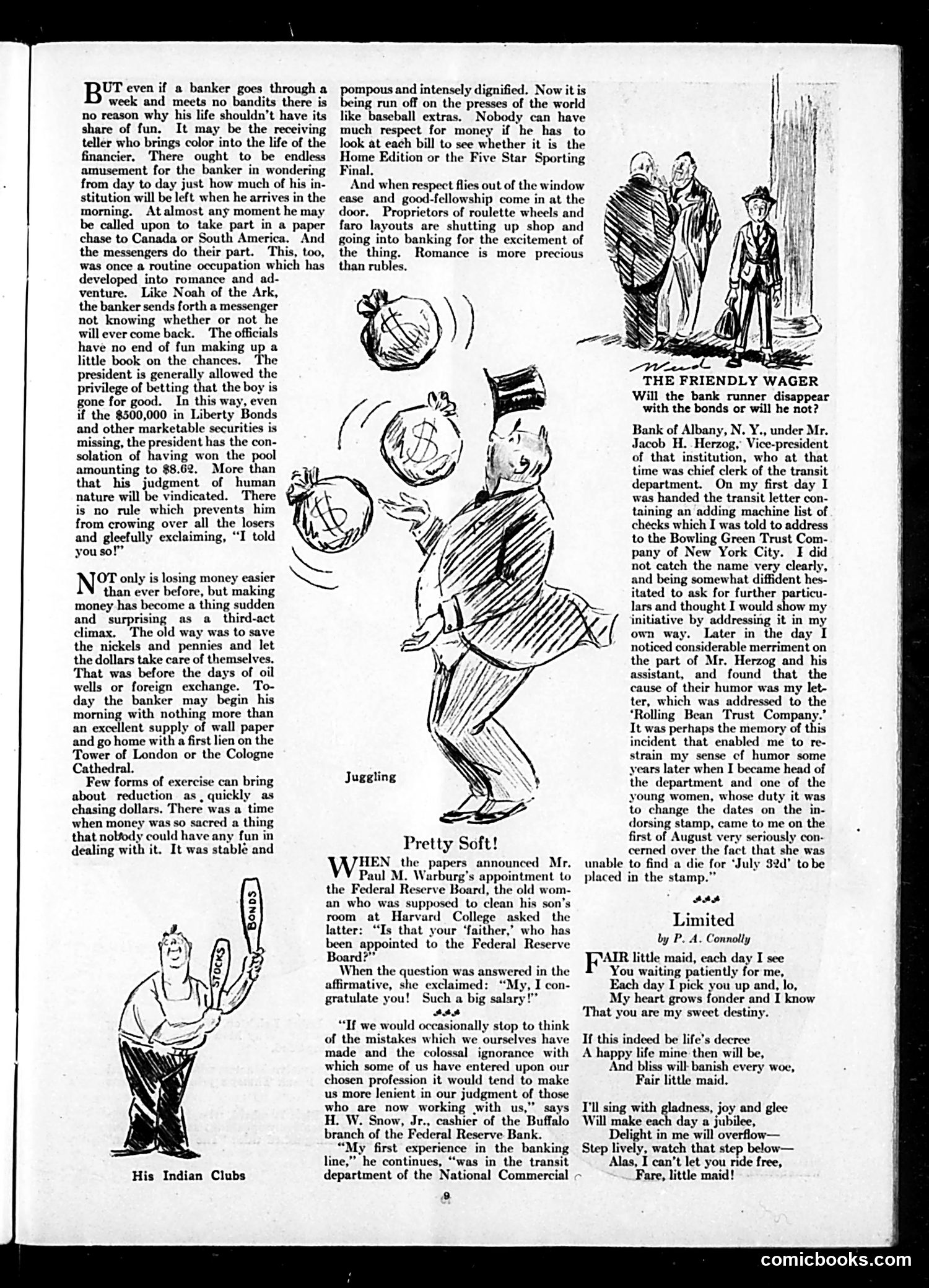
This page satirizes early 20th-century banking and financial instability. The main text mocks how bankers' routines have become chaotic—messengers might disappear with securities, money is printed like "baseball extras," and the profession has lost respectability. The piece suggests bankers now gamble on whether employees will abscond with bonds, treating it as entertainment. The "Juggling" cartoon (center-left) depicts a banker juggling money, visually representing the precarious, unstable nature of modern finance. A secondary anecdote mentions Paul M. Warburg's appointment to the Federal Reserve Board, treated humorously through a cleaning woman's naive reaction to his "big salary." The satire reflects anxiety about rapid financial change, currency instability, and post-WWI economic uncertainty, when banking seemed less dignified and more chaotic than traditional practice.
📄 Transcribed text from this page (OCR, searchable)
Machine-transcribed from the original scan — historical spelling and the odd misread are preserved.
Bo even if a banker goes through a week and meets no bandits there is no reason why his life shouldn’t have its share of fun. It may be the receiving teller who brings color into the life of the financier. There ought to be endless amusement for the banker in wondering from day to day just how much of his in- stitution will be left when he arrives in the morning. Atalmost any moment he may be called upon to take part in a paper chase to Canada or South America. And the messengers do their part. This, too, was once a routine occupation which has developed into romance and ad- venture. Like Noah of the Ark, the banker sends forth a messenger not knowing whether or not he will ever come back. The officials have no end of fun making up a little book on the chances. The president is generally allowed the privilege of betting that the boy is gone for good. In this way, even if the $500,000 in Liberty Bonds and other marketable securities is missing, the president has the con- solation of having won the pool amounting to $8.62. More than that his judgment of human nature will be vindicated. There is no rule which prevents him from crowing over all the losers and gleefully exclaiming, “I told you so!” No only is losing money easier than ever before, but making money has become a thing sudden and surprising as a_ third-act climax. The old way was to save the nickels and pennies and let the dollars take care of themselves, That was before the days of oil wells or foreign exchange. To- day the banker may begin his morning with nothing more than an excellent supply of wall paper and go home with a first lien on the Tower of London or the Cologne Cathedral. Few forms of exercise can bring about reduction as, quickly as chasing dollars. There was a time when money was so sacred a thing that nobody could have any fun in dealing with it. It was stable and His Indian Clubs pompous and intensely dignified. Now it is being run off on the presses of the world like baseball extras. Nobody can have much respect for money if he has to look at each bill to see whether it is the Home Edition or the Five Star Sporting Final. And when respect flies out of the window ease and good-fellowship come in at the door. Proprietors of roulette wheels and faro layouts are shutting up shop and going into banking for the excitement of the thing. Romance is more precious than rubles. Juggling Pretty Soft! WHEN the papers announced Mr. Paul M. Warburg’s appointment to the Federal Reserve Board, the old wom- an who was supposed to clean his son’s room at Harvard College asked the latter: “Is that your ‘faither,” who has been appointed to the Federal Reserve Board?” When the question was answered in the affirmative, she exclaimed: “My, I con- gratulate you! Such a big salary!” sae “If we would occasionally stop to think of the mistakes which we ourselves have made and the colossal ignorance with which some of us have entered upon our chosen profession it would tend to make us more lenient in our judgment of those who are now working with us,” says H. W. Snow, Jr., cashier of the Buffalo branch of the Federal Reserve Bank. “My first experience in the banking line,” he continues, “was in the transit department of the National Commercial “Wee THE FRIENDLY WAGER Will the bank runner disappear with the bonds or will he not? Bank of Albany, N. Y., under Mr. Jacob H. Herzog, Vice-president of that institution, who at that time was chief clerk of the transit department. On my first day I was handed the transit letter con- taining an adding machine list of checks which I was told to address to the Bowling Green Trust Com- pany of New York City. I did not catch the name very clearly, and being somewhat diffident hes- itated to ask for further particu- lars and thought I would show my initiative by addressing it in my own way. Later in the day I noticed considerable merriment on the part of Mr. Herzog and his assistant, and found that the cause of their humor was my let- ter, which was addressed to the ‘Rolling Bean Trust Company.’ It was perhaps the memory of this incident that enabled me to re- strain my sense cf humor some years later when I became head of the department and one of the young women, whose duty it was to change the dates on the in- dorsing stamp, came to me on the first of August very seriously con- cerned over the fact that she was unable to find a die for ‘July 32d" to be placed in the stamp.” ; Raed Limited by P. A. Connolly Far little maid, each day I see You waiting patiently for me, Each day I pick you up and, lo, My heart grows fonder and I know That you are my sweet destiny. Tf this indeed be life’s decree A happy life mine then will be, And bliss will banish every woe, Fair little maid. T'll sing with gladness, joy and glee Will make ca day a jubilee, Delight in me will overflow— Step lively, watch that step below— Alas, I can’t let you nde free, > Fare, little maid! comicbooks.com