
Judge, 1922-09-30 · page 17 of 36
Judge — September 30, 1922 — page 17: what you’re looking at
What you’re looking at
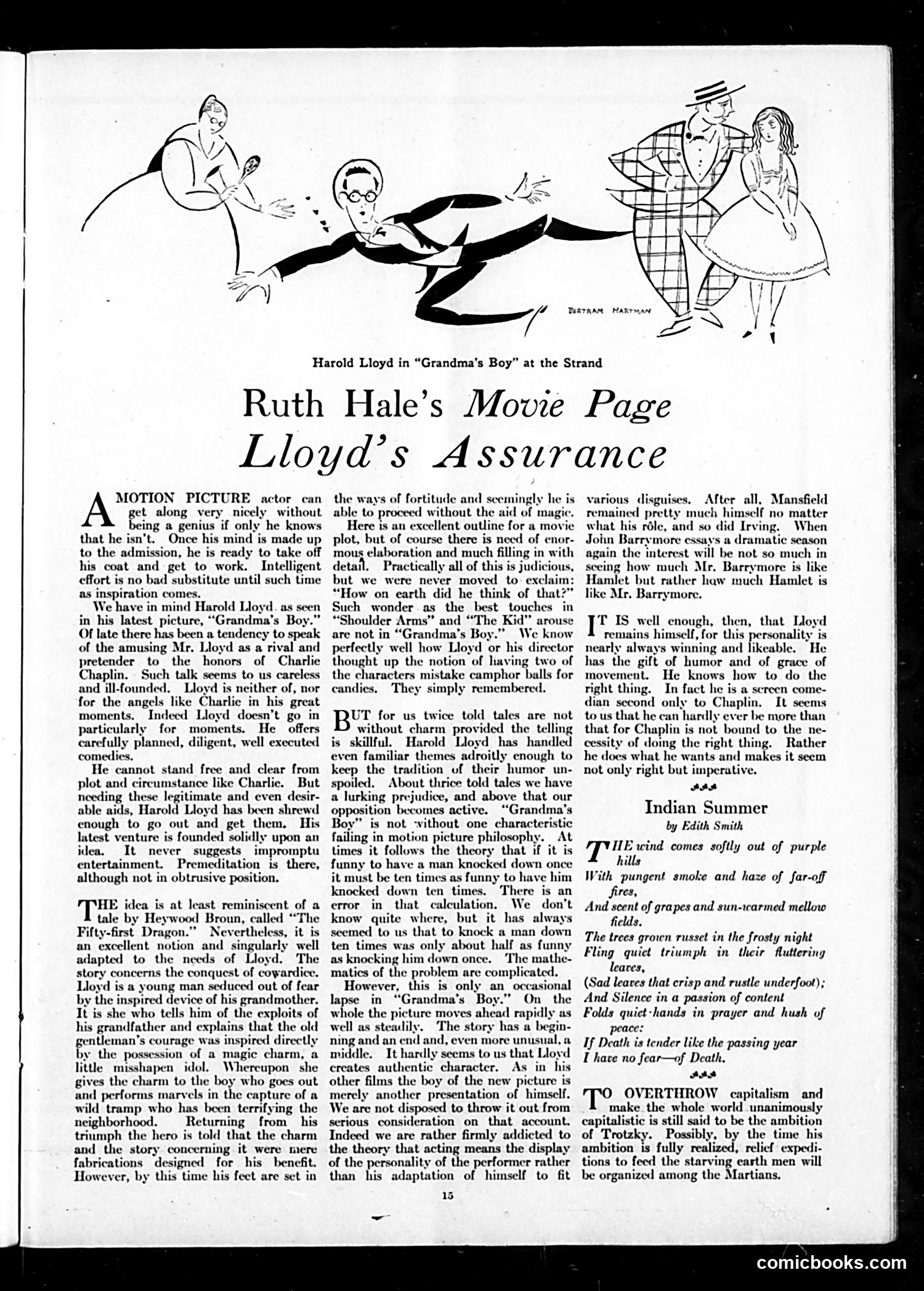
This is Ruth Hale's movie review column analyzing Harold Lloyd's film "Grandma's Boy," shown at the Strand Theatre. The cartoon at top depicts Lloyd performing his characteristic physical comedy—stretched horizontally in an exaggerated pose while flanked by supporting characters. Hale's review distinguishes Lloyd from Charlie Chaplin, the era's dominant comedy star. She argues Lloyd succeeds through careful, premeditated construction rather than Chaplin's spontaneous genius. The film's plot—a cowardly boy gains courage through a fake magical charm—derives from Heywood Broun's story "The Fifty-first Dragon." Hale praises Lloyd's competent execution but criticizes the film's repeated gag structure (knocking a man down ten times versus once). She notes Lloyd depends on plot and circumstance, unlike Chaplin's ability to create comedy from pure character. Overall, she finds "Grandma's Boy" a well-crafted but uninspired comedy that competently delivers entertainment without artistic brilliance.
📄 Transcribed text from this page (OCR, searchable)
Machine-transcribed from the original scan — historical spelling and the odd misread are preserved.
7 TeRTRAM MARTMAN, aN Harold Lloyd in “Grandma’s Boy” at the Strand Ruth Hale’s Movie Page Lloyd’s Assurance MOTION PICTURE actor can get along very nicely without being a genius if only he knows that he isn’t. Once his mind is made up to the admission, he is ready to take off his coat and get to work. Intelligent effort is no bad substitute until such time as inspiration comes. We have in mind Harold Lloyd. as seen in his latest picture, “Grandma’s Boy.” Of late there has been a tendency to speak of the amusing Mr. Lloyd as a rival and pretender to the honors of Charlie Chaplin. _ Such talk seems to us careless and ill-founded. Lloyd is neither of, nor for the angels like Charlie in his great moments. Indeed Lloyd doesn’t go in particularly for moments. He offers carefully planned, diligent, well executed comedies. He cannot stand free and clear from plot and circumstance like Charlie. But needing these legitimate and even desir- able aids, Harold Lloyd has been shrewd enough to go out and get them. His latest venture is founded solidly upon an idea. It never suggests impromptu entertainment. Premeditation is there, although not in obtrusive position. HE idea is at least reminiscent of a tale by Heywood Broun, called “The Fifty-first Dragon.” Nevertheless, it is an excellent notion and singularly well adapted to the needs of Lloyd. The story concerns the conquest of cowardice. Lloyd is a young man seduced out of fear by the inspired device of his grandmother. It is she who tells him of the exploits of his grandfather and explains that the old (se courage was inspired directly by the possession of a magic charm, a little misshapen idol. Whereupon she gives the charm to the boy who goes out and performs marvels in the capture of a wild tramp who has been terrifying the neighborhood. Returning from his triumph the hero is told that the charm and the story concerning it were mere fabrications designed for his benefit. However, by this time his fect are set in the ways of fortitude and scemingly he is able to proceed without the aid of magic. Here is an excellent outline for a movie plot, but of course there is need of enor- moug elaboration and much filling in w detail. Practically all of this is judiciou but we were never moved to: exclaim: “How on earth did he think of that?” Such wonder as the best touches in “Shoulder Arms” and “The Kid” arouse are not in “Grandma’s Boy.” We know perfectly well how Lloyd or his director thought up the notion of having two of the characters mistake camphor balls for candies, They simply remembered. UT for us twice told tales are not without charm provided the telling is skillful. Harold Lloyd has handled even familiar themes adroitly cnough to keep the tradition of their humor un- spoiled. About thrice told tales we have a lurking prejudice, and above that our opposition becomes active. “Grandma's Boy” is not -vithout one characteristic failing in motion picture philosophy. At times it follows the theory that if it is funny to have a man knocked down once it must be ten times as funny to have him knocked down ten times. There is an error in that calculation. We don’t know quite where, but it has always seemed to us that to knock a man down ten times was only about half as funny as knocking him down once. The mathe- matics of the problem are complicated. However, this is only an occasional lapse in “Grandma’s Boy.” On_ the whole the picture moves ahead rapidly as well as steadily. The story has a begin- ning and an end and, even more unusual, a middle. It hardly seems to us that Lloyd creates authentic character. As in his other films the boy of the new picture is merely another presentation of himself. We are not disposed to throw it out from serious consideration on that account, Indeed we are rather firmly addicted to the theory that acting means the display of the personality of the performer rather than his adaptation of himself to fit 15 Mansfield After all, remained pretty much himself no matter various disguises. what his rdle, and so did Irving. When Join Barrymore essays a dramatic season again the interest will be not so much in seeing how much Mr. Barrymore is like Hamlet but rather haw much Hamlet is like Mr. Barrymore. i IS well enough, then, that Lloyd remains himself, for this personality is nearly always winning and likeable. He has the gift of humor and of grace of movement. He knows how to do the right thing. In fact he is a screen come- dian second only to Chaplin, It seems to us that he can hardly ever be more than that for Chaplin is not bound to the ne- cessity of doing the right thing. Rather he does what he wants and makes it seem not only right but imperative. ADD Indian Summer by Edith Smith HE wind comes softly out of purple hills With pungent smoke and haze of far-off Sires, And scent of grapes and sun-warmed mellow fields, The trees grown russet in the frosty night Fling quict triumph in their fluttering leaves, (Sad leaves that crisp and rustle underfoot); And Silence in a passion of content Folds quict-hands in prayer and hush of peace: If Death is tender like the passing year I have no fear—of Death. Par OVERTHROW capitalism and make the whole world unanimously capitalistic is still said to be the ambition of Trotzky. Possibly, by the time his ambition is fully realized, relicf expedi- tions to feed the starving earth men will be organized among the Martians, comicbooks.com