
Judge, 1922-09-30 · page 21 of 36
Judge — September 30, 1922 — page 21: what you’re looking at
What you’re looking at
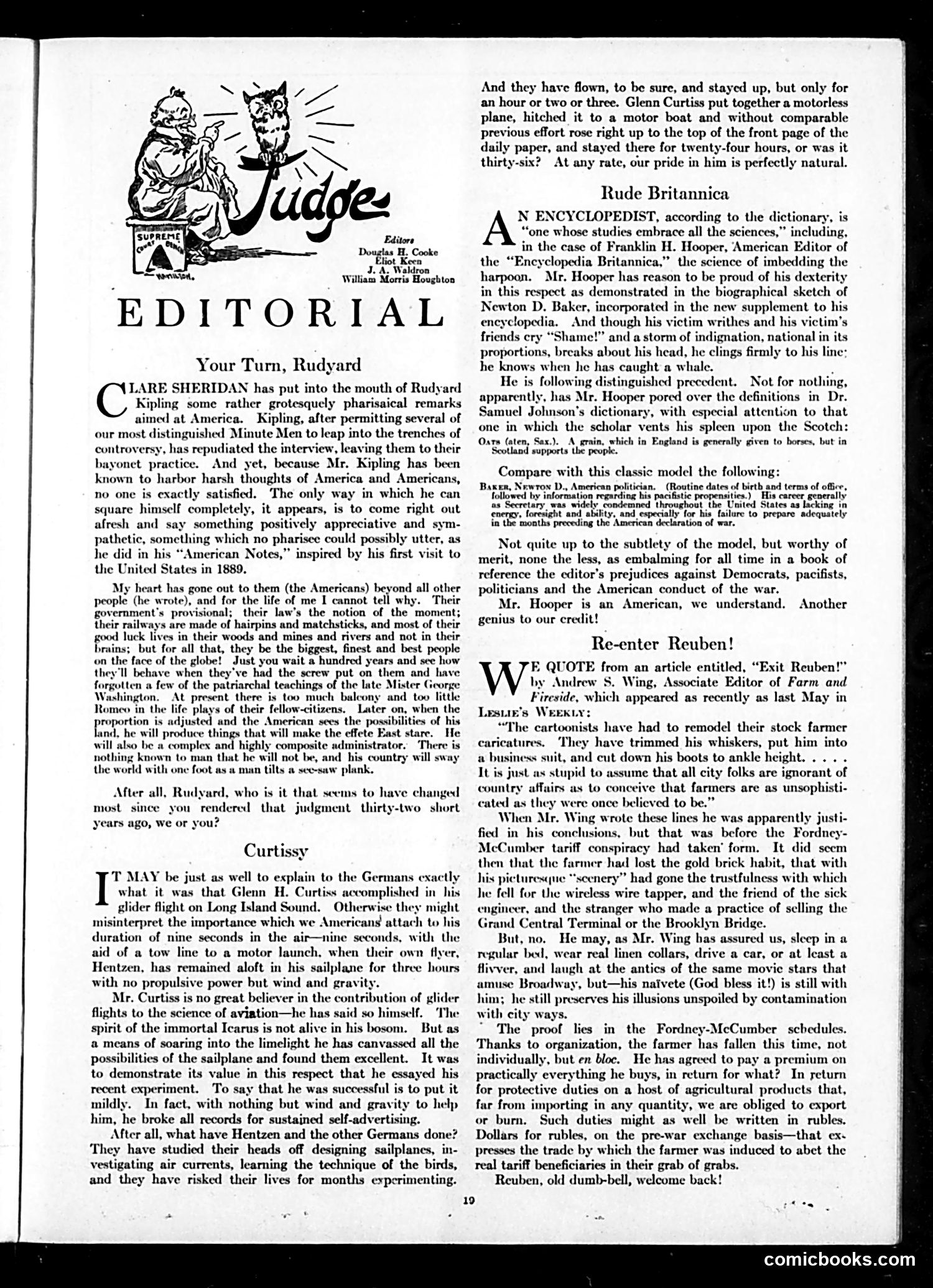
This editorial page from Judge magazine contains three distinct pieces satirizing prominent figures: **"Your Turn, Rudyard"** attacks author Rudyard Kipling for making critical remarks about America while previously praising Americans effusively. The editorial challenges Kipling to explain why his views have seemingly shifted, sarcastically noting that his 1889 prediction of American greatness appears validated. **"Curtissy"** mocks aviator Glenn Curtiss for his self-promotional stunt—a nine-second glider flight that generated massive press coverage. Judge contrasts this favorably to German aviator Hentzen's genuine three-hour unpowered flight achieved through serious engineering work. The satire suggests Curtiss prioritized publicity over scientific achievement: "he broke all records for sustained self-advertising." Both pieces reflect Progressive-era skepticism toward celebrity and self-promotion over genuine accomplishment, while maintaining ambivalence about American exceptionalism relative to European (particularly German) achievement.
📄 Transcribed text from this page (OCR, searchable)
Machine-transcribed from the original scan — historical spelling and the odd misread are preserved.
J. A, Waldron William Morris Houghton Your Turn, Rudyard LARE SHERIDAN has put into the mouth of Rudyard ipling some rather grotesquely pharisaical remarks aimed at America. Kipling, after permitting several of our most distinguished Minute Men to leap into the trenches of controversy, has repudiated the interview, leaving them to their bayonet practice. And yet, because Mr. Kipling has been known to harbor harsh thoughts of America and Americans, no one is exactly satisfied. The only way in which he can square himself completely, it appears, is to come right out afresh and say something positively appreciative and sym- pathetic, something which no pharisce could possibly utter, as he did in his “American Notes,” inspired by his first visit to the United States in 1889. My heart has gone out to them (the Americans) beyond all other people (he wrote), and for the life of me I cannot tell why. Their government's provisioasl; their law’s the notion of the moment; their railways are made of hairpins and matchsticks, and most of their good luck lives in their woods and mines and rivers and not in their brains; but for all that, they be the biggest, finest and best people on the face of the globe! Just you wait a hundred years and see how they'll behave when they've had the screw put on them and hav forgotten a few of the patriarchal teachings of the late Mister George Washington. At present there is too much balcony and too little Romeo in the life plays of their fellow-citizens, Later ‘on, when the proportion is adjusted and the American sees the poss of his and, he will produce things that will make the effete East stare. He will also be a complex and highly composite administrator. ‘There is nothing known to man that he will not be, and his country will sway the world with one foot as a man tilts a see-saw plank, After all, Rudyard, who is it that scems to have changed most since you rendered that judgment thirty-two short years ago, we or you? Curtissy T MAY be just as well to explain to the Germans exactly what it was that Glenn H. Curtiss accomplished in his glider flight on Long Island Sound. Otherwise they might misinterpret the importance which we Americans attach to his duration of nine seconds in the air—nine seconds, with U aid of a tow line to a motor launch, when their own flyer, Hentzen, has remained aloft in his sailplane for three hours with no propulsive power but wind and gravity. Mr. Curtiss is no great believer in the contribution of glider flights to the science of aviation—he has said so himself. The spirit of the immortal Icarus is not alive in his bosom. But as a means of soaring into the limelight he has canvassed all the possibilities of the sailplane and found them excellent. It was to demonstrate its value in this respect that he essayed his recent experiment. To say that he was successful is to put it mildly. In fact, with nothing but wind and gravity to help him, he broke all records for sustained self-advertising. After all, what have Hentzen and the other Germans done? They have studied their heads off designing sailplanes, in- vestigating air currents, learning the technique of the birds, and they have risked their lives for months experimenting. 19 And they have flown, to be sure, and stayed up, but only for an hour or two or three. Glenn Curtiss put together a motorless plane, hitched it to a motor boat and without comparable previous effort rose right up to the top of the front page of the daily Paper, and stayed there for twenty- -four hours, or was it At any rate, our pride in him is perfectly natural. Rude Britannica N ENCYCLOPEDIST, according to the dictionary, is “one whose studies embrace all the sciences,” including, in the case of Franklin H. Hooper, ‘American Editor of the science of imbedding the harpoon. Mr. Hooper has reason to be proud of his dexterity in this respect as demonstrated in the biographical sketch of Newton D. Baker, incorporated in the new supplement to his encyclopedia. And though his victim writhes and his victim’s friends cry “Shame!” and a storm of indignation, national in its proportions, breaks about his head, he clings firmly to his line: he knows when he has caught a whale. A He is following distinguished preecdent. Not for nothing, apparently, has Mr. Hooper pored over the definitions in Dr. Samuel Johnson's dictionary, with especial attention to that one in which the scholar vents his spleen upon the Scotch: Oars (aten, Sax.). A grain, which in England is generally given to horses, but in Scotland supports the people. A the “Encyclopedia Britannica,” Compare with this classic model the following: Bares, Newrox D. American politician, | (Routine dateyof birth and terms of offic, fc y information regarding his Paci ic propensities.) His career generally as Secretary: was widely condemned sti the United States as lacking in energy, foresight and al and especially for his failure to prepare adequately fn the months preceding the American declaration of war. Not quite up to the subtlety of the model, but worthy of merit, none the less, as embalming for all time in a book of reference the editor's prejudices against Democrats, pacifists, politicians and the American conduct of the war. Mr. Hooper is an American, we understand. genius to our credit! Another Re-enter Reuben! QUOTE from an article entitled, “Exit Reuben!” Andrew S$. Wing, Associate Editor of Farm and Fireside, which appeared as recently as last May in Lesiiz’s WEEKLY “The cartoonists have had to remodel their stock farmer caricatures. They have trimmed his whiskers, put him into a business suit, and cut down his boots to ankle height. It is just as stupid to assume that all city folks are ignorant of country affairs as to conceive that farmers are as unsophisti- cated as they were once believed to be.” When Mr. Wing wrote these lines he was apparently justi- fied in his conclusions, but that was before the Fordney- McCumber tariff conspiracy had taken’ form. It did seem then that the mer had lost the gold brick habit, that with his picturesque “scenery” had gone the trustfulness with which he fell for the wireless wire tapper, and the friend of the sick engineer, and the stranger who made a practice of selling the Grand Central Terminal or the Brooklyn Bridge. But, no. He may, as Mr. Wing bas assured us, sleep in a regular bed, wear real linen collars, drive a car, or at Icast a flivver, and laugh at the antics of the same movic stars that amuse Broadway, but—his natvete (God bless it!) is still with him; he still preserves his illusions unspoiled by contamination with city ways. “ The proof lies in the Fordney-McCumber schedules. Thanks to organization, the farmer has fallen this time, not individually, but en bloc. He has agreed to pay a premium on practically everything he buys, in return for what? In return for protective duties on a host of agricultural products that, far from importing in any quantity, we are obliged to export or burn, Such duties might as well be written in rubles. Dollars for rubles, on the pre-war exchange basis—that ex. presses the trade by which the farmer was induced to abet the real tariff beneficiaries in their grab of grabs. Reuben, old dumb-bell, welcome back! comicbooks.com