
Judge, 1922-09-30 · page 10 of 36
Judge — September 30, 1922 — page 10: what you’re looking at
What you’re looking at
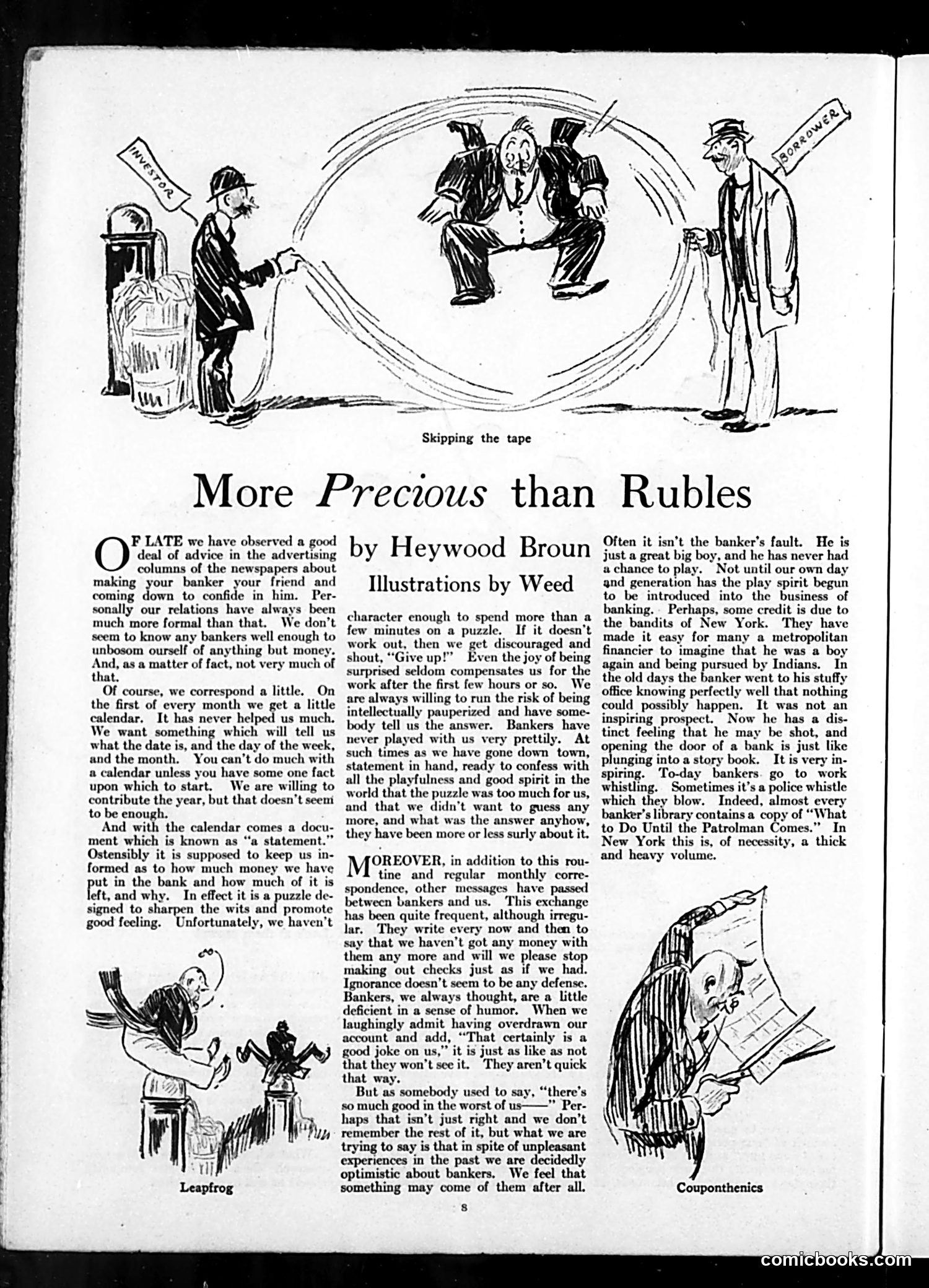
This page from *Judge* magazine contains a satirical essay by Heywood Broun about the awkward relationship between ordinary people and bankers, illustrated with humorous cartoons. **Main Points:** The essay mocks formal banking conventions—particularly monthly statements that are presented as "puzzles" the depositor must decipher, and confusing bank correspondence about overdrafts. Broun notes bankers lack humor; they don't appreciate jokes about overdrawing accounts. **The Satire:** The piece gently critiques both bankers' stuffiness and the public's financial ignorance. However, Broun's closing argument is ironic: he suggests bankers have become more interesting since New York's recent bank robberies—now they get excitement imagining being robbed ("pursued by Indians"), making their dull work feel like adventure stories. **The Cartoons:** The top illustration ("Skipping the tape") shows figures with a rope between them. The bottom illustrations ("Leapfrog" and "Coupothenics") appear to be separate humorous sketches, though their exact relevance is unclear from the visible text. This reflects early-20th-century middle-class anxieties about banking procedures and institutional formality.
📄 Transcribed text from this page (OCR, searchable)
Machine-transcribed from the original scan — historical spelling and the odd misread are preserved.
Skipping the tape More Precious than Rubles deal of advice in the advertising columns of the newspapers about making your banker your friend and coming down to confide in him. Per- sonally our relations have always been much more formal than that. We don’t seem to know any bankers well enough to unbosom ourself of anything but money. And, as a matter of fact, not very much of that. Of course, we correspond a little. On the first of every month we get a little calendar. It has never helped us much. We want something which will tell us what the date is, and the day of the week, and the month. You can’t do much with a calendar unless you have some one fact upon which to start. We are willing to contribute the year, but that doesn’t seent to be enough. And with the calendar comes a docu- ment which is known as ‘“‘a statement.” Ostensibly it is supposed to keep us in- formed as to how much money we have ut in the bank and how much of it is left, and why. In effect it is a puzzle de- signed to sharpen the wits and promote good feeling. Unfortunately, we haven't O* LATE we have observed a good by Heywood Broun Illustrations by Weed character enough to spend more than a few minutes on a puzzle. If it doesn’t work out, then we get discouraged and shout, “Give up!” Even the joy of being surprised seldom compensates us for the work after the first few hours or so. We are always willing to run the risk of being intellectually pauperized and have some- body tell us the answer. Bankers have never played with us very prettily. such times as we have gone down town, statement in hand, ready to confess with all the playfulness and good spirit in the world that the puzzle was too much for us, and that we didn’t want to guess any more, and what was the answer anyhow, they have been more or less surly about it. OREOVER, in addition to this rou- tine and regular monthly corre- spondence, other messages have passed between bankers and us. This exchange has been quite frequent, although irregu- lar. They write every now and then to say that we haven't got any money with them any more and will we please sto making out checks just as if we had. Ignorance doesn’t seem to be any defense. Bankers, we always thought, are a little deficient in a sense of humor. When we laughingly admit having overdrawn our account and add, “That certainly is a good joke on us,” it is just as like as not that they won't see it. They aren’t quick that way. But as somebody used to say, “there's so much good in the worst of us——”’ Per- haps that isn’t just right and we don’t remember the rest of it, but what we are trying to say is that in spite of unpleasant experiences in the past we are decidedly optimistic about bankers. We feel that something may come of them after all. At 5 Often it isn’t the banker's fault. He is just a great big boy, and he has never had achance to play. Not until our own day and generation has the play spirit begun to be introduced into the business of banking. Perhaps, some credit is due to the bandits of New York. They have made it easy for many a metropolitan financier to imagine that he was a boy again and being pursued by Indians. In the old days the banker went to his stuffy office knowing perfectly well that nothing could possibly happen. It was not an inspiring prospect. Now he has a dis- tinct feeling that he may be shot, and ing the door of a bank is just like plunging into a story book. It is very in- spiring. To-day bankers. go to work whistling. Sometimes it’s a police whistle which they blow. Indeed, almost every banker’s library contains a copy of “What to Do Until the Patrolman Comes.” In New York this is, of necessity, a thick and heavy volume.