
Judge, 1922-09-30 · page 23 of 36
Judge — September 30, 1922 — page 23: what you’re looking at
What you’re looking at
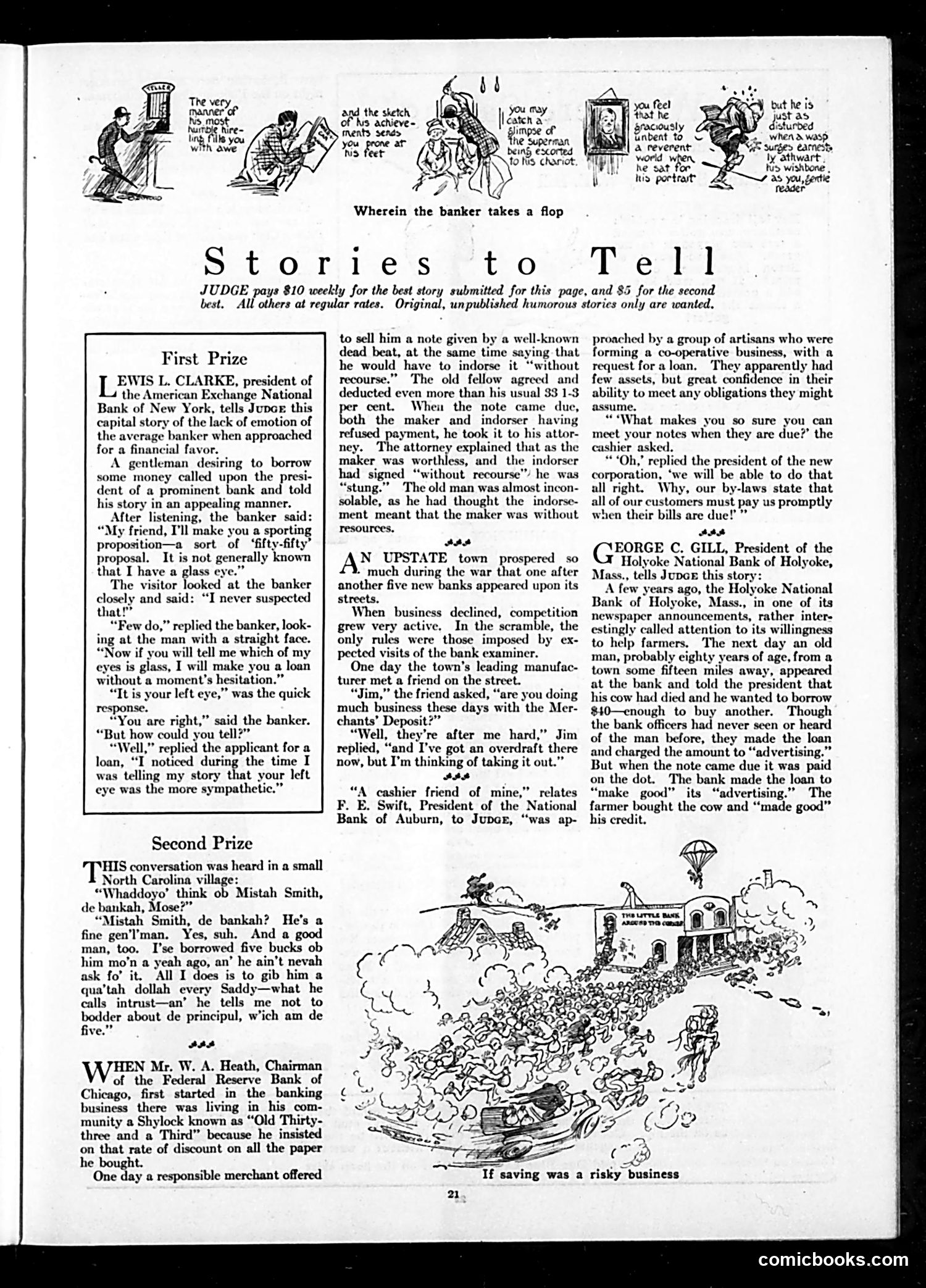
This page from *Judge* magazine presents humorous stories about bankers, satirizing their emotional coldness and questionable ethics during the early 20th century. **The Satire:** The first story mocks bankers' lack of sympathy—a loan applicant must identify which eye is glass (fake) to prove the banker has *any* capacity for feeling. The joke: the banker's "sympathetic" eye is the artificial one. **Social Context:** The other stories address banking practices and character. One depicts a naive Southern Black man praising a loan shark's generosity while unknowingly paying usurious interest. Another mocks an old moneylender ("Old Thirty-three and a Third") who doesn't understand loan contracts. A final story suggests banks compete aggressively, using suspicious practices during economic downturns. **The Point:** Collectively, these mock bankers as emotionally detached, dishonest, or incompetent—playing on public skepticism of financial institutions common in early-20th-century America, particularly following banking crises.
📄 Transcribed text from this page (OCR, searchable)
Machine-transcribed from the original scan — historical spelling and the odd misread are preserved.
Stories Wherein the banker takes a flop to faciously Unbent to & Tell JUDGE pays $10 weekly for the best story submitted for this page, and $5 for the second best. First Prize | heey L. CLARKE, president of the American Exchange National Bank of New York, tells Jupce this capital story of the lack of emotion of the average banker when approached for a financial favor. A gentleman desiring to borrow some money called upon the presi- dent of a prominent bank and told his story in an appealing manner. After listening, the banker said: “My friend, I'll make you a sporting proposition—a sort of ‘fifty-fifty’ proposal, It is not generally known that I have a glass eye.” The visitor looked at the banker closely and said: “I never suspected that!” “Few do,” replied the banker, look- ing at the man with a straight face. “Now if you will tell me which of my eyes is glass, I will make you a loan without a moment's hesitation.” “Tt is your left eye,” was the quick response, “You are right,” said the banker. “But how could you tell?” Vell,” replied the applicant for a loan, “I noticed during the time I was telling my story that your left eye was the more sympathetic.” Second Prize HIS conversation was heard in a small North Carolina village: “Whaddoyo’ think ob Mistah Smith, de bankah, Mose?” “Mistah Smith, de bankah? He's a fine gen'I’man. Yes, suh. And a good man, too. I’se borrowed five bucks ob him mo’n a yeah ago, an’ he ain’t nevah ask fo’ it. All I does is to gib him a qua’tah dollah every Saddy—what he calls intrust—an’ he tells me not to bodder about de principul, w’ich am de five.” as N Mr. W. A. Heath, Chairman of the Federal Reserve Bank of Chicago, first started in the banking business there was living in his com- munity a Shylock known as “Old Thirty- three and a Third” because he insisted on that rate of discount on all the paper he bought. One day a responsible merchant offered to sell him a note given by a well-known dead beat, at the same time saying that he would have to indorse it “without recourse.” The old fellow agreed and deducted even more than his usual 33 1-3 per cent. Whe the note came due, th the maker and indorser having refused payment, he took it to his attor- ney. The attorney explained that as the maker was worthless, and the indorser had signed “without recourse”) he was “stung.” The old man was almost incon- solable, as he had thought the indorse- ment meant that the maker was without resources, the N UPSTATE town prospered so . much during the war that one after another five new banks appeared upon its streets. When business declined, competition grew very active. In the scramble, the only rules were those imposed by ex- pected visits of the bank examiner. One day the town’s leading manufac- turer met a friend on the street. “Jim,” the friend asked, “are you doing much business these days with the Mer- chants’ Deposit?” “Well, they’re after me hard,” Jim replied, “and I’ve got an overdraft there now, but I’m thinking of taking it out.” rey cashier friend of mine,” relates Swift, President of the National of Auburn, to Jupor, “was ap- “uy F. E. Bank All others at regular rates. Original, unpublished humorous stories only are wanted. proached by a group of artisans who were forming a co-operative business, with a request for aloan, They apparently had few assets, but great confidence in their ability to mect any obligations they might assume, “‘What makes you so sure you can meet your notes when they are due?’ the cashier asked. “ ‘Oh,’ replied the president of the new corporation, ‘we will be able to do that all right. Why, our by-laws state that all of our customers must pay us promptly when their bills are due!’ ” Aas EORGE C. GILL, President of the Holyoke National Bank of Holyoke, Masz., tells JupcE this story: A few years ago, the Holyoke National Bank of Holyoke, Mass., in one of its newspaper announcements, rather inter- estingly called attention to its willingness to help farmers, The next day an old man, probably eighty years of age, from a town some fifteen miles away, appeared at the bank and told the president that his cow had died and he wanted to borrow $40—enough to buy another. Though the bank officers had never seen or heard of the man before, they made the loan and charged the amount to “advertising.” But when the note came due it was paid on the dot. The bank made the loan to “make good” its “advertising.” The farmer bought the cow and “made good” his credit. comicbooks.com