
Judge, 1922-09-30 · page 9 of 36
Judge — September 30, 1922 — page 9: what you’re looking at
What you’re looking at
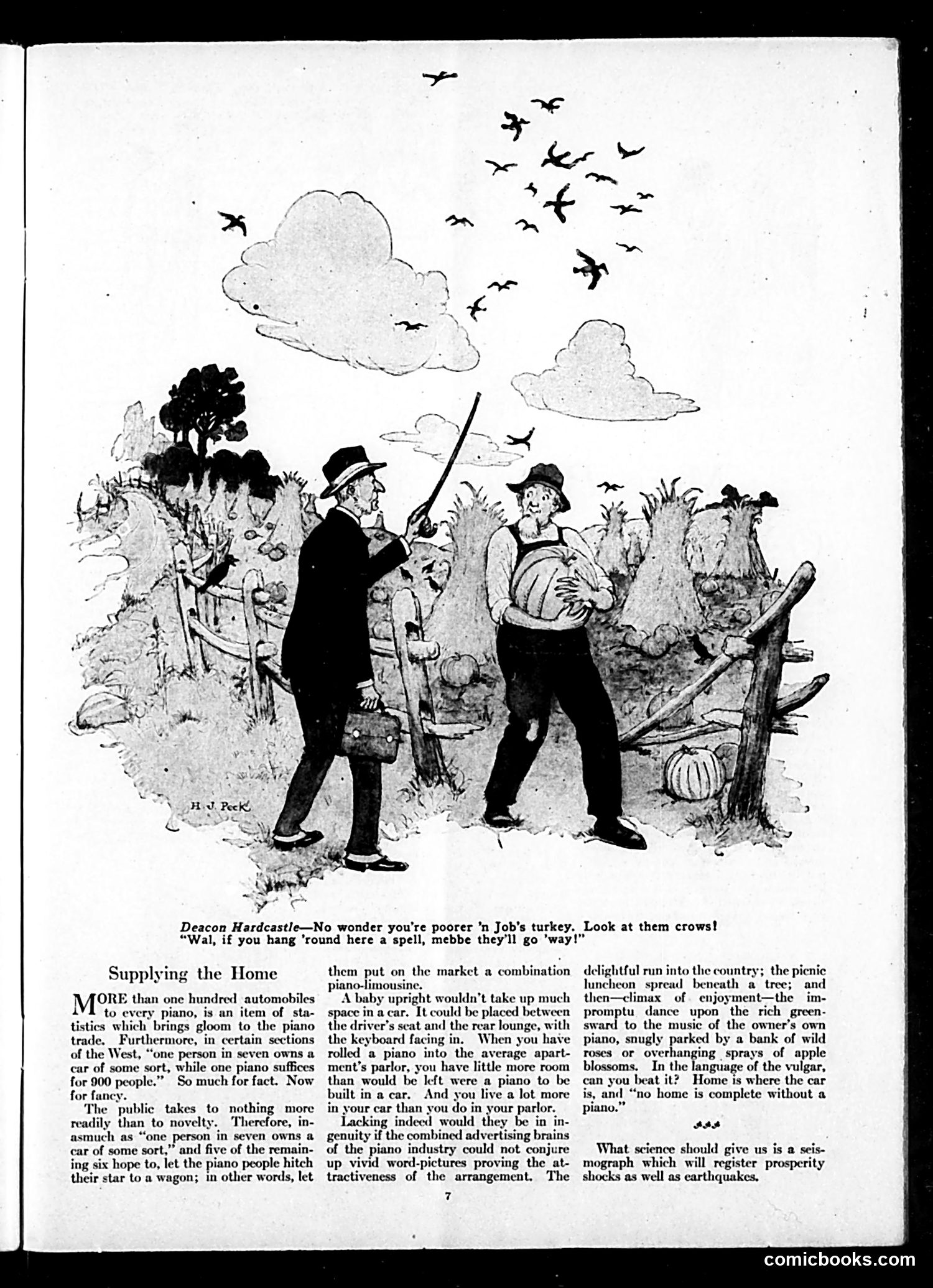
The cartoon depicts a rural farmer (Deacon Hardcastle) standing in a field damaged by crows, with another man suggesting he wait for the birds to leave. The visual joke: the farmer's crops are ruined, yet he seems resigned to inaction—a commentary on rural poverty and helplessness. The accompanying article satirizes the piano industry's response to declining sales. It proposes an absurd solution: a "combination piano-limousine"—placing a baby grand piano inside an automobile. The satire mocks both the piano industry's desperation and advertising's ability to spin fantasies (picnics with impromptu dances) to sell impractical products. The contrast is stark: automobiles vastly outnumber pianos (100+ cars per piano), yet the industry imagines forcing pianos into cars rather than accepting market reality. The final line about seismographs measuring "prosperity shocks" wryly suggests satire itself is the only honest measure of economic folly.
📄 Transcribed text from this page (OCR, searchable)
Machine-transcribed from the original scan — historical spelling and the odd misread are preserved.
Deacon Hardcastle—No wonder you're poorer ’n Job’s turkey. Look at them crows! “Wal, if you hang ‘round here a spell, mebbe they'll go ’way!” Supplying the Home ORE than one hundred automobiles a to every piano, is an item of sta- tistics which brings gloom to the piano trade. Furthermore, in certain sections of the West, “one person in seven owns a car of some sort, while one piano suffices for 900 people.” So much for fact. Now for fancy. The public takes to nothing more readily than to novelty. Therefore, in- asmuch as “one person in seven owns a car of some sort,” and five of the remain- ing six hope to, let the piano people hitch their star to a wagon; in other words, let them put on the market a combination piano-limousine. A baby upright wouldn’t take up much space in a car. It could be placed between the driver’s scat and the rear lounge, with the keyboard facing in. When you have rolled a piano into the average apart- ment’s parlor, you have little more room than would be left were a piano to be built in a car. And you live a lot more in your car than you do in your parlor. Lacking indeed would they be in i genuity if the combined advertising b: of the piano industry could not conjure up vivid word-pictures proving the at- tractiveness of the arrangement. The 7 delightful run into the country; the picnic luncheon spread beneath a tree; and then—climax of enjoyment—the im- promptu dance upon the rich green- sward to the music of the owner’s own piano, snugly parked by a bank of wild roses or overhanging sprays of apple blossoms. In the language of the vulgar, can you beat it? Home is where the car is, and “no home is complete without a piano.” Sas What science should give us is a seis- mograph which will register prosperity shocks as well as earthquakes, comicbooks.com