
A complete issue · 36 pages · 1922
Judge — September 23, 1922
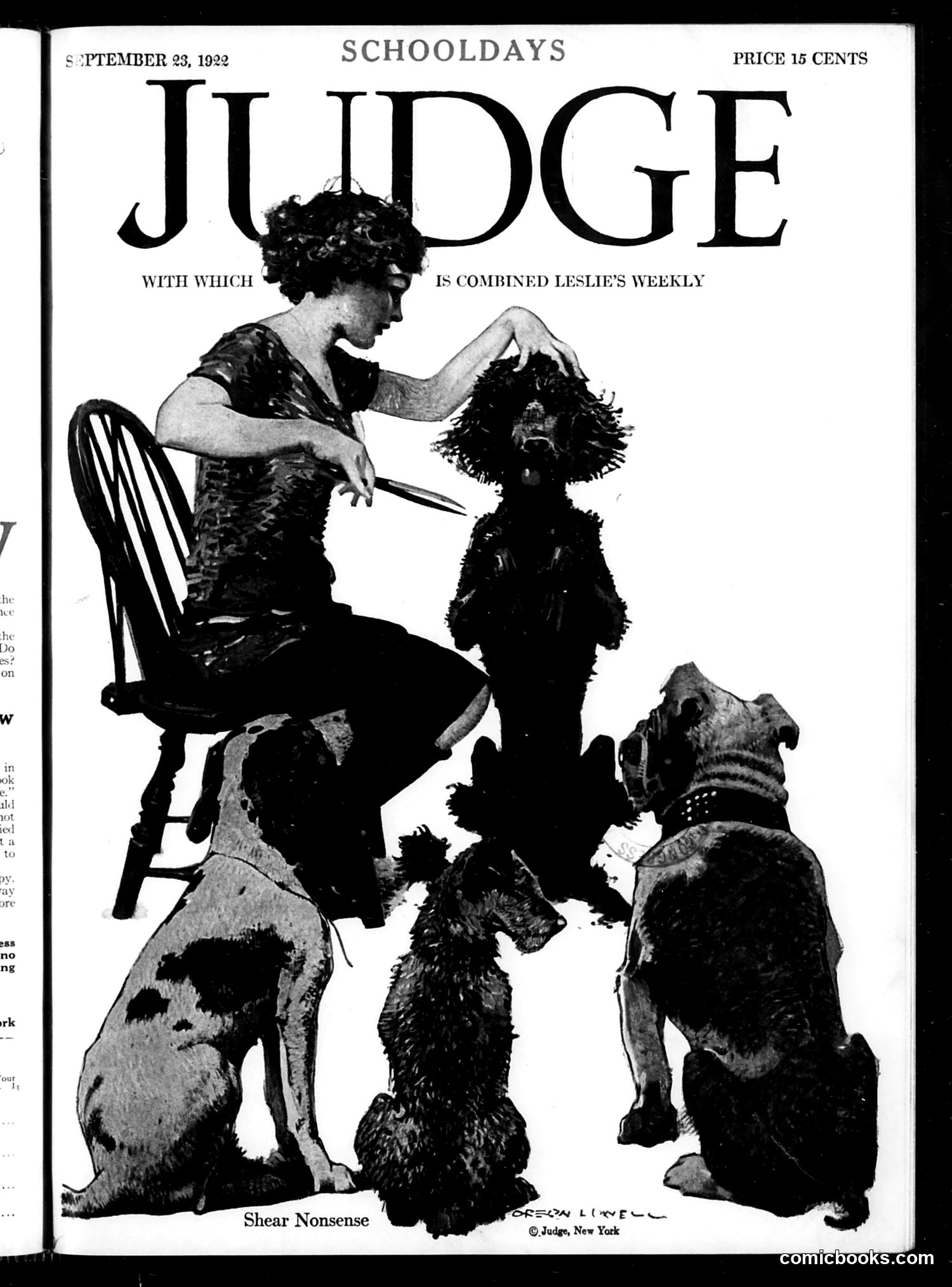
This cover illustration depicts a woman seated in a chair, cutting the hair of several dogs of varying sizes and breeds. The title "Shear Nonsense" is a pun on "sheer nonsense." The cartoon appears to satirize the fashionable practice of dog grooming and styling among wealthy women during the 1920s. The exaggerated attention given to the dogs' appearances—treating them as if they were human clients at a salon—mocks what the cartoonist viewed as excessive or frivolous pet care. This reflects broader 1920s satirical commentary on modern consumer culture and upper-class leisure activities, presenting dog grooming as an absurdly elaborate pastime worthy of ridicule.
This page is primarily **promotional text** rather than a political cartoon. It advertises next week's "Banker's Number" issue of *Judge* magazine. The text promises humorous stories about bankers' personal lives, claiming to reveal that financial institutions have human warmth and humor. It mentions contributors Angus MacDonall, Orson Lowell, John Held Jr., and Simon Werner producing illustrations. The satire is mild: the premise that bankers might possess "hearts" and "joy" suggests contemporary skepticism about banking institutions' humanity—likely reflecting post-WWI American attitudes toward finance and big business. The page also advertises upcoming special issues (Navy, Army, and Follies numbers), indicating *Judge's* regular publication practices and marketing approach to readers during this era.
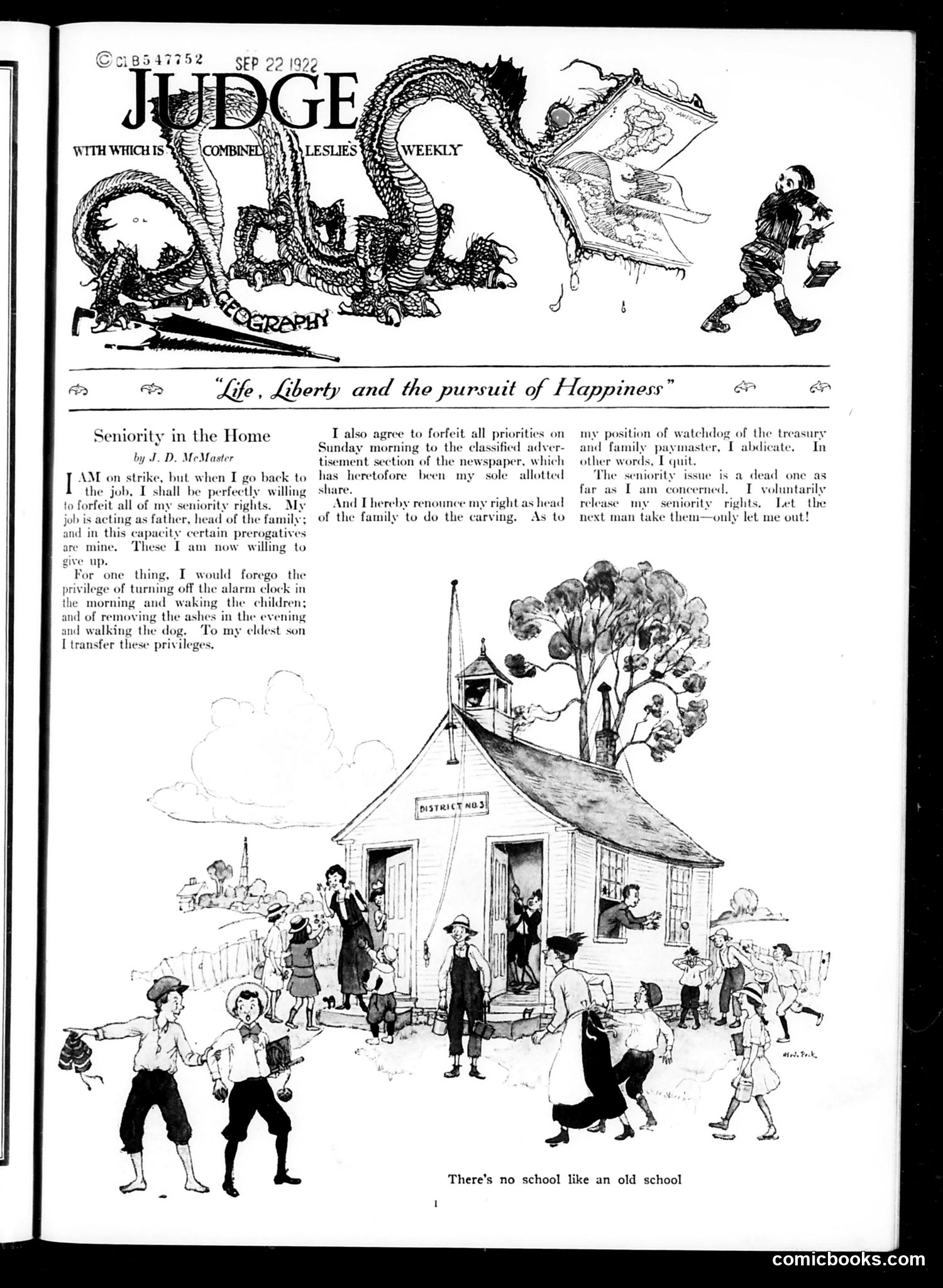
This 1922 satirical piece depicts the tension between family hierarchy and workplace strikes. The article's narrator—a striking worker—claims he'll forfeit seniority rights at his job to maintain domestic authority at home. He promises to transfer "privileges" like turning off the alarm clock and removing ashes to his eldest son, but only if allowed to retain his position as "head of the family" and "carving" authority at dinner. The satire mocks masculinity anxiety: the working man fears losing domestic power as readily as workplace seniority. The accompanying schoolhouse illustration with the caption "There's no school like an old school" reinforces the conservative point—traditional family structures (paternal authority) are as valuable as traditional education. The piece suggests 1920s debates about changing gender roles and labor organization.
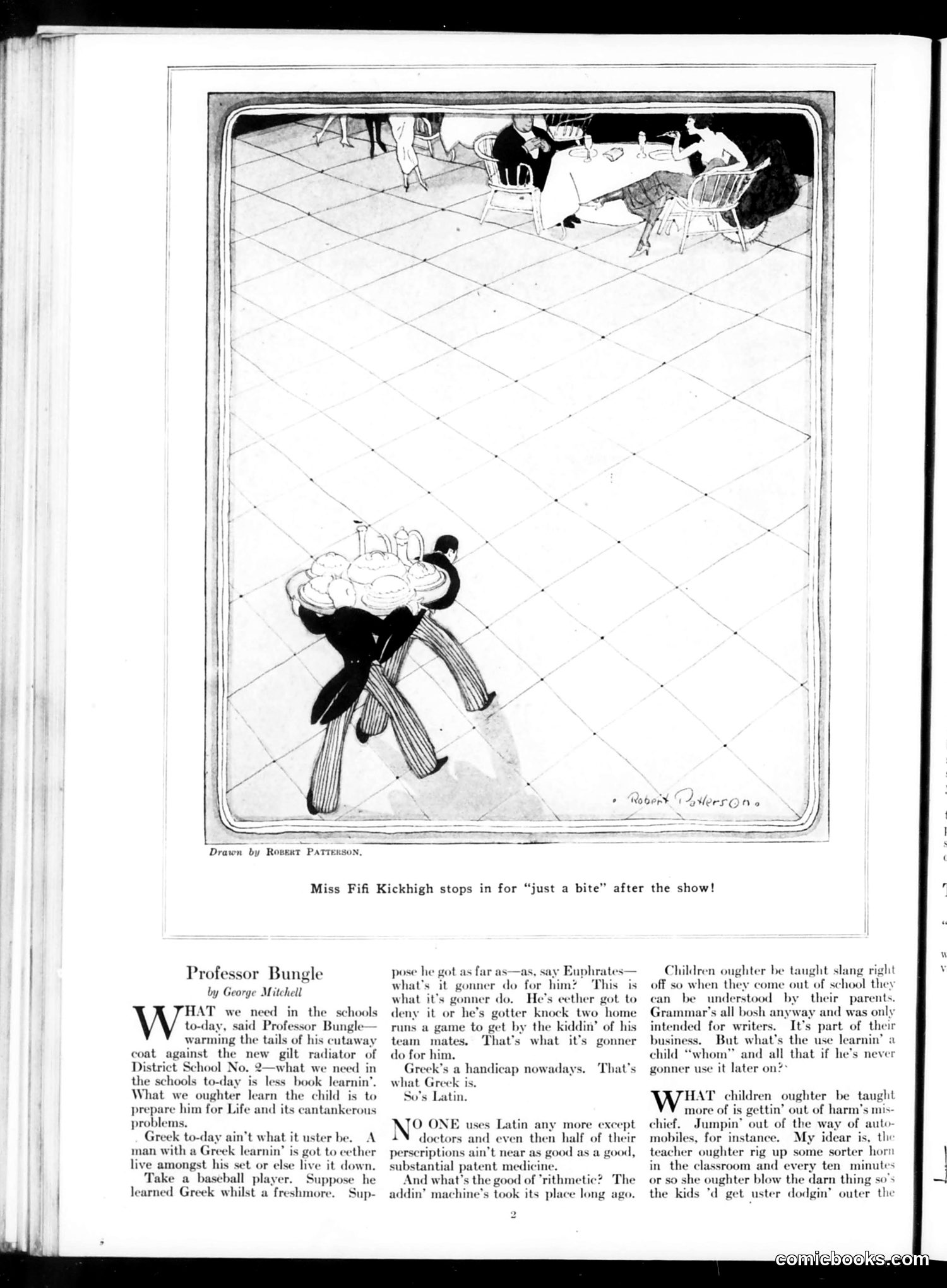
The cartoon by Robert Patterson shows "Miss Fifi Kickhigh" carrying an enormous ice cream sundae across a checkered floor, captioned "stops in for 'just a bite' after the show!" This is a visual gag about gluttony and ironic understatement—the character's claim of wanting "just a bite" contradicts the absurdly oversized dessert she's carrying. The exaggerated proportions and theatrical setting suggest she's a showgirl or performer. Below, the article "Professor Bungle" by George Mitchell satirizes outdated educational practices, particularly the emphasis on classical languages like Greek and Latin. Mitchell argues these subjects are impractical and obsolete compared to useful modern skills, making a modernization argument about what schools should teach.
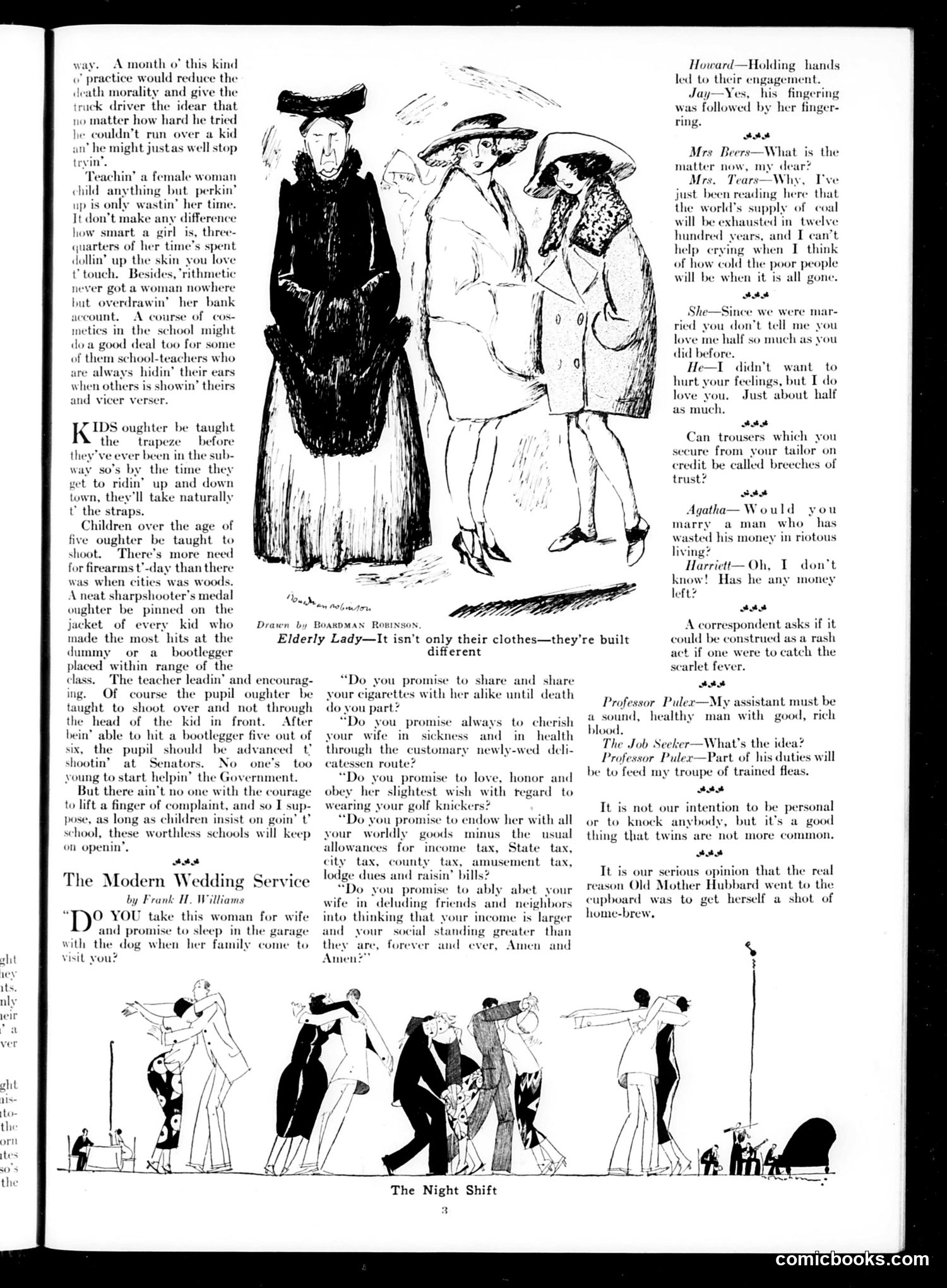
This satirical piece mocks contemporary marriage vows and domestic expectations. The top illustration shows an "Elderly Lady" commenting that newlyweds "aren't only their clothes—they're built different," suggesting women are fundamentally altered by marriage. The text presents increasingly absurd modern marriage promises, parodying traditional vows by adding contemporary financial obligations: income taxes, state taxes, city taxes, amusement taxes, and "lodge dues and raisin' bills." The satire targets how marriage has become economically burdensome rather than romantic. The bottom cartoon, "The Night Shift," depicts husbands performing domestic labor—washing dishes, changing diapers, doing laundry—suggesting role reversals and the joke that modern married men work constantly at home. Overall, the piece satirizes how 1920s marriage had become a financial and domestic treadmill rather than a romantic union.
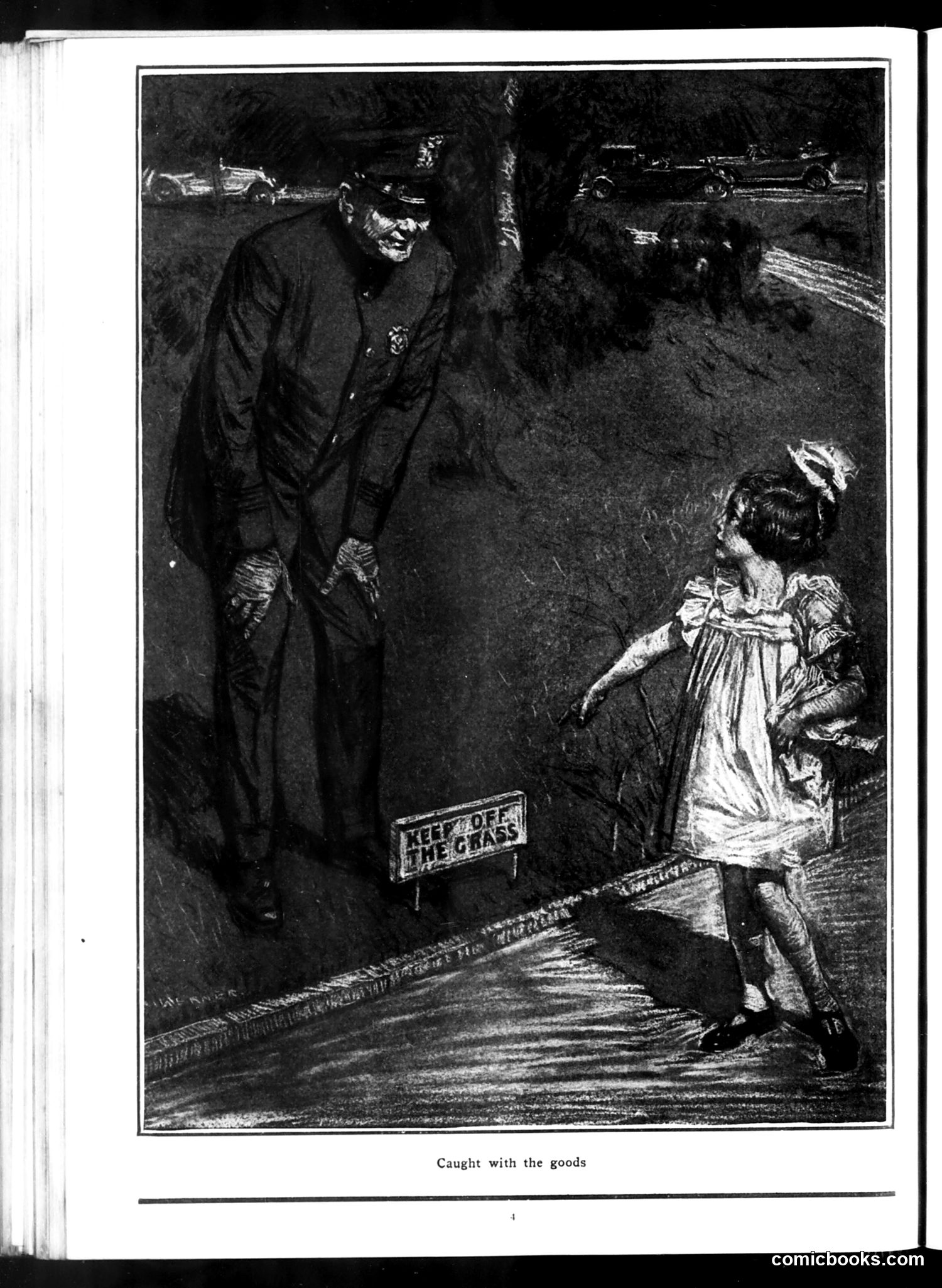
This political cartoon depicts an authority figure (likely a police officer or official, given his dark uniform and stern expression) confronting a small child caught in an apparent act of theft or vandalism. The child holds what appears to be stolen goods or contraband, while a "Keep Off the Grass" sign is visible in the scene. The satire likely critiques either law enforcement's harsh treatment of minor offenses or, conversely, childhood misbehavior and lack of discipline. The stark contrast between the intimidating adult and vulnerable child emphasizes the cartoon's moral point. Without additional context from Judge magazine's publication date and surrounding articles, the specific political or social target remains unclear, though the image suggests commentary on justice, authority, or parental responsibility.
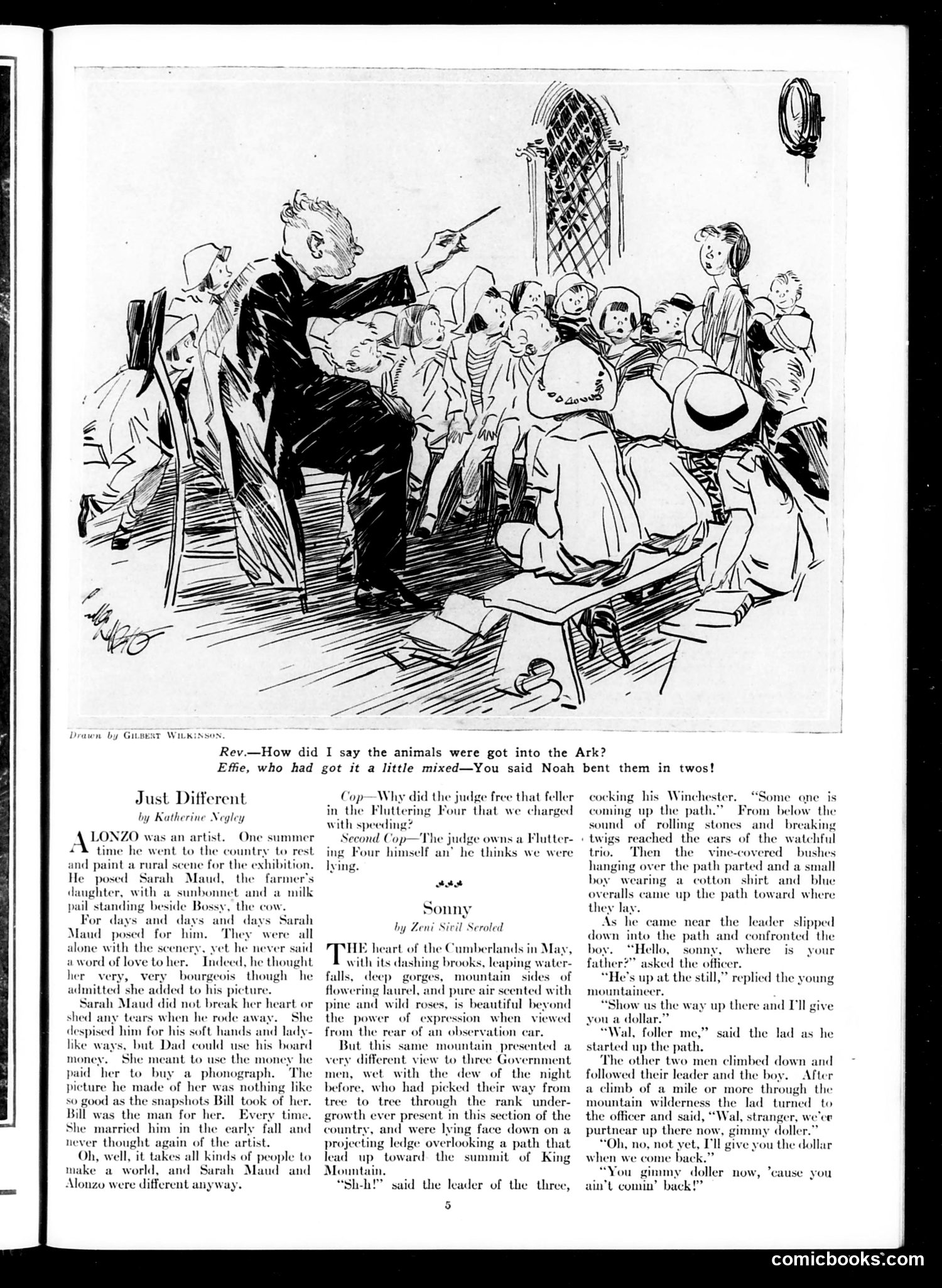
This Judge magazine page contains three separate stories/cartoons: 1. **Top cartoon**: A gentle joke about a child mishearing religious instruction—the reverend explained Noah loaded animals "two by two," but the girl (Effie) understood he "bent them in twos." 2. **"Just Different"**: A short story satirizing artistic pretension. An affected painter (Alonzo) poses a farm girl (Sarah Maud) for an exhibition piece, treating her as mere subject matter while considering her "bourgeois." She's unmoved by him, marries the practical Bill instead, and never thinks of the artist again. The satire mocks the artist's self-importance and disconnection from reality. 3. **"Sonny"**: A prohibition-era story about federal agents tracking a moonshine still in the Appalachian mountains. A boy guides them, then demands payment before revealing the final location, implying he'll rob them ("you ain't comin' back!")—suggesting rural resistance to federal enforcement. The page reflects early 20th-century concerns: religious education, artistic pretension, and bootlegging during Prohibition.
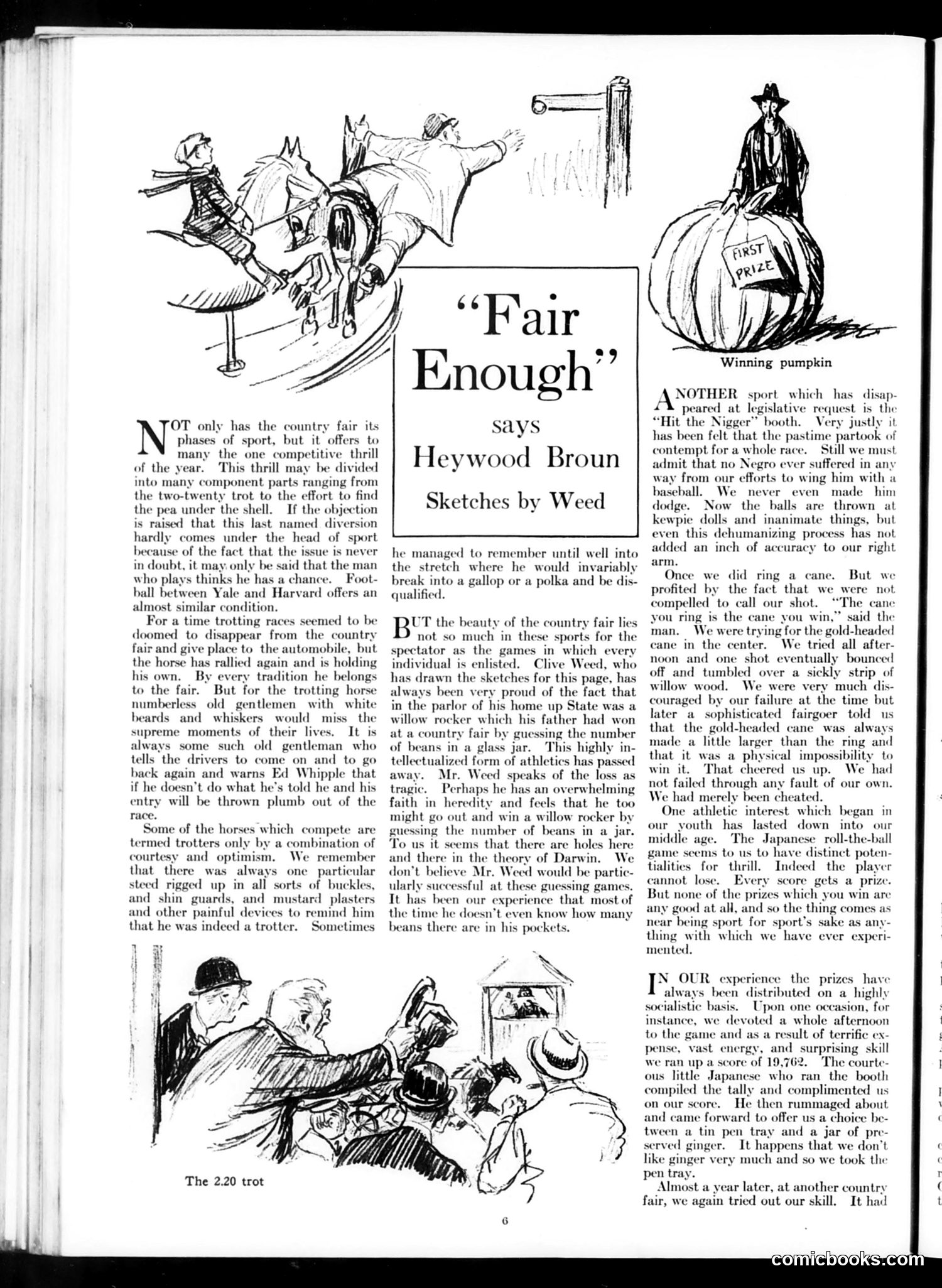
This 1920s *Judge* magazine article by Heywood Broun celebrates country fairs as authentic American entertainment, with illustrations by Clive Weed. The piece humorously describes fair competitions: trotting races (where poorly-trained horses comically break into gallops), carnival games like guessing beans in jars, and ring-toss contests. Most strikingly to modern readers, Broun openly discusses the now-infamous "Hit the Nigger" booth—a racist carnival game where fairgoers threw balls at Black targets. He acknowledges its removal as "justly" requested by legislators, claiming no one was actually hit. He then trivializes this racist entertainment by comparing it favorably to safer modern alternatives like throwing balls at Kewpie dolls. The casual tone normalizing racial violence reflects the era's casual racism, even among ostensibly progressive publications. The piece unwittingly documents how dehumanizing entertainment was standard fair fare, presented as innocent fun rather than the racist violence it represented.
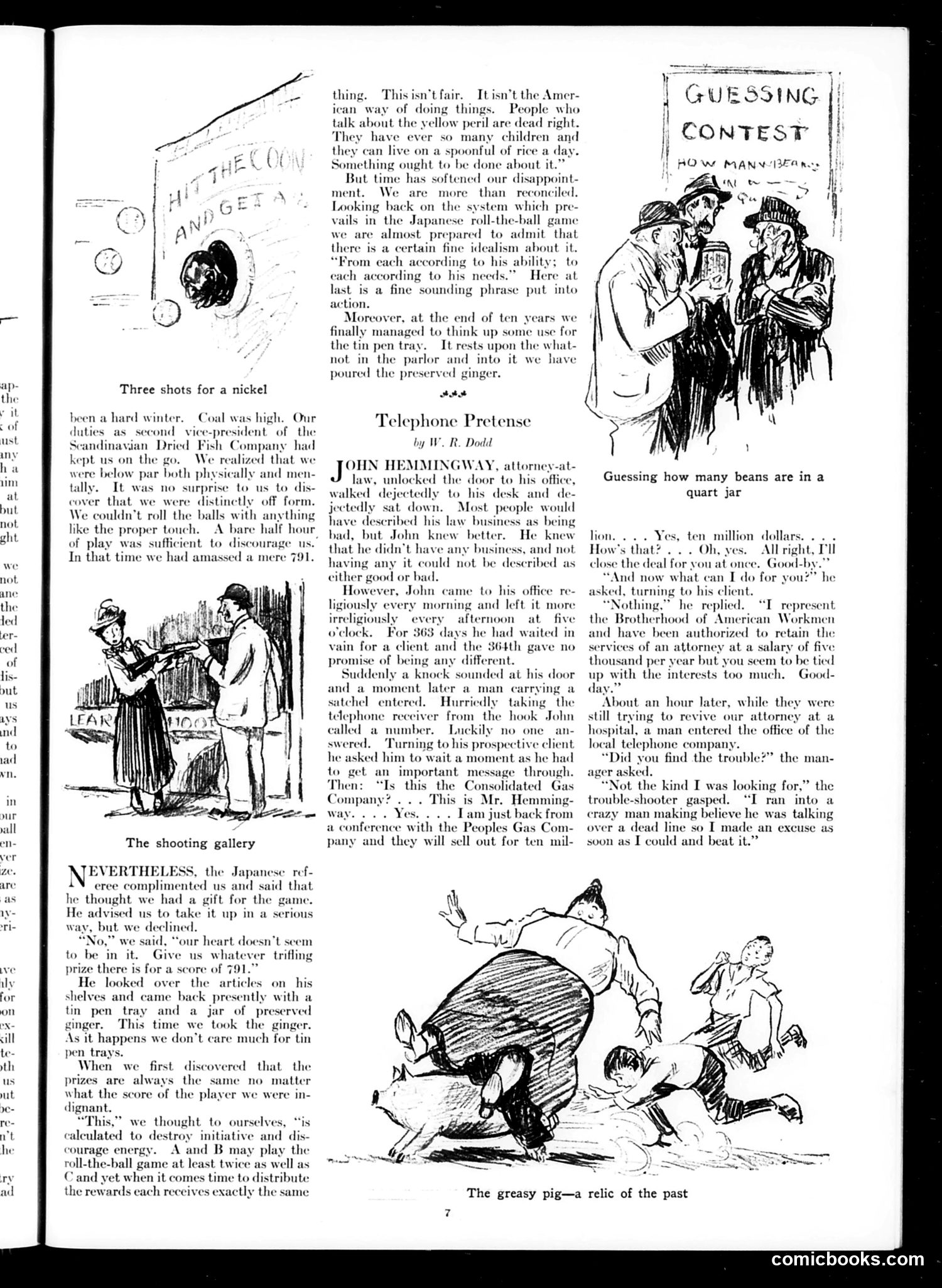
This page contains two distinct pieces of satire: **"Three Shots for a Nickel"** critiques Japanese cultural practices through the lens of an American shooting gallery. The author visits a Japanese-run arcade and receives identical prizes regardless of skill level, initially outraged at this "unfair" system. However, he eventually recognizes the philosophy as idealistic—paraphrasing Marx's "from each according to his ability, to each according to his needs." The satire mocks both American competitive capitalism and the author's gradual, bemused acceptance of communist-adjacent principles in an unexpected context. **"Telephone Pretense"** depicts an unemployed lawyer, John Hemmingway, faking a lucrative business call to impress a potential client who enters his empty office. The joke exposes the performance of success—he fabricates deals and importance through theatrical phone conversation to appear professionally established, revealing the gap between appearance and reality in business. Both pieces use humor to critique American values: competitiveness, status-seeking, and the performance of success.
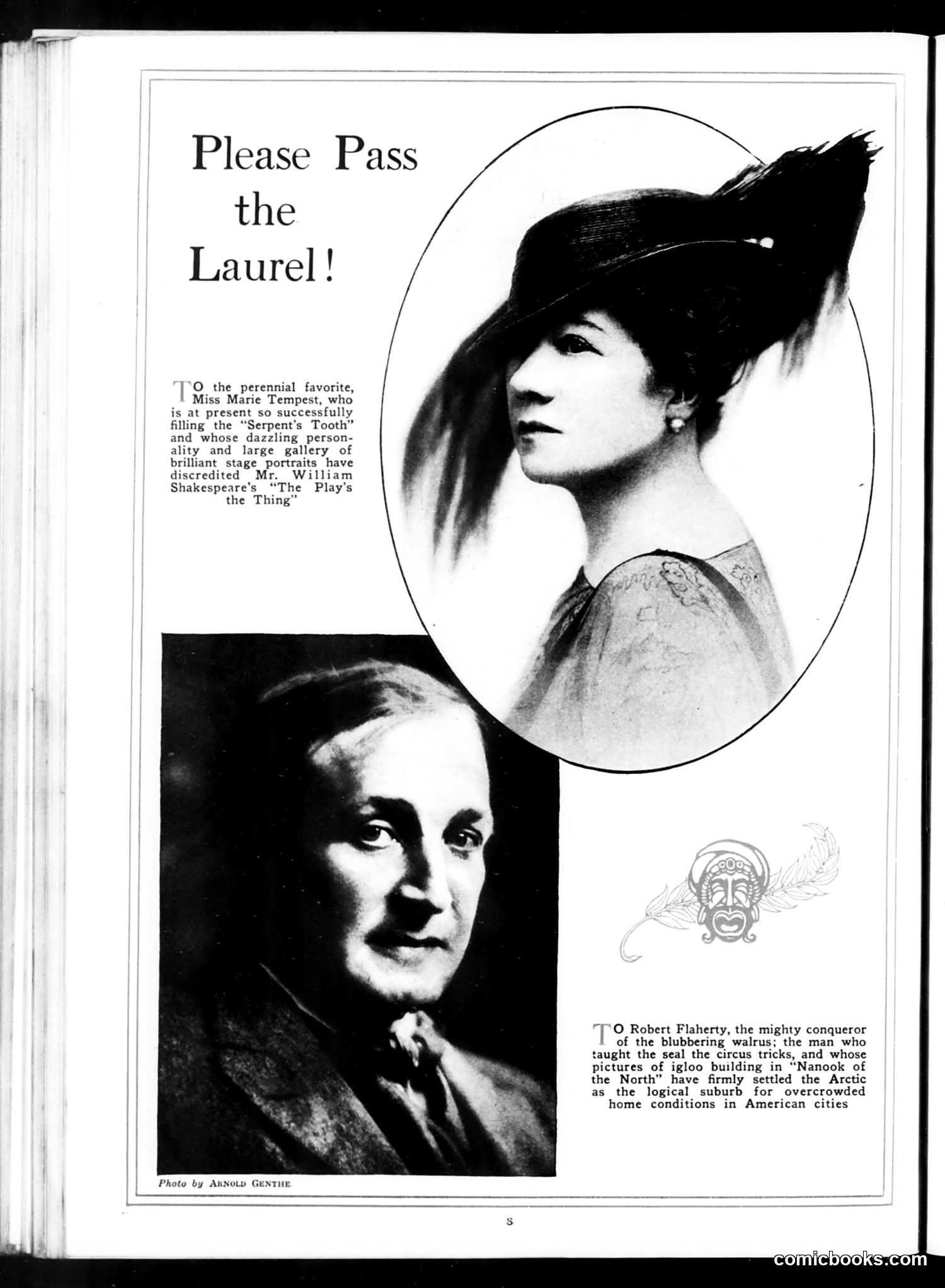
This page awards satirical "laurels" (honors) to two entertainers: **Marie Tempest** (upper right): A stage actress praised for her performance in "The Serpent's Tooth," a play. The satire mocks her talent by suggesting she has made Shakespeare's famous line "The Play's the Thing" seem irrelevant—her personality overshadows the dramatic text itself. **Robert Flaherty** (lower left): A filmmaker whose documentary "Nanook of the North" (about Arctic Inuit life) was apparently popular. The satire ridicules the film's influence, joking that audiences now view the Arctic as a practical solution to American urban overcrowding, when it actually depicts extreme living conditions. Both entries use exaggerated praise to mock contemporary celebrity culture and the outsized influence of stage and film entertainers on public imagination. The "laurel" is ironic recognition of their cultural impact, whether deserved or not.
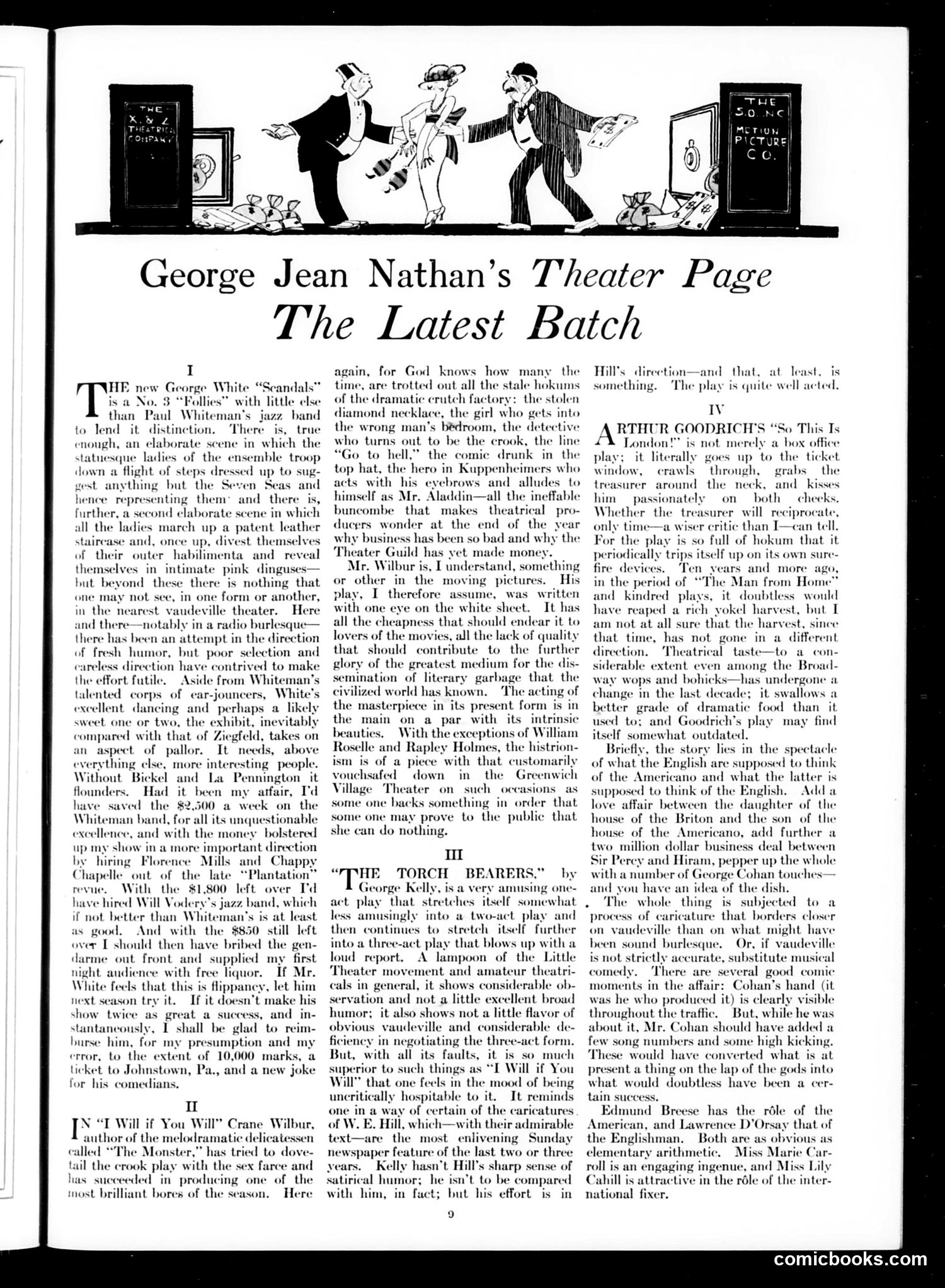
This is theater critic George Jean Nathan's review column. The header illustration shows three theatrical figures in exaggerated poses amid money, representing the commercial chaos of Broadway production. Nathan reviews three shows with characteristic acerbity: 1. **George White's "Scandals"** — criticized as derivative of Ziegfeld's "Follies," saved only by Paul Whiteman's jazz band. Nathan argues the elaborate staging and chorus girls cannot mask lack of originality or interesting talent. 2. **"I Will if You Will"** — a sex farce/crime play by Crane Wilbur, dismissed as recycled theatrical clichés (stolen necklaces, mistaken bedrooms, comic drunks). Nathan acidly notes Wilbur works in movies, suggesting the play's cheapness reflects cinema's "literary garbage." 3. **"The Torch Bearers"** — by George Kelly (review continues off-page). Nathan's satire targets Broadway's commercial formula: lavish spectacle substituting for wit, and producers' bafflement at poor box office despite their tired conventions. The tone is sophisticated mockery of theatrical mediocrity.
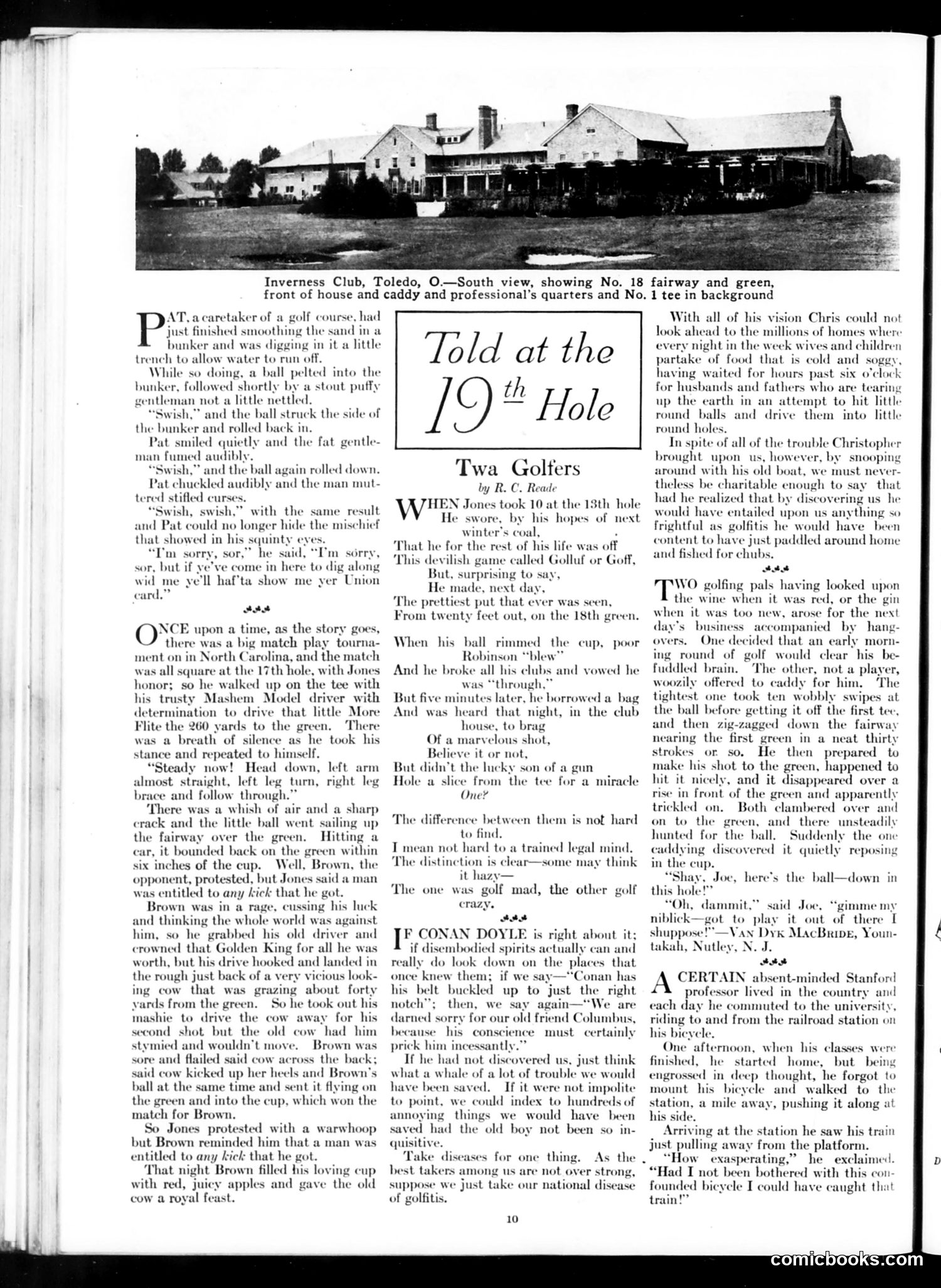
This page presents two humorous golf anecdotes typical of Judge's satirical content. The first story mocks working-class Irish immigrants through "Pat," a golf course caretaker who refuses to work alongside a wealthy golfer lacking a union card—a pointed jab at labor organizing and class tensions of the era. The second, "Twa Golfers," contrasts two players' responses to golf frustrations: Jones cheats when frustrated but rationalizes it; Brown cheats but celebrates his "luck." The satire targets golf's pretension and the absurdity of how wealthy men rationalize poor sportsmanship. The photograph shows the Inverness Club in Toledo, Ohio—a real country club—establishing this as insider commentary on elite leisure culture. The "19th hole" (the bar) framing device suggests these are tall tales told by club members, reinforcing Judge's mockery of upper-class golf culture's self-deception and moral flexibility. The humor relies on readers' familiarity with golf clubs and their social hierarchies.
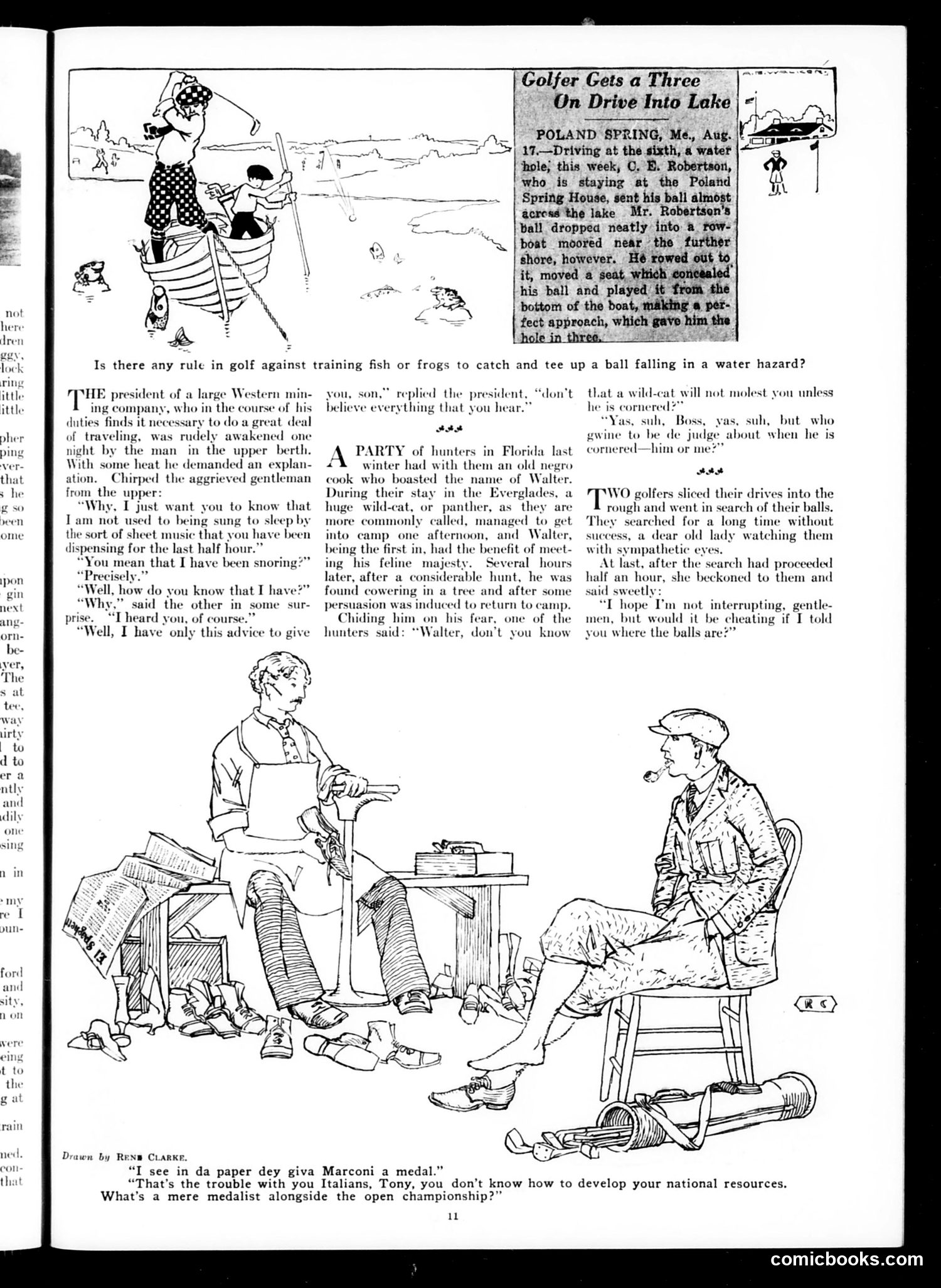
This page contains three separate humorous anecdotes: 1. **"Golfer Gets a Three On Drive Into Lake"**: A golfer at Poland Spring, Maine drives into a water hazard but, rather than take a penalty, rows out to a rowboat, moves a seat, and plays his ball from the boat bottom—technically scoring a three. The heading poses a satirical question: whether golf rules permit training animals to retrieve balls from water hazards. 2. **Upper Berth Story**: A traveling mining company president is awakened by his upper-berth neighbor complaining about his snoring, which the president dismisses by saying "don't believe everything that you hear." 3. **Bottom Cartoon**: Two men discuss Marconi receiving a medal. One (Tony, appearing Italian by name) notes Italians give medals for achievements, while the other sarcastically responds that winning an "open championship" is more valuable—satirizing the gap between individual honors and major sporting accomplishments. The page satirizes class pretension, golfing absurdities, and ethnic attitudes toward achievement and recognition.
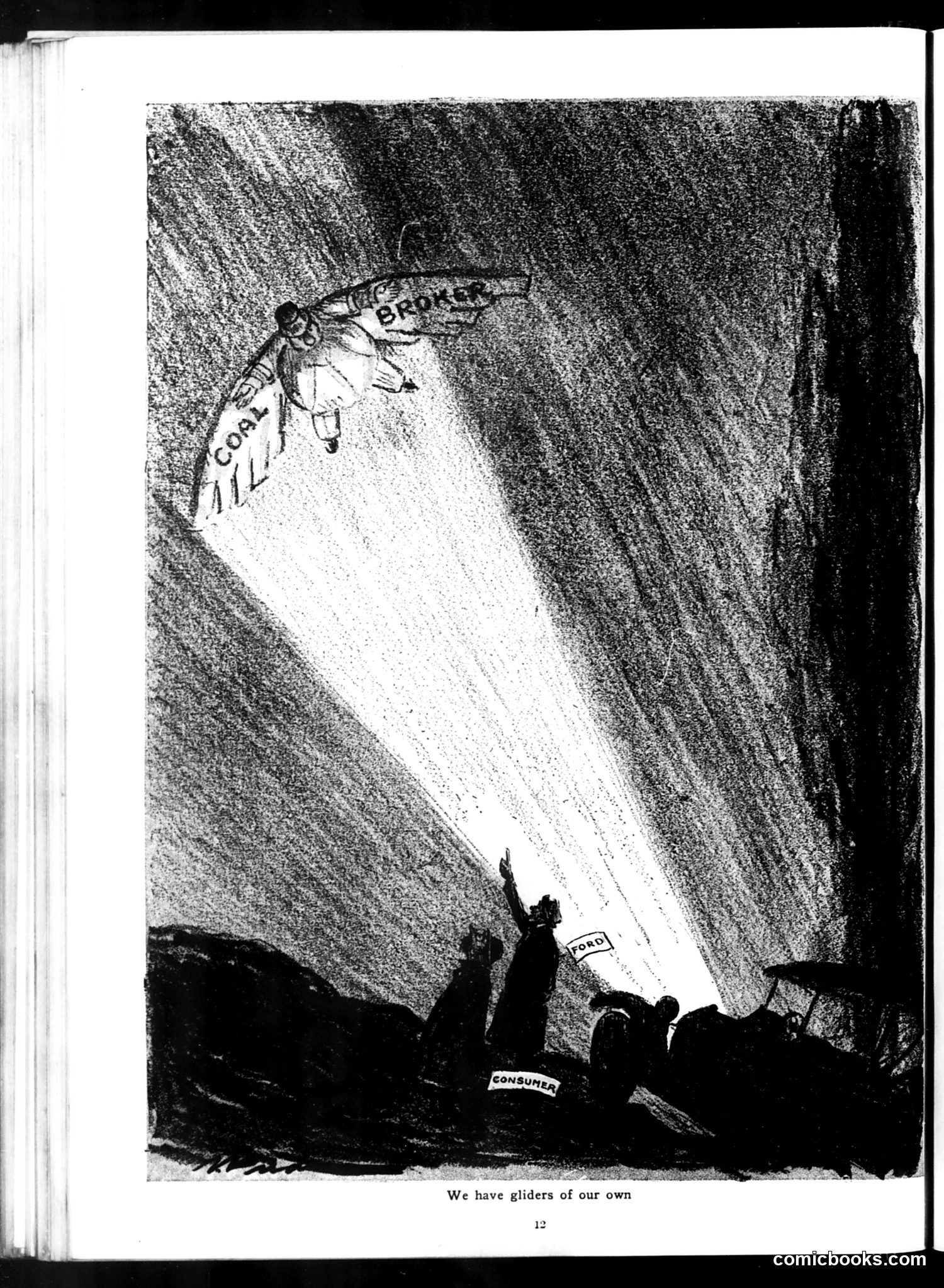
This cartoon shows a large aircraft labeled "Broker" shining a searchlight beam downward onto silhouetted figures below labeled "Consumer" and "Ford." The caption reads "We have gliders of our own." This appears to be Depression-era satire critiquing the relationship between financial brokers, automobile manufacturers (Ford), and consumers. The "gliders" metaphor suggests that brokers and Ford are using consumers as unpowered aircraft—extracting value while consumers have no real agency or independent power. The searchlight implies surveillance or targeting of the vulnerable working class. The cartoon likely comments on how big business exploited consumers during economic hardship, with Ford (then a major employer) and financial interests depicted as controlling forces.
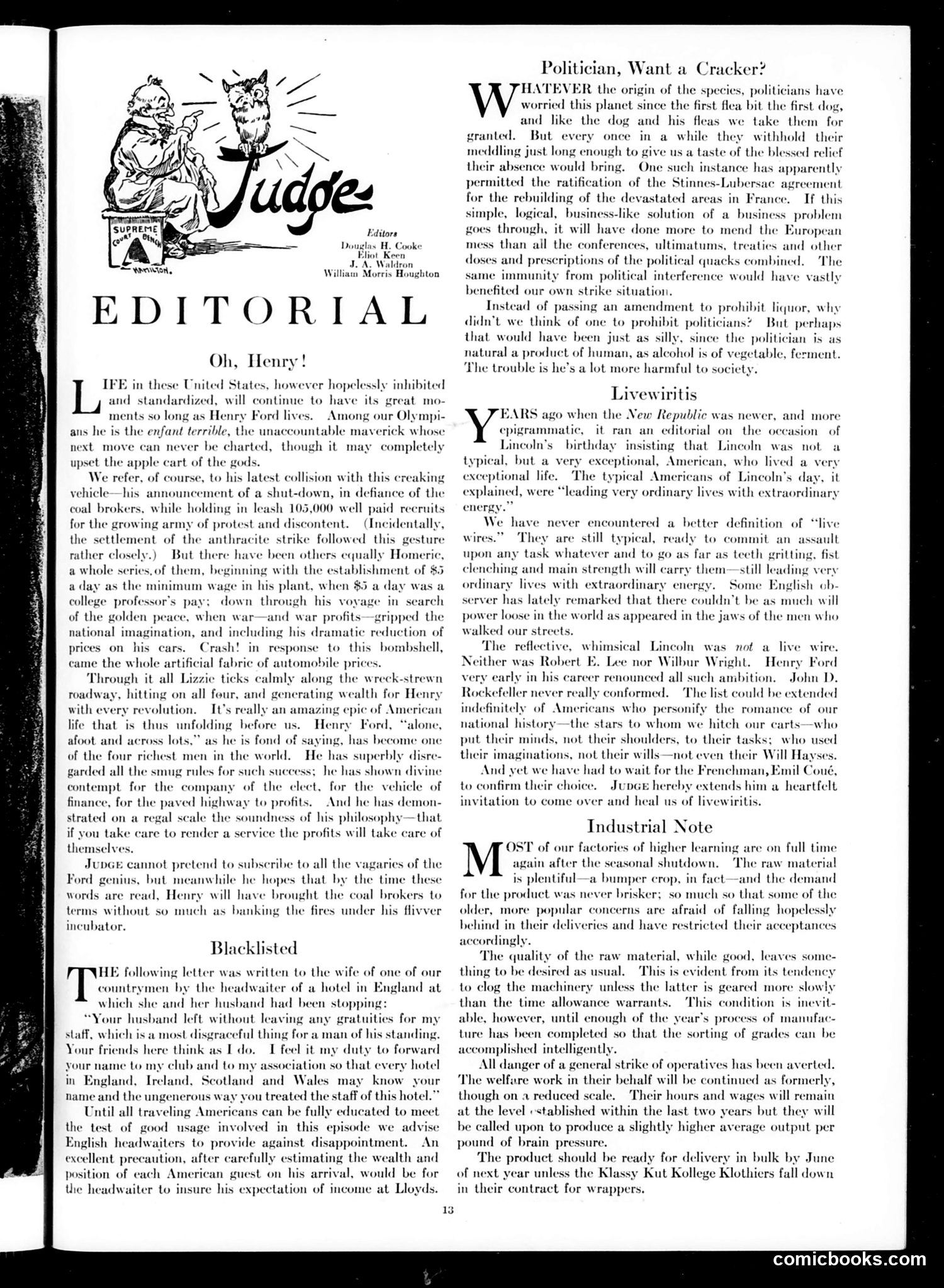
This page contains three distinct editorial pieces satirizing American figures and international politics circa the 1920s. **"Oh, Henry!"** praises Henry Ford as an unpredictable "enfant terrible" who disrupts the status quo—celebrating his $5 minimum wage, price cuts on automobiles, and recent plant shutdown defying coal brokers. Judge frames Ford's disregard for convention as admirably American. **"Blacklisted"** mocks American tourists abroad through a complaint letter from an English hotel headwaiter about an American guest who failed to tip staff. The satire targets American travelers' perceived rudeness and wealth-flaunting. **"Politician, Want a Cracker?"** compares politicians to parasites like fleas on dogs, suggesting they're tolerated nuisances. It praises the "Stinnes-Lubersac agreement" (likely post-WWI German reparations negotiations) as rare intelligent political action. The page's overall tone: affectionate toward American industrial iconoclasts (Ford), scornful of American social conduct abroad, and cynically dismissive of politicians generally.
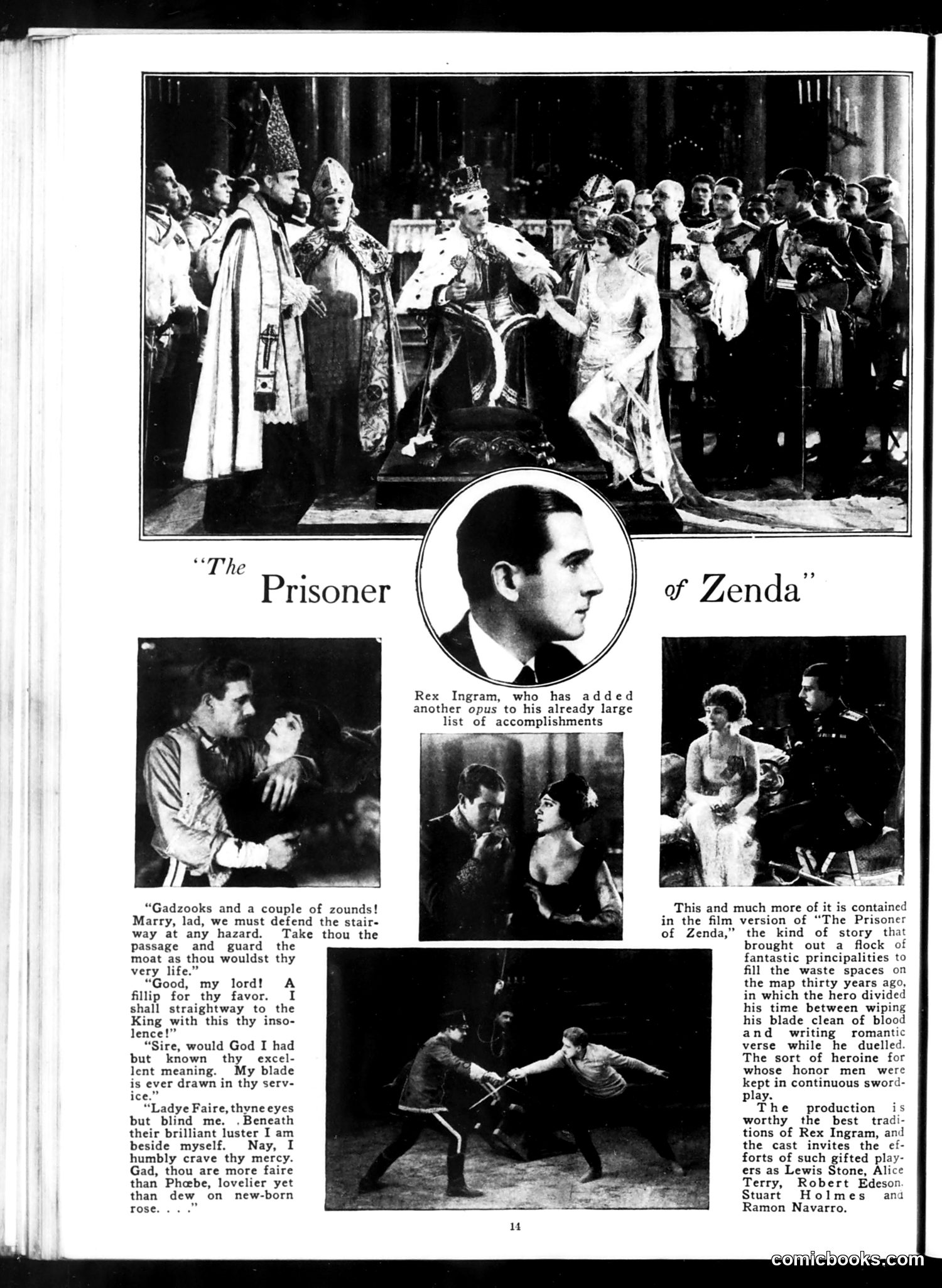
This is a Judge magazine review of director Rex Ingram's film adaptation of *The Prisoner of Zenda*. The page mocks the story's overwrought theatrical conventions—archaic dialogue ("Gadzooks," "thyne eyes"), melodramatic honor codes, and romantic sword-play that dominated swashbuckling adventure tales of the era. The quoted dialogue satirizes the florid, anachronistic language and absurd plot devices typical of such productions: servants pledging loyalty in pseudo-medieval speech, heroes torn between dueling and composing verse. The review notes the film features the "fantastic principalities" and romantic complications characteristic of this genre, which apparently still appealed thirty years prior. The cast—including Lewis Stone and Ramon Navarro—represents prestigious talent the reviewer credits to Ingram's directorial reputation. This appears straightforward entertainment criticism rather than political satire, mocking the genre's conventions for modern (1920s) audiences.
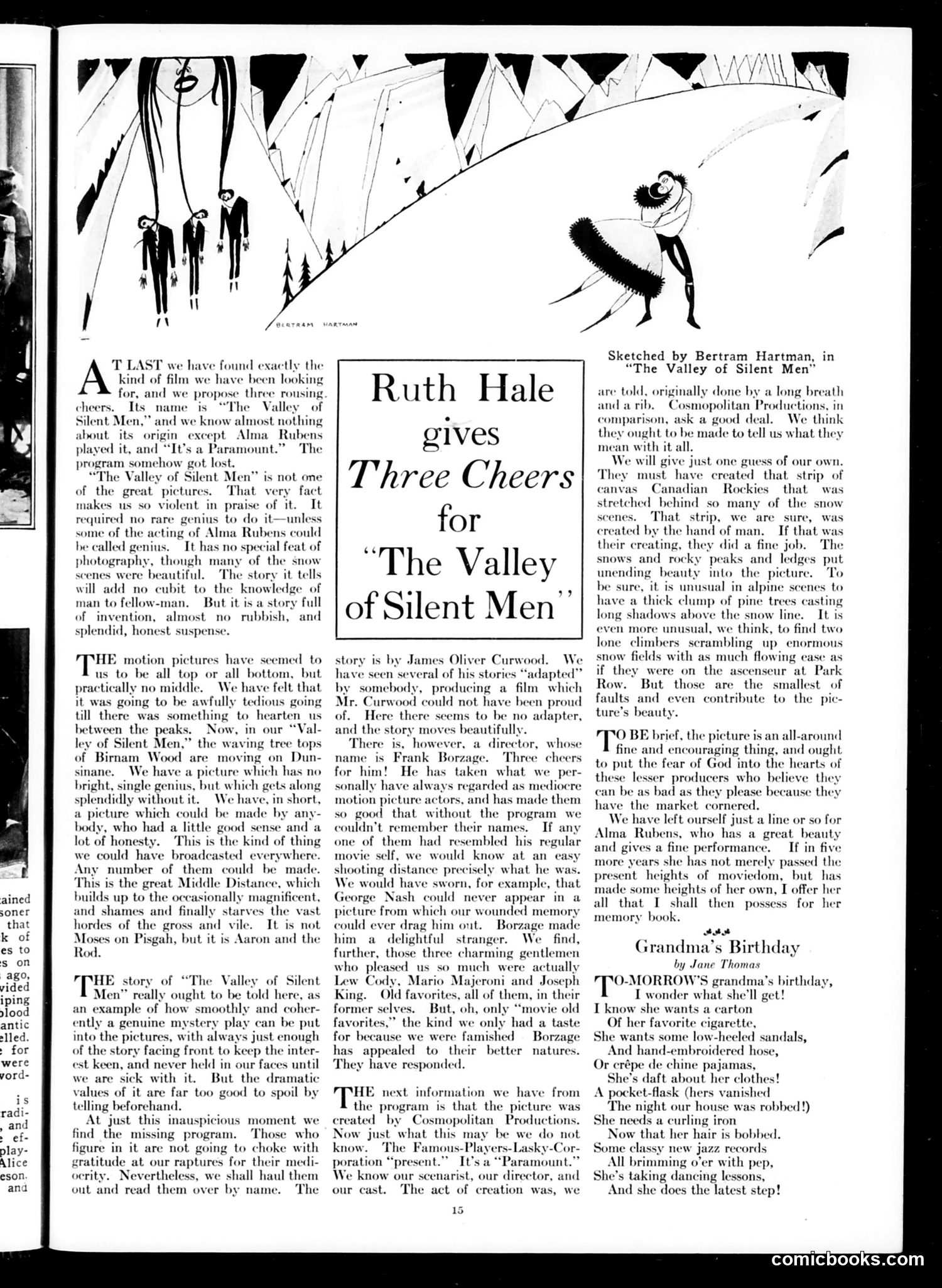
This page is primarily a **film review**, not political satire. Ruth Hale praises the 1920 Paramount film "The Valley of Silent Men," directed by Frank Borzage and based on a James Oliver Curwood story. The review's satire is **cinematic, not political**: Hale celebrates the film precisely because it's competently made but unpretentious—a "middle distance" picture with no genius but honest craftsmanship. She praises director Borzage for elevating mediocre actors (Lew Cody, Mario Majeroni, Joseph King) into credible performances through skilled direction rather than special photography or elaborate plotting. The bottom section reprints a poem by Jane Thomas about grandmother's birthday gifts—unrelated filler content typical of Judge's mixed editorial format. **No political figures or social commentary** appear on this page. It's entertainment criticism reflecting 1920s film industry attitudes.
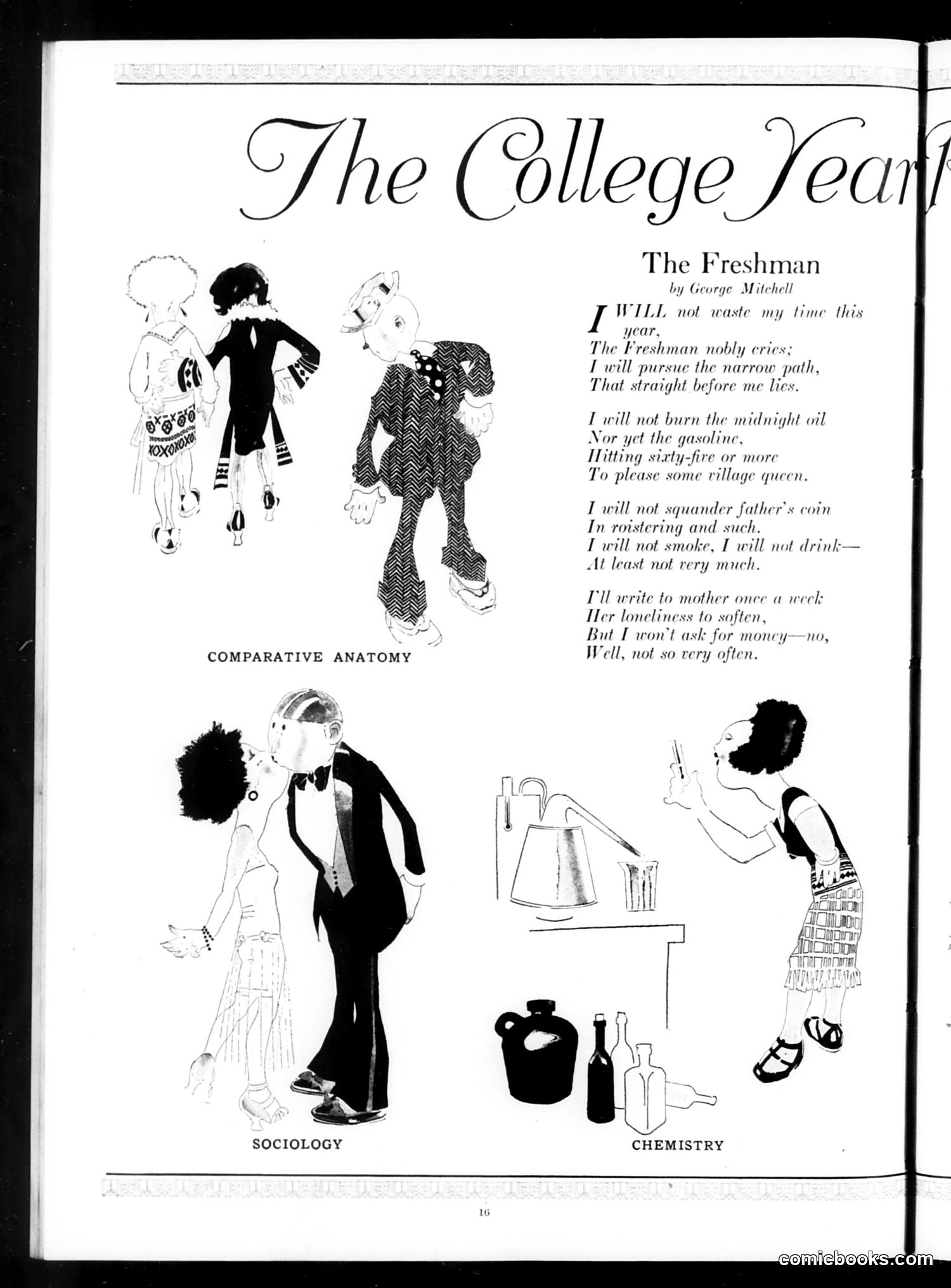
This page satirizes the idealistic promises college freshmen make versus their actual behavior. George Mitchell's poem presents a freshman solemnly vowing to live responsibly: study hard, avoid excess spending, not pursue romantic distractions, abstain from smoking and drinking, and write home regularly. The humor lies in the contradictions baked into the text itself—phrases like "not very much" drinking and "not so very often" asking for money undercut the noble declarations. The illustrations use "Comparative Anatomy" as a framework, showing the freshman's idealized self versus reality across different "subjects": **Sociology** depicts a gentleman versus his actual behavior with women; **Chemistry** shows laboratory equipment alongside bottles of alcohol, suggesting the freshman's real "experiments" involve drinking rather than academics. This reflects 1920s concerns about college students' actual conduct—partying, spending money frivolously, and pursuing romantic interests despite parental expectations of academic focus.
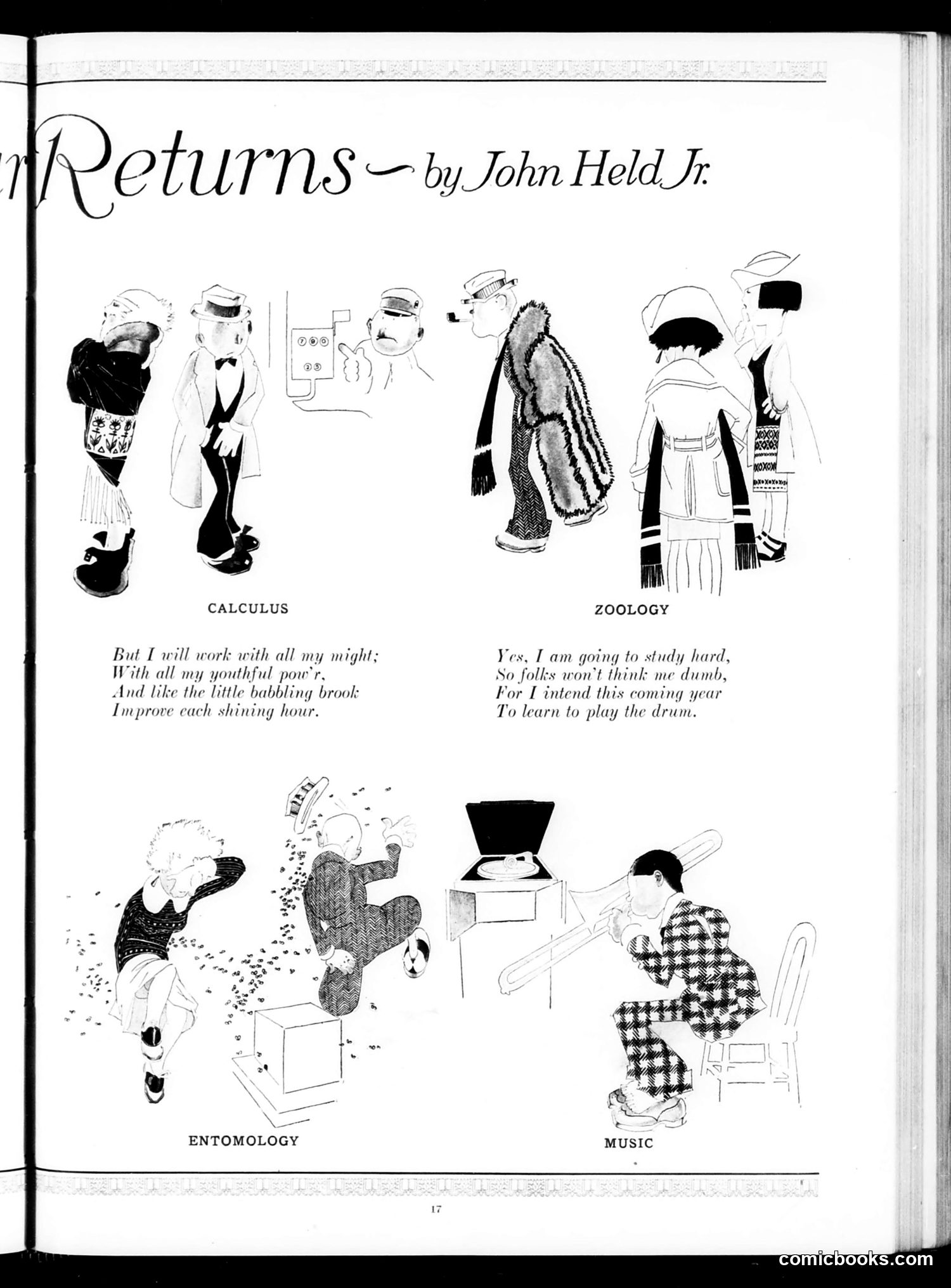
This satirical cartoon depicts college students' humorous resolutions to study hard in various subjects. Each panel shows a student making earnest promises about self-improvement—studying calculus, zoology, entomology, and music—yet the illustrations undercut their declarations with comedic irony. The joke relies on visual contradiction: while students recite serious academic intentions, the drawings show them engaged in chaotic, silly behavior instead. For instance, the music student promises dedication while sitting awkwardly; the entomology student appears to be jumping around wildly rather than studying insects scientifically. This reflects early 20th-century humor about college life and youthful procrastination—the gap between stated ambitions and actual behavior. Held was known for capturing Jazz Age collegiate culture with witty illustrations that gently mocked student pretensions about academic rigor.
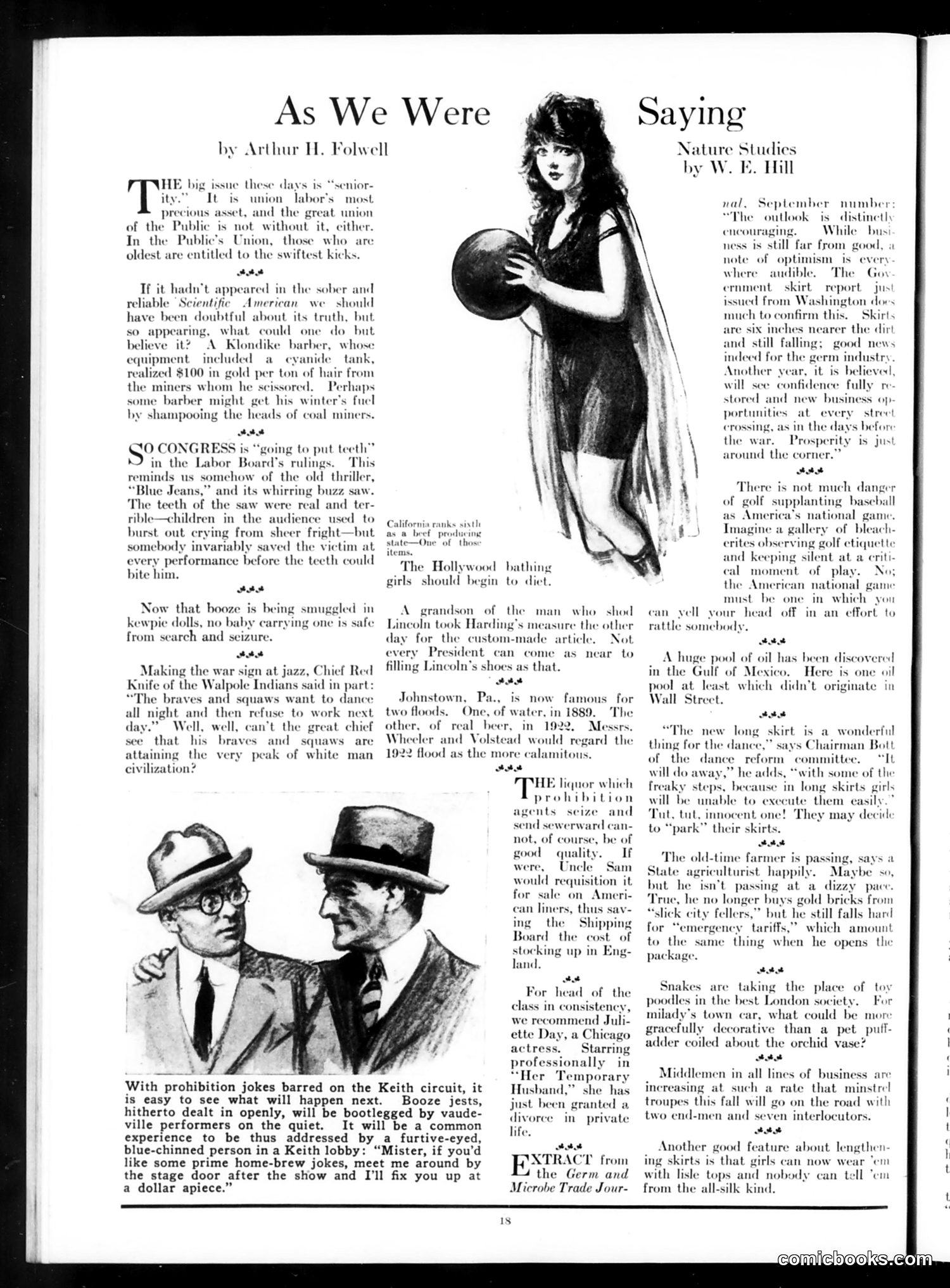
This page contains satirical commentary on 1920s American life, particularly targeting Prohibition and labor issues. **Main Cartoons/Content:** The top illustration shows a Hollywood bathing girl, accompanying commentary that such performers "should begin to diet"—satirizing vanity culture. The lower cartoon depicts two men in hats, illustrating a joke about Prohibition enforcement: with "prohibition jokes barred" from Keith vaudeville circuits, comedians will now bootleg humor "under the stage door" like illegal alcohol—mocking how Prohibition's failures mirror its absurdity. **Key References:** - **Prohibition**: Multiple sections mock the failed alcohol ban (1920-1933), mentioning seized low-quality liquor and Johnstown's 1922 beer flood - **Labor unions**: Opening satirizes union "seniority" rules - **Harding administration**: References President Harding and Lincoln shoe-fitting - **Keith circuit**: Vaudeville theaters with content restrictions **The Satire:** Judge ridicules Prohibition's hypocrisy—illegal "booze" mirrors illegal "joke bootlegging"—and broader 1920s social pretensions around labor, entertainment, and government regulation.
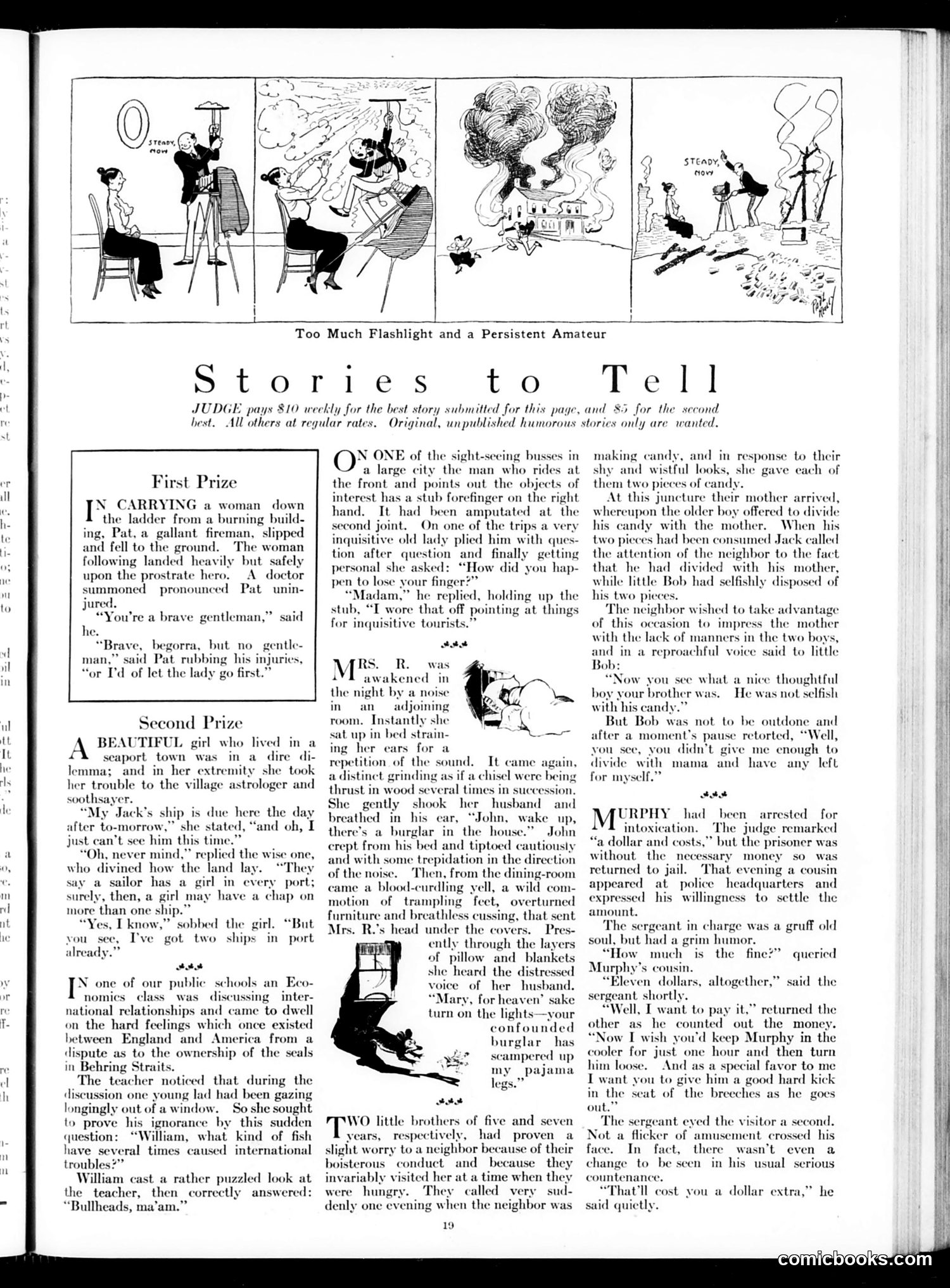
This is a submission page for short humorous stories, offering payment ($10 for first prize, $5 for second). The top cartoon, "Too Much Flashlight and a Persistent Amateur," depicts a figure using a flashlight while attempting photography or similar activities, with comedic consequences shown across sequential panels. The page contains four separate joke stories, each illustrating common comedic scenarios of early 20th-century American life: 1. **A fireman's self-deprecating modesty** after protecting a woman from a burning building 2. **A sailor's girlfriend consulting an astrologer** about relationship complications (the joke: she already has two ships' worth of sailors) 3. **A schoolboy's wordplay** answering a history question—"bullheads" causes international trouble (a pun on fish and stubborn people) 4. **A tour guide's worn-down finger** from pointing at sights for tourists These represent typical domestic humor appealing to Judge's middle-class readers: wordplay, marital situations, and gentle social observation rather than sharp political satire.
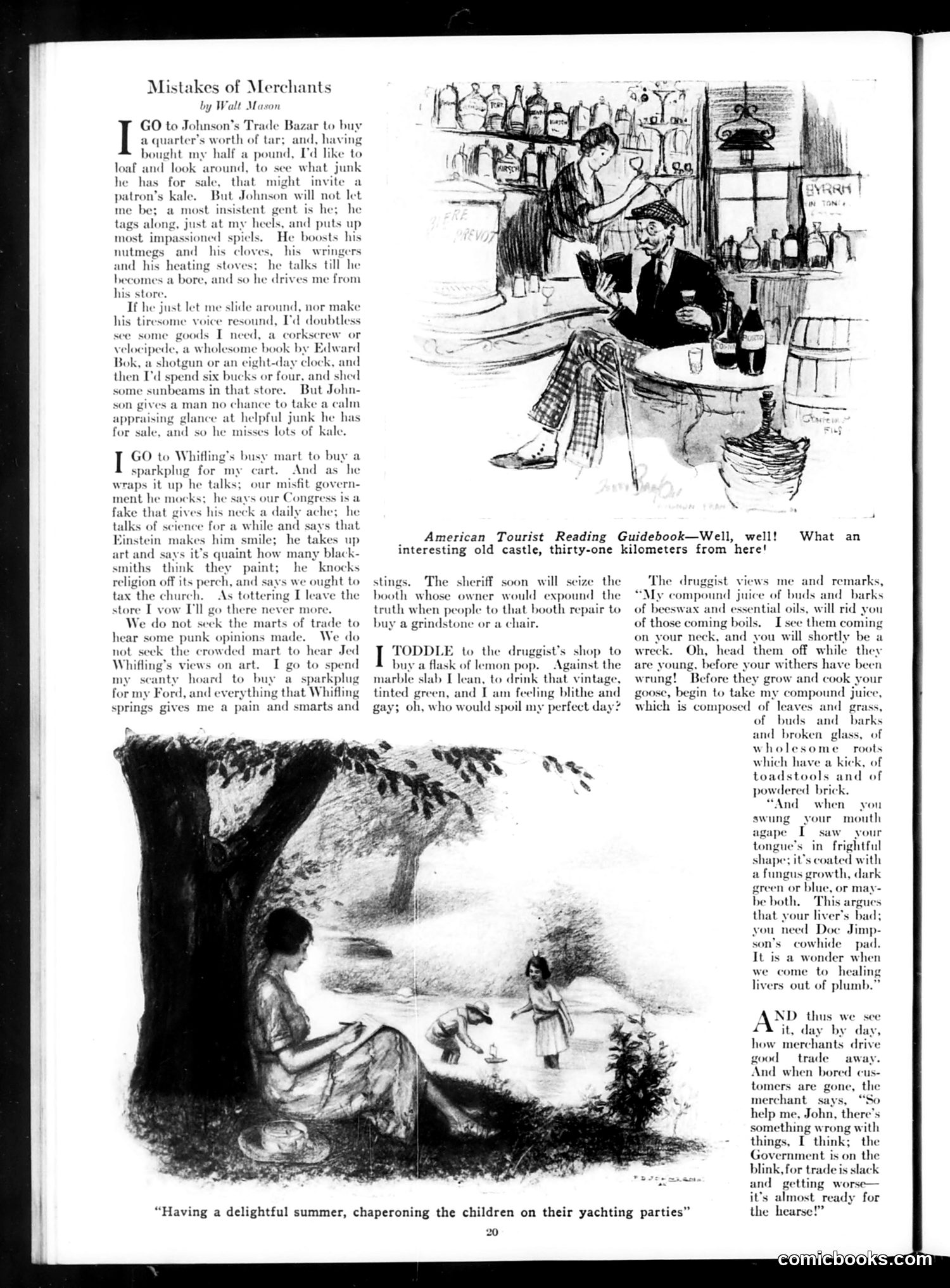
This satirical poem by Walt Mason, illustrated with a shop scene, ridicules merchants who talk customers to death instead of letting them browse and buy. The satire targets three types of shopkeepers: 1. **Johnson** (Trade Bazaar owner) – constantly pitches and boasts aggressively, driving away potential customers 2. **Whifling** (auto parts dealer) – hijacks sales with unsolicited opinions on art, religion, and science, making customers flee 3. **The druggist** – launches into unsolicited medical diagnoses, recommending dubious patent remedies Mason's point: **merchants destroy sales through excessive talking**. Customers simply want to make quick purchases, but instead endure exhausting monologues. The poem concludes with merchants ironically blaming government and economic conditions ("trade is slack") when their own behavior drives business away. The bottom illustration shows a woman on holiday, disconnected from the merchant troubles above—representing the leisure class the poem implies shopkeepers should court quietly, without annoying pitches.
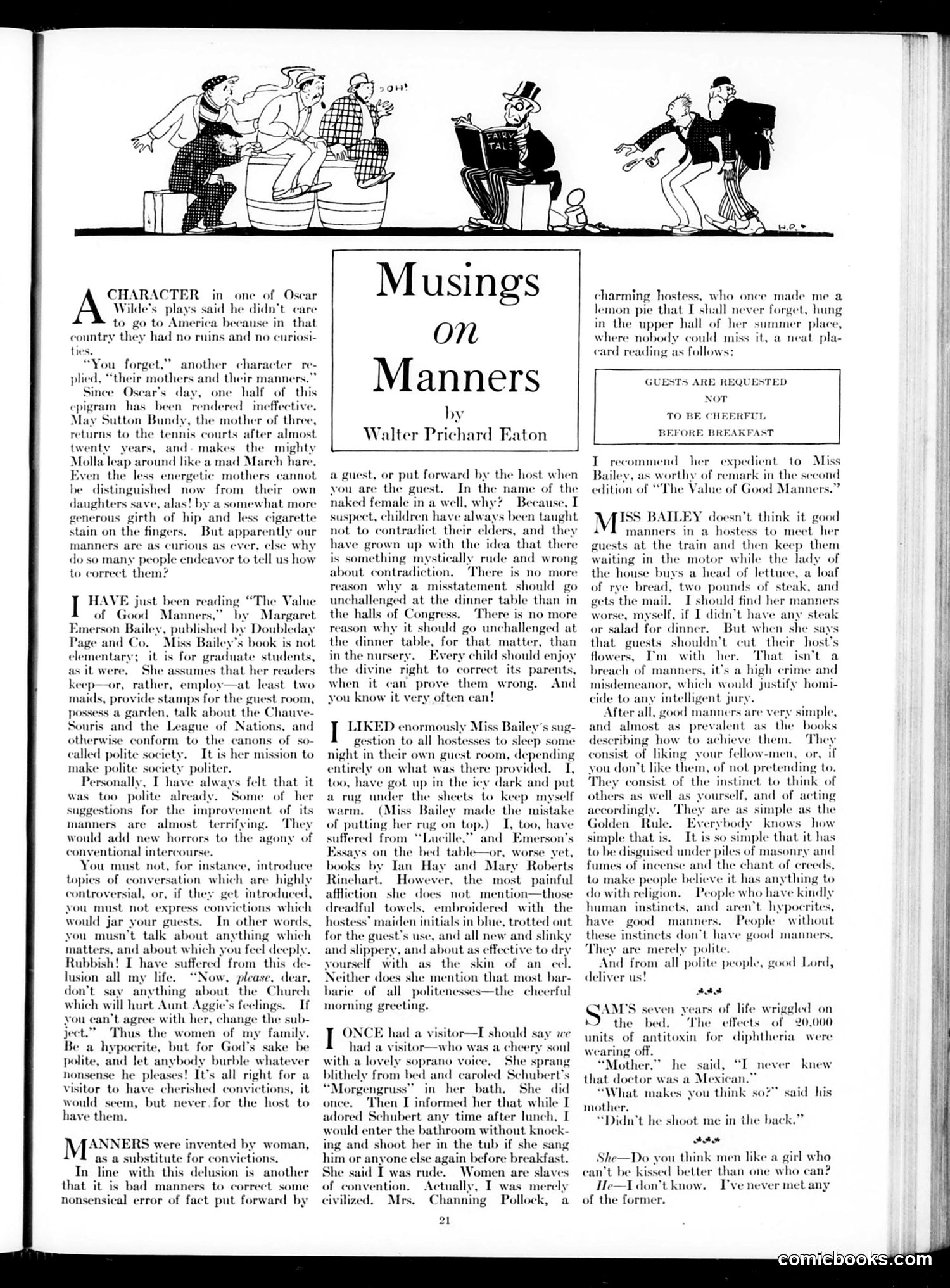
This page contains a satirical essay titled "Musings on Manners" by Walter Prichard Eaton, criticizing contemporary etiquette advice. **The Target:** Miss Margaret Emerson Bailey's book *The Value of Good Manners*, which Eaton mocks as overly restrictive guidance for the wealthy elite. **The Satire:** Eaton ridicules Bailey's prescriptions that guests avoid controversial topics and never correct factual errors at dinner—arguing this enforces hypocrisy over honesty. He advocates for guests and hosts alike to speak authentically about matters of substance, even if disagreement results. **Social Context:** The essay reflects 1920s anxieties about "polite society" and class performance. Eaton suggests Bailey's rules serve the pretentious upper class (who employ maids, discuss avant-garde theater) while stifling genuine conversation. **The Cartoons** (top) appear to illustrate social awkwardness and performative behavior, though specific figures aren't identified in the text. The piece ultimately argues that enforced politeness masks intellectual dishonesty—a critique of manners culture masking class pretension.
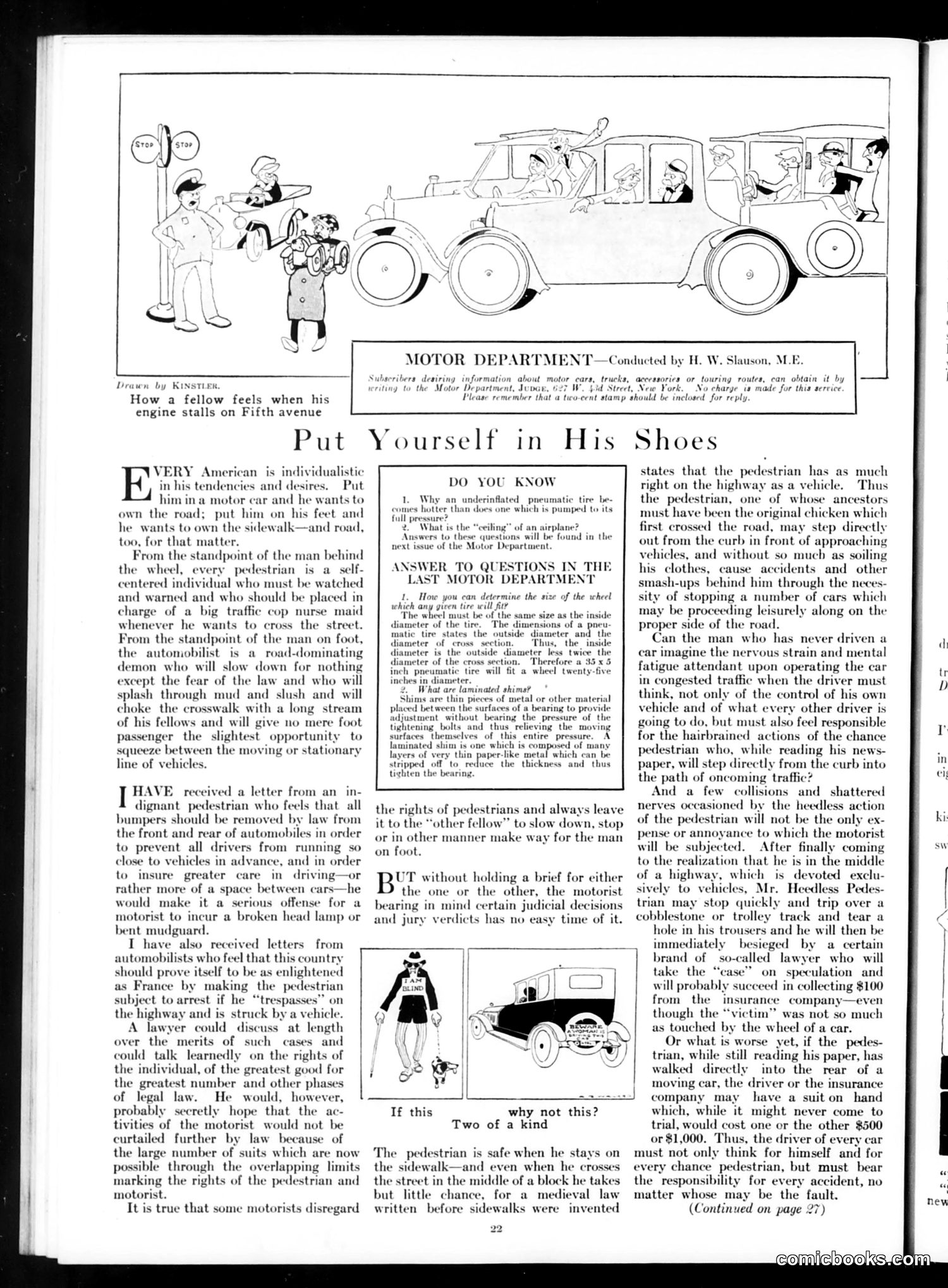
This page satirizes the tension between pedestrians and motorists in 1920s America. The cartoon at top—drawn by Kinstler—shows a car stalled on Fifth Avenue surrounded by frustrated pedestrians and traffic, illustrating the chaos when automobiles malfunction on busy streets. The article's title humorously demands empathy: motorists should understand pedestrians' vulnerability, and vice versa. The text mocks both groups' self-centered attitudes—drivers viewing pedestrians as obstacles, pedestrians expecting absolute right-of-way regardless of traffic. The satire peaks in the ironic closing: pedestrians have legal rights to step into traffic from curbs, potentially causing accidents and lawsuits, yet motorists bear responsibility. The piece criticizes this legal imbalance while acknowledging motorists secretly welcome it (more lawsuits = job security for lawyers). The humor derives from highlighting the absurdity of early automotive-era traffic laws struggling to accommodate new technology within pedestrian-centered urban infrastructure.
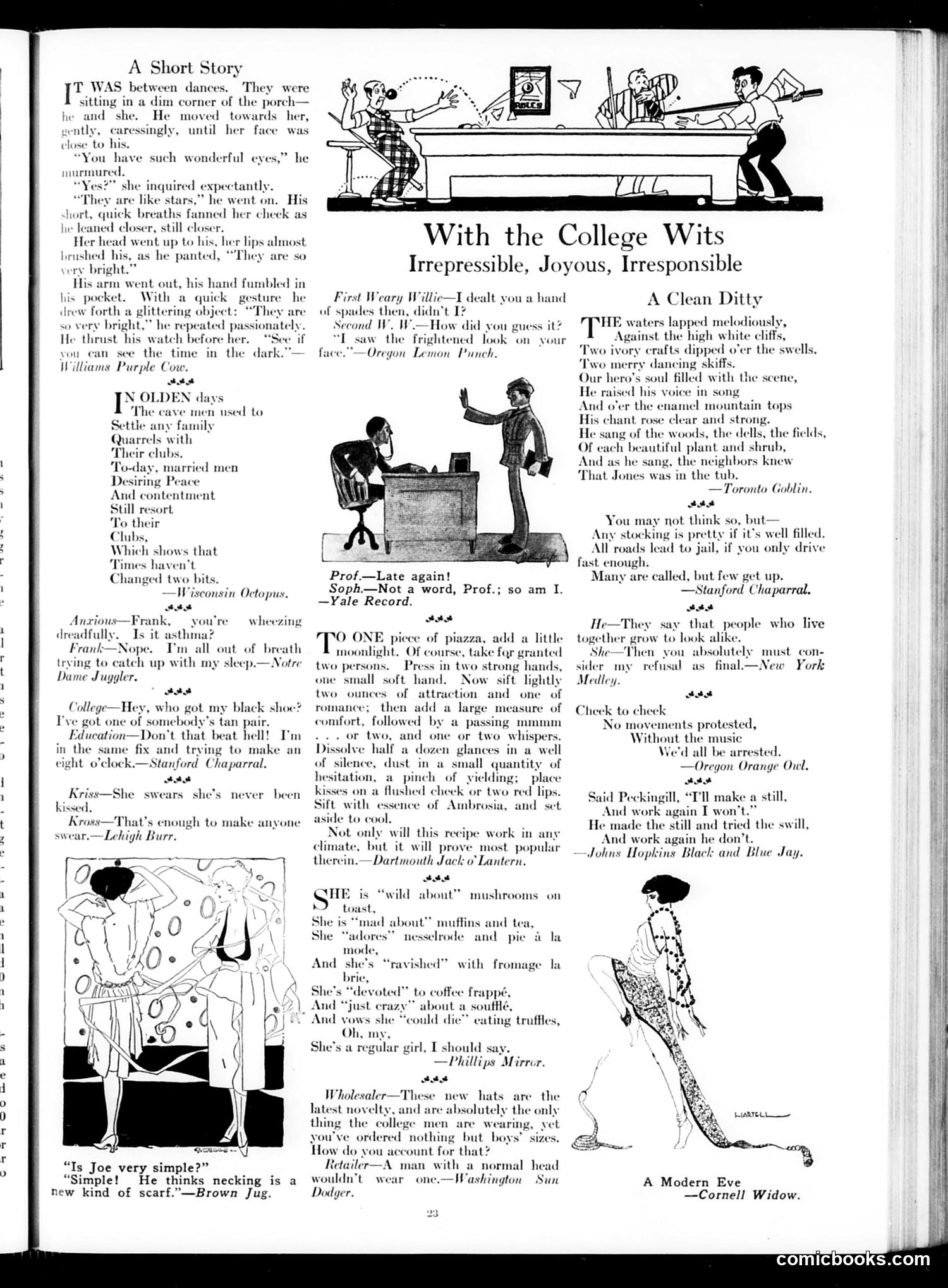
This page from *Judge* magazine contains primarily short humorous pieces and jokes targeting college students and young people of the early 20th century. **The main cartoons:** The opening "Short Story" satirizes romantic clichés—a young man seduces a woman with flowery language about her eyes, then undercuts the romance by pulling out a glowing pocket watch instead of a ring, treating sentimentality as a cheap trick. The illustrations throughout accompany college humor columns poking fun at student life: professors arriving late, students mixing up shoes in crowded dorms, young men obsessed with trendy fashions, and girls using exaggerated slang ("wild about," "ravished") to describe ordinary foods. **The satire:** These pieces mock college culture's affectations—romantic pretension, fashion obsession, and overwrought speech patterns. The humor relies on deflating expectations and revealing hypocrisy beneath polished surfaces. The wholesaler joke about oversized hats for "college men" mocks the vanity of young male students. Overall, this is good-natured social commentary on youth culture rather than political satire.
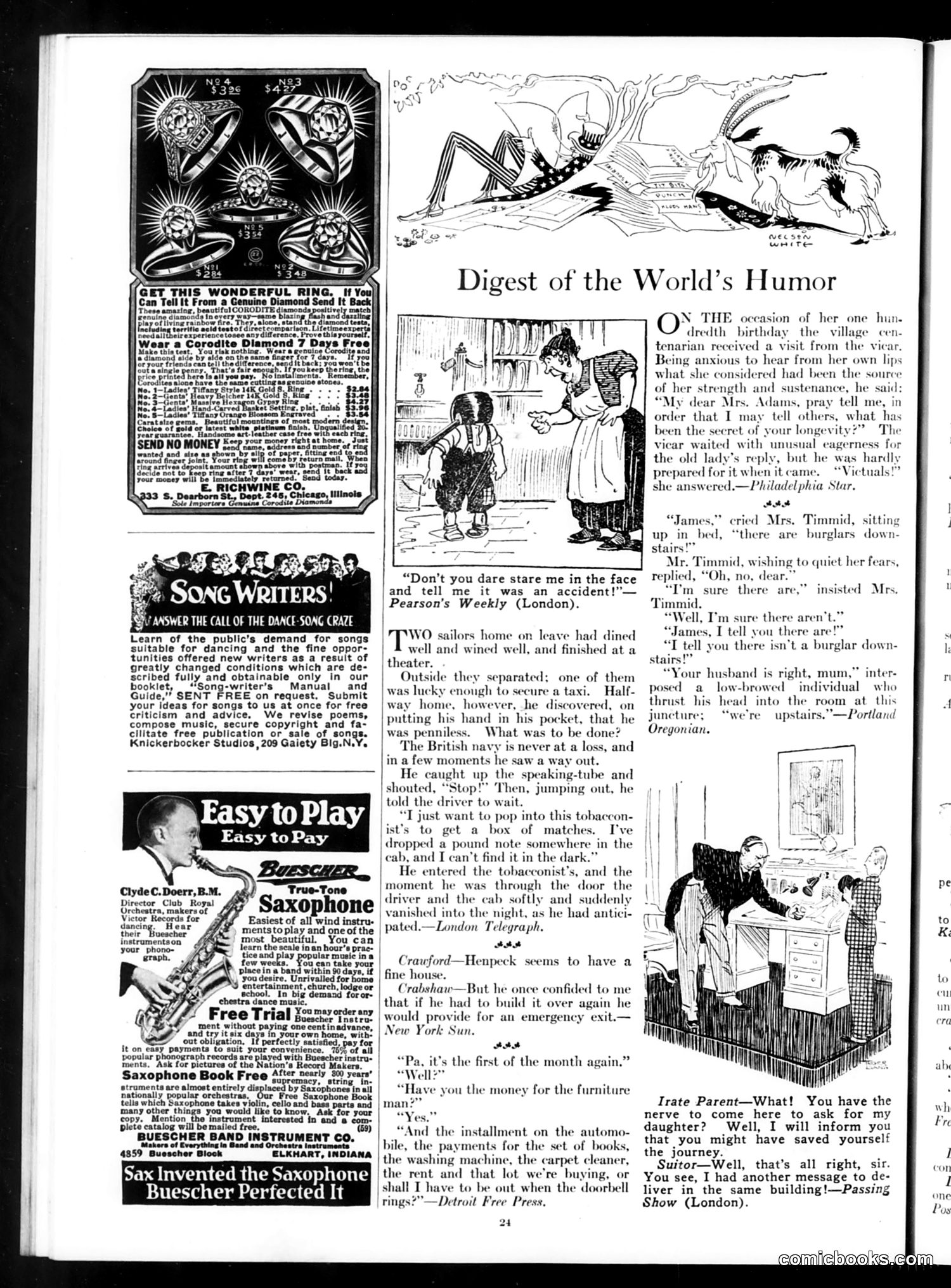
This page from *Judge* magazine presents a humor compilation with cartoons and anecdotes from various international sources. The main content includes: **Cartoon narratives:** - A domestic dispute where a woman accuses a man of staring ("Don't you dare stare me in the face and tell me it was an accident!") - A taxi driver scam where a sailor, unable to pay, tricks the driver by claiming he dropped money in the cab, then abandoning him - A henpecked husband worried about endless bills (automobile, books, washing machine, rent) - A nervous husband reassuring his fearful wife about burglars **The humor relies on:** everyday domestic tensions, marital comedy (nagging wives, frightened husbands), working-class mishaps, and class-based pranks. These are presented as international anecdotes credited to London publications and American newspapers. **Context for modern readers:** This represents early 20th-century "safe" humor centered on gender stereotypes, financial anxiety, and petty deception—entertainment reflecting middle-class anxieties about money, marriage, and social conduct.
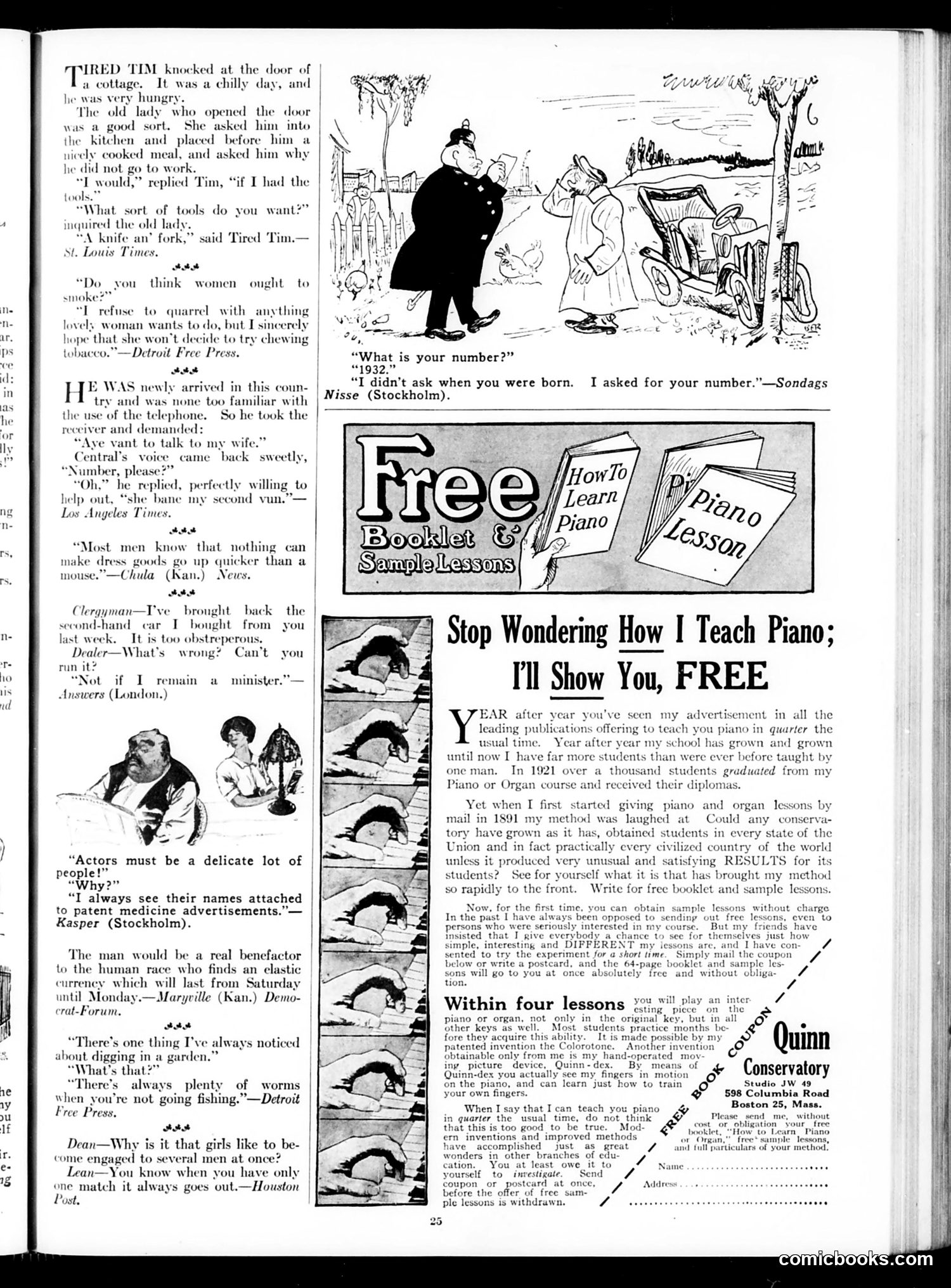
This page contains mostly **humorous anecdotes and jokes** rather than political cartoons. The content reflects early 1920s American humor: **The jokes' themes:** - "Tired Tim" seeking work tools (a knife and fork) — satirizing hobos/unemployment - A newly-arrived immigrant struggling with telephone terminology — mocking immigrant unfamiliarity with American technology - Gender debates about women's behavior - A clergyman's malfunctioning used car — poking fun at automobiles' unreliability **The dominant feature** is a **piano lesson advertisement** by the Quinn Conservatory, promising to teach piano in "quarter the usual time" through mail correspondence. This reflects the era's optimism about correspondence courses and self-improvement. The satire is **mild and domestic** — focused on everyday modern inconveniences (phones, cars, employment) rather than serious political critique. The humor assumes readers share frustrations with new technologies and social changes of the post-WWI period.
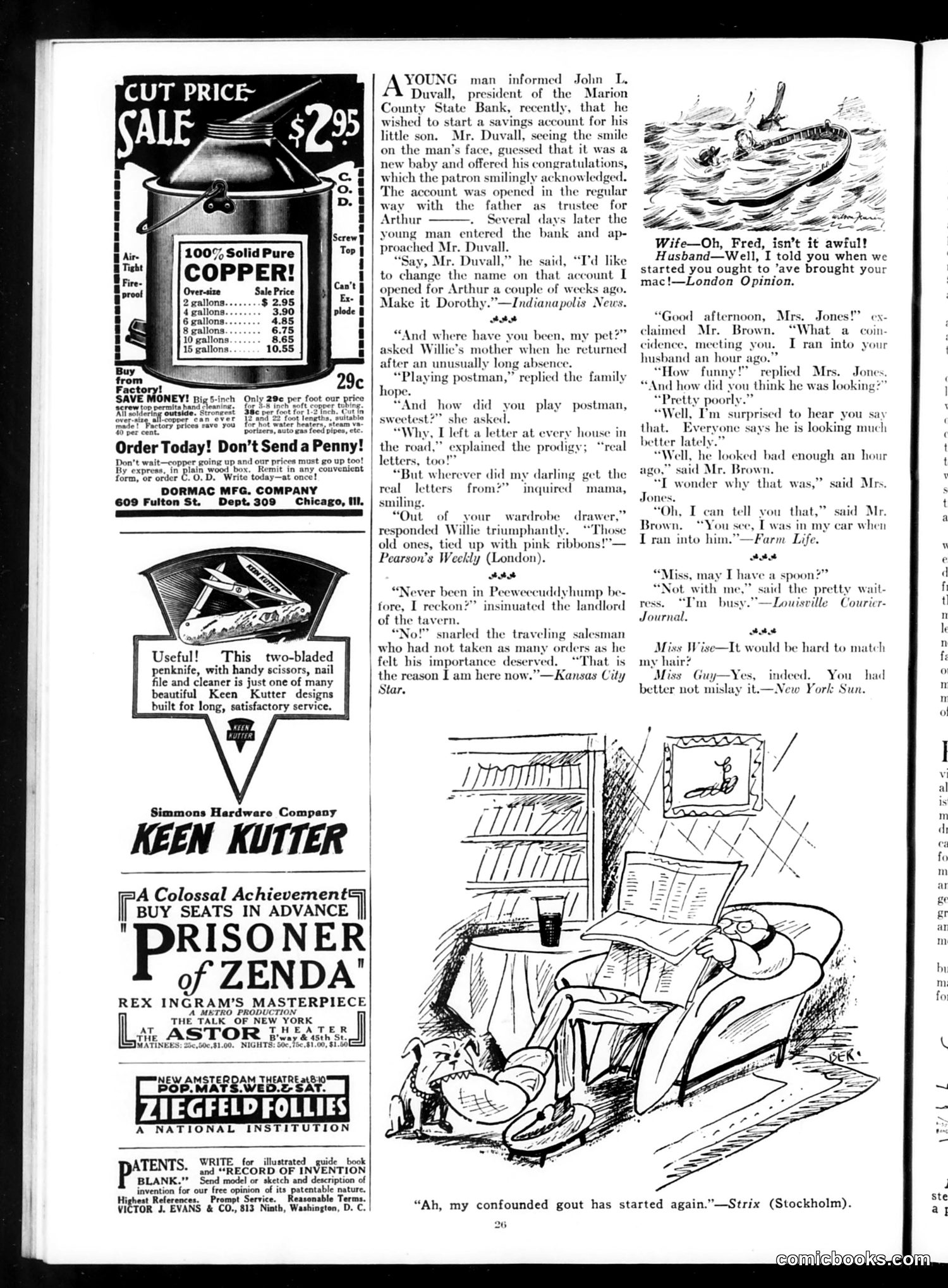
This page is primarily **advertisements and humor shorts** rather than political cartoons. The main elements are: **Advertisements:** - Copper cookware ("Cut Price Sale") - Keen Kutter knives/tools - "Prisoner of Zenda" film at the Astor Theatre - Patent service **Humor Content:** The page contains brief comedic anecdotes typical of Judge magazine: - A banker's mix-up changing a baby account to "Dorothy" (implying unexpected baby gender) - A child playing "postman" using love letters from mother's drawer - A husband blaming his wife for forgetting her raincoat during a chance meeting - Brief flirty exchanges between customers/waitresses **Context for Modern Readers:** These are genteel, domestic humor pieces reflecting early-20th-century concerns: new fatherhood, propriety, marital banter, and mild flirtation. The tone is whimsical rather than satirical or political. This appears to be a middle-to-back page of the magazine, mixing modest advertising with light social comedy aimed at middle-class readers.
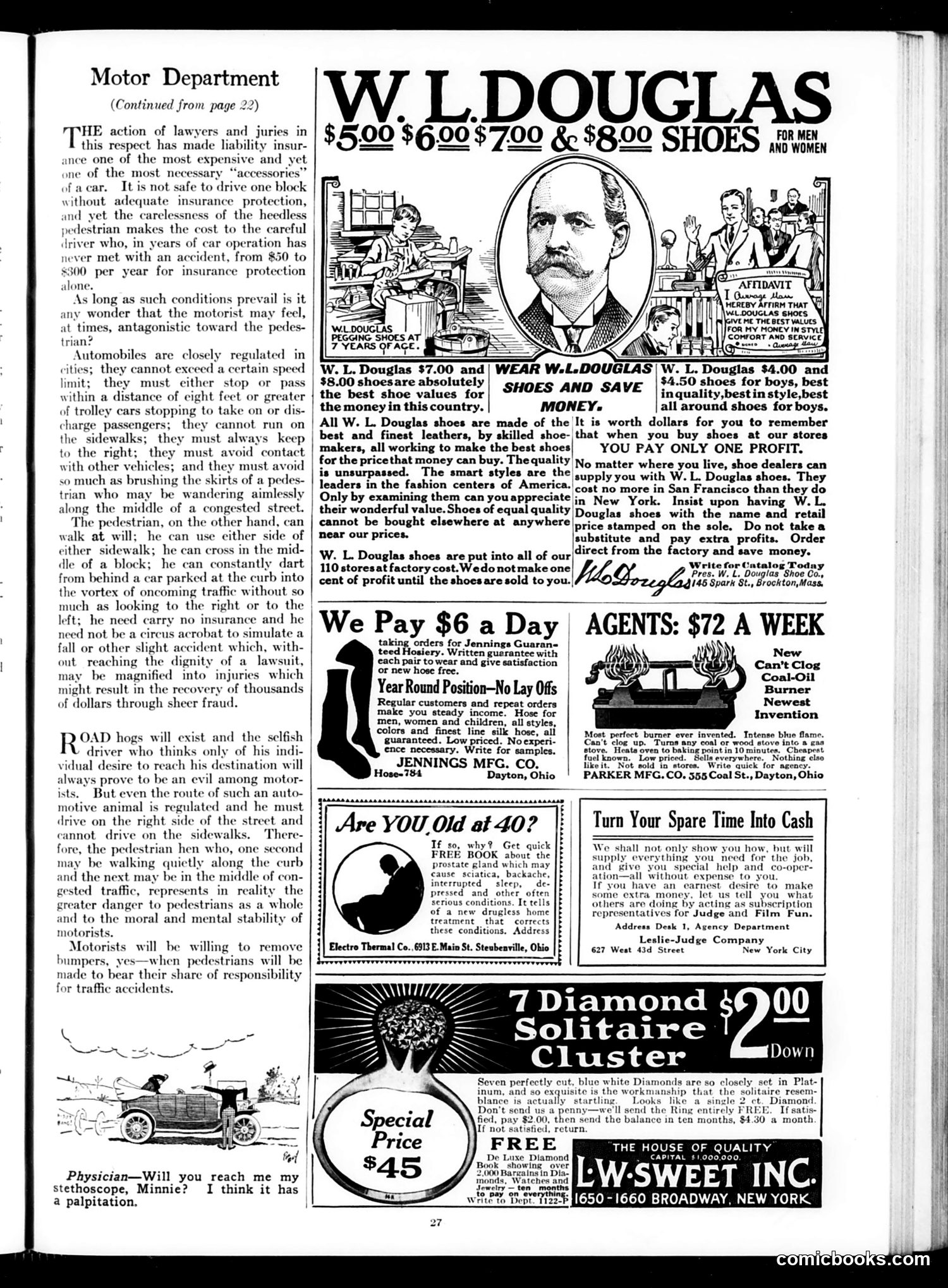
This page's main article argues that pedestrians—not motorists—pose the greater traffic danger. The author complains that while automobiles face strict regulations (speed limits, stopping distances, staying off sidewalks), pedestrians operate without restraint: they can jaywalk, dart from behind parked cars, and cross mid-block with impunity. The satire's point: pedestrians exploit this asymmetry, sometimes faking accidents to extract insurance settlements through fraud. The author sarcastically suggests motorists will only accept bumper removal when pedestrians "bear their share of responsibility for traffic accidents." This reflects early 20th-century tensions as cars proliferated in cities. The piece defends motorists' interests against pedestrian lawsuits and advocates for traffic regulations favoring vehicles—a perspective that shaped modern traffic law favoring cars over pedestrians. The remainder is advertising for W.L. Douglas shoes and other products.
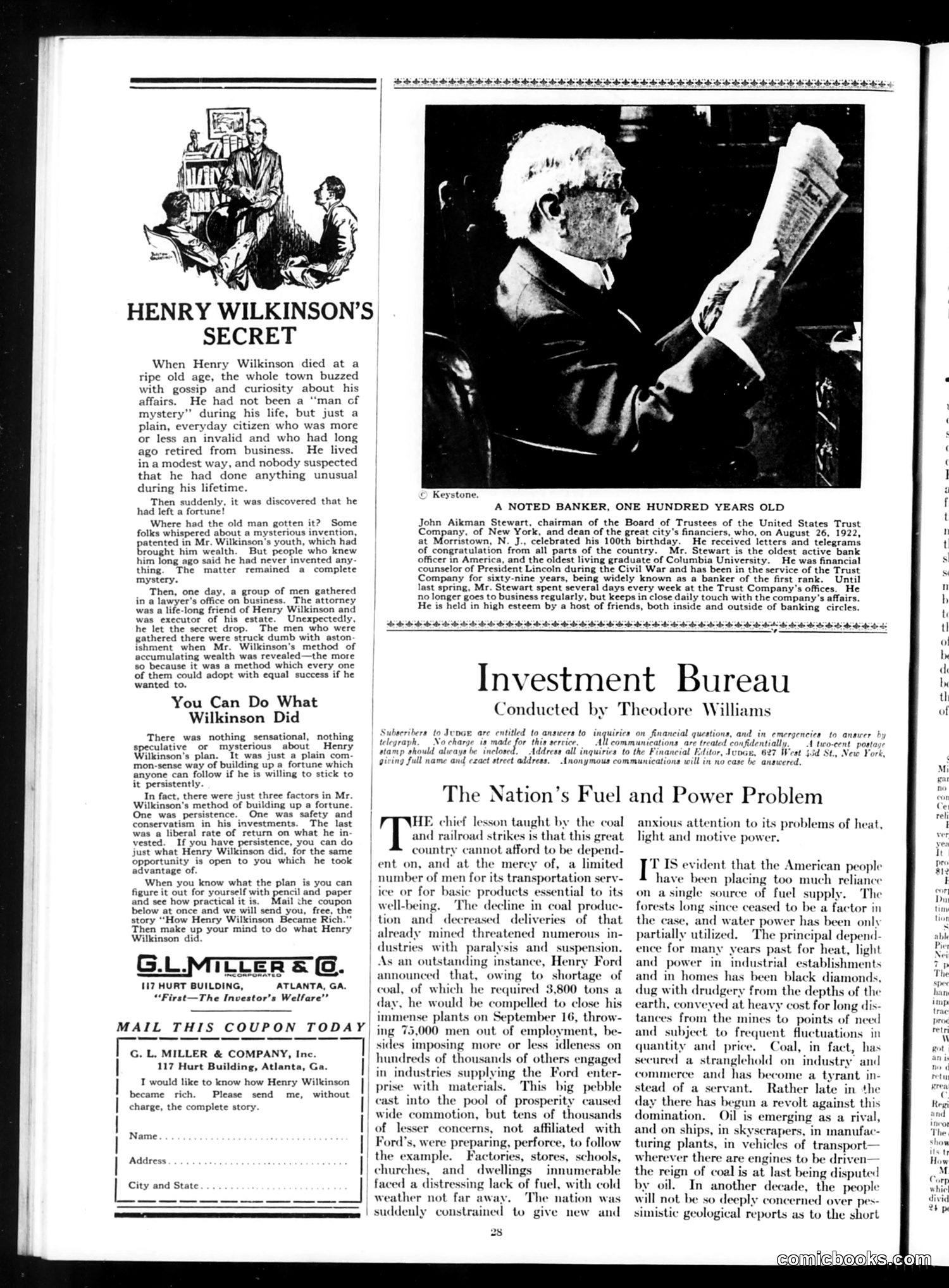
This page contains advertising and news content rather than political satire. **Main content:** - A lengthy advertisement from G.L. Miller & Company (Atlanta) promoting investment advice through the parable of "Henry Wilkinson's Secret"—a rags-to-riches story meant to persuade readers that ordinary people can build wealth through persistence, conservative investing, and good returns. Readers are urged to mail a coupon for the full story. - A news photograph and caption celebrating John Aikman Stewart, chairman of the U.S. Trust Company, on his 100th birthday (August 26, 1922). The text notes his 69 years of service, his role as Lincoln's financial counselor during the Civil War, and his continued involvement in banking despite his advanced age. - An "Investment Bureau" header introducing financial advice by Theodore Williams. The page reflects Judge's dual purpose as both satirical magazine and vehicle for advertisements targeting affluent readers interested in finance and investment.
This page is primarily **financial advice and investment advertising** rather than political satire. The dominant content consists of: 1. **Editorial column** (top): An argument for developing renewable energy sources—hydroelectric power, wind, and solar energy—as alternatives to depleting coal and oil reserves. The writer challenges Edison and Ford to apply their inventive genius to these technologies rather than monetary system reform. 2. **"Answers to Inquiries" section**: A Q&A column where readers ask about specific stocks and bonds. Responses evaluate companies' financial health, dividend reliability, and investment worthiness. Companies mentioned include utility stocks, oil companies, and manufacturing firms. 3. **Advertisements**: Multiple investment-related ads, including preferred stock offerings and financial services. **For modern readers**: This reflects 1920s investment culture—individual readers writing directly to magazines seeking stock advice, and the era's emerging concern about resource depletion and alternative energy, topics remarkably contemporary in their framing.
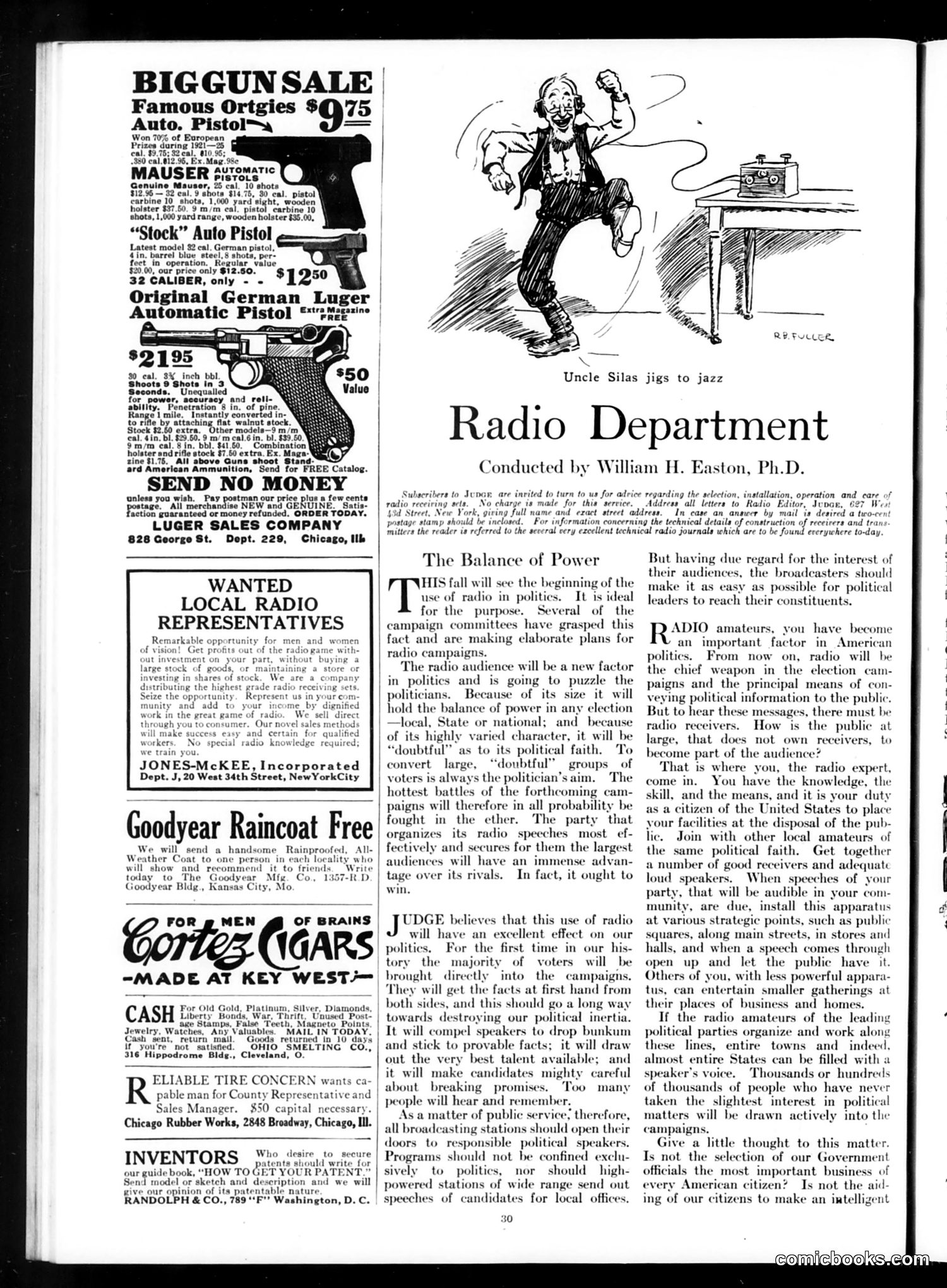
This page is primarily **advertising** rather than editorial content. The dominant images are product advertisements for firearms (Mauser, Luger, and Ortgies pistols) and various business opportunities. The single **cartoon** shows "Uncle Silas jigs to jazz"—a figure dancing energetically to a radio set on a table. This appears to satirize the cultural shift of the 1920s: older Americans adopting modern jazz culture via radio broadcast. "Uncle Silas" likely represents traditional, rural America, while his enthusiastic dancing to jazz symbolizes how radio was breaking down cultural barriers and spreading contemporary trends to previously isolated communities. The accompanying **"Radio Department" editorial** discusses using radio for political campaigns—a novel concept in the early 1920s. It argues radio's mass audience will force politicians to present facts directly to voters, eliminating "bunkum" and reducing "political inertia."
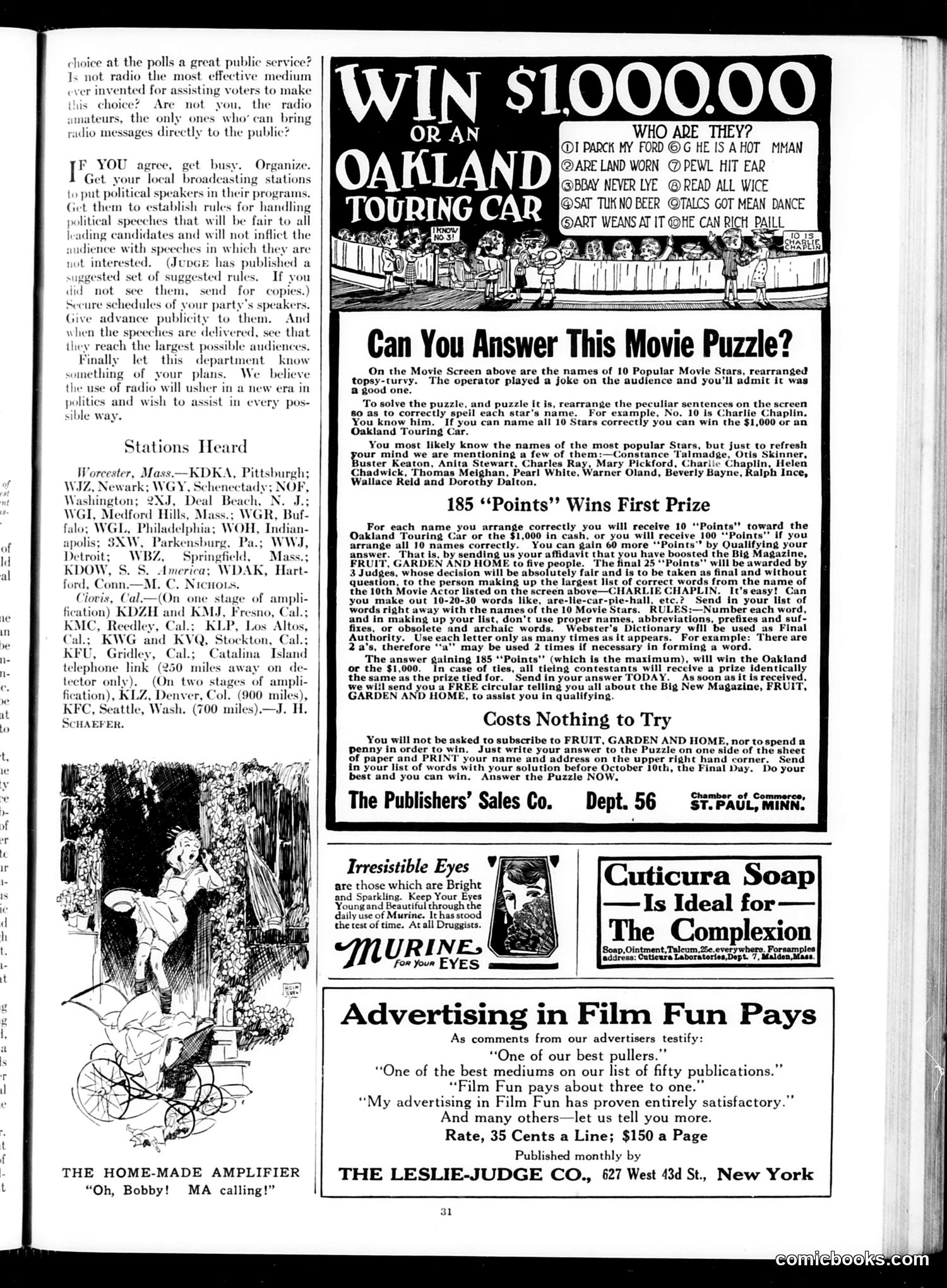
This page is primarily **advertising and entertainment content**, not political satire. The main feature is a movie star name-puzzle contest offering $1,000 or an Oakland Touring Car as prizes. The puzzle shows scrambled names of 1920s silent film stars (Chaplin, Keaton, Pickford, etc.), rearranged into nonsensical phrases. Contestants must unscramble them and qualify by promoting *Fruit, Garden and Home* magazine to five people. The side cartoon shows a domestic scene: a boy using a homemade radio amplifier, with his mother calling "MA calling!" It illustrates the novelty of early 1920s radio technology. The adjacent editorial discusses using radio to broadcast political speeches fairly during elections. The advertisements for Murine eye drops and Cuticura soap are period-typical. The page reflects the era's fascination with cinema celebrities and emerging radio technology as mass media.
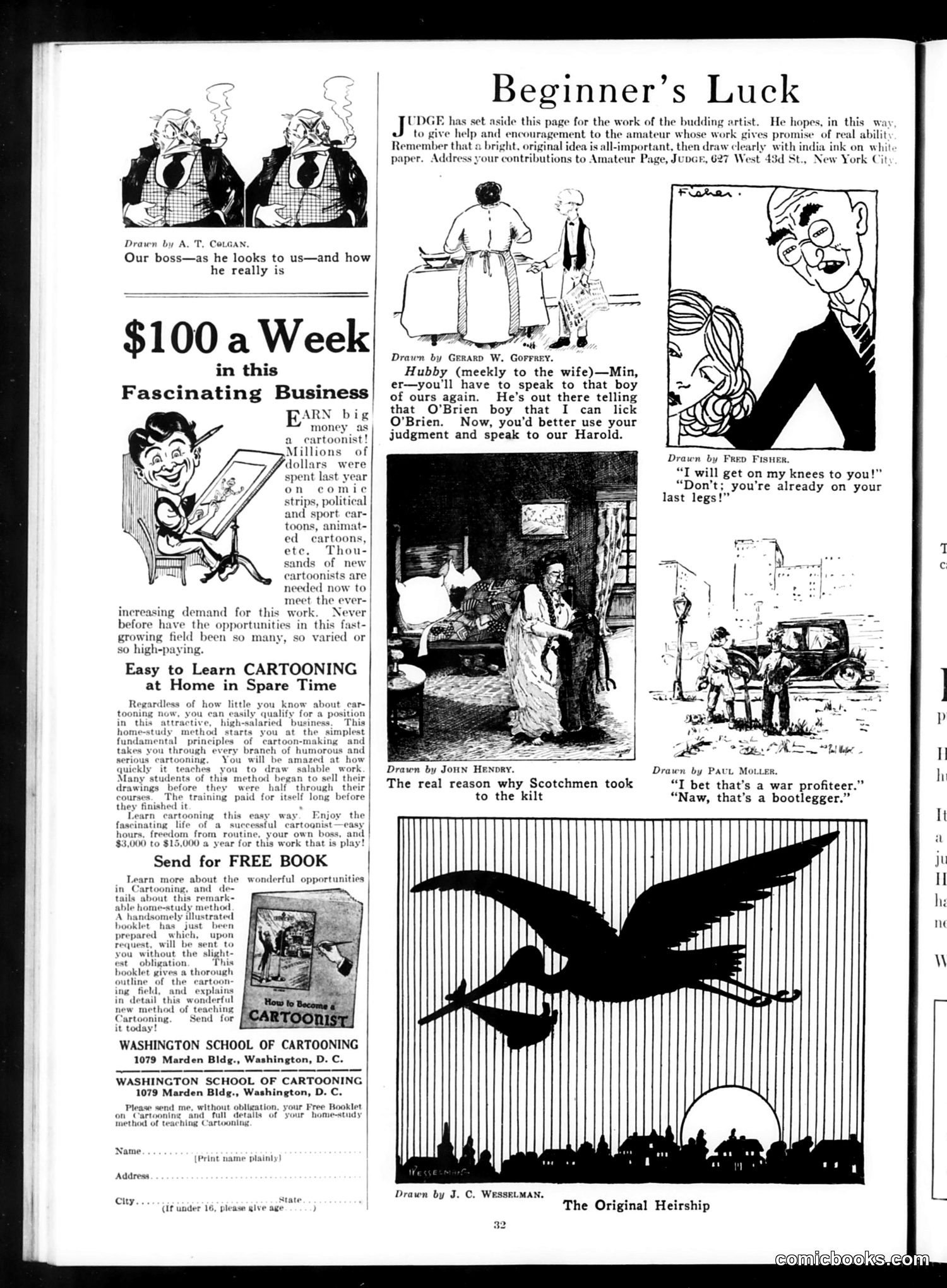
This page from *Judge* magazine mixes satirical cartoons with advertising for a cartooning correspondence school. **The cartoons:** The top cartoon by Colgan contrasts how a boss appears to employees versus reality—a common workplace satire about management perception gaps. The domestic cartoon by Goffrey depicts a husband meekly asking his wife to discipline their son Harold, who's boasting he can fight the O'Brien boy. The satire targets emasculated husbands deferring to wives on parental authority—a recurring early 20th-century anxiety. Fisher's cartoon is a flirtatious exchange where a woman threatens to kneel before a man; he jokes she's "already on your last legs," implying her romantic prospects are fading. Hensby's cartoon about Scotsmen and kilts is unclear without more context. Wesselman's silhouette showing an airplane dropping bombs over a city likely references war profiteering or bootlegging during Prohibition, with the ambiguity suggesting both crimes seemed equally predatory to contemporary observers. The page primarily advertises cartooning instruction, promising $100-$15,000 yearly income.
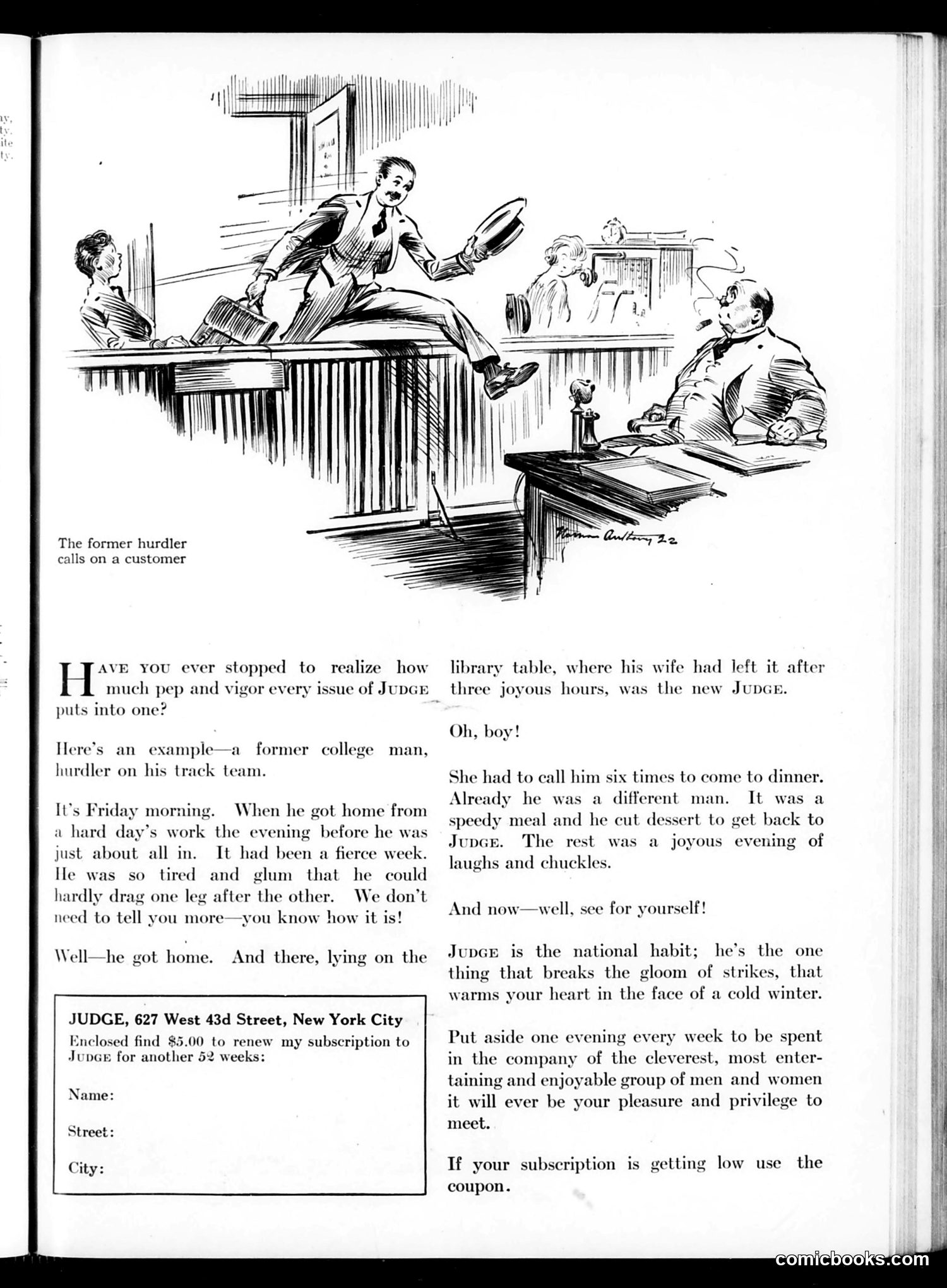
This is a **subscription advertisement** for *Judge* magazine disguised as editorial content. The cartoon illustrates the magazine's claimed restorative power. **The Setup:** A tired, exhausted businessman returns home after a brutal work week—so depleted he can barely walk. He discovers *Judge* magazine left on his library table. **The Transformation:** Reading *Judge* utterly revitalizes him. He becomes so engaged he ignores dinner (requiring six summons), rushes through the meal, and spends an energetic evening laughing and enjoying himself with his wife. **The Satire/Sales Pitch:** The ad sarcastically suggests *Judge* is a miracle cure for modern urban fatigue and despair—particularly relevant given the text's reference to strikes and "cold winter" hardships. By positioning the magazine as "the national habit" that "breaks the gloom," the advertisement appeals to readers seeking escapism and entertainment during presumably difficult economic times. The "former hurdler" metaphor suggests even washed-up athletes find renewal through the magazine's humor.
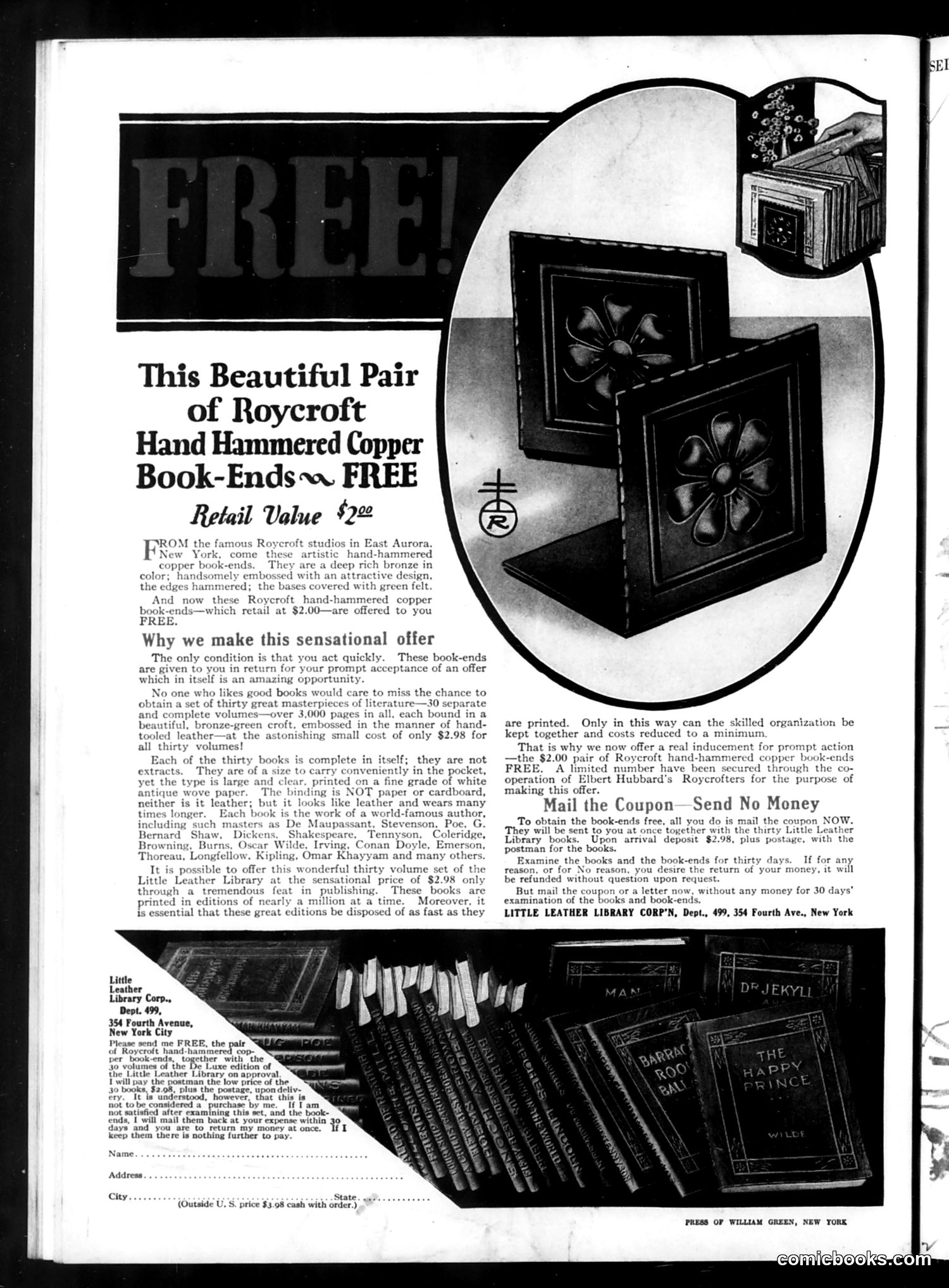
This page is primarily **commercial advertising**, not political satire or cartoon content. It promotes the Little Leather Library Corporation's offer of free Roycroft hand-hammered copper book-ends (valued at $2.00) to customers who purchase a 30-volume classic literature set for $2.98. **The offer's appeal**: During this era (appears early 20th century), such "classics collections" were marketed as affordable ways for middle-class Americans to access prestigious literature—works by Poe, Stevenson, Doyle, and others—while the artistic book-ends suggested cultured taste. **The sales strategy**: The "free gift" and 30-day trial with money-back guarantee were standard early mail-order tactics designed to lower purchase resistance. **Historical context**: The Roycrofters were a real Arts and Crafts movement workshop in East Aurora, New York, lending authenticity and prestige to the promotion. No satire or political commentary appears on this page—it's straightforward period advertising targeting aspirational readers.