
Judge, 1922-09-23 · page 30 of 36
Judge — September 23, 1922 — page 30: what you’re looking at
What you’re looking at
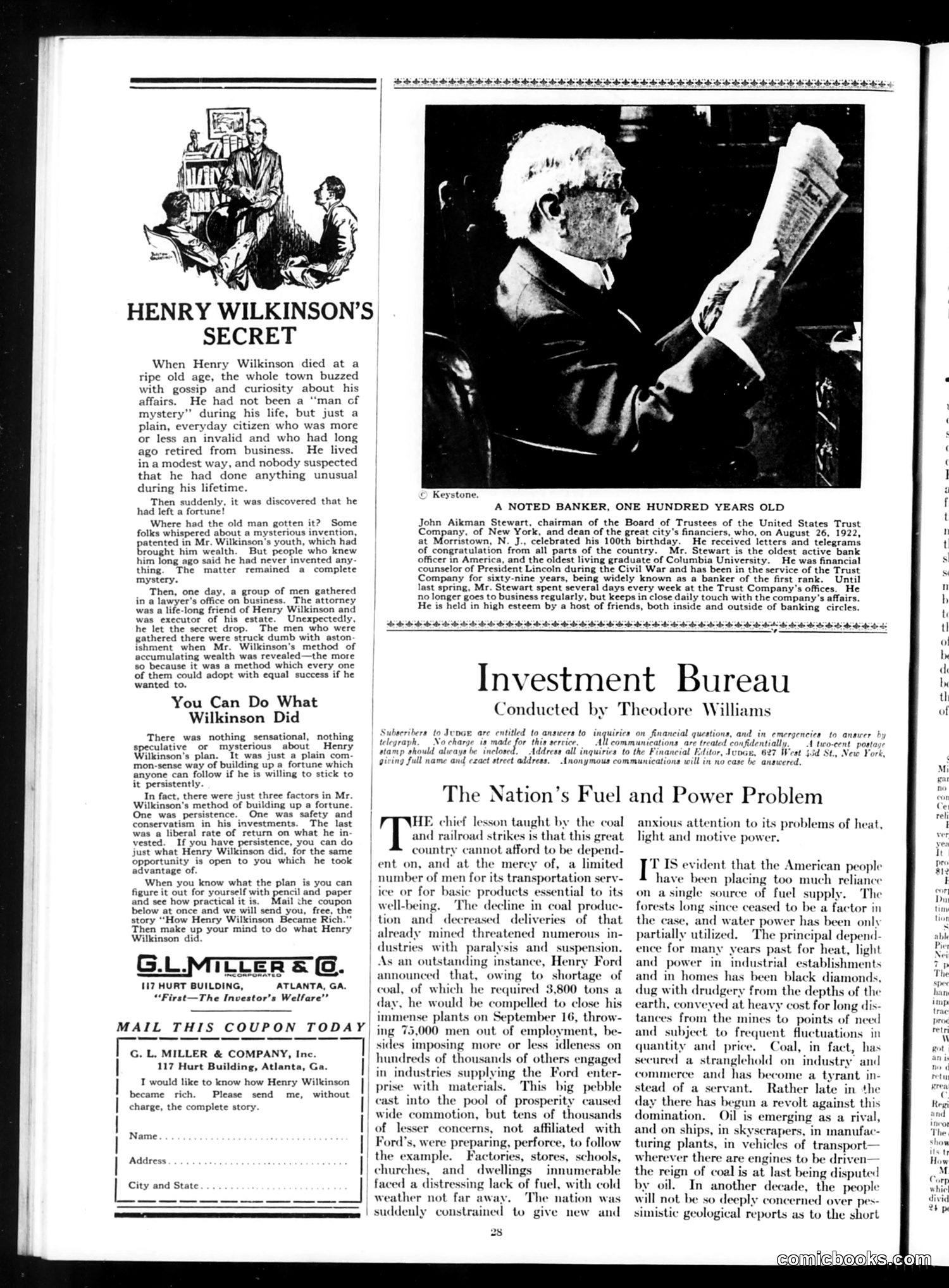
This page contains advertising and news content rather than political satire. **Main content:** - A lengthy advertisement from G.L. Miller & Company (Atlanta) promoting investment advice through the parable of "Henry Wilkinson's Secret"—a rags-to-riches story meant to persuade readers that ordinary people can build wealth through persistence, conservative investing, and good returns. Readers are urged to mail a coupon for the full story. - A news photograph and caption celebrating John Aikman Stewart, chairman of the U.S. Trust Company, on his 100th birthday (August 26, 1922). The text notes his 69 years of service, his role as Lincoln's financial counselor during the Civil War, and his continued involvement in banking despite his advanced age. - An "Investment Bureau" header introducing financial advice by Theodore Williams. The page reflects Judge's dual purpose as both satirical magazine and vehicle for advertisements targeting affluent readers interested in finance and investment.
📄 Transcribed text from this page (OCR, searchable)
Machine-transcribed from the original scan — historical spelling and the odd misread are preserved.
HENRY WILKINSON’S SECRET When Henry Wilkinson died at a ripe old age, the whole town buzzed with gossip and curiosity about his affairs. He had not been a “man cf mystery” during his life, but just a plain, everyday citizen who was more or less an invalid and who had long go retired from business. He lived in a modest way, and nobody suspected that he had done anything unusual during his lifetime. Then suddenly, it was discovered that he had left a fortune! Where had the old man gotten it? Some folks whispered about a mysterious invention, patented in Mr. Wilkinson's youth, which had brought him wealth. But people who knew him long ago said he had never invented any. thing. The matter remained a complete mystery. Then, one day, a group of men gathered in a lawyer's office on business. The attorney was a life-long friend of Henry Wilkinson and was executor of his estate. Unexpectedly, he let the secret drop. The men who were gathered there were struck dumb with aston. ishment when Mr. Wilkinson's method of accumulating wealth was revealed—the more so because it was a method which every one of them could adopt with equal success if he wanted to. You Can Do What Wilkinson Did There was nothing sensational, nothing speculative or mysterious about Henry Wilkinson's plan. It was just a plain com. mon-sense way of building up a fortune which anyone can follow if he is willing to stick to it persistently. In fact, there were just three factors in Mr, Wilkinson's method of building up a fortune One was persistence. One was safety and conservatism in his investments. The last was a liberal rate of return on what he in vested. If you have persistence, you can do just what Henry Wilkinson did, for the same opportunity is open to you which he took advantage of. When you know what the plan is you can figure it out for yourself with pencil and paper and see how practical it is. Mail the coupon below at once and we will send you, free, the story ‘“‘How Henry Wilkinson Became Rich.”" Then make up your mind to do what Henry Wilkinson did. G.L.MILcER & G. 117 HURT BUILDING, ATLANTA, GA. “First—The Investor's Welfare” MAIL THIS COUPON TODAY IL MILLER & COMPANY, Inc. G. L, MILLER & COMPANY, Inc. 117 Hurt Building, Atlanta, Ga. | T would like to know how Henry Wilkinson became rich. Please send me, without charge, the complete story Name Address City and State | | | | | HHHASSEPAS HSS SHS SSH S EEE EEE EEE 4S ESSE SEs 4 HESS E EEE Es, ystone. A NOTED BANKER, ONE HUNDRED YEARS OLD John Aikman Stewart, chairman of the Board of Trustees of the United States Trust Company, of New York, and dean of the great city’s financiers, who, on August 26, 1922, at Morristown, N. J., celebrated his 100th birthday. of congratulation from all parts of the country. officer in America, and the oldest living graduate of Columbia University. He received ‘letters and telegrams Mr. Stewart is the oldest active bank He was financial counselor of President Lincoln during the Civil War and has been in the service of the Trust Company for sixty-nine years, being widely known as a banker of the first rank. Until last spring, Mr. Stewart spent several days every week at the Trust Company's offices. He no longer goes to business regularly, but keeps in close daily touch with the company’s affairs. He is held in high esteem by a host of friends, both inside and outside of banking circles. SHSEAASSELALESHESASEASSSASSHSES ESSE SEES ESSE OSES E ESE Ss: Investment Bureau Conducted by Theodore Williams Subscribers to Jepae are entitled to answers to inquiries on financial questions, and in emergencies to anawer {ll communications are treated confidentially to the Anonymous communications will in no case be answered. is made for this service. telegraph. No charge Address all inquiries amp should alicays be inclosed. ing full name and ezact street address { tico-cent posta Financial Editor, Juoae, 6 The Nation’s Fuel and Power Problem HE chief lesson taught by the coal and railroad strikes is that this great ‘ountry cannot afford to be depend- ent on, and at the merey of, a limited number of men for its transportation serv. ice or for basic products essential to its well-being. The decline in coal produc- tion and decreased deliveries of that already mined threatened numerous in- dustries with paralysis and_ suspension. As an outstanding instance, Henry Ford announced that, owing to shortage of coal, of which he required 3,800 tons a v. he would be compelled to close his immense plants on September 16, throw- ing 75,000 men out of employment, be- sides imposing more or less idleness on hundreds of thousands of others engaged in industries supplying the Ford enter- prise with materials. This big pebble cast into the pool of prosperity caused wide commotion, but tens of thousands of lesser concerns, not affiliated with Ford's, were preparing, perforce, to follow the example. Factories, stores, schools, churches, and dwellings innumerable faced a distressing lack of fuel, with cold weather not far awa The nation was suddenly constrained to give new and 28 anxious attention to its problems of heat, light and motive power. IS evident that the American people have been placing too much reliance on asingle source of fuel supply. The forests long since ceased to be a factor in the case, and water power has been only partially utilized. The principal depend- ence for many years past for heat, light and power in industrial establishments and in homes has been black diamonds, dug with drudgery from the depths of the earth, conveyed at heavy cost for long dis- tances from’ the mines to points of need and subject to frequent fluctuations. in quantity and price. Coal, in fact, has secured a stranglehold on industry and commerce and has become a tyrant in- stead of a servant. Rather late in the day there has begun a revolt against this domination. Oil is emerging as a rival, and on ships, in skyscrapers, in manufac- turing plants, in vehicles of transport- wherever there are engines to be driven— the reign of coal is at last being dispute by oil. In another decade, the people will not be so deeply concerned over pes- simistic geological reports as to the short West jd St., New York, Corp divid 2h p