
Judge, 1922-09-23 · page 17 of 36
Judge — September 23, 1922 — page 17: what you’re looking at
What you’re looking at
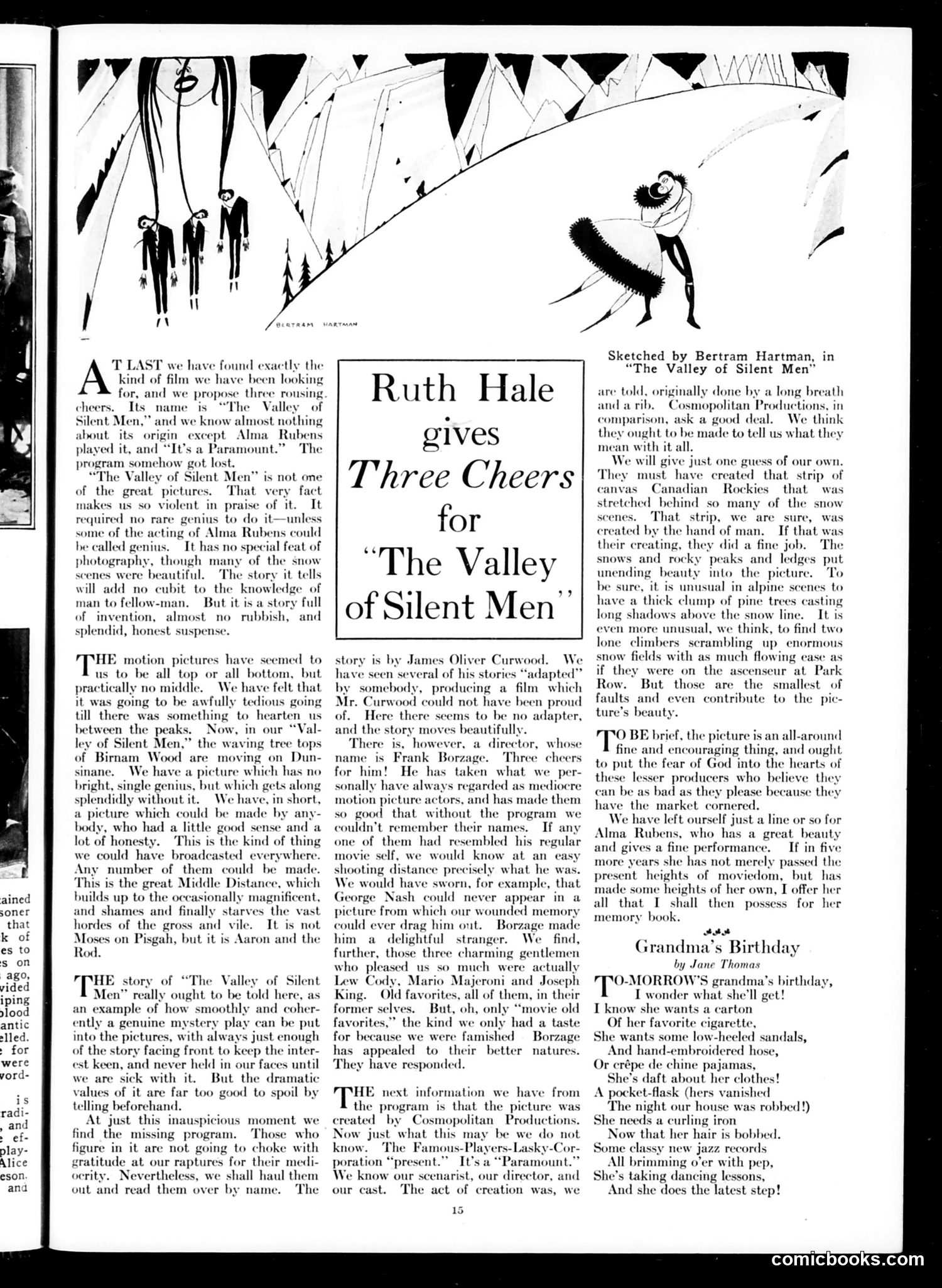
This page is primarily a **film review**, not political satire. Ruth Hale praises the 1920 Paramount film "The Valley of Silent Men," directed by Frank Borzage and based on a James Oliver Curwood story. The review's satire is **cinematic, not political**: Hale celebrates the film precisely because it's competently made but unpretentious—a "middle distance" picture with no genius but honest craftsmanship. She praises director Borzage for elevating mediocre actors (Lew Cody, Mario Majeroni, Joseph King) into credible performances through skilled direction rather than special photography or elaborate plotting. The bottom section reprints a poem by Jane Thomas about grandmother's birthday gifts—unrelated filler content typical of Judge's mixed editorial format. **No political figures or social commentary** appear on this page. It's entertainment criticism reflecting 1920s film industry attitudes.
📄 Transcribed text from this page (OCR, searchable)
Machine-transcribed from the original scan — historical spelling and the odd misread are preserved.
T LAST we have found exactly the kind of film we have been looking for, and we propose three rousing cheers. Its name is “The Valley of Silent Men,” and we know almost nothing about its origin except: Alma Rubens played it, and “It’s a Paramount.” The program somehow got lost. “The Valley of Silent Men” is not one of the great pictures. That very fact makes us so violent in praise of it. It required no rare genius to do it—unless some of the acting of Alma Rubens could be called genius. It has no special feat of photography, though many of the snow scenes were beautiful. ‘The story it tells will add no cubit to the knowledge of man to fellow-man, But it is a story full of invention, almost no rubbish, and splendid, honest suspense. HE motion pictures have seemed to us to be all top or all bottom, but practically no middle. We have felt that it was going to be awfully tedious going till there was something to hearten us between the pea Now, in our “Val- ley of Silent Men,” the waving tree tops of Birnam Wood are moving on Dun- sinane. We have a picture which has no bright, single genius, but which gets along splendidly without it. We have, in short, a picture which could be made by any- body, who had a little good sense and a lot of honesty. This is the kind of thing we could have broadcasted everywhere. Any number of them could be made. This is the great Middle Distance, which builds up to the occasionally magnificent, and shames and finally starves the vast hordes of the gross and vile. It is not Moses on Pisgah, but it is Aaron and the Rod. TTHE story of “The Valley of Silent Men” really ought to be told here, as an example of how smoothly and coher- ently a genuine mystery play can be put into the pictures, with always just enough of the story facing front to keep the inter- est keen, and never held in our faces until we are sick with it. But the dramatic values of it are far too good to spoil by telling beforehand. At just this inauspicious moment we find the missing program. Those who figure in it are not going to choke with gratitude at our raptures for their medi- ocrity. Nevertheless, we shall haul them out and read them over by name. The Ruth Hale gives Three Cheers for “The Valley of Silent Men” story is by James Oliver Curwood. W. have seen several of his stories “‘adapte by somebody, producing a film which Mr. Curwood could not have been proud of. Here there seems to be no adapter, and the story moves beautifully. There is, however, a director, whose name is Frank Borzage. Three cheers for him! He has taken what we per- sonally have always regarded as mediocre motion picture actors, and has made them so good that without the program we couldn't remember their names. If any one of them had resembled his regular movie self, we would know at an easy shooting distance precisely what he was. We would have sworn, for example, that George Nash could never appear in a picture from which our wounded memory could ever drag him out. Borzage made him a delightful stranger. We find, further, those three charming gentlemen who pleased us so much were actually Lew Cody, Mario Majeroni and Joseph King. Old favorites, all of them, in their former selves. But, oh, only “movie old favorites,” the kind we only had a taste for because we were famished — Borzage has appealed to their better natures. They have responded. HE next information we have from the program is that the picture was ed by) Cosmopolitan Productions. Now just what this may be we do not know. The Famous-Players-Lasky-Cor- poration “present.” It’s a “Paramount.” We know our scenarist, our director, and our cast. The act of creation was, we 15 Sketched by Bertram Hartman, in “The Valley of Silent Men” are told, originally done by a long breath anda rib. Cosmopolitan Productions, in comparison, ask a good deal. We think they ought to be made to tell us what they mean with it all. We will give just one guess of our own. They must have created that strip of canvas Canadian Rockies that was stretched behind so many of the snow scenes. That strip, we are sure, ted by the hand of man. If that their creating, they did a fine job. The snows and rocky peaks and ledges put unending beauty into the picture. ‘To be sure, it is unusual in alpine scenes to have a thick clump of pine trees casting long shadows above the snow line. It is even more unusual, we think, to find two lone climbers scrambling up enormous snow fields with as much flowing ease as if they were on the ascenseur at Park Row. But those are the smallest of faults and even contribute to the pic- ture’s beauty. Te BE brief, the picture is an all-around fine and encouraging thing, and ought to put the fear of God into the hearts of these lesser producers who believe they can be as bad as they please because they have the market cornered. We have left ourself just a line or so for Alma Rubens, who has a great beauty and gives a fine performance If in five more years she has not merely passed the present heights of moviedom, but has made some heights of her own, I offer her all that I shall then for her memory book. possess tos Grandma’s Birthday by Jane Thomas O-MORROW’S grandma’s birthday, I wonder what she'll get! I know she wants a carton Of her favorite cigarette, She wants some low-heeled sandals, And hand-embroidered hose, t about her clothes! ask (hers vanished The night our house was robbed!) She needs a curling iron Now that her hair is bobbed. Some classy new jazz records All brimming o’er with pep, She’s taking dancing lessons, And she does the latest step! comicbooks.com