
Judge, 1922-09-23 · page 23 of 36
Judge — September 23, 1922 — page 23: what you’re looking at
What you’re looking at
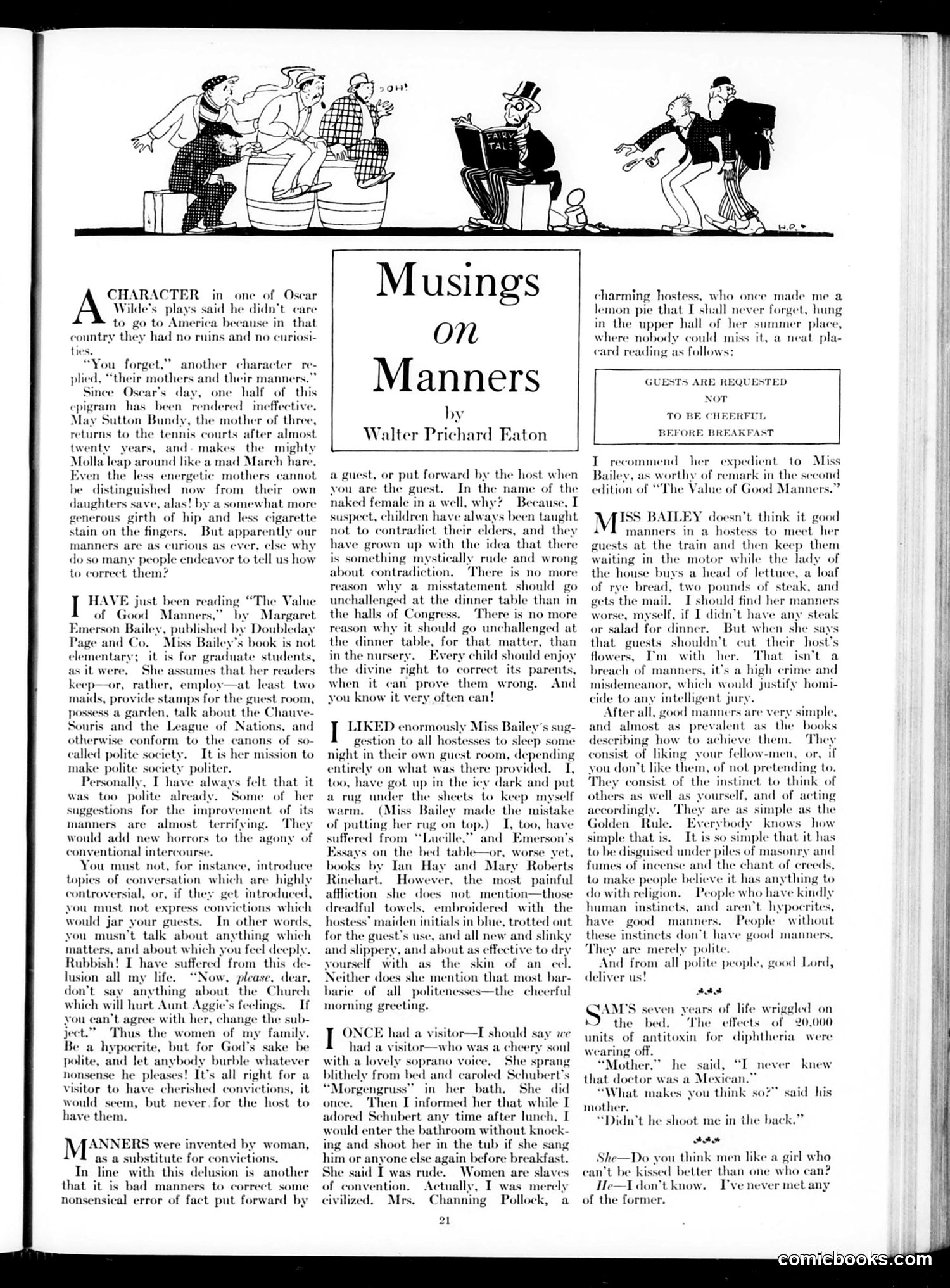
This page contains a satirical essay titled "Musings on Manners" by Walter Prichard Eaton, criticizing contemporary etiquette advice. **The Target:** Miss Margaret Emerson Bailey's book *The Value of Good Manners*, which Eaton mocks as overly restrictive guidance for the wealthy elite. **The Satire:** Eaton ridicules Bailey's prescriptions that guests avoid controversial topics and never correct factual errors at dinner—arguing this enforces hypocrisy over honesty. He advocates for guests and hosts alike to speak authentically about matters of substance, even if disagreement results. **Social Context:** The essay reflects 1920s anxieties about "polite society" and class performance. Eaton suggests Bailey's rules serve the pretentious upper class (who employ maids, discuss avant-garde theater) while stifling genuine conversation. **The Cartoons** (top) appear to illustrate social awkwardness and performative behavior, though specific figures aren't identified in the text. The piece ultimately argues that enforced politeness masks intellectual dishonesty—a critique of manners culture masking class pretension.
📄 Transcribed text from this page (OCR, searchable)
Machine-transcribed from the original scan — historical spelling and the odd misread are preserved.
CHARACTER in one of Oscar Wilde’s plays said he didn’t to go to America because in that country they had no ruins and no curiosi- tie “You forget,” another cha plied, “their mothers and their manne: Since Osear’s day, one half of this cpigram has been rendered. ineffecti May Sutton Bundy, the mother of thre returns to the tennis courts after almost twenty years, and» makes the mighty Molla leap around like a mad March hare. Even the less energetic mothers cannot he distinguished now from. their own daughters save, alas! by a somewhat more generous girth of hip and less cigarette stain on the fingers. But apparently our manners are as curious ‘se: why do so many people endeavor to tell us how to correct them? ever, of Good Manners,” by Margaret rerson Bailey, published by Doubleday Miss Bailey's book is not it is for graduate students, as it were. She assumes that her readers: keep—or, rather, employ—at least. two maids, provide stamps for the guest room, possess a garden, talk about the Chauve- Souris and the League of ions, and otherwise conform to the canons of so- called polite society. It is her mission to make polite society politer. Personally, I hi was too polite ¢ Some of her suggestions for the improvement. of its manners are almost. terrifying. They would add new horrors to the agony of conventional intercourse. You must not, for instance, introduce topies of conversation which are highly controversial, or, if they get introduced, You must not express convictions which would jar your guests. In other words, you musn’t talk about anything which matters, and about which you feel deeply. Rubbish! I have sutfe from this de- lusion all my life. “Now, please, dear, don’t say anything about the Church which will hurt Aunt Aggie’s feelings. If you can’t agree with her, change t] ject.” Thus the women of my family. Be a hypocrite, but for God’s sake be polite, and let anybody burble whatever nonsense he pleases! It’s all right for a visitor to have cherished convictions, it would see but never for the host to have then XV SRS were invented by woman, a substitute for convictions. In line with this delusion is another that it is bad manners to correct some nonsensical error of fact put forward by I HAVE just been reading “The Value I ge and Cc elementary s felt that it Musings on Manners by Walter Prichard Eaton a guest, or put forward by the host when you are the guest. In the name of the naked female in a well, why? Because, I suspect, children have always been taught not to contradict their elders, and they have grown up with the idea that there is something mystically rude and wrong about contradiction. ‘There is no more n why a misstatement should go unchallenged at the dinner table than in the halls of Congress. There is no more reason why it should go unchallenged at the dinner table, for that matter, than in the nursery. Every child should enjoy the divine right to correct its parents, when it can prove them wrong. And you know it very often can! LIKED enormously Miss Bailey's sug- gestion to all hostesses to sleep some night in their own guest room, depending entirely on what was there provided. I, too, have got up in the icy dark and put a rug under the sheets to keep myself warm. (Miss Bailey made the mistake of putting her rug on top.) I, too, have suffered from “Lucille,” and Emerson's: Essays on the bed table—or, worse yet, books by Ian Hay and Mary Roberts Rinehart. However, the most painful affliction she does not | mention—those dreadful towels, embroidered with the * maiden initials in blue, trotted out nd slinky hoste for the guest's use. and slippery, and yourself with Neither does she baric of all politenesses—the cheerful morning greeting. ONCE had a visitor—I should say we had a visitor—who was a cheery soul with a lovely soprano voice. She sprang blithely from bed and caroled Schubert's “Morgengruss” in her bath. She did once. Then I informed her that while I adored Schubert any time after lunch, I would enter the bathroom without knock- ing and shoot her in the tub if she sang im or anyone else again before breakfast. 1 I was rude. Women are slaves nyention. Actually, I was merely Mrs. Channing Pollock, a lemon pie that I shall never forget, hung in the upper hall of her summer plac where nobody could miss it, a neat pla- card reading as follows: GUESTS ARE REQUESTED NoT TO BE CHEERFUL BEFORE BREAKFAST IT recommend ler expedient to Miss as worthy of remark in the second edition of “The 1e of Good Manners.” NV ISS BAILEY doesn’t think it good 4 manners in a hostess to meet her guests at the train and then keep them waiting in the motor while the lady of the house buys a head of lettuce, a loaf of rye bread, two pounds of steak, and gets the mail. T should find her manners worse, myself, if I didn’t have any steak or salad for dinner. But when she says that guests shouldn’t cut their host's flowers, I'm with her. ‘That isn’t: a breach of manners, it’s a high crime and misdemeanor, which would justify homi- cide to any intelligent jury. After all, good manners are very simple, and almost as prevalent as the books describing how to achieve them. ‘They consist of liking your fellow-men, or, if you don’t like them, of not pretending to. They consist of the instinct to think of others as well as yourself, and of acting accordingly. They are as simple as the Golden Rule. Everybody knows how simple that is. It is So simple that it has to be disguised under piles of masonry and fumes of incense and the chant of creeds, to make people believe it has anything to do with religion. People who have kindly human instincts, and aren't hypocrites, have good manners. People without these instinets don’t have good manners. They are merely polite. And from all polite people, good Lord, deliver us! sae SAM'S seven years of life wri 1 on the bed. The effects of 000 units of antitoxin for diphtheria were wearing off. ther,” he said, “I never knew that doctor was a Mexican.” “What makes you think so? mother. “Didn't he shoot me in the back.” said his toe She—Do you think men like a girl who can’t be kissed better than one who can? He—I dow t know. I've never met any of the former,