
Judge, 1922-09-23 · page 11 of 36
Judge — September 23, 1922 — page 11: what you’re looking at
What you’re looking at
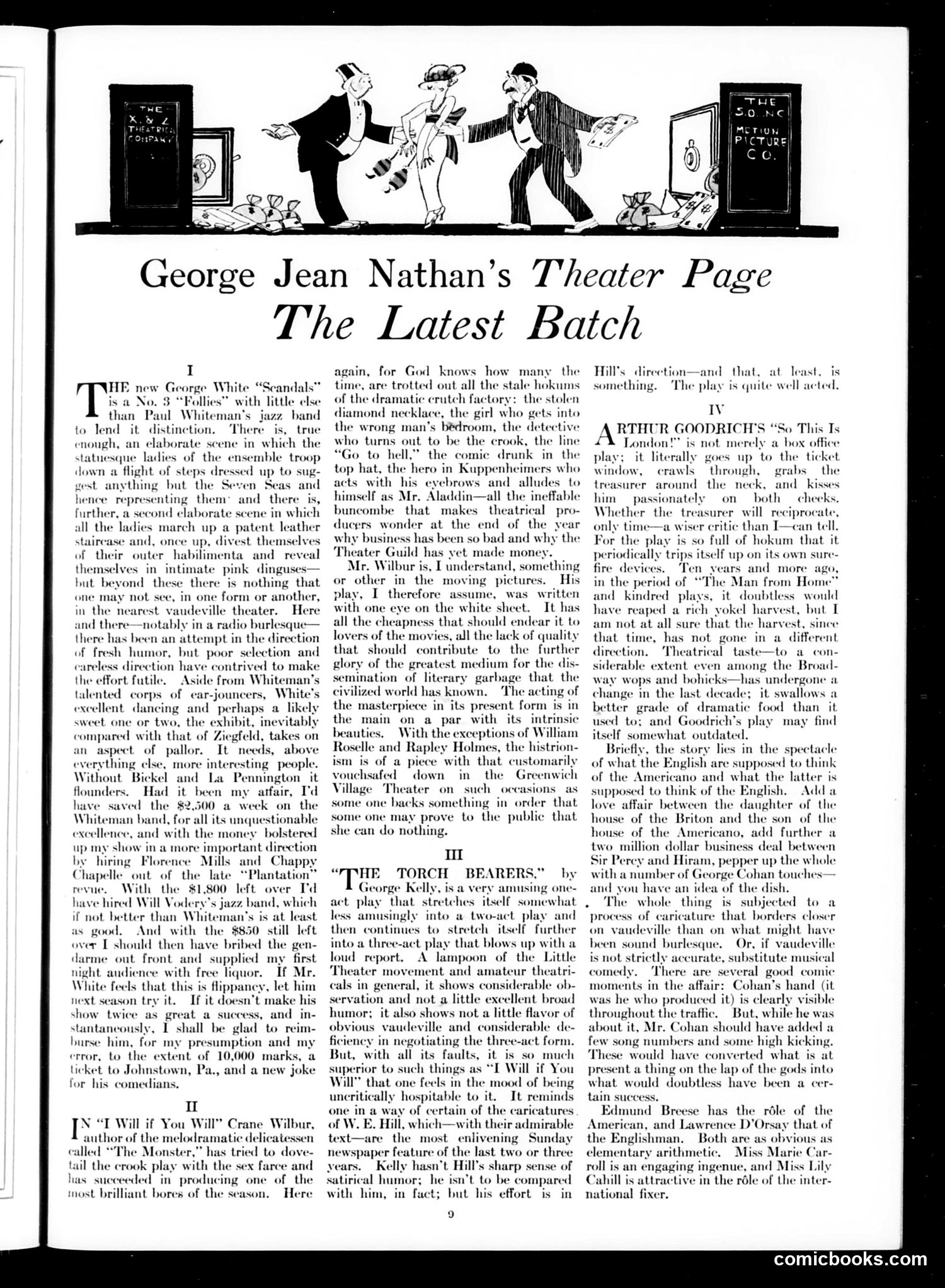
This is theater critic George Jean Nathan's review column. The header illustration shows three theatrical figures in exaggerated poses amid money, representing the commercial chaos of Broadway production. Nathan reviews three shows with characteristic acerbity: 1. **George White's "Scandals"** — criticized as derivative of Ziegfeld's "Follies," saved only by Paul Whiteman's jazz band. Nathan argues the elaborate staging and chorus girls cannot mask lack of originality or interesting talent. 2. **"I Will if You Will"** — a sex farce/crime play by Crane Wilbur, dismissed as recycled theatrical clichés (stolen necklaces, mistaken bedrooms, comic drunks). Nathan acidly notes Wilbur works in movies, suggesting the play's cheapness reflects cinema's "literary garbage." 3. **"The Torch Bearers"** — by George Kelly (review continues off-page). Nathan's satire targets Broadway's commercial formula: lavish spectacle substituting for wit, and producers' bafflement at poor box office despite their tired conventions. The tone is sophisticated mockery of theatrical mediocrity.
📄 Transcribed text from this page (OCR, searchable)
Machine-transcribed from the original scan — historical spelling and the odd misread are preserved.
George Jean Nathan’s Theater Page The Latest Batch I HE new George White “Scandals” is a No. 3 “Follies” with little else than Paul Whiteman’s 7 band to lend it distinction, Th true enough, an elaborate scene in which the statuesque ladies of the ensemble troop a flight of steps dressed up to sug- ything but the Seven Seas and representing them> and there is, furthe second elaborate scene in which all the ladies march up a patent leather staircase and, once up, divest themselves of their outer habilimenta and rev themselves in intimate pink dinguses— but beyond these there is nothing that one may not see, in one form or another, in the nearest vaudeville theater. Here and there—notably in a radio burlesque— there has been an attempt in the direction of fresh humor, but poor selection and careless direction have contrived to make the effort futile. side from Whiteman’s talented corps of ear-jouncers, White’ excellent. dancing and perhaps a likely sweet one or two, the exhibit, inevitably compared with that of Ziegfeld, takes on n aspect of pallor. It needs, above thing else, more interesting people. Without Bickel and La Pennington it flounders. Had it been my. arfair, ['d have saved the $2,500 a week on the Whiteman band, fo Lits unquestionable and with the money bolstered up my show in a more important direction Florence Mills and Chappy le out of the late “Plantation” revue, With the ft over Td have hired Will Vode: and, which if not better than Whiteman’s is at least as good. And with the $850. still left over T should then have bribed the gen- darme out front and supplied my first night audience with free liquor. If Mr. White feels that this is flippancy, let him next season try it. If it doesn’t make his show twice as great a succe ii stantancously, T shall be glad to reim- burse him, for my presumption error, to the extent of 10,000 ticket to Johnstown, Pa., and a new joke for his comedians. down gest Il “T Will if You Will” Crane Wilbur, tuthor of the melodramatic delicatessen called “The Monster,” has tried to dove- tail the crook play with the sex farce and has succeeded in’ producing one of the tnost brilliant bores of the season. Here N for God knows how time, are trotted out all the stale hokums of the dramatic crutch factory: the stolen diamond necklace, the girl who gets into the wrong man’s bedroom, the detective who turns out to be the crook, the line “Go to hell,” the comic drunk in the top hat, the hero in Kuppenheimers who acts with his eyebrows and alludes to himself as Mr. Aladdin—all the ineffable buncombe that makes theatrical pro- ducers wonder at the end of the year why business has been so bad and why the Theater Guild has yet made money. Mr. Wilbur is, I understand, something or other in the moving pictures. His I therefore assume, was written vith one eye on the white sheet. It has all the cheapness that should endear it to lovers of the movies, all the lack of quality that should contribute to the further glory of the greatest medium for the dis- smination of literary garbage that the civilized world has known. The acting of the masterpiece in its present form is in the main on a par with its intrins beauties. With the exceptions of William Roselle and Rapley Holmes, the histrion- ism is of a piece with that customarily vouchsafed down in’ the Greenwich ri Theater on such occasions ‘one backs something in order that ne may prove to the public that she can do nothing. Tl HE TORCH BEARERS,” by ‘orge Kelly, is a very amusing one- act sis that stretches itself somewhat less amusingly into a two-act play and then continues to stretch itself further into a three-act play that blows up with a ad report. A lampoon of the Little heater movement and amateur theatri- cals in general, it shows considerable ob- servation and not a little excellent broad it also shows not a little flavor of us vaudeville and considerable de- 'y in negotiating the three-act form. But, with all its faults, it is so much superior to such things as “I Will if You Will” that one feels in the mood of being uncritically hospitable to it. It reminds one in a way of certain of the caricatures of W Hill, which—with their admirable text—are the most enlivening Sunday newspaper feature of the last two or three years. Kelly hasn't Hill’s sharp sense of satirical humor; he isn’t to be compared with him, in fact; but his effort in 9 again, many the as Hill's direction—and that, at least. is something. The play is quite well acted, IV RTHUR GOODRICH'S “So This Is London!” is not merely a box office it literally goes up to the ticket through, the the neck, and kisses him passionately on both — cheeks, Whether the treasurer will reciprocate, only time—a wiser critic than I—can tell. For the play is so full of hokum that it i trips itself up on its own sure- ¥ rs and more ago, “The Man from Home” and kindred plays, it doubtless would have reaped a rich yokel harvest, but I am not at all sure that the harvest, since that time, has not gone in a different direction. Theatrical taste—to a con- siderable extent even among the Broad- way wops and bohicks—has undergone a change in the last decade; it swallows a better grade of dramatic food than it used to; and Goodrich’s play may find itself somewhat outdated. Briefly, the story lies in the spectacle of what the English are supposed to think of the Americano and what the latter is supposed to think of the English. Add a love affair between the daughter of the house of the Briton and the son of the house of the Americano, add furthe two million dollar business deal betw Sir Percy and Hiram, pepper up the whe with a number of George Cohan touches— and you have an idea of the dish. The whole thing is subjected to a process of caricature that borders closer on vaudeville than on what might have been sound burlesque. Or, if vaudev is not strictly accurate, substitute musical comedy. ‘There are several good comic moments in the affair: Cohan’s hand (it was he who produced it) is clearly visible throughout the traffic. But, while he was about it, Mr. Cohan should have added a few song numbers and some high kicking. ‘These would have converted what is at present a thing on the lap of the gods into what would doubtless have been a cer- tain success. Edmund Breese has the réle American, and Lawrence D’Orsay that of the Englishman. Both are as obvious as elementary arithmetic. Miss Marie Car- roll is an engaging ingenue Cahill is attractive in the réle of the inter- national fixer. play; window, — crawls treasurer around grabs in the period of comicbooks.com