
Judge, 1922-09-23 · page 24 of 36
Judge — September 23, 1922 — page 24: what you’re looking at
What you’re looking at
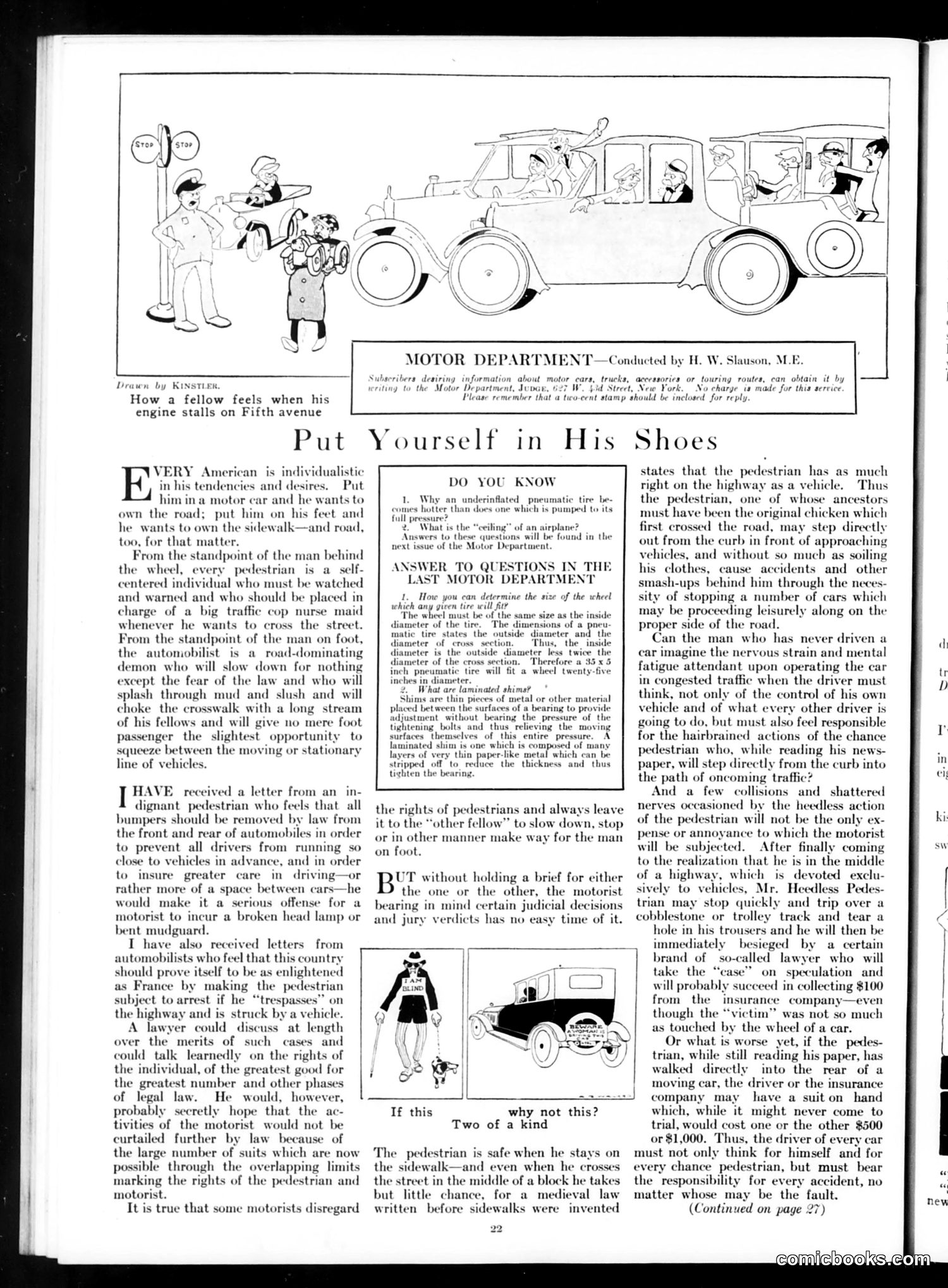
This page satirizes the tension between pedestrians and motorists in 1920s America. The cartoon at top—drawn by Kinstler—shows a car stalled on Fifth Avenue surrounded by frustrated pedestrians and traffic, illustrating the chaos when automobiles malfunction on busy streets. The article's title humorously demands empathy: motorists should understand pedestrians' vulnerability, and vice versa. The text mocks both groups' self-centered attitudes—drivers viewing pedestrians as obstacles, pedestrians expecting absolute right-of-way regardless of traffic. The satire peaks in the ironic closing: pedestrians have legal rights to step into traffic from curbs, potentially causing accidents and lawsuits, yet motorists bear responsibility. The piece criticizes this legal imbalance while acknowledging motorists secretly welcome it (more lawsuits = job security for lawyers). The humor derives from highlighting the absurdity of early automotive-era traffic laws struggling to accommodate new technology within pedestrian-centered urban infrastructure.
📄 Transcribed text from this page (OCR, searchable)
Machine-transcribed from the original scan — historical spelling and the odd misread are preserved.
Drawn by KANSTLER. How a fellow feels when his engine stalls on Fifth avenue Put VERY American is individualistic in his tendencies and desires. Put him ina motor car and he wants to put him on his feet and and road, own the road; he wants to own the sidewalk— too, for that matter. From the standpoint of the man behind the wheel, every pedestrian is a self- centered individual who must be watched and warned and who should be placed in charge of a big traffic cop nurse maid whenever he wants to cross the street. From the standpoint of the man on foot, the automobilist is a road-dominating demon who will slow down for nothing except the fear of the law and who will splash through mud and slush and will choke the crosswalk with g stream of his fellows and will give no mere foot passenger the slightest opportunity to squeeze between the moving or stationary line of vehicles. HAVE received a letter from an_in- dignant pedestrian who feels that all bumpers should be removed by law from the front and rear of automobiles in order to prevent all drivers from running so close to vehicles in advance, and in order to insure greater care in driving—or rather more of a space between cars—he would make it a serious offense for a motorist to incur a broken head lamp or bent mudguard. I have also received letters from MOTOR DEPARTMENT-— formation about mc wera desiri t Me riment, Juvae, in Yourself bO YOU KNOW 1 pneu e which is f next issue of the Motor Departin ANSWER TO QUESTIONS IN THE LAST MOTOR L v1 1. How you can determine the size which any giren tire will fit? heel must be of the same size as the of the wheel side pneu id the meter. are laminated shima? ec thin pieces of metal or other ma placed between th nf a bearing to provide adjustment without bearing the pressure of the bolts and thus relieving the moving selves of this entire pressure. A ate ‘one which is composed of layers of very thin paper-like metal which c be stripped off to reduce the thickness and thus tighten the bearing. Shims ar the rights of pedestrians and always leave it to the “other fellow” to slow down, stop or in other manner make way for the man on foot. UT without holding a brief for either the one or the other, the motorist bearing in mind certain judicial decisions and jury verdicts has no easy time of it. automobilists who feel that this country should prove itself to be as enlightened as France by making the pedestrian subject to arrest if he “trespasses” on the highway and is struck by a vehicle. A lawyer could discuss at length over the s of such and could arnedly on the rights of the individual, of the greatest good for the greatest number and other phases of legal law. He would, however, probably secretly hope that the ac- of the motorist would not be curtailed further by law because of the large number of suits which are now possible through the overlapping limits marking the its of the pedestrian and motorist. It is true that some motorists disregard “ases Conducted by H. W. Slauson, M.E. r cars, trucks, accessories or 7W. bid Street, New York. Please remember that a twco-cent stamp should be incl His Shoes suring routes, can obtain it by harge is made for this service for reply. states that the pedestrian has as much right on the highway . Thus the pedestrian, one of whose ancestors must have been the original chicken which first crossed the road, may step directly out from the curb in front of appro: vehicles, and without so much as soiling his clothes, cause accidents and other smash-ups behind him through the neces- ity of stopping a number of cars which may be proceeding leisurely along on the proper side of the road. Zan the man who has never driven a car imagine the nervous strain and mental fatigue attendant upon operating the car in congested traffic when the driver must think, not only of the control of hi: vehicle and of what every other dri going to do, but must also feel responsible for the hairbrained actions of the chance pedestrian who, while reading his news- paper, will step directly from the curb into the path of oncoming traffi And a few collisions and shattered nerves occasioned by the heedless action of the pedestrian will not be the only e pense or annoyance to which the motorist will be subjected. After lly coming to the rea ion that he is in the middle of which is devoted exclu- y les, Mr. Heedless Pedes- jan may stop quickly and trip over a or trolley track and tear a trousers and he will then be besieged by a certain Hed lawyer who will a ase” speculation and will probably succeed in collecting $100 from the insurance company—even though the “victim” was not so much as touched by the wheel of a car. Or what is worse yet, if the pedes- trian, while still reading his paper, has walked directly into the rear of a moving car, the driver or the insurance company 0 have a suiton hand tr cobbleste in hi immediately brand of — s« If this why not this? Two of a kind The pedestrian is safe when he stays on the sidewalk—and even when he crosses the street in the middle of a block he but little chance, for a medieval law written before sidewalks were invented which, while it might never come to trial, would cost one or the other $500 or $1,000. Thus, the driver of every car must not only th for himself and for every chance pedestrian, but must bear the responsibility for every accident, no matter whose may be the fault. (Continued on page 27)