
Judge, 1922-09-23 · page 12 of 36
Judge — September 23, 1922 — page 12: what you’re looking at
What you’re looking at
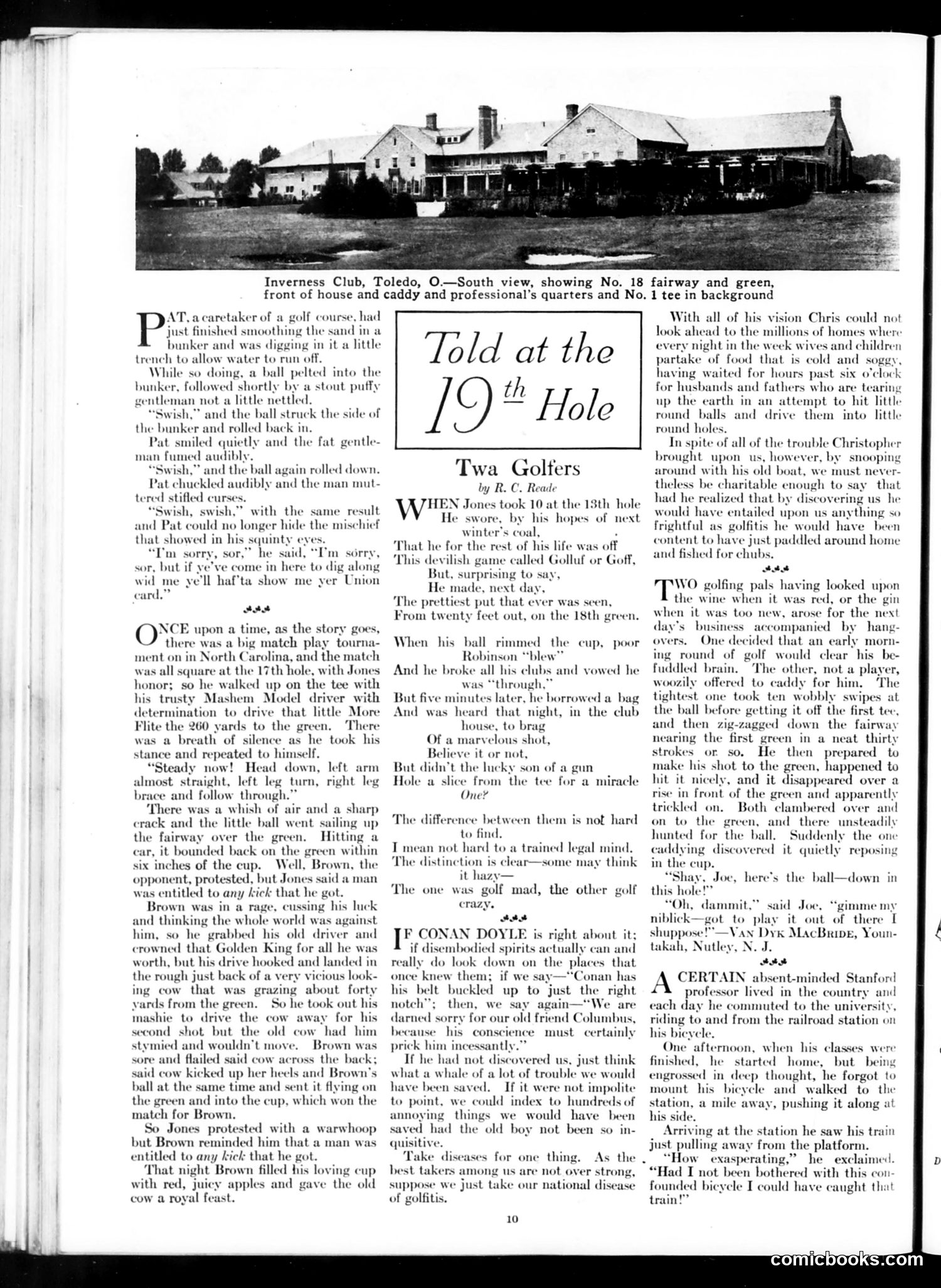
This page presents two humorous golf anecdotes typical of Judge's satirical content. The first story mocks working-class Irish immigrants through "Pat," a golf course caretaker who refuses to work alongside a wealthy golfer lacking a union card—a pointed jab at labor organizing and class tensions of the era. The second, "Twa Golfers," contrasts two players' responses to golf frustrations: Jones cheats when frustrated but rationalizes it; Brown cheats but celebrates his "luck." The satire targets golf's pretension and the absurdity of how wealthy men rationalize poor sportsmanship. The photograph shows the Inverness Club in Toledo, Ohio—a real country club—establishing this as insider commentary on elite leisure culture. The "19th hole" (the bar) framing device suggests these are tall tales told by club members, reinforcing Judge's mockery of upper-class golf culture's self-deception and moral flexibility. The humor relies on readers' familiarity with golf clubs and their social hierarchies.
📄 Transcribed text from this page (OCR, searchable)
Machine-transcribed from the original scan — historical spelling and the odd misread are preserved.
Inverness Club, Toledo, O.—South view, showing No. 18 fairway and green, front of house and caddy and professional's quarters and No, 1 tee in background AT. acaretaker of a golf course, had Pi finished smoothing the sand in a bunker and was digging in it a little trench to allow water to run While so doing, a ball p bunker, followed shortly by gentleman not a little nettled. Swish,” and the ball struck the side of the bunker and rolled back in. Pat smiled quietly and the fat gentle- man fumed audibly. Swish,” and the ball again rolled down. Pat chuckled audibly and the man mut- tered stifled curses. “Swish, swish,” with the same result and Pat could no longer hide the mischief that showed in his squinty eyes. “I'm sorry, sor,” he said, “I'm sorry, sor, but if ye’ve come in here to dig along wid me ye'll haf'ta show me yer Union card.” into the stout puffy ere ONCE upon a time, as the story goes, there was a big match play tourna- ment on in North Carolin id the match was all square at the 17th hole, with Jones honor; so he walked up on the tee with his trusty Mashem Model driver with determination to drive that little More Flite the 260 yards to the green, ‘There was a breath of silence as he took his stance and repeated to himself. “Steady now! Head down, left arm almost straight, left leg turn, right leg brace and follow through.” There was a whish of air and a sharp crack and the little ball went sailing up the fairway over the green. Hitting a , it bounded back on the green within six inches of the cup. Well, Brown, the opponent, protested, but Jones said a man was entitled to any kick that he got. Brown was in a rage, cussing his luck and thinking the whole world was against him, so he grabbed his old driver and crowned that Golden King for all he was worth, but his drive hooked and landed in the rough just b ry vicious look- ing cow that w ig about forty yards from the gree: So he took out his mashie to drive the cow away for his second shot but the old cow had him stymied and wouldn't move. Brown was and flailed said cow across the back; aid cow kicked up her heels and Brown's ball at the : time and sent it flying on the green and into the cup, which won the match for Brown. So Jones protested with a warwhoop but Brown reminded him that a man was entitled to any kick that he got. That night Brown filled his loving cup with red, juicy apples and gave the old cow a royal feast. Told at the r aro Twa Golfers by R. C. Reade Ww! ones took 10 at the 13th hole He swore, by his hopes of next winter's coal, ; That he for the rest of his life was off This devilish g -alled Golluf or Goff, But, surprising to He made, next dé ‘The prettiest put that ever was seen, From twenty feet out, on the 18th green. me When his ball rimmed the cup, poor Robinson “blew” And he broke all his clut was “throug! But five minutes later, he borrowed a bag And was heard that night, in the club house, to bra Of a marvelous shot, Believe it or not, But didn’t the lucky son of a gun Hole a slice from the tee for a miracle One? and vowed he The difference between them is not hard to find. T mean not hard te The distinction is ined legal mind. rsome may think it hazy— The one was golf mad, the other golf crazy. aes about it: F CONAN DOYLE is right if disembodied spirits actually ean and really do look down on the places that once knew them; if we say—*Conan has his belt buckled up to just the right notch”; then, we say again—“We are darned sorry for our old friend Columbus, because his conscience must certainly prick him incessantly.” If he had not discovered us, just think what a whale of a lot of trouble we would have been saved. If it were not impolite to point, we could index to hundreds of nnoying things we would have been saved had the old boy not been so in- quisitive. _ » diseases for one thing. As the best takers among us are not over strong, suppose we just take our national disease of golfitis. 10 1 to the millions of homes where ght in the week wives and children and s¢ having waited for hours past six o'clock for husbands and fathers who are tearing up the earth in an attempt to hit little round balls and drive them into little round holes. In spite of all of the trouble Christopher brought upon us, however, by snooping around with his old boat, we must never- theless be charitable enough to say that had he realized that by discovering us he would entailed upon us anything so frightful as golfitis he would have been content to have just paddled around home and fished for chubs, sae TWO golfing pals having looked upon the wine when it was red, or the gin when it was too new, arose for the next day’s business accompanied by hang- overs. One decided that an early morn- ing round of golf would clear his be- fuddled brain. The other, not a player, woozily offered to caddy for him. ‘The tightest one took ten wobbly swipes at the ball before getting it off the first tec, and then zig-zagged down the fairway nearing the first green in a neat thirty strokes or so. He then prepared to make his shot to the green, happened to hit it nicely, and it disappeared over a rise in front of the green and apparently trickled on. Both clambered over and on to the green, and there unsteadily hunted for the ball. Suddenly the on caddying discovered it quietly reposing in the cup. “Sha this hole! “Oh, d Joe, here’s the ball—down in jammit,” said Joe, “gimme my niblick—got to play it out of there I shuppose!""—Van Dyk MacBripe, Youn- takah, Nutley, N. J. tae CERTAIN absent-minded Stanford professor lived in the country ch day he commuted to the university, ng to and from the railroad station on his bieyele. One afternoon, when his classes were finishe ted hom but being engrossed in deep thought, he forgot to mount his bi » and walked to the station, a mile away, pushing it along at his side. Arriving at the station he saw his train just pulling away from the platform. “How perating,” he exclaimed “Had I not been bothered with this cou founded bieyele I could have caught that train!” le exal